Menu

Achi Biz GuidesLimited Partnership (LP)

Singapore Limited Partnership (LP)

Introduction of a Limited Partnership (LP) In Singapore

Singapore Citizen or Singapore Permanent Resident can register a partnership with one or more partners. In limited partnership, the number of partners should be at least 2 and maximum 20. In the business, at least 1 active partner and at least 1 limited partner is required to run a limited partnership business.
A partnership consisting of foreign individuals or persons will not be registered by the Registrar unless there is a Singapore local resident manager.
An LP may be registered under the Limited Partnership Act where it has limited partners that are registered as such under the Act. An LP is deemed to be a general partnership unless one or more persons are registered as limited partners of the firm in accordance with the Act.

A Firm is treated as general partnership until reasonable notice of
registration of LP

A Partnership (general) can also be converted into an LP where one or more
(but not all) of its partners register themselves as limited partners. The
resulting LP formed must also register itself as an LP under the Limited
Partnership Act. Where a person deals with a firm after it becomes an LP,
that person is entitled to treat the firm as a general partnership until he
has notice of the registration of that firm as an LP. He is also entitled to
treat any person who was a partner of the firm as a general partner of the
LP until he has notice of the registration of that person as a limited
partner.

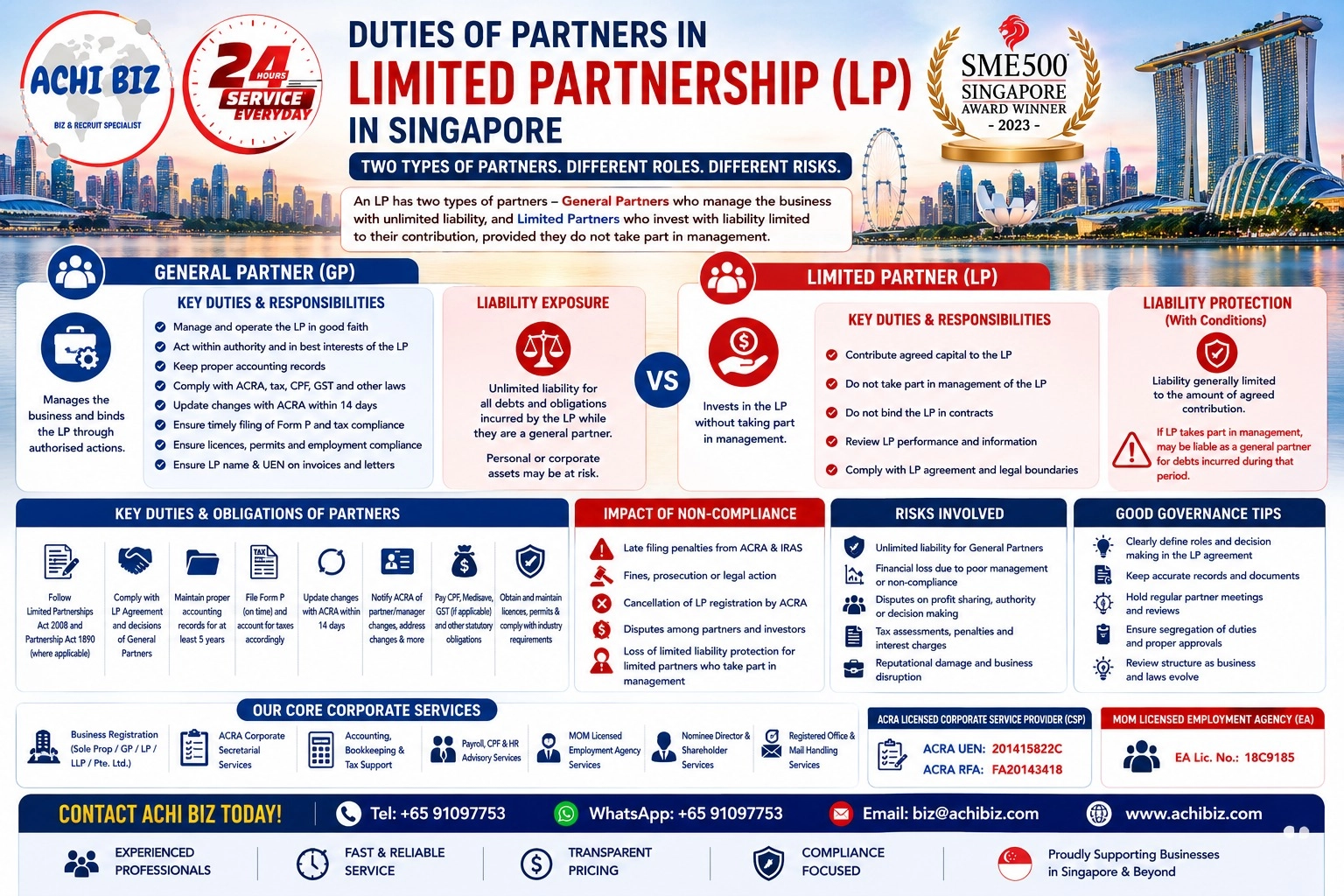
Limited Partners

  • Limited Partners are not liable for debts or obligations of firm beyond
    agreed amount
  • The key difference between LPs and Partnerships lies in the fact that
    LPs have ‘limited partners’. A limited partner is defined as any partner
    who, under the terms of the partnership agreement, shall not be liable
    for the debts or obligations of the firm beyond the amount of his agreed
    contribution.
  • The limited partner is thus said to enjoy ‘limited liability’ status.
    Anyone who is not a limited partner of an LP is a general partner.
    General partners are regarded in exactly the same manner as partners in
    a Partnership and are liable for all the debts and obligations of the LP
    incurred while they are general partners.

Requirements of Registration under the Limited Partnerships Act

Parties who wish to be limited partners in an LP have to register themselves
as such under the Limited Partnerships Act. Failing to do so will result in the limited partners being treated as if
they were general partners of the LP. They will thereby lose their limited
liability status. Also, where a person deals with an LP after a partner
becomes a limited partner, that person is entitled to treat that partner as
a general partner of the LP until he has notice of the registration of that
partner as a limited partner.

Limited Partners are not to take part in management of the Limited
Partnership

Limited partners should not take part in the management of the LP and should
not have the power to bind the LP. Limited partners who take part in the
management of the LP are liable for all debts and obligations of the limited
partnership incurred while they so take part in the management as though
they were general partners.

Limited partners may vary contributions

Limited partners may increase, reduce or draw out their contributions with
the approval of the general partners, subject to the LP agreement.

When capital or Profits Distribution need to be Refunded?

Any distribution of capital or profits to the limited partners must be
refunded if the following conditions are present:

  • Every general partner of the LP was insolvent at the time of the
    distribution or became insolvent as a result of the distribution;
  • The limited partner knew or ought to have known at the time of the
    distribution that every general partner was insolvent or would become
    insolvent as a result of the distribution; and
  • Every general partner is adjudicated bankrupt or is ordered to be wound
    up within one year after the date of the distribution.

Dissolution of Limited Partnership (LP)

  • The dissolution of LPs is similar to that for Partnerships (General).
    There are, however, some differences which relate to limited partners.
    For example, limited partners are not entitled to dissolve the LP by
    notice. Also, an LP is not dissolved on the death, dissolution,
    bankruptcy or liquidation of a limited partner.
  • In the event of the dissolution of an LP, its affairs are to be wound up
    by the general partners unless there is a court order to the contrary.

Pros or Advantages of a Limited Partnership

  • Tax benefits: As with a general partnership, the
    profits and losses in a limited partnership flow through the business to
    the partners, all of whom are taxed on their personal income tax
    returns. The difference is that the limited partners in the relationship
    get to share in the profits and losses, but they do not have to
    participate in the business itself.
  • Liability limits: A limited partner’s liability for the
    partnership’s debt is limited to the amount of money or property that
    individual partner contributed to the partnership. This is not true of
    the general partnership, where any money or property contributed becomes
    an asset of all the partners.
  • The general partners take charge: In a limited
    partnership, the general partners deal with the daily operations and
    responsibilities and don’t need to consult the limited partners for most
    business decisions.
  • No turnover issues: Limited partners can be replaced or
    leave without dissolving the limited partnership.
  • Less paperwork: Creating a limited partnership, like a
    general partnership, requires less paperwork than forming a corporation.
    However, it’s important to create and file a partnership agreement in
    the county where your company does business.
  • Investment opportunities: A limited partnership is a
    great way to offer investors the opportunity to benefit from the profits
    and losses of your business without getting them actually involved in
    the business.

Pros or Advantages of a Limited Partnership

  • Tax benefits: As with a general partnership, the
    profits and losses in a limited partnership flow through the business to
    the partners, all of whom are taxed on their personal income tax
    returns. The difference is that the limited partners in the relationship
    get to share in the profits and losses, but they do not have to
    participate in the business itself.
  • Liability limits: A limited partner’s liability for the
    partnership’s debt is limited to the amount of money or property that
    individual partner contributed to the partnership. This is not true of
    the general partnership, where any money or property contributed becomes
    an asset of all the partners.
  • The general partners take charge: In a limited
    partnership, the general partners deal with the daily operations and
    responsibilities and don’t need to consult the limited partners for most
    business decisions.
  • No turnover issues: Limited partners can be replaced or
    leave without dissolving the limited partnership.
  • Less paperwork: Creating a limited partnership, like a
    general partnership, requires less paperwork than forming a corporation.
    However, it’s important to create and file a partnership agreement in
    the county where your company does business.
  • Investment opportunities: A limited partnership is a
    great way to offer investors the opportunity to benefit from the profits
    and losses of your business without getting them actually involved in
    the business.
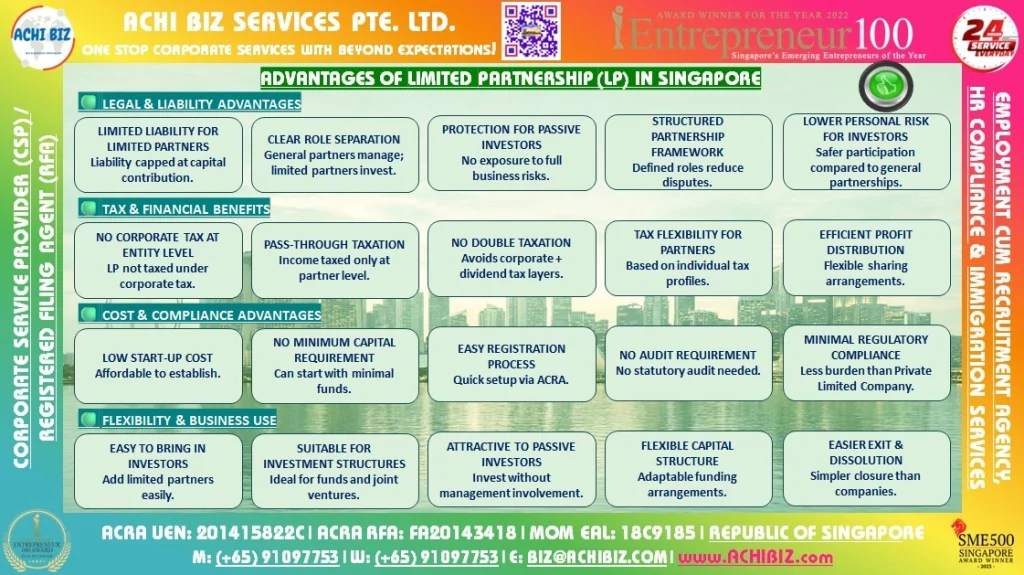
Here go with categorised advantages:

LEGAL & LIABILITY ADVANTAGES

  • LIMITED LIABILITY FOR LIMITED PARTNERS Liability capped at capital contribution.
  • CLEAR ROLE SEPARATION General partners manage; limited partners invest.
  • PROTECTION FOR PASSIVE INVESTORS No exposure to full business risks.
  • STRUCTURED PARTNERSHIP FRAMEWORK Defined roles reduce disputes.
  • LOWER PERSONAL RISK FOR INVESTORS Safer participation compared to general partnerships.

TAX & FINANCIAL BENEFITS

  • NO CORPORATE TAX AT ENTITY LEVEL LP not taxed under corporate tax.
  • PASS-THROUGH TAXATION Income taxed only at partner level.
  • NO DOUBLE TAXATION Avoids corporate + dividend tax layers.
  • TAX FLEXIBILITY FOR PARTNERS Based on individual tax profiles.
  • EFFICIENT PROFIT DISTRIBUTION Flexible sharing arrangements.

COST & COMPLIANCE ADVANTAGES

  • LOW START-UP COST Affordable to establish.
  • NO MINIMUM CAPITAL REQUIREMENT Can start with minimal funds.
  • EASY REGISTRATION PROCESS Quick setup via ACRA.
  • NO AUDIT REQUIREMENT No statutory audit needed.
  • MINIMAL REGULATORY COMPLIANCE Less burden than Private Limited Company.

FLEXIBILITY & BUSINESS USE

  • EASY TO BRING IN INVESTORS Add limited partners easily.
  • SUITABLE FOR INVESTMENT STRUCTURES Ideal for funds and joint ventures.
  • ATTRACTIVE TO PASSIVE INVESTORS Invest without management involvement.
  • FLEXIBLE CAPITAL STRUCTURE Adaptable funding arrangements.
  • EASIER EXIT & DISSOLUTION Simpler closure than companies.

Click here to learn more about Advantages or Pros of all types of
Entities in Singapore.

Cons or Disadvantages of a Limited Partnership

  • Risks to the general partners: In a limited
    partnership, the general partners must carry the burden of all the
    business’s debts and obligations. If the company is sued or enters into
    bankruptcy, all debts and liabilities are the responsibility of the
    general partners. Also, each general partner has the ability to make
    decisions on behalf of the company, and those decisions become the
    responsibility of all the general partners.
  • Compliance challenges: A general partnership does
    require less paperwork than a corporation, but because in essence you
    have investors (the limited partners), you must still hold annual
    meetings and create a detailed partnership agreement.
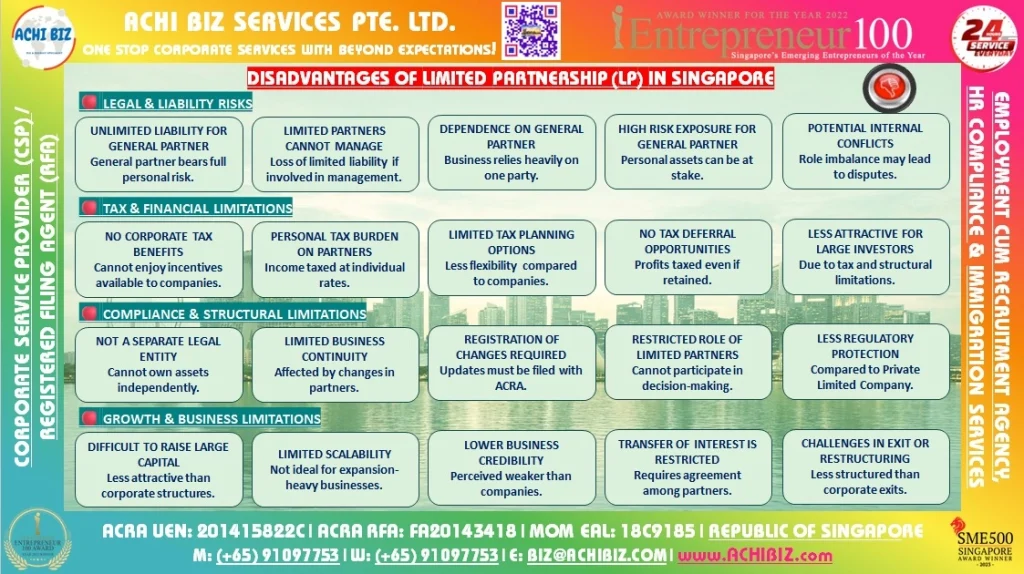
Here go with categorised disadvantages:

LEGAL & LIABILITY RISKS

  • UNLIMITED LIABILITY FOR GENERAL PARTNER General partner bears full personal risk.
  • LIMITED PARTNERS CANNOT MANAGE Loss of limited liability if involved in management.
  • DEPENDENCE ON GENERAL PARTNER Business relies heavily on one party.
  • HIGH RISK EXPOSURE FOR GENERAL PARTNER Personal assets can be at stake.
  • POTENTIAL INTERNAL CONFLICTS Role imbalance may lead to disputes.

TAX & FINANCIAL LIMITATIONS

  • NO CORPORATE TAX BENEFITS Cannot enjoy incentives available to companies.
  • PERSONAL TAX BURDEN ON PARTNERS Income taxed at individual rates.
  • LIMITED TAX PLANNING OPTIONS Less flexibility compared to companies.
  • NO TAX DEFERRAL OPPORTUNITIES Profits taxed even if retained.
  • LESS ATTRACTIVE FOR LARGE INVESTORS Due to tax and structural limitations.

COMPLIANCE & STRUCTURAL LIMITATIONS

  • NOT A SEPARATE LEGAL ENTITY Cannot own assets independently.
  • LIMITED BUSINESS CONTINUITY Affected by changes in partners.
  • REGISTRATION OF CHANGES REQUIRED Updates must be filed with ACRA.
  • RESTRICTED ROLE OF LIMITED PARTNERS Cannot participate in decision-making.
  • LESS REGULATORY PROTECTION Compared to Private Limited Company.

GROWTH & BUSINESS LIMITATIONS

  • DIFFICULT TO RAISE LARGE CAPITAL Less attractive than corporate structures.
  • LIMITED SCALABILITY Not ideal for expansion-heavy businesses.
  • LOWER BUSINESS CREDIBILITY Perceived weaker than companies.
  • TRANSFER OF INTEREST IS RESTRICTED Requires agreement among partners.
  • CHALLENGES IN EXIT OR RESTRUCTURING Less structured than corporate exits.

Click here to learn more about Disadvantages or Cons of all types of
Entities in Singapore.


Please CONTACT us if you wish to know about these or many other services.