Menu

Achi Biz GuidesPartnership (General)

Partnership (General / Normal) Firm In Singapore

Introduction of a Singapore Partnership (General / Normal)

Singapore Citizen or Singapore Permanent Resident can register a partnership with one or more partners. These partners jointly manage the company’s day-to-day operations and share responsibility for its debts and liabilities. Each partner contributes to the partnership — both financially and in sweat equity — and shares in the company’s profits and losses.
A partnership consisting of foreign individuals or persons will not be registered by the Registrar unless there is a Singapore local resident manager.
Generally, all partners have equal rights in the management of the partnership. To avoid possible disputes, it is preferable that a partnership agreement is drawn up. 
Partnerships may have between two and twenty partners. Once there are more than twenty partners, the business firm must be registered as a company.
A partnership is not a legal entity such that the partnership has to sue or be sued in the names of the partners. The liability of each partner is unlimited.
The advantage of operating a partnership is that disclosures of financial statements to the general public are not required.
Losses incurred by such businesses can be set off against other personal income such as interest, rental and dividend as well as employment income (if any).

Pros or Advantages of a Partnership (General / Normal)

  • Partnerships face fewer statutory controls than companies.
  • There is no requirement to audit or publish accounts or to register the Partnership Agreement. No returns are required to be made by partnerships, except for income tax.
  • The internal structure of partnerships is very flexible. Most of the rules for the structure of partnerships can be overridden if the partners agree otherwise.
  • Partnerships can be simple and cheap to set up. There is no requirement to have any written documentation, although a Partnership Agreement is advisable (see above).
  • Partners owe a duty of good faith to each other. Partners must also account to the partnership for any secret profits that they make from the partnership without the consent of the other partners, including any profits gained from any competing business.

Here goes with Categorised Advantages:

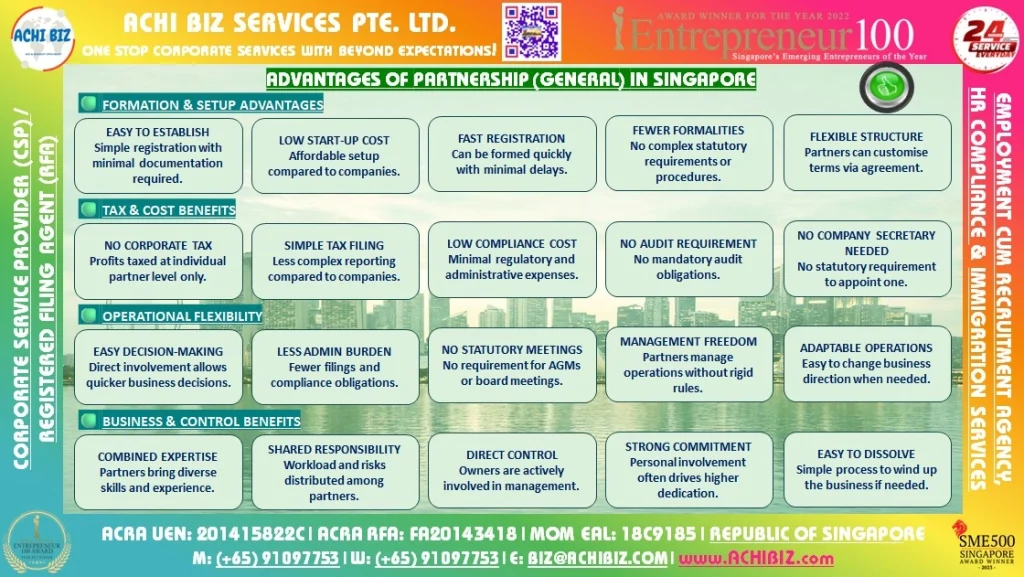
🤝 FORMATION & SETUP ADVANTAGES
  • EASY TO ESTABLISH
    Simple registration with minimal documentation required.
  • LOW START-UP COST
    Affordable setup compared to companies.
  • FAST INCORPORATION
    Can be formed quickly with minimal delays.
  • FEWER FORMALITIES
    No complex statutory requirements or procedures.
  • FLEXIBLE STRUCTURE
    Partners can customise terms via agreement.
💰 TAX & COST BENEFITS
  • NO CORPORATE TAX
    Profits taxed at individual partner level only.
  • SIMPLE TAX FILING
    Less complex reporting compared to companies.
  • LOW COMPLIANCE COST
    Minimal regulatory and administrative expenses.
  • NO AUDIT REQUIREMENT
    No mandatory audit obligations.
  • NO COMPANY SECRETARY NEEDED
    No statutory requirement to appoint one.
⚙️ OPERATIONAL FLEXIBILITY
  • EASY DECISION-MAKING
    Direct involvement allows quicker business decisions.
  • LESS ADMIN BURDEN
    Fewer filings and compliance obligations.
  • NO STATUTORY MEETINGS
    No requirement for AGMs or board meetings.
  • FREEDOM IN MANAGEMENT
    Partners manage operations without rigid rules.
  • ADAPTABLE OPERATIONS
    Easy to change business direction when needed.
👥 BUSINESS & CONTROL BENEFITS
  • COMBINED EXPERTISE
    Partners bring diverse skills and experience.
  • SHARED RESPONSIBILITY
    Workload and risks distributed among partners.
  • DIRECT CONTROL
    Owners are actively involved in management.
  • STRONG COMMITMENT
    Personal involvement often drives higher dedication.
  • EASY TO DISSOLVE
    Simple process to wind up the business if needed.

Click here to learn more about Advantages or Pros of all types of Entities in Singapore.

Cons or Disadvantages of a Partnership (General / Normal)

  • Partners face unlimited liability for all the debts of the partnership. This means that the personal assets of each partner are at risk.
  • Partners are jointly liable for partnership debts. This means that if one partner fails to pay his share of the partnership debt, the other partners must make up the shortfall.
  • Any individual partner can be sued for all the debts of the partnership.
  • The partnership does not have its own separate legal identity from the partners. Therefore, unless otherwise agreed, the partnership will come to an end each time a partner leaves.
  • The avenues available for access to further capital for expansion are restricted by the amount of security that can be given personally by the individual partners.

Here goes with Categorised Disadvantages:

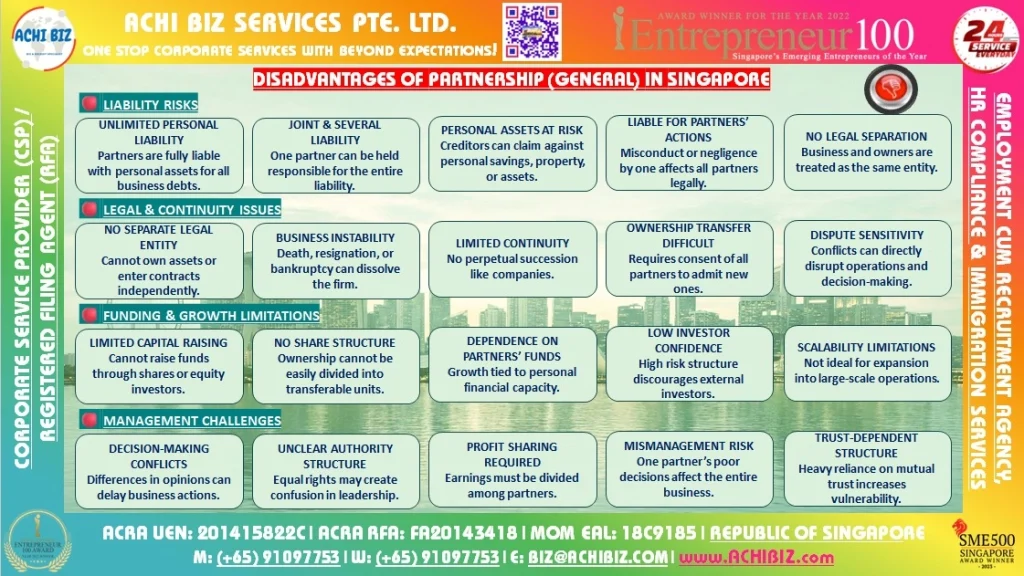
⚠️ LIABILITY RISKS
  • UNLIMITED PERSONAL LIABILITY
    Partners are fully liable with personal assets for all business debts.
  • JOINT & SEVERAL LIABILITY
    One partner can be held responsible for the entire liability.
  • PERSONAL ASSETS AT RISK
    Creditors can claim against personal savings, property, or assets.
  • LIABLE FOR PARTNERS’ ACTIONS
    Misconduct or negligence by one affects all partners legally.
  • NO LEGAL SEPARATION
    Business and owners are treated as the same entity.
⚖️ LEGAL & CONTINUITY ISSUES
  • NO SEPARATE LEGAL ENTITY
    Cannot own assets or enter contracts independently.
  • BUSINESS INSTABILITY
    Death, resignation, or bankruptcy can dissolve the firm.
  • LIMITED CONTINUITY
    No perpetual succession like companies.
  • OWNERSHIP TRANSFER DIFFICULT
    Requires consent of all partners to admit new ones.
  • DISPUTE SENSITIVITY
    Conflicts can directly disrupt operations and decision-making.
💰 FUNDING & GROWTH LIMITATIONS
  • LIMITED CAPITAL RAISING
    Cannot raise funds through shares or equity investors.
  • NO SHARE STRUCTURE
    Ownership cannot be easily divided into transferable units.
  • DEPENDENCE ON PARTNERS’ FUNDS
    Growth tied to personal financial capacity.
  • LOW INVESTOR CONFIDENCE
    High risk structure discourages external investors.
  • SCALABILITY LIMITATIONS
    Not ideal for expansion into large-scale operations.
⚙️ MANAGEMENT CHALLENGES
  • DECISION-MAKING CONFLICTS
    Differences in opinions can delay business actions.
  • UNCLEAR AUTHORITY STRUCTURE
    Equal rights may create confusion in leadership.
  • PROFIT SHARING REQUIRED
    Earnings must be divided among partners.
  • MISMANAGEMENT RISK
    One partner’s poor decisions affect the entire business.
  • TRUST-DEPENDENT STRUCTURE
    Heavy reliance on mutual trust increases vulnerability.

Click here to learn more about Disadvantages or Cons of all types of Entities in Singapore.

Please CONTACT us if you wish to know about these or many other services.