
AGM: Compliance or Opportunity?
For many business owners, the Annual General Meeting (AGM) feels like just another compliance task. Something to tick off the list and move on.
But if you look closer, AGM is more than a legal requirement—it’s a key moment of transparency, accountability, and trust-building within your company.
So, is AGM just a hassle, or does it actually add value? Let’s break it down.
What Is an AGM?
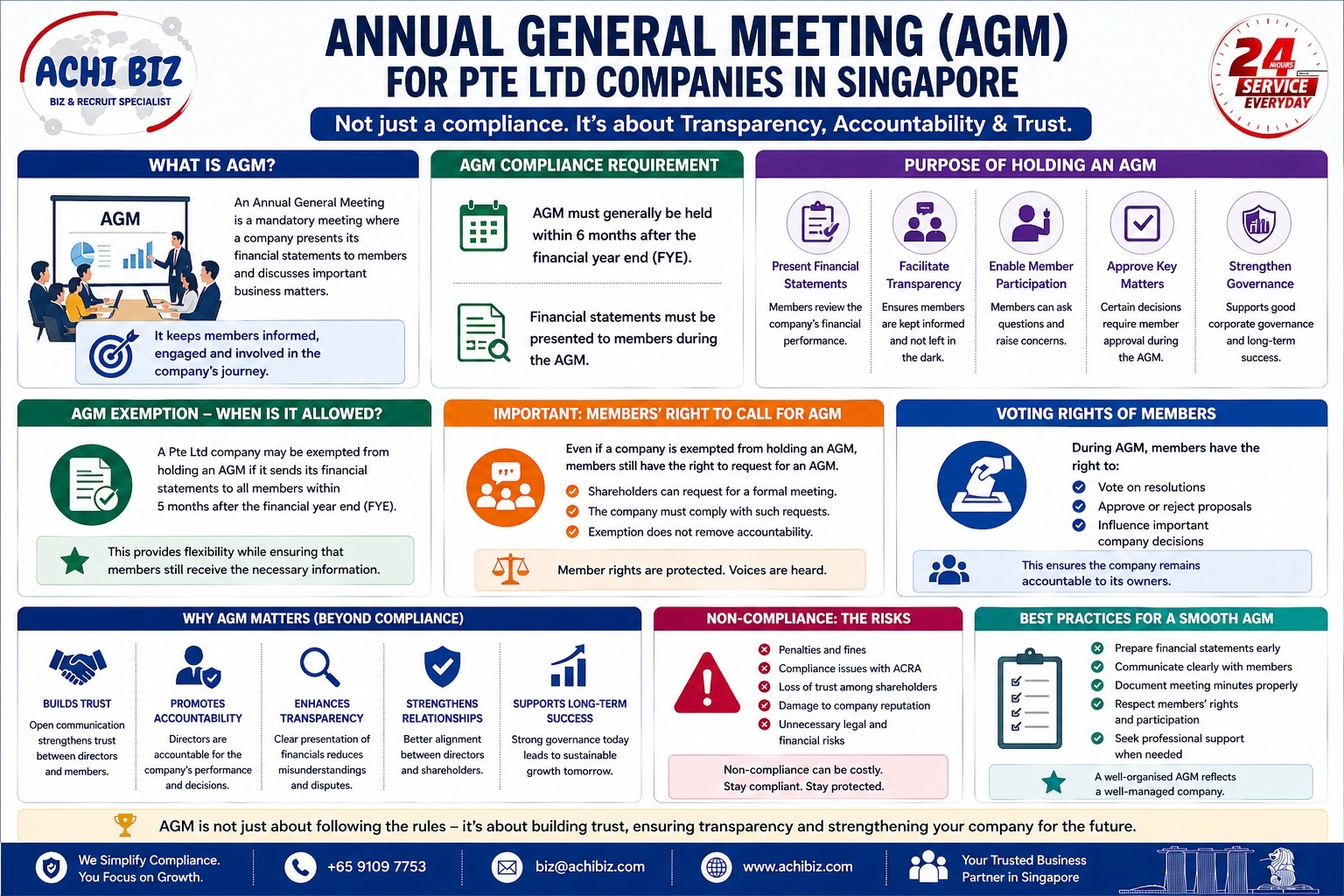
An Annual General Meeting (AGM) is a mandatory meeting where a company presents its financial statements to shareholders (members) and discusses key matters of the business.
It gives members the opportunity to:
- Review the company’s financial performance
- Ask questions and raise concerns
- Vote on important decisions
In simple terms, it keeps everyone informed and aligned.
AGM Compliance Requirements in Singapore
For private limited companies (Pte Ltd) in Singapore:
- AGM must generally be held within 6 months after the financial year end (FYE)
- Financial statements must be presented to members during the AGM
This ensures timely communication of the company’s financial position.
Purpose of Holding an AGM
The AGM serves several important purposes:
Present Financial Statements
Directors present the company’s financial statements so members can review performance and financial health.
Facilitate Transparency
AGM ensures that shareholders are not left in the dark about company matters.
Enable Member Participation
Members have the right to ask questions and participate in discussions.
Approve Key Matters
Certain decisions may require approval during the AGM, including financial matters and governance-related issues.
AGM Exemption: When Is It Allowed?
Singapore allows some flexibility.
A Pte Ltd company may not be required to hold an AGM if:
👉 The company sends its financial statements to all members within 5 months after FYE
This is commonly known as AGM exemption.
It reduces administrative work while still ensuring members receive the necessary information.
Important: Members’ Right to Call for AGM
Even if a company qualifies for AGM exemption:
👉 Members still have the right to request for an AGM
This means:
- Shareholders can ask for a formal meeting
- The company must comply with such requests
So, exemption does not remove accountability—it simply provides flexibility.
Voting Rights of Members
AGM is also important because it allows members to exercise their voting rights.
Members can:
- Vote on resolutions
- Approve or reject proposals
- Influence company decisions
This ensures that the company is not controlled solely by directors, but remains accountable to its owners.
Why AGM Matters (Beyond Compliance)
AGM is not just about following the rules—it plays a bigger role in building a strong company.
Builds Trust
Open communication through AGM strengthens trust between directors and shareholders.
Promotes Accountability
Directors are accountable for the company’s performance and decisions.
Enhances Transparency
Clear presentation of financials reduces misunderstandings and disputes.
Strengthens Governance
Good governance practices are essential for long-term success, and AGM is a key part of it.
Is AGM a Hassle or a Value-Add?
It depends on how you approach it.
If treated as a routine compliance task, AGM may feel like a burden.
But when used effectively, it becomes:
- A platform for communication
- A tool for building confidence
- A way to strengthen relationships with shareholders
In reality, AGM is an opportunity—not just an obligation.
Impact of Non-Compliance
Failing to comply with AGM requirements can lead to:
- Penalties and fines
- Compliance issues with ACRA
- Loss of trust among shareholders
Ignoring AGM obligations can create unnecessary risks for your business.
Best Practices for AGM
To make AGM smooth and effective:
- Prepare financial statements early
- Communicate clearly with members
- Document meeting minutes properly
- Respect members’ rights and participation
- Seek professional support if needed
A well-organised AGM reflects a well-managed company.
Final Thoughts
The Annual General Meeting (AGM) in Singapore is more than a statutory requirement—it’s a cornerstone of good corporate governance.
The key takeaway is simple:
AGM is not just about compliance—it’s about trust, transparency, and accountability.
Whether you choose to hold an AGM or rely on exemption, what matters most is keeping your shareholders informed and engaged.
Done right, AGM becomes a powerful tool to strengthen your company—not just a box to tick.
#achibiz