
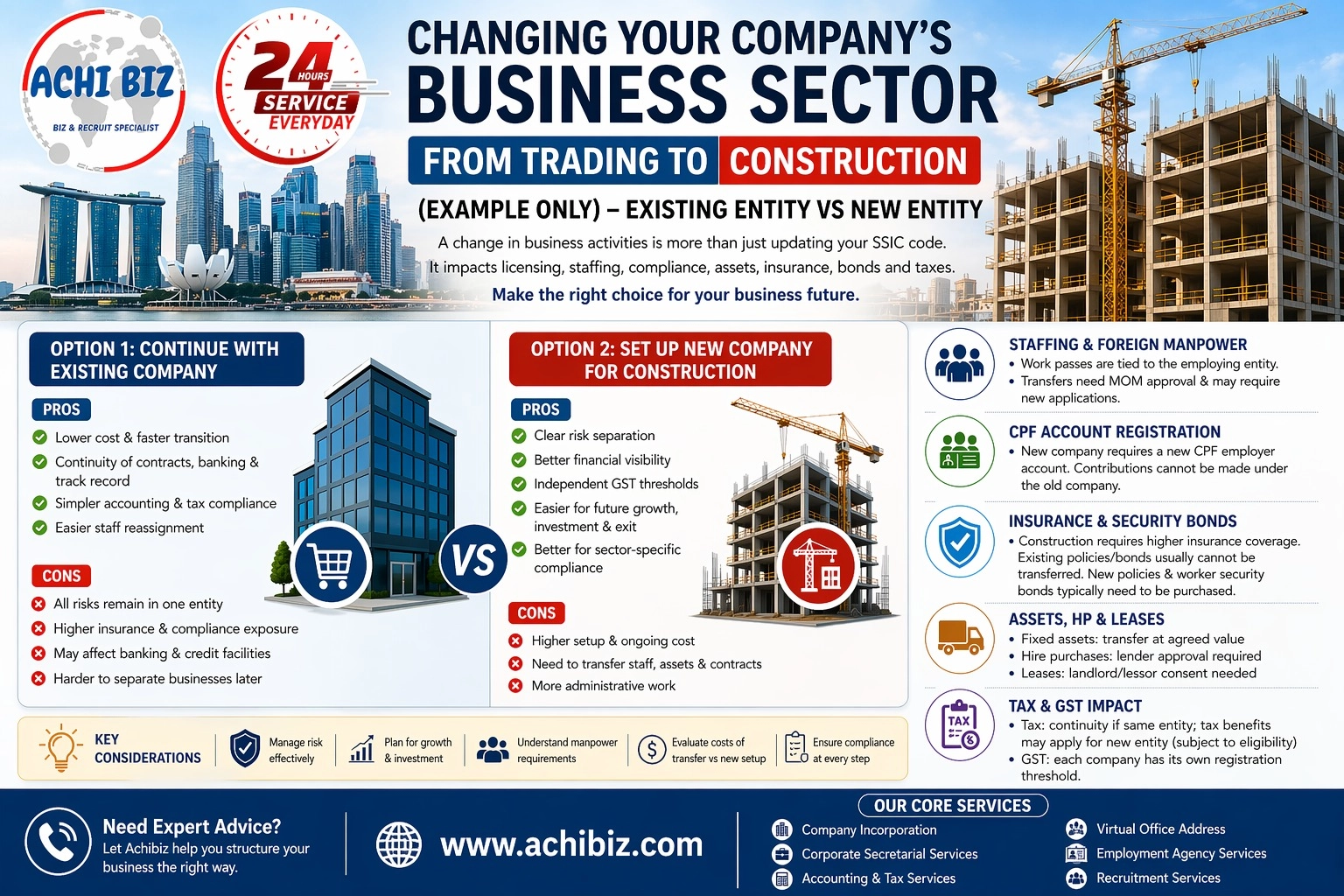
From Trading to Construction (Example Only) — Keep the Same Entity or Set Up a New One?
Shifting your business activities in Singapore from one sector to another—such as from trading to construction—is more than a simple update. This example highlights how a major change in business direction can affect your company structure, licences, staffing, foreign manpower, assets, contracts, insurance, security bonds, and tax position. The key decision is whether to continue under your existing Pte Ltd company or incorporate a new Pte Ltd company in Singapore for the new business activity.
Can You Change Your Business Activity with the Same Company?
Yes. You can update your SSIC code Singapore and reflect the new principal activity with ACRA. From a filing perspective, this is straightforward. However, when the new activity is significantly different—like construction compared to trading—the operational and compliance requirements can change quite drastically. So the real question is not just whether you can do it, but whether it makes sense from a risk and business standpoint.
Option 1: Continue with the Existing Company
What this looks like
You update your business activity with ACRA, obtain the necessary licences, and continue operating under the same entity.
Pros
- Lower cost and quicker transition
- Continuity of banking, contracts, and company track record
- Simpler corporate tax Singapore and accounting setup
- Easier internal reassignment of staff
- Existing insurance policies and bonds may continue (subject to insurer approval)
Cons
- All risks are combined under one entity
- Existing liabilities and obligations remain tied to the same company
- Changes in business nature may affect banking relationships and credit facilities
- Insurance coverage may need to be upgraded significantly for construction risks
- Existing policies may not fully cover new activities or may require endorsements
Option 2: Set Up a New Company for the New Activity
What this looks like
You incorporate a new Pte Ltd company in Singapore for the new sector while keeping the existing company for its original business.
Pros
- Clear risk separation between different business activities
- Better visibility of financial performance
- Flexibility for future expansion, investment, or exit
- Independent GST registration Singapore thresholds
- Easier to manage sector-specific compliance
Cons
- Additional incorporation and maintenance costs
- Need to transfer staff, assets, and contracts
- More administrative and operational complexity
- New setup required for insurance, bonds, and licences
Licensing & Compliance Considerations
Different sectors come with different regulatory requirements. For example, construction may require specific registrations, safety compliance, and permits that are not applicable to trading. Managing these within a separate entity often provides better control and clarity.
Impact on Local Staffing & Foreign Manpower
Local staff
If you continue with the same company, staff can usually be reassigned internally. If you move to a new entity, new employment contracts or formal transfers may be required. You should also consider continuity of benefits and HR policies.
Foreign manpower
Work passes in Singapore are tied to the employing company. Moving employees to a new entity typically requires new applications or approvals from MOM. Different sectors may also have different quota and levy requirements, so planning is important to avoid disruptions.
CPF Registration Requirements
This is an area many businesses overlook. If you continue using the existing company, your current CPF employer account remains active and you simply continue contributions for eligible employees.
However, if you set up a new company, you will need to register a new CPF employer account with the CPF Board before making any salary payments. CPF contributions cannot be processed under the old company, even if the employees are the same.
Impact on Insurance & Security Bonds
This is a critical but often underestimated area.
If you continue with the same company:
- Existing insurance policies (e.g. general liability, work injury compensation) may need to be reviewed or upgraded
- Insurers may require policy endorsements to cover construction-related risks
- Premiums are likely to increase due to higher risk exposure
If you set up a new company:
- You will typically need to purchase new insurance policies from scratch
- Existing policies from the old company generally cannot be transferred
- For foreign workers, security bonds required by MOM are tied to the employer entity and cannot be transferred
- New bonds must be issued under the new company for each worker
Failing to arrange proper insurance or bonds can delay operations or lead to non-compliance.
Transferring Fixed Assets, Hire Purchases & Leases
If you set up a new company, you’ll need to properly transfer assets and obligations.
Fixed assets
Assets should be transferred at an agreed value, with proper documentation and updates to accounting records.
Hire purchase arrangements
These usually require lender approval. In some cases, refinancing or restructuring may be needed.
Leases
Office, warehouse, or equipment leases may require consent from landlords or lessors before they can be transferred or reassigned.
Key Strategic Considerations
The decision comes down to a few practical factors. If the new business carries higher risk, separating it may protect your existing operations. If you expect growth or plan to bring in investors, a new entity offers more flexibility. On the other hand, if cost and simplicity are your priority, continuing with the same company may be more practical.
Final Thoughts
Changing your company’s business sector in Singapore—whether from trading to construction or any other shift—is not just an administrative step. It’s a strategic decision that affects your risk exposure, compliance obligations, and long-term growth.
Taking the time to structure it properly from the start can save you from complications later.
Need Help Structuring Your Business Transition?
If you’re planning to change your business activities in Singapore or are unsure whether to use your existing company or set up a new one, Achibiz can guide you through the process with practical advice.
📩 Reach out to Achibiz for support on restructuring, compliance, and business setup in Singapore.
#achibiz