
Company Constitution in Singapore Pte. Ltd. Companies-FAQ
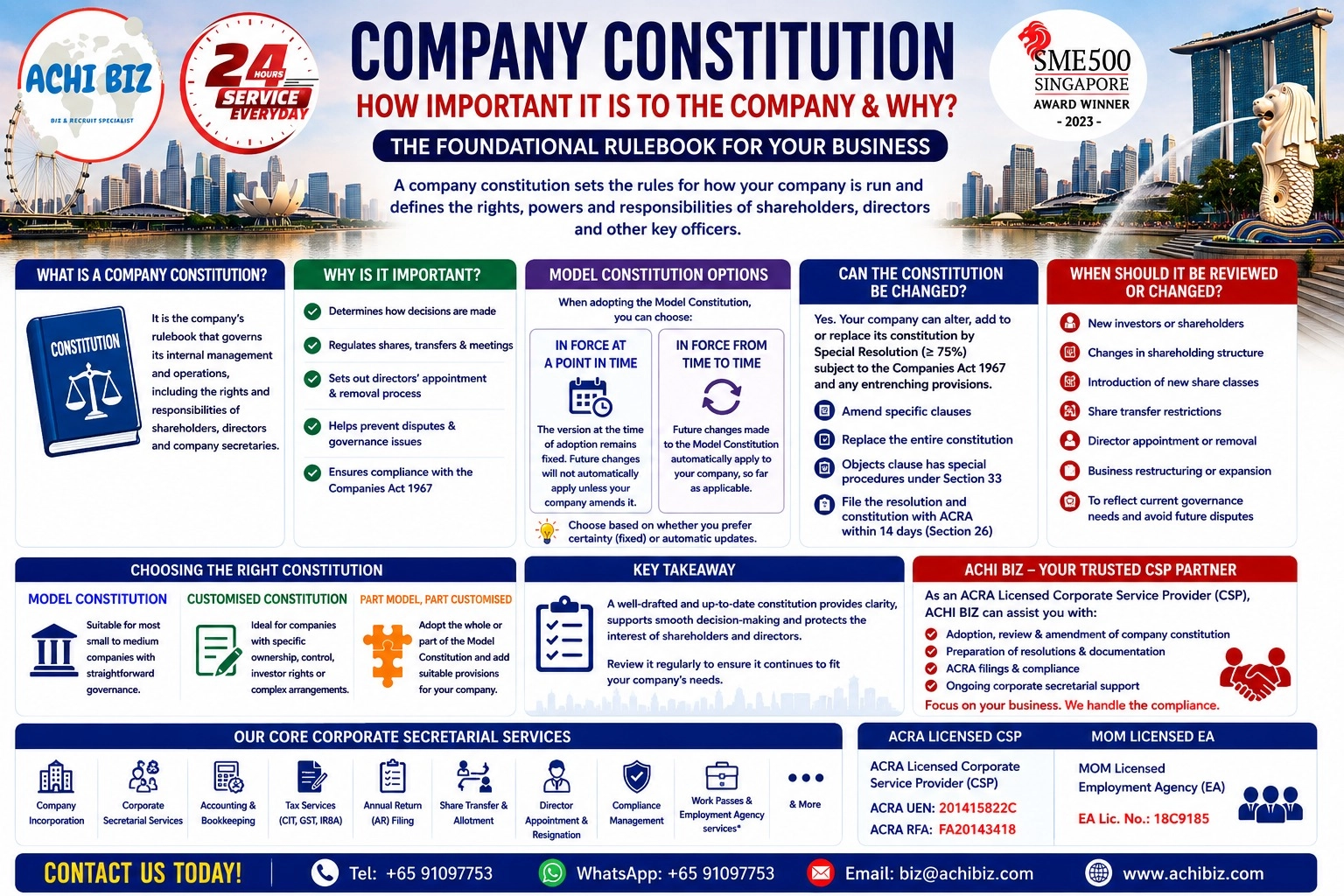
A company constitution is one of the most important governance documents of a Singapore Private Limited (Pte. Ltd.) company. It establishes the rules under which the company operates and helps determine the rights, powers and responsibilities of shareholders, directors and other company officers.
It should not be treated merely as an incorporation document that is filed or adopted when the company is formed and then forgotten. The constitution can become particularly important when the company appoints or removes directors, transfers shares, introduces new shareholders, conducts meetings, declares dividends or encounters disagreements over corporate decision-making.
In Singapore, a company may adopt the prescribed Model Constitution or use a customised constitution. A company adopting the whole Model Constitution can also choose between the version “in force at a point in time” and the version “in force from time to time.” These choices can have practical consequences years after incorporation. ACRA expressly provides these options when a company is registered through Bizfile.
This FAQ explains what a company constitution means, why it matters, when it should be reviewed or amended, whether an entirely new constitution can be adopted, and how companies should consider the Model Constitution versus a customised constitution.
What is a company constitution in Singapore?
A company constitution is the document containing the fundamental rules governing how a company is organised and operated.
ACRA describes the constitution as setting out the rules for running the company and defining the rights and responsibilities of directors, shareholders and company secretaries. It may deal with matters such as share transfers, meetings, appointment and resignation of directors and other governance procedures.
For a Pte. Ltd. company, the constitution therefore operates as an internal governance framework rather than simply an administrative document.
Is a company constitution compulsory for a Singapore Pte. Ltd. company?
Yes. Singapore’s Companies Act 1967 contains requirements concerning a company’s constitution, including prescribed information that must be stated in it. The Act also provides for model constitutions for private companies and companies limited by guarantee.
For companies incorporated before 3 January 2016, the position may be different in form because their former memorandum and articles are generally treated as their constitution under the transitional framework.
Why is the company constitution so important?
Its importance becomes clearer when a company needs to make an actual corporate decision.
Questions may arise such as:
- Who has authority to make a particular decision?
- How can directors be appointed?
- What procedures apply to directors’ meetings?
- How can shares be transferred?
- What voting rights apply?
- What procedures apply to members’ meetings?
- What happens when shareholders disagree?
- What restrictions apply to the company’s shares?
The answer cannot always be obtained simply by looking at what shareholders or directors would prefer to do. The Companies Act and the company’s actual constitution must be considered.
Is the constitution legally binding on the company and its members?
The constitution has legal significance and should not be treated as a set of optional internal guidelines.
Once adopted, the company must conduct relevant corporate affairs consistently with the applicable Companies Act requirements and its constitution. This is why companies should check the constitution before implementing significant corporate actions rather than checking it only after a dispute or procedural problem arises.
What is the difference between a company constitution and an ordinary company policy?
An internal policy normally deals with operational or administrative matters and can often be changed internally according to management procedures.
A constitution occupies a fundamentally different position. It forms part of the company’s formal governance framework, and changing it generally involves the statutory process applicable to alteration of a constitution.
A company therefore should not attempt to override a constitutional provision simply by adopting an internal policy.
Does every Singapore Pte. Ltd. company have the same constitution?
No.
Two companies incorporated on the same day can have different constitutions.
One may use the Model Constitution in force at the point in time. Another may adopt the Model Constitution in force from time to time. A third may have a fully customised constitution.
It is therefore unsafe to assume that a provision applying to one Singapore company automatically applies to another.
What is the Model Constitution for a Singapore private company?
The Model Constitution is a standard constitution prescribed under the Companies (Model Constitutions) Regulations 2015. A model constitution for a private company limited by shares is prescribed in the First Schedule to those Regulations.
It provides companies with a ready-made governance framework rather than requiring every new company to draft an entirely bespoke constitution.
Is adopting the Model Constitution compulsory?
No. ACRA’s current incorporation guidance allows a company to either upload a customised constitution or adopt the Model Constitution.
The appropriate choice depends largely on the company’s ownership structure, governance arrangements and commercial requirements.
What is a customised company constitution?
A customised constitution is drafted or modified to reflect governance requirements that are specific to a particular company.
Instead of relying entirely on the standard provisions of the Model Constitution, it can contain appropriately drafted provisions dealing with matters relevant to the company’s ownership and management arrangements, subject to Singapore law.
Customisation becomes more relevant as a company’s ownership or investment arrangements become more sophisticated.
When might a customised constitution be more appropriate?
A customised constitution may deserve consideration where the company has multiple founders or investor groups, different classes of shares, special voting arrangements, specific restrictions on share transfers, reserved matters, particular director appointment mechanisms or other governance arrangements that are not adequately addressed by the standard model.
Customisation should have a genuine commercial or governance purpose. Adding complicated provisions merely to make a constitution look sophisticated can create unnecessary difficulties later.
Is the Model Constitution suitable for a small Pte. Ltd. company?
It can be.
For a straightforward owner-managed company with uncomplicated shareholding and governance arrangements, the Model Constitution may provide a practical framework without unnecessary customisation.
However, “small company” does not automatically mean “simple company.” A company with only two shareholders can still have complicated governance requirements if the shareholders have different rights, investment expectations or control arrangements.
What does adopting the Model Constitution “in force at a point in time” mean?
It means the company adopts the version of the Model Constitution applicable at the time of adoption.
ACRA explains that this version remains fixed and does not automatically change when the prescribed Model Constitution is subsequently amended. The company’s constitution changes only if the company subsequently takes the necessary steps to amend it.
This provides greater certainty about the precise constitutional provisions adopted by the company.
What does adopting the Model Constitution “in force from time to time” mean?
This is fundamentally different.
If the company chooses “in force from time to time,” subsequent changes made to the prescribed Model Constitution automatically become applicable to the company, so far as applicable.
ACRA expressly explains that the company automatically adopts future changes made to the Model Constitution. Section 37 of the Companies Act provides the statutory basis for this option.
What is the main difference between “in force at a point in time” and “in force from time to time”?
The distinction is essentially fixed version versus automatically evolving version.
In force at a point in time:
The company adopts a particular version. Later amendments to the statutory Model Constitution do not automatically alter the company’s adopted version.
In force from time to time:
The company’s constitution follows the Model Constitution as it is amended over time, so far as applicable.
This is an important incorporation decision and should not be selected merely because it appears as an option on Bizfile.
Which option is better: “in force from time to time” or “in force at a point in time”?
There is no single option that is universally better.
“In force from time to time” may be attractive to a straightforward company that wants its adopted Model Constitution to follow future changes without separately amending its constitution each time.
“In force at a point in time” may be preferred where shareholders want greater certainty that the agreed governance provisions will remain fixed unless the company deliberately changes them.
The appropriate choice therefore depends on whether the company values automatic updating or greater control over constitutional changes.
Does “in force from time to time” mean the company never needs to review its constitution?
No.
Automatic adoption of amendments to the Model Constitution does not eliminate the need for governance reviews.
The company still needs to understand which provisions currently apply to it. In fact, because the applicable Model Constitution can change over time, companies using this option should be aware that the current rules may not be identical to those that existed on their incorporation date.
Does “in force at a point in time” mean the constitution becomes outdated?
Not necessarily.
A fixed constitution does not become invalid merely because a later version of the Model Constitution is introduced. However, the company should periodically review whether its constitution remains suitable for its current operations and complies with applicable law.
A constitution can remain legally usable while becoming commercially unsuitable for the company.
Can a Singapore company alter its constitution after incorporation?
Yes.
Section 26 of the Companies Act generally permits a company to alter or add to its constitution by special resolution, subject to the Act and any applicable entrenching provisions.
Accordingly, adopting a particular constitution at incorporation does not normally lock the company permanently into that document.
Can only one clause of the constitution be amended?
Yes, where legally permissible.
A company does not necessarily need to replace its entire constitution simply because one provision requires amendment. Specific clauses may be altered, deleted or supplemented through the appropriate procedure.
Whether a targeted amendment or broader replacement is preferable depends on how extensive the required changes are.
Can the entire company constitution be replaced?
Generally, a company may undertake a comprehensive alteration and adopt a substantially revised or replacement constitution, subject to the Companies Act, the company’s existing constitutional restrictions and any applicable entrenching provisions.
Where numerous provisions are obsolete, inconsistent or unsuitable, replacing the constitution comprehensively can sometimes be cleaner than making repeated piecemeal amendments.
When should a company consider replacing the whole constitution instead of amending individual clauses?
A complete review may make more sense where the existing constitution is significantly outdated, contains numerous obsolete provisions, no longer reflects the ownership structure, or requires extensive changes across interconnected clauses.
Repeated amendments can eventually create a document that is difficult to interpret. A consolidated replacement can provide greater clarity, provided the adoption process is properly handled.
What is a special resolution for alteration of a company constitution?
A special resolution is the shareholder approval mechanism generally required under Section 26 for altering or adding to the constitution.
The Companies Act refers to a 75% minimum majority in the context of special resolutions and entrenching provisions.
Companies must nevertheless examine their own constitution because entrenching provisions can impose a higher threshold or additional conditions.
Does an amendment to the constitution take effect immediately?
Under Section 26, an alteration or addition generally forms part of the constitution from the date of the special resolution or from a later date specified in that resolution, subject to the Companies Act.
However, particular alterations can be subject to additional statutory requirements. Changes to objects, for example, are governed by specific provisions under Section 33.
Must an amended constitution be lodged with ACRA?
Generally, where Section 26 applies, the relevant resolution or document affecting the constitution and the constitution as adopted or altered must be lodged with the Registrar within the statutory timeframe, unless an applicable exception or different statutory procedure applies.
Section 26 provides a 14-day lodgement requirement for the relevant resolution/order and, unless dispensed with, the constitution as adopted or altered.
The precise filing requirements should therefore be checked against the type of amendment being made.
Are changes to the company’s objects treated differently?
Yes, and this is an area where companies should be particularly careful.
Section 33 contains specific procedures for altering provisions concerning the company’s objects, including special-resolution and notice requirements. ACRA has also issued a Registrar’s Interpretation explaining that alterations to objects should be handled separately because Sections 26 and 33 have different procedural and lodgement requirements.
A company should therefore not casually combine an objects-clause amendment with unrelated constitutional amendments in a single resolution.
What is an entrenching provision in a company constitution?
An entrenching provision makes specified constitutional provisions harder to amend than under the ordinary amendment procedure.
For example, it may require a majority greater than the usual 75% threshold or impose specified additional conditions.
Under Section 26A, inserting an entrenching provision after incorporation requires the agreement of all members, and removing or altering such an entrenching provision also requires all members to agree.
Why would shareholders want an entrenching provision?
Entrenchment can be useful where shareholders regard particular governance rights as fundamental and do not want them changed merely because another shareholder or shareholder group later obtains the ordinary special-resolution majority.
It can therefore provide additional protection for carefully negotiated governance arrangements.
However, excessive entrenchment can also make future restructuring difficult. Such provisions should be used deliberately rather than routinely.
When should an existing company review its constitution?
A constitutional review is particularly useful when the company’s circumstances materially change.
Examples include bringing in new investors, introducing different share classes, restructuring ownership, changing governance arrangements, preparing for succession, experiencing shareholder disagreements, undertaking major corporate transactions or discovering that existing provisions no longer reflect how the business is actually managed.
The constitution should also be checked before a proposed transaction where the validity or procedure of that transaction may depend on constitutional provisions.
Should the constitution be reviewed when new shareholders enter the company?
Yes, particularly where the incoming shareholder has negotiated special rights.
The company should determine whether those rights need to be reflected in the constitution, a shareholders’ agreement or both.
Failing to align the company’s constitutional framework with the intended ownership arrangement can create uncertainty later.
Should a constitution be reviewed when shares are transferred?
It should at least be checked.
The constitution may contain procedures or restrictions relating to share transfers. ACRA itself identifies share-transfer procedures as one of the governance matters covered by a company constitution.
A company should therefore verify the applicable constitutional provisions before treating a proposed share transfer as a purely administrative exercise.
Should the constitution be checked before appointing or removing a director?
Yes.
Director appointment, resignation and related governance procedures can be affected by the company’s constitution. ACRA specifically identifies director appointment and resignation processes among matters addressed by a constitution.
The applicable Companies Act provisions and the company’s own constitution should therefore be considered together.
Can shareholders simply agree among themselves to ignore an inconvenient constitutional provision?
That is not a sound governance approach.
If an existing provision is unsuitable, the proper question is whether it should be formally amended through the applicable corporate procedure.
Operating informally in contradiction to the constitution can create uncertainty about whether decisions and transactions were properly authorised.
What happens if the shareholders disagree about changing the constitution?
The required approval threshold still applies.
If the necessary special-resolution majority—or any higher threshold imposed by an entrenching provision—is not achieved, the proposed alteration generally cannot simply be treated as approved.
This illustrates why constitutional arrangements can become especially important in companies with two shareholder groups or closely divided ownership.
Can a majority shareholder change the constitution without considering minority shareholders?
Possessing enough votes to pass a special resolution does not mean every proposed constitutional amendment is automatically beyond challenge.
The exercise of corporate powers remains subject to applicable company law principles and statutory safeguards. Particular alterations may also carry additional requirements.
Companies dealing with contentious amendments should therefore obtain appropriate legal advice rather than viewing the voting percentage as the only consideration.
Is a customised constitution always better than the Model Constitution?
No.
A customised constitution is not automatically superior simply because it is longer or more detailed.
For a simple company, excessive customisation can increase complexity and create provisions that shareholders do not understand or follow.
The objective should be to adopt a constitution that is legally appropriate, understandable and suitable for the company’s actual ownership and governance structure.
Is the Model Constitution always sufficient for a Pte. Ltd. company?
No.
It provides a useful standard framework, but a company’s commercial arrangements can go beyond what a standard constitution was designed to address.
Where founders or investors have negotiated particular control, transfer, voting or economic rights, the company should consider whether a customised constitution is required.
Can a company adopt only part of the Model Constitution?
Yes.
Section 37 allows a specified company to adopt the whole or part of the prescribed Model Constitution. Where only part is adopted, additional provisions are included, or object clauses are included, a copy of the constitution must be submitted to the Registrar in accordance with the statutory framework.
This provides flexibility between a completely standard model and a completely bespoke document.
Can an existing company switch from the Model Constitution to a customised constitution?
Generally, yes, provided the company follows the applicable constitutional amendment procedures.
The company should first establish exactly which constitution currently applies, prepare the proposed replacement or amendments, obtain the required approval and complete the applicable ACRA lodgement.
Can a company with a customised constitution later adopt the Model Constitution?
The Companies Act permits adoption of the whole or part of the Model Constitution through the applicable special-resolution mechanism.
Whether doing so is sensible is a separate question. Existing customised rights should be reviewed carefully before replacing them with standard provisions.
What happens to old Memorandum and Articles of Association?
For companies existing before the constitutional reforms took effect on 3 January 2016, the previous memorandum and articles are generally treated as the company’s constitution rather than requiring every existing company automatically to adopt the new Model Constitution. ACRA’s published FAQ confirms that existing companies were not required simply to replace their documents with the Model Constitution.
Older companies should therefore identify the actual governing document rather than assuming that the current Model Constitution applies to them.
Must the company keep a copy of its constitution?
Yes. ACRA’s guidance states that a signed copy should be kept at the company’s registered office and that subscribers sign the copy at incorporation.
Companies should also ensure that the copy being relied upon reflects amendments made after incorporation.
Why is keeping the latest version of the constitution important?
Because an outdated copy can result in decisions being made under rules that no longer apply.
The Companies Act specifically regulates the issue of copies following alteration: after an alteration, a company should not issue a copy that fails to reflect the alteration unless the relevant resolution or order is annexed and the affected clauses are identified as required.
Good corporate housekeeping therefore requires a clear and current constitutional record.
Should directors understand the company’s constitution?
Yes.
Directors should not assume that governance procedures are solely the responsibility of the company secretary or Corporate Service Provider.
The constitution governs important aspects of corporate decision-making. Directors should understand the provisions relevant to their authority, meetings, decision-making and the transactions they approve.
Should shareholders read the constitution before investing in a company?
They should.
A prospective shareholder should understand the governance framework governing the shares being acquired, including applicable transfer restrictions, voting arrangements and other relevant rights.
This becomes even more important where the company uses a customised constitution.
Is the constitution the same as a shareholders’ agreement?
No.
The constitution is the company’s formal constitutional document, whereas a shareholders’ agreement is generally a contractual arrangement between its parties.
The two documents may cover overlapping matters, but they have different legal characteristics. Where both exist, they should be drafted and reviewed carefully to reduce inconsistencies.
What happens if the shareholders’ agreement and constitution contain different provisions?
Potential conflict can create significant practical and legal difficulties.
The company and shareholders should not assume that one document automatically makes the other irrelevant in every circumstance. The nature of the provision, parties involved and applicable law need to be considered.
Ideally, important governance arrangements should be reviewed across both documents before they are implemented.
Should the constitution be changed every time the business changes?
No.
A change in customers, products, employees or ordinary business operations does not automatically require a constitutional amendment.
The relevant question is whether the change affects matters governed by the constitution or whether the existing constitutional framework has become unsuitable.
Is there a legal requirement to amend the constitution every year?
No general requirement exists simply to amend a constitution annually.
However, periodic review is sensible. A company can operate for many years after incorporation, during which its shareholders, directors, financing arrangements and governance needs may change substantially.
The constitution should therefore be treated as a living governance document, even though formal amendments are made only when necessary.
What should be checked before altering a company constitution?
Before proceeding, the company should establish the current constitution, identify whether it is customised or based on the Model Constitution, determine whether the Model Constitution was adopted at a point in time or from time to time, identify any entrenching provisions, analyse the clauses requiring amendment and determine the correct approval and ACRA filing procedures.
Where objects clauses are involved, the special procedure under Section 33 should be considered separately.
What should be done after the constitution has been amended?
The company should complete the applicable ACRA lodgement, maintain the resolution and supporting corporate records, update the constitution to reflect the approved amendments and ensure that directors, shareholders and the company secretary work from the current version.
Any internal governance procedures affected by the amendment should also be aligned with the new constitution.
Can poor drafting of a constitution create problems later?
Yes.
Ambiguous provisions can create uncertainty over voting, share transfers, director powers and shareholder rights precisely when clarity is most needed.
A constitution should therefore not simply contain more clauses; it should contain provisions that are internally consistent, legally appropriate and suited to the company’s actual arrangements.
What is the practical advantage of reviewing the constitution before a dispute occurs?
A review conducted while shareholders are cooperating is usually far easier than attempting to repair governance provisions after relationships have deteriorated.
If weaknesses are identified early, shareholders can consider appropriate amendments while there is still sufficient agreement to approve them.
Once a dispute arises, obtaining the necessary voting threshold may itself become part of the problem.
What is the best constitution for a newly incorporated Singapore Pte. Ltd. company?
There is no single constitution that is best for every company.
For a straightforward owner-managed business, the Model Constitution may be entirely adequate. For businesses involving multiple investor groups, special share rights, sophisticated governance arrangements or carefully negotiated control mechanisms, a customised constitution may be more appropriate.
If the Model Constitution is selected, the company should also consciously decide between “in force at a point in time” and “in force from time to time”, rather than treating the choice as a technical incorporation formality.
What is the key takeaway about a Singapore company constitution?
The constitution should be viewed as the company’s governance rulebook, not simply as paperwork required for incorporation.
The right constitution can provide clarity over how important corporate decisions are made and how shareholders and directors exercise their respective rights and powers. An unsuitable, outdated or poorly understood constitution can do the opposite.
Companies should therefore know which constitution they have adopted, which version applies, what its important provisions actually say, and whether those provisions still fit the company’s present ownership and governance needs.
How can ACHI BIZ assist with company constitution and corporate secretarial compliance?
ACHI BIZ, an ACRA Licensed Corporate Service Provider (CSP), provides company constitution and ongoing corporate secretarial support for Singapore Pte. Ltd. companies.
Our services include assistance with the adoption and amendment of company constitutions, preparation of the necessary corporate resolutions and documentation, ACRA lodgements, maintenance of statutory registers and records, changes to directors and shareholders, share transfers and other corporate secretarial matters.
Whether you are incorporating a new company, reviewing an existing constitution or making changes to your company’s governance structure, ACHI BIZ can assist with the required corporate procedures and compliance documentation.
We also provide a range of ongoing company secretarial and corporate compliance services to help Singapore companies maintain their statutory requirements throughout their business lifecycle.
Related Pages:
Constitution of the Company: What is it and why is it important?
#achibiz