
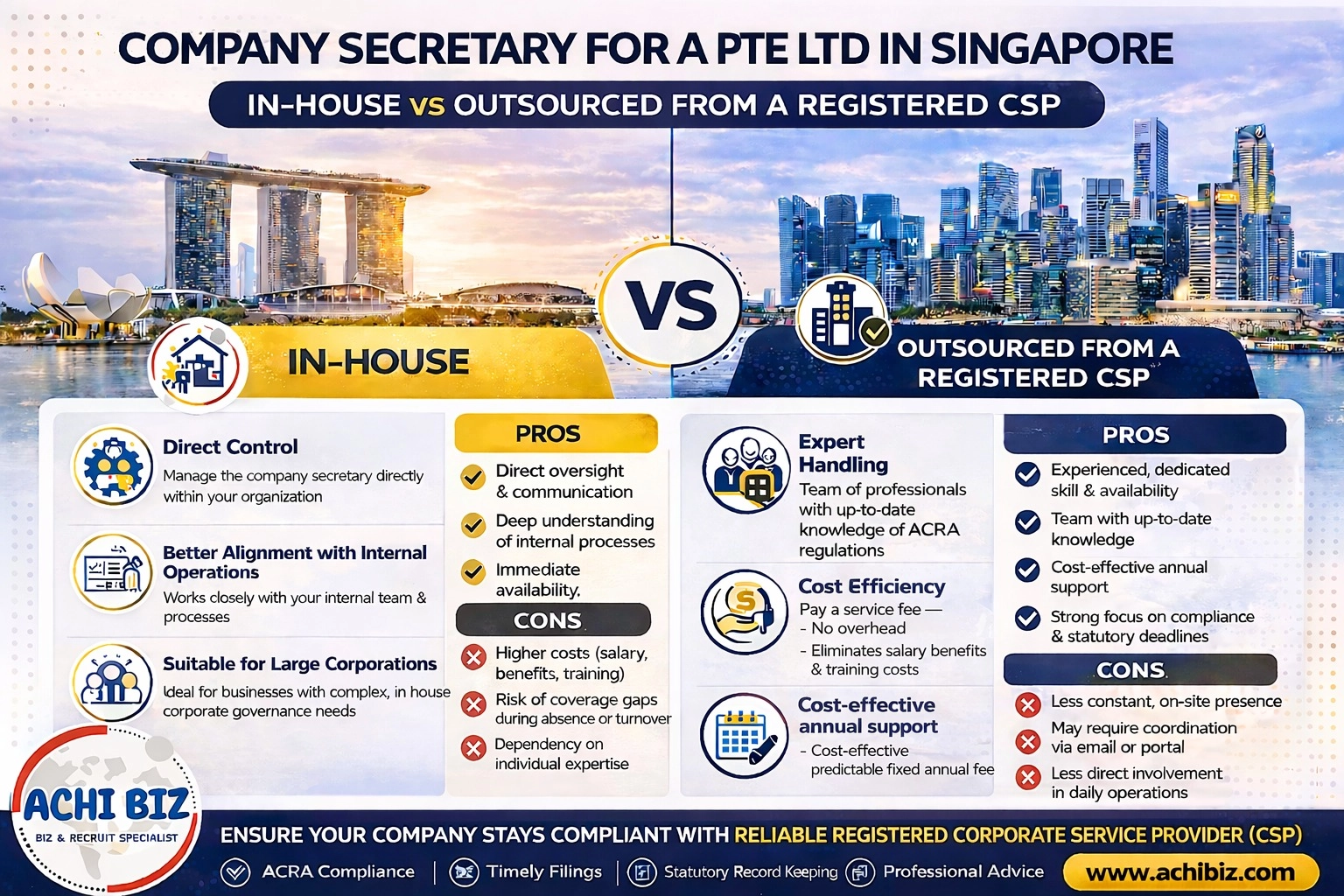
Company Secretary for a Pte Ltd in Singapore
In-House vs Outsourced CSP
If you’re running a private limited company in Singapore, appointing a company secretary isn’t optional—it’s a legal requirement. But once that box is ticked, the real question becomes: Should you hire someone in-house, or outsource the role to a registered Corporate Service Provider (CSP)?
On the surface, both options can get the job done. But when you look closer, the differences in cost, efficiency, and risk become hard to ignore.
Let’s break it down properly so you can make a clear, practical decision.
Why the Company Secretary Role Matters
In Singapore, every Pte Ltd must appoint a company secretary within 6 months of incorporation, in line with requirements set by the Accounting and Corporate Regulatory Authority (ACRA).
But this role goes far beyond just meeting a requirement.
A company secretary is responsible for:
- Maintaining statutory registers
- Filing annual returns
- Ensuring compliance with ACRA regulations
- Preparing resolutions and documentation
- Advising directors on governance matters
In short, this role keeps your company legally compliant and properly structured behind the scenes.
What Does “In-House Company Secretary” Mean?
An in-house company secretary is someone you hire as part of your internal team—either full-time or part-time.
They work directly within your company and handle corporate secretarial matters alongside other responsibilities.
What Does an Outsourced CSP Provide?
An outsourced solution involves engaging a duly registered Corporate Service Provider (CSP) with Accounting and Corporate Regulatory Authority.
Instead of relying on one individual, you get access to a team of professionals who specialise in corporate compliance and governance.
Key Differences at a Glance
1. Expertise and Experience
An in-house hire depends heavily on the individual’s experience. If they’re junior or stretched across multiple roles, gaps can happen.
A CSP, on the other hand, brings a team-based approach with up-to-date knowledge of regulations and best practices.
2.Cost Structure
In-house means salary, CPF contributions, bonuses, training, and overhead costs.
Outsourcing to a CSP typically involves a fixed annual fee—predictable and often more cost-effective, especially for SMEs.
3. Continuity and Reliability
If your in-house secretary resigns or goes on leave, your compliance responsibilities don’t pause.
With a CSP, there’s continuity. Someone is always available to handle filings and deadlines.
4. Compliance Risk
In-house setups can become risky if compliance isn’t the person’s sole focus.
A CSP operates in a regulated environment, where compliance is the core function—reducing the chances of errors and penalties.
5. Scalability
As your business grows, your compliance needs become more complex.
An in-house setup may struggle to scale without additional hiring.
A CSP can support growth without requiring you to expand your internal team.
Pros and Cons: In-House Company Secretary
Pros
Direct control and immediate access
Better alignment with internal operations
Suitable for large companies with complex internal structures
Cons
Higher overall cost (salary, benefits, overheads)
Dependency on one individual
Risk of knowledge gaps or inexperience
No backup during absence or turnover
Requires ongoing training to stay updated
Pros and Cons: Outsourced CSP
Pros
Access to experienced professionals
Cost-effective and predictable pricing
Strong compliance focus
Continuity and reliability
Scalable as your business grows
Cons
Less day-to-day physical presence
May feel less “embedded” in your internal team
The Hidden Risks Most Businesses Overlook
Many companies choose in-house thinking it gives them more control.
But here’s the reality—control doesn’t equal compliance.
Missed filings, incorrect records, or outdated practices can lead to:
- Penalties from ACRA
- Legal complications
- Operational disruptions
These risks often come from lack of expertise, not lack of effort.
So, Which Option Is Better?
It comes down to your business size and priorities.
In-house may make sense if:
- You’re a large company with complex governance needs
- You require full-time, on-site support
- You have the budget to maintain a qualified professional
Outsourcing to a CSP is usually the better choice if:
- You want cost efficiency without compromising compliance
- You prefer expert handling over internal trial and error
- You want peace of mind knowing deadlines won’t be missed
The Bottom Line
The company secretary role isn’t just administrative—it’s critical to keeping your business compliant and running smoothly.
An in-house setup can work, but it comes with higher costs and risks tied to one individual.
An outsourced Corporate Service Provider (CSP) offers expertise, consistency, and a structured approach—making it the smarter choice for most SMEs.
Need Reliable Company Secretarial Support?
If you’re looking for a dependable, cost-effective solution, ACHI BIZ, a duly registered Corporate Service Provider (CSP) with Accounting and Corporate Regulatory Authority, can handle your company secretarial needs with precision and care.
Get in touch with ACHI BIZ today and ensure your compliance is always in good hands—so you can focus on growing your business.
#achibiz