
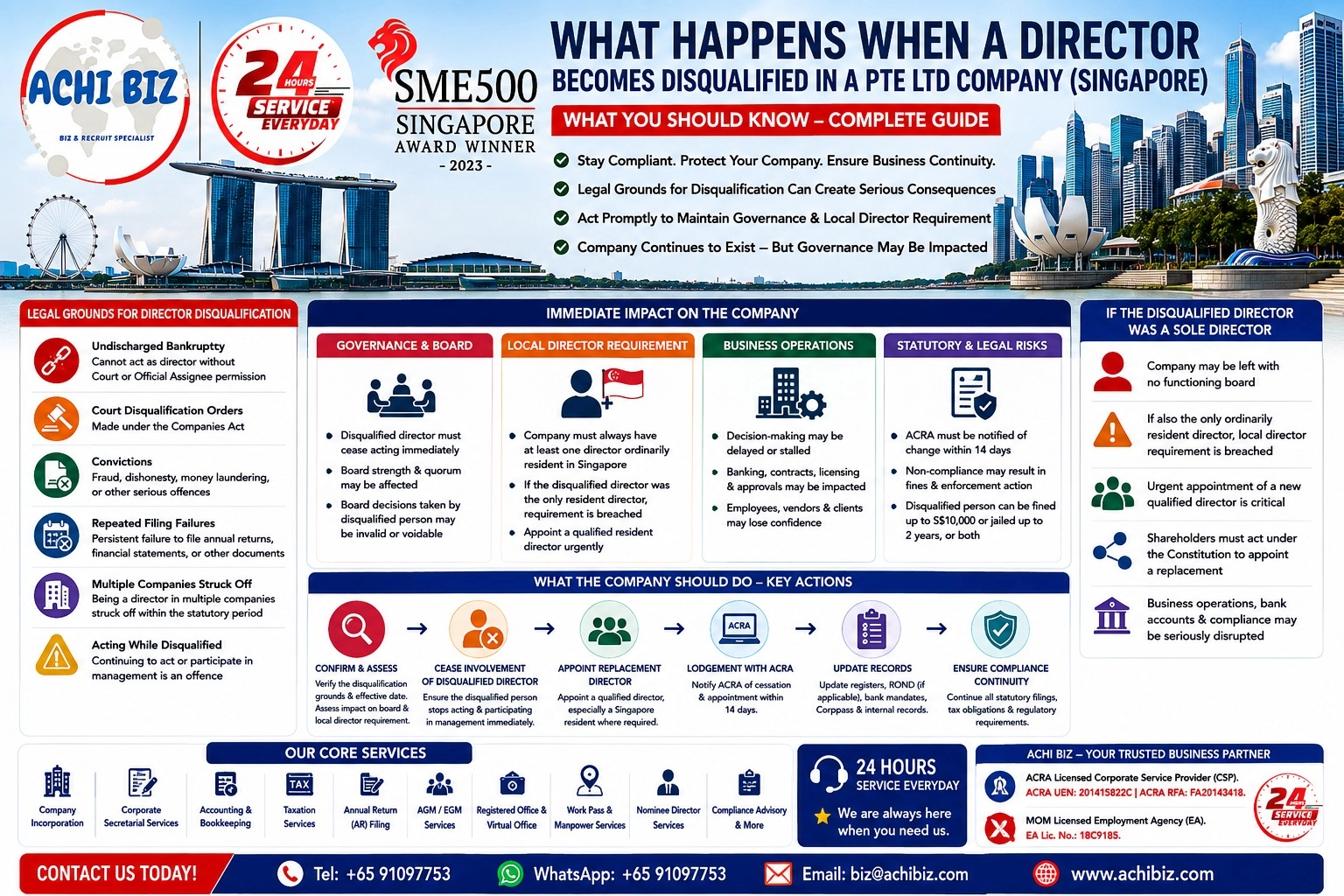
What Happens to the Company, Sole Director and Local Director Requirement?
A director becoming disqualified in a Singapore Private Limited (Pte. Ltd.) company is fundamentally different from a voluntary resignation. A resignation is generally initiated by the director. Disqualification, however, arises because the individual is legally prohibited from acting as a director or participating in company management under applicable law or a disqualification order.
This can create an immediate governance problem for the company. The situation becomes particularly serious where the disqualified person is the company’s only ordinarily resident director or sole director. Every Singapore company must maintain at least one director who is ordinarily resident in Singapore.
The company therefore needs to identify the legal basis and effective date of the disqualification, determine whether its board can continue functioning, assess whether the local director requirement remains satisfied, appoint a qualified replacement where necessary, update ACRA and protect the continuity of the company’s business and statutory compliance.
This FAQ focuses specifically on director disqualification and its consequences, rather than repeating the voluntary director-resignation process.
FAQ on Director Disqualification in Singapore
What does it mean when a director becomes disqualified in Singapore?
A disqualified director is legally restricted from acting as a director and, depending on the applicable provision, from taking part directly or indirectly in the management of a corporation during the disqualification period.
This is not merely an administrative notation on the ACRA business profile. Continuing to act despite disqualification can itself constitute an offence.
Is director disqualification the same as resignation?
No.
A resignation is a voluntary cessation of office initiated by the director. Disqualification arises through operation of law, a court order, regulatory action or another statutory ground.
The practical consequences may overlap—for example, the company may need another director—but the legal reason for cessation is entirely different.
What are some reasons a director can become disqualified?
The Companies Act contains several grounds and mechanisms for disqualification. Depending on the circumstances, these can include:
- being an undischarged bankrupt;
- certain convictions involving fraud, dishonesty, money laundering or corporate misconduct;
- disqualification orders made by the court;
- repeated statutory filing failures; and
- involvement as director in multiple companies struck off by ACRA within the applicable statutory period.
The exact duration and consequences depend on the provision under which the individual is disqualified.
Is an undischarged bankrupt automatically unable to act as a director?
An undischarged bankrupt generally cannot act as a director or directly or indirectly participate in managing a company unless the required permission has been obtained.
ACRA states that an undischarged bankrupt may act where there is permission from the Court or written permission from the Official Assignee. Acting without the required permission can attract a fine of up to S$10,000, imprisonment for up to two years, or both.
Does bankruptcy automatically mean that the company itself is bankrupt?
No.
The director and the Pte. Ltd. company are separate legal persons.
A director’s personal bankruptcy does not, by itself, mean that the company is insolvent or bankrupt. However, the resulting director disqualification can seriously affect the company’s governance, especially where the individual was the sole director, resident director, bank signatory or person responsible for daily operations.
Can ACRA disqualify directors because of repeated compliance failures?
Yes, Singapore law contains director-disqualification mechanisms connected with repeated corporate non-compliance.
For example, ACRA identifies repeated filing failures as a ground under which a person may be prevented from acting as a director or taking part in company management.
The applicable provision and circumstances should always be established rather than assuming that every late filing automatically results in disqualification.
Does one late Annual Return automatically disqualify a director?
No.
A single late filing should not be confused with automatic director disqualification.
Late filing can result in penalties and enforcement action, while repeated failures and convictions can eventually create more serious consequences, including disqualification under applicable provisions.
Can directors be disqualified because several companies under them were struck off?
Yes, subject to the statutory conditions.
Singapore’s Companies Act contains a disqualification regime concerning individuals who were directors of multiple companies that were struck off the register within the relevant period.
The regime was amended so that a first-time disqualification under section 155A may generally run for three years, while repeat disqualification remains five years.
Can a director be disqualified for fraud or dishonesty?
Yes.
ACRA identifies certain convictions involving fraud or dishonesty as grounds restricting an individual from acting as director.
The exact consequences depend on the offence and statutory provision concerned.
Can a money-laundering conviction result in director disqualification?
Yes.
From 6 May 2026, Singapore’s director-disqualification framework was strengthened to disqualify individuals convicted of specified money-laundering offences under the Corruption, Drug Trafficking and Other Serious Crimes (Confiscation of Benefits) Act 1992.
This change is also reflected in ACRA’s revised Form 45 for new director appointments.
What should a company do immediately after learning that a director is disqualified?
The company should first establish the legal basis and effective date of disqualification rather than acting on rumours or incomplete information.
It should then determine whether:
the person must immediately cease participating in management; sufficient qualified directors remain; at least one ordinarily resident director remains; the board can still form the necessary quorum; authorised signatories and operational authorities need replacement; ACRA must be updated; and urgent statutory or commercial matters are pending.
Where the legal status is unclear or disputed, legal advice should be obtained.
Can a disqualified director continue attending board meetings?
A person who is prohibited from acting as director or participating in management should not attempt to circumvent the disqualification by continuing to exercise the substance of a director’s powers without the title.
ACRA states that a disqualified person can be prohibited not only from formally acting as director but also from taking part in company management.
Can the disqualified person continue making company decisions informally?
That can be particularly dangerous.
Removing someone’s formal designation while allowing that person to continue directing the company’s affairs behind the scenes may defeat the purpose of the disqualification.
The company should establish a genuine new governance arrangement rather than merely changing names on ACRA.
What happens to the director’s office when the individual becomes legally disqualified?
The applicable Companies Act provision and the company’s Constitution need to be considered.
For example, Singapore’s Model Constitution provides for a director’s office to become vacant where the individual becomes disqualified under specified statutory provisions.
A company using a customised Constitution should review its own provisions rather than automatically assuming that every Constitution contains identical wording.
Must the company notify ACRA of the disqualification?
Changes to company officers must be properly reflected with ACRA.
ACRA states that companies must report changes to key officers within 14 days. A director who has become disqualified can also personally notify ACRA if the company fails to do so.
What happens if the company fails to update ACRA?
ACRA states that failure to report changes to key officers within the required period can expose the company and officers in default to penalties.
More importantly, leaving a disqualified person shown as the company’s active director can create inaccurate public records and practical difficulties concerning governance, banks, counterparties and future corporate filings.
Does director disqualification automatically close or dissolve the company?
No.
Disqualification concerns the individual director’s eligibility to act. It does not automatically dissolve the Pte. Ltd. company.
The company remains a separate legal entity and continues to have its contracts, assets, liabilities, employees, tax obligations and statutory responsibilities.
The real issue is whether it still has a legally functioning governance structure.
What happens if one director is disqualified but several other directors remain?
If other qualified directors remain, the company may be able to continue operating without major interruption.
However, it should still assess the board composition, Constitution, quorum, local-director requirement, signing mandates and responsibilities previously assigned to the disqualified director.
The impact therefore depends heavily on the company’s existing board structure.
What happens if the disqualified director was the company’s only ordinarily resident director?
This creates an urgent compliance issue.
Every Singapore company must have at least one director ordinarily resident in Singapore. If the disqualified person was the only director satisfying that requirement, the company needs to address the deficiency and appoint a qualified resident director as soon as legally and procedurally possible.
The company should not continue indefinitely without satisfying the statutory resident-director requirement.
What happens if the disqualified director was the sole director of the Pte. Ltd. company?
This is potentially the most serious scenario.
Once the sole director is legally unable to act, the company can effectively be left without a functioning board. There may be nobody with ordinary board authority to approve transactions, execute certain corporate decisions, oversee compliance or exercise powers reserved to directors.
The company still legally exists, but its governance machinery may be severely impaired.
The shareholders and professional advisers should therefore deal with the replacement-director issue urgently.
Does a sole shareholder who is also the sole director create additional complications?
Yes.
Singapore allows one person to be both the sole shareholder and sole director, provided the statutory requirements are met.
If that person becomes disqualified as a director, the individual’s shareholding does not automatically disappear. The person may remain the shareholder while being prohibited from acting as director.
The company then needs to use the legally available shareholder and constitutional mechanisms to establish a compliant board.
Can a disqualified sole director simply appoint his own replacement as director?
This should not be assumed.
Once disqualification has taken effect, the person may no longer have legal authority to exercise directors’ management powers. Whether a replacement can be appointed through shareholder powers or another mechanism depends on the company’s Constitution, shareholding and circumstances.
This distinction becomes particularly important where the disqualified sole director is not the sole shareholder.
Can shareholders appoint a replacement director?
Depending on the company’s Constitution and the applicable Companies Act provisions, shareholders may have mechanisms available to appoint a new director.
Where the company has no functioning board, the Constitution should be reviewed immediately to determine the correct appointment procedure.
The replacement should not merely be inserted into Bizfile without proper corporate authority.
What if the disqualified sole director is also the sole shareholder?
The individual may still retain shareholder rights unless another legal restriction affects those rights.
Accordingly, there may be a lawful route to appoint an eligible replacement director in the person’s capacity as shareholder rather than attempting to continue exercising prohibited powers as director.
Because the boundary between shareholder action and prohibited participation in management can become important in such a case, professional legal advice is advisable.
What if the sole director is disqualified and there are several shareholders who disagree about the replacement?
The company may face a genuine governance dispute.
The Constitution, shareholders’ rights and Companies Act procedures become critical. If shareholders cannot validly appoint a replacement or there is disagreement about who should take control, legal advice may be necessary.
A CSP should not attempt to resolve a substantive shareholder dispute merely by filing whichever appointment one party requests.
Can the company continue trading while it has no eligible director?
The company does not automatically cease to exist merely because its director becomes disqualified.
However, operating without the legally required board structure can create serious corporate governance and compliance problems. The company should prioritise restoring a compliant directorship rather than treating the situation as business as usual.
What happens to contracts already signed by the director before disqualification?
Disqualification does not automatically mean that every legitimate company transaction entered into before the disqualification becomes invalid.
The legal effect of a particular contract depends on when it was executed, the director’s authority at that time, the circumstances and applicable law.
Transactions entered into after the person became prohibited from acting require much greater scrutiny.
What happens to company bank accounts when a director becomes disqualified?
ACRA disqualification and bank mandates are separate systems.
A bank may still have the person’s signing authority recorded until it is informed and its mandate is changed. The company should therefore promptly review authorised signatories, online banking administrators, payment approvers and security tokens.
Leaving a legally disqualified director with practical control over company funds can create obvious governance and risk concerns.
What happens if the disqualified director was the only bank signatory?
The company may face immediate operational disruption.
Payments, payroll, supplier settlements and other transactions could be affected until the bank accepts a replacement authorised signatory.
This is one reason companies—particularly small companies with a single director—should understand the business continuity consequences of director disqualification, not merely the ACRA filing consequences.
What happens to Corppass and government transaction access?
The company should review all digital authorities associated with the disqualified director.
Where necessary, authorised roles should be transferred to eligible persons. The company should ensure that statutory filings, tax matters, employment-related transactions and government correspondence do not become inaccessible because one individual previously controlled all digital access.
Can a disqualified director still be an employee of the company?
This requires careful analysis.
Director disqualification concerns acting as director and, under relevant provisions, taking part in company management. Simply changing the person’s job title to “employee” cannot lawfully be used to circumvent a prohibition against participation in management.
Whether the individual can perform a genuinely non-management employment role depends on the applicable disqualification and actual duties. Legal advice may be appropriate.
Can a disqualified director become a consultant to the same company?
A consultancy label does not solve the problem if the individual continues to exercise management powers.
Regulators and courts can look at substance rather than title. A company should not create a consultancy arrangement merely to allow the disqualified person to continue running the business indirectly.
Does disqualification remove the person’s shares in the company?
No, not merely because of director disqualification.
Directorship and share ownership are separate legal capacities.
A disqualified director may continue to be a shareholder unless the shares are transferred or another legal event affects the person’s ownership.
Does disqualification remove the person as beneficial owner or registrable controller?
Not automatically.
If the individual continues to meet the criteria for being a registrable controller, the person’s Register of Registrable Controllers (RORC) status does not disappear simply because the directorship ends.
The company should assess director status and controller status separately.
What happens if the disqualified director is also a nominee director?
The cessation of the directorship may have consequential implications for the company’s nominee-director records.
The company should separately review its Register of Nominee Directors (ROND) and applicable Central ROND information rather than assuming that changing the ACRA officer record automatically deals with every nominee-register obligation.
Does disqualification wipe out the director’s liability for conduct before disqualification?
No.
Disqualification does not erase what happened while the individual was legally acting as director.
Breaches of statutory or fiduciary duties, false filings, misuse of company assets, dishonest conduct or other wrongdoing during the person’s tenure may still be investigated or pursued after disqualification.
Indeed, some forms of misconduct may themselves be the reason for the disqualification.
Is the company itself punished merely because one of its directors becomes disqualified?
Not automatically.
The director’s disqualification is principally a consequence affecting that individual. But the company can develop separate exposure if it fails to restore statutory compliance, allows the disqualified person to continue managing the company, fails to update required information or commits other breaches.
The company should therefore distinguish between the director’s original disqualification and the company’s subsequent compliance obligations.
Could disqualification affect the company’s reputation?
Yes.
Depending on the reason for disqualification, banks, investors, suppliers, customers, auditors and regulators may ask questions about the company’s governance.
The impact can be greater where the disqualification arose from fraud, dishonesty, money laundering, serious compliance failures or multiple struck-off companies rather than a personal bankruptcy unrelated to the company’s conduct.
Can director disqualification affect bank financing?
Potentially.
Banks conduct their own risk assessments. A change in directors—particularly involving a disqualification—may trigger KYC reviews, mandate changes, facility-condition reviews or requests for additional information.
The outcome depends on the bank, financing documents and reason for disqualification.
Can disqualification affect licences held by the company?
Potentially.
Certain regulated businesses have requirements concerning directors, controllers, managers or fit-and-proper persons.
The company should check the rules applying to its specific licence instead of assuming that an ACRA director replacement alone resolves the issue.
Can director disqualification affect work passes or foreign employees?
Not automatically, but it can have operational consequences.
If the disqualified director was responsible for employment matters, Corppass, work-pass transactions or company administration, the company needs to ensure that another properly authorised person can manage these functions.
Any sector-specific or MOM implications should be considered separately where relevant.
What happens to pending Annual Returns, financial statements and tax filings?
They remain the company’s obligations.
A director’s disqualification does not suspend statutory deadlines. The replacement board and responsible officers must ensure continuity of accounting, financial reporting, ACRA filings and IRAS compliance.
If the sole director becomes disqualified close to a filing deadline, the company should address the governance gap urgently rather than assuming that the deadline will automatically be extended.
What if the director was disqualified because of the company’s own repeated filing failures?
Then the company should address the underlying compliance failures as well as replacing the director.
Simply appointing another person without correcting overdue Annual Returns, AGM matters, financial records or other outstanding obligations does not solve the root problem.
The replacement director should understand the company’s existing compliance position before accepting appointment.
Should a replacement director investigate what happened before taking office?
A prospective replacement director should carry out reasonable due diligence, particularly where the predecessor was disqualified for compliance or misconduct reasons.
The incoming director should understand the company’s financial position, outstanding ACRA and IRAS matters, litigation, regulatory correspondence, bank facilities, statutory registers and material transactions.
A replacement director should not accept appointment merely to restore a name on the ACRA record.
Should the replacement director sign the latest ACRA Form 45?
For a new appointment, the company should use ACRA’s current Form 45 – Consent to Act as Director and Statement of Non-Disqualification to Act as Director.
ACRA amended Form 45 from 6 May 2026, including additional declarations concerning money-laundering convictions and awareness of directors’ statutory obligations.
This is particularly relevant when replacing a disqualified director: the company should ensure that the new person is genuinely eligible rather than rushing to appoint whoever is available.
Can another nominee director simply be appointed immediately to solve the resident-director problem?
A company should not treat a nominee director as an emergency name-lending arrangement.
The proposed director must be eligible, properly consent to appointment, understand directors’ duties and satisfy applicable requirements. Where nominee director services are provided by way of business, Singapore’s CSP regulatory framework must also be considered.
The objective is to restore a legally compliant board, not merely to make the Bizfile profile look compliant.
Can a disqualified person obtain permission to act as a director again?
In some circumstances, applicable legislation provides a mechanism to seek permission or leave.
For example, an undischarged bankrupt may be able to act with the required Court or Official Assignee permission. Certain disqualified directors may also have statutory avenues to seek leave from the Court or Registrar, depending on the applicable provision.
Until the required permission has actually been granted, the person should not assume that an application itself authorises continued management.
Does ACRA’s Registrar have power to grant leave in certain disqualification cases?
Yes. Amendments to Singapore’s disqualification regime introduced an avenue for the Registrar to grant leave in certain cases under section 155A, in addition to the existing court route.
The availability of this mechanism depends on the particular statutory ground for disqualification.
How long can director disqualification last?
There is no single period applicable to every case.
The duration depends on the legal basis for disqualification. Some statutory regimes specify three or five years, while court-ordered or conviction-related consequences depend on the applicable provisions.
For example, the revised section 155A regime provides a three-year period for first-time disqualification and five years for repeat disqualification.
Can a disqualified director simply start managing another company?
No, where the applicable disqualification prohibits acting as director or participating in management.
The restriction is not necessarily confined to the company where the problem originally arose. ACRA’s enforcement guidance makes clear that disqualification can prevent the individual from acting as director or managing corporations during the applicable period.
What are the risks of knowingly allowing a disqualified director to continue controlling the company?
This can undermine the purpose of the disqualification and expose the individual and potentially others to serious legal and regulatory consequences.
The company should promptly establish genuine control by eligible directors and ensure that the disqualified individual no longer exercises prohibited management powers.
This is especially important for family businesses and small Pte. Ltd. companies where one individual previously controlled almost everything.
What is the practical difference between disqualification of one director and disqualification of a sole director?
With multiple directors, the remaining eligible board members may often preserve business continuity while a replacement is considered.
With a sole director, the company may suddenly have no functioning board at all. If that individual was also the only ordinarily resident director, the company simultaneously loses its board and fails the resident-director requirement.
That is why sole-director companies face a much higher business continuity and corporate governance risk from director disqualification.
Should a small Pte. Ltd. company plan for possible director incapacity or disqualification?
Yes.
A company heavily dependent on one person can face operational paralysis if that individual suddenly becomes legally unable to act.
Good governance includes knowing who can access corporate records, who controls banking and government accounts, how shareholders can appoint another director and where essential corporate information is maintained.
This is particularly important for single-director and foreign-owned Singapore companies.
What should shareholders do when they discover that their sole director has become disqualified?
The priority should be to verify the disqualification and its effective date, prevent unauthorised continuation of management, review the Constitution and shareholder appointment powers, identify an eligible replacement director—particularly an ordinarily resident director where required—and restore a functioning board.
ACRA, banking and other consequential updates should then be handled correctly.
Where the corporate authority to appoint the replacement is uncertain, legal advice should be obtained before making filings.
What are the most serious mistakes a company can make after director disqualification?
The most dangerous mistakes are ignoring the disqualification, allowing the person to continue running the business informally, leaving the company without an ordinarily resident director, assuming the company itself has automatically ceased to exist, failing to establish a replacement board, overlooking bank and digital authorities, and appointing another unsuitable or disqualified person simply to restore the ACRA record.
Why should an ACRA Licensed Corporate Service Provider (CSP) be involved when a director becomes disqualified?
Director disqualification can trigger multiple corporate compliance issues at the same time: cessation of office, replacement-director appointment, resident-director compliance, corporate resolutions, ACRA lodgements and applicable statutory-register changes.
An ACRA Licensed Corporate Service Provider (CSP) can assist with the corporate secretarial and filing aspects while conducting the appropriate compliance checks for the new appointment.
Where the matter involves contested disqualification, interpretation of a court order, potential criminal liability, shareholder disputes or questions about whether the former director can continue participating in management, a Singapore lawyer should be consulted.
How can ACHI BIZ assist when a director of a Singapore company becomes disqualified?
ACHI BIZ SERVICES PTE. LTD. can assist companies with the corporate compliance and secretarial consequences of director disqualification, including reviewing the company’s officer structure, coordinating replacement-director documentation, preparing appropriate corporate records, lodging changes with ACRA and attending to applicable statutory-register requirements.
For companies that lose their only qualifying resident director, the situation should be addressed urgently so that the company can restore the required corporate structure and maintain business continuity.
ACHI BIZ is an ACRA Licensed Corporate Service Provider (CSP) providing company incorporation, corporate secretarial, nominee director, registered office, accounting, bookkeeping, taxation, Annual Return and other corporate services.
ACHI BIZ is also a MOM Licensed Employment Agency (EA) providing employment and work-pass related services.
ACRA UEN: 201415822C | ACRA RFA: FA20143418
MOM EA Lic. No.: 18C9185
What is the key takeaway when a director becomes disqualified?
Director disqualification is not simply another form of director resignation.
The first question is whether the individual is legally prohibited from continuing to act or participate in management. The second is whether the company still has a valid and functioning board. The third—and often most urgent—is whether the company continues to satisfy Singapore’s requirement for at least one ordinarily resident director.
For a company with several directors, disqualification of one director may be manageable with proper corporate action. For a sole-director company, however, disqualification can create an immediate governance vacuum, particularly if the person was also the company’s only resident director.
The company itself does not automatically disappear, its contracts do not automatically terminate, and the disqualified person’s shares do not automatically vanish. Instead, the company must restore a legally compliant governance structure, protect business continuity and ensure that the disqualified person does not continue exercising powers that the law prohibits.
Disclaimer: This FAQ provides general information on director disqualification and Singapore corporate compliance and does not constitute legal advice. The consequences of bankruptcy, conviction, court-ordered or statutory disqualification depend on the particular legal provision, effective date, company Constitution and individual circumstances. Legal advice should be obtained for disputed or complex cases.