
Duties of a Sole Proprietor in Singapore – FAQ Guide
A sole proprietorship is often chosen because it is one of the simplest ways for an individual to operate a business in Singapore. However, a simple business structure does not mean that the owner has only a few responsibilities.
The most important point to understand is that a sole proprietorship does not have a separate legal identity from its owner. The owner and the business are legally the same person. This makes the position fundamentally different from owning shares in a private limited company. Business profits belong to the proprietor, but business debts, contractual obligations, claims and other liabilities can also fall personally on the proprietor.
A sole proprietor may therefore have responsibilities arising from business registration, taxation, record keeping, licences, contracts, employees, CPF and MediSave, GST, consumer transactions, data protection and industry-specific regulations, depending on the nature of the business.
This FAQ focuses specifically on sole proprietorships in Singapore. General partnerships, limited partnerships (LPs) and limited liability partnerships (LLPs) should be considered separately because their legal structures and responsibilities are different.
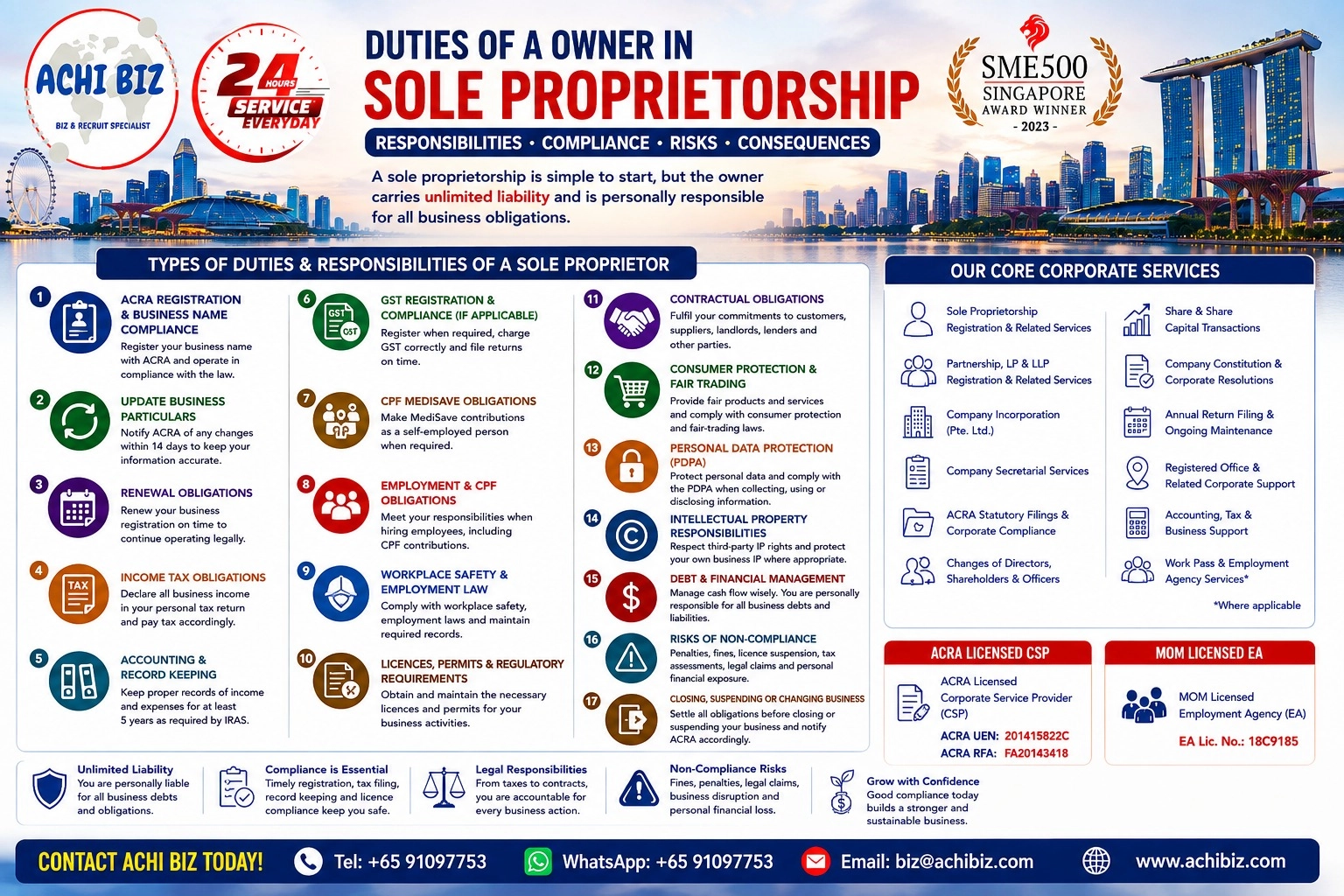
Types of Duties and Responsibilities of a Sole Proprietor in Singapore
Broadly, a sole proprietor may need to deal with the following:
- ACRA registration and business-name compliance
- Duty to keep registered business particulars updated
- Business registration renewal obligations
- Income tax obligations
- Accounting and record-keeping responsibilities
- GST registration and compliance, where applicable
- CPF MediSave obligations as a self-employed person
- Employment and CPF obligations when hiring employees
- Workplace safety and employment-law responsibilities, where applicable
- Business licensing and permit requirements
- Contractual obligations to customers, suppliers, landlords and other parties
- Consumer protection and fair-trading responsibilities
- Personal data protection obligations, where applicable
- Intellectual property and third-party rights considerations
- Industry-specific regulatory responsibilities
- Debt and financial-management responsibilities
- Obligations when changing, suspending or closing the business
The exact responsibilities depend heavily on what the sole proprietorship actually does.
What is a sole proprietorship in Singapore?
A sole proprietorship is a business owned by one person. Unlike a Singapore Pte. Ltd. company, it does not create a separate legal entity distinct from its owner.
This distinction affects almost every aspect of the proprietor’s position. The owner receives the profits of the business and controls its operations, but also bears its liabilities personally.
For this reason, understanding the duties of a sole proprietor is not simply a matter of ACRA compliance. It is also an important part of protecting the owner’s personal financial position.
Is the owner of a sole proprietorship legally separate from the business?
No. A sole proprietorship and its proprietor are legally the same person.
This means the structure does not provide the limited-liability protection normally associated with a private limited company. Business obligations can therefore become personal obligations of the proprietor.
This is one of the most important risks to understand before choosing a sole proprietorship.
Are the duties of a sole proprietor the same as the duties of a company director?
No.
A company director holds office in a company that has its own separate legal personality. A sole proprietor, by contrast, owns and operates a business that is not legally separate from the proprietor.
Accordingly, it is not accurate simply to apply a director’s duties to a sole proprietor. The proprietor’s responsibilities arise from the laws and regulatory requirements applicable to the individual and the business activity being conducted.
Is a sole proprietor personally responsible for business debts?
Generally, yes.
Because there is no legal separation between the proprietor and the sole proprietorship, the proprietor has unlimited liability for the debts and obligations of the business.
If business assets are insufficient to meet legitimate liabilities, the proprietor’s personal assets may potentially be exposed, subject to applicable laws governing the particular assets and enforcement process.
Can a sole proprietor lose personal assets because of business liabilities?
Potentially, yes. This is the principal structural risk of a sole proprietorship.
A substantial unpaid supplier account, contractual claim, loan, regulatory liability or other business obligation does not necessarily remain confined to assets held under the business name.
This is why the level of commercial and liability risk should be considered when deciding whether a sole proprietorship remains an appropriate business structure.
Does registering a business name with ACRA give the proprietor limited liability?
No.
Registering a sole proprietorship with ACRA gives the business its registered status and business name, but it does not turn it into a separate legal entity or provide limited liability.
Business registration and legal separation are two different concepts.
What are the main ACRA compliance duties of a sole proprietor?
A registered sole proprietor should ensure that the business remains properly registered, its particulars remain accurate, changes are notified within the prescribed period, and its registration is renewed when required.
ACRA currently requires relevant changes to business or position-holder particulars to be notified within 14 days.
What changes must a sole proprietor report to ACRA?
Relevant changes can include matters such as the registered business address, business activities and particulars relating to the owner or authorised representative.
The key principle is straightforward: information maintained on ACRA’s register should remain current and accurate.
ACRA states that owners and authorised representatives must report applicable changes within 14 days.
Must a sole proprietorship renew its ACRA registration?
Yes, if the owner intends to continue operating the registered business.
ACRA states that the registration must be renewed before expiry to continue running the business. Renewal can presently be made up to 60 days before the expiry date.
What happens if a sole proprietor continues business after the registration expires?
This should not be treated as a harmless administrative delay.
ACRA expressly states that it is an offence to run the business after its registration has expired. Late renewal may also result in penalties, and the registration may ultimately be cancelled if it remains unrenewed.
Can a sole proprietor simply trade under any business name?
No.
Where registration is required, the proprietor must operate consistently with the registered business particulars. ACRA identifies operating without proper registration, operating under a different business name and continuing under a name after registration has been cancelled or ceased as offences under the Business Names Registration Act framework.
Is providing inaccurate information to ACRA an offence?
It can be.
ACRA identifies the provision of false or misleading information in documents or statements submitted to ACRA as an offence. This can include knowingly supplying untrue information or omitting material information so that a submission becomes misleading.
What tax duties does a sole proprietor have in Singapore?
A sole proprietorship is not taxed as a separate company.
Business income is generally taxable in the sole proprietor’s own name. The business income is combined with the proprietor’s other personal income and is subject to the applicable individual income tax rules.
This is another major distinction between a sole proprietorship and a Pte. Ltd. company.
Does a sole proprietor pay corporate income tax?
Not merely because the person operates a sole proprietorship.
IRAS treats income earned through the sole proprietorship as the proprietor’s business income rather than as income of a separate company.
Must every sole proprietor file an income tax return?
The proprietor must follow the prevailing IRAS filing requirements applicable to self-employed persons.
Whether a return needs to be submitted in a particular year depends on the applicable filing rules and circumstances. Business owners should therefore check the current IRAS requirements rather than assume that having little or no profit automatically removes all filing responsibilities.
Must a sole proprietor declare all business income?
Yes. Business income must be properly accounted for and reported according to the applicable tax rules.
This includes maintaining sufficient records to support both the income declared and deductible business expenses claimed.
Under-reporting income or claiming unsupported expenses can lead to additional assessments and penalties.
Does a sole proprietor need to keep accounting records?
Yes.
IRAS requires self-employed persons, including sole proprietors, to keep proper records and accounts of their business transactions. Records should be supported by relevant invoices, receipts, vouchers and other documentation.
How long must a sole proprietor keep business records?
IRAS currently requires accounting records and supporting documents to be retained for five years.
Proper records are important not merely for bookkeeping. They allow the proprietor to substantiate reported income, expenses and tax positions if IRAS reviews the business.
What happens if proper accounting records are not maintained?
The consequences can be significant.
IRAS states that inadequate record keeping may result in expenses being disallowed, additional income being assessed based on IRAS’s best estimate and/or penalties being imposed.
In practical terms, poor records also make it much harder for an owner to know whether the business is actually profitable.
Does a sole proprietor need to prepare accounts?
A self-employed person is expected to maintain proper accounts. IRAS’s current guidance states that a statement of accounts comprises a Profit and Loss Account and Balance Sheet.
The tax reporting format required will depend on the applicable IRAS rules and the circumstances of the business.
Can personal and business money be mixed together?
The absence of a separate legal entity does not make poor financial controls advisable.
Keeping business transactions identifiable and properly documented makes accounting, tax reporting, cash-flow management and evidence of business expenditure considerably easier.
Using proper financial records also reduces the risk of personal expenditure being incorrectly treated as deductible business expenditure.
Is a separate business bank account compulsory for a sole proprietorship?
The legal position should be distinguished from good business practice.
Even where a separate account is not itself the legal feature that creates separation—because the sole proprietorship is not a separate legal person—maintaining a dedicated business account can substantially improve transaction tracking, bookkeeping and financial control.
Is a sole proprietor required to contribute to CPF MediSave?
A sole proprietor is generally regarded as a self-employed person for these purposes and must comply with applicable MediSave requirements.
ACRA also states that arrangements concerning outstanding MediSave contributions are relevant to renewal of sole proprietorship registrations.
Can outstanding MediSave affect renewal of the sole proprietorship?
Yes.
Under ACRA’s current renewal requirements, the owner must have made arrangements with CPF Board to make the applicable MediSave contributions in full or through the permitted instalment arrangement.
This demonstrates why the proprietor’s personal statutory obligations and the operation of the business can sometimes intersect.
When must a sole proprietorship register for GST?
GST registration depends on the prevailing statutory registration rules and the business’s circumstances.
The owner should monitor taxable turnover and other applicable GST-registration tests instead of waiting until year-end to consider the issue.
Where GST registration becomes compulsory, failure to register when required can create backdated tax liabilities and other consequences.
What duties arise after a sole proprietorship becomes GST-registered?
A GST-registered business takes on additional responsibilities, including proper GST accounting, filing GST returns, paying GST due, maintaining prescribed records and complying with applicable invoicing and price-display requirements.
IRAS also requires GST-registered businesses to retain business and accounting records for at least five years, including after cessation or GST deregistration.
Can a sole proprietor charge GST without being GST-registered?
A proprietor should not simply add “GST” to customer invoices because the business wants to recover additional costs.
GST collection must follow Singapore’s GST legislation and registration framework. Whether the business is registered and entitled or required to account for GST must therefore be established first.
What responsibilities arise when a sole proprietor hires employees?
Once employees are hired, the proprietor becomes an employer and additional legal responsibilities arise.
Depending on the circumstances, these can include employment terms, salary payment, statutory leave, CPF contributions for eligible employees, workplace safety, employment records, foreign manpower requirements and other obligations under Singapore employment legislation.
The fact that the business is a sole proprietorship does not exempt an employer from employment laws that apply to it.
Is the sole proprietor personally responsible for employment-law breaches?
Potentially, yes.
Because the sole proprietorship has no separate legal identity, employment-related obligations should be taken particularly seriously. Depending on the particular legislation and breach, regulatory action, financial liability or other consequences may arise.
Can a sole proprietorship employ foreign workers?
Potentially, where the business and proposed employment meet the prevailing requirements.
Hiring foreign manpower is regulated separately from registering the sole proprietorship. The business must satisfy the relevant MOM eligibility, quota, levy, work pass and sector-specific requirements applicable to the proposed worker.
ACRA registration alone does not give a business an automatic right to employ foreign workers.
Must a sole proprietor comply with workplace safety requirements?
Where the relevant workplace safety legislation applies to the business and its activities, yes.
The owner should assess workplace hazards, employee safety and industry-specific requirements rather than assume that safety rules apply only to larger companies.
Does a sole proprietorship need business licences?
Possibly.
ACRA registration does not automatically grant every regulatory approval needed to carry out the proposed activity.
Certain industries, occupations and activities require separate licences, permits, registrations or approvals from the relevant government authority. The proprietor should establish these requirements before commencing the regulated activity.
Who is responsible for ensuring that licences remain valid?
Ultimately, the proprietor must ensure that the business operates lawfully.
Obtaining a licence at the start is not enough where renewal, continuing conditions, personnel qualifications, reporting or operational requirements apply.
Is a sole proprietor personally bound by business contracts?
Generally, yes.
Since the business is not a separate legal person, contracts entered into in connection with the sole proprietorship can create obligations for the proprietor personally.
This makes careful review of leases, loans, supply agreements, service contracts and other significant commitments particularly important.
What happens if the sole proprietorship breaches a customer or supplier contract?
The counterparty may have contractual remedies depending on the agreement and applicable law.
Because there is no corporate liability shield between the sole proprietorship and its owner, a valid claim against the business may ultimately expose the proprietor personally.
Is the owner responsible for debts even if the business has stopped operating?
Stopping operations does not automatically extinguish existing liabilities.
Outstanding contractual obligations, debts, taxes, employee matters and other liabilities should therefore be properly dealt with when closing a sole proprietorship.
What duties does a sole proprietor have towards customers?
The precise obligations depend on the goods or services supplied, the contractual terms and applicable legislation.
At a practical level, proprietors should ensure that representations, pricing, contractual promises, refunds, warranties and delivery of goods or services comply with the laws applicable to their transactions.
Does the PDPA apply to a sole proprietorship?
Depending on the circumstances, Singapore’s personal data protection requirements may apply where the business collects, uses, discloses or otherwise handles personal data.
Small size is not, by itself, a reason to ignore data-protection obligations.
Businesses handling customer, employee, marketing or other personal information should establish what obligations apply to their activities.
Is cybersecurity also a responsibility of the sole proprietor?
It can be an important operational and compliance issue, particularly where the business stores customer information, payment data, employee information or confidential commercial records electronically.
A cyber incident can create financial, contractual, reputational and potentially regulatory consequences.
What responsibility does a proprietor have for intellectual property?
The proprietor should ensure that the business has appropriate rights to use its name, branding, software, photographs, written materials, designs and other intellectual property.
Similarly, the proprietor should consider protecting valuable intellectual property developed for the business where appropriate.
Can the owner be personally sued for something done through the sole proprietorship?
Potentially, yes.
A business name does not create a separate person standing between the proprietor and a claimant. This personal exposure is one of the fundamental differences between a sole proprietorship and a company.
Does business insurance remove the owner’s unlimited liability?
No.
Appropriate insurance may help manage particular insured risks, but it does not change the legal structure of the business or transform unlimited liability into limited liability.
Policy exclusions, limits, deductibles and uninsured events can still leave the proprietor exposed.
What is the financial risk of borrowing money as a sole proprietor?
Borrowing should be assessed carefully because the proprietor ultimately bears the business’s financial obligations.
The owner should consider repayment capacity, interest costs, security, guarantees and the consequences of business cash flow deteriorating before taking on substantial debt.
Can a sole proprietor become bankrupt because of business debts?
Potentially, yes.
Since business liabilities can be personal liabilities, serious unpaid debts can have consequences for the proprietor personally, including insolvency consequences where the applicable legal requirements are met.
Can an undischarged bankrupt run a sole proprietorship?
Restrictions apply.
ACRA states that an undischarged bankrupt cannot manage or run a business without written permission from the Official Assignee or leave of the High Court.
Does the proprietor have compliance duties even when the business has no revenue?
Potentially, yes.
A dormant or temporarily inactive business may still have registration, tax, record-keeping or other outstanding matters.
“No sales” and “no responsibilities” are not the same thing.
What should a sole proprietor review every year?
A useful annual compliance review should consider whether:
- ACRA registration remains valid and business particulars are current;
- tax records and accounts are complete;
- income has been correctly reported;
- MediSave matters are in order;
- GST status has been reviewed;
- licences and permits remain valid;
- employment obligations are being met;
- contracts and insurance remain appropriate; and
- the sole proprietorship is still the right legal structure for the size and risk of the business.
When should an owner consider converting from a sole proprietorship to a Pte. Ltd. company?
There is no single turnover or profit figure that automatically determines when conversion is necessary.
However, reconsideration may be sensible where the business is expanding, employing more people, entering substantial contracts, borrowing significantly, bringing in investors, accumulating valuable assets or facing greater liability exposure.
The decision should consider legal risk, tax treatment, compliance cost, ownership plans and long-term business objectives—not simply whether a company appears more professional.
Does successful business growth increase the risks of remaining a sole proprietor?
It can.
As transaction values, employees, assets, customers and contractual commitments increase, the potential financial consequences of a claim or business failure may also increase.
The simplicity that makes a sole proprietorship attractive at the beginning should therefore be weighed against the owner’s continuing personal exposure.
What are the consequences of non-compliance by a sole proprietor?
There is no single penalty covering every breach because the proprietor’s obligations arise under different laws.
Depending on the non-compliance, consequences can include late filing or renewal penalties, cancellation of business registration, tax assessments, disallowance of expenses, tax penalties, fines, regulatory enforcement, licence consequences, contractual claims, employee claims and personal financial exposure. ACRA also identifies offences such as operating without proper registration and providing false or misleading information.
Can paying a fine settle every compliance problem?
Not necessarily.
A penalty does not automatically correct the underlying default. The proprietor may still have to lodge outstanding information, pay tax, settle liabilities, rectify regulatory breaches or take whatever corrective action the relevant authority requires.
Who is ultimately responsible for compliance in a sole proprietorship?
The owner.
Accountants, bookkeepers, tax agents, corporate service providers and other professionals can assist with different areas, but engaging a professional does not turn the sole proprietorship into a separate legal person or transfer ultimate ownership responsibility away from the proprietor.
What must the owner do before closing a sole proprietorship?
Closing the registration should normally come after the business affairs have been properly addressed, not as a substitute for doing so.
ACRA’s current guidance says relevant administrative matters should be settled before closure, including matters such as ongoing contractual obligations, outstanding loans or grants and GST cancellation where applicable.
Does closing the sole proprietorship erase outstanding debts or obligations?
No.
Cessation of the registered business does not mean legitimate obligations incurred while operating simply disappear.
The owner should therefore resolve outstanding creditors, taxes, contracts, employee matters and other liabilities as applicable.
What happens after a sole proprietorship is closed with ACRA?
For an immediate cessation, ACRA states that the registration status changes to “Ceased registration” immediately. A future-dated cessation remains “To be ceased” until the selected cessation date.
Records and outstanding tax or other legal obligations may nevertheless continue beyond cessation.
Why is compliance particularly important for a sole proprietor?
Because the owner does not have a separate corporate entity standing between the business and personal liability.
For a sole proprietor, poor business compliance can become a personal problem very quickly. Good record keeping, timely filings, responsible financial management, proper licensing and awareness of regulatory obligations are therefore not merely administrative housekeeping—they are part of managing personal financial risk.
What is the biggest misconception about owning a sole proprietorship in Singapore?
Probably that “simple to set up” means “simple to be responsible for.”
The structure is administratively straightforward compared with a company, but the owner personally carries the business. That simplicity comes with unlimited liability and direct responsibility for applicable tax, regulatory, contractual and operational obligations.
What is the key takeaway for a sole proprietor in Singapore?
Treat the business as seriously as you would a larger legal structure even though its administration may be simpler.
Know which regulations apply to the activity, keep accurate accounts, report changes promptly, maintain registration and licences, meet tax and employment obligations, monitor business liabilities and regularly assess whether the sole proprietorship remains appropriate as the business grows.
A well-managed sole proprietorship can be an efficient structure. An inadequately managed one can expose its owner directly to avoidable financial and regulatory risks.
How Can ACHI BIZ Assist with Sole Proprietorship and Other Corporate Services in Singapore?
ACHI BIZ provides business registration, corporate secretarial and related corporate services for individuals, entrepreneurs and businesses in Singapore.
For those planning to start a business as a sole proprietor, ACHI BIZ can assist with the registration process and applicable ACRA-related business matters. We can also support existing sole proprietors with relevant changes to registered business particulars, renewal, cessation and other applicable administrative requirements.
Beyond sole proprietorship services, ACHI BIZ provides a broad range of corporate services, including:
- Sole Proprietorship Registration & Related Services
- Partnership, LP & LLP Registration & Related Services
- Singapore Pte. Ltd. Company Incorporation
- Company Secretarial Services
- ACRA Statutory Filings & Corporate Compliance
- Changes of Directors, Shareholders & Company Officers
- Share & Share Capital Transactions
- Company Constitution & Corporate Resolutions
- Annual Return Filing & Ongoing Corporate Maintenance
- Registered Office & Related Corporate Support
- Accounting, Tax & Related Business Support
- Work Pass & Employment Agency Services, where applicable
As an ACRA Licensed Corporate Service Provider (CSP), ACHI BIZ assists businesses with their corporate and regulatory administration while helping business owners understand the compliance requirements relevant to their chosen business structure.
For entrepreneurs who are uncertain whether to operate as a sole proprietorship, partnership, Limited Liability Partnership (LLP) or Pte. Ltd. company, understanding the differences in ownership, liability, compliance and ongoing administration before registration can help them choose a structure that better suits their business plans.
Disclaimer
This FAQ is provided for general information and service related purposes only. Requirements applicable to a sole proprietor may vary according to the nature of the business, industry, licences, tax status, employees and individual circumstances. Laws, regulations and administrative requirements may also change from time to time. The information should not be treated as legal, tax, accounting or other professional advice. Business owners should check the prevailing requirements with the relevant Singapore authorities and obtain professional advice where necessary.
Related Pages:
Sole Proprietorship in Singapore for First-Time Owners
DP Holder: Sole Proprietorship vs Pte Ltd in Singapore
#achibiz