
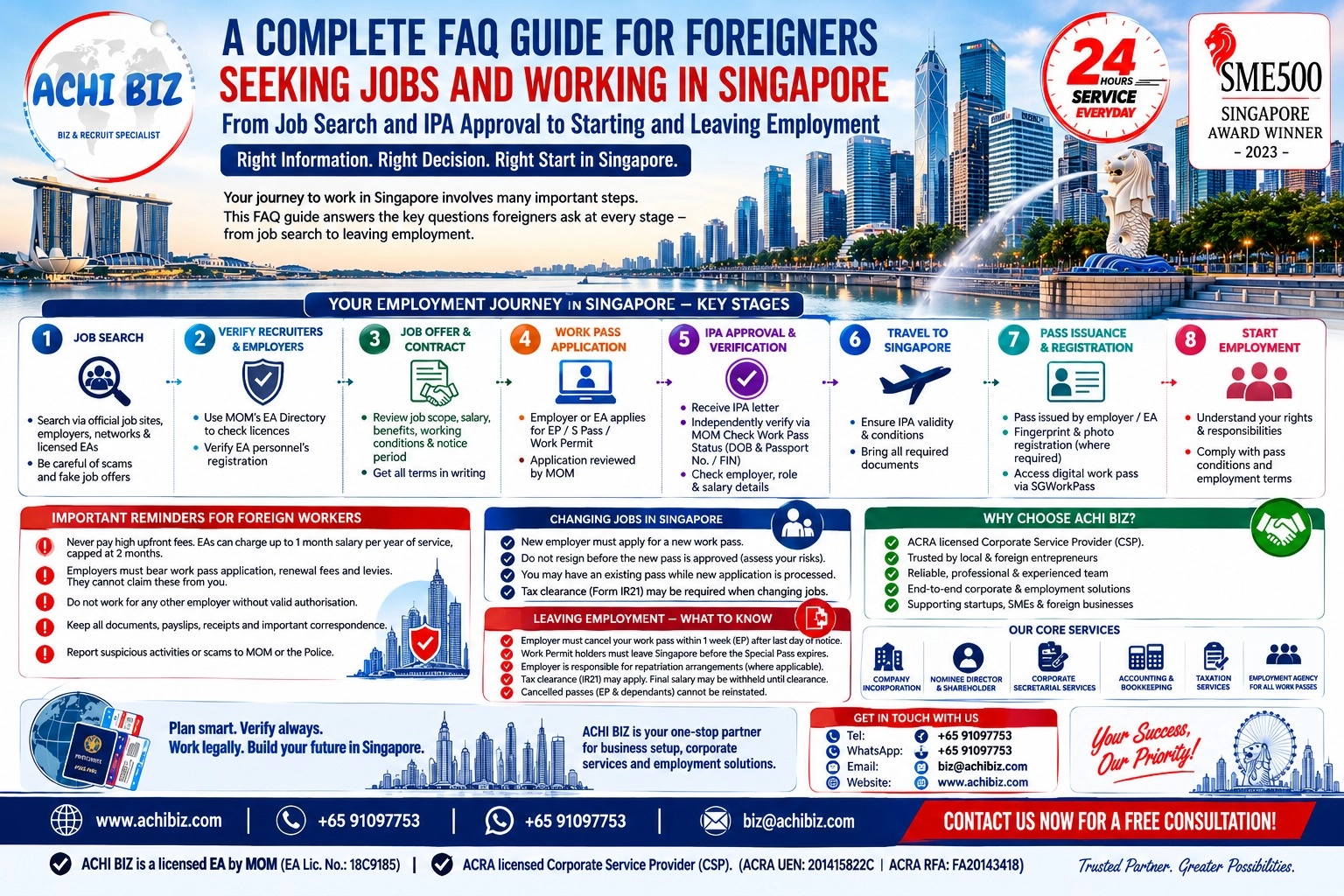
A Complete FAQ Guide for Foreigners Seeking Jobs and Working in Singapore: From Job Search and IPA Approval to Starting and Leaving Employment
For foreigners planning to find a job and work in Singapore, the process involves much more than simply securing an employment offer. Foreign jobseekers need to understand Singapore’s recruitment practices, Employment Agency regulations, work pass requirements, In-Principle Approval (IPA), employment conditions, salary arrangements, immigration procedures and what happens when employment eventually ends.
Whether you are applying for an Employment Pass (EP), S Pass, Work Permit or another eligible work pass, it is important to understand the process before resigning from your existing job, paying recruitment fees, travelling to Singapore or starting employment.
One of the most important points is simple: a foreigner generally needs the appropriate work authorisation to work legally in Singapore. A job offer by itself does not give a foreign candidate permission to commence employment.
Candidates should also independently verify their work pass application through the Ministry of Manpower (MOM), especially before paying substantial costs, resigning from an existing job overseas or travelling to Singapore.
This detailed FAQ follows the typical employment journey:
Searching for a job → verifying recruiters → receiving an offer → work pass application → IPA verification → travelling to Singapore → pass issuance → starting employment → understanding workplace rights and responsibilities → changing jobs → resignation or termination → tax clearance → work pass cancellation → departure from Singapore.
Frequently Asked Questions for Foreigners Looking for Jobs in Singapore
Can foreigners apply for jobs in Singapore from overseas?
Yes.
Foreign candidates can search and apply for Singapore jobs while residing overseas. Many employers recruit internationally where they require suitable skills, qualifications or experience.
However, obtaining a job offer does not automatically mean that the foreigner can work in Singapore. The appropriate work pass must be applied for and approved where required.
Where can foreigners search for jobs in Singapore?
Foreign candidates can explore opportunities through:
- Employers’ official career websites;
- Established online job portals;
- Professional networking platforms;
- MOM-licensed Employment Agencies;
- Industry-specific recruitment firms;
- Professional associations;
- Career fairs;
- Personal and professional networks; and
- Direct applications to Singapore employers.
Candidates should be particularly cautious when jobs are advertised solely through informal WhatsApp, Telegram, Facebook or other social-media channels without a clearly identifiable employer or licensed recruitment agency.
Can a foreigner come to Singapore first and then search for a job?
A foreign visitor may attend appropriate meetings or interviews subject to immigration rules, but being permitted to enter Singapore as a visitor does not itself authorise employment.
A person should never assume that entering Singapore on a visit pass allows them to start working while waiting for a work pass.
Can a foreigner start working immediately after receiving a job offer?
No.
A signed employment contract or offer letter is not itself a work pass.
The employer must obtain the appropriate work authorisation before the foreigner begins employment where a work pass is required.
What types of Singapore work passes should foreign jobseekers know about?
The appropriate pass depends on the nature of the employment, salary, qualifications, occupation, sector and other eligibility requirements.
Common categories include:
Employment Pass (EP) – generally for foreign professionals, managers and executives meeting the applicable requirements.
S Pass – generally for skilled foreign employees who meet applicable salary and eligibility requirements, with employers also subject to quota and levy requirements.
Work Permit – applies to specified categories of migrant workers and sectors, subject to source-country or region, quota, levy and other requirements.
There are also specialised passes and work arrangements for particular circumstances.
Can a foreign candidate choose whether to apply for an Employment Pass or S Pass?
Not simply by preference.
The candidate and employment must satisfy the eligibility criteria for the relevant pass.
The employer should assess the appropriate work pass based on the actual job, salary, candidate profile and applicable MOM requirements.
Who applies for an Employment Pass or S Pass?
Generally, the Singapore employer or its appointed Employment Agency submits the application.
Foreign candidates should therefore be cautious of anyone claiming that the candidate can simply “buy” an EP, S Pass or Work Permit independently.
Does paying an agent guarantee a Singapore work pass?
No.
No Employment Agency, consultant or intermediary can legitimately guarantee MOM approval.
MOM decides whether a work pass application is approved based on the applicable requirements and information submitted.
Promises such as “100% guaranteed Singapore Work Permit”, “confirmed EP approval” or “pay first and IPA guaranteed” should be treated cautiously.
FAQs About Employment Agencies and Recruitment Scams
Should foreigners use only MOM-licensed Employment Agencies in Singapore?
Yes, where they are engaging an Employment Agency in Singapore.
Foreign jobseekers should work only with MOM-licensed Employment Agencies and registered EA personnel.
How can a foreign jobseeker check whether a Singapore Employment Agency is genuine?
Use MOM’s official Employment Agencies and Personnel Search directory.
Do not rely solely on an EA licence certificate, screenshot, business card, website or WhatsApp profile supplied by the recruiter.
The candidate should independently verify the Employment Agency through MOM.
Should the individual recruitment consultant also be verified?
Yes.
Checking only the Employment Agency company is not enough. Candidates should also verify whether the person handling the recruitment is properly registered as EA personnel where required.
This helps reduce the risk of dealing with someone falsely claiming to represent a genuine licensed Employment Agency.
Does an ACRA-registered company automatically have an Employment Agency licence?
No.
ACRA business registration and MOM Employment Agency licensing are different things.
A company can legally exist in Singapore without being licensed to perform regulated Employment Agency activities.
Can a candidate be charged an agency fee before securing employment?
Candidates should be particularly cautious about demands for upfront placement fees.
Singapore Employment Agencies are subject to MOM rules governing when agency fees may be collected and the maximum amount that may be charged.
How much can a Singapore Employment Agency charge a foreign worker?
Singapore Employment Agencies are subject to statutory limits on agency fees charged to workers.
Candidates should verify the latest MOM requirements and ensure that any fee charged is lawful and properly documented.
Can an EA charge a worker for renewing a Singapore work pass?
Work pass application and renewal administrative costs are generally the responsibility of the employer and should not simply be passed on to foreign employees contrary to MOM requirements.
What are common warning signs of a Singapore job scam?
Be cautious where someone:
- Refuses to disclose the actual employer;
- Cannot be verified as licensed EA personnel;
- Demands suspicious or excessive upfront payments;
- Guarantees MOM approval;
- Requests payment into unrelated personal accounts;
- Offers an unusually high salary for an ordinary job;
- Sends an IPA but discourages independent MOM verification;
- Asks you to provide false qualifications or experience;
- Says your salary will be different from what is declared to MOM;
- Refuses to provide written employment terms;
- Pressures you to travel immediately; or
- Claims you can start working on a tourist or visit pass.
Several warning signs together justify serious caution.
FAQs Before Accepting a Singapore Job Offer
What should a foreign candidate check before accepting a Singapore employment offer?
Do not look only at the headline salary.
Review the job title, actual duties, basic salary, fixed allowances, deductions, working hours, working days, rest days, overtime arrangements where applicable, probation, annual leave, medical benefits, notice period, termination provisions, accommodation where applicable and any legitimate agency fees.
Why is the basic salary different from the gross salary?
A compensation package may contain different components.
Candidates should understand exactly what is guaranteed as basic salary, what constitutes fixed allowances and what depends on overtime, commissions, incentives or other conditions.
Never assume that an advertised “up to S$X per month” figure is guaranteed monthly pay.
Should candidates obtain their employment terms in writing?
Yes.
Written terms reduce misunderstandings about what was actually promised.
Candidates should carefully review their employment contract, offer letter and applicable Key Employment Terms before accepting the job.
Should candidates check the employer before accepting the job?
Yes.
Candidates should independently research whether the employer genuinely exists and whether the offer actually came from that company.
Be cautious where a recruiter refuses to allow direct verification or where the employer’s name changes during the recruitment process.
Should a foreigner resign from their current overseas job immediately after receiving a Singapore offer letter?
That can be risky.
A job offer does not guarantee work pass approval.
Where possible, candidates should understand the work pass position and contractual implications before making irreversible decisions.
FAQs About Work Pass Applications and IPA Letters
What is an In-Principle Approval or IPA letter in Singapore?
An In-Principle Approval (IPA) is issued following approval of the relevant work pass application.
It is an important document in the process leading to the foreign employee’s entry, pass issuance and commencement of employment, depending on the pass type and circumstances.
Is an IPA the same as the final work pass?
No.
The IPA represents approval in principle. Further steps may still be required before the pass is issued and the candidate is fully ready to commence employment.
These may include entry requirements, medical examination where applicable, pass issuance, document verification, registration of fingerprints and photograph, or other pass-specific requirements.
Can an IPA letter be fake?
A PDF, screenshot or printed document can potentially be altered or fabricated.
That is why a candidate should independently verify the work pass application through MOM, rather than treating the document itself as conclusive proof.
How can foreigners verify whether their Singapore IPA is genuine?
Candidates should use MOM’s official Check Work Pass and Application Status service.
A new applicant can generally check the application using the required personal particulars, such as date of birth and passport number.
Candidates should perform this verification themselves instead of relying only on a screenshot supplied by an employer, recruiter or overseas agent.
Can a candidate check a work pass application without having the IPA?
MOM provides an online service through which applicants can check their work pass application status using the required identification particulars.
This is particularly useful for detecting fake recruitment claims.
What details should a candidate compare against the job offered?
Pay particular attention to:
Employer → occupation → salary → application/pass status.
Any significant discrepancy should be clarified before travelling to Singapore.
What if the salary on MOM’s system differs from what the recruiter promised?
Do not ignore it.
Contact the employer or licensed EA and obtain clarification before coming to Singapore.
A candidate should not travel assuming that an unexplained salary discrepancy can simply be resolved after arrival.
What if the occupation stated in the IPA is different?
Clarify it before travelling.
The job information submitted for the work pass should properly reflect the employment arrangement.
Material discrepancies between the promised job and the approved occupation should not simply be ignored.
What if the employer shown by MOM is not the company that interviewed me?
Treat this as a significant discrepancy.
Do not accept explanations casually. Establish why the employer is different and confirm the genuine employment arrangement before travelling or paying further money.
Can a candidate save proof of the MOM verification?
Yes.
Keeping a copy or screenshot of the verified application information can be useful, particularly before travelling.
FAQs Before Travelling to Singapore on an IPA
Is an IPA automatically permission to enter Singapore?
The entry arrangements depend on the relevant pass and the conditions stated in the IPA.
Candidates should read the entire IPA carefully and comply with the applicable immigration, travel and pass requirements rather than relying on a recruiter’s verbal explanation.
Should I buy a flight ticket immediately after receiving an IPA?
First confirm that the IPA is genuine, check its validity and conditions, ensure the employment details are correct and coordinate the intended arrival with the employer or licensed EA.
What documents should a foreign employee keep before travelling?
Keep accessible copies of relevant documents such as:
- Passport;
- IPA;
- Employment contract or offer letter;
- Employer contact details;
- EA details, where applicable;
- Receipts for legitimate recruitment payments;
- Qualification documents where required;
- Medical documents where applicable;
- Accommodation information; and
- Relevant travel documents.
Do not keep the only copy of important documents solely inside a messaging application.
Should candidates keep screenshots of recruitment conversations?
Yes, particularly where important representations were made through WhatsApp, email or other messaging services.
Retaining recruitment correspondence, payment receipts and employment documents can be useful if a dispute later arises.
Should a worker hand over their original passport permanently to an agent?
Candidates should exercise extreme caution with identity documents.
A passport may sometimes need to be produced temporarily for legitimate administrative processes, but workers should understand why it is required, who is holding it and when it will be returned.
FAQs After Arriving in Singapore
Can a foreigner start working immediately upon landing in Singapore?
Not necessarily.
Arrival does not automatically mean that every work pass issuance requirement has been completed.
The employer or EA should complete the required pass issuance steps before employment begins in accordance with the relevant pass requirements.
Who gets the work pass issued?
For common employer-sponsored passes, the employer or appointed EA generally handles the issuance process after the required conditions have been fulfilled.
Will foreigners need fingerprint and photo registration?
Depending on the type of work pass and individual circumstances, fingerprint and photo registration may be required.
For work pass holders who are required to register, MOM’s process provides for fingerprint and photo registration, followed by access to or setting up the digital work pass.
What is SGWorkPass?
SGWorkPass allows work pass holders to access their digital work pass information and provides a convenient way to check relevant pass details.
Should employees verify their pass after issuance?
Yes.
Do not assume everything is correct simply because a physical or digital pass exists.
Check the details and raise discrepancies promptly.
FAQs About Working in Singapore as a Foreigner
Must a foreign employee work for the employer stated on the employer-sponsored work pass?
Employer-sponsored work passes are tied to the authorised employment arrangement.
A worker should not casually work for another business, undertake unauthorised employment or assume that a pass allows unrestricted employment across Singapore.
Can a foreign employee take a second job?
Do not assume so.
The conditions of the relevant work pass must be followed. Employer-sponsored passes generally do not provide unrestricted permission to work for whichever company the holder chooses.
Can my employer ask me to perform a completely different occupation from the one approved?
Material discrepancies between declared and actual employment should not simply be ignored.
Employees concerned that their actual employment materially differs from what was represented should seek clarification and, where necessary, guidance from MOM.
Can an employer reduce the salary after the worker arrives?
Salary changes should comply with applicable employment and work pass requirements.
If the employee is asked to accept a salary materially different from what was promised or declared, the employee should obtain clarification rather than silently accepting unexplained arrangements.
Should foreign employees keep their payslips?
Yes.
Keep employment contracts, payslips, salary-payment records, leave records and important employment correspondence.
Good records can become essential if there is later disagreement over salary or employment terms.
What if the employer asks the worker to return part of the salary in cash?
This is a serious warning sign.
Employees should not participate in arrangements intended to create a false appearance that a declared salary is being paid when money is actually being returned to the employer.
Who pays Work Permit or S Pass levy?
Where a foreign worker levy applies, it is an employer responsibility.
Workers should be cautious if they are asked to reimburse an employer for levy payments contrary to applicable requirements.
Can the employer recover work pass application or renewal fees from the worker?
Work pass application and renewal administrative costs are generally employer responsibilities and should not be improperly recovered from foreign employees.
What should a foreign worker do if an employer or EA demands improper payments?
Keep evidence and seek assistance.
Where appropriate, the worker can approach MOM regarding suspected breaches. Suspected criminal conduct may also warrant a Police report.
FAQs About Changing Employers in Singapore
Can a foreign employee change employers?
Potentially, but the procedure depends on the work pass.
Do not assume that an existing employer-sponsored work pass automatically transfers to another company.
Can an Employment Pass holder simply use the existing EP with a new employer?
Generally, no.
The new employer must obtain the appropriate work authorisation for the new employment.
Can someone have a current work pass while a new employer applies for another one?
Depending on the applicable pass and circumstances, a person may have an existing work pass while another work pass application is being processed.
The applicable MOM requirements should be checked for the particular situation.
Should a foreign employee resign before the new work pass is approved?
This requires careful consideration.
Resigning first can create immigration, income and employment risk if the new application is subsequently rejected.
Candidates should understand the status of the new application, their contractual notice obligations and the consequences for their existing pass before deciding.
Does changing employer trigger Singapore tax clearance?
Tax clearance requirements may apply when a non-Singapore Citizen ceases employment with an employer, subject to applicable exemptions and circumstances.
The existing employer should determine whether Form IR21 tax clearance is required.
FAQs About Resignation and Termination
Can a foreign employee resign from a Singapore job?
Yes.
Being a work pass holder does not mean an employee is permanently tied to the employer.
However, the employee must comply with applicable contractual notice requirements or other lawful arrangements.
Does the employer have to agree before an employee can resign?
An employee’s contractual right to resign should not be confused with requiring the employer’s personal consent to resignation.
The employee should comply with the applicable notice period or other contractual requirements.
What happens to the work pass after employment ends?
For employer-sponsored passes, the employer must generally cancel the work pass when the employee no longer works for the company, in accordance with MOM requirements.
Can an employer keep an Employment Pass active after the employee has stopped working?
The employer should cancel the pass according to MOM’s requirements when the employment ends.
Can a cancelled Employment Pass be reinstated?
Employees should not assume they can simply reactivate a cancelled work pass.
If they intend to start new employment, they should follow the appropriate work pass procedures.
What happens to Dependant’s Passes connected to the employee’s EP?
The cancellation or expiry of the main work pass can affect related family passes.
Foreign professionals relocating with spouses or children should therefore understand the implications for their dependants before ending employment.
FAQs About Tax Clearance When Leaving Employment
What is Form IR21 tax clearance?
Tax clearance is a process that may apply when a non-Singapore Citizen employee ceases employment in Singapore, goes on an overseas posting or plans to leave Singapore for an extended period.
Where applicable, the employer submits the required information to IRAS and may need to withhold monies due to the employee pending tax clearance.
When must the employer file Form IR21?
Where tax clearance is required, employers should comply with IRAS’s applicable filing timeline.
Foreign employees planning to resign or leave Singapore should understand that tax clearance may need to begin before their final working day.
Why has my employer suddenly withheld my final salary?
It may be because of tax clearance rather than an ordinary salary dispute.
Where tax clearance applies, an employer may be required to withhold monies due to the foreign employee pending IRAS clearance.
What payments can be withheld for tax clearance?
Depending on the circumstances, monies due to the employee may include salary and other employment-related payments.
The exact treatment should follow IRAS requirements.
Does withholding the final salary mean the employer can keep it?
No.
Withholding for tax clearance is not the same as the employer becoming entitled to keep the employee’s money.
The monies should be handled in accordance with the applicable tax-clearance outcome and other legal obligations.
Is Form IR21 always required for every foreign employee?
No.
Exemptions and different circumstances can apply.
The employer should determine whether tax clearance is required for the particular employee.
What if the employer does not obtain tax clearance?
Where tax clearance should have been carried out but has not been, the employee or employer may need to approach IRAS for guidance.
FAQs About Work Pass Cancellation and Leaving Singapore
What happens after an Employment Pass is cancelled while the foreigner is still in Singapore?
Depending on the circumstances, an appropriate temporary immigration arrangement may allow the person to remain lawfully in Singapore for a limited period.
A temporary stay arrangement should not be confused with permission to continue working.
What happens when a Work Permit is cancelled?
Follow the applicable MOM requirements concerning cancellation, temporary stay and departure.
The worker should leave Singapore before their lawful immigration permission expires.
Who normally pays for repatriation of a Work Permit holder?
Employers have repatriation responsibilities for Work Permit holders under applicable MOM requirements.
The precise requirements should be checked based on the worker’s circumstances.
Are there repatriation requirements for EP holders?
Employers and employees should check the applicable MOM requirements concerning repatriation costs and arrangements when employment ends.
Should a foreign employee leave Singapore immediately after the last working day?
Not necessarily on the same day, but the person must maintain valid immigration status after the employment-linked work pass ends.
Never assume that an expired or cancelled work pass gives an unlimited grace period.
Practical FAQs Foreign Jobseekers Often Overlook
Is an IPA enough proof that everything promised by an agent is genuine?
No.
The IPA is extremely important, but candidates should compare it against:
MOM’s online record + employer identity + employment contract + salary + occupation + EA details + payments made.
Use multiple verification methods instead of relying on a single document.
Should a foreigner borrow large amounts of money to pay recruitment fees?
High recruitment debt creates substantial vulnerability.
Is a Singapore mobile number proof that a recruiter is genuine?
No.
Neither a Singapore telephone number nor a Singapore bank account proves that someone is a licensed recruiter.
Verify the EA and individual EA personnel through MOM.
Is an ACRA business profile proof of a genuine job offer?
No.
Should candidates pay money just because an IPA has been issued?
Not automatically.
What records should a foreign worker retain throughout employment?
Keep copies of your:
- Passport and work pass information;
- IPA;
- Employment contract;
- Key Employment Terms;
- Payslips;
- Salary bank records;
- EA receipts;
- Important WhatsApp and email correspondence;
- Leave records;
- Tax documents;
- Resignation or termination notice; and
- Pass cancellation or temporary-stay documents.
Good documentation is one of the simplest forms of protection available to a foreign employee.
What should I do if my Passport Number Changes after the work pass application?
Do not travel assuming that mismatched identity information will automatically resolve itself.
What should foreigners know about Singapore income tax before accepting a job?
Foreign employees working in Singapore may incur Singapore income tax depending on their circumstances, including tax-residency status and applicable tax rules.
Is CPF normally deducted from foreign work pass holders?
CPF contribution requirements depend on an individual’s status.
Foreign work pass holders should not assume that CPF arrangements applicable to Singapore Citizens or Permanent Residents automatically apply to them.
FAQs About Problems, Complaints and Getting Help
What should a foreign worker do if the actual job is completely different from the promised job?
Raise the discrepancy promptly with the employer or licensed EA and preserve the original offer, IPA and communications.
What if the worker is paid less than the salary stated in the employment documents?
Keep salary records, payslips and bank statements and seek clarification immediately.
Do not simply accept a persistent unexplained discrepancy as normal recruitment practice.
What if an agent threatens the candidate for refusing to make additional payments?
Preserve the evidence.
Depending on the circumstances, regulatory complaints to MOM or reports to the Police may be appropriate.
Can foreign workers complain against a licensed Employment Agency?
Yes.
Licensing does not place an Employment Agency above the law. You can report suspected breaches of Singapore Employment Agency requirements to MOM.
Can foreign workers report suspected criminal fraud to the Police?
Yes, where the circumstances genuinely indicate suspected criminal conduct such as cheating, forgery or other offences.
A commercial disagreement is not automatically criminal fraud, so the appropriate avenue depends on what actually occurred.
A Simple Pre-Departure Checklist for Foreigners Coming to Work in Singapore
Before leaving your home country, a foreign employee should ideally be able to answer yes to the following:
- Do I know the full legal name of my Singapore employer?
- Do I understand my actual job and duties?
- Do I know my basic salary, allowances and deductions?
- Do I have written employment terms?
- If I used a Singapore EA, have I checked its MOM licence?
- Have I verified the individual EA personnel?
- Do I understand every recruitment fee I have paid?
- Have I received a proper receipt?
- Have I obtained my IPA where applicable?
- Have I independently checked my work pass application through MOM?
- Does the employer shown by MOM match my actual employer?
- Does the occupation match the job offered?
- Does the salary information correspond with what I agreed?
- Have I clarified every discrepancy before travelling?
- Do I understand what needs to happen after arrival before I start work?
Complete Employment Journey: What Should a Foreigner Remember From Job Search to Departure?
The safest approach to working in Singapore is to treat employment as a sequence of verifiable steps rather than simply trusting an employer, recruiter or document.
Before applying, understand what jobs realistically match your qualifications and experience.
During recruitment, establish the identity of the employer and verify any Singapore Employment Agency and EA personnel through MOM.
Before paying recruitment fees, understand who is charging you, what the payment is for and whether it complies with Singapore’s requirements.
After receiving a job offer, read the employment terms carefully rather than focusing only on headline salary.
After work pass approval, independently check the application through MOM’s official portal. Any discrepancy involving the employer, occupation, salary or work pass details should be clarified before travelling to Singapore.
During employment, keep your employment documents, payslips and salary records, follow the conditions of your work pass and do not participate in false salary, kickback or unauthorised employment arrangements.
When changing jobs, remember that an employer-sponsored work pass does not simply transfer automatically to another employer.
When resigning or facing termination, understand your notice obligations, tax clearance, final salary arrangements, work pass cancellation and immigration status.
Before leaving Singapore, complete any required tax clearance and ensure that your immigration status remains valid until your departure.
Singapore provides official online facilities that allow foreign workers to verify important information independently. Foreign jobseekers should make use of these official channels before making major financial, employment or travel decisions.
Disclaimer: Singapore’s work pass, employment, immigration, Employment Agency and tax requirements may change and can differ according to the type of work pass, industry and individual circumstances. Foreign jobseekers and employees should always check the latest requirements with MOM, ICA, IRAS and other relevant Singapore authorities before acting.
Related pages:
5 Useful Tips for Businesses to Hire the Right Employment Agency
Why Is It Important to Engage a MOM-Licensed Employment Agency-FAQ
#achibiz