
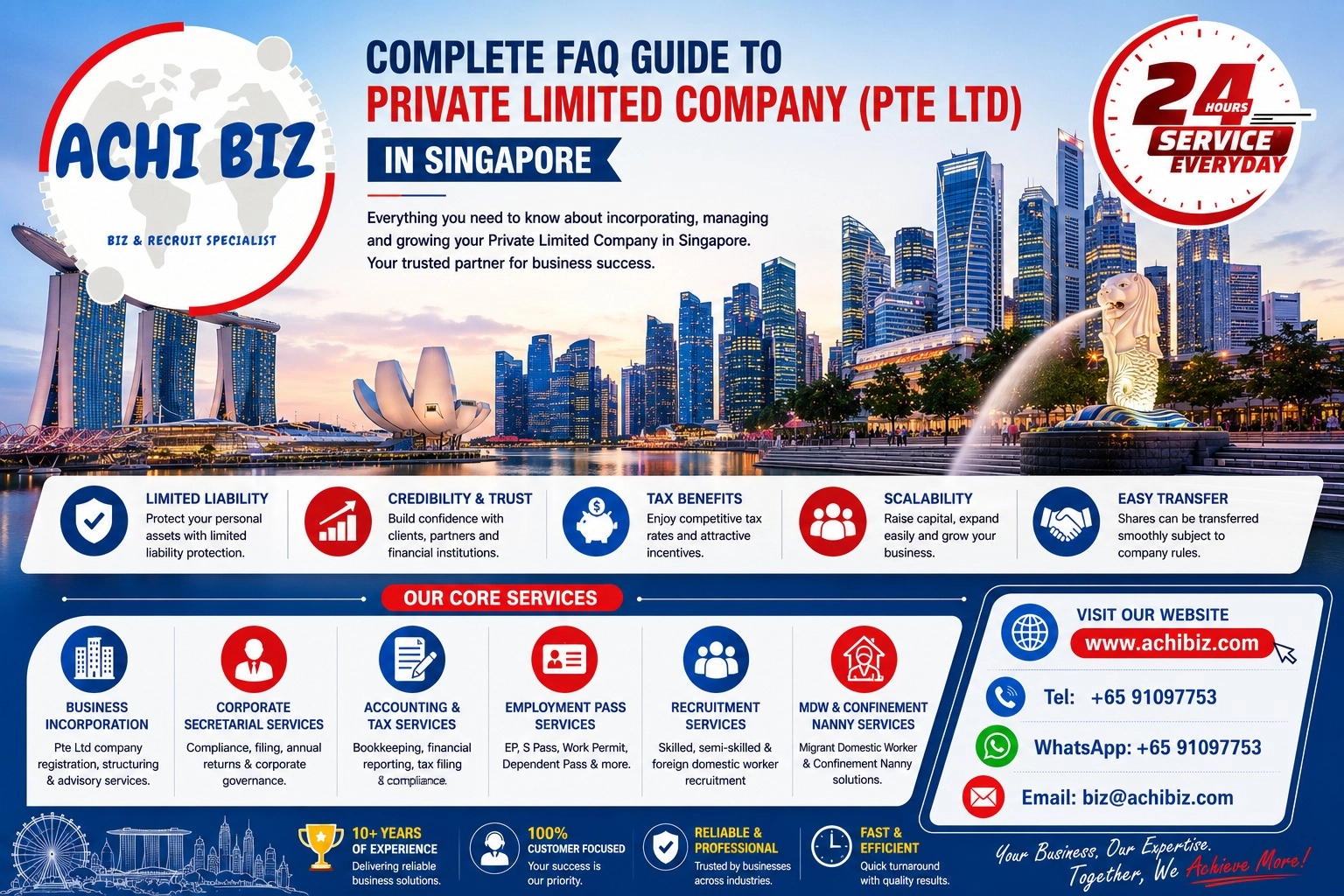
Complete FAQ Guide to Private Limited Company (Pte Ltd) in Singapore
What is a Private Limited Company (Pte Ltd) in Singapore?
A Private Limited Company (Pte Ltd) is a separate legal entity registered with ACRA. It is the most popular business structure in Singapore due to its limited liability protection, scalability, and strong credibility with clients, banks, and investors.
What does “limited by shares” mean in Singapore companies?
“Limited by shares” means shareholders are only liable up to the amount they invested in the company. Their personal assets are protected even if the company incurs debts or liabilities.
Why is a Pte Ltd company the most preferred business structure in Singapore?
A Pte Ltd company offers limited liability, tax benefits, credibility, ease of raising capital, and continuity. It is ideal for both startups and established businesses planning long-term growth.
Can a Private Limited Company operate independently from its owners?
Yes, a Pte Ltd company is a separate legal entity. It can own property, enter into contracts, and carry out business independently of its shareholders and directors.
How many shareholders can a Singapore Pte Ltd company have?
A Private Limited Company can have a minimum of 1 and a maximum of 50 shareholders.
Can a company have corporate shareholders instead of individuals?
Yes, shareholders can be individuals or corporate entities, whether local or foreign.
Is 100% foreign ownership allowed in Singapore companies?
Yes, foreigners can fully own a Singapore Pte Ltd company, provided at least one local director is appointed.
What is the minimum requirement for directors in Singapore?
At least one director must be a Singapore resident (Citizen, PR, or eligible pass holder). Additional directors can be foreigners.
Can a foreigner be the sole director of a company?
No, a foreigner cannot be the sole director unless they also hold a valid Singapore residency status. A local director is mandatory.
What is the difference between a director and a shareholder?
A director manages the company’s operations and decisions, while a shareholder owns shares and has ownership interest in the company.
Can one person be both director and shareholder?
Yes, a single individual can act as both director and shareholder in a Pte Ltd company.
What is the minimum paid-up capital required to start a company?
The minimum paid-up capital is SGD 1, but businesses often inject higher capital depending on operational needs.
Does higher paid-up capital improve company credibility?
Yes, higher paid-up capital can improve credibility with banks, suppliers, and government applications such as work passes.
Can paid-up capital be withdrawn after incorporation?
Paid-up capital should not be withdrawn arbitrarily. It must be used for legitimate business purposes and properly accounted for.
What is authorised share capital in Singapore?
Singapore no longer requires authorised capital. Companies can issue shares as needed without a fixed limit.
Can a company issue different types of shares?
Yes, companies can issue ordinary shares, preference shares, or other classes based on their constitution.
What is the company constitution?
The constitution is a legal document outlining rules governing the company, including shareholder rights, director powers, and share transfers.
Is a registered office address mandatory?
Yes, every company must have a registered address in Singapore where official correspondence is sent.
Can a residential address be used as a business address?
Yes, subject to URA’s or HDB’s Home Office Scheme approval.
What is the role of ACRA in Singapore company registration?
ACRA (Accounting and Corporate Regulatory Authority) regulates company registration, compliance, and corporate governance in Singapore.
How long does it take to incorporate a company in Singapore?
Incorporation is usually completed within 1–2 working days, subject to approval and complete documentation.
What are the key documents required for company incorporation?
Documents include passport/NRIC copies, proof of address, business activity details, and shareholder/director information.
Is a company secretary compulsory?
Yes, every company must appoint a corporate secretary within 6 months of incorporation.
What does a corporate secretary do?
A corporate secretary ensures compliance with statutory obligations, maintains records, and handles filings with ACRA.
Can a director act as company secretary?
No, a sole director cannot act as the company secretary.
What is an Annual Return (AR)?
An Annual Return is a mandatory filing with ACRA that updates company details such as directors, shareholders, and financial status.
What is the deadline for filing Annual Returns?
Annual Returns must be filed within 7 months after the financial year end.
Is AGM mandatory for all companies?
Not all companies are required to hold AGMs. Small companies may be exempt under certain conditions.
What is the financial year end (FYE)?
FYE is the end of the company’s accounting period used for financial reporting and tax purposes.
What is Estimated Chargeable Income (ECI)?
ECI is a company’s estimated taxable income that must be filed with IRAS within 3 months after FYE.
What is the corporate tax rate in Singapore?
The corporate tax rate is 17%, with various exemptions and rebates available.
What are startup tax exemptions in Singapore?
New companies enjoy tax exemptions on the first SGD 100,000 of chargeable income, subject to qualifying conditions.
Are dividends taxable in Singapore?
No, dividends paid to shareholders are tax-free under Singapore’s one-tier tax system.
Is GST registration required for all companies?
GST registration is required only if annual taxable turnover exceeds SGD 1 million or is expected to exceed it.
Can a company hire foreign workers?
Yes, companies can hire foreign workers subject to MOM regulations, quotas, and pass eligibility.
Can a company sponsor work passes?
Yes, companies can apply for Employment Pass, S Pass, or Work Permit for eligible foreign employees.
Can a company change its name after incorporation?
Yes, companies can change their name by applying through ACRA and obtaining approval.
Can a company change shareholders after incorporation?
Yes, shares can be transferred or new shares issued, subject to company rules.
What happens if a shareholder exits the company?
Shares can be transferred to another party or bought back, depending on agreements.
Can a company be struck off in Singapore?
Yes, a company can be struck off if it is no longer in operation and meets ACRA requirements.
What is the difference between striking off and liquidation?
Striking off / de-registration is a simpler closure process, while liquidation is used when there are liabilities to settle.
What penalties apply for non-compliance?
Failure to comply with ACRA or IRAS requirements may result in fines, penalties, or legal action.
Why is corporate compliance important in Singapore?
Compliance ensures legal operation, avoids penalties, and maintains business reputation.
Can a Pte Ltd company convert into LLP or sole proprietorship?
Direct conversion is not typical; restructuring requires closing and setting up a new entity.
What industries benefit most from a Pte Ltd structure?
Almost all industries benefit, especially trading, services, tech startups, and investment holding companies.
Is a Pte Ltd company suitable for holding investments?
Yes, many investors use Pte Ltd companies as holding entities for tax efficiency and liability protection.
Can a Pte Ltd company own property in Singapore?
Yes, companies can own commercial properties, subject to regulatory approvals.
What is the difference between local and foreign company registration?
Local companies are incorporated in Singapore, while foreign companies register as branches or subsidiaries.
Why choose Achibiz for company incorporation in Singapore?
Achibiz offers professional, efficient, and compliant services including company registration, corporate secretarial support, immigration assistance, and ongoing compliance advisory tailored to your business needs.
Related articles:
Benefits of Company Compliance in Singapore
FAQ Guide to General Partnership
#achibiz