
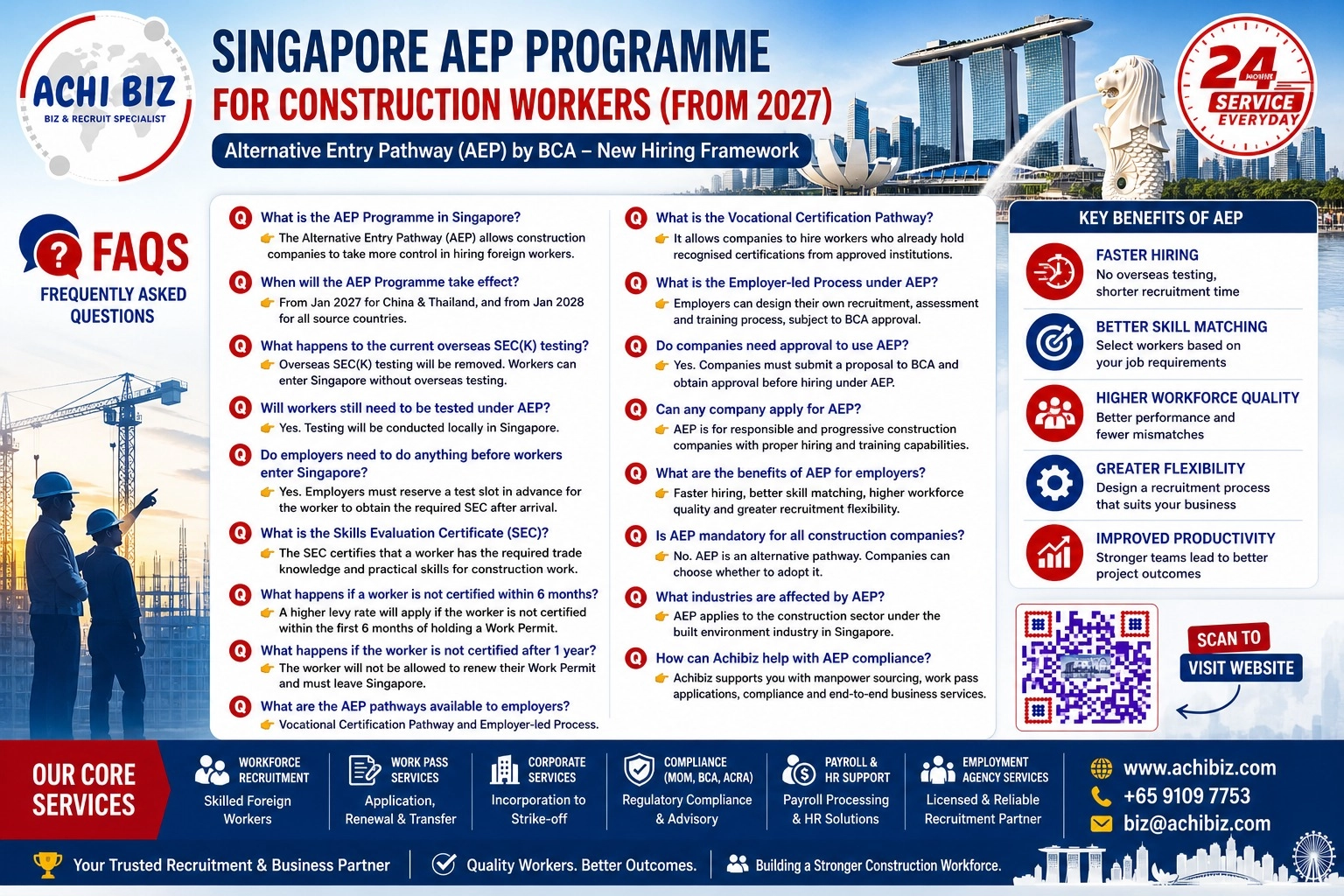
What is the Alternative Entry Pathway (AEP) Programme in Singapore?
The Alternative Entry Pathway (AEP) is a new hiring framework introduced by BCA that allows construction companies to take more control over recruiting foreign workers. Instead of relying only on overseas testing, firms can directly select and assess workers based on their specific needs.
When will the AEP Programme take effect?
The changes will begin from January 2027 for workers from China and Thailand, and will be extended to all source countries by January 2028.
What happens to the current overseas SEC(K) testing?
Overseas SEC(K) testing will be gradually phased out. Workers will no longer need to pass the test in their home countries before entering Singapore.
Will workers still need to be tested under AEP?
Yes. Workers will still be assessed, but the testing will be done locally in Singapore instead of overseas.
Do employers need to do anything before workers enter Singapore?
Yes. Employers must reserve a test slot in advance for the worker to obtain the required Skills Evaluation Certificate (SEC) after arrival.
What is the Skills Evaluation Certificate (SEC)?
The SEC is a certification that confirms a worker has the required trade knowledge and practical skills to work in Singapore’s construction sector.
What happens if a worker is not certified within 6 months?
A higher levy rate will apply if the worker is not certified within the first 6 months of holding a Work Permit.
Can a worker continue working without certification?
Workers can continue working temporarily, but they must obtain certification within the required timeline to avoid penalties and renewal issues.
What happens if the worker is not certified after 1 year?
The worker will not be allowed to renew their Work Permit, which means they must leave Singapore.
What are the AEP pathways available to employers?
There are two main pathways:
- Vocational Certification Pathway (for workers with recognised qualifications)
- Employer-led Process (custom recruitment and training approach designed by the company)
What is the Vocational Certification Pathway?
This pathway allows companies to hire workers who already hold recognised certifications, reducing the need for further testing.
What is the Employer-led Process under AEP?
It allows companies to design their own recruitment process, including interviews, skill tests, and training programmes, subject to BCA approval.
Do companies need approval to use AEP?
Yes. Companies must submit a proposal to BCA and obtain approval before hiring workers under the AEP framework.
Can any company apply for AEP?
AEP is generally targeted at responsible and progressive construction firms that can demonstrate proper hiring and training processes.
What are the benefits of AEP for employers?
AEP offers faster hiring, better skills matching, improved worker quality, and greater flexibility in recruitment.
Will AEP reduce hiring time?
Yes. Since overseas testing is removed, companies can bring in workers faster and complete assessments locally.
Does AEP improve workforce quality?
Yes. Employers can select workers based on actual job requirements, leading to better performance and fewer skill mismatches.
Is AEP mandatory for all construction companies?
No. AEP is an alternative pathway. Companies can choose whether to adopt it based on their hiring strategy.
What are the risks of not complying with AEP requirements?
Non-compliance can lead to higher levies, inability to renew work permits, and potential disruption to your workforce planning.
What industries are affected by AEP?
AEP applies specifically to the construction sector under the built environment industry in Singapore.
How does AEP impact manpower planning?
Companies will need to plan ahead, especially for testing timelines, certification requirements, and recruitment strategies
Does AEP increase employer responsibility?
Yes. Employers now have greater control, but also greater responsibility to ensure workers are properly assessed and certified.
Can AEP reduce dependency on low-skilled labour?
Yes. The programme encourages hiring of better-skilled workers, supporting Singapore’s move towards a higher-quality workforce.
What is the long-term goal of AEP?
The goal is to improve productivity, raise industry standards, and ensure a better match between workers’ skills and job requirements.
What is the main objective of AEP?
AEP aims to improve worker quality and skill level, ensure proper training and certification, and reduce reliance on low-skilled labour.
What details must be included in the AEP proposal?
Employers must provide details on recruitment process, source countries and trades, training and certification route, deployment plan, and cost breakdown for employer and workers.
Can I submit one proposal for multiple countries?
No. A separate AEP proposal must be submitted for each source country.
What is the minimum number of workers required under AEP?
Employers must plan to bring in at least 30 workers under each AEP proposal.
How should employers select workers under AEP?
Employers are expected to be actively involved in the selection process, ensure workers are skilled and experienced, and verify work experience through proper checks.
How can employers validate workers’ experience?
Employers can validate experience by reviewing employment records, conducting interviews or trade tests, and working with verified recruitment partners.
What training requirements must workers meet?
Workers should be trained by recognized vocational institutes, receive government-recognised vocational certificates, and undergo proper assessment in their trade.
What information is required for vocational certification?
Employers must provide training duration, course syllabus, and assessment criteria.
How should workers be deployed after arrival?
Employers must ensure workers are assigned to the same trade they were trained in and properly matched to job roles based on their skills.
What costs are involved under AEP?
Costs may include passport application, medical check-up, air tickets, recruitment fees, and training and certification. A detailed cost comparison with the traditional route must be provided.
Who bears the cost under AEP?
Costs are shared between employer and worker. Employers must clearly disclose the cost breakdown.
Can AEP reduce reliance on traditional recruitment methods?
Yes. AEP focuses on structured recruitment and pre-trained workers, improving efficiency and quality compared to traditional hiring.
What is the link for submission of form for AEP proposal application?
Link details: https://form.gov.sg/67da6d3cb46da8f14b03f9b9
Click here for more details on AEP.
Refer to requirements on construction sector for more details.
#achibiz