
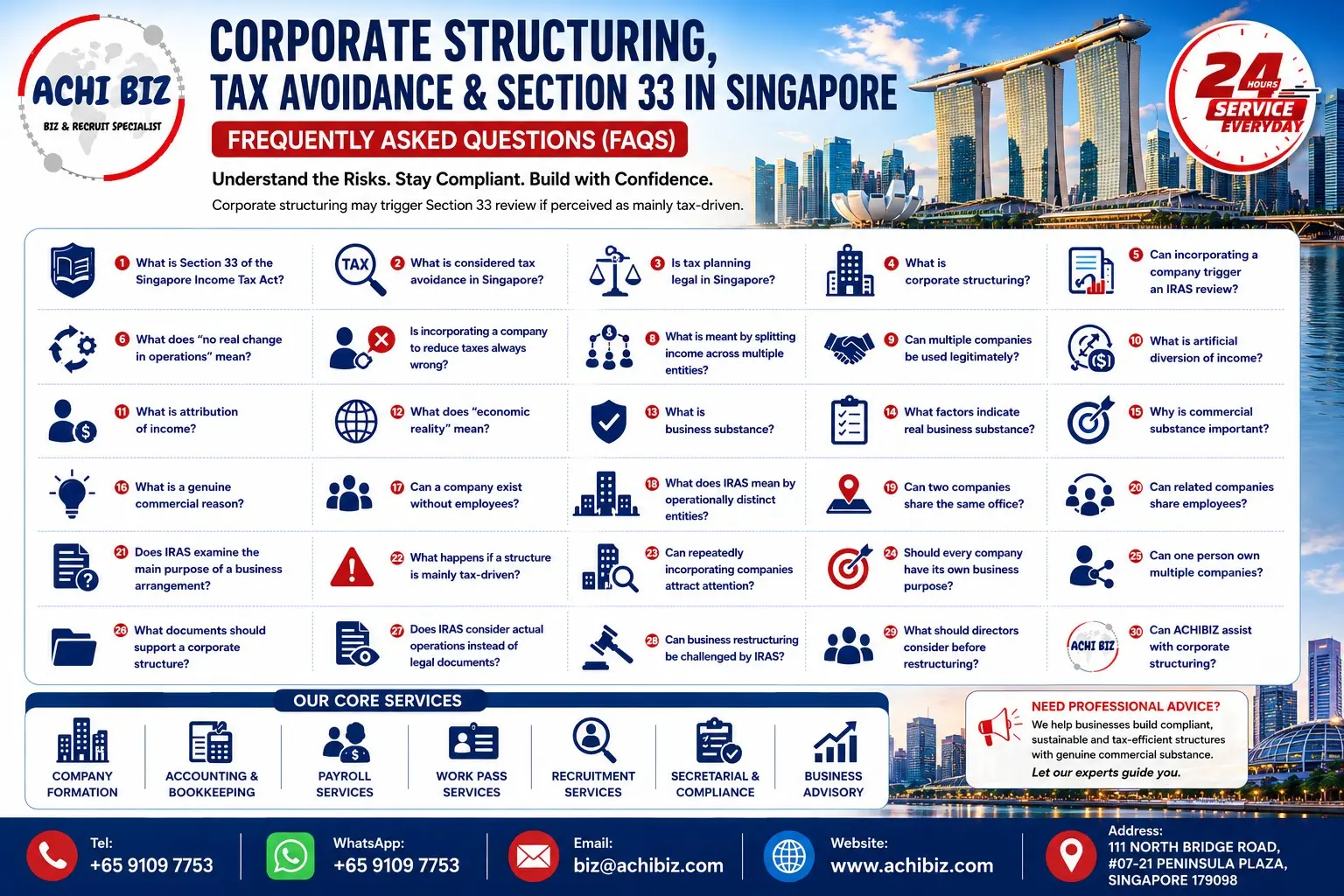
Corporate Structuring, Tax Avoidance & Section 33 in Singapore: Frequently Asked Questions (FAQs) for Business Owners
Corporate structuring is a legitimate business practice when it is carried out for genuine commercial reasons. However, where a structure is designed mainly to obtain tax benefits without real commercial substance, it may attract scrutiny under Section 33 of the Singapore Income Tax Act, which contains the General Anti-Avoidance Provision (GAAR).
Below are some of the most frequently asked questions to help business owners, directors, shareholders and entrepreneurs understand Singapore’s tax compliance requirements.
What is Section 33 of the Singapore Income Tax Act?
Section 33 is Singapore’s General Anti-Avoidance Provision (GAAR). It empowers the Inland Revenue Authority of Singapore (IRAS) to disregard or vary arrangements that are considered to have been entered into mainly for the purpose of obtaining a tax advantage.
What is considered tax avoidance in Singapore?
Tax avoidance generally refers to arrangements that technically comply with the law but are structured mainly to reduce or avoid taxes without any genuine commercial or business purpose.
Unlike legitimate tax planning, tax avoidance may be challenged by IRAS under Section 33.
Is tax planning legal in Singapore?
Yes.
Businesses are entitled to arrange their affairs in a tax-efficient manner. However, the structure should be supported by genuine commercial reasons, business substance and economic reality rather than solely achieving tax savings.
What is corporate structuring?
Corporate structuring refers to organising business operations through companies, subsidiaries, holding companies or related entities to achieve commercial, operational, legal or financial objectives.
Can incorporating a company trigger an IRAS review?
Yes.
Simply incorporating a company is not a concern. However, if incorporation appears to be mainly tax-driven without any real change in business operations, IRAS may review the arrangement under Section 33.
What does “no real change in operations” mean?
This generally refers to situations where:
- The same individual continues performing exactly the same services.
- The same customers remain unchanged.
- The same business activities continue.
- Only the legal structure changes while the commercial reality remains the same.
Is incorporating a company to reduce taxes always wrong?
No.
Many businesses legitimately enjoy lower corporate tax rates and tax incentives. Problems generally arise only where tax reduction appears to be the main purpose without genuine commercial justification.
What is meant by splitting income across multiple entities?
Income splitting refers to dividing income among several companies or individuals without any genuine commercial reason, primarily to reduce tax liabilities.
Such arrangements may attract closer scrutiny by IRAS.
Can multiple companies be used legitimately?
Yes.
Many business groups operate multiple companies for legitimate reasons, such as:
- Different business activities.
- Different investors.
- Risk segregation.
- Separate business divisions.
- International expansion.
- Regulatory requirements.
Each company should have its own commercial purpose.
What is artificial diversion of income?
Artificial diversion of income occurs where income is transferred to another company or person without corresponding business activities or commercial justification.
What is attribution of income?
Attribution of income refers to determining who actually earned the income based on the economic reality of the arrangement.
IRAS may disregard arrangements where income is attributed to a different entity without genuine business substance.
What does “economic reality” mean?
Economic reality refers to whether business activities actually match the legal documents and company structure.
IRAS considers whether:
- The company genuinely carries on business.
- Income reflects actual business activities.
- Risks and responsibilities match commercial operations.
What is business substance?
Business substance means a company genuinely operates as an active business rather than existing merely on paper.
What factors indicate real business substance?
Some indicators include:
- Employees.
- Office premises.
- Business assets.
- Commercial contracts.
- Independent decision-making.
- Business risks.
- Active operations.
Why is commercial substance important?
Commercial substance demonstrates that a company exists for genuine business purposes rather than simply obtaining tax benefits.
What is a genuine commercial reason?
Examples include:
- Expanding into new markets.
- Bringing in investors.
- Asset protection.
- Risk management.
- Business succession planning.
- Regulatory compliance.
- Separate business operations.
Can a company exist without employees?
Yes.
Some legitimate businesses outsource functions or operate with directors only. However, the overall commercial substance must still support the business activities.
What does IRAS mean by operationally distinct entities?
Each company should operate independently with its own:
- Business purpose.
- Operations.
- Contracts.
- Customers.
- Assets.
- Liabilities.
- Commercial risks.
Can two companies share the same office?
Yes.
Sharing office space does not automatically create tax issues. IRAS considers the overall commercial substance rather than a single factor.
Can related companies share employees?
Yes.
Shared services arrangements are common. However, the arrangements should be properly documented, commercially justifiable and supported by appropriate agreements.
Does IRAS examine the main purpose of a business arrangement?
Yes.
One important consideration is whether the primary benefit appears to be reducing tax rather than achieving genuine commercial objectives.
What happens if a structure is mainly tax-driven?
IRAS may invoke Section 33 to disregard or adjust the arrangement and assess taxes based on what it considers to be the true commercial substance.
Can repeatedly incorporating companies attract attention?
Potentially, yes.
Repeated incorporation of multiple entities without clear commercial reasons may increase regulatory scrutiny.
Should every company have its own business purpose?
Yes.
Each entity within a corporate group should have a clearly identifiable commercial purpose supported by actual business activities.
Can one person own multiple companies?
Yes.
There is no restriction on owning multiple companies, provided each company operates legitimately and independently where appropriate.
What documents should support a corporate structure?
Useful supporting documents include:
- Business plans.
- Board resolutions.
- Commercial agreements.
- Service agreements.
- Employment contracts.
- Customer contracts.
- Financial records.
- Operational policies.
Does IRAS consider actual operations instead of legal documents?
Yes.
IRAS generally considers both legal documentation and actual commercial conduct when assessing arrangements.
Can business restructuring be challenged by IRAS?
Potentially.
Where restructuring appears primarily designed to obtain tax advantages without genuine commercial justification, IRAS may review the arrangement.
What should directors consider before restructuring?
Directors should ensure that:
- There is a genuine commercial purpose.
- Business substance supports the structure.
- Operations match documentation.
- Risks and responsibilities are properly allocated.
- The arrangement complies with Singapore tax laws.
Can ACHIBIZ assist with corporate structuring?
Yes.
ACHI Biz Services Pte. Ltd. assists businesses with company incorporation, corporate structuring, business advisory, accounting, tax compliance and corporate secretarial services while helping clients understand their statutory obligations under Singapore law.
How can I obtain professional advice before restructuring my business?
Every business is unique. Before implementing any corporate restructuring or tax planning arrangement, it is advisable to obtain professional advice to ensure compliance with the Singapore Income Tax Act and other applicable regulations.
For professional assistance, contact ACHI Biz Services Pte. Ltd.
Related articles:
Corporate income tax in Singapore
Pte Ltd Companies in Singapore
#achibiz