
Financial Year End (FYE) in Singapore Pte Ltd: Why It Matters and How to Get It Right
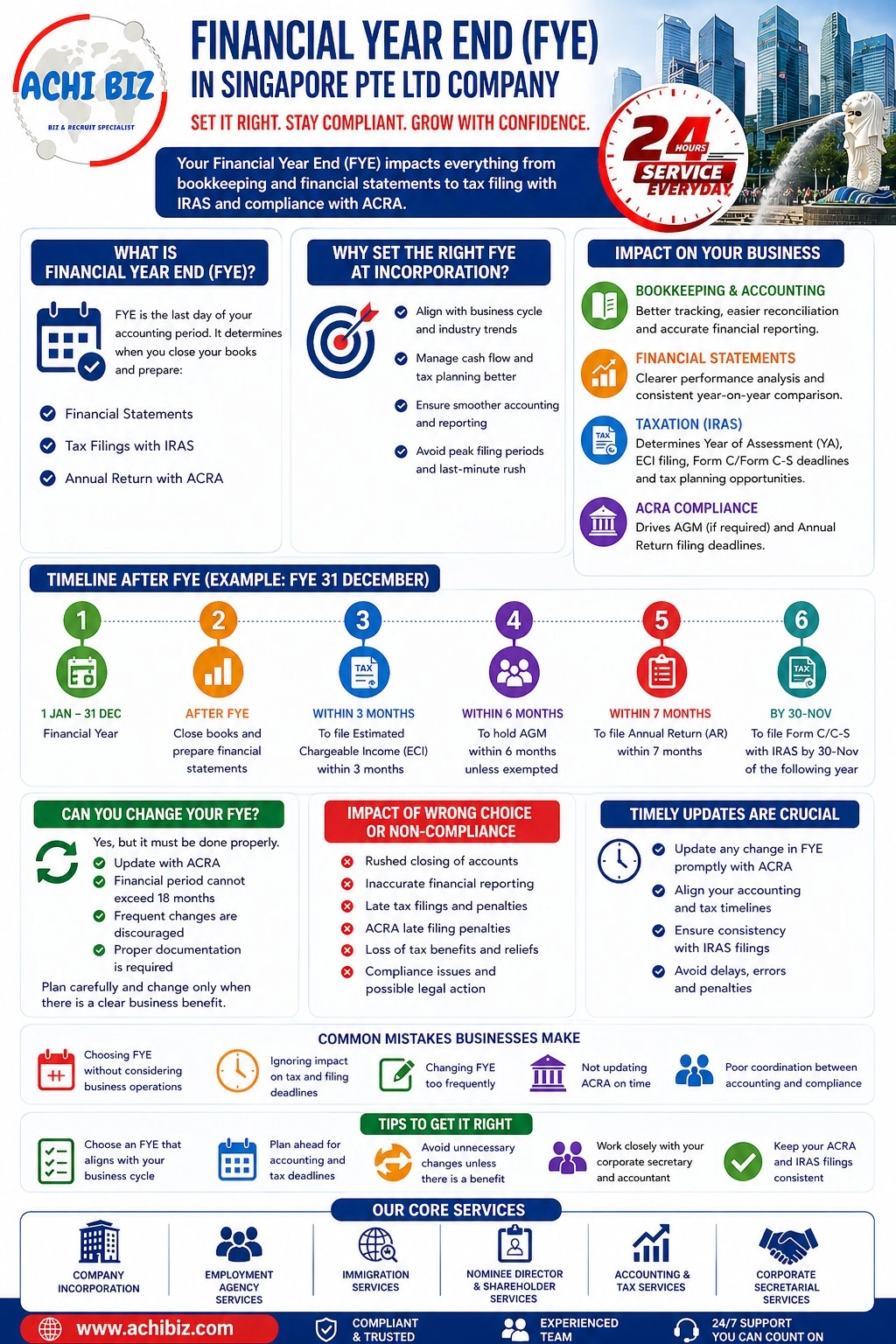
When you incorporate a Pte Ltd company in Singapore, one of the first decisions you’ll make is your Financial Year End (FYE). It might seem like a small administrative detail, but it directly affects your bookkeeping, accounting, financial statements, tax filing with IRAS, and compliance with ACRA.
Get it right from the start, and your compliance becomes smoother. Get it wrong, and you’ll spend unnecessary time fixing timelines, chasing deadlines, and dealing with avoidable complications.
What Is Financial Year End (FYE)?
Your Financial Year End in Singapore is the date your company closes its accounts for the year. For example, if your FYE is 31 December, your financial year runs from 1 January to 31 December.
It determines when you prepare:
- Financial statements
- Corporate tax filings
- Annual returns with ACRA
Why Setting the Right FYE at Incorporation Is Important
Many businesses simply choose 31 December without much thought. While that works for some, it’s not always the best option.
Choosing the right FYE for your Singapore company helps you:
- Align with your business cycle or industry trends
- Manage cash flow and tax planning better
- Ensure your accounting team has enough time for closing and reporting
- Avoid peak periods when everyone is filing at the same time
For example, if your business is seasonal, setting your FYE after your peak period makes reporting more meaningful and manageable.
Impact on Bookkeeping and Accounting
Your FYE directly affects your bookkeeping and accounting process in Singapore.
A well-planned FYE allows:
- Proper tracking of income and expenses within a meaningful period
- Easier reconciliation and closing of accounts
- Better financial analysis and decision-making
If your FYE is poorly chosen, you may face:
- Rushed closing of accounts
- Increased accounting errors
- Difficulty in managing records across financial periods
Impact on Financial Statements
Your financial statements in Singapore—including profit and loss, balance sheet, and cash flow—are prepared based on your FYE.
A clear and well-structured FYE ensures:
- Accurate reflection of business performance
- Consistency in reporting
- Better comparability year to year
Changing FYE too frequently can make financial analysis confusing.
Impact on Corporate Tax (IRAS)
Your FYE determines your Year of Assessment (YA) for corporate tax Singapore filings with IRAS.
It affects:
- When your Estimated Chargeable Income (ECI) must be filed
- When your Form C / Form C-S is due
- Eligibility for tax exemptions and reliefs
A properly planned FYE helps with:
- Smoother tax planning
- Better use of available tax incentives
- Avoiding last-minute tax submissions
Impact on ACRA Filing (Annual Return)
Your FYE also drives your ACRA compliance timeline.
After your FYE:
- You must hold your Annual General Meeting (AGM) (unless exempted)
- File your Annual Return with ACRA within the required deadline
If your FYE is not well planned, you may end up:
- Missing deadlines
- Facing late filing penalties
- Struggling to align financial statements with filing timelines
Can You Change Your Financial Year End?
Yes, you can change your Financial Year End in Singapore after incorporation—but it must be done carefully.
Key Points to Note:
- Changes must be updated with ACRA
- The financial period cannot exceed 18 months
- Frequent changes are discouraged and may attract scrutiny
- Proper documentation and planning are required
When Should You Consider Changing FYE?
You may consider adjusting your FYE if:
- Your business operations have changed significantly
- You want better alignment with your group company or holding company
- Your current FYE is causing compliance or operational challenges
- You want to optimise tax planning
Importance of Timely Updates to ACRA and IRAS
Whenever there are changes to your FYE, it’s important to ensure:
- ACRA records are updated promptly
- Your accounting and tax timelines are adjusted accordingly
- IRAS filings are aligned with the new financial period
Delays or incorrect updates can lead to:
- Filing errors
- Compliance issues
- Penalties
Common Mistakes Businesses Make
- Choosing FYE without considering business operations
- Ignoring the impact on tax and filing deadlines
- Changing FYE too frequently
- Not updating ACRA on time
- Poor coordination between accounting and compliance
Practical Tips to Get It Right
- Choose an FYE that aligns with your business cycle
- Plan ahead for accounting and tax deadlines
- Avoid unnecessary changes unless there is a clear benefit
- Work closely with your corporate secretary and accountant
- Keep your ACRA and IRAS filings consistent
Final Thoughts
Your Financial Year End for a Pte Ltd company in Singapore is more than just a date—it’s the foundation for your entire financial and compliance framework.
A well-chosen FYE keeps your bookkeeping, financial reporting, tax filing, and ACRA compliance smooth and predictable. It helps you stay organised and reduces the risk of penalties.
Need Help Setting or Changing Your FYE?
If you’re unsure about choosing or adjusting your Financial Year End in Singapore, it’s worth getting proper guidance early.
Achibiz can assist with:
- Company incorporation Singapore
- Setting up the right FYE
- Accounting and bookkeeping support
- ACRA and IRAS compliance
📩 Reach out to Achibiz for practical support in managing your company’s financial and compliance timeline properly
#achibiz