
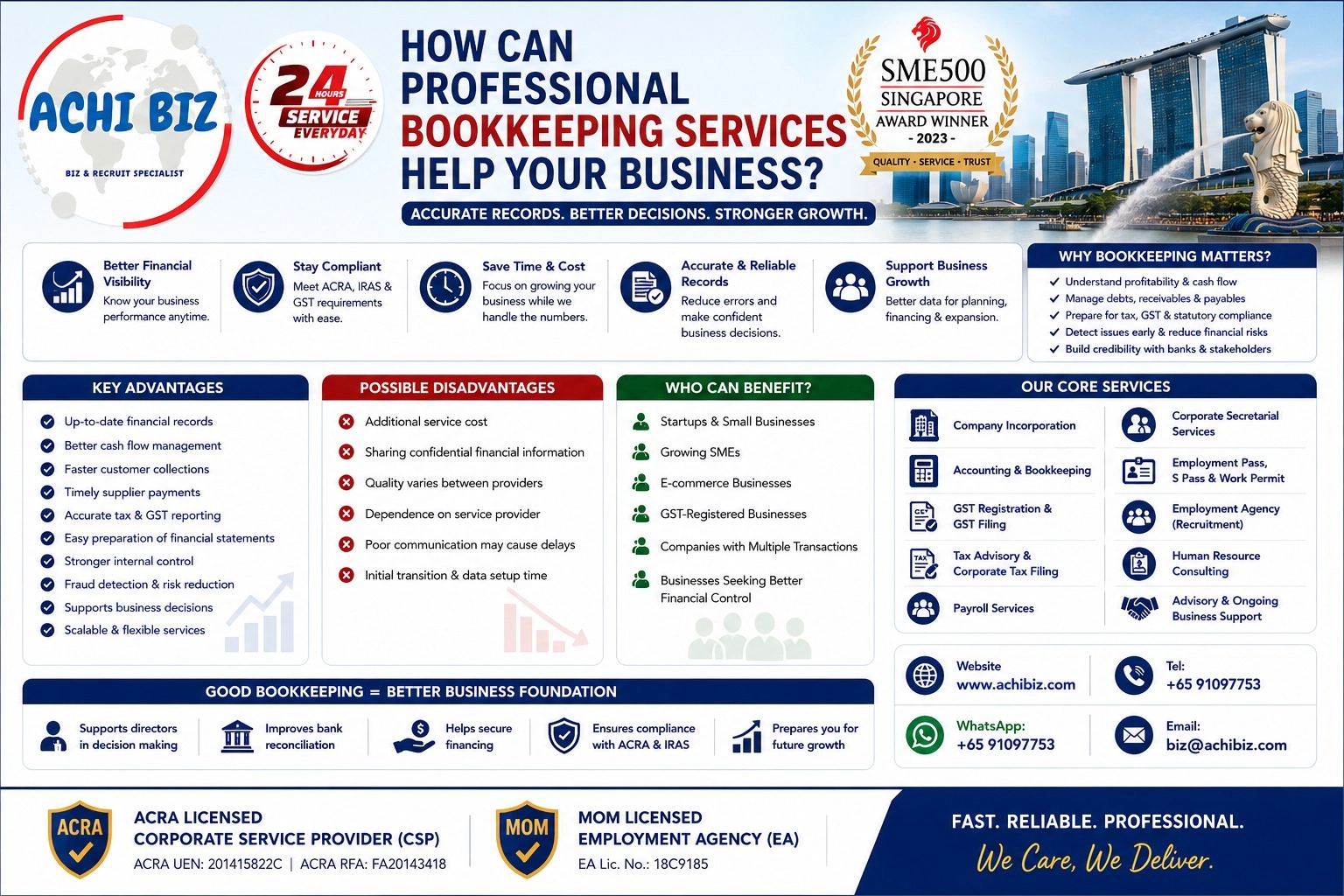
How Can Professional Bookkeeping Services Help Your Business?
Professional bookkeeping is much more than recording income and expenses. For businesses in Singapore, properly maintained books provide the financial foundation for management decisions, tax compliance, GST reporting where applicable, preparation of financial statements and understanding the true financial position of the business.
IRAS requires companies to maintain proper records of their financial transactions and generally retain source documents, accounting records, schedules, bank statements and other relevant business records for at least five years from the relevant Year of Assessment. ACRA also states that companies must keep accounting records that enable true and fair financial statements to be prepared.
The following FAQs examine how professional bookkeeping services in Singapore can help businesses, why bookkeeping matters, its advantages and possible disadvantages, and what business owners should consider before outsourcing their bookkeeping.
What is bookkeeping?
Bookkeeping is the systematic recording, organising, classifying and maintaining of a business’s financial transactions and supporting records.
Depending on the business, bookkeeping may cover sales, purchases, receipts, payments, expenses, bank transactions, customer balances, supplier balances, loans, fixed assets, payroll-related entries and other financial activities.
Good bookkeeping creates an organised financial record from which accounts, tax computations and management information can subsequently be prepared.
Why is bookkeeping important for a business in Singapore?
A business cannot reliably understand its financial position when its underlying records are incomplete or outdated.
Proper bookkeeping helps management determine how much the business is earning, what it is spending, what customers owe, what it owes suppliers and whether the business is actually profitable.
It also supports regulatory and tax compliance. IRAS specifically identifies good record keeping as useful for making better business decisions, understanding the company’s financial status and reducing the effort required for corporate income tax filing and responding to tax queries.
Is bookkeeping compulsory for Singapore companies?
Keeping proper accounting records is a legal requirement, although engaging an external professional bookkeeper itself is not compulsory.
ACRA states that companies must keep accounting records for at least five years after the end of the financial year in which the relevant transactions or operations were completed, and those records must enable true and fair financial statements to be prepared.
Therefore, a company may maintain its books internally or outsource the work, but outsourcing does not remove the company’s or directors’ underlying responsibilities.
What are professional bookkeeping services?
Professional bookkeeping services involve engaging a competent external service provider or accounting professional to maintain some or all of the business’s accounting records.
Instead of leaving bookkeeping entirely to the business owner or administrative employees, the business establishes an organised process for providing invoices, receipts, bank statements and other documents to the bookkeeper for recording and reconciliation.
What does a professional bookkeeper normally do?
The actual scope depends on the engagement. It may include recording sales and expenses, maintaining ledgers, bank reconciliation, accounts receivable and payable tracking, recording fixed assets and loans, maintaining supporting schedules and assisting with periodic financial reports.
For GST-registered businesses, additional bookkeeping processes may be needed to support GST reporting. IRAS requires GST-registered businesses to retain appropriate income, purchase and expense records, bank statements, general ledgers and financial statements, among other records.
What is the difference between bookkeeping and accounting?
The two functions are closely connected but are not identical.
Bookkeeping primarily focuses on capturing and organising financial transactions accurately.
Accounting goes further by using those records to prepare financial statements, make adjustments, analyse financial results and support tax and statutory reporting.
Put simply, bookkeeping builds the financial records; accounting interprets and reports what those records mean.
Why should a small business consider professional bookkeeping?
Small businesses often postpone bookkeeping because the owner is occupied with sales, customers and daily operations.
That creates a common problem: records accumulate until tax filing or year-end reporting becomes urgent.
Regular professional bookkeeping can keep the accounts current throughout the year, allowing the owner to identify problems earlier rather than discovering them months later.
Can professional bookkeeping save a business owner’s time?
Yes. For many SMEs, this is one of its most practical benefits.
Every hour an owner spends sorting receipts, entering transactions, matching bank payments and chasing accounting discrepancies is time unavailable for customers, sales, operations and business development.
Outsourcing can therefore make sense where the owner’s time has greater value when directed towards the core business.
Does professional bookkeeping automatically save money?
Not necessarily.
A business must pay bookkeeping fees, and a very small business with only a handful of straightforward transactions may be able to maintain its own records economically.
The real question is whether the cost of outsourcing is justified by the time saved, accuracy gained, compliance support and better financial visibility obtained.
Can bookkeeping tell whether a business is actually profitable?
It provides the information needed to determine profitability.
A healthy bank balance does not necessarily mean the business is profitable. Cash in the bank can include loans, customer deposits or amounts that will shortly be required to pay suppliers, employees, taxes and other liabilities.
Properly maintained accounts provide a clearer picture of revenue, expenses, assets, liabilities and business performance.
Why is bank reconciliation important in professional bookkeeping?
Recording transactions alone is not enough.
Bank reconciliation compares transactions recorded in the books against the actual bank statements. This can identify duplicated entries, omitted transactions, incorrect amounts, unidentified receipts, unpresented payments and other discrepancies.
Regular reconciliation therefore improves the reliability of the accounting records.
How can professional bookkeeping improve cash-flow management?
Bookkeeping helps management see where money is coming from and where it is going.
When records are current, management can monitor outstanding customer balances, upcoming supplier payments, recurring expenses and other commitments more effectively.
It does not create cash flow by itself, but it provides information needed to manage cash flow intelligently.
Can bookkeeping help a company collect customer debts faster?
Potentially.
When accounts receivable records are properly maintained, management can identify unpaid invoices and long-outstanding customers more easily.
Without reliable records, businesses may overlook overdue invoices or follow up only after considerable delay.
Can bookkeeping help manage supplier payments?
Yes.
Proper accounts payable records help a business identify what is payable, to whom and when. This can reduce accidental duplicate payments, missed invoices and unnecessary late-payment issues.
It can also help management plan payments around available cash flow rather than reacting to supplier demands at the last minute.
How does professional bookkeeping help with corporate income tax?
Accurate bookkeeping provides the underlying records required for preparation of accounts and tax computations.
IRAS requires companies to maintain records explaining transactions relating to income, expenses and purchases. Failure to maintain adequate records can result in IRAS estimating revenue, disallowing expense claims or capital allowances and imposing penalties.
Proper books therefore make tax preparation considerably more defensible and efficient.
How does bookkeeping help GST-registered businesses?
GST bookkeeping requires particular attention because sales, purchases, output tax, input tax and supporting documents need to be properly captured.
GST-registered businesses must keep appropriate business and accounting records for at least five years to support their GST declarations.
Incorrect bookkeeping can lead to incorrect GST returns even where the underlying commercial transactions were legitimate.
Can professional bookkeeping reduce tax mistakes?
It can significantly reduce avoidable recording errors, although no professional service can guarantee that every tax issue will disappear.
Proper classification and supporting documentation can reduce problems such as duplicated expenses, omitted income, unsupported claims and incorrect transaction recording.
Complex tax positions should still be reviewed by an appropriately qualified tax professional.
Does professional bookkeeping help with annual financial statements?
Yes. Reliable bookkeeping provides the foundation from which financial statements are prepared.
If bookkeeping has not been maintained properly throughout the year, considerable clean-up may be required before accurate year-end accounts can be produced.
Good monthly or quarterly bookkeeping can therefore make the financial year-end process considerably smoother.
Can bookkeeping make Annual Return and tax compliance easier?
Indirectly, yes.
Bookkeeping itself is not the same as filing an Annual Return or Corporate Income Tax Return. However, up-to-date financial records help the company and its professionals prepare the financial information required for the relevant compliance work.
The quality of the final reporting is heavily dependent on the quality of the underlying records.
How can professional bookkeeping help directors understand the company’s financial position?
Directors should not have to wait until year-end to discover whether their company is profitable or struggling.
Periodic bookkeeping allows management reports to be prepared from current records. Depending on the scope of service, directors may review profit and loss, balance sheet items, receivables, payables and other financial information.
This provides a much stronger basis for management oversight.
Can bookkeeping help detect fraud or unusual transactions?
It can help.
Regular reconciliations and transaction reviews can expose unusual payments, unexplained withdrawals, duplicated expenses or inconsistencies that warrant investigation.
IRAS itself notes that proper record keeping helps companies remain aware of their financial status, including whether there may be internal fraud or theft.
However, ordinary bookkeeping should not be confused with a forensic investigation or audit.
Can professional bookkeeping improve internal financial controls?
Yes, particularly when the process is properly designed.
For example, the person approving a payment need not necessarily be the same person recording and reconciling it. Clear documentation and periodic review can make unauthorised or unexplained transactions harder to conceal.
For small businesses, even basic separation of responsibilities can improve control.
Does outsourcing bookkeeping eliminate directors’ responsibilities?
No.
This is an important misconception.
A company may outsource bookkeeping, accounting, tax or corporate secretarial work, but its directors remain responsible for complying with their legal obligations.
Outsourcing should therefore be treated as professional support, not as a transfer of ultimate corporate responsibility.
How frequently should bookkeeping be done?
There is no single frequency suitable for every business.
A business with substantial daily transactions may require weekly or monthly bookkeeping. A smaller business with relatively few transactions might reasonably operate on a monthly or quarterly cycle.
However, waiting until the financial year has ended before organising an entire year’s records usually reduces the usefulness of bookkeeping for management purposes.
Is monthly bookkeeping better than annual bookkeeping?
For an active business, generally yes.
Annual bookkeeping may satisfy a basic year-end requirement after substantial reconstruction, but it provides little ongoing management value.
Monthly bookkeeping gives management more timely information and allows errors, missing documents and outstanding balances to be identified sooner.
Should a newly incorporated company start bookkeeping immediately?
Ideally, yes.
Transactions may arise even before substantial revenue begins: incorporation-related expenses, deposits, equipment purchases, professional fees, capital contributions, loans and operating expenses.
Starting with an organised system is normally easier than reconstructing several months of activity later.
What documents should a business provide to its bookkeeper?
Depending on the business, these may include sales invoices, purchase invoices, receipts, payment vouchers, bank statements, loan documents, contracts, payroll information, expense claims, credit notes and other supporting documents.
IRAS requires companies to retain source documents, accounting records and schedules, bank statements and other records connected with business transactions for at least five years from the relevant YA.
Is keeping bank statements alone sufficient?
No.
IRAS specifically states that keeping only bank statements constitutes poor record keeping. Companies need source documents and records capable of explaining transactions relating to income, business expenses and purchases, together with accounting records and schedules summarising transactions systematically.
Can bookkeeping records be maintained electronically?
Yes.
IRAS strongly encourages companies to use accounting software, and source documents such as receipts, invoices and vouchers may generally be retained physically or electronically, subject to applicable requirements.
Digital bookkeeping can also make searching, sharing, backing up and reviewing records more efficient.
What are the main advantages of professional bookkeeping services?
The major advantages include better organised financial records, time savings for business owners, more timely financial information, easier bank reconciliation, improved receivable and payable monitoring, support for tax and GST compliance, smoother year-end accounting and greater visibility over the company’s financial health.
The real benefit is not simply having somebody enter transactions. It is having financial information that management can actually rely upon.
What are the disadvantages of outsourcing bookkeeping?
Professional bookkeeping is not without drawbacks.
There is an ongoing service cost. The company must disclose confidential financial information to an external party. Service quality can vary considerably between providers. Poor communication may cause delays, and an external bookkeeper may initially have less understanding of unusual transactions than an experienced internal employee.
There can also be excessive dependence on the service provider if the company does not retain access to its own accounting records and supporting documents.
Is confidentiality a risk when outsourcing bookkeeping?
Potentially, because the bookkeeper may have access to sensitive information such as revenue, supplier costs, payroll information, bank transactions and customer or supplier details.
Businesses should therefore evaluate the provider’s confidentiality practices, access controls, data handling arrangements and contractual obligations before appointment.
Can outsourced bookkeeping create dependency on the service provider?
Yes, if poorly managed.
The business should retain ownership and accessibility of its records, understand which accounting system is being used and ensure that data can be retrieved when required.
IRAS specifically notes that where a business uses accounting software or engages a bookkeeper, it should be able to extract or request copies of its business accounts and general ledgers for audit purposes.
What happens if the bookkeeper makes a mistake?
The mistake still affects the company’s records.
That is why directors and management should review meaningful financial reports and raise questions when figures appear unusual. Professional bookkeeping reduces risk; it does not justify abandoning management oversight.
The service agreement should also clearly establish the scope of work, responsibilities, information deadlines and correction procedures.
Is the cheapest bookkeeping service always the best option?
No.
A low fee may be attractive, particularly for a small company, but businesses should compare what is actually included.
One provider may merely perform basic transaction entry, while another may include reconciliations, schedules, periodic reporting and year-end support.
The appropriate comparison is therefore scope, competence, responsiveness and reliability versus cost, rather than price alone.
Should bookkeeping be outsourced or handled by an in-house employee?
It depends on the company’s size, transaction volume, complexity and internal resources.
An in-house bookkeeper can provide immediate access and deeper familiarity with daily operations. Outsourcing can avoid the cost of maintaining a dedicated accounting employee and provide access to external expertise.
Some growing businesses use a hybrid arrangement: internal staff collect and approve documents while an external professional handles bookkeeping, reconciliation and reporting.
Is outsourced bookkeeping suitable for startups?
It can be particularly useful for startups that do not yet have enough accounting work to justify a full-time finance employee.
However, founders should still understand their key numbers. Outsourcing the bookkeeping function should not mean outsourcing awareness of the company’s finances.
Is professional bookkeeping useful for established SMEs?
Yes.
As transaction volumes increase, informal spreadsheets and ad-hoc record keeping can become increasingly difficult to control.
Professional bookkeeping can establish a more structured financial process and give management better information as the business grows.
Can professional bookkeeping support business expansion?
Yes, indirectly.
Expansion decisions should be based on credible financial information. Before hiring more employees, opening another outlet, acquiring equipment or entering another market, management should understand profitability, operating costs, liabilities and available cash.
Reliable books make that analysis possible.
Can bookkeeping help when applying for business financing?
Potentially.
Banks and other financiers may request financial statements or other financial information when assessing a business. Well-maintained records make it easier to produce consistent financial information when required.
Professional bookkeeping does not guarantee financing approval, but disorganised or unreliable financial records can make the process more difficult.
Can good bookkeeping improve business credibility?
It can contribute to credibility.
Accurate and timely records demonstrate stronger financial discipline when dealing with shareholders, accountants, tax advisers, banks, investors and other relevant parties.
However, bookkeeping by itself does not establish that a company is financially strong. It makes the company’s actual financial position easier to understand and substantiate.
How can poor bookkeeping damage a business?
Poor bookkeeping can result in inaccurate financial statements, missed customer collections, duplicated payments, unsupported expenses, incorrect tax reporting, cash-flow surprises and delayed compliance work.
It can also leave management making major decisions based on figures that are incomplete or simply wrong.
What are the consequences of failing to keep proper accounting records in Singapore?
The consequences can extend beyond inconvenience.
IRAS states that non-compliance with record-keeping requirements may lead to estimated revenue assessments, disallowance of expense claims, capital allowances or GST input tax claims, and penalties. Failure to comply with applicable record-keeping requirements can also constitute an offence.
How long should business and accounting records be kept in Singapore?
As a general tax requirement, companies must retain relevant business and accounting records for at least five years from the relevant Year of Assessment.
ACRA separately states that companies must keep accounting records for at least five years after the end of the financial year in which the relevant transactions or operations were completed.
Businesses should therefore ensure their retention practices satisfy all applicable requirements rather than discarding records immediately after a tax return or Annual Return has been filed.
Does a company still need to retain records after it has been struck off?
Yes, applicable retention obligations can continue after dissolution.
IRAS states that where a company has been struck off and dissolved, a person who was an officer immediately before dissolution must ensure that its books and papers are retained for at least five years after dissolution.
How can professional bookkeeping help during an IRAS query or audit?
Well-maintained books make it easier to trace reported figures back to ledgers, invoices, receipts, bank records and supporting schedules.
This can substantially reduce the time spent reconstructing transactions when IRAS requests information.
Good bookkeeping does not prevent an audit, but it makes the company considerably better prepared to substantiate its figures.
Does using accounting software remove the need for a professional bookkeeper?
Not necessarily.
Accounting software is a tool. It does not automatically know whether every transaction has been entered correctly, whether an expense has been classified appropriately or whether bank balances reconcile.
A sophisticated accounting system containing incorrect data can still produce incorrect reports.
The value of professional bookkeeping therefore lies in both the system and the quality of the person maintaining and reviewing the records.
Can cloud accounting improve bookkeeping efficiency?
Yes, when implemented properly.
Cloud-based systems can enable faster document sharing, bank-feed integration, remote access and more timely updating of accounts.
However, businesses should consider access permissions, cybersecurity, backups, confidentiality and continued access to their accounting data.
How should a business choose a professional bookkeeping service provider in Singapore?
Look beyond the monthly fee.
Consider the provider’s experience, accounting knowledge, familiarity with Singapore requirements, bookkeeping software, reconciliation procedures, data security, turnaround time, communication standards and ability to support the business as transaction volumes grow.
The engagement scope should also be clearly documented so that both parties understand who is responsible for providing documents, recording transactions, reviewing reports and handling filing-related work.
What should be included in a bookkeeping service agreement?
The agreement should clearly identify the services included, frequency of bookkeeping, information required from the client, reporting arrangements, fees, confidentiality provisions, access to accounting data and responsibilities of each party.
It should also distinguish bookkeeping from additional services such as financial statement preparation, GST filing, corporate income tax, payroll and audit support where those services are not included.
When should a business consider changing its bookkeeper?
Warning signs include consistently late accounts, unreconciled bank balances, unexplained figures, repeated errors, missing records, poor communication, difficulty obtaining accounting data or an inability to explain how balances were derived.
A business should not wait for a tax deadline or audit before addressing persistent bookkeeping problems.
Can a new bookkeeper correct previous years’ bookkeeping errors?
Potentially, but this may require a separate clean-up or reconstruction exercise.
The new provider may need to review historical ledgers, bank statements, invoices, previous financial statements and tax filings to determine what went wrong.
If earlier tax or GST filings may be affected, the business should obtain appropriate professional advice before making corrections.
Is professional bookkeeping worth the cost for a Singapore business?
For many active businesses, yes—provided the service is competent, appropriately scoped and proportionate to the company’s needs.
The value should not be judged solely by how many transactions the bookkeeper enters. Professional bookkeeping can provide management with reliable financial information, stronger record keeping, better financial control and a cleaner foundation for accounting and tax compliance.
For a very small and simple business, outsourcing may not always be necessary. But once transaction volumes, GST obligations, employees, suppliers, customers or management reporting requirements increase, informal bookkeeping can quickly become a false economy.
What is the biggest advantage of professional bookkeeping?
The biggest advantage is financial clarity.
A business owner should be able to answer basic questions without guessing: Are we profitable? How much do customers owe us? What do we owe suppliers? Where is our money being spent? Are our records up to date? Can we support the figures reported to IRAS?
Professional bookkeeping helps turn day-to-day transactions into reliable financial information that can answer those questions.
What is the biggest disadvantage of professional bookkeeping?
The main disadvantage of outsourcing is that the business incurs additional cost and entrusts sensitive financial information to an external provider.
Those risks can be managed through careful provider selection, confidentiality safeguards, clear service agreements and continued management oversight.
The greater danger for many businesses is not the cost of bookkeeping—it is operating for months without knowing whether their financial records are accurate.
How can ACHI BIZ assist with bookkeeping and accounting services in Singapore?
ACHI BIZ can support businesses with organised bookkeeping and related accounting requirements, helping companies maintain financial records systematically and prepare for their periodic accounting and compliance obligations.
Businesses should select the scope and frequency of bookkeeping according to their transaction volume, reporting requirements and operational complexity rather than adopting a one-size-fits-all package.
For businesses that prefer to focus their internal resources on operations and growth, engaging professional bookkeeping support can provide a more structured way to keep their financial records current and manageable.
Disclaimer: This FAQ provides general information on bookkeeping and record keeping in Singapore and should not be treated as accounting, tax or legal advice for a specific business. Requirements can differ depending on the entity, transactions, GST status and circumstances.
Related Pages
4 Useful Tips to Find the Right Bookkeeping Service
5 Mistakes to Avoid While Hiring Professional Bookkeeping Services
#achibiz