
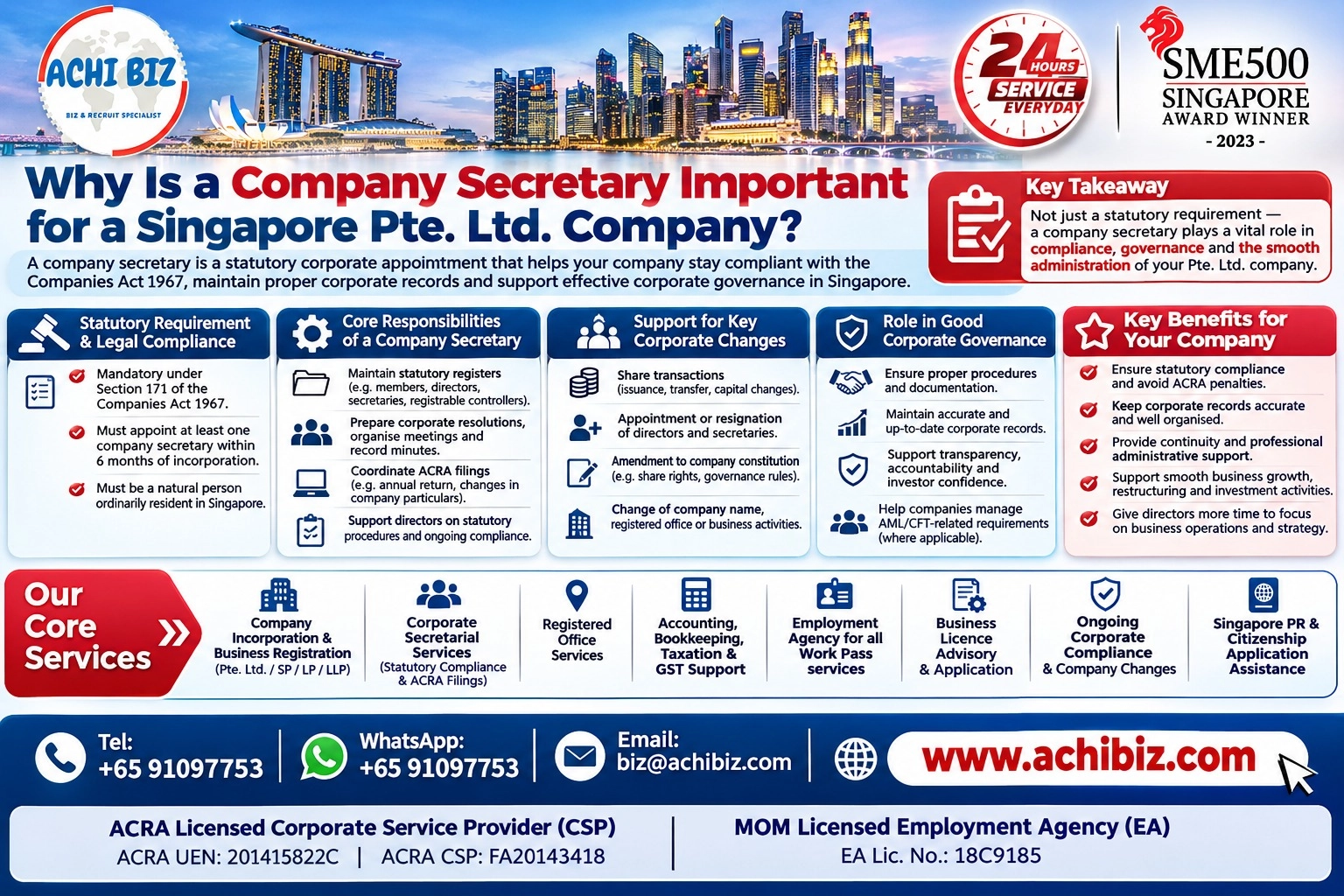
Why Is a Company Secretary Important for a Singapore Pte. Ltd. Company? Roles, Responsibilities, Benefits & Compliance FAQs
A Comprehensive Guide to Corporate Secretarial Services, Statutory Compliance, Directors’ Responsibilities and Good Corporate Governance in Singapore
Introduction
In Singapore, incorporating a Private Limited Company (Pte. Ltd.) is only the beginning of running a legally compliant business. Once incorporated, a company must fulfil ongoing statutory obligations under the Companies Act 1967, maintain proper corporate records, meet filing deadlines and ensure that important corporate decisions are documented correctly.
This is where a company secretary plays an essential role.
A company secretary is not simply an administrative assistant or someone who prepares documents for ACRA. The position is a statutory corporate appointment with responsibilities that contribute to regulatory compliance, corporate governance, recordkeeping and the orderly administration of a company.
Under Section 171 of the Companies Act 1967, every Singapore-incorporated company must appoint at least one company secretary within six months of incorporation. The appointed secretary must meet the applicable statutory requirements, including the requirement to be ordinarily resident in Singapore.
For private limited companies, particularly small and medium-sized enterprises (SMEs), startups, family-owned businesses, investment holding companies and foreign-owned subsidiaries, an experienced company secretary can help directors understand their obligations and avoid preventable administrative mistakes.
However, appointing a company secretary does not transfer all legal responsibilities away from the directors. Directors remain accountable for managing the company and ensuring that its statutory obligations are fulfilled.
This FAQ guide examines why company secretaries are important in Singapore, what they actually do, how their responsibilities differ from those of directors, the benefits of professional corporate secretarial services, and the risks companies should understand.
Part 1: Understanding the Importance of a Company Secretary in Singapore
Why is a company secretary important for a Singapore Pte. Ltd. company?
A company secretary helps a private limited company maintain its statutory records, administer required corporate procedures, coordinate regulatory filings and support compliance with the Companies Act 1967.
The importance of this role becomes clearer when a company undergoes changes such as appointing directors, issuing shares, changing shareholders, updating its registered office or preparing its annual return.
These events often require specific documentation, internal approvals and ACRA filings.
An experienced company secretary helps ensure that the relevant steps are identified and completed properly.
Is appointing a company secretary mandatory for every Singapore private limited company?
Yes.
Section 171 of the Companies Act requires every Singapore-incorporated company to have one or more secretaries.
The first secretary must be appointed within six months after incorporation.
The requirement applies to private limited companies regardless of their size, profitability or business activity.
Why does Singapore law require companies to appoint a company secretary?
A company is a separate legal entity with statutory obligations that continue throughout its existence.
The company secretary provides an identifiable corporate officer responsible for supporting important administrative and governance functions.
The requirement helps promote orderly corporate administration, proper documentation and accountability.
Is a company secretary merely an administrative assistant?
No.
Although the role involves administrative work, a company secretary is a statutory officer of the company.
Corporate secretarial responsibilities may include maintaining statutory registers, preparing corporate resolutions, coordinating meetings, facilitating ACRA filings and advising directors on procedural compliance.
The role should not be confused with ordinary clerical or personal secretarial duties.
What is the difference between a company secretary and a corporate secretary?
In Singapore, these expressions are commonly used interchangeably when referring to the statutory secretary appointed under the Companies Act.
A company secretary is the individual appointed as the company’s statutory officer.
Corporate secretarial services generally refers to the professional services provided to support the company’s statutory administration.
A corporate service provider may assist a company by arranging a qualified individual to serve as its company secretary and providing related administrative support.
Is a company secretary necessary if a company has only one director?
Yes.
A company with only one director must still appoint a company secretary.
Furthermore, where a company has only one director, that sole director cannot simultaneously serve as the company’s secretary.
The company must appoint another eligible individual.
Does a small company need a company secretary even if it has very few transactions?
Yes.
The statutory requirement is not based on transaction volume.
A company with minimal business activity may still need to maintain registers, file annual returns, record corporate decisions and comply with applicable statutory obligations.
Does a dormant company need a company secretary?
Yes.
Dormant status does not automatically remove the requirement to appoint a company secretary.
Although certain financial reporting or audit requirements may differ for eligible dormant companies, the company continues to exist as a legal entity and remains subject to applicable corporate administration requirements.
Does an investment holding company need a company secretary?
Yes.
An investment holding company incorporated in Singapore must appoint a company secretary even if it has no employees or conducts few transactions.
Changes involving investments, share ownership, directors, financial statements or corporate structure may still require proper documentation.
Does a foreign-owned Singapore Pte. Ltd. company need a local company secretary?
Yes.
A Singapore-incorporated company must appoint a secretary who is ordinarily resident in Singapore, regardless of whether its shareholders are Singapore residents or foreign persons.
Foreign ownership does not exempt a company from this requirement.
Is the company secretary important only during incorporation?
No.
The company secretary’s role continues throughout the company’s lifecycle.
The company’s needs may change from initial incorporation to business expansion, restructuring, changes in ownership and eventual closure.
Corporate secretarial support is therefore an ongoing requirement rather than a one-time incorporation service.
Part 2: Legal Requirements for Appointing a Company Secretary
What is the legal basis for appointing a company secretary in Singapore?
The principal statutory provision is Section 171 of the Companies Act 1967.
It establishes the requirement for a company to have a secretary and sets out important conditions relating to appointment, eligibility and the office of secretary.
Other provisions of the Companies Act govern matters such as company records, annual returns, corporate meetings and directors’ responsibilities.
How soon must a newly incorporated company appoint its first company secretary?
A Singapore company must appoint its first secretary within six months after incorporation.
The appointment should be arranged early enough to avoid unnecessary compliance risks.
Many companies appoint their secretary shortly after incorporation so that their corporate administration can be organised from the beginning.
Can a company appoint its secretary immediately after incorporation?
Yes.
There is no need to wait until the end of the six-month period.
Early appointment is often practical because the company may need assistance with initial corporate records, statutory registers, share documentation and other post-incorporation matters.
Can a company operate without a secretary during its first six months?
The Companies Act allows up to six months for the first secretary’s appointment.
However, this does not suspend the company’s other statutory responsibilities during that period.
A company should not assume that it can disregard corporate documentation or compliance requirements simply because its first secretary has not yet been appointed.
Must a Singapore company secretary be ordinarily resident in Singapore?
Yes.
Section 171 requires a company secretary to be a natural person who has their principal or only place of residence in Singapore.
A foreign shareholder or overseas director who does not satisfy this residency requirement cannot be appointed merely because they own or manage the company.
Can a Singapore citizen serve as a company secretary?
Yes, provided the individual satisfies the applicable legal requirements and is not disqualified.
Singapore citizenship alone should not be treated as proof of professional competence.
The company should consider whether the individual has sufficient knowledge and ability to perform the role.
Can a Singapore Permanent Resident serve as a company secretary?
Yes, provided the individual meets the statutory residency and eligibility requirements.
The company should also consider the person’s experience, competence and ability to carry out the required duties.
Can an Employment Pass holder be appointed as a company secretary?
An Employment Pass holder may potentially satisfy the ordinary residency requirement if their principal or only place of residence is in Singapore.
However, the proposed appointment must also comply with applicable immigration, employment and work pass conditions.
Holding an Employment Pass does not automatically authorise a person to undertake secretarial work for any company.
Must a company secretary hold professional qualifications?
Not every secretary of a private limited company must hold a particular professional qualification.
However, the person must meet the statutory requirements and should have the necessary knowledge and competence to perform the role properly.
Additional qualification and experience requirements apply to secretaries of public companies.
What qualifications are required for a public company secretary?
Section 171 imposes additional requirements concerning the qualifications and experience of secretaries appointed by public companies.
These requirements may be satisfied through specified professional qualifications, relevant experience or other statutory criteria.
The requirements for public companies should not be automatically applied to every private limited company.
Can a director also serve as the company secretary?
In certain circumstances, yes.
A director may also serve as secretary if the appointment satisfies the Companies Act.
However, a sole director cannot simultaneously serve as the company’s sole secretary.
Companies should also consider practical governance concerns when combining the two roles.
Can a sole director act as the sole company secretary?
No.
Section 171 prohibits a company’s sole director from also acting as its secretary.
A single-director company must appoint another eligible individual.
Can a shareholder be appointed as the company secretary?
Yes, provided the shareholder satisfies the applicable statutory requirements.
Share ownership does not automatically disqualify a person from serving as secretary.
However, the company should consider whether the individual has the necessary competence and capacity to perform the role.
Can a company appoint more than one company secretary?
Yes.
The Companies Act allows a company to appoint one or more secretaries.
Whether multiple appointments are necessary depends on the company’s structure, governance needs and administrative arrangements.
Can another company be appointed as the statutory company secretary?
No.
The statutory secretary must be a natural person.
A corporate service provider may supply secretarial services and arrange for an eligible individual to be appointed, but the provider company itself does not replace the statutory appointment of an individual.
Who is responsible for appointing the company secretary?
The appointment is made through the company’s proper corporate procedures, ordinarily by the board of directors in accordance with the company’s constitution and applicable law.
The appointment should be appropriately documented and the required particulars lodged with ACRA.
Does the appointed company secretary need to consent?
Yes.
The company should obtain the individual’s consent to act and confirm that the person satisfies the relevant statutory requirements.
The appointment should not be treated as effective merely because the individual’s name has been suggested.
Must the appointment of a company secretary be filed with ACRA?
Yes.
The company must ensure that the appointment and relevant particulars are properly reflected in ACRA’s records within the applicable filing requirements.
Companies should maintain supporting documentation for the appointment.
Can a company secretary resign?
Yes.
A company secretary may resign in accordance with the applicable legal and contractual arrangements.
The company must address the resulting vacancy and make the required ACRA notification.
How long can the position of company secretary remain vacant?
Under Section 171, the office of secretary must not be left vacant for more than six months at any one time.
Nevertheless, a company should appoint a replacement promptly rather than routinely relying on the maximum vacancy period.
What happens if a company fails to appoint a secretary within the statutory period?
The company may be in breach of the Companies Act.
The company and relevant officers may face enforcement action or statutory penalties, depending on the applicable provision and circumstances.
The absence of a secretary can also disrupt corporate administration and delay necessary filings.
Can ACRA disqualify a person from acting as company secretary?
The Companies Act contains provisions concerning persons who are disqualified from acting as company secretaries.
Companies should verify that a proposed secretary is eligible and not subject to an applicable disqualification.
Part 3: Duties and Responsibilities of a Company Secretary
What are the main duties of a company secretary in Singapore?
The precise responsibilities depend on the law, the company’s constitution, internal arrangements and the secretary’s engagement.
Common duties include maintaining statutory registers, preparing corporate resolutions, coordinating meetings, supporting ACRA filings, maintaining corporate records and reminding directors of relevant compliance obligations.
The secretary may also assist with documenting changes to the company’s corporate structure.
Is the company secretary responsible for maintaining statutory registers?
Maintaining or coordinating the maintenance of statutory registers is a common corporate secretarial function.
These may include records concerning members, directors, secretaries and other information required by law.
The company must ensure that its statutory records are maintained in the prescribed manner, whether internally or through an appointed service provider.
What is the company secretary’s role in maintaining the Register of Members?
The Register of Members records the company’s membership and shareholding particulars in accordance with the applicable statutory framework.
For Singapore private companies, ACRA’s electronic register framework is particularly relevant.
The secretary may help ensure that share allotments, transfers and other changes are properly documented and lodged so that the relevant records remain accurate.
Does the company secretary maintain the Register of Directors and Secretaries?
The secretary commonly coordinates the company’s records and ACRA filings concerning directors and secretaries.
The company must ensure that changes in appointments, resignations and relevant particulars are accurately reported.
What is the company secretary’s role in the Register of Registrable Controllers?
Singapore companies subject to the relevant requirements must maintain information concerning their registrable controllers.
A company secretary or corporate service provider may assist with identifying filing requirements, preparing notices, maintaining records and coordinating updates.
However, determining registrable controllers may require information and cooperation from shareholders, directors and other relevant persons.
Does the company secretary handle nominee director and nominee shareholder registers?
Corporate secretarial support may include assisting companies with their obligations concerning nominee directors and nominee shareholders.
These obligations are subject to the applicable Companies Act provisions and ACRA requirements.
The company should ensure that nominee arrangements are correctly identified, documented and reported where required.
Can a company secretary assist with identifying beneficial owners?
Yes.
A company secretary or corporate service provider may assist with gathering ownership information and supporting the company’s beneficial ownership compliance processes.
However, beneficial ownership assessments may involve complex questions of indirect ownership, control and nominee arrangements.
The secretary should not simply assume that the person named as the registered shareholder is always the ultimate beneficial owner.
Is the company secretary responsible for preparing directors’ resolutions?
Preparing and maintaining directors’ resolutions is a common corporate secretarial function.
Resolutions may be required for matters such as bank account arrangements, changes in officers, share transactions, approval of certain agreements and other corporate decisions.
The secretary’s role is generally to support proper documentation and procedure, not to make commercial decisions on behalf of the board.
What is the company secretary’s role in shareholders’ resolutions?
The secretary may assist with preparing resolutions, identifying applicable approval procedures and maintaining records of decisions made by shareholders.
Different corporate matters may require ordinary resolutions, special resolutions or other forms of approval.
The company’s constitution and the Companies Act must be considered.
Does a company secretary organise board meetings?
A company secretary may coordinate board meetings, prepare notices, circulate documents, assist with agendas and record minutes.
The extent of involvement depends on the company’s arrangements.
The board remains responsible for its decisions.
Is the company secretary responsible for preparing meeting minutes?
Preparing and maintaining minutes is a common responsibility.
Minutes provide an important record of corporate proceedings and decisions.
Accurate minutes can help demonstrate that appropriate approvals were obtained and relevant procedures followed.
Can a company secretary sign company documents?
A company secretary may sign certain documents where authorised or where the relevant law permits.
However, the scope of signing authority depends on the document, applicable statutory provisions and the company’s internal authorisation arrangements.
Appointment as secretary does not automatically provide unrestricted authority to sign every contract or make every corporate decision.
Does the company secretary have authority to bind the company?
Not automatically for every transaction.
The secretary’s authority depends on the nature of the act, the applicable law and any actual or apparent authority arising from the company’s arrangements.
Companies should establish clear approval and signing procedures, especially for significant financial or commercial transactions.
Can a company secretary make business decisions for the directors?
Ordinarily, no.
Directors are responsible for managing or directing the management of the company’s business, subject to the Companies Act and the company’s constitution.
The secretary may provide administrative and procedural support, but does not automatically assume the board’s management powers.
Does the company secretary ensure that directors comply with the Companies Act?
A company secretary can help directors understand relevant statutory procedures, deadlines and documentation requirements.
However, it would be inaccurate to suggest that the secretary personally guarantees the company’s compliance.
Directors and other officers retain their respective legal responsibilities.
Is the company secretary responsible for monitoring statutory filing deadlines?
Monitoring and communicating relevant filing deadlines is a common feature of professional corporate secretarial services.
This may include annual returns and changes in company particulars.
Nevertheless, the company should maintain its own oversight and provide the secretary with accurate information promptly.
Can a company secretary advise on corporate governance?
Yes, within the person’s competence and professional scope.
A knowledgeable secretary may assist with board procedures, shareholder approvals, recordkeeping and governance practices.
Complex legal questions should be referred to appropriately qualified legal professionals where necessary.
Part 4: The Company Secretary’s Role in ACRA Annual Returns and Financial Reporting
Why is a company secretary important for ACRA annual return filing?
Annual return filing is one of the recurring compliance responsibilities of a Singapore-incorporated company.
A company secretary commonly helps identify the relevant filing deadline, coordinate the necessary information and prepare or arrange the submission through ACRA’s Bizfile system.
The secretary may also check whether changes in the company’s particulars need to be addressed before the annual return is filed.
This reduces the risk of inconsistent corporate records, overlooked filing requirements and avoidable delays.
Does every Singapore Pte. Ltd. company need to file an annual return?
Generally, yes.
Singapore-incorporated companies must file annual returns with ACRA in accordance with the Companies Act, including companies that are dormant or have limited business activity.
The applicable filing requirements may differ according to the company’s circumstances, but inactivity alone does not eliminate the obligation.
What is the annual return filing deadline for a Singapore private limited company?
For an ordinary non-listed Singapore company, the annual return is generally due within seven months after its financial year-end (FYE).
Different deadlines may apply to certain companies, including listed companies and companies with particular statutory circumstances.
The secretary should assess the company’s actual filing position rather than assume that every company has the same deadline.
Can a company secretary file an annual return without receiving the necessary financial information?
The secretary may be unable to complete the filing accurately if required information or documents have not been provided.
Directors should ensure that financial statements and other relevant records are prepared and supplied on time.
A secretary should not invent financial figures or submit inaccurate information simply to meet a deadline.
Is the company secretary responsible for preparing financial statements?
Not automatically.
Financial statements are ordinarily prepared by the company’s accounting personnel, external accountants or other appropriately engaged professionals.
The company secretary may coordinate their presentation, approval, circulation and related corporate procedures.
The directors remain responsible for fulfilling the company’s financial reporting obligations.
Is a company secretary the same as an accountant?
No.
A company secretary primarily supports corporate administration, governance and statutory company compliance.
An accountant generally focuses on bookkeeping, financial reporting, accounting records and related financial matters.
Some corporate service providers offer both services, but they remain distinct professional functions.
Can a company secretary replace an external auditor?
No.
The statutory secretary and external auditor perform different functions.
A company secretary does not become the company’s independent auditor merely because the person maintains corporate records or coordinates financial statement procedures.
Where a statutory audit is required, the company must comply with the applicable auditor appointment and audit requirements.
Can a company secretary determine whether a Pte. Ltd. company qualifies for audit exemption?
An experienced company secretary may assist directors in understanding the statutory audit exemption criteria and coordinate an assessment with the company’s accountant or auditor.
However, eligibility depends on the relevant financial and corporate circumstances.
The company should not assume that every private limited company automatically qualifies for audit exemption.
Does an audit-exempt company still need a company secretary?
Yes.
Audit exemption and the requirement to appoint a company secretary are separate matters.
A company may qualify for audit exemption while remaining subject to corporate secretarial, annual return and other statutory obligations.
Does the company secretary file corporate income tax returns with IRAS?
Not necessarily.
Corporate income tax filing is a separate compliance function, commonly handled by the company’s accountant or tax agent.
A corporate service provider may offer tax filing services separately, but the appointment of a company secretary does not automatically include preparation or filing of corporate income tax returns.
Can a company secretary help coordinate ACRA and IRAS compliance?
Yes.
A secretary may help identify corporate filing requirements and coordinate with accountants or tax agents regarding relevant financial reporting matters.
However, ACRA annual returns and IRAS corporate income tax returns are separate filings, with different statutory requirements and deadlines.
Completing one does not automatically satisfy the other.
What happens if a company misses its ACRA annual return deadline?
Late filing may result in late lodgement penalties and other regulatory consequences.
Persistent non-compliance may expose the company and responsible officers to further enforcement action.
A company secretary can assist with monitoring deadlines, but the company and its directors should remain actively involved in compliance management.
Can a company secretary guarantee that ACRA penalties will never occur?
No.
No professional should guarantee that a company will never face late filing penalties or regulatory action.
Compliance depends on timely information, accurate documentation, appropriate approvals and the company’s cooperation.
A reliable secretary can help reduce preventable mistakes, but cannot eliminate every risk.
Can a company secretary assist with a change of financial year-end?
Yes.
Changing a company’s financial year-end may involve corporate approvals, ACRA notifications and statutory restrictions.
The secretary may help assess the applicable filing procedure and coordinate the necessary documentation.
The change may also affect annual return deadlines and financial reporting obligations, so the company should consider the wider consequences before proceeding.
Part 5: Shareholders, Share Capital and Corporate Ownership Changes
Why is a company secretary important when a Pte. Ltd. company issues new shares?
Issuing new shares changes the company’s share capital and may affect ownership percentages, voting rights and shareholder relationships.
The company secretary may assist with preparing resolutions, checking relevant constitutional requirements, coordinating allotment documentation and filing the necessary information with ACRA.
A share issue should not be treated as a simple administrative change because it may also have commercial, contractual and legal consequences.
Can a company secretary issue shares without directors’ approval?
No general authority to issue shares arises merely from being appointed company secretary.
A share allotment must comply with the Companies Act, the company’s constitution and applicable corporate approval requirements.
The secretary may coordinate the process but should not independently authorise the transaction.
What is the company secretary’s role in a transfer of shares?
The secretary may assist with share transfer documentation, corporate approvals, stamp duty coordination where applicable and the relevant ACRA filing requirements.
The transaction must comply with the company’s constitution and any applicable shareholder agreements.
The secretary should also ensure that the company’s records reflect the completed transaction accurately.
Can a company secretary decide the selling price of shares?
No.
The consideration for a share transfer is generally a commercial matter for the relevant parties, subject to applicable law and contractual arrangements.
A secretary may assist with documentation and procedural requirements but should not independently determine the transaction price.
Can a company secretary advise on shareholding percentages?
Yes, within the scope of the engagement.
For example, the secretary may assist with calculating the ownership percentages arising from a proposed share allotment.
However, ownership calculations should be distinguished from legal or financial advice concerning valuation, dilution, shareholder rights and investment terms.
Why should a company secretary review the company’s constitution before a share transaction?
The constitution may contain provisions affecting share transfers, share issues, voting rights, approval procedures and other corporate matters.
Ignoring these provisions may result in an improperly documented or disputed transaction.
The secretary can help identify relevant procedural requirements and recommend further professional advice where necessary.
Can a company secretary assist with pre-emption rights?
Yes.
A company secretary may help identify whether relevant pre-emption rights arise under the company’s constitution, shareholders’ agreement or applicable law.
The secretary may also coordinate notices, resolutions and supporting documents.
However, interpreting complex shareholder rights or resolving disputes may require legal advice.
Can a company secretary assist with the appointment of new shareholders?
The term appointment of shareholders is not generally the appropriate legal description.
A person becomes a shareholder through a legally recognised process, such as a share allotment or transfer, rather than through appointment in the same way as a director.
The secretary may help coordinate the appropriate share transaction and update the relevant records.
Can a company secretary help a company increase its paid-up share capital?
Yes.
The secretary may assist with the corporate procedures and ACRA filings associated with an allotment of additional shares.
However, the company should distinguish between issuing new shares, increasing paid-up capital and changing the terms of existing shares.
These transactions may have different legal and accounting consequences.
Is a company secretary involved in reducing share capital?
A secretary may assist with the procedural and documentation requirements for a proposed capital reduction.
However, a capital reduction is a significant corporate transaction governed by specific statutory requirements.
The company should obtain appropriate professional advice before proceeding.
Can a company secretary help with changes to share classes?
Yes.
Where a company proposes to create or alter share classes, the secretary may coordinate the relevant corporate procedures, resolutions and filings.
The company must consider the rights attached to the shares, constitutional provisions and applicable statutory requirements.
Can a company secretary help resolve shareholder disputes?
A secretary may help locate corporate records, identify documented decisions and explain relevant administrative procedures.
However, a company secretary is not automatically a mediator, arbitrator or legal representative.
Disputes involving ownership, director conduct or shareholder rights may require independent legal advice.
Why are accurate shareholder records important?
Shareholder records affect ownership, voting rights, dividend entitlements and the administration of corporate transactions.
Inaccurate records can create confusion and potentially lead to disputes or regulatory difficulties.
Maintaining accurate records is therefore an important part of sound corporate governance.
Part 6: Directors’ Appointments, Resignations and Corporate Governance
What role does a company secretary play when appointing a new director?
A secretary may assist with checking the required corporate procedures, preparing appointment documents, obtaining relevant declarations and consent, and coordinating the ACRA filing.
The company must also consider whether the proposed director meets the statutory eligibility requirements.
Can a company secretary appoint a director independently?
No.
The appointment of a director must follow the applicable corporate approval procedures.
A company secretary may prepare and lodge the relevant documentation but does not ordinarily have independent authority to select or appoint directors.
What happens when a director resigns?
The company must ensure that the resignation is properly documented and that the relevant statutory requirements are satisfied.
The secretary may coordinate the necessary records and ACRA notification.
A company must also ensure that it continues to meet the statutory requirement to have at least one director who is ordinarily resident in Singapore.
Can a director resign if the company will have no remaining director ordinarily resident in Singapore?
The Companies Act restricts a director’s resignation where it would leave the company without a director ordinarily resident in Singapore.
The company should arrange an eligible replacement before proceeding where necessary.
The secretary can assist with coordinating the sequence of appointments and resignations.
Is the company secretary responsible for checking directors’ eligibility?
A secretary or corporate service provider may assist with obtaining declarations and checking relevant statutory eligibility requirements.
However, the proposed director and the company must provide accurate information.
Certain appointments may also require additional regulatory checks or approvals.
Can a company secretary assist with a change in the company’s business activities?
Yes.
Where a company changes its principal business activities, the secretary may help coordinate the necessary ACRA updates.
The company should also consider whether the new activities require additional business licences or regulatory approvals.
Can a company secretary assist with changing the company’s name?
Yes.
A name change may require name availability checks, corporate approvals and ACRA filings.
The secretary may assist with these procedures and the updating of relevant corporate records.
The company should also review the practical implications for contracts, banking arrangements, licences and business communications.
Can a company secretary assist with amending the company’s constitution?
Yes.
The secretary may coordinate the required resolutions and filing procedures.
However, amendments to a constitution can affect shareholder rights, management powers and corporate governance.
Substantive changes should be carefully reviewed and, where appropriate, supported by legal advice.
Why is the company secretary important for proper corporate governance?
Good corporate governance depends on clear authority, documented decisions, accurate records and appropriate procedures.
The company secretary supports these elements by helping directors and shareholders follow the relevant corporate processes.
This becomes particularly important when a company grows, admits new investors or develops a more complex ownership structure.
Does a company secretary owe duties to the company?
Yes.
A company secretary is a statutory officer and may be subject to legal duties and responsibilities arising from the Companies Act, the nature of the appointment and applicable general law.
The precise duties and potential liability depend on the circumstances.
The secretary should act within the scope of authority and avoid knowingly participating in improper corporate conduct.
Can a company secretary be personally liable for corporate compliance failures?
Potentially, yes.
The Companies Act imposes responsibilities and penalties on companies and, in appropriate circumstances, officers in default.
Whether a particular secretary is personally liable depends on the statutory provision, the person’s conduct and the facts of the case.
The position should not be regarded as one without legal responsibility.
Does appointing a company secretary remove directors’ personal responsibilities?
No.
Directors retain their statutory and fiduciary responsibilities.
They cannot automatically avoid liability by claiming that the company secretary or corporate service provider was responsible for the relevant matter.
Professional support helps directors manage compliance; it does not replace their legal accountability.
Part 7: Company Secretary and Anti-Money Laundering Compliance
Why is AML/CFT compliance relevant to corporate secretarial services in Singapore?
Corporate service providers may be exposed to money laundering, terrorism financing and proliferation financing risks because they assist with company formation, ownership arrangements and corporate administration.
Singapore regulates relevant corporate service provider activities to reduce the misuse of corporate structures for unlawful purposes.
A company secretary working within a regulated corporate service provider may therefore be involved in collecting customer information and supporting compliance procedures.
Is every company secretary automatically an AML/CFT compliance officer?
No.
The statutory appointment of a company secretary and the appointment of an AML/CFT compliance officer are different matters.
A corporate service provider must establish appropriate compliance arrangements under the applicable regulatory framework.
The responsibilities of its compliance personnel should not be automatically attributed to every company secretary.
What is the difference between a company secretary and an ACRA Licensed Corporate Service Provider (CSP)?
A company secretary is an individual appointed as a statutory officer of a company.
A corporate service provider is a business that provides regulated corporate services and must comply with the applicable CSP regulatory framework.
An ACRA Licensed Corporate Service Provider (CSP) may provide corporate secretarial services through appropriately appointed individuals, together with other services within its authorised scope.
The two roles are related but legally distinct.
Why does customer due diligence matter when appointing a corporate secretarial service provider?
Customer due diligence helps a regulated service provider understand its customers, ownership structures and the nature of the proposed business relationship.
Depending on the circumstances, this may involve verifying identities, identifying beneficial owners, assessing risks and obtaining supporting documents.
These procedures help protect the integrity of Singapore’s corporate services sector.
Can a company secretary help identify unusual corporate transactions?
An experienced secretary may recognise unusual changes in ownership, unexplained appointments, inconsistent corporate instructions or transactions requiring additional clarification.
However, identifying unusual circumstances does not automatically establish that an offence has occurred.
Where concerns arise, they should be addressed through the applicable internal compliance and reporting procedures.
Can a corporate service provider refuse a company secretary appointment?
Yes.
A provider may decline an engagement where it cannot satisfy applicable due diligence requirements, where the proposed arrangement raises unacceptable risks or where the engagement cannot be performed lawfully.
A company should not assume that payment of a service fee automatically guarantees acceptance.
Can a company secretary disclose a customer’s confidential information?
A company secretary should handle confidential information responsibly and comply with applicable legal, contractual and professional obligations.
However, confidentiality is not absolute.
Disclosure may be required or permitted under applicable laws, including regulatory reporting, statutory filing and lawful information requests.
Why should directors cooperate with their corporate service provider’s compliance checks?
Directors and shareholders may be asked to provide identification documents, ownership information and explanations concerning business activities.
Prompt and accurate cooperation helps the provider complete required checks and maintain appropriate records.
Refusing to provide necessary information may delay or prevent the provision of services.
Part 8: Professional Corporate Secretarial Services Versus In-House Administration
Should a Singapore Pte. Ltd. company appoint an in-house or outsourced company secretary?
Both arrangements may be suitable.
An in-house secretary may be appropriate for a larger company with frequent corporate transactions and complex governance requirements.
Outsourced corporate secretarial services may be more practical for SMEs, startups and companies without a dedicated corporate administration department.
The choice depends on the company’s size, complexity, resources and service expectations.
What are the benefits of outsourcing company secretarial services in Singapore?
Outsourcing may provide access to experienced corporate administration personnel without the cost of employing a full-time in-house secretary.
It can also help companies coordinate routine filings, maintain corporate records and manage procedural requirements.
However, the quality and scope of outsourced services vary between providers.
Is outsourcing company secretarial services more cost-effective?
It can be, particularly for companies with relatively straightforward corporate structures.
An outsourced arrangement may reduce the need for a dedicated employee and provide access to specialised administrative support.
Nevertheless, companies should compare the actual scope of services rather than relying solely on the advertised annual fee.
What is usually included in an annual corporate secretarial service package?
The scope depends on the provider’s engagement terms.
A typical package may include the appointment of a company secretary, maintenance of specified statutory records, routine corporate administration and assistance with annual return filing.
Additional services such as share allotments, share transfers, director changes, constitutional amendments and complex restructuring may be charged separately.
Are ACRA filing fees included in company secretary service fees?
Not necessarily.
Professional service fees and ACRA statutory filing fees are different charges.
Companies should clarify whether government fees, disbursements, document preparation and transaction-specific services are included in the quoted price.
What should companies check before signing a corporate secretarial service agreement?
The agreement should clearly explain the services provided, responsibilities of the parties, annual charges, additional fees, document handling arrangements and termination procedures.
Companies should also check how statutory deadlines are monitored and how corporate records will be transferred if the engagement ends.
Clear terms reduce misunderstandings later.
Can a company appoint a secretary from one firm and an accountant from another?
Yes.
A company may engage separate providers for corporate secretarial, accounting and tax services.
However, effective coordination is important because corporate filings and financial reporting may depend on information maintained by different professionals.
Is it better to engage one provider for incorporation, secretarial, accounting and tax services?
An integrated service arrangement may simplify communication and coordination.
For example, the provider may be better positioned to identify when a corporate change has accounting or tax implications.
However, integration alone does not guarantee better service.
The company should consider each provider’s competence, regulatory standing, responsiveness and service scope.
Can a company secretary help foreign entrepreneurs understand Singapore compliance requirements?
Yes.
Foreign entrepreneurs may be unfamiliar with Singapore’s statutory filing procedures, company registers, shareholder resolutions and directors’ obligations.
A knowledgeable secretary can explain relevant corporate administration requirements and help coordinate the necessary procedures.
However, legal, immigration, taxation and other specialised matters may require separate professional advice.
Why is a reliable company secretary important for foreign-owned subsidiaries?
Foreign-owned subsidiaries may have directors and shareholders located in different jurisdictions.
Corporate approvals, document execution and reporting requirements may therefore require additional coordination.
A reliable Singapore-based secretary can assist with local statutory administration and communication between the company and its overseas stakeholders.
Part 9: Company Secretary Fees, Appointment Changes and Service Quality
How much does a company secretary cost in Singapore?
Corporate secretarial fees vary according to the provider, the company’s circumstances and the services included.
Some providers offer annual packages for routine compliance support, while others charge separately for annual return filing, resolutions, changes in officers and share transactions.
Companies should request a detailed quotation and compare the total expected cost.
Is the cheapest company secretary service always the best choice?
Not necessarily.
A low annual fee may be attractive, but it is important to understand what the package actually covers.
A company may incur additional charges for routine transactions, urgent requests, document retrieval or termination-related administration.
Reliability, accuracy and responsiveness should be considered alongside price.
What are the warning signs of an unreliable company secretary?
Potential warning signs include repeated filing delays, inaccurate corporate records, poor communication, unexplained charges and difficulty obtaining company documents.
A provider that cannot clearly explain its service scope or statutory procedures may also warrant closer scrutiny.
Companies should address these issues early rather than waiting until a compliance problem arises.
How can directors evaluate the performance of their company secretary?
Directors can assess whether statutory filings are handled promptly, corporate records remain accurate and requests receive clear responses.
They should also consider whether the secretary identifies relevant procedural requirements and communicates important deadlines.
Regular review is particularly useful when the company undergoes frequent corporate changes.
Can a Singapore company change its company secretary?
Yes.
A company may replace its secretary through the appropriate corporate procedures.
The appointment of the incoming secretary and cessation of the outgoing secretary must be properly documented and reported to ACRA within the applicable statutory requirements.
What should a company consider before changing its corporate secretarial service provider?
The company should review its existing engagement terms, outstanding fees, pending filings and corporate records.
It should also confirm the incoming provider’s service scope and establish a clear handover arrangement.
A poorly coordinated transition may result in missing records or overlooked deadlines.
What documents should be handed over when changing company secretaries?
Depending on the company’s circumstances, the handover may include its constitution, statutory records, resolutions, minutes, share-related documentation, filing acknowledgements and other relevant corporate records.
The company should also identify outstanding compliance matters and pending transactions.
The handover should be documented so that both the company and incoming provider understand what has been transferred.
Can an outgoing company secretary withhold statutory company records?
The company’s statutory records should not be treated as the personal property of the outgoing secretary.
The parties’ rights and obligations concerning document custody, outstanding fees and handover arrangements depend on the law and the relevant engagement terms.
Disputes should be addressed promptly, particularly where withholding records may affect statutory compliance.
Can a company secretary resign without arranging a replacement?
A secretary may resign in accordance with applicable law and the appointment arrangements.
However, the company remains responsible for ensuring that the position is not vacant beyond the statutory period.
Directors should arrange a replacement promptly and ensure the required filings are completed.
Can a company secretary be removed for poor performance?
Yes, subject to the company’s constitution, applicable law and contractual arrangements.
The company should document the change properly and ensure continuity of its statutory administration.
Where poor performance has caused filing errors or compliance failures, those issues should be reviewed separately.
Part 10: Company Secretaries During Business Expansion, Restructuring and Closure
How can a company secretary support business expansion?
Business expansion may involve new shareholders, additional directors, changes in share capital or changes to the company’s corporate structure.
A company secretary can assist with documenting these developments and coordinating the required corporate filings.
Where transactions have significant legal, financial or tax consequences, additional professional advice may be necessary.
Is a company secretary involved when a company opens a new branch or business location?
The secretary may assist with corporate approvals and relevant ACRA updates where required.
However, opening a business location may also involve property-use conditions, licensing requirements and other regulatory matters outside the secretary’s ordinary responsibilities.
Can a company secretary assist with a change in the company’s registered office address?
Yes.
The secretary may coordinate the corporate documentation and ACRA filing associated with a registered office address change.
Under Section 143 of the Companies Act, a change in the situation of the registered office must be notified to ACRA within 14 days after the change.
Does the company secretary need to maintain the registered office’s former three-hour daily opening requirement?
No.
Following the amendments effective 20 October 2026, the former minimum three-hour daily registered office opening requirement was removed.
However, companies must continue maintaining a valid registered office in Singapore and complying with applicable statutory record inspection requirements.
The company secretary can help directors distinguish between these separate obligations.
Can a company secretary assist with corporate restructuring?
Yes.
The secretary may coordinate the resolutions, records and ACRA filings required for certain restructuring activities.
However, restructuring may involve complex legal, accounting, taxation and commercial considerations.
The secretary’s procedural role should not be confused with providing all the specialist advice needed for the transaction.
Can a company secretary assist with converting a company’s status?
Certain changes in company status or structure may be possible under the applicable legislation.
A secretary may help coordinate the relevant procedures and documentation.
However, the company should first determine whether the proposed conversion is legally available and commercially appropriate.
What is the company secretary’s role when a company applies for striking off?
The secretary or corporate service provider may assist with the documentation and application process for striking a company off ACRA’s register.
However, striking off is subject to eligibility requirements.
The company should consider outstanding liabilities, tax matters, legal proceedings and other relevant conditions before applying.
Does a company secretary remain necessary while a company is preparing to close?
Generally, the company remains subject to its applicable statutory obligations while it continues to exist.
The secretary may assist with final corporate administration and filing requirements, depending on the closure process.
Directors should not assume that the secretary’s appointment can simply be disregarded because business operations have stopped.
Can a company secretary act as a liquidator?
Not automatically.
A liquidator performs a distinct legal function in a winding-up process.
A company secretary does not become qualified or authorised to act as liquidator merely by holding the secretary appointment.
The company must comply with the relevant insolvency and winding-up requirements.
Part 11: Practical Scenarios for Singapore Pte. Ltd. Companies
Example 1: Why should a newly incorporated company appoint a secretary early?
Consider a newly incorporated Singapore Pte. Ltd. company with one director and one shareholder.
The owner may initially focus on banking arrangements, customers and business development.
However, the company must also establish its corporate records and comply with statutory requirements.
Appointing a secretary early helps organise the company’s initial administration and reduces the risk of overlooking its first compliance obligations.
Example 2: Why does a dormant company still benefit from professional secretarial services?
Suppose a company has stopped trading temporarily but remains incorporated.
Its directors may assume that no further corporate administration is necessary.
However, the company must continue complying with applicable statutory requirements, including maintaining a secretary and filing annual returns.
Professional support can help the directors distinguish between obligations that continue and exemptions that may be available.
Example 3: How can a company secretary help when a new investor joins a Pte. Ltd. company?
Imagine that a Singapore company wishes to issue new shares to an investor.
The transaction may change ownership percentages and require corporate approvals, documentation and ACRA filings.
The secretary can coordinate the relevant procedures and help ensure that the transaction is properly recorded.
Legal and financial advisers may separately address the investment agreement, valuation and shareholder rights.
Example 4: What happens when a sole director wants to resign?
Suppose a private limited company has only one director who is ordinarily resident in Singapore.
That director cannot simply resign and leave the company without a locally resident director.
The company must first address the statutory director requirement.
A secretary can assist with the necessary appointment and resignation procedures.
Example 5: Why is the company secretary important when a company misses an annual return deadline?
Consider a company that has not completed its financial statements and is approaching its ACRA filing deadline.
The secretary can alert the directors, explain the relevant filing position and coordinate the necessary administrative steps.
However, the secretary cannot lawfully resolve the problem by submitting inaccurate financial information.
The company must address the underlying delay and any resulting compliance consequences.
Example 6: How does a company secretary support a family-owned business?
Family-owned companies may have informal decision-making practices.
As the business grows, disagreements can arise if ownership changes, director appointments or major decisions are not properly documented.
A company secretary helps maintain formal corporate records and supports consistent procedures.
This can be especially valuable when ownership passes between family members or new investors become involved.
Example 7: Why does an overseas business owner need a dependable Singapore company secretary?
A foreign shareholder may manage a Singapore company while residing overseas.
The company must still meet its local statutory obligations.
A dependable Singapore-based secretary can coordinate corporate documentation, ACRA filings and communication concerning relevant administrative matters.
However, the secretary’s appointment does not replace any separate requirement for a locally resident director.
Part 12: Frequently Overlooked Questions About Company Secretaries
Does appointing a company secretary guarantee that the company is fully compliant?
No.
A company secretary can provide valuable support, but compliance depends on several parties performing their responsibilities properly.
Directors must provide accurate information, approve relevant decisions and ensure that the company meets its legal obligations.
The secretary’s role is to support the process, not guarantee every outcome.
Can a company secretary be responsible for mistakes made by directors?
Responsibility depends on the particular circumstances.
Directors remain accountable for their own duties, while a secretary may have separate responsibilities concerning their conduct.
A secretary should not knowingly prepare false records or participate in improper corporate activities merely because a director has instructed them to do so.
Can directors rely entirely on reminders from their company secretary?
Directors may reasonably use professional reminders and compliance support, but they should maintain independent oversight.
Important deadlines should be monitored through suitable internal systems.
This is particularly relevant where a filing depends on financial information or decisions that only the company can provide.
Is a company secretary required to attend every board meeting?
Not necessarily.
Attendance depends on the company’s governance arrangements and the nature of the meeting.
The secretary may attend to assist with procedural matters or prepare minutes, but there is no general requirement that the secretary personally attend every board meeting of every private limited company.
Can a company secretary work remotely?
Many corporate secretarial functions can be performed remotely through electronic records, digital communication and online filing systems.
However, the statutory secretary must satisfy the applicable residency requirement, and the company must continue meeting its legal obligations.
Remote working does not remove those requirements.
Can a company secretary use electronic signatures and digital documents?
Electronic documents and signatures may be used where permitted by the applicable legislation and where the relevant formalities are satisfied.
However, not every document or transaction is subject to identical execution requirements.
Companies should verify the appropriate signing method for each document.
Is the company secretary responsible for renewing business licences?
Not automatically.
Business licensing is a separate regulatory matter.
A corporate service provider may offer business licence advisory or application assistance as an additional service.
The company should clarify whether licence monitoring and renewal assistance are included in its engagement.
Does appointing a company secretary help improve investor confidence?
Proper corporate administration can contribute to investor confidence.
Investors may expect accurate ownership records, properly documented approvals and reliable statutory filings.
A knowledgeable secretary can help maintain these records and support orderly governance.
However, appointing a secretary alone does not establish the company’s financial strength or investment suitability.
Can a company secretary help during a corporate due diligence exercise?
Yes.
A due diligence exercise may require access to corporate records, resolutions, ownership information and historical filing documents.
A secretary who maintains organised and accurate records can help the company respond efficiently to legitimate information requests.
This may be useful during investment, financing, acquisition or restructuring transactions.
Why should company directors understand the secretary’s role even when they outsource the service?
Understanding the role helps directors provide appropriate instructions, identify matters requiring approval and recognise their continuing responsibilities.
It also reduces the risk of assuming that the service provider will automatically handle every legal, tax or business matter.
A productive working relationship requires clear communication and a shared understanding of responsibilities.
Part 13: Choosing the Right Company Secretary for Long-Term Business Compliance
What qualities should a good company secretary possess?
A dependable company secretary should have a sound understanding of relevant corporate procedures, strong attention to detail and the ability to communicate clearly.
Other important qualities include confidentiality, professional integrity, reliability and responsiveness.
The secretary should also recognise when a matter requires specialist legal, accounting or tax advice.
Why is practical experience important when choosing a company secretary?
Practical experience can help a secretary recognise common documentation problems, filing requirements and procedural risks.
For example, changes involving directors, shareholders and share capital may require several coordinated steps.
An experienced secretary is often better positioned to identify those requirements before mistakes occur.
Should a company choose a secretary based only on annual fees?
No.
The annual fee is important, but it should be considered alongside the service scope, experience, communication standards and reliability of the provider.
A low-cost arrangement that results in repeated errors or inadequate support may ultimately be more expensive.
What questions should directors ask a potential corporate secretarial service provider?
Directors should clarify what is included in the annual package, how additional transactions are charged and who will be appointed as the statutory secretary.
They should also ask how filing deadlines are monitored, how corporate records are maintained and how urgent matters are handled.
The provider’s regulatory standing and applicable service conditions should be verified.
How often should a company review its corporate secretarial arrangements?
There is no universal requirement to conduct a formal annual service-provider review.
However, reviewing the arrangement periodically is good practice, particularly when the company expands, changes ownership or experiences service difficulties.
An annual review alongside the company’s broader compliance planning may be practical.
What is the biggest mistake directors make when dealing with company secretarial compliance?
One common mistake is treating corporate secretarial services as a formality rather than an ongoing compliance function.
This can lead to late instructions, incomplete documentation and unrealistic expectations that the secretary will resolve every problem independently.
Directors should regard corporate secretarial administration as part of responsible company management.
What is the long-term value of appointing a competent company secretary?
The long-term value lies in maintaining organised corporate records, supporting lawful procedures and helping directors manage recurring statutory responsibilities.
As a company grows, accurate documentation and consistent governance become increasingly important.
A competent company secretary can contribute to business continuity, transparency and more efficient corporate administration.
Conclusion: A Company Secretary Is an Essential Part of Responsible Corporate Management
A company secretary plays an important role in the legal and administrative framework of a Singapore Pte. Ltd. company.
Although the statutory appointment is mandatory, its practical value extends beyond satisfying Section 171 of the Companies Act 1967.
A competent company secretary helps businesses manage corporate records, coordinate ACRA filings, document directors’ and shareholders’ decisions, maintain proper procedures and understand relevant statutory requirements.
For SMEs, startups, foreign-owned companies and established businesses, professional corporate secretarial support can reduce administrative pressure and help prevent avoidable compliance problems.
However, directors should remember that appointing a company secretary does not remove their own statutory responsibilities.
Effective corporate compliance depends on cooperation between the company’s directors, shareholders, secretary, accountants and other relevant professional advisers.
The objective is not simply to appoint someone whose name appears in ACRA’s records. It is to establish a reliable corporate administration arrangement that supports the company’s operations, governance and long-term development.
Related Articles
Understanding the Role and Features of a Company Secretary
Singapore Company Secretary 2025: The Heart of Corporate Compliance
#achibiz