
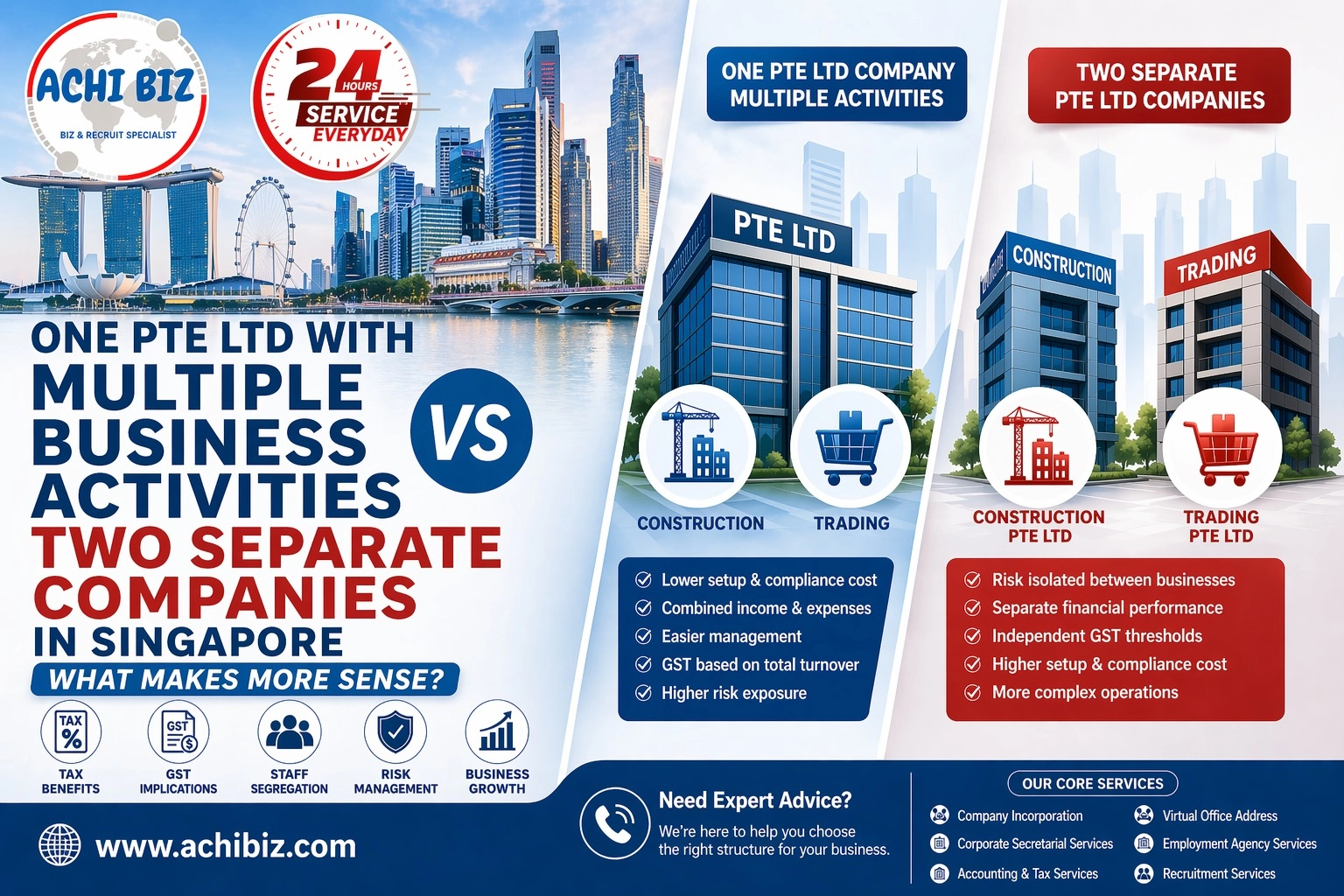
One Pte Ltd with Multiple Business Activities vs Two Separate Companies in Singapore: What Makes More Sense?
If you’re running or planning to start a business in Singapore, it’s common to explore more than one line of business. Maybe you’re doing trading and consulting, or combining services with e-commerce.
The real question is this:
Should you run both activities under one private limited company in Singapore, or set up two separate Pte Ltd companies?
On the surface, it looks like a structural choice. In reality, it affects tax, GST, risk exposure, staffing, compliance, and long-term scalability. Let’s walk through it properly.
Can One Company Have Multiple Business Activities?
Yes. A Pte Ltd company in Singapore can register more than one business activity (SSIC codes). Many companies operate this way.
But just because you can doesn’t mean you always should.
Option 1: One Pte Ltd Company with Multiple Activities
How it works
You run different business lines under a single company incorporation Singapore setup. All revenue, expenses, staff, and risks sit within one entity.
Key Features
- Single legal entity
- Combined financial statements
- One set of compliance filings
- Shared resources (staff, systems, branding)
Tax Implications
From a corporate tax Singapore perspective, all income is combined and taxed at the company level. This can be beneficial if one segment is profitable while another is making losses, as losses can offset profits. However, it may also push total profits higher over time, which could affect eligibility for certain tax exemptions.
GST Implications
GST registration in Singapore is based on total taxable turnover of the company. If combined revenue exceeds S$1 million, GST registration Singapore becomes mandatory. Even if one business activity is small, it will still fall under GST once the threshold is crossed. This means one fast-growing segment can trigger GST for the entire company.
Staffing & Operations
- Easier to manage staff under one company
- No need for intercompany billing or cost allocation
- Simpler payroll and HR structure
Pros
- Lower setup and maintenance cost
- Simpler compliance and accounting
- Easier cash flow management
- Ability to offset profits and losses
Cons
- Higher business risk exposure as all activities sit under one entity
- GST triggered earlier due to combined revenue
- Harder to track performance by business segment
- Less flexibility if you want to sell or separate one activity later
Option 2: Two Separate Pte Ltd Companies
How it works
You set up two different Pte Ltd companies in Singapore, each handling a separate business activity.
Key Features
- Separate legal entities
- Independent financials and compliance
- Clear separation of operations
Tax Implications
Each company is taxed separately under corporate tax Singapore. Each entity may qualify for start-up tax exemptions Singapore (subject to conditions), but losses cannot be offset between companies. This gives flexibility but reduces tax consolidation benefits.
GST Implications
GST is assessed per entity. Each company has its own GST registration threshold Singapore, so one business crossing S$1 million does not automatically affect the other. This can help manage GST exposure for smaller segments.
Staffing & Segregation
- Clear staff segregation between business units
- Easier to track roles, costs, and performance
- May require intercompany arrangements if resources are shared
Pros
- Risk isolation between businesses
- Better clarity in financial performance
- Greater flexibility for investors or future sale
- Separate GST thresholds
Cons
- Higher setup and maintenance cost
- More compliance and filings
- More complex operations and intercompany transactions
- No ability to offset losses across entities
Practical Example: Construction & Trading Under Service Sector
Let’s take a common real-world scenario.
You run a construction business in Singapore and also do trading of materials or equipment under the same brand. Both fall broadly under the service and commercial sector, but the risk profile is very different.
Construction typically involves:
- Higher operational and safety risks
- Project-based income
- Potential liabilities (e.g. defects, delays, claims)
Trading, on the other hand, is usually:
- Lower operational risk
- More straightforward transactions
- Easier to scale
If both are placed under one Pte Ltd company, any issue from the construction side—such as disputes, claims, or liabilities—can affect the entire business, including the trading arm.
Also, if construction revenue grows quickly and pushes total turnover beyond S$1 million, the trading side will also be pulled into GST registration Singapore, even if it is still small.
If you separate them into two companies:
- The construction company handles project risk independently
- The trading company remains protected and more flexible
- Each entity manages its own GST threshold
- Financial performance is clearer for each business
This is why many business owners in similar situations choose to separate higher-risk activities from lower-risk ones.
Key Strategic Considerations
-
Risk Level of Each Business
If one activity carries higher risk, separating it into another Pte Ltd company Singapore helps protect the rest of the business.
-
Revenue & GST Planning
If one segment is expected to grow quickly, separating entities helps manage GST registration Singapore exposure.
-
Future Exit or Investment
If you plan to bring in investors or sell one part of the business, separate entities make the process easier.
-
Cost vs Control
One company offers lower cost and simplicity, while two companies provide better control and flexibility.
When One Company Makes Sense
- Early-stage business
- Closely related activities
- Lower risk operations
- Focus on cost efficiency
When Two Companies Make More Sense
- Different industries or risk levels
- High growth in one segment
- Plans for investors or business exit
- Need for clear financial separation
Common Mistakes to Avoid
- Combining unrelated businesses just to save cost
- Ignoring GST impact from combined revenue
- Not planning for future restructuring
- Mixing high-risk and low-risk activities
Final Thoughts
There’s no one-size-fits-all answer to one company vs multiple companies Singapore. Starting with one company may be practical, but as the business grows, separating activities can provide better control, risk management, and long-term flexibility.
Need Help Structuring Your Business Properly?
Choosing between one Pte Ltd company or multiple companies in Singapore is a strategic decision. Achibiz can help you plan the right structure based on your business model, tax position, and growth plans.
📩 Reach out for tailored advice on structuring your business the right way.
Related Pages
Why Choose Two Related Business Activities in One Pte Ltd Company? – FAQ Guide
Why Choose Two Different-Sector Business Activities in One Pte Ltd Company – FAQ Guide
#achibiz