
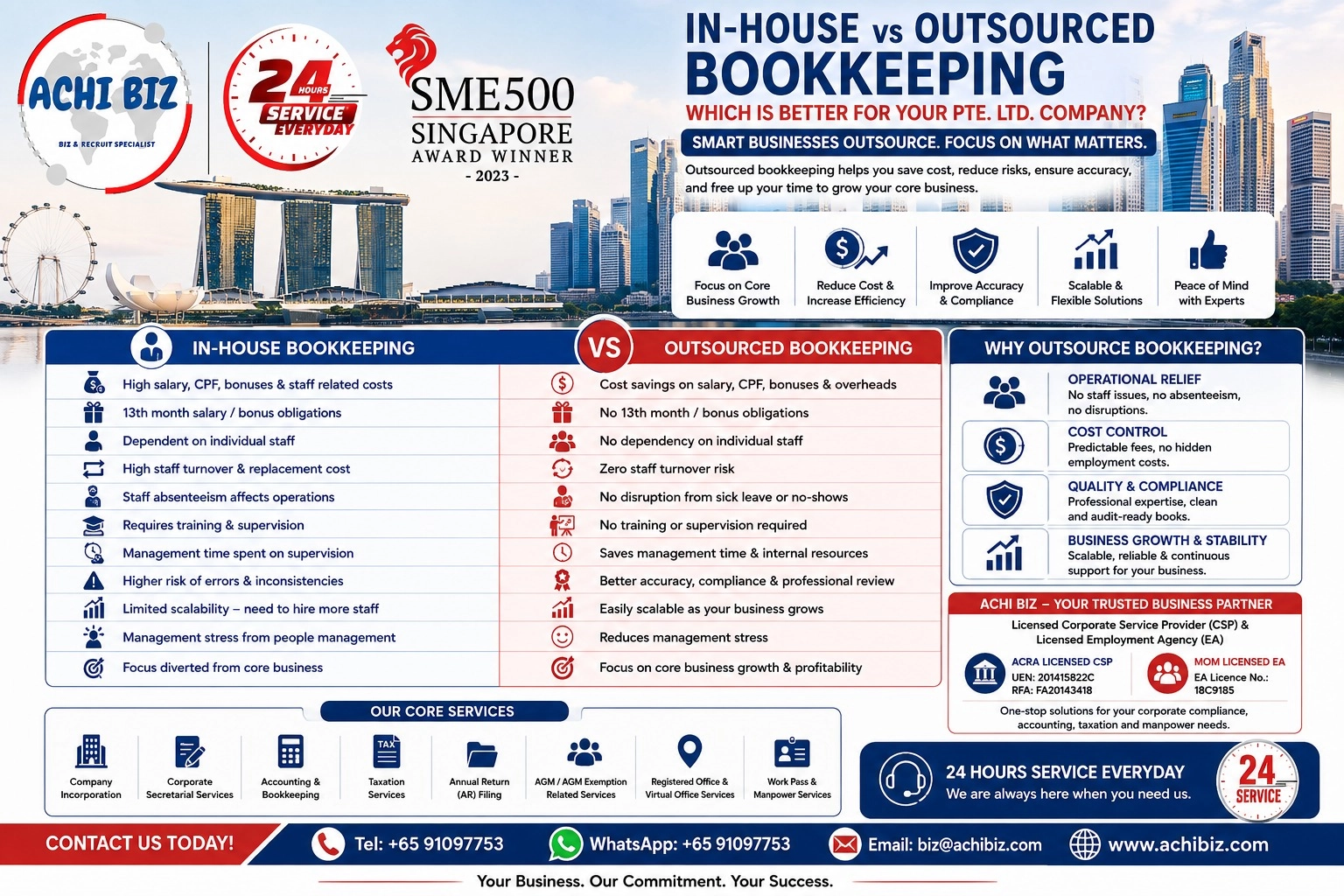
In-House vs Outsourced Bookkeeping in Singapore: Which Is Better for Pte. Ltd. Companies?
For a Singapore Private Limited (Pte. Ltd.) company, bookkeeping is not merely an administrative exercise. Proper accounting records support financial statements, corporate income tax computation, cash-flow management, management reporting and statutory compliance.
The practical question for many startups and SMEs is therefore: should bookkeeping be handled by an in-house employee or outsourced to a professional accounting service provider?
There is no universal answer. A larger business with continuous accounting activity may benefit from an internal finance team. However, for many small and growing Pte. Ltd. companies, outsourced bookkeeping can provide professional accounting support without the fixed employment cost, staff dependency, training requirements and continuity risks of maintaining an in-house bookkeeping function.
Importantly, outsourcing does not remove directors’ responsibilities. ACRA expressly recognises that record-keeping and financial statement preparation can be outsourced, but directors remain legally responsible for their company’s financial reporting and must ensure complete and accurate records are maintained.
Frequently Asked Questions on In-House vs Outsourced Bookkeeping in Singapore
What is in-house bookkeeping?
In-house bookkeeping means the company employs its own staff to perform day-to-day accounting work.
Depending on the business, an internal bookkeeper or accounts executive may handle sales invoices, supplier bills, receipts, payments, bank entries, reconciliations, accounts receivable, accounts payable, payroll-related accounting and preparation of accounting schedules.
The company therefore bears the employment costs and is responsible for recruiting, training, supervising and retaining that employee.
What is outsourced bookkeeping?
Outsourced bookkeeping means engaging an external professional accounting service provider to maintain some or all of the company’s accounting records.
The scope may include transaction recording, bank reconciliation, accounts receivable and payable, fixed asset schedules, accruals, prepayments, management reports, year-end accounting schedules and support for financial statement and corporate tax preparation.
The arrangement can be monthly, quarterly or otherwise structured according to the company’s transaction volume and reporting requirements.
Is bookkeeping compulsory for a Singapore Pte. Ltd. company?
Proper accounting records are compulsory even though the company is not legally required to employ a person with the job title “bookkeeper.”
ACRA states that all companies must keep proper accounting records for at least five years after the end of the financial year in which the relevant transactions or operations were completed, and those records must enable true and fair financial statements to be prepared.
Therefore, the company can maintain the records internally or outsource the work, but it cannot simply neglect bookkeeping.
Does ACRA allow a company to outsource its accounting records?
Yes. ACRA’s current guidance expressly recognises that record-keeping and financial statement preparation may be outsourced to professional accounting service providers.
However, outsourcing does not transfer the directors’ legal responsibility for the financial statements to the service provider.
Why do many small Pte. Ltd. companies outsource bookkeeping?
The main reason is efficiency.
A small company may require only a few hours or days of accounting work each month. Employing a full-time accounts employee for that workload may not be commercially sensible.
Outsourcing allows the company to obtain accounting support according to its actual requirements without necessarily maintaining another permanent employee.
Is outsourced bookkeeping always cheaper than hiring an employee?
No. It depends on transaction volume, complexity and service scope.
However, companies should compare the total employment cost, rather than salary alone.
An internal employee can involve salary, employer CPF where applicable, leave, bonuses or benefits, recruitment expenses, workstation and equipment, accounting software access, training, supervision and replacement costs when the employee leaves.
An outsourced arrangement is generally based on an agreed service fee and scope.
For a small business with moderate transaction volumes, that can be significantly more economical. For a large company requiring several accounting personnel working continuously, an internal department may make more sense.
Can outsourcing bookkeeping eliminate salary and employee-benefit costs?
It eliminates the need to incur those employment costs for the outsourced bookkeeping position itself.
Instead of hiring another employee, the company purchases an accounting service.
This can remove costs associated with that position such as salary, employer CPF where applicable, employee benefits, leave and certain employment-related overheads.
It should not be marketed as “free accounting”, however—the professional service provider charges fees for its work.
Does outsourced bookkeeping eliminate annual salary increment pressure?
Generally, it changes the cost structure.
An employee may expect salary adjustments as experience, responsibilities and market salaries change.
An outsourced provider works according to an agreed commercial fee arrangement. Fees can still increase, particularly if transaction volumes or service requirements grow, but the company is negotiating a business service rather than an employee’s compensation package.
Does outsourcing remove the need to pay a 13th-month salary or bonus?
An external bookkeeping provider is a service provider rather than the company’s employee.
Therefore, employment benefits applicable to employees do not ordinarily arise in the same manner.
The company instead pays the professional fees agreed under the service engagement.
Can outsourced bookkeeping reduce staff absenteeism problems?
Yes, provided the accounting firm has appropriate staffing and continuity arrangements.
An internal bookkeeping function that depends entirely on one employee can be disrupted by sick leave, emergency leave, extended absence or other unexpected circumstances.
A properly structured external provider should be able to maintain service continuity through its wider team.
What is “key-person dependency” in bookkeeping?
Key-person dependency arises when important accounting knowledge is concentrated in one employee.
For example, one person may know:
- how transactions are classified;
- where documents are stored;
- how bank reconciliations are performed;
- which customer balances require follow-up;
- how particular accounting schedules are maintained; and
- what unresolved year-end issues remain.
If that person suddenly resigns, management may struggle to reconstruct the accounting history.
Can outsourcing reduce dependency on one individual employee?
Yes. This is one of its strongest operational advantages.
A professional accounting provider should maintain working papers, records and internal processes so that accounting work does not depend entirely on one individual’s memory.
The client should nevertheless make sure it retains appropriate access to its own records and accounting data.
What happens to bookkeeping when an in-house accounts employee resigns?
The company may need to recruit a replacement, conduct interviews, negotiate salary, serve the employee’s notice period, arrange handover and train the replacement.
If the outgoing employee leaves poor records, the new employee may spend considerable time understanding the accounts before normal work resumes.
This is a genuine business-continuity risk for companies relying on a single accounts employee.
Does outsourcing eliminate staff turnover risk completely?
Not completely.
Employees of an accounting firm can also resign.
The difference is that the service provider, rather than the client, is responsible for managing its personnel resources.
A well-managed accounting firm should therefore be capable of assigning another qualified staff member without forcing the client to recruit and train a replacement employee.
Does outsourced bookkeeping require less training by management?
Usually.
When a company hires an inexperienced bookkeeper, management may need to teach that employee the company’s systems, procedures and accounting requirements.
A professional outsourced provider should already understand bookkeeping principles and accounting workflows.
The provider will still need to understand the client’s business and obtain appropriate information, but management should not have to teach basic accounting from the beginning.
Does outsourcing mean management does not need to supervise the accounts?
No.
It reduces day-to-day staff supervision, but management and directors must still review the financial information.
ACRA specifically states that directors remain legally responsible even when external professionals are used. Directors should review financial statements carefully, understand them and question accounting treatments that do not reflect their understanding of the transactions.
Does outsourcing reduce management stress?
It can.
For a small-business owner, managing another employee involves recruitment, leave, performance, training, supervision, resignation and replacement.
Outsourcing transfers much of the personnel-management burden associated with the bookkeeping function to the service provider.
Management can then concentrate more heavily on customers, sales, operations and business development.
Can outsourcing allow business owners to focus more on their core business?
Yes.
A director’s time may be better spent obtaining customers, developing products, supervising operations and planning growth rather than checking whether every invoice has been entered into the accounting system.
Outsourcing administrative financial work can therefore create a meaningful opportunity-cost saving.
Is outsourced bookkeeping more scalable?
Often, yes.
Imagine a business processing 100 transactions per month that grows to 500 or 1,000.
An internal employee may eventually become overloaded, requiring overtime or additional staff.
An accounting service provider may be able to adjust its service capacity according to the client’s increasing transaction volume.
The service fee would normally change accordingly, but recruitment may not be necessary.
Can a company scale down outsourced bookkeeping if its activity decreases?
Potentially, depending on the service agreement.
This flexibility can be particularly valuable to startups, seasonal businesses and companies with fluctuating transaction volumes.
Permanent employee costs are generally less flexible.
Does outsourcing guarantee professional accounting expertise?
No provider should be selected simply because it calls itself an accounting firm.
The company should assess the provider’s qualifications, experience, internal processes, service scope and familiarity with Singapore accounting and tax requirements.
ACRA itself advises directors who outsource record keeping and financial statement preparation to ensure the people engaged are qualified and knowledgeable.
Is a professional bookkeeper different from an administrative employee who knows basic accounting software?
Yes.
Knowing how to enter transactions into accounting software is not the same as understanding accounting.
A competent accounting professional should understand why a transaction belongs in a particular account, whether it is an asset or expense, when accrual accounting applies, how prepayments should be treated and why Balance Sheet accounts must be reconciled.
Software processes entries. Professional judgement determines whether those entries make sense.
Can outsourcing improve bookkeeping accuracy?
It can, particularly where the alternative is assigning bookkeeping to someone without adequate accounting knowledge.
Professional providers normally use standardised procedures, account classifications, reconciliations and review processes.
However, outsourcing itself is not a guarantee of accuracy. The quality depends on the provider and on whether the company supplies complete and correct information.
Can outsourcing reduce trial-and-error accounting?
That should be one of the objectives of using an experienced provider.
Accounting errors can occur when inexperienced staff learn through experimentation—for example, incorrectly posting loan repayments as expenses, failing to recognise fixed assets or leaving bank accounts unreconciled.
Professional accounting support can reduce these errors before they accumulate.
Why are bank reconciliations important in outsourced bookkeeping?
A bank reconciliation compares the accounting records with the actual bank statement.
It can identify missing entries, duplicate postings, bank charges, unidentified receipts, incorrect payments and timing differences.
Without regular reconciliation, a bookkeeping system can appear complete while still containing significant errors.
Can outsourced bookkeeping improve accounts receivable management?
Yes, where receivable reporting is included in the engagement.
A properly maintained receivable schedule can show which customers owe money and how long invoices have remained outstanding.
Management can then follow up on overdue amounts rather than discovering unpaid invoices months later.
Can it also improve accounts payable management?
Yes.
An accounts payable schedule helps management understand what is owed to suppliers and when payments become due.
This improves cash-flow planning and can reduce missed or duplicate payments.
What management reports should an outsourced bookkeeping provider prepare?
Depending on the engagement and company’s requirements, useful reports may include:
Balance Sheet, Profit & Loss Statement, Trial Balance, General Ledger, bank reconciliation, accounts receivable ageing, accounts payable ageing, fixed asset schedule, accrual schedule, prepayment schedule, loan schedules, director/shareholder accounts and other reconciled Balance Sheet schedules.
A good bookkeeping service should produce more than a collection of entered transactions.
Why is proper bookkeeping important for financial statements?
Because the financial statements are built from the accounting records.
If the bookkeeping contains missing revenue, duplicated expenses, unreconciled bank balances or incorrect classifications, those problems can flow into the financial statements.
ACRA requires directors to ensure that financial statements comply with prescribed accounting standards and give a true and fair view of the company’s financial performance and position.
Can outsourcing improve the quality of financial reporting?
Yes, when bookkeeping, reconciliation and management reporting are properly integrated.
Instead of trying to repair a year’s worth of accounting problems at FYE, the company can maintain cleaner books throughout the year.
This makes year-end financial statement preparation considerably more structured.
Is bookkeeping relevant to Singapore corporate income tax?
Absolutely.
Corporate tax computation starts with the company’s accounting information before the necessary tax adjustments are made.
IRAS specifically states that good record keeping helps companies understand their financial status and can reduce the cost and effort involved in preparing Corporate Income Tax Returns and responding to IRAS queries.
Can poor bookkeeping result in inaccurate corporate tax filing?
Yes.
If income is omitted or expenses are incorrectly recorded, the accounting profit itself may be wrong.
The tax computation then begins from unreliable financial information.
Tax preparation should therefore not be treated as a substitute for proper bookkeeping.
Can an outsourced accountant automatically decide whether every expense is tax deductible?
No.
Accounting treatment and tax treatment are related but not identical.
The bookkeeping records what happened financially. Corporate tax preparation then analyses the relevant transactions according to Singapore tax rules.
This is another reason why expenses should be properly classified rather than placed indiscriminately under “miscellaneous expenses.”
Does outsourced bookkeeping improve ACRA compliance?
It can support compliance by helping the company maintain the proper accounting records needed for financial reporting.
However, bookkeeping is only one part of corporate compliance.
Annual Returns, AGM requirements where applicable, statutory registers, company changes and other Companies Act obligations must still be managed separately.
Does outsourced bookkeeping remove directors’ responsibility?
No. This point is critical.
A director cannot defend inaccurate financial statements simply by saying, “the accountant prepared them.”
ACRA explicitly states that directors remain legally responsible for financial statements even when external help is used.
Outsourcing provides professional assistance; it does not outsource statutory accountability.
What information must a company provide to its outsourced bookkeeper?
Depending on the business, the provider may require:
bank statements, sales invoices, supplier invoices, receipts, payment records, payroll reports, loan statements, contracts, fixed asset invoices, GST information and explanations for unusual transactions.
An accountant cannot reliably account for transactions that the company fails to disclose.
Who owns the accounting records when bookkeeping is outsourced?
The company’s accounting records remain fundamentally important company records.
The engagement should clearly establish access, storage, retention, confidentiality and handover arrangements.
Management should never put itself in a position where it cannot retrieve its own financial records when the service relationship ends.
How long must companies keep their accounting records?
ACRA states that companies must generally keep accounting records for at least five years after the end of the financial year in which the transactions or operations were completed.
IRAS likewise requires companies to retain relevant source documents, accounting records, schedules, bank statements and other transaction records for at least five years from the relevant Year of Assessment for tax purposes.
Is data security an important consideration when outsourcing bookkeeping?
Very much so.
The provider may have access to bank statements, payroll information, supplier details, customer records and commercially sensitive financial information.
Companies should therefore consider confidentiality controls, access permissions, document-transfer methods, accounting-system access and data-retention procedures before appointing a provider.
Is in-house bookkeeping more confidential than outsourcing?
Not automatically.
Internal employees can mishandle information just as external providers can.
The real issue is whether proper controls exist.
A reputable professional provider should have confidentiality and access-control procedures, while an in-house finance function should also restrict sensitive information to authorised personnel.
Can outsourced bookkeeping reduce the risk of poor employee attitude or disengagement?
It can reduce the company’s direct exposure to that particular employment-management issue.
An unhappy or disengaged employee may affect productivity, accuracy or continuity.
With outsourcing, the company purchases an agreed service from a business rather than depending on the motivation of one employee.
However, service quality still needs to be monitored.
What happens if the outsourced accountant makes a mistake?
Errors can still happen.
The engagement should clearly define responsibilities, review procedures and how errors are rectified.
Management should also provide accurate information promptly and review reports instead of assuming everything must be correct because an external professional prepared them.
Is outsourced bookkeeping suitable for a one-person or owner-managed Pte. Ltd. company?
Often, yes.
Owner-managed businesses may have no commercial need for a full-time accounts employee but still require proper accounting, reconciliation, management reports, financial statements and tax compliance.
This is one of the situations where outsourcing can be particularly cost-effective.
Is outsourcing suitable for startups?
Yes, especially where transaction volumes are initially low.
Instead of building an accounting department before the business requires one, a startup can purchase the level of support it currently needs and expand the scope as the company grows.
Is outsourcing suitable for foreign-owned Singapore companies?
It can be particularly useful.
Foreign directors may not be familiar with Singapore accounting, ACRA compliance or IRAS requirements.
A Singapore-based professional provider can coordinate local bookkeeping and accounting support while management operates from overseas.
When is in-house bookkeeping the better choice?
In-house accounting can be preferable where the company has:
very high daily transaction volumes, complex inventory operations, continuous finance-related activity, substantial management-reporting requirements, large internal departments or a need for immediate full-time accounting personnel onsite.
The decision should be based on operational needs rather than assuming outsourcing is always superior.
Can a company use both in-house and outsourced accounting?
Yes. A hybrid arrangement is common.
Internal staff may handle invoices, collections and routine data entry while an external accounting professional handles reconciliations, management accounts, year-end closing, financial statements or taxation.
This can provide operational convenience while retaining professional oversight.
Should bookkeeping and corporate tax services be handled by the same provider?
There can be advantages.
Where the provider understands the accounting records throughout the year, preparing the year-end accounts and corporate tax computation can be more efficient.
It reduces the need for another provider to reconstruct or reinterpret the bookkeeping from the beginning.
However, companies should still assess expertise, scope and independence where relevant.
Should bookkeeping and corporate secretarial services be coordinated?
For many small Pte. Ltd. companies, yes.
Accounting events can have corporate implications and vice versa.
For example, changes involving share capital, dividends, directors, loans or financial year-end may affect multiple areas of corporate administration.
A coordinated provider can reduce communication gaps between accounting and corporate compliance work.
Should businesses choose the cheapest outsourced bookkeeping package?
Not necessarily.
Bookkeeping is one area where an extremely cheap service can become expensive later if the records need to be reconstructed.
Businesses should compare:
scope of work, transaction limits, reconciliation frequency, management reports, professional review, response time, year-end support, accounting software, data security, experience and pricing.
A quotation that excludes reconciliations or year-end schedules is not directly comparable with a comprehensive bookkeeping service.
What questions should a company ask before appointing an outsourced bookkeeper?
Management should establish exactly what the provider will do, how frequently the books will be updated, what reports will be produced, what documents the client must provide, how reconciliations are performed, who reviews the accounts, how queries are handled, how data is protected and what happens when the engagement ends.
Clear scope at the beginning prevents disputes later.
Can outsourced bookkeeping provide predictable accounting costs?
Often, yes.
Where transaction volumes and scope are clearly defined, companies can agree on monthly, quarterly or annual service fees.
This makes budgeting easier than dealing with recruitment, staff turnover, salary negotiations and replacement costs.
Additional work, however, may still attract additional fees.
What are the hidden costs of in-house bookkeeping?
The true cost may extend well beyond basic salary.
It can include recruitment, employer CPF where applicable, leave, bonuses and benefits, training, management supervision, computer equipment, software licences, office space, replacement costs and productivity losses during vacancies or handovers.
These should be included when comparing in-house employment against outsourcing.
What are the possible disadvantages of outsourced bookkeeping?
A balanced comparison should acknowledge them.
Potential disadvantages include less immediate physical access to the accountant, reliance on timely document sharing, service fees increasing as transaction volumes grow, possible communication delays and confidentiality concerns if the provider has weak controls.
These risks can be reduced through a well-defined engagement and selection of a reliable provider.
What are the possible disadvantages of in-house bookkeeping?
Potential disadvantages include higher fixed employment costs, dependency on individual employees, absenteeism, staff turnover, recruitment and training costs, limited expertise in a small accounting team and the need for ongoing management supervision.
A single inexperienced accounts employee may also lack access to the wider technical knowledge available within a professional accounting team.
How should a company compare the cost of in-house versus outsourced bookkeeping?
The comparison should use total annual cost, not simply monthly salary versus monthly accounting fee.
For an internal employee, calculate the full employment and operational cost.
For outsourcing, calculate the annual service fees plus any additional charges for financial statements, tax computation, GST, payroll or other work not included in the standard package.
Then compare service capability, continuity and expertise—not price alone.
Is outsourcing bookkeeping the same as outsourcing management responsibility?
No.
Management remains responsible for providing documents, explaining transactions, reviewing reports and making business decisions.
A good outsourcing relationship is therefore a partnership between the company’s management and its accounting provider.
Can outsourcing help maintain cleaner accounts throughout the year?
Yes, if the service is performed regularly.
The ideal process is:
Source Documents → Bookkeeping → Reconciliation → Management Reports → Year-End Review → Financial Statements → Corporate Tax Computation
Regular processing prevents year-end accounting from becoming a twelve-month reconstruction exercise.
Why is continuity one of the biggest advantages of professional outsourced bookkeeping?
Accounting is cumulative.
The closing balance of one period becomes the opening balance of the next.
A disruption caused by staff resignation, poor handover or lost working papers can therefore affect more than one month.
A properly managed external accounting team should maintain institutional continuity even when individual staff members change.
Can outsourced bookkeeping help a company grow without immediately expanding headcount?
Yes.
This is particularly relevant to SMEs.
As sales and transaction volumes increase, the company may increase its accounting service scope rather than immediately recruiting additional administrative personnel.
Management can therefore direct internal headcount toward revenue-generating or strategically important functions.
Does outsourcing accounting make a company more professional?
Outsourcing by itself does not.
What matters is whether the resulting accounting records are accurate, timely, properly reconciled and useful to management.
A competent in-house finance team can be excellent. A poor outsourced provider can be inadequate.
The correct comparison is therefore quality and suitability, not simply “internal versus external.”
Is outsourced bookkeeping only about saving money?
No.
Cost savings are only one possible advantage.
For many SMEs, the more important benefits are continuity, professional expertise, scalability, reduced key-person dependency, reduced management supervision and better integration between bookkeeping, financial reporting and tax compliance.
How does proper bookkeeping improve management decision-making?
Good bookkeeping produces reliable financial information.
Management can then assess:
profitability, operating expenses, customer debts, supplier obligations, available cash, working capital and financial trends.
Business decisions based on accurate accounts are inherently more informed than decisions based solely on the bank balance.
What is the strongest argument for outsourcing bookkeeping for a small Singapore company?
For many small businesses, it comes down to resource allocation.
The company can either maintain a permanent accounting employee and assume the associated employment, training and continuity responsibilities, or purchase professional accounting capacity according to actual business requirements.
Where the workload does not justify a full-time accounting position, outsourcing can be the more efficient model.
What is the strongest argument for keeping bookkeeping in-house?
Control and immediate availability.
Businesses with substantial daily accounting activity may benefit from having finance staff continuously available to management, customers, suppliers and other departments.
As the business becomes larger and more complex, building an internal finance department can become commercially justified.
What is the best bookkeeping model for most small Pte. Ltd. companies in Singapore?
There is no automatic answer, but a practical approach is to examine:
transaction volume + accounting complexity + required reporting frequency + internal expertise + total employment cost + continuity risk + management time + future growth.
A small company with straightforward transactions may find professional outsourcing highly efficient.
A larger company with continuous financial operations may benefit from an internal or hybrid finance function.
In-House vs Outsourced Bookkeeping: Quick Comparison
| Area | In-House Bookkeeping | Outsourced Bookkeeping |
|---|---|---|
| Staffing | Company recruits employee | Provider manages personnel |
| Salary & benefits | Fixed employment costs | Professional service fee |
| Absenteeism | Can disrupt small team | Provider should maintain continuity |
| Staff turnover | Company replaces employee | Provider manages replacement |
| Training | Company’s responsibility | Provider supplies trained personnel |
| Expertise | Depends on employee | Access to accounting professionals |
| Scalability | May require new hiring | Scope can usually be expanded |
| Management supervision | Generally higher | Generally lower |
| Availability | Immediate internal access | Depends on service arrangement |
| Confidentiality | Internal controls required | Provider controls required |
| Continuity | Can depend on key employee | Team-based continuity possible |
| Cost suitability | Better for substantial workload | Often attractive for SMEs |
| Business focus | Internal resources used on accounting | More management time for core operations |
Why Professional Bookkeeping Matters Regardless of the Model
Whether bookkeeping is maintained internally or externally, the objective should remain the same: complete, accurate and properly reconciled accounting records capable of supporting reliable financial statements and tax compliance.
Singapore directors cannot treat bookkeeping as somebody else’s responsibility simply because the work has been delegated.
ACRA requires directors to ensure proper records are maintained and financial statements give a true and fair view, while IRAS emphasises that good record keeping supports better business decisions and reduces the cost and effort involved in corporate tax filing and responding to tax queries.
How Can ACHI BIZ Assist with Outsourced Bookkeeping and Accounting in Singapore?
For businesses that prefer to outsource their accounting function, ACHI BIZ SERVICES PTE. LTD. can provide bookkeeping and accounting support as part of a broader corporate compliance arrangement.
Services can include bookkeeping, Balance Sheet and Profit & Loss reporting, bank reconciliation, accounts receivable and payable schedules, fixed asset schedules, accruals and prepayments, management reporting, financial statement preparation and corporate taxation support, depending on the agreed engagement.
This can also be coordinated with corporate secretarial and other statutory services so that accounting and corporate compliance are not managed in isolation.
ACHI BIZ also provides applicable work pass and manpower services through its MOM-licensed Employment Agency activities.
Conclusion: Should a Pte. Ltd. Company Outsource Its Bookkeeping?
For many Singapore startups and SMEs, outsourced bookkeeping can be a practical alternative to maintaining a dedicated in-house accounting employee.
It can reduce fixed staffing costs, minimise dependency on individual employees, avoid recruitment and training cycles, improve service continuity and give businesses access to professional accounting expertise as their requirements change.
But outsourcing should never mean abandoning oversight.
The best arrangement is one where management retains control of its financial information while trained accounting professionals handle the technical bookkeeping, reconciliations and reporting efficiently.
For a small or growing Pte. Ltd. company, that combination can offer a strong balance of cost control, professional expertise, continuity, financial reporting quality and scalability—while allowing management to spend more time building the business rather than managing the bookkeeping function.
Related articles:
How to Outsource Your Company’s Recruitment Process?
Ask These 4 Questions to Decide If You Should Outsource Your Company’s Accounting Functions
#achibiz