
Preparation of Un-Audited Financial Statements by Pte Ltd Companies in Singapore: A Practical Guide
If you run a private limited company (Pte Ltd) in Singapore, preparing your un-audited financial statements (FS) is not just a year-end routine—it’s a core part of staying compliant and running a financially sound business. Many companies assume that if they are audit-exempt, financial statements are less important. In reality, the opposite is true. Even without an audit, your financial statements must still be properly prepared, structured, and supported by records, because they are relied upon by regulators, banks, and stakeholders alike.
What Do Un-Audited Financial Statements Actually Include?
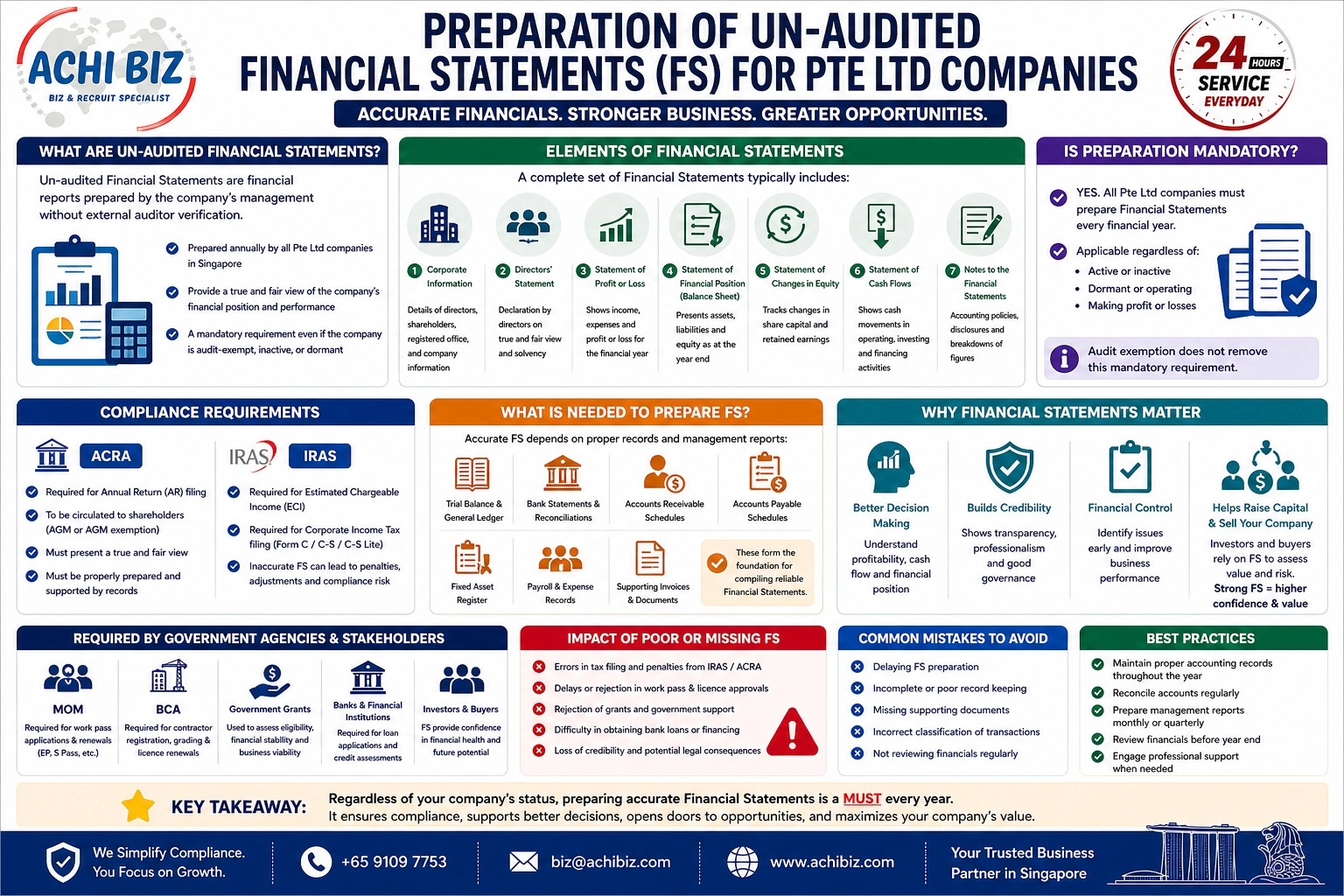
A complete set of financial statements in Singapore is not just a profit and loss summary. It is a structured report made up of several key sections. A typical FS set includes corporate information such as directors, shareholders and registered office, followed by a directors’ statement confirming that the financial statements give a true and fair view and that the company is able to meet its obligations. It also includes the statement of profit or loss showing income and expenses, the statement of financial position (balance sheet) presenting assets, liabilities and equity, the statement of changes in equity tracking movements in capital and retained earnings, and the statement of cash flows explaining how cash moves through the business. The notes to the financial statements provide detailed disclosure, accounting policies, and breakdowns that support the figures presented
Is Preparation of Financial Statements Mandatory?
Yes, all Pte Ltd companies in Singapore must prepare financial statements annually. This applies regardless of whether the company is active or inactive, totally dormant or operating, or making profits or losses. Even if your company has no transactions or revenue, preparation of financial statements is still a mandatory yearly obligation. Audit exemption does not remove this requirement.
Compliance with ACRA and IRAS
From a regulatory perspective, financial statements are required for both ACRA and IRAS compliance. ACRA requires financial statements for Annual Return filing and for circulation to shareholders, whether through AGM or AGM exemption. The financial statements must present a true and fair view and be properly supported by accounting records. On the IRAS side, financial statements are necessary for filing Estimated Chargeable Income (ECI) and Corporate Income Tax Returns such as Form C, C-S or C-S Lite. Without proper FS, tax filings may be inaccurate and expose the company to risk.
What Is Needed to Prepare Financial Statements?
Behind every proper set of financial statements is a strong foundation of management reports and records. These include the trial balance, general ledger, bank statements and reconciliations, accounts receivable and payable schedules, fixed asset register, payroll records, and all supporting invoices and documents. These records form the basis for compiling accurate and reliable financial statements. Without them, the figures in your FS cannot be trusted.
Why Financial Statements Matter (Beyond Compliance)
Financial statements are not just prepared to meet regulatory requirements—they are essential tools for managing your business. They help you understand your company’s profitability, cash flow and overall financial position. They also build credibility, showing stakeholders that your business is professionally managed and transparent. At the same time, they provide financial control by highlighting issues such as high costs, weak cash flow, or potential risks early on.
How Financial Statements Help When Selling Your Company or Seeking Investors
This is one of the most overlooked advantages. If you plan to sell your company or bring in investors, your financial statements become one of the first things that will be reviewed. Properly prepared FS show a clear financial track record, making due diligence smoother and faster. They give potential buyers or investors confidence that the business is well-managed, compliant, and transparent. On the other hand, incomplete or poorly prepared financial statements raise red flags, delay negotiations, and may even reduce the valuation of your company. Simply put, strong financial statements can directly impact how attractive your business is in the market.
Why Government Agencies Require Financial Statements
Financial statements are often required when dealing with various government agencies in Singapore. The Ministry of Manpower (MOM) may request FS when assessing work pass applications or renewals to determine whether the company can support its employees. The Building and Construction Authority (BCA) requires FS for contractor registration, grading and licence renewals. Government grant bodies rely on financial statements to assess eligibility, financial stability and business viability. Banks and financial institutions also depend heavily on FS when evaluating loan applications or credit facilities. Without proper financial statements, these applications may be delayed or rejected.
Impact of Poor or Missing Financial Statements
Failing to prepare proper financial statements can create serious consequences. It may lead to errors in tax filings, penalties from IRAS or ACRA, delays in work pass or licence approvals, rejection of grants, and difficulty in obtaining bank financing. It can also damage your company’s credibility and, in more serious cases, expose directors to compliance risks.
Common Mistakes Companies Make
Many companies face issues due to poor bookkeeping practices. Common mistakes include delaying financial statement preparation, maintaining incomplete records, missing supporting documents, incorrectly classifying transactions, and failing to review financial reports properly. These issues often lead to compliance problems that could have been easily avoided.
Best Practices for Preparing Un-Audited Financial Statements
To stay compliant and efficient, companies should maintain proper accounting records throughout the year, reconcile accounts regularly, prepare management reports periodically, and review financial data before year-end. Avoid leaving everything to the last minute. Engaging a professional service provider can also help ensure accuracy and compliance.
Final Thoughts
Preparation of un-audited financial statements in Singapore is not just about compliance—it is about understanding and strengthening your business. The key takeaway is simple: regardless of whether your company is active or inactive, totally dormant or operating, or making profits or losses, preparing financial statements is still a mandatory annual obligation. When done properly, financial statements become more than just reports—they become tools for decision-making, credibility, and growth, and a strong foundation when you plan to sell your business or attract investors.
#achibiz