
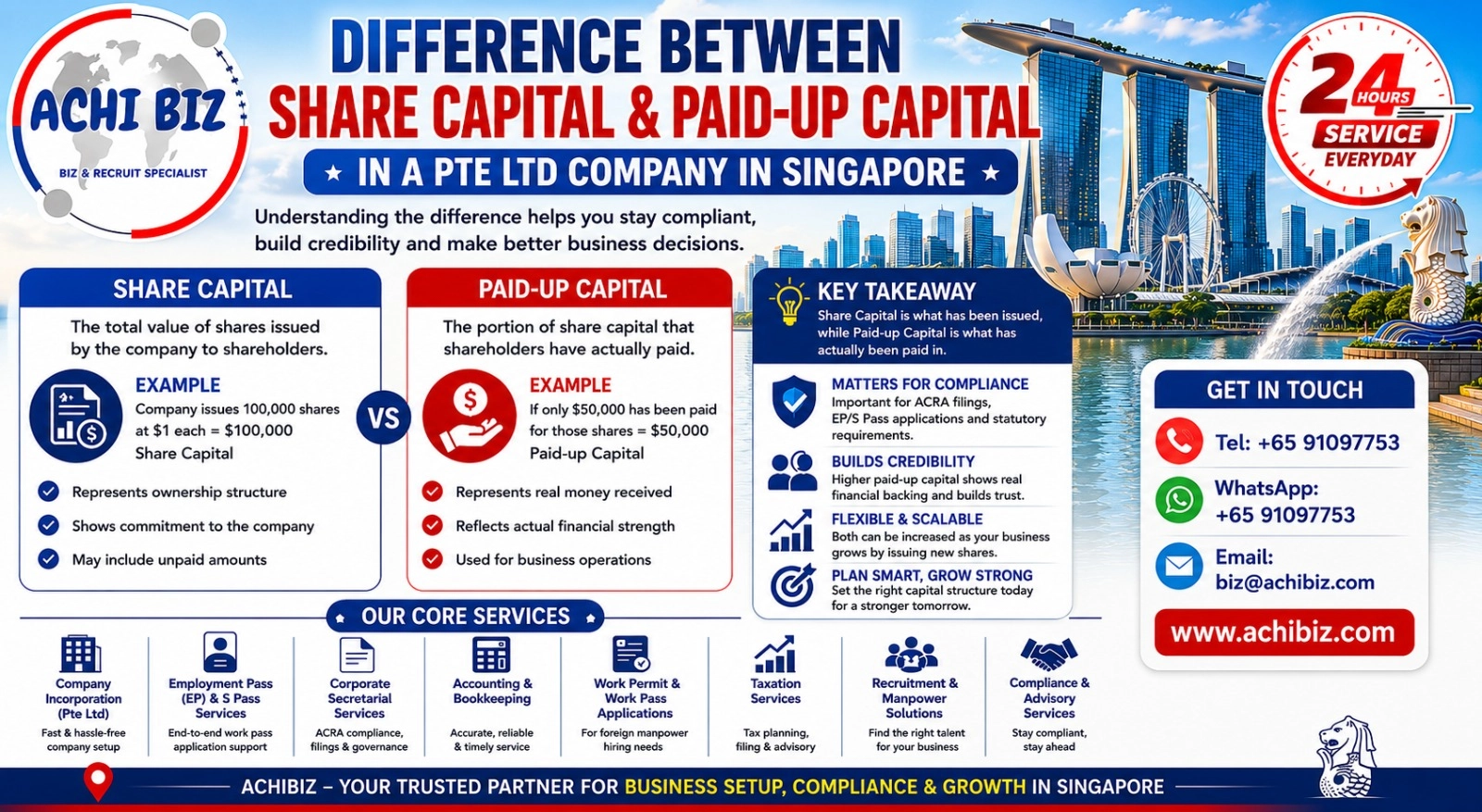
Difference Between Share Capital & Paid-Up Capital in a Pte Ltd Company in Singapore
If you’re running or setting up a Private Limited Company (Pte Ltd) in Singapore, you’ve probably come across the term share capital. It refers to the total value of shares a company has issued to its shareholders and reflects the ownership structure—who owns what portion of the company.
For example, if a company issues 100,000 shares at $1 each, the share capital is $100,000. This shows the value of shares issued, but it doesn’t necessarily mean that all this money has been paid into the company.
Understanding Paid-Up Capital
This is where paid-up capital comes in. Paid-up capital is the portion of the share capital that shareholders have actually paid.
Using the same example, if only $50,000 has been paid for those shares, then the paid-up capital is $50,000. This is the actual money the company has received and can use for its operations.
Key Difference in Simple Terms
The easiest way to understand it is this:
share capital is what has been issued, while paid-up capital is what has actually been paid in. One reflects commitment, while the other reflects real funding.
Why Paid-Up Capital Matters More in Practice
When someone looks at your company—whether it’s a bank, a partner, or even regulators—they’re more interested in paid-up capital in Singapore companies because it shows real financial strength. Share capital might look large on paper, but if it hasn’t been paid, it doesn’t carry the same weight.
Impact on ACRA Compliance
Under ACRA filing requirements in Singapore, companies must declare both the number of shares issued and the paid-up capital. Any changes, such as issuing new shares or increasing capital, must be properly recorded. Keeping this updated is essential for compliance.
Relevance for Work Pass Applications
For businesses applying for Employment Pass (EP) or S Pass, paid-up capital plays a practical role. Authorities assess whether the company appears financially sustainable, and paid-up capital gives a clearer picture than share capital alone. A company may have high share capital, but if very little is paid up, it can still raise concerns.
Business Credibility and Perception
From a business perspective, paid-up capital helps build credibility. It shows that there is real money behind the company and that shareholders are committed. This can influence how clients, partners, and banks view your business.
When Share Capital Equals Paid-Up Capital
In many cases, companies keep things simple by ensuring that share capital and paid-up capital are the same, meaning all issued shares are fully paid. This avoids confusion and presents a clearer financial position.
Can You Increase Capital Later?
Both share capital and paid-up capital can be increased over time. Companies can issue new shares and receive additional funds from shareholders as the business grows. This flexibility allows you to adjust your capital structure when needed.
Common Mistakes to Avoid
A common misunderstanding is assuming that share capital equals cash in the bank—it doesn’t. Some businesses also set high share capital without actually paying it or overlook paid-up capital when planning for work pass applications. These small mistakes can create bigger issues later.
Which One Matters More?
From a practical standpoint, paid-up capital matters more because it reflects real funds, supports operations, and influences how others assess your business. Share capital is still important, but it mainly defines ownership and structure.
Final Thoughts
Understanding the difference between share capital and paid-up capital in Singapore helps you make better decisions, stay compliant, and present your business more effectively. It’s not just about definitions—it’s about setting up your company in a way that supports growth and avoids unnecessary complications.
If you need guidance on structuring your company properly or managing ongoing compliance, it’s always a good idea to contact Achibiz for corporate secretarial services to ensure everything is handled correctly from the start.
Related articles
Individual vs Corporate Shareholding in Singapore Pte Ltd: Which Is Better for Your Business?
#achibiz