
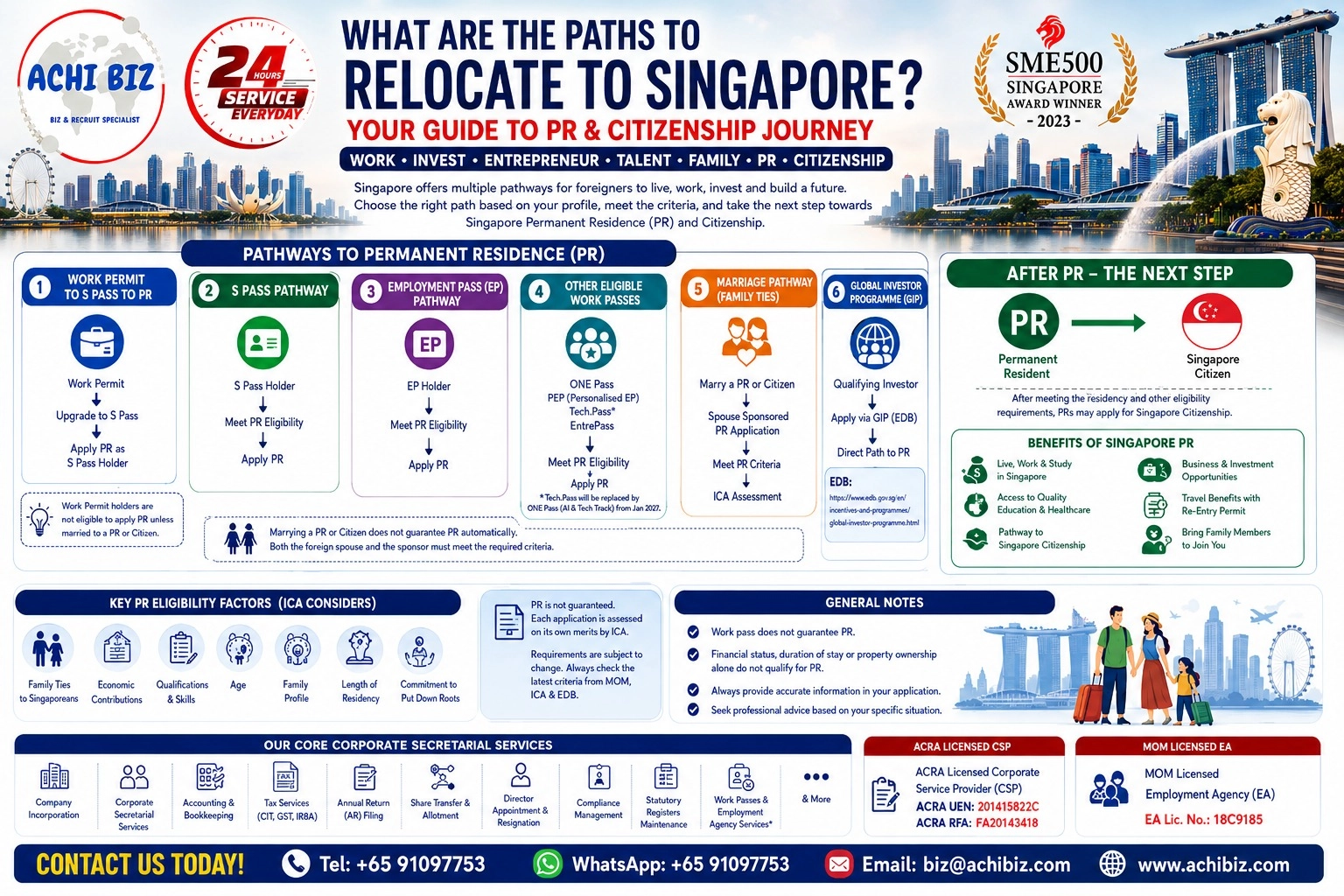
What Are the Pathways to Relocate to Singapore
Singapore offers several pathways for foreigners who wish to work, establish a business, invest, join family members and potentially build a long-term future in the country. However, relocating to Singapore, obtaining Permanent Residence (PR) and becoming a Singapore Citizen are three separate stages.
Holding a Singapore work pass does not automatically lead to PR. Likewise, being eligible to submit a PR application does not mean that ICA will approve it. Marriage to a Singapore Citizen or Permanent Resident can provide a family-based route to apply for PR, but marriage itself does not guarantee PR.
Depending on the individual’s circumstances, possible pathways may include:
Work Permit → S Pass → PR → Singapore Citizenship
S Pass → PR → Singapore Citizenship
Employment Pass (EP) → PR → Singapore Citizenship
ONE Pass / PEP / applicable specialised professional or talent route → PR, where eligible → Singapore Citizenship
EntrePass → PR, where eligible → Singapore Citizenship
Marriage to Singapore Citizen or PR → Sponsored PR Application → Singapore Citizenship, where subsequently eligible
Qualifying Global Investor → Global Investor Programme (GIP) → PR → Singapore Citizenship, where subsequently eligible
Each stage is subject to the prevailing eligibility criteria and assessment requirements of the relevant Singapore authority.
What are the main pathways to relocate to Singapore?
Foreigners generally relocate to Singapore through one of several broad routes: employment, entrepreneurship, specialised talent, investment or family ties.
The appropriate pathway depends on the individual’s occupation, qualifications, employment circumstances, business background, investment profile or relationship with a Singapore Citizen or PR.
There is no single immigration route suitable for everyone.
Does obtaining a Singapore work pass automatically put someone on a PR pathway?
No.
A work pass provides permission to work and reside in Singapore subject to the conditions of that pass. Permanent Residence is a separate immigration status administered by ICA.
Someone may work in Singapore for many years without automatically becoming a PR.
Can a Work Permit holder apply for PR simply because he or she holds a Work Permit?
Generally, Work Permit holders are not included in ICA’s employment-based PR eligibility category merely by virtue of holding a Work Permit. ICA expressly identifies Employment Pass and S Pass holders among those eligible to apply under its published PR framework.
This distinction is important when planning a long-term employment-based pathway.
What is the Work Permit → S Pass → PR pathway?
For an eligible Work Permit holder seeking a longer-term employment-based pathway, a possible progression is:
Work Permit → qualify for S Pass → obtain S Pass → apply for PR → PR if approved
The important word is qualify.
A Work Permit does not automatically convert into an S Pass after a certain number of years. The worker must satisfy the prevailing S Pass eligibility requirements, including the applicable qualifying salary criteria, and the employer must satisfy the prevailing requirements applicable to employing S Pass holders.
Can every Work Permit holder eventually upgrade to an S Pass?
No.
Length of employment in Singapore alone does not create an entitlement to an S Pass.
The worker must meet MOM’s prevailing S Pass eligibility criteria, including the applicable qualifying salary requirements, while the prospective employer must meet the applicable quota, levy and other requirements.
Because MOM periodically revises work pass requirements and qualifying salary thresholds, companies and workers should always check the requirements applicable at the time of application rather than relying on historical figures.
Why is upgrading from Work Permit to S Pass significant for someone considering PR?
Because ICA expressly recognises S Pass holders as a category eligible to apply for Singapore PR.
Therefore, for a Work Permit holder whose long-term objective is employment-based PR, becoming eligible for an S Pass can represent an important change in immigration position.
It still does not guarantee PR.
If a Work Permit holder obtains an S Pass, how soon can the person apply for PR?
ICA’s published eligibility framework does not prescribe a universal fixed period that every S Pass holder must complete before being eligible to submit a PR application.
However, eligibility to submit an application and the strength of that application are different matters.
ICA considers various factors when assessing PR applications, including economic contributions, qualifications, age, family profile, family ties and length of residency.
Can an S Pass holder apply for Singapore PR?
Yes.
An S Pass holder is expressly recognised by ICA as a person who may be eligible to apply for Singapore PR.
The broad pathway may therefore be:
S Pass → PR application → PR if approved → Citizenship application later, if eligible
Does an S Pass guarantee PR?
No.
An S Pass gives the holder eligibility to submit a PR application under ICA’s published framework. It does not give the holder an entitlement to PR.
ICA independently assesses each PR application.
Can an Employment Pass holder apply for Singapore PR?
Yes.
ICA expressly identifies an Employment Pass holder as a category that may be eligible to apply for Singapore PR.
For many foreign professionals, the progression may therefore be:
Overseas professional → Employment Pass → establish career and residence in Singapore → PR application → PR if approved → Citizenship application later, if eligible
What should a foreign professional know about Employment Pass eligibility?
An Employment Pass is intended for qualifying foreign professionals, managers and executives.
Applicants must satisfy the prevailing MOM eligibility requirements, including the applicable qualifying salary requirements and, where applicable, the Complementarity Assessment Framework (COMPASS).
These criteria can change. Employers and applicants should therefore refer to MOM’s prevailing requirements at the time of application rather than relying on salary figures published in older articles.
Does earning a high salary guarantee PR for an EP holder?
No.
A stronger professional and economic profile may be relevant to ICA’s assessment, but there is no published salary figure that automatically guarantees PR.
ICA assesses the overall profile rather than applying a publicly disclosed salary-to-PR conversion formula.
Can an Overseas Networks & Expertise Pass (ONE Pass) holder apply for PR?
Yes.
MOM expressly states that ONE Pass holders are eligible to apply for Singapore PR through ICA, similar to EP and S Pass holders.
ONE Pass is designed for qualifying top talent across sectors such as business, arts and culture, sports, academia and research.
Does ONE Pass guarantee PR?
No.
ONE Pass provides a highly flexible work and residence framework for qualifying top talent, but PR remains subject to a separate ICA application and assessment.
What should applicants know about ONE Pass eligibility?
ONE Pass has specific eligibility requirements relating to matters such as professional standing, earnings or outstanding achievements, depending on the applicable route.
Because MOM may revise immigration policies and eligibility conditions, applicants should check the prevailing ONE Pass requirements before making relocation plans.
Can a Personalised Employment Pass (PEP) holder eventually become a PR?
It is possible for a PEP holder to subsequently become a Singapore PR, subject to the applicable ICA eligibility route and assessment.
However, PEP should not be presented as an automatic PR programme.
A person considering this route should separately establish:
PEP eligibility → lawful employment and residence in Singapore → applicable PR eligibility → ICA assessment
What should applicants know about PEP eligibility?
PEP is intended for qualifying high-earning foreign professionals and provides greater employment flexibility than an ordinary employer-specific Employment Pass.
Applicants must satisfy the prevailing MOM eligibility and salary criteria.
Because those requirements can change, current MOM criteria should always be checked before an application is prepared.
Can an EntrePass holder progress towards Singapore PR?
Potentially, yes.
EntrePass is designed for qualifying foreign entrepreneurs who intend to start and operate eligible businesses in Singapore.
A possible long-term progression may therefore be:
Qualifying entrepreneur → EntrePass → establish and develop Singapore business → PR application when eligible under the applicable ICA framework → PR if approved
Is registering a Singapore Pte. Ltd. company enough to obtain an EntrePass?
No.
Company incorporation and immigration eligibility are separate matters.
A foreigner does not become eligible for EntrePass simply because he or she owns shares in or becomes a director of a Singapore company.
The applicant and business must satisfy the prevailing EntrePass eligibility requirements prescribed by MOM.
Is owning a Singapore company enough to obtain PR?
No.
Being a shareholder, director or beneficial owner of a Singapore company does not itself create PR eligibility.
A foreign business owner must separately establish the appropriate immigration route.
What about Tech.Pass as a relocation and PR pathway?
Tech.Pass has historically provided a specialised pathway for qualifying technology leaders.
However, Singapore’s talent-pass framework evolves over time. Applicants should therefore check the current status, availability and prevailing eligibility requirements of Tech.Pass or any successor specialised technology talent programme before relying on it as part of a relocation strategy.
The underlying principle remains the same: holding a specialised talent pass should not be represented as an automatic guarantee of PR.
Why should immigration articles avoid relying heavily on fixed salary figures?
Because MOM periodically changes work-pass qualifying salaries and other eligibility requirements.
A salary figure that is correct when an article is published may become outdated later.
For long-term guidance, it is more appropriate to explain that applicants must satisfy the prevailing qualifying salary and other eligibility criteria prescribed by MOM at the time of application.
Can a Work Permit holder obtain PR through marriage instead of upgrading to an S Pass?
Potentially, yes, where the individual genuinely marries a Singapore Citizen or PR and qualifies under the applicable family-based PR framework.
This is a different PR pathway from the employment-based route.
The basis of the application becomes the qualifying spousal relationship rather than the Work Permit itself.
Can a Work Permit holder marry a Singapore Citizen or PR without checking MOM requirements?
This should not be assumed.
Certain current and former Work Permit holders may need to obtain MOM’s approval before marrying a Singapore Citizen or Permanent Resident.
The applicable marriage restrictions should therefore be checked before marriage rather than only when preparing a subsequent PR application.
Does marrying a Singapore Citizen automatically make the foreign spouse a PR?
No.
This is an important misconception.
A foreign spouse of a Singapore Citizen may become eligible for a spouse-sponsored PR application, but the marriage itself does not automatically confer PR.
ICA assesses the application separately.
Does marrying a Singapore PR automatically make the foreign spouse a PR?
No.
A Singapore PR spouse may sponsor an eligible foreign spouse’s PR application, but approval remains at ICA’s discretion.
Therefore:
Marriage to PR → eligibility for applicable sponsored PR application → ICA assessment → PR if approved
It is not:
Marriage to PR = automatic PR
What criteria must the foreign spouse and Singapore sponsor satisfy?
The application must satisfy ICA’s prevailing requirements for the applicable family-based PR category.
ICA considers the applicant and family circumstances holistically. Relevant factors can include family ties, economic contribution, qualifications, age, family profile, length of residency and commitment to putting down roots in Singapore.
The sponsor’s and foreign spouse’s actual circumstances therefore matter.
Who sponsors a foreign spouse’s PR application?
For the spouse category, the Singapore Citizen or Singapore PR spouse acts as sponsor and submits the application through ICA’s prescribed process.
The foreign spouse’s immigration status and supporting documents must also satisfy the prevailing application requirements.
Does the length of marriage guarantee PR?
No.
A longer and established marriage may form part of the overall family circumstances, but ICA does not publish a rule stating that being married for a particular number of years automatically guarantees PR.
What is the difference between a genuine marriage pathway and a marriage entered into for immigration purposes?
A genuine marriage creates a legitimate family relationship from which immigration eligibility may arise.
A marriage should never be entered into merely to circumvent Singapore’s immigration requirements. False declarations, sham arrangements or misleading information can carry serious legal and immigration consequences.
Are there PR pathways for children and parents of Singapore Citizens or PRs?
Yes, subject to ICA’s prevailing eligibility requirements.
ICA recognises certain family categories, including eligible children of Singapore Citizens or PRs and aged parents of adult Singapore Citizens.
These are separate from employment-based PR applications.
Can certain students apply for Singapore PR?
Yes.
ICA provides a PR eligibility route for certain students studying in Singapore who satisfy the prescribed educational requirements.
This is another distinct route and should not be confused with EP, S Pass or family-sponsored PR applications.
Is there a direct pathway to Singapore PR without first obtaining a work pass?
Yes.
For qualifying global investors, Singapore’s Global Investor Programme (GIP) provides a direct pathway to apply for Permanent Residence.
The GIP is administered by the Singapore Economic Development Board (EDB).
What is the Global Investor Programme?
The Global Investor Programme (GIP) is designed for eligible global investors who have a substantial business track record and successful entrepreneurial background and who intend to drive their business and investment growth from Singapore.
Unlike the conventional employment pathway, a qualifying applicant does not first need to progress through Work Permit, S Pass or EP simply to access the GIP PR route.
Is GIP therefore a direct PR pathway?
Yes.
For applicants who satisfy the programme’s requirements, GIP provides a direct route to apply for Singapore Permanent Residence.
The broad pathway is:
Qualifying global investor → GIP application → fulfil applicable programme requirements → PR, if approved
Does applying through GIP guarantee Singapore PR?
No.
GIP is a direct PR application pathway, not an automatic purchase of PR.
Applicants must satisfy EDB’s prevailing eligibility, business track-record, investment and other programme requirements and undergo the applicable assessment.
Is GIP simply for anyone who has enough money to invest in Singapore?
No.
This is another common misconception.
GIP is intended for qualifying global investors meeting detailed eligibility requirements. Financial capacity alone should not be treated as sufficient.
The applicant’s business and entrepreneurial profile and the applicable programme conditions are also important.
What investment options are available under GIP?
EDB’s GIP framework provides different investment options with their own requirements.
Because investment amounts, qualifying conditions and programme requirements can be revised, prospective applicants should refer directly to the current EDB GIP Factsheet and official programme requirements rather than relying on fixed figures reproduced in an article that may later become outdated.
Can buying property in Singapore give a foreigner PR?
Buying property in Singapore does not by itself provide a direct entitlement to Singapore PR.
Property ownership should not be confused with participation in the Global Investor Programme.
Can investing in an ordinary Singapore company automatically qualify someone for PR?
No.
Making an investment in or becoming a shareholder of a Singapore company does not automatically make a foreigner a PR.
GIP applicants must separately satisfy the programme’s prevailing requirements.
What does ICA consider when deciding ordinary PR applications?
ICA explains that PR applications are assessed holistically.
Factors considered include matters such as:
- family ties to Singaporeans;
- economic contributions;
- qualifications;
- age;
- family profile; and
- length of residency.
ICA also considers the applicant’s ability to contribute to Singapore, integrate into society and demonstrate commitment to putting down roots.
Is there a published PR points calculator?
No publicly disclosed simple points calculator guarantees an outcome based on salary, age, education or number of years worked.
Applicants should therefore be cautious about claims that a particular combination of salary and residency automatically produces PR approval.
Is there a guaranteed minimum salary for PR approval?
No.
Work-pass salary requirements and PR assessment should not be confused.
A person must satisfy the requirements of the relevant work pass, but ICA separately decides the PR application.
There is no published salary level at which PR becomes automatic.
Does staying in Singapore for many years guarantee PR?
No.
Length of residency is relevant to ICA’s overall assessment, but it does not create an automatic entitlement to permanent residence.
Does paying Singapore income tax guarantee PR?
No.
Employment, income and economic contribution can form part of an applicant’s overall profile, but paying Singapore tax does not itself create a right to PR.
Can an unsuccessful PR applicant apply again?
Potentially, yes.
However, eligibility to submit another application should not be confused with the likelihood of a different outcome.
If the person’s circumstances have materially changed—for example, career progression, family circumstances or other relevant factors—the later application may present a different profile.
Should someone relocate to Singapore solely because they expect to obtain PR later?
That can be risky.
Most relocation routes do not guarantee eventual PR.
A person should therefore first determine whether the underlying employment, business, investment or family relocation makes sense independently of the possibility of obtaining PR later.
What happens after Singapore PR is approved?
Obtaining PR is an important milestone, but it is not the same as becoming a Singapore Citizen.
A PR must continue complying with the applicable requirements of permanent residence, including relevant Re-Entry Permit requirements where applicable.
Once the person meets the prevailing citizenship eligibility criteria, he or she may consider a separate citizenship application.
Can a Singapore PR subsequently apply for Singapore Citizenship?
Yes, where the individual satisfies ICA’s prevailing eligibility requirements.
The broad progression is:
Eligible foreigner → PR application → PR approved → satisfy citizenship eligibility requirements → citizenship application → Singapore Citizenship if approved
Citizenship is therefore another separate application and assessment, not an automatic upgrade from PR.
Does becoming a PR guarantee Singapore Citizenship later?
No.
A PR may become eligible to apply for citizenship after satisfying the relevant criteria, but ICA separately assesses citizenship applications.
PR should therefore not be viewed as an automatic waiting period leading inevitably to citizenship.
Can a foreign spouse of a Singapore Citizen eventually become a Singapore Citizen?
Potentially, yes.
A typical progression may be:
Foreign spouse → spouse-sponsored PR application → PR if approved → meet applicable citizenship eligibility requirements → citizenship application → citizenship if approved
Each stage has its own requirements.
Does Singapore generally permit adult dual citizenship?
Singapore generally does not permit adult dual citizenship.
A PR considering naturalisation should therefore understand the nationality implications before completing the citizenship process.
What is the difference between Work Permit, S Pass, EP and PR in long-term relocation planning?
They should not be treated as equivalent immigration statuses.
A Work Permit allows qualifying migrant workers to work in Singapore under the applicable sector and employment framework.
An S Pass is intended for qualifying skilled workers who meet MOM’s prevailing requirements and is expressly recognised by ICA as a PR-eligible employment category.
An Employment Pass is intended for qualifying foreign professionals, managers and executives and is also expressly recognised as a PR-eligible employment category.
Permanent Residence is a separate immigration status granted by ICA and is not simply another type of work pass.
What is a practical comparison of the main Singapore relocation pathways?
| Starting Position | Possible Long-Term Pathway | PR Guaranteed? |
|---|---|---|
| Work Permit holder | WP → qualify for S Pass → PR application | No |
| S Pass holder | S Pass → PR application | No |
| EP holder | EP → PR application | No |
| ONE Pass holder | ONE Pass → PR application | No |
| PEP holder | PEP → applicable PR route | No |
| Entrepreneur | EntrePass → applicable PR route | No |
| Specialised talent | Applicable talent pass → applicable PR route | No |
| Foreign spouse of Citizen/PR | Marriage → sponsored PR application | No |
| Qualifying global investor | GIP → direct PR application | No |
| Singapore PR | PR → citizenship application when eligible | No |
Which route may be suitable for a current Work Permit holder who wants PR eventually?
For someone relying on an employment-based route, a practical progression may be to build the skills, qualifications, experience, occupation and remuneration necessary to satisfy the prevailing S Pass requirements.
If an eligible employer subsequently obtains an S Pass for the person, the individual then falls within ICA’s expressly recognised S Pass category for PR applications.
There is still no guarantee that ICA will approve PR.
Which route may be suitable for an overseas professional?
Depending on the person’s role, professional profile and prevailing eligibility requirements, an Employment Pass may be the conventional route.
Higher-level professionals and internationally established talent may potentially qualify for other professional or talent passes, subject to MOM’s prevailing criteria.
Which route may be suitable for an entrepreneur?
A qualifying entrepreneur intending to establish and operate an eligible innovative or venture-backed business may consider EntrePass.
An established global entrepreneur or investor with the required business track record and investment capacity may instead examine the Global Investor Programme.
These routes should not be confused: EntrePass is a work/business immigration pass, whereas GIP is a direct PR application programme for qualifying global investors.
Which route may be suitable for top international talent?
ONE Pass or another prevailing specialised talent route may be appropriate for qualifying individuals.
Eligibility should always be checked against MOM’s current requirements because Singapore’s talent and work-pass frameworks evolve over time.
Which route is the most direct pathway to PR?
Among the pathways discussed here, GIP is specifically structured as a direct PR programme for qualifying global investors.
Employment-based applicants generally first obtain an appropriate work status before becoming eligible to apply for PR, while family-based applicants rely on an eligible relationship with a Singapore Citizen or PR.
“Direct”, however, does not mean “guaranteed”.
What are the biggest misconceptions about relocating permanently to Singapore?
One of the biggest misconceptions is that Singapore operates a fixed immigration ladder:
Work in Singapore for a certain number of years → automatically obtain PR → automatically become a Citizen.
It does not.
A more accurate way to understand the process is:
Qualify for appropriate immigration status → establish eligibility to apply for PR → undergo ICA assessment → obtain PR if approved → subsequently meet citizenship eligibility → undergo another ICA assessment.
Why should applicants always check the prevailing requirements?
Singapore’s work-pass, immigration and investment programme requirements can change.
Salary criteria, eligibility conditions, pass frameworks, investment requirements, documentation and administrative procedures may be revised from time to time.
For that reason, an applicant should rely on the prevailing MOM, ICA and EDB requirements at the time of application, rather than assuming that criteria quoted in an older article remain current.
What is the key takeaway about pathways to relocate to Singapore?
There is no single guaranteed pathway to permanent settlement.
A Work Permit holder may seek to qualify for an S Pass before pursuing an employment-based PR application. S Pass and EP holders are expressly recognised within ICA’s PR eligibility framework. Qualifying top talent and entrepreneurs may have other work or business immigration options. A genuine spouse of a Singapore Citizen or PR may use the applicable family-sponsored PR pathway, but marriage never guarantees PR.
For qualifying global investors, the Global Investor Programme provides a direct PR application route, subject to EDB’s prevailing requirements.
After PR is obtained, Singapore Citizenship is another separate stage, with its own eligibility criteria and assessment.
The right pathway should therefore be selected according to the person’s genuine employment, professional skills, entrepreneurial background, investment profile or family circumstances—not simply according to which route appears to offer the fastest path to PR.
How can ACHI BIZ assist with Singapore work pass and relocation matters?
ACHI BIZ provides support for applicable Singapore work pass and employment agency matters, together with corporate services for businesses and entrepreneurs establishing or operating companies in Singapore.
For business owners and companies, ACHI BIZ also provides company incorporation, company secretarial, corporate compliance and related services as an ACRA Licensed Corporate Service Provider (CSP).
PR, citizenship and specialised immigration or investment programmes remain subject to the eligibility requirements and assessment of the relevant Singapore authorities.
Disclaimer
The information in this FAQ is provided for general informational and educational purposes only and should not be regarded as legal, immigration or professional advice. Singapore immigration, work pass, Permanent Residence (PR), Global Investor Programme (GIP) and citizenship policies, eligibility requirements and assessment criteria may be amended by the relevant authorities from time to time.
Holding a particular work pass, upgrading from a Work Permit to an S Pass, marrying a Singapore Citizen or Permanent Resident, investing in Singapore, or residing and working in Singapore for a particular period does not guarantee PR or Singapore Citizenship approval. Each application is assessed by the relevant authority based on the prevailing criteria and the applicant’s individual circumstances.
Applicants should always check the latest requirements directly with MOM, ICA and EDB, where applicable, before making any application or relocation decision. ACHI BIZ does not guarantee the approval or outcome of any work pass, PR, citizenship or other immigration-related application.
Related Pages:
Singapore Permanent Residency (PR) Services
Singapore Citizenship (SC) services
#achibiz