
A Practical Guide for Business Owners
When you’re starting a business, one of the first big decisions you’ll face is choosing the right ownership structure. It may seem like a technical detail, but this decision directly affects your liability, taxes, control, funding options, and how your business grows over time. If you’re planning to start a company in Singapore, understanding the different types of ownership in companies will help you make a more informed and strategic choice.
Before diving into the different structures, it’s important to understand that there’s no one-size-fits-all option. The right structure depends on how much control you want, your risk tolerance, whether you’re working alone or with partners, and your long-term business goals. Choosing the wrong structure can lead to unnecessary tax burdens, compliance issues, or limitations when scaling your business, while the right one can set a strong foundation for growth.
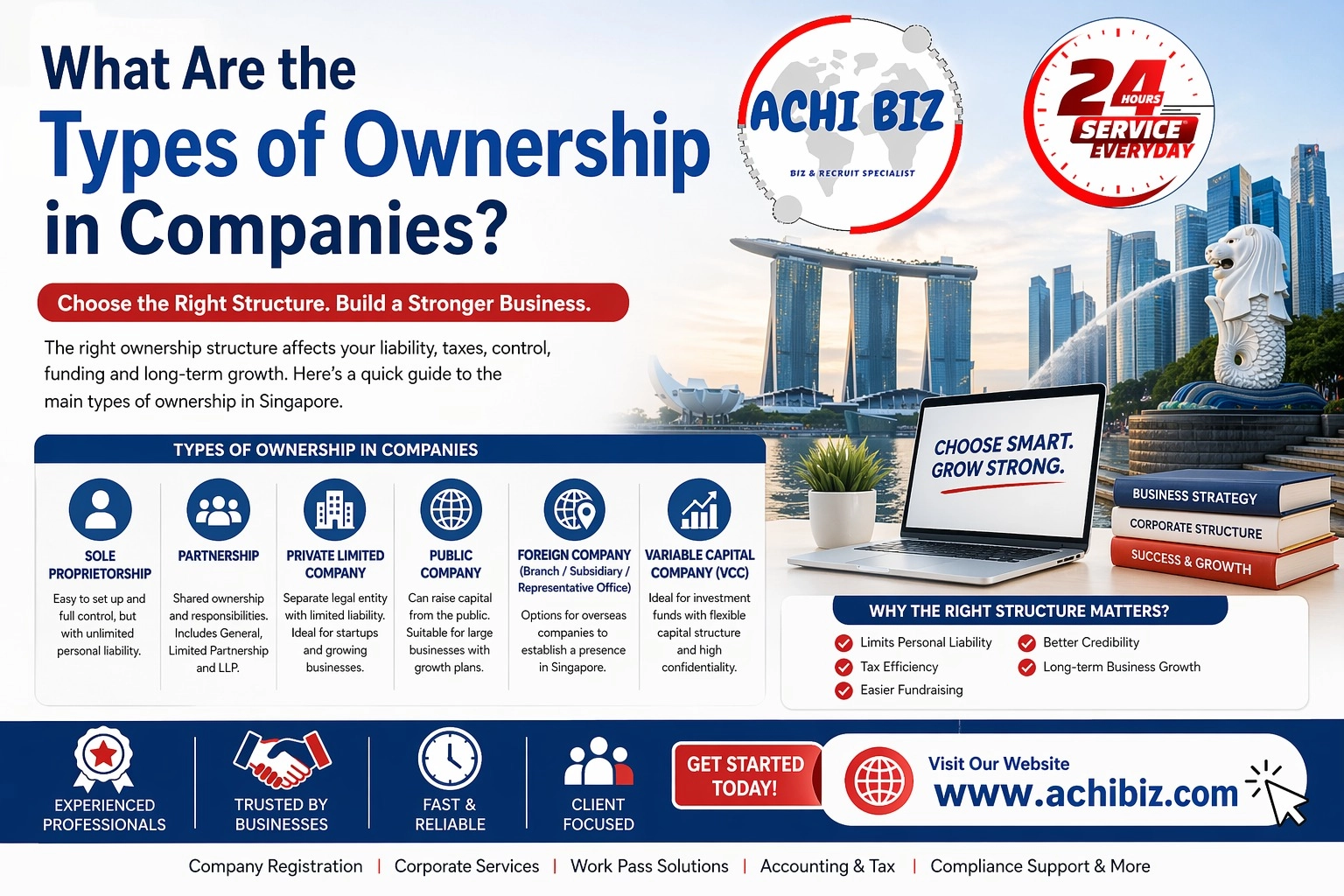
A sole proprietorship in Singapore is the simplest form of business ownership. In this structure, you and the business are considered the same legal entity. It gives you full control and is easy and cost-effective to set up, making it suitable for freelancers or small, low-risk businesses. However, the downside is significant—there is unlimited liability, meaning your personal assets are at risk if the business faces debts or legal issues. It is also not ideal for scaling or attracting investors.
A partnership business in Singapore involves two or more individuals running a business together. There are different forms, including general partnerships, limited partnerships (LP), and limited liability partnership (LLP) in Singapore. Partnerships allow you to combine skills, share responsibilities, and pool resources. While this can be beneficial, especially for professional services or small teams, it also comes with risks. In general partnerships, partners may have unlimited liability, and without a clear agreement, disputes can arise. A well-drafted partnership agreement is essential to avoid complications later.
A private limited company in Singapore is the most commonly chosen structure, especially for startups and growing businesses. It is a separate legal entity from its owners, which means shareholders enjoy limited liability and their personal assets are protected. This structure also offers stronger credibility, makes it easier to raise funds, and allows for long-term growth. While it does come with higher compliance requirements such as annual filings and corporate obligations, it is generally the preferred choice for those who are serious about building and scaling a business.
A public company in Singapore is typically suited for large businesses that intend to raise capital from the public. It can offer shares to the public and may be listed on a stock exchange. While this structure provides access to significant funding and increased visibility, it also involves strict regulatory requirements and high levels of compliance. For most small and medium-sized businesses, this is not a practical starting point but rather a stage of growth.
For foreign businesses looking to expand, setting up a foreign company in Singapore can be done through a branch office, subsidiary, or representative office. A branch office is considered an extension of the parent company, while a subsidiary company in Singapore is a separate legal entity. Most foreign businesses prefer setting up a subsidiary because it offers greater flexibility and limits liability within Singapore.
Another increasingly popular structure, especially for investment and fund management purposes, is the Variable Capital Company (VCC) in Singapore. The VCC is designed for investment funds and offers high flexibility in capital structure. It allows for easy issuance and redemption of shares, can be set up as a standalone fund or an umbrella fund with multiple sub-funds, and provides strong confidentiality for shareholders. This makes it an attractive option for asset managers, family offices, and investment-focused businesses. However, it is not suitable for typical trading or service-based companies.
When comparing these ownership types, the key differences lie in liability, control, scalability, and compliance requirements. Business structures in Singapore such as sole proprietorships and general partnerships are easier to set up but carry higher personal risk. Private limited companies provide better protection and growth potential but require more structured management and compliance. Public companies offer the highest scalability but come with the most stringent regulations, while VCCs serve a niche purpose for investment structures.
Choosing the right ownership structure ultimately comes down to your business goals. If you are testing a small idea, a sole proprietorship may be sufficient. If you are working with partners, a partnership or LLP could be suitable. However, if you are building a long-term business with plans to grow, a private limited company is usually the most practical and strategic choice. For international expansion, a subsidiary structure is often preferred, while VCCs are ideal for investment-related setups.
One of the most common mistakes business owners make is choosing a structure based purely on cost or convenience without considering long-term implications. Others underestimate liability risks or fail to plan for future growth. In partnerships, skipping a proper agreement is another frequent issue that can lead to serious disputes. While it is possible to change your business structure later, doing so can involve additional costs, time, and administrative effort.
Understanding the different types of ownership in companies is not just about meeting legal requirements—it is about building your business on the right foundation. The structure you choose will influence how your business operates, manages risk, and grows in the future.
If you are planning to start a business in Singapore and are unsure which structure is right for you, getting professional guidance early can help you avoid costly mistakes and make more confident decisions.
For tailored advice and end-to-end support, feel free to reach out to Achibiz. Our team can guide you through the right business structure in Singapore, assist with company setup, including VCC formation in Singapore, and ensure full compliance from day one.
📩 Contact us today to get started with confidence.
#achibiz