
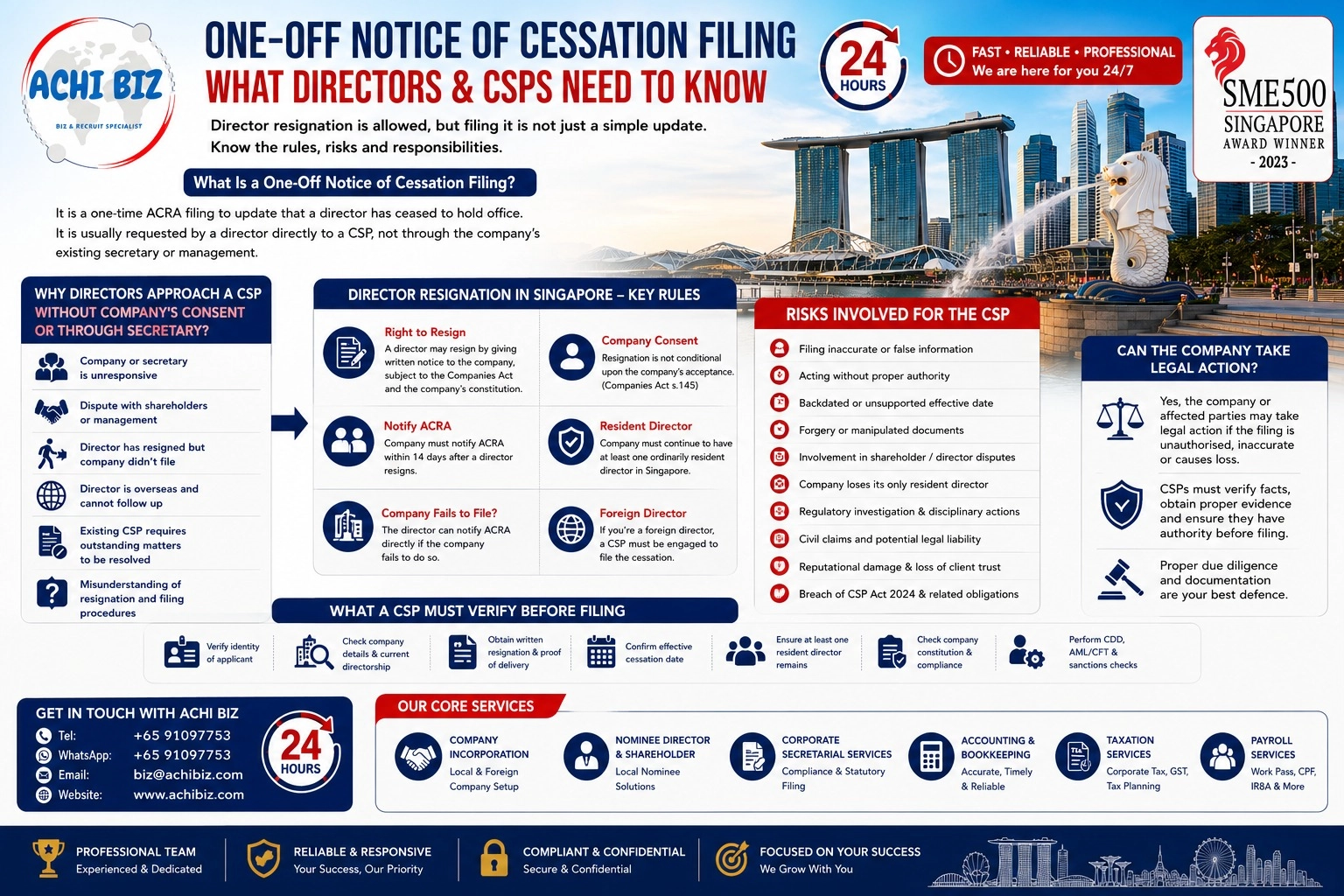
What Is a One-Off Notice of Cessation Filing? Why Do Some Foreign Directors Approach a CSP to Resign Without Going Through the Company’s Secretary, and What Are the Risks to the CSP?
A Notice of Cessation of a director is not merely an administrative change to a company’s ACRA profile. It records that an individual has ceased to hold office as a director of a Singapore company and can have significant legal, governance and compliance consequences.
The issue becomes more sensitive when a foreign director independently approaches an unrelated Corporate Service Provider (CSP) and asks the CSP to lodge a one-off cessation without going through the company’s existing company secretary, CSP, shareholders or management.
There may be perfectly legitimate reasons for such a request. For example, the director may have properly resigned but the company has failed to update ACRA. However, there may also be a shareholder dispute, disagreement over the resignation date, an attempt to avoid existing responsibilities, or a misunderstanding of the legal procedure.
Under Singapore law, a director’s resignation is not necessarily dependent upon the company’s consent. However, that does not mean an independent CSP should automatically accept an instruction from any person claiming to be a director and immediately lodge the cessation.
The CSP must distinguish between two separate questions:
Does the director have a legal right to resign?
and
Does the CSP have sufficient authority, evidence and regulatory basis to make the requested filing?
These are not the same question.
The following FAQs examine director resignation in Singapore, one-off Notice of Cessation filings, foreign director cessation, ACRA filing requirements and the legal and regulatory risks faced by registered CSPs.
Important: This article provides general corporate compliance information and is not legal advice. Disputed resignations, contested effective dates, shareholder disputes and threatened legal proceedings should be referred for appropriate Singapore legal advice.
Frequently Asked Questions on One-Off Notice of Cessation Filing and Director Resignation in Singapore
What is a Notice of Cessation of a director in Singapore?
A Notice of Cessation is the filing used to update ACRA when a registered position holder, such as a director, ceases to hold that position.
ACRA states that a company must notify ACRA within 14 days when a director resigns.
The filing changes the company’s official Bizfile records and should therefore reflect an actual and properly supported corporate event.
What is meant by a “one-off Notice of Cessation filing”?
“One-off filing” is generally a practical description rather than a separate type of company or resignation.
It usually describes a situation where a person approaches a CSP solely to perform a particular ACRA transaction, even though that CSP does not ordinarily provide company secretarial services to the company concerned.
For example, a foreign director may approach an independent CSP and say:
“I have resigned from this Singapore company. The company has not updated ACRA. Can you file my cessation?”
That creates a different risk profile from a routine cessation handled by the company’s existing corporate secretary, who may already hold the company’s statutory records and understand its corporate history.
Can a director of a Singapore company resign?
Yes, subject to the Companies Act and the company’s constitution.
Section 145 of the Companies Act provides that, subject to the statutory requirements and unless the constitution provides otherwise, a director may resign by giving the company written notice of resignation.
Does a Singapore company have to consent before a director can resign?
Not necessarily.
This is an important distinction.
The Companies Act expressly provides, subject to the relevant requirements, that a director’s resignation is not conditional upon the company’s acceptance of the resignation.
Therefore, saying that a director can never resign “without company consent” would be legally misleading.
The real issues are whether the resignation is valid, whether the applicable requirements have been satisfied and whether the claimed effective date is correct.
Does this mean a director can simply ask any CSP to remove the directorship from ACRA?
No.
The director’s legal ability to resign and the CSP’s authority to lodge a filing are separate matters.
A registered CSP should establish the legal and factual basis for the requested transaction before using its filing access.
What conditions must generally be satisfied for a director to resign?
ACRA states that a director can resign where:
- the resignation process complies with the company’s constitution; and
- the company will continue to have at least one director who is ordinarily resident in Singapore.
The company must then update ACRA within 14 days.
Why is the requirement for an ordinarily resident director important?
Section 145 of the Companies Act requires every company to have at least one director who is ordinarily resident in Singapore.
Therefore, a proposed cessation becomes particularly sensitive where the resigning person is the company’s only ordinarily resident director.
A CSP should not treat this as an ordinary data-entry exercise.
What happens if the company fails to lodge the director’s resignation?
ACRA states that where a company fails to notify ACRA, the director can notify ACRA directly.
This is an important safeguard for directors who have genuinely resigned but remain incorrectly shown on the register because the company has failed to act.
Why would a foreign director approach an independent CSP for a one-off cessation?
There are several possible reasons.
The company’s secretary or existing CSP may be unresponsive. The director may have fallen out with shareholders. The company may have ceased communicating with the director. The existing CSP may require outstanding matters to be resolved. The director may have moved overseas. There may be disagreement over whether the resignation occurred or its effective date.
Alternatively, the foreign director may simply be unable to complete the relevant Bizfile transaction personally and therefore seeks CSP assistance.
ACRA’s Bizfile guidance specifically states that where an appointed or withdrawn position holder is a foreigner, a CSP should be engaged to file the transaction.
That makes foreign-director cessation enquiries legitimate in principle, but it does not remove the CSP’s need to verify the underlying facts.
Is approaching another CSP automatically suspicious?
No.
It should be treated as a risk indicator requiring explanation, not proof of wrongdoing.
There may be a completely legitimate explanation.
However, an independent CSP normally has less institutional knowledge about the company than its existing secretary or CSP. The new CSP therefore needs to establish the facts independently.
Why should the CSP ask why the existing company secretary is not handling the resignation?
Because the answer may reveal important information about the transaction.
There is a considerable difference between:
“The company secretary has acknowledged my resignation but cannot assist me with the filing.”
and:
“The shareholders dispute my resignation and told the secretary not to file it.”
The second situation potentially involves a corporate dispute and requires substantially greater caution.
Should a CSP contact the existing company secretary before filing?
Whether this is necessary depends on the circumstances and the authority under which the transaction is being lodged.
However, for an unusual one-off cessation, obtaining appropriate corroboration can materially reduce the risk of acting on incomplete or disputed information.
The CSP should not assume that the applicant’s version of events is the complete corporate history.
Should the CSP verify that the applicant is actually a director?
Yes.
Identity and current position should be independently established rather than accepted from an email, passport copy or verbal representation alone.
The company’s current ACRA records should be checked.
Should the CSP verify the foreign director’s identity?
Yes.
The CSP should conduct the customer due diligence applicable to the engagement.
Singapore’s Corporate Service Providers Act 2024 took effect on 9 June 2025 and introduced the current regulatory framework governing registered CSPs.
Is an email from the foreign director sufficient evidence of resignation?
Ordinarily, an email asking a CSP to perform a filing should not by itself be treated as conclusive evidence of every fact required for the filing.
The CSP should distinguish between:
instruction to the CSP and evidence that a valid resignation occurred.
Those are different documents and serve different purposes.
What resignation documents should a CSP consider obtaining?
Depending on the circumstances, relevant evidence may include the signed resignation notice, evidence showing delivery of that notice to the company, acknowledgment by the company, relevant correspondence, applicable constitutional provisions and other corporate records establishing the effective cessation.
The precise documentation required will depend upon the facts.
Why is proof of delivery of the resignation notice important?
Because a director generally resigns by giving the company written notice, subject to the applicable requirements.
If there is subsequently a dispute over whether or when the company received the notice, the effective date may become important.
A CSP should therefore avoid assuming that the date printed on a resignation letter automatically establishes the legal cessation date.
Can a director backdate a resignation?
A CSP should be extremely cautious about any request to enter an earlier cessation date merely because the applicant wants the ACRA record changed retrospectively.
There is a difference between reporting a genuine historical resignation late and creating or backdating a resignation now.
If the director genuinely resigned earlier and can establish that fact, a late filing may be required. That does not justify manufacturing evidence or entering an unsupported historical date.
What if the foreign director asks the CSP to “just file today’s date”?
The CSP should still establish whether today’s date is actually the correct cessation date.
Convenience should not determine the information entered into a statutory filing.
What if the director asks the CSP to use a date several months or years earlier?
That should trigger enhanced scrutiny.
The CSP should establish why the filing was not made earlier and obtain satisfactory contemporaneous evidence supporting the claimed cessation date.
Is the CSP responsible for determining whether the resignation itself is legally valid?
A CSP is not a court and should not attempt to adjudicate a contested legal dispute.
Where validity depends upon disputed facts, interpretation of the company’s constitution or competing legal claims, appropriate legal advice may be necessary before the filing proceeds.
What happens if the company disputes the director’s resignation?
That substantially changes the risk profile.
A straightforward filing engagement may have become a corporate dispute.
The CSP should not allow itself to become a tactical instrument for one side of a shareholder or director dispute.
What if the company says it never received the resignation notice?
The CSP should not simply choose which party to believe.
Evidence should be examined. If the effective resignation itself is materially disputed, legal advice may be appropriate.
What if the director says the company is deliberately refusing to remove the director from ACRA?
This can happen.
ACRA expressly recognises that a company may fail to notify ACRA following a resignation and states that the director can notify ACRA directly in such circumstances.
Therefore, a company’s refusal to cooperate does not automatically prove that the director remains in office.
But the CSP still needs adequate evidence before facilitating a filing.
Can the company secretary prevent a valid director resignation simply by refusing to file it?
Not necessarily.
A valid resignation and the subsequent regulatory filing are separate issues.
As noted above, the Companies Act states that a resignation is not necessarily conditional upon the company’s acceptance.
The secretary’s refusal to lodge a transaction therefore does not by itself determine whether the director remains legally in office.
Why is this distinction important for CSPs?
Because a CSP can make two opposite mistakes.
One is assuming:
“The company did not consent, therefore the director cannot resign.”
The other is assuming:
“The director says he resigned, therefore we can immediately remove him from ACRA.”
Neither approach is sufficiently careful.
Does ACRA endorsement protect the CSP from risk?
Not necessarily.
ACRA’s current Bizfile guidance states that most position-holder changes require endorsement, but endorsement is not required when the transaction is filed by a CSP.
That makes the CSP’s own verification particularly important.
The absence of an endorsement requirement should not be interpreted as permission to lodge unverified information.
Why is the absence of endorsement particularly significant for a CSP?
Because the CSP’s filing route can potentially cause the change to be processed without the same endorsement mechanism applicable in other circumstances.
A CSP should therefore have a defensible file showing who instructed it, what was verified, what documents were reviewed and why it reasonably considered the filing appropriate.
Must a CSP add the company as a client before filing?
ACRA’s current guidance states that a registered CSP must update its client list before filing transactions for the client.
This reinforces the point that CSP filing access is part of a regulated professional relationship, not simply an open filing facility for anyone willing to pay a transaction fee.
What is the central authorisation risk in a one-off cessation?
The key question is:
Who is the CSP’s client, and in what capacity is the CSP authorised to make the filing?
If the CSP cannot answer that clearly, it should not proceed merely because the applicant appears on ACRA as a director.
Can a CSP rely solely on the foreign director’s passport?
No.
A passport can help establish identity.
It does not establish:
- that a resignation occurred;
- the effective date;
- compliance with the constitution;
- delivery of notice to the company;
- whether the resident-director requirement remains satisfied; or
- the CSP’s authority to make every requested representation.
Identity verification and transaction verification are separate controls.
What are the main risks to a CSP handling a one-off director cessation?
The principal risks include:
- filing inaccurate information;
- acting without adequate authority;
- relying on forged or manipulated documents;
- becoming involved in a corporate dispute;
- recording an incorrect cessation date;
- facilitating an improper backdated transaction;
- causing the company to lose its only ordinarily resident director;
- insufficient customer due diligence;
- inadequate documentary evidence;
- regulatory complaints;
- civil claims;
- reputational damage; and
- disciplinary or enforcement consequences where statutory obligations are breached.
Could the resignation request be part of a shareholder dispute?
Yes.
A director may also be a shareholder, nominee, founder, investor or representative of another shareholder.
Their departure can therefore form part of a much broader dispute concerning ownership, control, money, intellectual property or management.
The CSP should understand whether the requested filing is genuinely administrative or connected to contested corporate control.
What if the departing director is also a shareholder?
Resignation as a director does not automatically mean cessation as a shareholder.
Directorship and share ownership are legally distinct positions.
Removing a director from ACRA should not be confused with transferring that person’s shares.
What if the director is also the company secretary?
Each position must be considered separately.
Cessation from one office does not automatically establish cessation from another office.
What if the departing person is a nominee director?
Additional nominee-director considerations may arise.
Singapore’s regulatory framework now includes central filing requirements relating to the Register of Nominee Directors (ROND). A change in nominee status or nominator information can therefore involve additional compliance obligations.
Should a CSP check whether the applicant is a nominee director?
Where relevant, yes.
This can materially affect the compliance analysis and documentation required.
Could a foreign director be trying to escape liability by resigning?
Possibly, but resignation should not automatically be interpreted that way.
A director may have entirely legitimate reasons to leave.
Equally, a director might seek urgent removal after discovering financial irregularities, regulatory problems or disputes.
The CSP should therefore understand the context without assuming guilt.
Does resignation erase a director’s responsibility for conduct that occurred while in office?
No.
Resignation does not rewrite history.
A person ceasing to be a director does not automatically eliminate liabilities or responsibilities arising from acts, omissions or breaches occurring during the period in which the person served as director.
Could a director resign immediately after discovering wrongdoing in the company?
Potentially, subject to the applicable resignation requirements.
But whether resignation addresses any existing statutory or fiduciary responsibilities is a separate legal issue.
A CSP should not advise a director that cessation will erase past exposure.
Should a CSP ask about the reason for resignation?
For a routine filing, detailed personal explanations may not always be necessary.
For an unusual one-off engagement, however, understanding the purpose and circumstances of the transaction can form an important part of the risk assessment.
Is urgency a red flag?
Not automatically.
There may be legitimate urgency.
But statements such as:
“File it immediately.”
“Don’t contact the company.”
“Don’t tell the secretary.”
“Use this old date.”
“I will pay extra if you do it today.”
should trigger heightened scrutiny.
What if the director specifically instructs the CSP not to contact the company?
The CSP should understand why.
There may be a legitimate legal reason, but secrecy combined with disputed authority, retrospective dates or insufficient documentation significantly increases risk.
Can a duly registered CSP face regulatory consequences for an improper filing?
Potentially, yes.
Registered CSPs operate under the Corporate Service Providers Act 2024 and related regulations. ACRA states that registered CSPs must comply with ongoing statutory requirements, and registrations may be suspended or cancelled where key requirements are not fulfilled.
The exact consequence depends on what occurred and which legal or regulatory obligation was breached.
Could the affected company complain to ACRA about the CSP?
Yes.
If a company believes an unauthorised, false or otherwise improper filing has been made concerning its officers, it may challenge the matter and potentially raise it with ACRA.
Whether the complaint is ultimately justified depends upon the underlying facts.
Can the affected company take legal action against the CSP?
Potentially, yes.
A company or another affected party could seek legal remedies if it believes a CSP’s conduct caused legally actionable loss or interfered with its rights.
However, it would be inaccurate to say that every disputed cessation automatically gives the company a successful claim against the CSP.
Whether liability exists would depend on matters such as:
- the CSP’s authority;
- the accuracy of the filing;
- representations made;
- documentary evidence;
- applicable statutory obligations;
- the CSP’s conduct;
- causation;
- actual loss; and
- the particular legal cause of action.
That is ultimately a legal question determined by the facts.
Could the company sue merely because it did not consent to the director’s resignation?
Not simply on that basis.
This is precisely why the legal distinction matters.
Singapore law provides that a director’s resignation is not necessarily conditional upon company acceptance.
Therefore, the absence of company “consent” alone does not establish that the resignation or filing was wrongful.
When would the CSP’s litigation risk become more serious?
Risk increases considerably if evidence suggests that the CSP:
- knowingly filed false information;
- ignored obvious inconsistencies;
- acted without proper authority;
- accepted an unsupported backdated cessation;
- ignored a known dispute;
- relied on questionable documentation without investigation;
- made representations it knew were inaccurate; or
- failed to comply with applicable CSP obligations.
Can directors or shareholders personally take action against the CSP?
Potentially, depending upon whether they have an actionable legal basis and can establish the relevant elements of a claim.
The mere fact that somebody disagrees with a filing does not automatically create liability.
Can a CSP protect itself simply by obtaining an indemnity from the foreign director?
No.
An indemnity may provide contractual protection in certain circumstances, but it is not a substitute for regulatory compliance or proper verification.
A client cannot contractually authorise a CSP to disregard statutory obligations.
Is a signed declaration from the resigning director useful?
Yes, as part of the evidence.
For a higher-risk one-off engagement, the CSP may consider obtaining written declarations confirming matters such as the resignation, effective date, delivery to the company and accuracy of supporting documents.
But a declaration should corroborate due diligence, not replace it.
Should the CSP retain evidence of the transaction?
Yes.
A strong compliance file can be crucial if the filing is subsequently challenged.
The file should enable an independent reviewer to understand what happened, who instructed the CSP, what evidence was obtained, what checks were performed and why the filing was considered appropriate.
What should a CSP verify before accepting a one-off director cessation?
A prudent risk-based review would ordinarily consider:
- Identity of the applicant;
- Current ACRA position;
- Company’s UEN and corporate particulars;
- Applicant’s authority and capacity;
- Written resignation evidence;
- Evidence that resignation was communicated to the company;
- Effective date;
- Company’s constitution where relevant;
- Remaining directors;
- Whether at least one ordinarily resident director remains;
- Existing company secretary/CSP circumstances;
- Whether the resignation is disputed;
- Whether the applicant is also a shareholder or nominee director;
- Applicable CDD, sanctions and AML/CFT checks;
- Whether documents appear authentic and internally consistent; and
- Whether legal advice is required before proceeding.
Should a CSP perform customer due diligence even though it is only a one-off filing?
The fact that the engagement is small or one-off should not be treated as an exemption from applicable CSP compliance requirements.
ACRA identifies filing services performed for others as corporate services regulated under the CSP framework.
Is a one-off filing necessarily low risk because little money is involved?
No.
Transaction value and corporate risk are different things.
A relatively inexpensive filing can materially alter a company’s public corporate records.
The financial value of the CSP’s invoice therefore tells you very little about the legal significance of the transaction.
Should the CSP check sanctions, PEP and adverse information?
The CSP should apply the customer due diligence and risk controls required under the applicable regulatory framework and its own risk-based procedures.
Higher-risk indicators should lead to appropriate enhanced review rather than automatic acceptance.
What if the director refuses to provide the company’s constitution?
The CSP should determine whether the constitution is necessary to establish compliance with the resignation requirements.
ACRA specifically identifies compliance with the company’s constitution as a condition relevant to director resignation.
If a material legal question cannot be resolved from the available information, proceeding merely because the applicant wants a quick filing would be unwise.
What if all documentation appears genuine but the company objects after the filing?
An objection does not retrospectively prove that the CSP acted improperly.
The CSP’s position will be substantially stronger if its contemporaneous records demonstrate proper identity verification, authority, documentary evidence, compliance review and a reasonable basis for making the filing.
Should a CSP automatically reject every director who approaches independently?
No.
That would also be inappropriate.
ACRA expressly recognises circumstances in which a director may notify ACRA where the company has failed to do so, and foreign position holders may require a CSP to facilitate the relevant filing.
The correct approach is therefore verification and risk assessment, not automatic rejection.
When should a CSP decline a one-off cessation engagement?
Declining or pausing the engagement should be seriously considered where:
- identity cannot be satisfactorily established;
- authority remains unclear;
- the resignation cannot be substantiated;
- the effective date is unsupported;
- documents appear altered or inconsistent;
- the applicant requests artificial backdating;
- the resident-director requirement creates an unresolved issue;
- the resignation is subject to an active corporate dispute;
- the applicant refuses reasonable CDD;
- sanctions or serious AML/CFT concerns arise; or
- the CSP cannot obtain sufficient evidence to make a defensible filing.
When should the CSP seek legal advice rather than make a commercial compliance decision?
Legal advice should be considered where there is a genuine dispute concerning:
- validity of resignation;
- interpretation of the constitution;
- effective cessation date;
- board or shareholder authority;
- competing instructions;
- court proceedings;
- threatened litigation;
- allegations of fraud or forgery; or
- potential liability arising from the proposed filing.
A CSP’s role is to provide corporate services—not to decide contested questions of law between opposing parties.
What is the difference between refusing a filing and saying the director cannot resign?
They are completely different.
A CSP may decide:
“We do not have sufficient evidence or authority to undertake this filing.”
That does not mean:
“You have no legal right to resign.”
The director may have other statutory or legal avenues available.
This distinction protects both the director and the CSP from confusing professional engagement acceptance with the underlying legal right.
What is the safest approach for CSPs handling foreign director resignation requests?
The safest approach is neither automatic acceptance nor automatic rejection.
It is a documented, risk-based verification process.
The CSP should establish:
Identity → Capacity → Resignation → Effective Date → Notification → Constitutional Compliance → Resident Director Position → Authority to File → CDD/AML Review → Supporting Evidence
Only after those matters are satisfactorily resolved should the CSP determine whether it can properly undertake the filing.
What is the key lesson for CSPs regarding one-off Notice of Cessation filings?
A Notice of Cessation may look like a simple Bizfile transaction, but the underlying corporate event can be anything but simple.
A genuine foreign director who has properly resigned should not necessarily remain trapped on a company’s register merely because the company or its secretary fails to cooperate. Singapore’s framework recognises that problem. At the same time, a CSP should not become an alternative filing channel through which an inadequately verified, disputed or false cessation is placed on the public register.
The core principle is therefore:
A director’s right to resign does not automatically equal a CSP’s right to file without verification.
For a duly registered CSP, the safest position is to establish the legal and factual basis of the cessation, confirm its authority to act, conduct the required compliance checks, preserve supporting evidence and escalate genuinely disputed cases for legal review.
That approach protects the integrity of Singapore’s corporate register while reducing regulatory, civil, reputational and professional risks for Corporate Service Providers.