
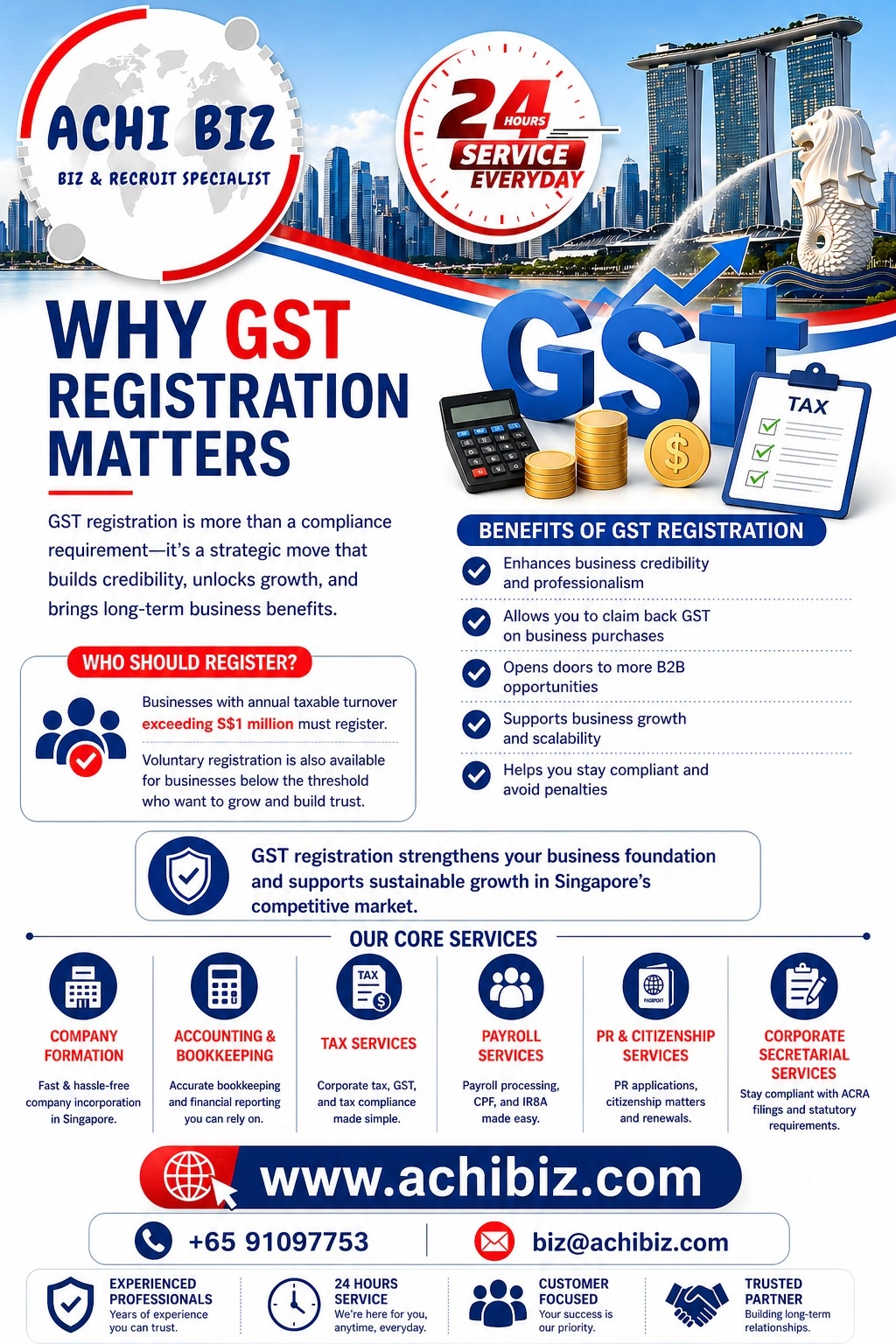
If you run a business in Singapore, GST registration isn’t just a compliance checkbox—it can shape how your company grows, prices its services, and positions itself in the market.
Whether you’re approaching the mandatory threshold or thinking of registering voluntarily, understanding how GST works (and what it actually does for your business) can save you from costly mistakes—and open up some strategic advantages.
What is GST and Who Needs to Register?
In Singapore, Goods and Services Tax (GST) is a consumption tax currently set at 9%. It’s governed by the Inland Revenue Authority of Singapore.
You’re required to register for GST if:
- Your taxable turnover exceeds SGD 1 million (retrospective basis)
- You expect it to exceed SGD 1 million in the next 12 months (prospective basis)
That said, even if you don’t meet the threshold, you can register voluntarily—and that’s where strategy comes into play.
Why GST Registration Matters (More Than You Think)
1.It Signals Credibility and Scale
Being GST-registered tells clients (especially corporate clients) that your business has reached a certain level of revenue and operational maturity. For B2B businesses, this matters. Many larger companies prefer dealing with GST-registered vendors because it fits into their own tax reporting systems.
You Can Claim Input Tax (Real Cost Savings)
This is one of the biggest advantages. If you’re GST-registered, you can claim back the GST paid on business purchases, operating expenses, and imports.
Example: If you spend $10,900 on equipment (including $900 GST), you can claim that $900 back—reducing your actual cost. Without GST registration, that $900 is simply absorbed as an expense.
Better Positioning for Growth
If your business is scaling fast, registering early avoids disruption later. Crossing the $1M threshold suddenly means you must register quickly, adjust pricing, and potentially deal with penalties if you delay. Voluntary registration helps you stay ahead and plan properly.
More Professional Pricing Structure
GST forces you to be clearer about pricing strategy, margins, and cost structures. It pushes your business toward a more structured, disciplined financial model—which is exactly what growing companies need.
How GST Registration Helps Your Business
Improves Cash Flow (When Managed Properly)
If your input GST (expenses) is higher than output GST (sales), you may even receive refunds.
Strengthens B2B Relationships
GST-registered clients can claim your GST, making your pricing effectively neutral to them.
Supports Expansion
If you’re dealing with imports, exports, or regional operations, GST registration simplifies tax handling and compliance.
The Downsides You Need to Be Honest About
GST isn’t all upside. There are real trade-offs.
Increased Administrative Work
You’ll need to file GST returns regularly (usually quarterly), maintain proper records, and track input versus output tax. This adds operational complexity, especially for smaller businesses without proper systems.
Higher Prices for End Consumers
If you sell directly to consumers (B2C), GST makes you more expensive compared to non-GST competitors. That 9% can affect price-sensitive customers and reduce competitiveness in certain markets.
Strict Compliance Requirements
The Inland Revenue Authority of Singapore does not take GST mistakes lightly. Common risks include late filing penalties, incorrect claims, and poor documentation. Once registered, you must comply—there’s no casual approach.
Cash Flow Mismanagement Risk
GST collected is not your money—it belongs to the tax authority. Businesses sometimes spend collected GST and struggle when it’s time to pay, which creates unnecessary financial stress.
Should You Register Voluntarily?
It depends on your business model.
Voluntary GST Registration Makes Sense If:
- You deal mainly with GST-registered clients (B2B)
- You have high business expenses and want to claim input tax
- You’re scaling and expect to cross $1M soon
It May Not Make Sense If:
- You sell mainly to consumers (B2C)
- Your margins are tight and price-sensitive
- Your admin setup isn’t ready
The Bottom Line
GST registration isn’t just about tax—it’s about how your business operates.
Done right, it improves cost efficiency, strengthens your brand credibility, and supports long-term growth.
Handled poorly, it adds unnecessary complexity, hurts pricing competitiveness, and creates compliance risk.
There’s no one-size-fits-all answer. The key is understanding where your business stands—and where it’s heading.
Need Help with GST Registration?
If you’re considering GST registration or unsure whether it’s the right move for your business, ACHI BIZ can guide you through the entire process—from assessment to registration and ongoing compliance.
Reach out to ACHI BIZ today to get clear, practical advice and ensure everything is handled properly from the start.
#achibiz