
Introduction: Singapore’s Registered Office Requirements Have Changed
Singapore companies now have greater flexibility in managing their registered office opening hours following an important amendment to the Companies Act 1967.
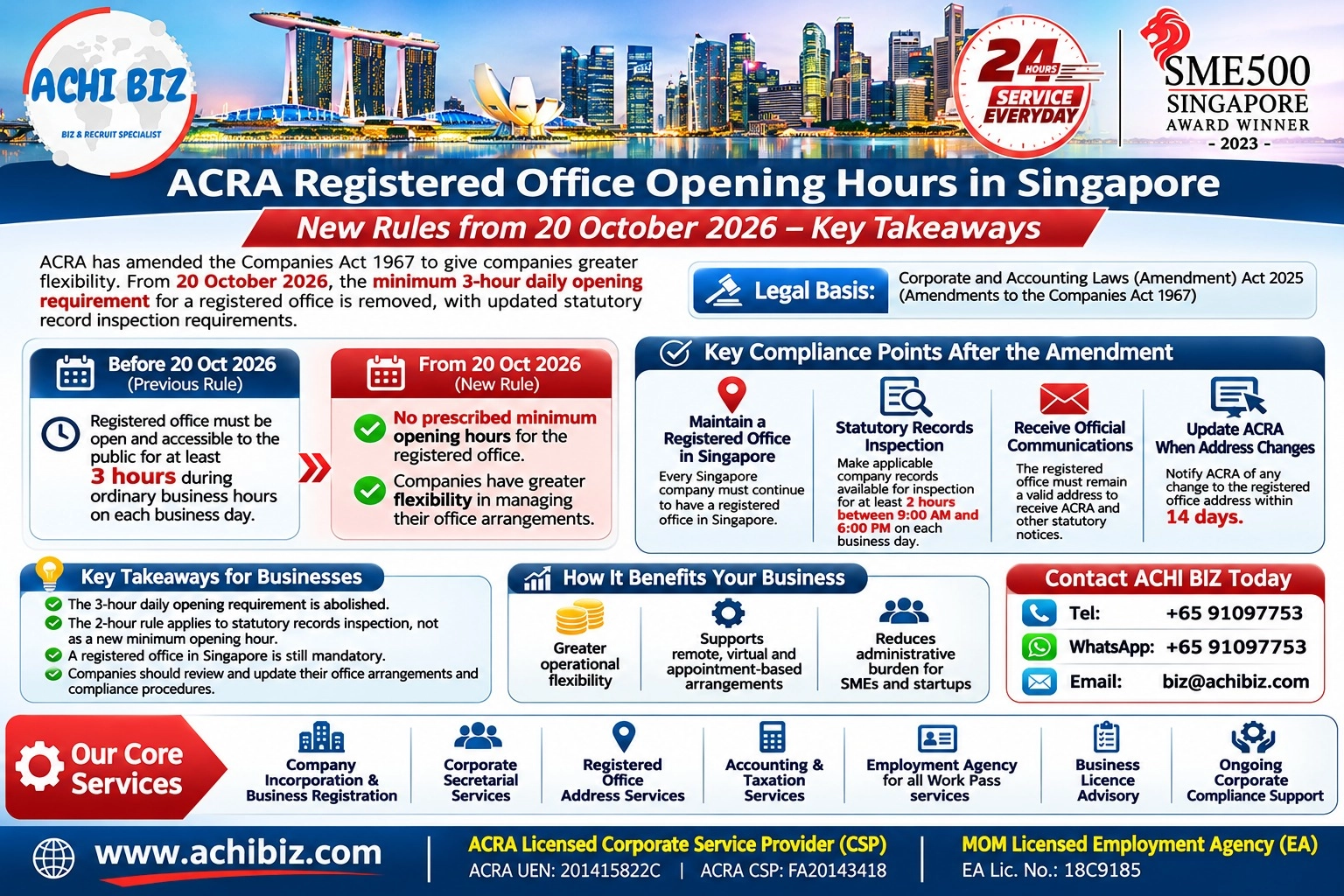
With effect from 20 October 2026, the Accounting and Corporate Regulatory Authority (ACRA) implemented legislative changes removing the longstanding requirement for a company’s registered office to remain open and accessible to the public for at least three hours during ordinary business hours on each business day.
The change forms part of the Corporate and Accounting Laws (Amendment) Act 2025, which seeks to reduce unnecessary regulatory burdens while maintaining appropriate corporate governance and access to statutory company records.
However, removing the minimum opening-hour requirement does not mean that companies can disregard their registered office responsibilities.
Every Singapore-incorporated company must continue to maintain a registered office address in Singapore where official communications and notices may be addressed. Companies must also comply with the revised statutory record inspection requirements, including the obligation to make applicable company records available for inspection for at least two hours between 9:00 AM and 6:00 PM on each business day, subject to the provisions of the Companies Act.
ACRA confirmed these changes in its announcement dated 6 October 2026, with the relevant amendments commencing on 20 October 2026.
For company directors, business owners, corporate secretaries, entrepreneurs and businesses using registered office address services in Singapore, understanding the distinction between registered office opening hours and statutory record inspection obligations is essential.
This comprehensive FAQ guide explains the new ACRA requirements, the practical implications of the amendments, and the continuing compliance responsibilities of Singapore companies.
Part 1: Understanding the New ACRA Registered Office Opening-Hour Rules
What are the latest ACRA registered office opening-hour requirements in Singapore?
From 20 October 2026, Singapore companies are no longer subject to a prescribed minimum number of daily opening hours for their registered offices under Section 142(1) of the Companies Act 1967.
Previously, companies were required to ensure that their registered offices were open and accessible to the public for at least three hours during ordinary business hours on each business day.
That requirement has now been removed.
Companies therefore have greater flexibility to determine appropriate office opening arrangements according to their operational needs.
Nevertheless, they must continue to maintain a registered office in Singapore to which official communications and notices may be addressed.
Is the minimum three-hour registered office opening requirement still applicable in Singapore?
No.
The previous minimum three-hour daily opening requirement was abolished with effect from 20 October 2026.
Companies are no longer required under Section 142(1) to maintain three hours of daily public accessibility merely to satisfy the registered office requirement.
However, this should not be confused with the separate statutory obligation to make certain company records available for inspection.
When did ACRA remove the three-hour registered office opening requirement?
The amendment took effect on 20 October 2026.
ACRA announced the commencement of the relevant legislative changes on 6 October 2026.
The changes were introduced through the Corporate and Accounting Laws (Amendment) Act 2025, which amended the Companies Act 1967.
Why did Singapore abolish the minimum registered office opening-hour requirement?
The amendment was intended to reduce unnecessary administrative burdens and give companies greater operational flexibility.
Many businesses now operate through digital communications, remote working arrangements, outsourced corporate administration and appointment-based services.
A mandatory daily opening period may not always reflect how these businesses function.
By removing the fixed opening-hour requirement while preserving statutory inspection rights, the legislation seeks to balance business flexibility with corporate transparency and accountability.
Does the amendment mean Singapore companies no longer need a registered office?
No.
The amendment removes the minimum opening-hour requirement, not the obligation to maintain a registered office.
Every Singapore-incorporated company must continue to have a registered office within Singapore from the date of incorporation.
This address serves as an official point of contact for statutory communications, notices and other relevant correspondence.
What is the difference between a registered office address and registered office opening hours?
A registered office address is the official Singapore address maintained by a company under the Companies Act.
Registered office opening hours refer to the periods during which the premises are accessible.
The amended legislation continues to require a valid registered office address but no longer imposes the former three-hour minimum daily opening period.
The distinction matters because the removal of one requirement does not eliminate the other.
What does the amended Section 142 of the Companies Act 1967 require?
Section 142(1), as amended from 20 October 2026, requires a company to have a registered office within Singapore from its incorporation, to which all communications and notices may be addressed.
The former wording requiring the office to be open and accessible to the public for at least three hours during ordinary business hours has been deleted.
Section 142(2) continues to provide penalties for failure to comply with the registered office requirement.
Is the new registered office opening-hour rule applicable to existing companies?
Yes.
The amendment applies to companies subject to the relevant provisions of the Companies Act, including existing Singapore-incorporated companies.
An existing company does not need to incorporate a new entity or change its registered office address merely to benefit from the removal of the minimum opening-hour requirement.
However, it should review its existing office arrangements and ensure that all continuing statutory obligations remain satisfied.
Does the amendment apply to newly incorporated Singapore companies?
Yes.
A newly incorporated Singapore company must maintain a registered office within Singapore from its date of incorporation.
However, it is no longer subject to the former three-hour minimum opening requirement.
The company should establish suitable arrangements for receiving official correspondence and facilitating statutory record inspections where required.
Does the amendment apply to private limited companies in Singapore?
Yes.
Singapore private companies limited by shares, commonly referred to as Pte. Ltd. companies, are subject to the amended registered office requirements.
The change is particularly relevant to SMEs, startups, investment holding companies and companies using professional registered office address services.
Does the amendment apply to public companies and companies limited by guarantee?
Yes, where the relevant Companies Act provisions apply.
The removal of the minimum opening-hour requirement is not confined to private limited companies.
However, public companies and companies limited by guarantee may have additional regulatory, governance or sector-specific obligations that should be considered separately.
Does the amendment automatically apply to LLPs, LPs and sole proprietorships?
Not necessarily.
The amendment discussed here concerns the registered office requirements imposed on companies under the Companies Act 1967.
Limited Liability Partnerships, Limited Partnerships and sole proprietorships operate under different legislative frameworks.
Businesses should not automatically assume that every rule governing company registered offices applies identically to other business structures.
Does the amendment apply to foreign company branches registered in Singapore?
Foreign companies registered in Singapore are subject to separate statutory provisions governing foreign company registration and local office arrangements.
The amendment to Section 142 should not automatically be treated as removing every office-related obligation applicable to a foreign company branch.
Foreign companies should assess their specific obligations under the relevant provisions of the Companies Act.
Part 2: Registered Office Opening Hours and Practical Business Operations
Can a Singapore company decide its own registered office opening hours?
Yes.
The removal of the prescribed minimum opening hours gives companies greater flexibility to determine their operating arrangements.
A company may adopt opening hours appropriate to its business activities, administrative arrangements and service requirements.
Nevertheless, it must continue to maintain a valid registered office and comply with applicable statutory inspection obligations.
Can a registered office operate for fewer than three hours per day?
Yes.
There is no longer a statutory three-hour minimum under Section 142(1).
A company may adopt shorter public opening periods where appropriate.
However, any separate obligation to make company records available for inspection must still be fulfilled.
Can a Singapore registered office operate on an appointment-only basis?
An appointment-based arrangement may be practical under the amended framework.
For example, a company may arrange visits and permitted statutory inspections through advance coordination rather than maintaining unrestricted daily walk-in access.
However, appointment arrangements must not obstruct lawful inspection rights or prevent the company from receiving official communications.
Can a registered office remain closed to walk-in visitors?
The removal of mandatory daily public opening hours means that a company is no longer required to maintain the former minimum walk-in accessibility period under Section 142(1).
Nevertheless, a company should not interpret this as permission to disregard official correspondence, statutory notices or lawful inspection requests.
A controlled-access or appointment-based arrangement may be suitable if the company’s continuing obligations are properly addressed.
Can a registered office be closed throughout the day?
The amended Section 142 does not prescribe a minimum daily public opening period.
However, whether a particular closed-office arrangement is compliant depends on the company’s ability to maintain a genuine registered office, receive communications and facilitate any statutory inspections required by law.
Companies should avoid treating the amendment as permission to maintain an address that is effectively unusable.
Is a company required to display fixed registered office opening hours?
The amended Companies Act no longer contains the former Section 143 office-hours notification framework.
Accordingly, the previous statutory requirements concerning notification of office opening hours have been replaced by provisions focused on changes to the registered office’s location.
Nevertheless, businesses may choose to communicate appointment or contact arrangements clearly for practical reasons.
Must a company continue operating from 9:00 AM to 6:00 PM?
No.
The 9:00 AM to 6:00 PM period is relevant to statutory company record inspection under Section 396A.
It does not impose a general requirement for every registered office to remain open throughout those nine hours.
Does the new law require a registered office to open for two hours every day?
Not as a general registered office opening-hour requirement.
The two-hour provision concerns the availability of company records that must be open for inspection under the Companies Act.
It should not be described as a replacement two-hour public opening requirement for all registered offices.
Can a company operate its registered office outside normal business hours?
A company may determine its operating arrangements without the former statutory three-hour minimum.
However, statutory records that must be available for inspection remain subject to the separate inspection period prescribed by Section 396A.
A company operating mainly outside conventional business hours should ensure that its inspection arrangements can still meet those requirements.
Must a director be physically present at the registered office?
The amended Section 142 does not impose a general requirement for a director to be physically present at the registered office during specified daily hours.
A company may appoint appropriate personnel or engage a professional service provider to assist with administrative arrangements.
Directors nevertheless remain responsible for ensuring that the company complies with its statutory obligations.
Must a company secretary be physically present at the registered office?
There is no general requirement under the amended Section 142 for the company secretary to be physically stationed at the registered office for a minimum number of hours each day.
Corporate secretarial functions may be managed through appropriate professional and administrative arrangements.
The company must still ensure that statutory responsibilities are properly discharged.
Can a company use a shared office as its registered office?
A shared office may be suitable, provided the address is valid for the intended purpose and the company can meet the applicable legal requirements.
The company should ensure that official communications can be received and that arrangements exist for lawful access to company records where required.
Can a Singapore company use a virtual office address?
A virtual office arrangement may be suitable where it provides a genuine and compliant registered office address.
However, not every virtual office package necessarily satisfies the company’s legal and practical needs.
The company should verify the address provider’s arrangements for correspondence handling, statutory notices and inspection coordination.
Can a company use a corporate service provider’s registered office address?
Yes, subject to appropriate arrangements and compliance with the relevant legal requirements.
A professional corporate service provider may offer registered office address services together with corporate secretarial and administrative support.
Companies should verify the provider’s service scope and ensure that statutory responsibilities are not overlooked.
Does removing the minimum opening hours make virtual office services automatically compliant?
No.
The amendment removes one particular statutory requirement.
It does not automatically validate every virtual office, mail forwarding or shared-address arrangement.
A company remains responsible for maintaining a compliant registered office and fulfilling its continuing obligations.
Part 3: Statutory Company Records Inspection Under the New Rules
What are the new ACRA statutory record inspection requirements from 20 October 2026?
Under the amended Section 396A of the Companies Act 1967, company records that are required by the Act to be available for inspection must be made available:
-
For at least two hours during the period between 9:00 AM and 6:00 PM on each business day.
-
At the location where the records are legally required to be kept.
-
Subject to the statutory requirements governing who is entitled to inspect the records and the applicable inspection procedures.
A person who is permitted to inspect company records must generally give reasonable notice of the intended inspection.
The legislation also specifies exceptions to this notice requirement for certain statutory powers and directions.
Singapore Statutes Online+1
What is the difference between the abolished three-hour rule and the new two-hour inspection requirement?
These are two distinct legal obligations.
| Matter | Previous requirement | From 20 October 2026 |
|---|---|---|
| Registered office public opening hours | Minimum 3 hours per business day | No prescribed minimum |
| Statutory company records inspection | Linked to the former inspection framework | At least 2 hours between 9 AM and 6 PM on each business day |
| Advance inspection notice | Previous statutory framework | Reasonable notice generally required |
| Registered office address | Mandatory | Still mandatory |
| Change of registered office address | Notify ACRA within 14 days | Still notify ACRA within 14 days |
The most important distinction is that the two-hour inspection requirement is not a new minimum opening-hour requirement for the registered office itself.
Does every company record need to be available for public inspection?
No.
Section 396A applies to company records that the Companies Act requires to be available for inspection.
Different records may have different eligibility, access, confidentiality and inspection requirements.
The provision does not create a general right for any member of the public to inspect every document belonging to a company.
Who is entitled to inspect a company’s statutory records?
Entitlement depends on the particular record and the applicable provisions of the Companies Act.
Depending on the record, inspection rights may belong to shareholders, company members, directors, authorised persons, regulators or other persons permitted by law.
Companies should verify the requesting person’s entitlement before disclosing information.
Can any member of the public demand access to confidential company records?
No.
The removal of registered office opening-hour requirements does not create unrestricted public access to confidential business information.
A company must distinguish between records that are legally open for inspection and records that remain confidential or subject to restricted access.
Must a person give advance notice before inspecting company records?
Generally, yes.
The amended Section 396A(1A) requires a person who wishes to inspect a company record, and who is permitted to do so under the Act, to give reasonable notice of that intention.
However, Section 396A(1B) preserves specified inspection and information-access powers exercised under statutory directions, requirements, warrants and court orders.
How much advance notice is considered reasonable?
The legislation uses the expression reasonable notice without prescribing one universal notice period for every inspection request.
What is reasonable may depend on the circumstances, including the type of record, its location, the requesting person’s entitlement and the administrative arrangements needed.
Companies should avoid imposing arbitrary notice periods that effectively defeat lawful inspection rights.
Is 24 hours’ notice sufficient for a statutory records inspection?
It may be sufficient in some circumstances, but there is no universal statutory rule stating that 24 hours is always reasonable.
The appropriate notice period should be assessed according to the particular inspection request.
Companies may establish practical procedures while remaining mindful of their legal obligations.
Can a company insist on seven days’ advance notice?
A company should not assume that a fixed seven-day notice period will be reasonable in every situation.
Although administrative procedures can be useful, an unnecessarily lengthy notice period may be difficult to justify for a straightforward inspection request.
The company should consider the circumstances and applicable statutory rights.
Can a company refuse an inspection request without reasonable notice?
Where the statutory reasonable-notice requirement applies, the company may request that the person comply with it.
However, the company should first determine whether the request falls within an exception or is governed by another specific legal requirement.
It should not automatically reject requests from regulators or other authorised persons exercising statutory powers.
Can ACRA inspect company records without following the ordinary notice procedure?
Certain statutory powers are expressly preserved under Section 396A(1B).
The reasonable-notice requirement does not restrict the exercise of the specified regulatory, investigative and judicial powers.
Companies should therefore distinguish ordinary inspection requests from legally authorised regulatory requirements.
Does the company have to provide inspection access immediately after receiving notice?
Not necessarily.
The legislation requires reasonable notice and compliance with the applicable inspection framework.
The practical timing should reflect the statutory requirements and the circumstances of the request.
Companies should respond promptly and coordinate access rather than unnecessarily delaying an inspection.
Must the two-hour inspection period be continuous?
Section 396A requires records to be available for two or more hours within the prescribed daily period.
The provision does not expressly state that those hours must be consecutive.
Nevertheless, companies should adopt clear, workable arrangements and avoid fragmented or impractical inspection periods that undermine the purpose of the requirement.
A continuous two-hour inspection window is a sensible operational approach.
Can a company offer statutory record inspections from 10:00 AM to 12:00 PM?
Yes, this is an example of a two-hour period falling within the statutory 9:00 AM to 6:00 PM window.
However, the company must ensure that the arrangements satisfy the applicable inspection requirements, including the correct location, entitlement and notice provisions.
Can a company offer inspections from 5:00 PM to 7:00 PM?
Not as the sole two-hour statutory inspection period.
Only the hour between 5:00 PM and 6:00 PM falls within the prescribed 9:00 AM to 6:00 PM window.
The company would need to ensure that the required two hours fall within the statutory period.
Does the inspection requirement apply on Saturdays, Sundays and public holidays?
The requirement refers to each business day as defined or interpreted under the applicable legislation.
Companies should apply the statutory meaning of a business day rather than assuming that their own preferred operating calendar determines the legal obligation.
For ordinary planning, companies should ensure compliant arrangements on applicable weekdays and verify any special circumstances.
Can statutory company records be inspected at a location other than the registered office?
The relevant records must be available for inspection at the place where the Companies Act requires them to be kept.
That place is not necessarily the registered office for every category of record.
Companies should establish the correct statutory location before deciding where an inspection must take place.
Can company records be kept electronically?
Yes, subject to applicable statutory requirements.
The Companies Act recognises electronic company records and provides for inspection arrangements involving electronic records.
Companies must ensure that their recordkeeping systems meet the relevant requirements and that permitted inspections can be facilitated.
Can an authorised person request electronic access to company records?
Section 396A provides for inspection of electronically maintained company records through appropriate reproductions or electronic means.
The company must comply with the relevant statutory provisions concerning the form of inspection and the facilities required.
However, this does not automatically mean that every requester is entitled to unrestricted remote access to the company’s systems.
Can a company provide scanned documents instead of physical inspection?
The appropriate method depends on the statutory requirements and the nature of the records.
Electronic copies may be suitable in some circumstances, but companies should not assume that sending scanned documents always replaces a legally required inspection process.
The requesting person’s rights and the relevant statutory provisions must be considered.
Can a person inspecting company records make copies or extracts?
Yes, where permitted by the applicable statutory provisions.
Section 396A(3) recognises the ability of persons entitled to inspect company records to make copies or take extracts.
Any applicable fees, restrictions or record-specific requirements should also be considered.
What happens if a company fails to provide proper facilities for inspecting electronic records?
Section 396A(4) requires companies keeping records electronically to provide proper facilities for their inspection.
Failure to comply with that subsection may expose the company and officers in default to a fine not exceeding S$1,000 and a default penalty.
Other breaches of recordkeeping or inspection requirements may carry different consequences.
What if a company uses an outsourced corporate secretary to maintain its statutory records?
Outsourcing corporate secretarial administration does not remove the company’s legal responsibilities.
The company should ensure that the service provider can identify where the relevant records are legally kept, maintain them appropriately and coordinate lawful inspections.
Clear responsibilities and communication procedures are especially important when records are maintained by an external service provider.
Can a company delay inspection because its corporate secretary is overseas?
The absence or unavailability of a particular individual does not automatically suspend statutory inspection obligations.
Companies should establish appropriate backup arrangements to avoid unnecessary delays.
A properly organised recordkeeping system should not depend entirely on one person’s physical presence.
What should a company do when it receives a statutory inspection request?
The company should first identify the record requested, verify the requester’s legal entitlement and determine whether the reasonable-notice requirement applies.
It should then confirm the lawful inspection location, arrange an appropriate inspection period and ensure that the records and necessary facilities are available.
The company should also maintain an appropriate internal record of the request and its response.
Part 4: Registered Office Address, ACRA Filing and Corporate Compliance
Must every Singapore company have a registered office address from incorporation?
Yes.
Section 142(1) requires a company to maintain a registered office within Singapore from the date of its incorporation.
The removal of the minimum opening-hour requirement does not affect this fundamental obligation.
Can a Singapore company register without providing a registered office address?
No.
A Singapore-incorporated company must satisfy the statutory registered office requirement.
The registered office address is part of the company’s formal corporate particulars.
Is a registered office the same as a company’s principal place of business?
Not necessarily.
A registered office is the company’s official statutory address.
Its principal place of business is generally the location from which its main business activities are conducted.
These may be the same address, but they do not have to be identical.
Can a Singapore company maintain its registered office at one address and operate from another?
Yes, subject to the applicable requirements.
For example, a company may maintain a registered office through a corporate service provider while conducting its day-to-day business from another suitable location.
It must ensure that the relevant addresses and business activities comply with applicable regulatory requirements.
Can a home address be used as a company’s registered office?
A residential address may be used in appropriate circumstances, subject to the relevant property-use restrictions, approvals and statutory requirements.
The removal of the three-hour rule does not override HDB, URA or other applicable residential property regulations.
Business owners should verify whether their proposed residential address is suitable before using it as a registered office.
Can a Singapore company use a P.O. Box as its registered office address?
A P.O. Box alone should not be treated as a substitute for a valid physical registered office address in Singapore.
The company must maintain a registered office that satisfies the applicable statutory requirements.
A postal box may serve certain correspondence purposes, but it is not equivalent to maintaining a registered office.
Can a company use a coworking space as its registered office?
Potentially, yes.
The suitability of a coworking space depends on the address arrangement, the provider’s permission, relevant property-use conditions and the company’s ability to fulfil its statutory responsibilities.
A company should verify these matters before registering the address with ACRA.
Is a registered office address service legal in Singapore?
Yes, registered office address services can be provided through appropriate professional arrangements.
However, the provider and the company must comply with applicable laws and regulatory requirements.
Where corporate service provider activities are regulated, the provider should also meet the relevant registration and compliance obligations.
Does ACRA require a registered office address to be owned by the company?
No general ownership requirement is imposed by Section 142.
A company may use premises under an appropriate lease, licence, service agreement or other lawful arrangement.
The important consideration is whether the address arrangement is valid and enables the company to meet its statutory obligations.
Can multiple companies use the same registered office address?
Multiple companies may use the same address where the arrangement is lawful and appropriate.
This is common in professional corporate secretarial and registered office service arrangements.
However, each company must independently satisfy its statutory obligations.
Is there a statutory limit on how many companies can use one registered office address?
The amended Section 142 does not prescribe a universal numerical limit on the number of companies sharing a registered office address.
Nevertheless, service providers and companies must consider practical capacity, lawful use of the premises, regulatory requirements and effective correspondence handling.
An address should not be used in a manner that compromises compliance.
Does a registered office need a receptionist?
Section 142 does not impose a general requirement for a receptionist to be physically present.
However, the company must maintain arrangements that enable official communications and notices to be addressed to its registered office.
Whether reception or administrative personnel are necessary depends on the particular service arrangement.
Can a registered office use a digital mail notification system?
Yes, a digital notification system may be a useful administrative tool.
For example, a registered office service provider may notify clients electronically when correspondence arrives.
However, digital notifications do not eliminate the need for proper handling of original documents, statutory notices or other communications requiring specific action.
Is a mail forwarding service alone sufficient for a registered office?
Not necessarily.
Mail forwarding is one administrative function, but a compliant registered office arrangement may require additional capabilities.
Companies should verify that the address can serve its statutory purpose and that lawful inspection arrangements can be supported.
What happens if a company’s registered office address changes?
The company must notify ACRA of the change within the statutory filing period.
Under Section 143 of the Companies Act, the change must be lodged with the Registrar within 14 days after it occurs.
How many days does a company have to update its registered office address with ACRA?
14 days after the change.
This requirement continues under the amended Section 143, notwithstanding the removal of the former opening-hour provisions.
Singapore Statutes Online+1
Does a company need to notify ACRA when changing only its registered office opening hours?
The amended Section 143 no longer contains the previous statutory framework requiring notification of registered office opening days and hours.
Its focus is now on changes in the situation of the registered office, including its address and designation.
Companies should nevertheless review any relevant Bizfile records or other regulatory obligations where applicable.
What if a company changes its registered office address but fails to notify ACRA?
Failure to lodge the required change within 14 days may constitute an offence under Section 143.
The company and officers in default may be liable on conviction to a fine not exceeding S$5,000 and a default penalty.
Companies should therefore update their registered office particulars promptly.
What happens if a company does not maintain a registered office in Singapore?
Failure to comply with Section 142(1) may constitute an offence.
Under Section 142(2), the company and every officer in default may be liable on conviction to a fine not exceeding S$5,000 and a default penalty.
The removal of the minimum opening-hour requirement does not remove these consequences.
Can ACRA take action against a company whose registered office cannot receive official correspondence?
A company must maintain a registered office to which communications and notices may be addressed.
If its address arrangement does not satisfy that requirement, the company may face compliance concerns and potential enforcement action.
A company should therefore avoid using an address where official communications cannot be properly handled.
Can a company continue using an outdated registered office address?
No.
A company should maintain accurate registered office particulars and notify ACRA of changes within the prescribed period.
Using an outdated address may cause important notices to be missed and create statutory compliance risks.
Does the registered office address appear in ACRA business records?
The registered office address forms part of the company’s registered particulars.
Relevant company information may be available through ACRA’s business information services, subject to the applicable disclosure framework.
Companies should therefore understand that their registered office address is not merely an internal administrative detail.
Part 5: Impact on SMEs, Startups, Directors and Corporate Service Providers
How does the removal of minimum registered office opening hours benefit Singapore SMEs?
The amendment offers SMEs greater flexibility in organising their administrative operations.
Small businesses may not need to maintain a staffed office solely to satisfy the former three-hour public opening requirement.
They can instead focus on maintaining an effective registered office arrangement, receiving official correspondence and meeting statutory inspection obligations.
This may reduce unnecessary administrative costs, although actual savings depend on the company’s circumstances.
How does the amendment benefit newly incorporated startups?
Startups often operate with limited resources, small teams and flexible working arrangements.
The removal of prescribed opening hours allows them to organise their registered office arrangements without being tied to the former daily three-hour requirement.
However, startups must still maintain a valid Singapore registered office and ensure compliance with the Companies Act.
Does the amendment reduce the cost of maintaining a registered office?
Potentially.
Companies may have greater flexibility in selecting suitable administrative arrangements.
Nevertheless, the amendment does not require registered office service providers to reduce their fees.
Service charges will continue to depend on the provider’s scope of services, correspondence handling, compliance support and other commercial considerations.
Can a one-person company benefit from the amended registered office rules?
Yes.
A company with a sole director or a small management team may benefit from the flexibility provided by the amendment.
However, the director must still ensure that the company maintains its registered office and meets its statutory obligations.
Does a dormant company still need a registered office?
Yes.
A dormant company remains subject to applicable statutory requirements unless a specific exemption applies.
Dormancy does not, by itself, remove the obligation to maintain a registered office under Section 142.
Does an investment holding company need a registered office even if it has no employees?
Yes.
A Singapore-incorporated investment holding company must maintain a registered office even if it has no employees or does not conduct daily customer-facing operations.
The registered office requirement is based on the company’s legal status, not its employee headcount.
Can a company operate entirely online without a physical business office?
A company may conduct its business activities online, subject to applicable laws.
However, a Singapore-incorporated company must still maintain a registered office within Singapore.
Operating digitally does not eliminate the statutory registered office requirement.
Does the amendment mean companies no longer need office administrative support?
No.
Although companies have greater flexibility regarding opening hours, administrative responsibilities remain.
These may include receiving correspondence, monitoring regulatory deadlines, maintaining statutory records and coordinating inspections.
Professional administrative support may continue to be valuable, particularly for companies without dedicated in-house personnel.
Should directors review their registered office service agreements following the amendment?
Yes, reviewing existing arrangements is advisable.
Directors should consider whether their service agreements accurately describe current legal requirements, correspondence procedures, inspection support and the responsibilities of the service provider.
However, the amendment does not automatically invalidate existing agreements.
Must registered office service providers change their operating hours immediately?
No general requirement compels providers to reduce or change their existing hours.
Providers may continue offering longer opening hours where commercially appropriate.
The amendment gives flexibility; it does not prohibit companies or service providers from maintaining conventional office hours.
Can a registered office provider continue offering three-hour or five-hour daily accessibility?
Yes.
The statutory minimum has been removed, but longer opening hours remain permissible.
A service provider may maintain these arrangements to support customer service, correspondence handling or operational convenience.
What should a company consider before choosing a registered office address service in Singapore?
A company should evaluate the suitability of the address and the reliability of the provider.
Important considerations include:
-
Whether the address can lawfully be used as the company’s registered office.
-
How official correspondence and statutory notices are received and communicated.
-
Whether statutory inspection arrangements can be coordinated where applicable.
-
Whether the service provider’s responsibilities are clearly documented.
-
Whether the provider is appropriately registered or licensed for regulated services it performs.
-
Whether the service agreement clearly explains its fees, limitations and termination arrangements.
The lowest-priced service may not necessarily offer the most suitable administrative support.
Part 6: Compliance Risks, Misconceptions and Practical Scenarios
Is it correct to say that ACRA has completely abolished registered office accessibility requirements?
That statement is too broad and may be misleading.
ACRA has removed the former prescribed minimum public opening hours under Section 142.
However, companies must continue maintaining a registered office to which communications and notices may be addressed.
They must also comply with applicable statutory record inspection requirements.
Is it correct to say that the new minimum registered office opening period is two hours?
No.
This is one of the most important misconceptions arising from the amendment.
The former three-hour registered office opening requirement has been removed.
The two-hour requirement under Section 396A relates specifically to the availability of company records for lawful inspection.
Registered office opening hours and statutory record inspection hours are not interchangeable.
Can a company ignore an official letter because its registered office is closed?
No.
The company must maintain a registered office to which communications and notices may be addressed.
A company should establish reliable procedures for monitoring and responding to official correspondence.
The absence of prescribed opening hours does not justify ignoring statutory communications.
Does the amendment affect the legal service of documents on a company?
The amendment should not be interpreted as eliminating the legal mechanisms for serving documents on a company.
The company must continue maintaining a registered office, and the applicable laws governing service of documents remain relevant.
Companies should not assume that closing their premises prevents legal documents from being validly served.
Can a company avoid receiving legal notices by restricting registered office access?
No.
The removal of minimum opening hours does not provide a mechanism for avoiding legal notices or statutory responsibilities.
A company that deliberately obstructs official communications may expose itself to additional legal and compliance risks.
Can a company use an address that exists only on paper?
A registered office arrangement must satisfy the statutory requirement for an office within Singapore to which communications and notices may be addressed.
A nominal address that cannot effectively fulfil this function may create compliance concerns.
Companies should ensure that their address arrangements are genuine and operationally workable.
What happens if the registered office provider stops operating?
The company remains responsible for maintaining a valid registered office.
If the provider’s closure affects the company’s registered office arrangement, the directors should promptly establish an alternative and make any necessary ACRA filings.
A change of registered office address must be notified within the statutory period.
What if the registered office provider fails to forward an important ACRA notice?
The company may still face consequences arising from missed statutory obligations.
The precise responsibilities between the company and provider will depend on the law, the circumstances and the service agreement.
Directors should not assume that outsourcing correspondence handling transfers all legal responsibility to the provider.
Can a company be penalised for missing an ACRA filing deadline even if it never received a reminder?
Yes, where the applicable law imposes a filing obligation and provides penalties for non-compliance.
A company’s statutory filing responsibilities generally do not depend on receiving reminders.
Reliable registered office administration is important, but directors should also maintain independent compliance monitoring.
Does the amendment remove the requirement to maintain statutory company registers?
No.
The amendment does not abolish statutory recordkeeping obligations.
Companies must continue maintaining the records required under the applicable legislation.
The new inspection framework addresses access to records, not the elimination of those records.
Can a company refuse to disclose records simply because it uses a virtual office?
No.
A virtual office arrangement does not override lawful inspection rights.
If the Companies Act requires a particular record to be available for inspection by an entitled person, the company must comply with the applicable requirements.
Can a company charge an appointment fee for statutory records inspection?
A company should not assume that it may impose arbitrary appointment or administrative fees on persons exercising statutory inspection rights.
Any inspection or copying charges must be assessed against the relevant provisions governing the particular record.
The use of an external registered office provider does not automatically authorise additional charges to persons entitled to inspect records.
Can a company refuse an inspection request because the records contain personal data?
Not automatically.
Companies must consider both their statutory disclosure obligations and applicable data protection requirements.
Where a person has a legal right to inspect particular records, the company should assess the scope of that right and any applicable restrictions.
Personal data protection should not be used as a blanket justification for refusing lawful access.
Does the removal of registered office opening hours affect corporate tax obligations?
No direct change to corporate tax obligations arises merely from the removal of the minimum registered office opening requirement.
Companies must continue complying with applicable IRAS requirements, including tax filing, recordkeeping and correspondence obligations.
The registered office amendment concerns company administration under the Companies Act.
Does the amendment affect GST registration or GST compliance?
The amendment does not, by itself, change GST registration thresholds, GST return obligations or other GST requirements.
Companies should continue assessing GST matters separately under the relevant tax legislation.
Does the amendment affect Employment Pass or other work pass requirements?
No direct change to work pass eligibility or application requirements follows from this amendment.
Companies employing foreign personnel must continue meeting the applicable Ministry of Manpower requirements.
A registered office address should not automatically be treated as proof of substantive business operations or a suitable work location.
Does the amendment mean ACRA no longer monitors registered office compliance?
No.
The removal of the minimum opening-hour requirement is a reduction in a specific regulatory obligation, not the elimination of registered office compliance.
ACRA continues to administer and enforce applicable statutory requirements.
What are the most common mistakes companies should avoid after the amendment?
Common misunderstandings include treating the new two-hour inspection requirement as a replacement registered office opening requirement, assuming a registered office is no longer necessary, failing to update an address change and overlooking official correspondence.
Companies should also avoid assuming that any virtual office package automatically satisfies all legal requirements.
Part 7: Practical Examples of the New Registered Office Rules
Example 1: Can a Singapore Pte. Ltd. company maintain appointment-only registered office arrangements?
Consider a private limited company that conducts its operations remotely and uses a professional registered office address service.
The company does not receive walk-in customers and prefers to arrange administrative visits by appointment.
Following the amendment, it is no longer required to maintain the former minimum three-hour daily public opening period under Section 142.
However, it must continue to ensure that official communications can be addressed to its registered office and that lawful statutory record inspections can be facilitated.
An appointment-based arrangement may therefore be suitable if these continuing obligations are met.
Example 2: Can a registered office operate for one hour daily?
Suppose a company chooses to provide general administrative access from 11:00 AM to 12:00 PM each business day.
The amended Section 142 does not prohibit this merely because the opening period is shorter than three hours.
However, if the company is required to make statutory records available for inspection, its arrangements must separately comply with Section 396A.
A one-hour general opening period should not be confused with satisfying the statutory two-hour record inspection requirement.
Example 3: Can a company offer record inspections between 2:00 PM and 4:00 PM?
A two-hour inspection period from 2:00 PM to 4:00 PM falls within the prescribed 9:00 AM to 6:00 PM statutory window.
It may therefore be a suitable arrangement, provided the other requirements concerning inspection entitlement, notice, location and record availability are satisfied.
Example 4: What happens if a company changes its registered office address but does not update ACRA?
Suppose a company relocates its registered office on 1 November 2026.
Under Section 143, it must lodge notice of the change within 14 days after the change.
Failure to make the required filing may expose the company and officers in default to statutory penalties.
The removal of minimum opening hours does not extend the address-change filing deadline.
Example 5: Can a dormant investment holding company use a professional registered office address?
Consider a Singapore investment holding company with no employees and no customer-facing business activities.
It may engage an appropriate registered office service provider rather than maintaining its own staffed office.
However, the company must ensure that the registered office arrangement satisfies the Companies Act and that any statutory records inspection requirements can be fulfilled.
Part 8: Business Compliance and Recommended Action
What should existing Singapore companies review following the 20 October 2026 amendment?
Companies should review their registered office arrangements to determine whether they remain suitable under the revised legislation.
Particular attention should be given to the accuracy of ACRA-registered address information, correspondence handling, statutory record locations and inspection procedures.
Companies should also review outdated internal policies that still refer to the abolished three-hour minimum opening requirement.
Should companies remove the old three-hour requirement from their internal compliance checklists?
Yes, where the checklist describes the former statutory requirement as currently applicable.
However, the checklist should not simply delete all references to registered office accessibility and record inspection.
It should instead distinguish between the continuing registered office requirement under Section 142 and the statutory inspection framework under Section 396A.
Should corporate secretaries update their advice to clients?
Yes.
Corporate secretaries should ensure that their advice reflects the legislation in force from 20 October 2026.
In particular, they should avoid stating that every Singapore company’s registered office must still be open to the public for at least three hours each business day.
They should also explain the separate two-hour statutory record inspection requirement accurately.
What should registered office address service providers update after the amendment?
Providers should review their service descriptions, contractual terms, customer communications and compliance procedures.
Any references suggesting that three hours of daily public opening are still legally mandatory should be reconsidered.
Providers should also ensure that their arrangements for correspondence handling and statutory record inspections remain effective.
Should companies update their websites to reflect the new ACRA rules?
Where a company’s website describes the previous three-hour minimum opening requirement as current law, the information should be corrected.
This is particularly relevant to corporate service providers, company incorporation websites and registered office address service providers.
Accurate regulatory information helps businesses make informed decisions and reduces confusion about their compliance obligations.
What is the best way to maintain registered office compliance under the new rules?
A practical approach is to maintain a valid registered office, reliable correspondence-handling arrangements, accurate ACRA records and a clear procedure for lawful statutory inspections.
Companies should also ensure that directors, corporate secretaries and relevant service providers understand their respective responsibilities.
The objective should be effective compliance rather than simply meeting the lowest possible administrative standard.
How can ACHI BIZ assist companies with registered office address requirements in Singapore?
ACHI BIZ SERVICES PTE. LTD. provides registered office address and corporate secretarial services for businesses in Singapore.
Companies may seek assistance with registered office address arrangements, corporate secretarial administration, ACRA-related filings and ongoing corporate compliance matters, subject to the applicable service scope and engagement terms.
Professional assistance can be particularly useful for newly incorporated companies, SMEs, overseas entrepreneurs and businesses that do not maintain dedicated in-house corporate administration personnel.
Why should companies engage an ACRA Licensed Corporate Service Provider (CSP)?
Engaging an appropriately licensed or registered corporate service provider can help companies access professional assistance with relevant corporate administration and compliance matters.
However, engaging a service provider does not automatically remove directors’ statutory responsibilities.
Companies should select providers based on their regulatory standing, service scope, reliability and ability to support their administrative needs.
Conclusion: Greater Flexibility Does Not Mean Fewer Core Compliance Responsibilities
The removal of Singapore’s longstanding three-hour registered office opening requirement represents a meaningful change in corporate administration.
From 20 October 2026, companies have greater flexibility to determine their registered office opening hours without being bound by the former minimum three-hour daily requirement.
However, three important obligations remain:
-
Every Singapore-incorporated company must maintain a registered office within Singapore to which communications and notices may be addressed.
-
Company records that must be available for statutory inspection remain subject to the applicable inspection requirements, including the two-hour availability period between 9:00 AM and 6:00 PM on each business day.
-
Changes to a company’s registered office address must continue to be notified to ACRA within 14 days.
The amendment should therefore be understood as a move towards more flexible business administration, not as a relaxation of fundamental corporate accountability.
Companies should use this opportunity to review their registered office arrangements, update outdated compliance procedures and ensure that their corporate administration remains appropriate under the amended Companies Act.
Registered Office Address & Corporate Secretarial Services in Singapore
ACHI BIZ SERVICES PTE. LTD. as an ACRA Licensed Corporate Service Provider (CSP), ACHI BIZ supports Singapore businesses with corporate administration and related compliance services.
Our services include company incorporation and business registration, corporate secretarial services, registered office address services, accounting and taxation support, business licence advisory and ongoing corporate compliance assistance.
For enquiries about Singapore registered office address services or corporate secretarial matters, contact us.
Related Articles
Virtual Registered Address in Singapore: Features, Pros, Cons & What You Should Know
Virtual vs Home Registered Address for Small-Scale Pte Ltd Companies
#achibiz