
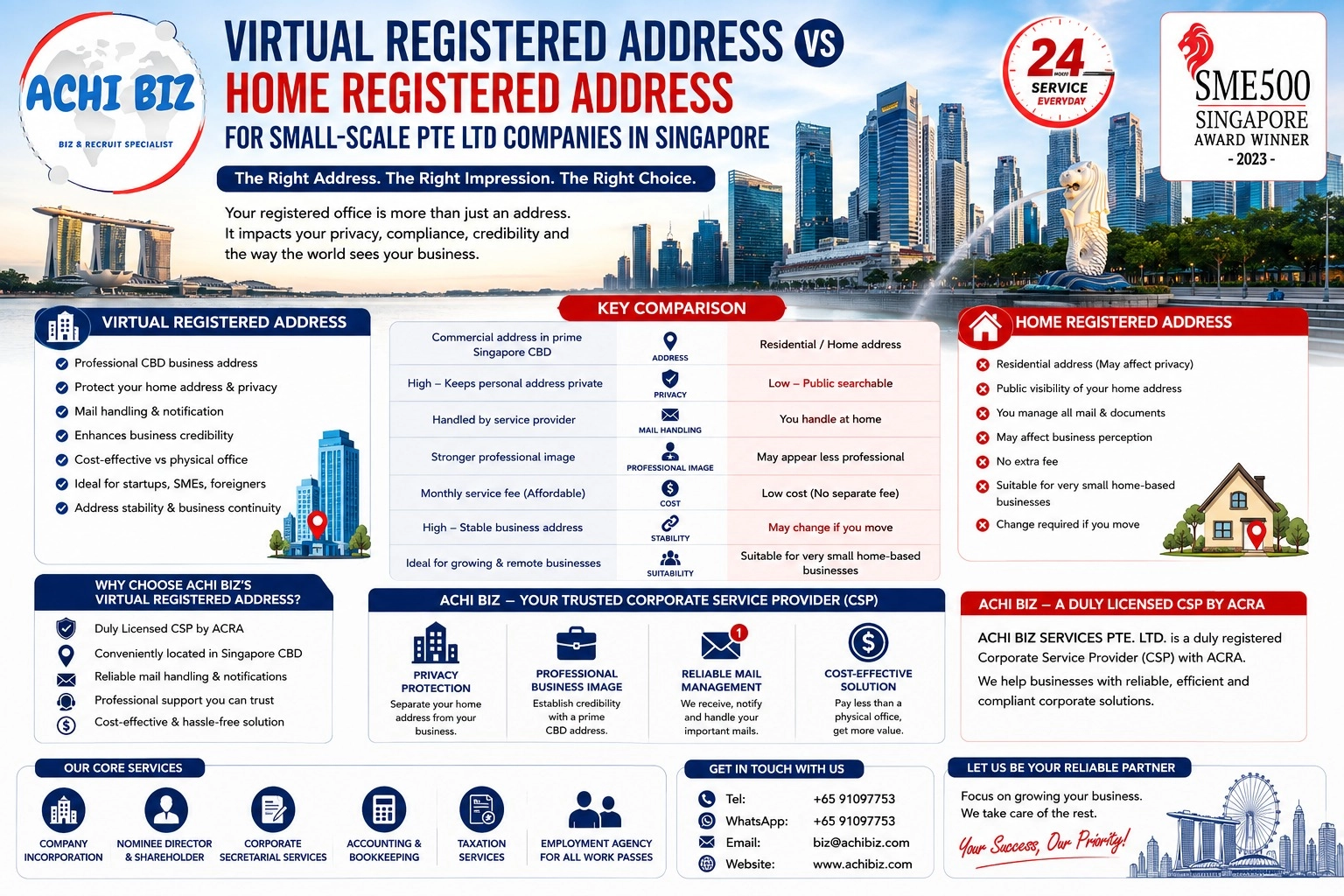
Virtual Registered Address vs Home Registered Address for Small-Scale Pte Ltd Companies in Singapore
For a small-scale Private Limited (Pte Ltd) company in Singapore, choosing a registered office address may appear to be a minor administrative decision. In practice, it can affect privacy, professional image, correspondence management, regulatory compliance and how customers, banks, suppliers and other parties perceive the business.
Many startups, consultants, freelancers, family-owned companies, online businesses and newly incorporated Pte Ltd companies do not require a permanent commercial office. This commonly leaves two practical choices: using a home address as the company’s registered office where legally permitted, or engaging a service provider for a virtual registered office address.
Importantly, a virtual registered address does not mean that the company itself is “virtual”. A Singapore company must still have a valid physical registered office in Singapore that satisfies ACRA’s requirements.
ACRA states that a local company’s registered office must be a Singapore address, must be open and accessible to the public during normal business hours on each business day, and does not have to be the same place where the company actually carries out its business.
This FAQ compares the practical advantages, limitations and compliance considerations of a virtual registered office address versus a residential or home registered office address for Singapore Pte Ltd companies.
Frequently Asked Questions – Virtual Registered Address vs Home Address in Singapore
What is a registered office address for a Singapore Pte Ltd company?
The registered office is the company’s official address registered with the Accounting and Corporate Regulatory Authority (ACRA).
It is the address where ACRA and other parties can send communications, notices and legal documents to the company. Company records and registers are also required to be kept at the registered office as applicable.
Must every Singapore Pte Ltd company have a registered office address?
Yes.
A Singapore-incorporated company must have a registered office address that complies with the applicable requirements.
This applies regardless of whether the company is a startup, dormant company, consultancy, online business, one-person company or larger operating business.
Must the registered office be located in Singapore?
Yes.
ACRA requires the registered office of a local company to be a Singapore address.
A foreign residential or overseas business address therefore cannot simply replace the required Singapore registered office.
Can a Pte Ltd company use a P.O. Box as its registered office?
A registered office needs to be an actual Singapore address satisfying the statutory accessibility requirements. A P.O. Box should not be treated as a substitute for the company’s required physical registered office.
Does the registered office have to be where the company actually conducts business?
No.
This is one of the most useful features for small companies.
ACRA states that the registered office does not have to be the same place where the business activities are conducted. For example, a company’s registered office could be in the CBD while its actual operations take place elsewhere.
This makes registered office services particularly practical for businesses that work remotely, operate online or conduct their activities at customers’ premises.
What is commonly called a virtual registered office address in Singapore?
A virtual registered office generally refers to a physical address provided by a service provider that a company is permitted to use as its registered office without renting an entire conventional office unit.
Depending on the package, related services may include receiving statutory correspondence, mail notifications, mail collection, forwarding or other administrative support.
The term “virtual” should not be misunderstood. The underlying registered office still needs to satisfy Singapore’s applicable registered-office requirements.
Can a licensed Corporate Service Provider (CSP) provide a virtual registered office address in Singapore?
Yes. A duly registered Corporate Service Provider (CSP) can provide registered office address services as part of its corporate support services, subject to applicable regulatory requirements, customer due diligence and the CSP’s service terms.
For businesses that do not require a dedicated physical office, engaging an established CSP for a registered office address can provide a practical combination of regulatory compliance, business continuity, mail management and greater separation between the company’s official address and the business owner’s residential address.
Does ACHI BIZ provide a virtual registered office address in Singapore?
Yes. ACHI BIZ SERVICES PTE. LTD. is a duly registered Corporate Service Provider (CSP) with ACRA and provides virtual registered office address services for eligible Singapore companies, subject to applicable compliance requirements and customer due diligence.
ACHI BIZ’s registered office address service is conveniently located in Singapore’s Central Business District (CBD), making it particularly suitable for startups, small and medium-sized businesses, foreign entrepreneurs and Pte Ltd companies that do not require a dedicated commercial office but prefer an established business location for their company’s registered address.
Using a conveniently located CBD registered office can also provide greater separation between a director’s personal residence and the company’s business correspondence, while allowing the company to maintain an established Singapore corporate address without incurring the considerably higher cost of leasing a conventional CBD office.
Companies should nevertheless remember that a virtual registered office is an official corporate address service and not a substitute for physical operational premises where the nature of the business, licensing conditions or regulatory requirements require dedicated premises.
Why consider ACHI BIZ’s CBD virtual registered address instead of using a home address?
For a small Pte Ltd company, using a home address may initially appear to be the simplest and cheapest option. However, businesses that prefer privacy, professional presentation, address continuity and separation of personal and corporate correspondence may find a CBD virtual registered office more suitable.
ACHI BIZ’s conveniently located Singapore CBD registered office address service can be particularly useful for entrepreneurs operating remotely, online businesses, consultants, newly incorporated companies and foreign-owned Singapore companies that do not need to maintain a full-time physical office.
This allows eligible companies to establish an official registered office through a duly registered CSP while avoiding the unnecessary expense of renting conventional commercial premises solely for registered-address purposes.
The appropriate choice ultimately depends on the company’s business activities, regulatory requirements, operational needs and circumstances.
Is a virtual office the same as a registered office?
Not automatically.
A provider may advertise “virtual office”, “business address” or “mailing address” services without necessarily offering a service that satisfies every requirement applicable to an ACRA registered office.
A company should therefore specifically confirm that the address can legally and contractually be used as its ACRA registered office address.
What is a home registered office address?
It generally means using an eligible residential property as the company’s registered office rather than engaging a separate commercial or virtual office address.
Depending on the property and how business activities are conducted there, HDB or URA requirements may also need to be considered.
Can a small Pte Ltd company use a home address as its registered office?
Potentially, yes, provided the applicable requirements are satisfied.
However, the company should not assume that incorporation with ACRA automatically gives unrestricted permission to conduct business activities from residential premises.
Residential-property use is separately regulated.
What is Singapore’s Home Office Scheme?
The Home Office Scheme allows residents to operate certain small-scale offices from their homes, subject to applicable conditions.
Homeowners, tenants or authorised occupants of eligible residential properties may be able to operate small-scale offices from home under the applicable HDB or URA requirements.
Can a tenant use a rented residential property for a Home Office?
Potentially, but permission matters.
Where the applicant is not the property owner, the applicable property-use requirements and the tenancy agreement should be checked and the required consent obtained.
A tenant should not simply register a landlord’s property as a business location without considering these requirements.
Does using a home address mean the property can become a full commercial office?
No.
Where a residential property is used under an applicable home-office arrangement, the property must continue to retain its residential character.
Business activities must remain compatible with residential use and applicable conditions. A home-office arrangement should not be treated as unrestricted permission to convert residential premises into full commercial premises.
Can employees work from a Home Office?
Subject to the applicable Home Office Scheme conditions, limited non-resident employee activity may be permitted.
Businesses expecting their workforce to expand substantially should consider whether residential premises will remain suitable for their operations.
Is the Home Office Scheme the same as the Home-Based Business Scheme?
No.
They serve different purposes and have different conditions.
Certain small-scale home-based activities may be permitted subject to applicable criteria, while a Home Office arrangement addresses a different category of business use.
Businesses should determine which regime actually applies to their intended activity.
Is every business activity suitable to operate from a residential property?
No.
Residential business use remains subject to planning, licensing, nuisance, safety and other regulatory requirements.
Restrictions may apply to matters such as employees, signage, heavy equipment, large-scale storage, customer traffic and frequent loading or unloading.
Other regulatory authorities may also impose requirements depending on the business activity.
What is the biggest advantage of using a home address for a small Pte Ltd company?
Cost savings.
For a very small owner-operated company, using an eligible home address may avoid paying separately for a registered office or commercial premises.
This can make sense during the early stage of a business when keeping fixed overheads low is important.
What is the biggest disadvantage of using a home address?
Privacy and separation between personal and business life.
The company’s registered office forms part of its corporate information. Using a residence as the company’s registered office therefore associates that location with the business.
Is a company’s registered office address publicly searchable?
Company information available through ACRA may include the company’s registered office address.
This should be carefully considered before using a family residence as the company’s registered office.
Does using a home address create privacy concerns?
It can.
Customers, suppliers, creditors and other persons obtaining company information may be able to associate the business with the residential location.
For some owners this is insignificant. For others—particularly those who value separation between home and business—it can be an important concern.
Does Singapore protect directors’ residential addresses from public disclosure?
Singapore has a Contact Address regime intended to provide greater privacy for individuals’ residential addresses.
A Contact Address may be displayed in public records instead of an individual’s residential address where the applicable requirements are satisfied.
This should not, however, be confused with the company’s registered office address.
Is a director’s Contact Address the same as the company’s Registered Office Address?
No. This distinction is important.
The registered office address belongs to the company.
A Contact Address relates to an individual position holder, such as a director or company secretary.
They can sometimes be the same physical location, but legally and administratively they serve different purposes.
Can a director use a CSP’s office as the director’s Contact Address?
Potentially, provided the applicable Contact Address requirements are satisfied and the CSP permits such use.
This is a separate arrangement from the company’s registered office service.
Can a foreign director automatically use the Singapore company’s address as a Contact Address?
Not necessarily.
The requirements applicable to an individual’s Contact Address should be considered separately from the company’s registered office requirements.
Does a virtual registered office improve privacy for business owners?
It can substantially improve the separation between the company’s business address and the owner’s home address.
Instead of using the residential premises as the company’s registered office, the company can use an eligible service-provider address.
However, this does not remove separate obligations of individuals to provide required personal particulars to the relevant authorities.
Can a virtual registered office improve the company’s professional image?
Potentially.
A business address in an established commercial area may appear more appropriate for professional services, consulting, trading, technology or international businesses than a residential address.
However, the address itself does not establish the quality, financial strength or credibility of the company.
Does having a CBD virtual office mean the company actually operates from the CBD?
Not necessarily.
This is important for truthful marketing.
A registered office can be located in the CBD while the company’s employees work remotely or its operational premises are elsewhere.
Businesses should avoid creating a misleading impression that they occupy substantial physical premises at an address when they merely use it for registered-office purposes.
Is a virtual office suitable for a one-person Pte Ltd company?
Often, yes.
A single-director or owner-managed company may not need dedicated office premises, particularly where work is performed:
- Remotely;
- Online;
- At customers’ premises;
- Overseas;
- From co-working locations; or
- From project sites.
In these situations, maintaining a separate commercial lease purely to satisfy registered-office requirements may be unnecessary.
Is a virtual registered address suitable for an online business?
Often, yes.
E-commerce, digital consultancy, IT, marketing, design and other online businesses may have little practical need for permanent office premises.
A registered-office service can provide an official corporate address while the actual operations remain remote.
Is a virtual registered address useful for foreign entrepreneurs incorporating in Singapore?
It can be particularly useful.
A foreign shareholder establishing a Singapore Pte Ltd company may not own or rent premises in Singapore at incorporation.
An eligible registered-office service can therefore address the company’s Singapore registered-office requirement without requiring the entrepreneur to immediately enter into a conventional commercial lease.
Other incorporation requirements, including the requirement for at least one director meeting Singapore’s local residency requirements, remain separate.
Does using a virtual office affect the company’s legal status?
No.
A properly incorporated Pte Ltd company remains a Singapore company regardless of whether its compliant registered office is provided through a service provider, located at its operational premises or situated at an eligible residential address.
Is a virtual registered office evidence that a company is a shell company?
No.
The use of a registered-office service by itself does not establish that a company lacks genuine operations.
Many legitimate startups, investment holding companies, consultants, international businesses and remote-working companies do not require dedicated physical office space.
Can a dormant company use a virtual registered office?
Yes, provided the address meets the applicable requirements and the service arrangement remains active.
Dormant status does not remove the company’s registered-office requirement.
Can an investment holding company use a virtual registered address?
Potentially, yes.
An investment holding company may have very little day-to-day physical activity and therefore may not need conventional office premises.
Can a consulting company use a virtual registered office?
Often, yes.
Consultants frequently work from client premises, remotely or while travelling. A virtual registered office can therefore provide corporate-address continuity without unnecessary commercial rent.
Is a virtual registered office suitable for businesses requiring special licences?
It depends.
Some regulated activities may require separate operational premises, inspections, approved layouts, storage areas or licensing conditions.
The fact that an address can be used as the company’s ACRA registered office does not automatically mean that every licensing authority will accept it as the operational premises.
Can a restaurant use a virtual office as its operational address?
A restaurant requires suitable physical premises and relevant regulatory approvals for its operations.
A separate registered-office arrangement may still be possible, but the virtual registered address cannot replace the actual licensed food premises required for restaurant operations.
Can a construction company use a virtual registered office?
Potentially as its corporate registered office, but construction activities may involve separate BCA, MOM, workplace, storage, project-site or other requirements depending on the business.
The registered office and operational requirements should not be confused.
Can an Employment Agency use a virtual registered office?
Employment agencies are subject to MOM licensing requirements.
Whether a particular address arrangement satisfies MOM’s current EA licensing and operational requirements should be separately checked. ACRA registration of the address alone does not establish MOM approval.
Can a company open a corporate bank account using a virtual registered office?
The registered office may form part of the company’s corporate information, but banks conduct their own KYC, AML/CFT and onboarding checks.
A bank may ask for information concerning the company’s actual place of business, directors, beneficial owners, business model and supporting documentation.
Using a virtual registered office therefore does not guarantee bank-account approval.
Will a virtual office affect an Employment Pass application?
The company’s address is only one part of the wider factual circumstances considered in business and work pass matters.
A virtual office should not be presented as evidence of substantial physical operations if that is not actually the case.
The company should ensure that information submitted to government agencies accurately reflects its genuine business operations.
Can a virtual registered address be used on invoices?
Generally, a company’s registered office may appear on corporate documents where appropriate, but companies should ensure that invoices and regulated documents contain whatever particulars are legally required for the particular transaction.
Can it be used on the company’s website?
Generally, yes, where the company is authorised to use the address.
However, the website should not falsely imply that the company maintains staffed or customer-facing premises there if the service only provides registered-office and mail-handling facilities.
Can it be used on business cards and marketing materials?
That depends partly on the provider’s terms and the company’s actual arrangement.
The company should confirm what uses are permitted under the service agreement.
What mail is normally sent to a company’s registered office?
The address may receive:
- Government correspondence;
- Statutory notices;
- Legal documents;
- Bank correspondence;
- Supplier letters;
- Customer correspondence; and
- Other company-related mail.
This makes reliable mail management an important consideration when choosing a registered-office provider.
Why is reliable mail handling important?
Missing an ordinary marketing letter may have little consequence.
Missing a government notice, legal document or compliance correspondence can be much more serious.
A registered-office provider should therefore have a reliable process for identifying and notifying the company of important correspondence.
What happens if the virtual office provider receives legal documents?
The service arrangement should provide a clear process for handling official and legal correspondence.
Directors should not assume that using a third-party registered office transfers responsibility for responding to legal notices to the provider.
Is mail forwarding normally included with a virtual registered office?
Not necessarily.
Some providers include mail notification or collection while charging separately for scanning, forwarding or courier services.
Businesses should understand the package before signing up.
What happens if the virtual office service expires?
This is a major compliance risk.
If the company no longer has the right to use the address, it should promptly arrange another compliant registered office and update ACRA within the applicable timeline.
A company should never continue displaying or registering an address after its authority to use it has ended.
Can a company change from a home address to a virtual registered office later?
Yes.
A company that initially uses a residential address can subsequently move its registered office to an eligible virtual or commercial address and update ACRA accordingly.
This is common when a business begins from home and later wants stronger privacy or a more professional corporate presence.
Can a company change from a virtual office back to a home address?
Potentially, yes, provided the residential address is eligible and all relevant ACRA, HDB, URA, tenancy and other requirements are satisfied.
Why might a growing company eventually move away from a virtual office?
As the company grows, it may need:
- Full-time employees working onsite;
- Meeting rooms;
- Customer reception;
- Warehousing;
- Equipment;
- Dedicated telephone or reception facilities;
- Regulatory inspections;
- Licensed premises; or
- A permanent operational headquarters.
At that stage, conventional commercial premises may become more practical.
Does a virtual registered address provide meeting facilities?
Some providers offer meeting rooms or co-working facilities separately, while others provide only address and mail services.
The company should not assume that physical workspace is included.
Is a home address more convenient for receiving mail?
For some owner-managed businesses, yes.
Mail arrives directly at the residence and does not need to be collected or forwarded by an intermediary.
However, this convenience must be weighed against privacy and business-image considerations.
Is a virtual office better for keeping personal and business correspondence separate?
Usually, yes.
Business correspondence can be directed to the registered-office provider rather than mixed with family or personal mail.
This can be especially useful where several family members share the residence.
What happens if the owner moves house?
If the home is the company’s registered office, the company may need to change its registered office details when the owner relocates.
A virtual registered office can provide greater continuity because the company’s address does not necessarily change whenever a director changes residence.
Is address stability important for a Pte Ltd company?
It can be.
Frequent changes may require updates across ACRA records, banks, licences, suppliers, customers, contracts, invoices, websites and other business records.
A stable registered office can reduce administrative disruption.
Does a home registered address look less professional?
Not necessarily, but perception varies.
A residential address may be perfectly acceptable for a small consultancy or family business.
However, businesses dealing with corporate clients, overseas partners or investors may prefer a commercial business address for presentation and privacy reasons.
Does a CBD address automatically make a company more credible?
No.
An impressive postal address cannot replace genuine business substance, proper governance, financial capability, customer service or regulatory compliance.
A CBD registered office should be viewed as an administrative and branding benefit—not proof of business quality.
Which option is generally cheaper: home address or virtual registered office?
Using an eligible home address is usually the lower-cost option because there is no separate registered-office subscription.
A virtual office involves a service fee but may provide additional benefits such as privacy, mail handling, address continuity and a commercial business location.
Should price be the only factor when selecting a virtual registered office provider?
No.
A very cheap registered-office package can become expensive if the provider mishandles important correspondence or charges extra fees for every mail item.
Businesses should consider:
- Reliability;
- Compliance;
- Accessibility;
- Mail handling;
- Notification speed;
- Forwarding charges;
- Service duration;
- Renewal terms;
- Address reputation;
- Provider stability; and
- Support quality.
What should a small Pte Ltd company ask a virtual office provider before signing up?
Ask clearly:
- Can this address be used as an ACRA registered office?
- Does it satisfy the required accessibility requirements?
- What types of mail will be accepted?
- How quickly will mail notifications be sent?
- Is mail scanning available?
- Is forwarding available?
- What additional charges apply?
- Can government and legal correspondence be received?
- Are meeting rooms available?
- Can the address be used on websites and business cards?
- What happens when the service expires?
- How much notice is given before termination?
- Are there restrictions on particular industries?
- Are there KYC requirements?
- How long is mail retained?
Why might a virtual registered office provider conduct KYC checks?
A legitimate address provider may need to understand who is using its premises and for what purpose.
Fraudulent or unlawful businesses can potentially misuse registered addresses, so responsible providers may verify identities and company details as part of their risk management process.
Therefore, a provider that requests appropriate corporate and beneficial ownership information does not necessarily create unnecessary bureaucracy.
Can hundreds of companies legally share the same registered office address?
A commercial address may legitimately serve multiple companies, particularly where a Corporate Service Provider or business-centre operator provides registered-office services.
Does having many companies at one address automatically mean something is wrong?
No.
It is common for CSPs, accounting firms and virtual-office providers to provide registered-office services to multiple companies.
However, companies should still select a reputable provider with proper administrative controls.
What happens if someone uses a residential address without the owner’s permission?
This can create serious problems for the property owner and company.
Companies should only register an address that they have genuine authorisation to use. When using residential property, they should also consider property ownership, tenancy terms, and any applicable HDB or URA requirements.
Is the registered office requirement only an ACRA formality?
No.
It serves an important accountability function.
What is the difference between Registered Office, Business Address, Residential Address and Contact Address?
These terms should not be mixed up.
Registered Office Address – the company’s official Singapore address for notices, communications and applicable corporate records.
Business or Operational Address – where the company actually conducts its business. This may be different from its registered office.
Residential Address – the private residential address of an individual director, shareholder or other position holder where required.
Contact Address – an address used for an individual position holder in accordance with ACRA’s Contact Address requirements rather than treating it as the company’s registered office.
Can the same address serve all four purposes?
Sometimes, but not always.
For a home-operated company, the residence might potentially be the operational location and company registered office, while also being the director’s residential and Contact Address where permitted.
A company using a virtual office may instead have different addresses for different purposes.
Which address appears when someone searches the company through ACRA?
The company’s registered office address forms part of its corporate information.
Which option provides better privacy: virtual registered office or home registered office?
Generally, a virtual registered office provides better separation between the owner’s residence and the company’s business address.
That is one of its strongest advantages for small companies.
Which option provides greater convenience?
It depends.
A home address provides direct access to incoming mail.
A professionally managed registered office may offer better separation, notification and administrative support.
The better option depends on how the directors actually manage the company.
Which option provides greater address stability?
A well-established virtual registered office can provide greater continuity where the director rents accommodation or moves frequently.
A homeowner who expects to remain at the same property for many years may experience little difference.
Which option is better for a foreign-owned Pte Ltd company?
A compliant registered-office service is often more practical because overseas shareholders may not have an eligible residential property in Singapore.
However, the company should still consider its actual operating requirements and any sector-specific licensing conditions.
Which option is better for a Singapore resident running a very small company?
If cost is the overriding consideration and the business is suitable for residential use, a home address may be practical.
If privacy, professional presentation, mail separation and address continuity are more important, a virtual registered office may provide greater value.
Which option is better for a company planning rapid growth?
A virtual registered office can work well during the startup phase because it avoids committing to expensive premises too early.
Once employees, customers or operational requirements justify dedicated premises, the company can move to a conventional office.
What are the main advantages of a home registered office?
The principal advantages are:
- Low cost;
- Direct receipt of correspondence;
- Simple administration;
- Suitable for genuinely home-operated businesses; and
- No separate virtual-office subscription.
Potential disadvantages include:
- Reduced separation between personal and business life;
- Residential location becoming associated with the company;
- Possible HDB, URA or landlord requirements;
- Address changes when moving home;
- Customer or supplier visits to the residence;
- Limitations on business activities at residential premises; and
- Potentially less suitable presentation for certain businesses.
What are the main advantages of a virtual registered office?
Potential advantages include:
- Better residential privacy;
- Professional business address;
- Separation of business and personal correspondence;
- Address continuity;
- Lower cost than leasing a full commercial office;
- Mail-management support;
- Suitable for remote and online businesses; and
- Practical for foreign-owned companies.
Potential disadvantages include:
- Recurring fees;
- Dependence on the service provider;
- Possible mail-forwarding charges;
- Delays if correspondence is not promptly processed;
- Restrictions on address usage;
- It may not satisfy operational licensing requirements; and
- The company must change its registered office if the provider relationship ends and it no longer has authority to use the address.
Virtual Registered Address vs Home Address – which is better overall?
There is no universal winner.
For the smallest owner-operated business focused primarily on minimising cost, an eligible home address may be perfectly reasonable.
For a Pte Ltd company that values privacy, professional presentation, address continuity and separation between business and personal life, a reputable virtual registered-office service is often the more practical long-term choice.
The decision should be based on the company’s actual circumstances rather than appearance alone.
Can a virtual registered office replace a real business operation?
No.
A registered address solves an address and corporate administration requirement. It does not create business substance by itself.
Where the company requires employees, equipment, storage, customer-facing premises or regulatory approvals, appropriate operational premises may still be necessary.
What is the most important compliance point when choosing either option?
The address must be genuine, authorised, accessible and suitable for its intended regulatory purpose.
Do not register an address merely because it looks prestigious.
Also, do not use a residential address without considering property-use restrictions and necessary permissions.</p>
Furthermore, do not assume every virtual-office package qualifies as an ACRA
registered office.
And do not allow a registered-office service to expire while leaving the old address on the company’s ACRA record.
What is the practical conclusion for small-scale Singapore Pte Ltd companies?
For many modern businesses, paying for a conventional office simply to obtain an address makes little commercial sense.
A home registered office can be an economical and practical option for a genuinely small owner-operated business, especially when the owner has no privacy concerns and meets all residential-use requirements.
A virtual registered office, on the other hand, can provide a useful middle ground: the company gets a compliant Singapore business address and greater separation from the owner’s residence without taking on the cost of a traditional office lease.
For businesses looking for this arrangement, ACHI BIZ SERVICES PTE. LTD., as a duly registered Corporate Service Provider with ACRA, provides virtual registered office address services for eligible Singapore companies at a conveniently located CBD address, subject to applicable customer due diligence, compliance requirements and service terms.
A CBD registered office can be particularly practical for startups, consultants, online businesses, foreign entrepreneurs and small Pte Ltd companies seeking a professional Singapore business address without incurring the expense of leasing a conventional CBD office.
Whichever option directors choose, they should remember that the registered office serves a purpose beyond simply appearing on ACRA records. It is the company’s official point of contact for important communications and legal notices. The registered office must satisfy Singapore’s applicable requirements even though it does not necessarily have to be the location where the company’s actual business operations take place.
For small Pte Ltd companies, the right choice therefore comes down to balancing cost, privacy, professional image, compliance, mail reliability, operational needs and future growth.
Related pages:
Best Country to Incorporate a Business with a Pte Ltd Structure – Complete FAQ Guide
FAQ on Registration of Private Limited Company
#achibiz