
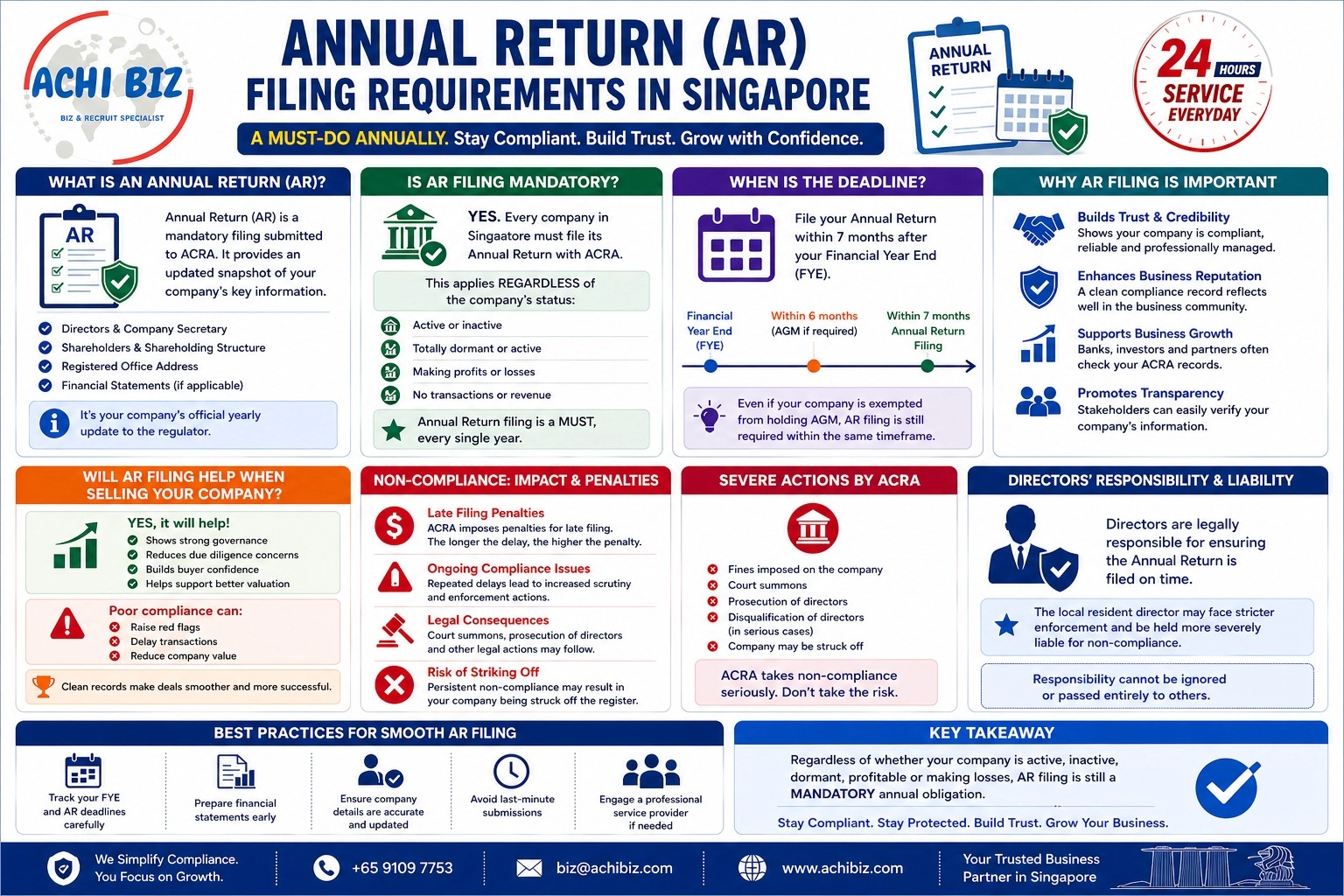
Mandatory Compliance to File Annual Return (AR) for Pte. Ltd. Companies in Singapore – Complete FAQ Guide
Filing an Annual Return (AR) with the Accounting and Corporate Regulatory Authority (ACRA) is one of the most important recurring statutory obligations for a Singapore Pte. Ltd. company. It is not the same as filing corporate income tax with IRAS, and it should not be treated as a routine formality that can be dealt with only when a reminder arrives.
An Annual Return provides ACRA with an updated statutory snapshot of the company and requires the company to review important information concerning its corporate structure, officers, shareholders, share capital, financial reporting position and other applicable compliance matters.
Frequently Asked Questions on Annual Return Filing for Singapore Pte. Ltd. Companies
What is an Annual Return (AR) for a Singapore Pte. Ltd. company?
An Annual Return is a statutory filing submitted to ACRA containing prescribed information about a Singapore company for the relevant financial period.
It allows ACRA’s corporate register to maintain important information concerning the company’s status, officers, shareholders, shares, registered office, Financial Year End (FYE) and other applicable corporate matters.
An AR should therefore not be regarded as simply clicking a filing button once a year. The company’s information should first be reviewed for accuracy.
Is filing an Annual Return mandatory for every Pte. Ltd. company in Singapore?
Yes.
Singapore-incorporated companies are generally required to file Annual Returns with ACRA in accordance with the Companies Act.
Being a small company, family-owned company, single-shareholder company or a company conducting limited business does not by itself remove the Annual Return filing obligation.
Does a dormant Pte. Ltd. company still need to file an Annual Return?
Yes.
One common misconception is that a company without revenue, transactions or active business operations does not need to file an AR.
A dormant company may qualify for certain accounting or financial reporting exemptions depending on its circumstances, but dormancy does not automatically remove the Annual Return filing obligation.
When must a Singapore Pte. Ltd. company file its Annual Return?
For a typical non-listed Singapore company, the Annual Return is generally required to be filed within seven months after its Financial Year End (FYE).
For example, where a company’s FYE is 31 December, its normal Annual Return filing deadline would generally fall on 31 July of the following year.
This is why companies should maintain a compliance calendar based on their FYE.
Why is the Financial Year End important for Annual Return filing?
The company’s FYE determines several important annual compliance deadlines.
Among other things, it affects when the company needs to prepare its financial statements, deal with its AGM requirements and file its Annual Return.
A company should therefore know its registered FYE and avoid assuming that its AR deadline is simply based on the anniversary of its incorporation.
Is the Annual Return due on the anniversary of company incorporation?
Not necessarily.
Under the current FYE-based compliance framework, the Annual Return deadline for a non-listed company is generally determined by reference to the company’s Financial Year End, with the AR normally due within seven months after FYE.
The incorporation anniversary and AR deadline can therefore be entirely different dates.
What information should be reviewed before filing an Annual Return?
Depending on the company and applicable filing requirements, the Annual Return process may require a review of matters including:
- Company name and UEN
- Company type and status
- Registered office address
- Financial Year End
- Primary and secondary business activities
- Directors and company secretary
- Shareholders
- Number and classes of shares
- Issued and paid-up share capital
- Company solvency status, where applicable
- AGM status
- Financial statement requirements
- Audit status or applicable audit exemption
- Register of Registrable Controllers (RORC)
- Register of Nominee Directors (ROND)
- Register of Nominee Shareholders (RONS)
- Other applicable statutory declarations and corporate information
The Annual Return can encompass several distinct areas of corporate and statutory information rather than being a single financial declaration.
Why should company information be checked before the AR is submitted?
Because information lodged with ACRA should accurately reflect the company’s current statutory position.
Directors may have changed, shares may have been transferred or allotted, the registered office may have moved, business activities may have changed or the company’s financial reporting status may be different from the previous year.
Simply relying on information carried forward from an earlier filing without checking it can result in incorrect corporate information being submitted.
Can a company wait until its Annual Return to update changes that occurred during the year?
Generally, no.
Many corporate changes have their own prescribed notification or filing deadlines.
For example, changes involving company officers, registered office particulars, shares or other statutory information may need to be lodged when the relevant event occurs.
The Annual Return should therefore be viewed as an annual review of the company’s records, not as a substitute for event-based statutory filings.
Why should directors review the Annual Return before filing?
Directors have statutory responsibilities concerning the company’s affairs and corporate compliance.
Even where preparation and filing are handled by a company secretary or licensed Corporate Service Provider, directors should ensure that the information supplied is accurate and complete.
Engaging a professional service provider assists with administration and compliance, but it does not mean directors can disregard their own statutory responsibilities.
Who can file an Annual Return with ACRA?
The filing may generally be undertaken by authorised company officers, such as a director or company secretary, or through an appropriately authorised Corporate Service Provider (CSP) engaged by the company.
Companies that do not maintain an internal corporate compliance function often engage a CSP to coordinate the process.
Is an Annual Return the same as an Annual General Meeting (AGM)?
No.
They are separate corporate compliance requirements.
An AGM concerns the company’s meeting and shareholder-related requirements, including the presentation of financial statements where applicable.
An Annual Return is a statutory filing made with ACRA.
For a typical non-listed company:
AGM: generally within 6 months after FYE, unless exempted or otherwise dispensed with under the applicable provisions.
Annual Return: generally within 7 months after FYE.
Must every Pte. Ltd. company hold an AGM before filing its Annual Return?
Not necessarily.
Certain private companies may qualify for an exemption from holding an AGM if the statutory requirements are satisfied. Private companies may also dispense with holding AGMs under applicable provisions.
However, an AGM exemption does not automatically exempt the company from filing its Annual Return.
If a private company is exempt from holding an AGM, must it still file an AR?
Yes.
This is an important distinction.
AGM exemption ≠ Annual Return exemption.
A qualifying private company may not need to physically hold an AGM, but it must still comply with its Annual Return filing obligation.
Why is sending financial statements to shareholders important where AGM exemption applies?
For a private company relying on the applicable AGM exemption, the timing of sending financial statements to members can be important.
Companies should therefore not wait until the seventh month after FYE to start dealing with their accounts.
By then, an earlier financial statement or AGM-related deadline may already have passed.
Does every Pte. Ltd. company need to prepare financial statements?
Companies generally need to maintain proper accounting records and prepare financial statements unless a specific statutory exemption applies.
Whether the financial statements must also be filed with ACRA is a separate issue.
The requirements depend on factors including the company’s type, status and applicable financial reporting exemptions.
Does every company have to file financial statements with its Annual Return?
No.
Some companies may qualify for exemption from filing their financial statements with ACRA.
For example, a qualifying solvent Exempt Private Company (EPC) may be exempt from filing financial statements with ACRA.
However, being exempt from filing financial statements does not necessarily mean the company is exempt from preparing accounts or maintaining proper accounting records.
Is audit exemption the same as exemption from preparing accounts?
No.
This is another common misunderstanding.
A company may qualify for the small company audit exemption, meaning its financial statements do not need to be audited, provided all applicable requirements are satisfied.
That does not mean the company can simply operate without proper bookkeeping or financial statements.
Audit exemption does not mean accounting exemption.
What are the general small-company audit exemption thresholds?
Broadly, a private company may qualify as a small company where it satisfies the applicable requirements, including meeting at least two of the following three criteria for the relevant periods:
- Annual revenue of S$10 million or less
- Total assets of S$10 million or less
- 50 or fewer employees
Additional requirements apply where the company forms part of a group.
Eligibility should therefore be assessed rather than automatically assumed.
Must an audit-exempt company still maintain proper accounting records?
Yes.
Proper accounting records remain fundamental to corporate compliance.
A company should maintain records that adequately explain its transactions and financial position and enable appropriate financial statements to be prepared.
Audit exemption should never be interpreted as permission to maintain incomplete accounts.
Why is bookkeeping important before Annual Return filing?
Annual Return compliance often depends on work completed much earlier in the financial reporting process.
A company may first need to:
Complete bookkeeping → perform reconciliations → close the accounts → prepare financial statements → determine audit requirements → address AGM requirements → review corporate information → file the Annual Return.
Incomplete accounting records can therefore delay the entire annual compliance cycle.
Why should bank reconciliation be completed before year-end accounts are finalised?
Bank reconciliation helps identify differences between accounting records and actual bank transactions.
It can reveal matters such as:
- Unrecorded payments
- Unidentified receipts
- Bank charges
- Duplicate entries
- Outstanding transactions
- Incorrect postings
- Timing differences
Accurate reconciliations improve the reliability of the financial records used for annual compliance.
What other accounts should normally be reconciled?
Depending on the company’s activities, reconciliation may include:
bank accounts, trade receivables, trade payables, accruals, prepayments, directors’ accounts, shareholders’ balances, loans, intercompany balances, payroll liabilities, CPF, GST, fixed assets, inventory, deposits and tax-related accounts.
These may not themselves be AR filing fields, but they support accurate year-end accounting and financial reporting.
Does the Annual Return include directors and company secretary information?
Yes.
The company’s officers form an important part of its statutory corporate information.
Before filing, the company should ensure that its director and company secretary information is accurate and that any changes which should already have been separately notified to ACRA have been properly dealt with.
Are shareholder details relevant to Annual Return filing?
Yes.
The company should ensure its shareholder and ownership information is accurate and consistent with its statutory records.
Share transfers, allotments and other ownership changes should be properly documented and lodged where required.
Is share capital information relevant to the Annual Return?
Yes.
Information concerning the company’s shares, issued share capital and paid-up share capital may form part of the AR information.
This is another reason why proper documentation of share allotments and transfers throughout the year is important.
What is the relevance of the Register of Registrable Controllers (RORC)?
Companies should ensure compliance with applicable Register of Registrable Controllers (RORC) requirements.
The annual compliance process provides a useful opportunity to verify that the company’s controller information and related statutory records remain properly maintained.
What about the Register of Nominee Directors (ROND)?
Companies should also assess their obligations concerning the Register of Nominee Directors (ROND).
The existence or absence of nominee arrangements should not simply be assumed without considering the applicable statutory definitions and requirements.
What about the Register of Nominee Shareholders (RONS)?
The Register of Nominee Shareholders (RONS) forms another important part of Singapore’s corporate transparency framework.
Companies should review whether nominee shareholder arrangements exist and ensure applicable records and filings are properly maintained.
Is the Annual Return the same as Form C-S or Form C filed with IRAS?
No.
These are completely separate filings.
Annual Return → ACRA → corporate statutory compliance
Form C-S/Form C → IRAS → corporate income tax compliance
Completing one does not automatically satisfy the other.
Is Annual Return filing the same as Estimated Chargeable Income (ECI)?
No.
ECI is a corporate income tax matter administered by IRAS.
The Annual Return is a corporate statutory filing administered by ACRA.
A company therefore needs to maintain separate compliance calendars for ACRA and IRAS obligations.
What happens if a Pte. Ltd. company files its Annual Return late?
Late filing can result in a late lodgement penalty.
Under the applicable two-tier framework, late AR filing may attract:
S$300 where the filing is made within three months after the deadline; and
S$600 where the filing is more than three months late.
Companies should verify the applicable penalty at the time of filing because regulatory fees and requirements can change.
Is paying the late lodgement penalty enough?
Not necessarily.
A company should not treat a statutory deadline as an optional deadline that can simply be extended by paying a late fee.
Continued or repeated statutory defaults can expose the company and responsible officers to further regulatory consequences.
Can directors personally face consequences for failure to file Annual Returns?
Yes.
Directors have statutory responsibilities concerning company compliance.
Repeated or serious non-compliance can potentially result in enforcement action against the company and responsible officers.
This is why Annual Return filing should be treated as a director-level corporate governance matter rather than merely an administrative responsibility of the accountant or secretary.
Can repeated non-compliance affect a person’s ability to remain a company director?
Repeated breaches of statutory filing obligations can potentially result in director disqualification consequences under the applicable corporate regulatory framework.
Directors managing multiple companies should therefore be particularly careful about recurring defaults.
Can a company eventually be struck off for persistent non-compliance?
Persistent non-compliance may expose a company to regulatory enforcement, including potential striking-off action in appropriate circumstances.
A company intending to continue operating should therefore regularise outstanding filings promptly rather than allowing defaults to accumulate.
What should a company do if its Annual Return is already overdue?
Do not delay further.
The company should determine:
- Which Annual Returns remain outstanding
- The applicable FYE for each period
- Whether the accounts have been completed
- Whether financial statements are required
- Whether an audit is required
- Whether AGM requirements have been satisfied or an exemption applies
- Whether company information is current
- Whether statutory registers are properly maintained
- What penalties have arisen
- What filings are required to regularise the company
Professional assistance may be advisable where multiple years or several compliance issues are involved.
Can a company change its FYE simply to avoid an overdue AR?
Generally, a change of FYE should not be regarded as a method of escaping an existing statutory default.
There are restrictions governing changes of FYE, including circumstances where regulatory approval may be required.
Companies should plan FYE changes for genuine business or reporting reasons rather than as a way to postpone overdue compliance.
Why should the registered office address be reviewed before AR filing?
The registered office is part of the company’s official statutory information.
An outdated registered office can also cause practical problems because regulatory correspondence and other important notices may be directed there.
Companies should therefore ensure the registered office information remains accurate.
Should the company’s SSIC business activities also be reviewed?
Yes.
A company’s registered primary and secondary business activities should reasonably reflect what the company actually does.
Where the company’s business has materially changed, the relevant corporate information should be reviewed and updated where required.
Why is solvency relevant to Annual Return compliance?
A company’s solvency position can affect certain declarations and financial reporting exemptions.
Directors should understand what they are confirming rather than treating a solvency question as an administrative checkbox.
Where there is genuine uncertainty over solvency, appropriate accounting or professional advice should be obtained.
Why should a company not simply copy the previous year’s Annual Return?
Because the company may have changed considerably during the year.
There could have been changes involving:
directors, secretary, shareholders, share capital, registered office, business activities, financial reporting status, audit exemption, nominee arrangements or other corporate particulars.
Pre-filled information should therefore be verified rather than blindly accepted.
What are the risks of filing incorrect or misleading information with ACRA?
Statutory filings should contain accurate information.
Directors and authorised filers should not knowingly submit false, misleading or materially incorrect information.
The annual return (AR) illustrates the seriousness of the filing declaration: the authorised filer confirms that the submitted information is true and correct to the best of their knowledge and acknowledges potential prosecution for false or misleading information.
Why should supporting records be retained after AR filing?
The company should maintain documentation supporting its statutory and financial position.
Depending on the circumstances, this may include:
financial statements, accounting records, bank reconciliations, directors’ resolutions, shareholders’ resolutions, AGM records, share documentation, statutory registers and supporting schedules.
Good record keeping becomes particularly important if the company’s filings are later reviewed or questioned.
Can late Annual Returns affect the company’s corporate credibility?
Potentially, yes.
Banks, investors, customers, suppliers, landlords and professional counterparties may conduct corporate searches or due diligence before entering important transactions.
A history of unresolved statutory defaults may create unnecessary questions about how the company is being administered.
Can poor AR compliance create problems during investment, restructuring or sale of a company?
Yes.
During due diligence, investors and purchasers commonly examine corporate records, shareholders, directors, share capital, financial statements and regulatory compliance.
Historical inconsistencies can delay transactions and increase the amount of corrective work required before completion.
Do startups need to file Annual Returns even if they have not generated revenue?
Yes.
The filing obligation relates to maintaining the incorporated company, not merely to whether the company has become profitable.
A startup with little or no revenue may still have accounting, corporate secretarial, financial reporting and Annual Return obligations.
Does a one-director or one-shareholder company still need to file an Annual Return?
Yes.
A privately held company with a simple ownership structure remains a separate legal entity.
The fact that the same person controls most aspects of the company does not remove the company’s statutory obligations.
Do foreign-owned Singapore Pte. Ltd. companies have to file Annual Returns?
Yes.
A Singapore-incorporated company remains subject to Singapore corporate law regardless of whether its shareholders are Singapore citizens, permanent residents or foreigners.
Foreign ownership does not create a general Annual Return exemption.
What role does the company secretary play in Annual Return compliance?
The company secretary commonly coordinates the compliance process, including monitoring deadlines, reviewing corporate records, obtaining information from directors and shareholders and facilitating statutory filings.
However, directors should remain involved and verify information that requires their confirmation.
Why should Annual Return preparation start well before the seven-month deadline?
Because seven months after FYE is generally the filing deadline—not the recommended starting point.
Before reaching that stage, the company may need to complete:
bookkeeping → reconciliations → financial statements → audit assessment → audit where required → circulation of financial statements → AGM or AGM exemption requirements → statutory record review → AR preparation.
Starting early creates time to identify and correct problems.
What is a practical annual compliance timeline for a Singapore Pte. Ltd. company?
A typical non-listed private company should broadly work towards the following sequence:
Immediately after FYE: complete bookkeeping and reconciliations.
Following months: finalise accounts and financial statements and determine audit/XBRL requirements.
Within applicable financial statement circulation deadlines: send financial statements to members where required, including where relying on the relevant AGM exemption.
By 6 months after FYE: hold the AGM where required.
No later than 7 months after FYE: file the Annual Return with ACRA.
Companies should aim to complete each stage comfortably before the statutory deadline rather than on the final day.
What are some common Annual Return mistakes made by Pte. Ltd. companies?
Common problems include assuming dormant companies need not file, confusing the AR with corporate income tax, waiting until the filing deadline to prepare accounts, overlooking changes in directors or shareholders, misunderstanding AGM exemption, assuming audit exemption means no accounts are required, overlooking financial statement or XBRL requirements and failing to verify pre-filled company information.
Most of these issues can be avoided through proper bookkeeping and an organised annual compliance calendar.
What is the difference between Annual Return filing and overall annual corporate compliance?
The Annual Return is only one component of the annual compliance cycle.
A properly managed annual process can involve:
Accounting & bookkeeping → reconciliations → financial statements → audit assessment → AGM/AGM exemption → statutory registers → company particulars review → Annual Return → corporate tax compliance.
Looking only at the AR filing deadline can therefore cause earlier obligations to be overlooked.
Why is timely Annual Return filing important for good corporate governance?
Timely AR filing demonstrates that the company is actively maintaining its statutory records and monitoring its corporate obligations.
It also encourages directors to periodically review whether the company’s ownership, officers, registered office, financial reporting status and statutory registers remain accurate.
For a Pte. Ltd. company, this is part of maintaining the corporate entity properly.
Can ACHI BIZ assist with Annual Return filing in Singapore?
Yes. ACHI BIZ SERVICES PTE. LTD. is a licensed Corporate Service Provider (CSP) in Singapore and provides Annual Return filing and related corporate compliance services to Singapore companies.
Annual Return compliance can involve considerably more than simply submitting an online form. Depending on the company’s circumstances, it may require reviewing corporate particulars, directors and shareholders, share capital, FYE, AGM position, financial statements, audit exemption status and other applicable statutory information.
ACHI BIZ can assist businesses in managing the Annual Return process seamlessly as part of their wider corporate compliance requirements, helping companies coordinate the necessary information and filings in an organised manner.
What other corporate services does ACHI BIZ provide besides Annual Return filing?
In addition to Annual Return services, ACHI BIZ provides a range of corporate and business support services, including company incorporation, corporate secretarial services, AGM and AGM-exemption related compliance, changes to directors and shareholders, share allotment and transfer-related services, registered office and virtual registered address services, nominee-related corporate services where applicable, accounting and bookkeeping, financial statement preparation, taxation and GST-related services, and other ongoing statutory and corporate compliance support.
Having related services coordinated through one provider can be particularly useful for SMEs that do not maintain their own full internal accounting and corporate compliance departments.
 Can ACHI BIZ also assist companies with Employment Agency and work pass services?
Yes. In addition to being a Corporate Service Provider, ACHI BIZ SERVICES PTE. LTD. is a licensed Employment Agency (EA) by Singapore’s Ministry of Manpower (MOM).
Accordingly, ACHI BIZ also provides Employment Agency and work pass-related services, including assistance relating to Employment Pass, S Pass, Work Permit and other applicable Singapore employment and work pass matters.
This allows businesses requiring both corporate compliance and manpower-related assistance to coordinate multiple requirements through the same service provider.
What are ACHI BIZ’s CSP and Employment Agency credentials?
ACHI BIZ SERVICES PTE. LTD.
ACRA UEN: 201415822C
ACRA RFA: FA20143418
MOM EA Licence No.: 18C9185
These services cover different regulated areas. Corporate services and ACRA-related filings follow the applicable CSP framework, while employment agencies provide work pass-related services under MOM’s Employment Agency regulatory framework.
Why may businesses prefer engaging a licensed CSP for Annual Return and other corporate services?
For many SMEs, the main advantage is coordination.
However, engaging a CSP does not remove directors’ statutory responsibilities. Directors should continue to provide accurate information, review relevant documents and properly manage the company’s affairs.
What is the key takeaway for directors about Annual Return filing?
The basic principle is straightforward:
Know your Financial Year End, maintain proper accounting and corporate records, prepare early, understand your financial statement and AGM requirements, verify the information before submission, and file your Annual Return within the statutory deadline.
For most non-listed Singapore Pte. Ltd. companies, the Annual Return is generally due within seven months after FYE.
Companies should not wait until the seventh month to start preparing. By that stage, the company may already need to complete other accounting, financial statement or AGM-related obligations.
Conclusion
Annual Return filing is one of the core recurring statutory compliance obligations of a Singapore Pte. Ltd. company.
The most effective approach is to treat AR filing as the final stage of an organised annual corporate compliance cycle, rather than an isolated online submission.
Proper bookkeeping and reconciliation should begin well before the filing deadline.
For businesses that prefer professional assistance, ACHI BIZ SERVICES PTE. LTD., as a licensed Corporate Service Provider, can assist with Annual Return filing together with other corporate, accounting and compliance services. As a MOM-licensed Employment Agency, ACHI BIZ can also support businesses with applicable Employment Agency and work pass-related services.
Maintaining timely and accurate compliance not only helps avoid late penalties and regulatory problems—it also contributes to better corporate governance and a properly maintained Singapore company.
Related Page:
Annual General Meeting (AGM) for Pte Ltd Companies
Register Private Limited Company in Singapore – Complete FAQ Guide for Business Owners
#achibiz