
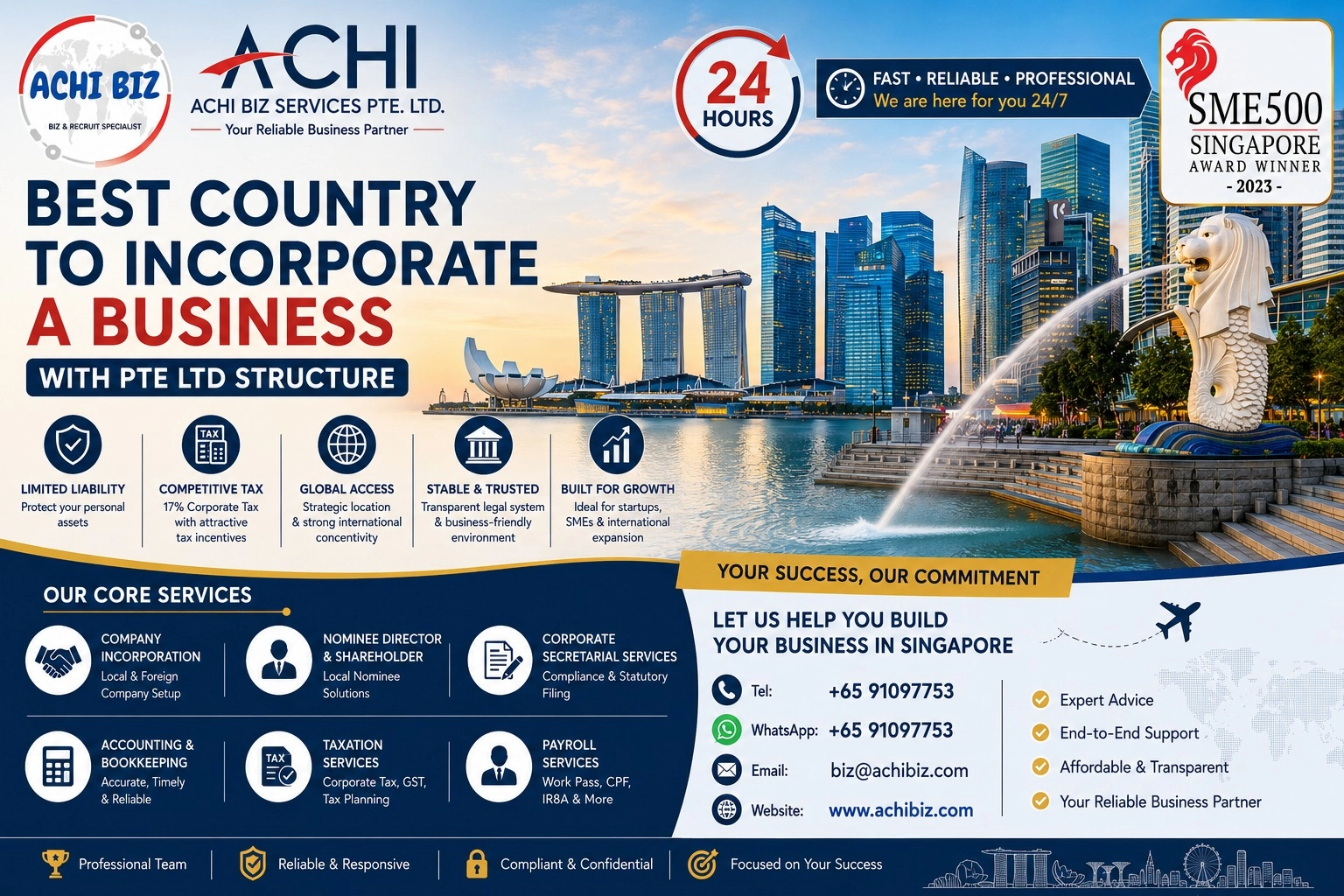
Best Country to Incorporate a Business – FAQ
Choosing the best country to incorporate a business is not simply about finding the lowest corporate tax rate. Business owners should also consider legal protection, international reputation, banking access, ease of administration, ownership rules, ongoing compliance, access to customers and the ability to expand internationally.
For entrepreneurs looking specifically for a Private Limited Company (Pte Ltd) structure, Singapore is one of the strongest jurisdictions to consider. A Singapore company is a separate legal entity, shareholders generally enjoy limited liability, and the country combines a competitive tax system with a well-established regulatory and business environment.
The following FAQs explain why Singapore is frequently considered when deciding where to incorporate a company, particularly for entrepreneurs, foreign investors, startups and international businesses.
Choosing the Best Country for Company Incorporation
What is the best country to incorporate a business with a Pte Ltd structure?
There is no single country that is automatically best for every business. The right jurisdiction depends on where the owners live, where the company will operate, its customers, tax position, banking requirements, regulatory obligations and future expansion plans.
For businesses targeting Singapore or the wider Asian market, Singapore can be an attractive jurisdiction for incorporating a Private Limited Company (Pte Ltd) because of its established legal system, business-friendly regulatory environment, international connectivity and competitive corporate tax framework. Singapore is also widely used as a regional headquarters location.
Why is Singapore considered one of the best countries to incorporate a company?
Singapore combines several advantages within one jurisdiction: a stable legal and regulatory framework, limited liability company structures, competitive taxation, strong infrastructure, access to international markets and an established financial and professional-services ecosystem.
The Singapore Economic Development Board describes Singapore as a business-friendly environment supported by transparent regulation, efficient processes and competitive tax policies.
Is Singapore a good country for foreign entrepreneurs to start a company?
Yes. Foreign entrepreneurs can establish companies in Singapore, subject to the applicable incorporation, local residency and immigration requirements.
Foreigners who do not have the appropriate local access must engage a registered Corporate Service Provider (CSP) to reserve the company name and register the business. A Singapore company must also satisfy the requirement for at least one ordinarily resident director.
What does Pte Ltd mean in Singapore?
“Pte Ltd” stands for Private Limited. It refers to a privately held company limited by shares.
The company has its own legal identity separate from its shareholders. This means it can own property, enter into contracts, sue or be sued in its own name. Shareholders generally have limited liability for the company’s debts and losses.
Is a Singapore Pte Ltd a separate legal entity?
Yes. A Singapore company is a separate legal entity from its shareholders and directors. It can hold assets and liabilities in its own name and continues to exist until it is formally wound up or struck off.
Does a Pte Ltd protect the shareholders’ personal assets?
Generally, shareholders of a company limited by shares have limited liability. Their personal liability is normally limited according to their obligations in respect of the shares they hold.
However, limited liability does not protect directors or shareholders from their own unlawful conduct, personal guarantees, breaches of statutory duties or other circumstances where personal liability may arise.
Singapore Pte Ltd Incorporation Requirements
What are the basic requirements to incorporate a Pte Ltd company in Singapore?
A Singapore Pte Ltd generally requires a company name, at least one shareholder, at least one director who satisfies Singapore’s local residency requirement, share capital, a Singapore registered office address and a company constitution. A company secretary must also be appointed within six months after registration.
How many shareholders are required to start a Singapore Pte Ltd?
At least one shareholder is required.
The permitted maximum depends on the type of private company. A private company limited by shares generally has no more than 50 shareholders, while an exempt private company has no more than 20 shareholders and is subject to additional conditions.
Can a foreigner own 100% of a Singapore Pte Ltd company?
Singapore generally permits foreign ownership of local companies. However, foreign ownership should not be confused with the requirement for an ordinarily resident director. A foreign shareholder can own the company while the company separately satisfies its local director requirement.
Does a Singapore company need a local director?
Yes. Every Singapore company must have at least one director who is ordinarily resident in Singapore. ACRA states that a director must also be at least 18 years old and satisfy the applicable eligibility requirements.
Can a foreigner be a director of a Singapore Pte Ltd?
Yes, additional foreign directors may generally be appointed, provided the company continues to have at least one director satisfying Singapore’s ordinary-residence requirement and the individuals concerned meet the applicable eligibility and immigration requirements.
Does every Singapore Pte Ltd need a company secretary?
Yes. Every company must have a company secretary, and the appointment must be made within six months of registration.
The secretary must satisfy the applicable local residency requirements and cannot be the same individual as the sole director of the company.
Does a Singapore Pte Ltd need a registered office address?
Yes. A Singapore company must maintain a registered office address. This is the address at which official communications and legal notices may be sent and where applicable company records are maintained.
Can a residential address be used as a company’s registered address?
It may be possible to use residential premises, subject to the applicable HDB or URA Home Office Scheme requirements and approval, where required. The nature and scale of the proposed business should also be compatible with residential-use rules.
Does a Singapore Pte Ltd require a company constitution?
Yes. A company must have a constitution setting out matters concerning the company’s governance and operation. Businesses may adopt an applicable model constitution or prepare their own constitution in accordance with Singapore requirements.
Cost of Incorporating in Singapore
How much does ACRA charge to incorporate a Pte Ltd company?
ACRA currently states a setup fee of S$315, comprising S$15 for the company name application and S$300 for company incorporation. Professional or Corporate Service Provider fees are separate.
Is Singapore expensive for company incorporation?
The statutory incorporation fee itself is relatively modest. The overall cost depends on the company’s circumstances and whether additional services are required, such as company secretary, registered address, nominee director, accounting, tax, licensing or immigration services.
Can I incorporate a Singapore company myself?
Eligible users with the required Singapore digital access may make filings through ACRA’s Bizfile.
However, foreigners must engage a Corporate Service Provider (CSP) to reserve a name and register a business structure in Singapore.
Why can incorporation costs be higher for foreign business owners?
A foreign owner may require additional services, particularly a local resident director arrangement, registered address, company secretary, compliance assistance and professional incorporation support.
The exact requirements depend on how the business will be structured and whether the foreign owner intends to relocate to Singapore.
Singapore Corporate Tax
What is the corporate income tax rate in Singapore?
Singapore’s prevailing Corporate Income Tax rate is 17% of chargeable income. The rate applies to both local and foreign companies.
Does every Singapore company actually pay 17% tax on all its profits?
Not necessarily. The 17% rate is the headline corporate income tax rate. The actual tax payable can differ depending on allowable deductions, exemptions, rebates and other applicable tax provisions.
Does Singapore provide tax exemptions for startup companies?
Yes. Qualifying new companies can benefit from Singapore’s Start-Up Tax Exemption (SUTE) scheme during their first three consecutive Years of Assessment, subject to the applicable qualifying conditions.
For YA 2020 onwards, the scheme provides a 75% exemption on the first S$100,000 of normal chargeable income and a 50% exemption on the next S$100,000 for qualifying companies.
What happens after the startup tax exemption period?
Companies may qualify for Singapore’s Partial Tax Exemption (PTE) scheme. For YA 2020 onwards, the scheme provides a 75% exemption on the first S$10,000 of normal chargeable income and a 50% exemption on the next S$190,000.
Is foreign income automatically tax-free for a Singapore company?
No. This is an important misconception.
Singapore has specific rules governing foreign-sourced income. Certain foreign-sourced dividends, foreign branch profits and foreign-sourced service income received in Singapore by a Singapore tax-resident company may qualify for exemption when the prescribed conditions are satisfied.
Can a Singapore company claim foreign tax credit?
Depending on the circumstances and applicable tax rules, a company may be able to claim foreign tax credit for foreign tax paid on the same income, thereby helping to reduce double taxation.
Singapore for International and Foreign Businesses
Why is Singapore attractive for international business?
Singapore’s geographic position, infrastructure, connectivity, financial ecosystem and access to Southeast Asian markets make it attractive for businesses with regional or international ambitions.
Singapore EDB highlights the country’s connectivity, business infrastructure, legal system and access to capital and talent as important advantages for companies expanding across Asia.
Is Singapore suitable for setting up an Asian regional headquarters?
Yes. Singapore is widely used as a base for regional and global headquarters. Its location, infrastructure, skilled workforce, financial services ecosystem and connectivity to Southeast Asia make it particularly relevant for businesses managing operations across multiple Asian markets.
Is Singapore suitable for startups?
Yes. A Pte Ltd can be particularly suitable for startups because it provides limited liability, a separate legal identity and a share-based ownership structure that can accommodate business growth and investment.
ACRA identifies an exempt private company as particularly suitable for small businesses and startups.
Is Singapore suitable for SMEs?
Yes. Singapore Pte Ltd companies are commonly used by SMEs because the structure separates the company from its owners while allowing ownership through shares and continuity beyond changes in individual shareholders.
Is Singapore suitable for e-commerce and online businesses?
Yes, subject to the nature of the products or services being sold and any sector-specific licensing requirements. E-commerce businesses can operate through a Singapore Pte Ltd and use Singapore as a base for domestic or international operations.
Is Singapore suitable for consultancy and professional services companies?
Yes. Consultancy, technology, management, professional and other service businesses commonly use a Pte Ltd structure. However, regulated professions and specific activities may require additional licences or professional approvals.
Is Singapore suitable for import and export businesses?
Yes. Singapore’s international connectivity makes it attractive for trading businesses. However, companies involved in importing or exporting goods must comply with Singapore Customs requirements and any product-specific licensing or permit requirements.
Is Singapore suitable for holding companies?
It can be. Singapore is frequently considered for regional holding structures because of its legal framework, tax treaty network and rules relating to qualifying foreign-sourced income. The appropriate structure should nevertheless be assessed based on the countries involved, economic substance and applicable tax rules.
Pte Ltd Versus Other Business Structures
Is a Pte Ltd better than a sole proprietorship?
For many growing businesses, a Pte Ltd offers stronger separation between the owner and the business.
A sole proprietorship does not have a separate legal identity from its owner, meaning the owner is personally responsible for its debts and losses. A company, in contrast, is a separate legal entity and its shareholders generally enjoy limited liability.
Is a Pte Ltd better than a partnership?
A conventional partnership is not a separate legal entity, and partners can be personally liable for the partnership’s debts and losses. A Pte Ltd provides a separate corporate identity and limited liability for shareholders.
Is a Singapore subsidiary the same as a foreign company branch?
No. A Singapore-incorporated subsidiary is a separate Singapore legal entity. A branch is an extension of the foreign parent company rather than a separate incorporated subsidiary.
A foreign company establishing a Singapore branch must also meet specific branch registration requirements, including having a locally resident authorised representative.
Should a foreign company establish a Singapore subsidiary or branch?
It depends on the intended operations, liability structure, tax position, corporate governance and relationship with the foreign parent.
Businesses seeking a distinct Singapore corporate identity often consider a subsidiary incorporated as a Pte Ltd, whereas a branch may suit businesses that want the Singapore operation to remain directly part of the foreign company.
Banking and Business Operations
Can a Singapore Pte Ltd open a corporate bank account?
Yes, a Singapore company can apply for a corporate bank account. However, incorporation does not guarantee bank account approval. Banks conduct their own KYC, AML, business-profile and risk assessments.
Can foreigners open a Singapore corporate bank account?
A foreign-owned Singapore company may apply for a corporate account, but requirements vary between banks. Banks may request information concerning directors, shareholders, beneficial owners, business activities, source of funds, expected transactions and commercial substance.
Does incorporating a Singapore company guarantee access to banking facilities?
No. Company incorporation and bank account approval are separate processes.
Can a Singapore Pte Ltd conduct business outside Singapore?
Yes. A Singapore company can conduct international business, subject to the laws of Singapore and the countries in which it operates.
Compliance After Incorporation
What compliance obligations does a Singapore Pte Ltd have?
Depending on the company’s circumstances, ongoing obligations can include maintaining statutory registers and accounting records, preparing financial statements, holding an AGM unless exempt, filing an Annual Return with ACRA, filing corporate tax returns with IRAS and updating changes to company particulars.
ACRA identifies annual returns, company registers, AGM requirements and the appointment of key officers among the continuing obligations of Singapore companies.
Does every Singapore Pte Ltd need an auditor?
No. Companies that qualify for the applicable audit exemption do not need to appoint an auditor. Where an audit is required, ACRA states that an auditor must generally be appointed within three months of incorporation.
Does a Singapore company need to file an Annual Return?
Yes, companies are generally required to file their Annual Return with ACRA according to the applicable statutory deadline.
Does a Singapore company need to file a corporate income tax return?
Yes, companies generally have corporate income tax filing obligations with IRAS, subject to the applicable filing rules and exemptions.
Is accounting compulsory for a Singapore Pte Ltd?
A company must maintain proper accounting records sufficient to explain its transactions and financial position. Whether a company requires an audit is a separate question.
Does incorporating a company automatically provide the licences needed to operate?
No. ACRA incorporation establishes the legal entity, but certain business activities require additional licences, permits or approvals from the relevant Singapore authorities.
The licensing requirements depend on the company’s actual activities.
Foreign Entrepreneurs and Work Passes
Can a foreigner incorporate a Singapore company without living in Singapore?
Yes. A foreign shareholder does not necessarily need to relocate to Singapore merely to own shares in a Singapore company. However, the company must satisfy its local director and other statutory requirements.
Can incorporating a Pte Ltd automatically give a foreign owner a Singapore work pass?
No. Company ownership and immigration status are separate matters.
If a foreigner intends to relocate to Singapore to manage or work for the business, the appropriate work pass must be obtained and the applicable MOM requirements must be satisfied. ACRA specifically notes that foreigners intending to move to Singapore to run their businesses need an appropriate work pass.
Can an Employment Pass holder become a director of another Singapore company?
Work pass holders should not assume that holding an Employment Pass automatically permits them to accept any directorship or conduct another business. ACRA advises FIN holders to check with their pass issuer, such as MOM or ICA, before registering a business or accepting a role.
Choosing Singapore Versus Another Country
Should I choose the country with the lowest corporate tax rate?
Not necessarily. A low headline tax rate can be attractive, but it should not be the only factor.
You should also consider banking, tax residency, double-taxation arrangements, economic substance, compliance costs, legal protection, customers, suppliers, investors and the reputation of the jurisdiction.
Is the cheapest country to incorporate always the best country?
No. Cheap incorporation can become expensive later if the jurisdiction creates problems with banking, compliance, taxation, payment processing, investors or international customers.
The best jurisdiction should be commercially suitable, not merely inexpensive to register.
Is an offshore company better than a Singapore Pte Ltd?
Not necessarily. They serve different purposes.
An offshore structure may be suitable for certain international holding, investment or cross-border arrangements. A Singapore Pte Ltd may be preferable where the business wants a substantive operating company in a recognised Asian commercial and financial centre.
Is Singapore an offshore jurisdiction?
Singapore is better described as an established international financial and business centre rather than a conventional zero-tax offshore jurisdiction. Singapore companies are subject to corporate taxation and substantive regulatory and compliance requirements.
Is Singapore better than Hong Kong for company incorporation?
There is no universal winner. Both are major Asian business centres. The better choice depends on where the company’s customers, operations, management, banking relationships and commercial interests are located.
For businesses focused on Southeast Asia and ASEAN, Singapore’s location and regional connectivity can be particularly attractive.
Is Singapore better than the UAE for incorporating a company?
It depends on the intended market and business model. Singapore can be particularly attractive for businesses targeting Asia and Southeast Asia, while UAE structures may be more relevant for businesses focused on the Middle East and surrounding markets.
Tax, residency, free-zone rules, substance requirements and operational costs should be compared before deciding.
Is Singapore better than the UK for incorporating a private company?
Both offer established legal systems and internationally recognised corporate structures. The appropriate jurisdiction depends largely on whether the business is primarily targeting Asia or the UK/European market, together with taxation, residency and operational considerations.
Is Singapore better than the United States for company incorporation?
It depends on the company’s objectives. A US corporation or LLC may be more appropriate for businesses primarily operating in or raising capital from the United States, while Singapore can be particularly suitable for businesses using Asia as their principal commercial base.
Which country is best for an Asian business headquarters?
Singapore is a major candidate for businesses establishing an Asian or Southeast Asian headquarters. EDB describes Singapore as a leading regional headquarters destination and highlights its infrastructure, talent, connectivity and business environment.
Practical Considerations Before Incorporation
What should I consider before choosing a country to incorporate my business?
Consider where your customers are located, where management decisions will be made, where employees will work, banking requirements, corporate and personal taxation, ownership structure, regulatory licences, investors, business reputation, annual compliance costs and future expansion.
Should I consider tax residency before incorporating overseas?
Yes. The place of incorporation and the company’s tax residence are not always the same concept. Management and control, business substance and applicable domestic tax rules can affect the company’s tax position.
Professional tax advice should be obtained where operations or owners span multiple jurisdictions.
Should I consider the owner’s personal tax residence?
Yes. Incorporating a company overseas does not automatically remove the owner’s personal tax obligations in their country of residence. Dividends, salaries, capital gains or other income received from the company may have personal tax consequences.
Should banking be considered before incorporating?
Absolutely. Banking should be considered before, not after, choosing a jurisdiction.
A company structure that looks attractive on paper may be impractical if suitable banks or payment providers are unwilling to support the intended activities.
Should I check licensing requirements before registering the company?
Yes. Certain activities—including financial services, employment agencies, food businesses, travel, education, healthcare, construction and other regulated sectors—may require licences or approvals in addition to ACRA incorporation.
Should I consider future investors when selecting the jurisdiction?
Yes. If you intend to raise external investment, consider whether prospective investors are comfortable investing in that jurisdiction and corporate structure.
A clear share structure, recognised legal system and appropriate shareholder protections can become increasingly important as the business grows.
Engaging a Corporate Service Provider
Why engage a Corporate Service Provider to incorporate a Singapore Pte Ltd?
A Corporate Service Provider can assist with company incorporation, statutory documentation, company secretary requirements, registered address services and ongoing corporate compliance.
For foreigners, engaging a CSP is also part of ACRA’s requirements for registering a business in Singapore.
Can a Corporate Service Provider help after the company is incorporated?
Yes. Depending on the services offered, ongoing support may include company secretarial services, registered address, accounting, taxation, Annual Return filing, corporate changes and other compliance matters.
How can ACHI Biz Services assist with Singapore company incorporation?
ACHI Biz Services can assist entrepreneurs and businesses with the establishment and ongoing administration of a Singapore Private Limited Company, including incorporation and related corporate services based on the client’s requirements.
Before proceeding, the proposed ownership structure, directors, business activities, registered address and any applicable licensing or immigration requirements should be reviewed so that the company is established on the correct footing from the beginning.
Is Singapore ultimately the best country to incorporate my business?
Singapore can be one of the strongest choices for a Pte Ltd structure, particularly for entrepreneurs and international businesses seeking a credible base in Asia. However, the best country ultimately depends on your actual business model, markets, ownership, tax circumstances and long-term plans.
Rather than choosing a jurisdiction solely because it is cheap or has a low headline tax rate, choose one that supports where and how you genuinely intend to conduct business.
Related articles:
FAQ on Cheapest Way to Incorporate a Pte Ltd Company
Complete FAQ Guide to Private Limited Company (Pte Ltd) in Singapore
#achibiz