
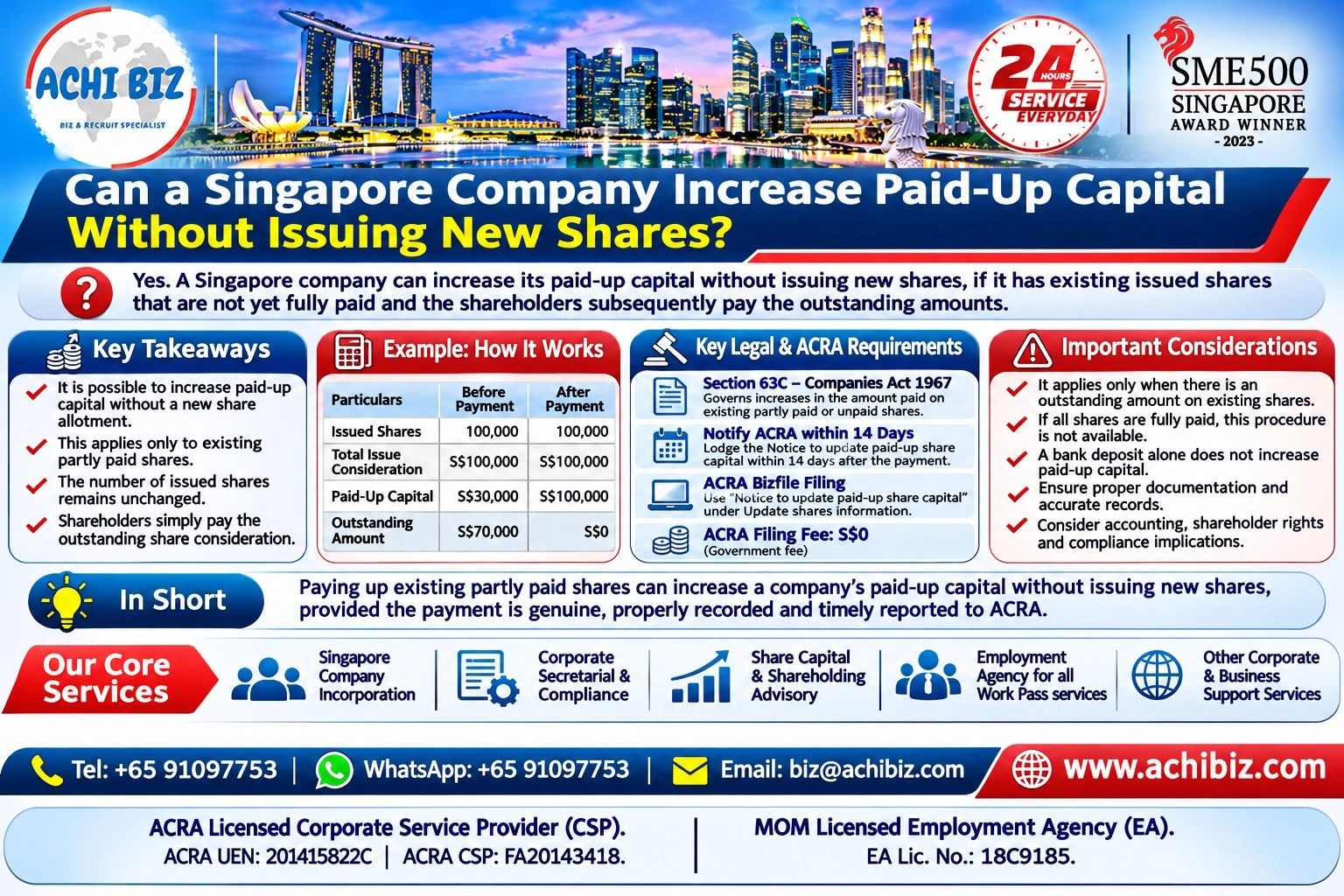
Can a Singapore Company Increase Paid-Up Capital Without Issuing New Shares? – FAQ Guide
A Comprehensive FAQ Guide to Paying Up Existing Shares, Outstanding Share Capital, ACRA Bizfile Updates, Shareholder Contributions and Corporate Compliance in Singapore.
Can a Singapore Private Limited Company (Pte. Ltd.) increase its paid-up capital without issuing additional shares?
Yes. A Singapore company can increase its paid-up capital without issuing new shares if it has existing issued shares that are not yet fully paid and the shareholders subsequently pay the outstanding amounts.
This distinction is important because many business owners assume that increasing paid-up capital always requires a new share allotment. In reality, the correct procedure depends on whether the company already has unpaid share capital.
For example, a Singapore company may have issued 100,000 ordinary shares for a total agreed subscription amount of S$100,000, but its shareholders have paid only S$30,000.
If the shareholders subsequently pay another S$70,000 towards those same shares, the company’s paid-up capital can increase from S$30,000 to S$100,000 without changing the number of issued shares.
However, where all existing shares are already fully paid, simply depositing additional money into the company’s bank account does not automatically increase its paid-up share capital.
The company must distinguish between shareholder loans, voluntary contributions, payments of outstanding share consideration and new equity subscriptions.
This distinction affects the company’s statutory share capital records, financial statements, shareholder obligations and filing requirements with the Accounting and Corporate Regulatory Authority (ACRA).
This comprehensive FAQ guide by ACHI BIZ SERVICES PTE. LTD., an ACRA Licensed Corporate Service Provider (CSP), explains when paid-up capital can increase without issuing new shares, how outstanding share payments are treated, the applicable ACRA procedures, accounting implications, shareholder responsibilities and common compliance mistakes.
Important scope distinction: This article focuses specifically on increasing the paid-up amount of shares already issued. It does not repeat the general procedures for increasing issued share capital, conducting new share allotments or introducing investors. Those subjects are addressed in ACHI BIZ’s separate share capital articles.
Understanding Paid-Up Capital Without New Share Allotments
Can a Singapore Pte. Ltd. company increase paid-up capital without issuing new shares?
Yes, provided there is an existing unpaid amount on previously issued shares that can be validly satisfied.
The company does not need to create additional shares merely because shareholders are paying outstanding subscription consideration.
For example:
| Particulars | Before payment | After payment |
|---|---|---|
| Number of issued shares | 100,000 | 100,000 |
| Total agreed issue consideration | S$100,000 | S$100,000 |
| Paid-up capital | S$40,000 | S$100,000 |
| Outstanding share consideration | S$60,000 | S$0 |
The number of issued shares remains unchanged.
Only the paid-up and outstanding amounts change.
What does increasing paid-up capital without issuing new shares actually mean?
It means that additional consideration is paid or otherwise validly satisfied in respect of shares that have already been issued.
The company is not creating additional ownership units.
Instead, it is reducing the outstanding payment obligation attached to existing shares.
This distinction is particularly relevant where the original shares were issued on partly paid terms.
What is the difference between issued share capital and paid-up capital in this situation?
Issued share capital relates to the shares already issued and their corresponding capital amount.
Paid-up capital represents the amount paid or deemed paid on those shares.
Where shares are partly paid, the paid-up amount may be lower than the total amount agreed for the shares.
Subsequent payments can increase paid-up capital without increasing the number of issued shares.
What are partly paid shares in Singapore?
Partly paid shares are shares for which the shareholder has not yet satisfied the full agreed issue consideration.
For example, 10,000 shares may have been issued for S$10 each, with S$4 per share initially paid.
The total agreed consideration is S$100,000, while the initial paid-up amount is S$40,000.
The remaining S$60,000 is outstanding under the relevant share issue terms.
Can fully paid shares become more fully paid?
No.
Once the agreed consideration for a share has been fully satisfied, there is no further unpaid amount on that share to collect.
A shareholder cannot increase the paid-up amount of an already fully paid share simply by making another payment and labelling it share capital.
Any proposed additional equity funding requires a separate legal and accounting basis.
Can a company increase paid-up capital while keeping the same shareholders?
Yes.
Where existing shareholders pay outstanding amounts on their existing shares, the shareholder identities generally remain unchanged.
The transaction does not require the admission of new shareholders.
Can the number of issued shares remain exactly the same after the paid-up capital increases?
Yes.
That is the defining feature of this type of transaction.
For example, a company may have 50,000 issued ordinary shares before and after the payment.
Its paid-up capital may increase from S$10,000 to S$50,000 while its issued share quantity remains 50,000.
Does paying outstanding share capital change the company’s ownership percentages?
Ordinarily, no.
Where shareholders simply pay amounts outstanding on their existing shares, the number of shares held by each shareholder remains unchanged.
However, different payment obligations or rights attached to partly paid shares may affect particular shareholder entitlements under the applicable terms.
Is increasing paid-up capital without issuing new shares the same as increasing issued share capital?
No.
A payment on existing partly paid shares does not create additional shares.
A new share allotment, by contrast, involves issuing new shares.
The procedures and resulting ownership consequences are therefore different.
Is this procedure available to every Singapore company?
It depends on the company’s existing share capital position.
If the company has unpaid amounts on previously issued shares, the procedure may be available.
If all existing shares are fully paid, there is ordinarily no outstanding share consideration to pay.
The company must first establish its actual statutory and accounting position.
Determining Whether Existing Shares Are Fully Paid or Partly Paid
How can a Singapore company check whether its shares are fully paid?
The company should review its ACRA share capital records, original allotment documentation, subscription agreements, accounting records and evidence of payment.
The relevant information should establish the number of issued shares, agreed consideration, amounts paid and any unpaid balance.
The company should not rely solely on a shareholder’s recollection.
Can the ACRA Business Profile show whether shares are fully paid?
ACRA records may provide information about the company’s issued and paid-up share capital.
However, the company may need to examine its detailed share records and supporting documents to understand the payment position for a particular allotment.
A Business Profile should not be treated as a substitute for reviewing the underlying transaction documents.
Can a company have issued share capital of S$100,000 but paid-up capital of only S$20,000?
Yes, where the shares were validly issued on terms allowing part of the agreed consideration to remain unpaid.
For example:
| Share capital information | Amount |
|---|---|
| Total agreed issue consideration | S$100,000 |
| Amount paid | S$20,000 |
| Outstanding amount | S$80,000 |
The company may subsequently collect the outstanding S$80,000 in accordance with the relevant terms.
Can a company have partly paid shares even if it has operated for several years?
Potentially, yes.
The age of the company does not, by itself, determine whether its shares are fully paid.
The company must examine the original share issue terms and any subsequent payments or adjustments.
However, long-standing unpaid balances should be reviewed carefully to ensure the records remain accurate.
Can some shareholders hold fully paid shares while others hold partly paid shares?
Yes, depending on the original allotment terms and subsequent payments.
For example, one shareholder may have fully satisfied their subscription consideration while another still owes an outstanding amount.
The company should maintain accurate records of the payment position.
Can shares within the same class have different paid-up amounts?
Potentially, yes, subject to the terms of issue and applicable legal requirements.
However, the company should consider whether different paid-up amounts affect any rights, obligations or contractual arrangements.
The records should clearly identify the relevant amounts.
Can a company assume that shares are partly paid because the bank account contains less money than the registered paid-up capital?
No.
Paid-up capital does not represent the company’s current bank balance.
Money originally contributed as share capital may subsequently have been used for legitimate business expenses.
A low bank balance does not establish that the shares are unpaid.
Does a company need to maintain the original share subscription documents?
Yes, proper supporting records are important.
These documents help establish the agreed issue consideration, payment terms and whether the shares were issued as fully paid or partly paid.
They may also be needed to resolve discrepancies or support later ACRA updates.
Singapore Companies Act Requirements for Paying Up Existing Shares
Which provision of the Companies Act allows paid-up capital to increase without issuing new shares?
Section 63C of the Companies Act 1967 specifically addresses increases in the amount paid on existing partly paid or unpaid shares of a private company.
Where a private company subsequently receives all or part of the unpaid amount on those shares, it must lodge the prescribed notice with ACRA.
This is the principal statutory provision relevant to the subject of this article.
Does Section 63C require the company to issue additional shares?
No.
Section 63C concerns payments received in respect of shares that have already been issued.
The company is updating the paid-up amount rather than allotting new shares.
This is why ACRA provides a separate filing service for updating paid-up share capital.
Is there a statutory deadline for notifying ACRA after receiving outstanding share capital?
Yes.
Section 63C requires the relevant notice to be lodged within 14 days after the payment.
For example, if a company receives an outstanding share payment on 1 November, it should ensure the prescribed notice is lodged within the statutory period.
Companies should not wait until their next annual return to update paid-up share capital.
Can a shareholder pay outstanding share capital before the company makes a formal call?
Potentially, yes.
Section 65(1)(b) permits a company, if authorised by its constitution, to accept all or part of the unpaid amount on shares even though that amount has not been called up.
The company should therefore review its constitution before accepting an advance payment of uncalled share capital.
What is a call on shares under Singapore company law?
A call on shares is a demand for payment of an outstanding amount on shares, made in accordance with the relevant share terms, constitution and applicable law.
For example, a shareholder may have subscribed for shares with S$50,000 outstanding.
Where the applicable arrangements permit, the company may call for payment of some or all of that amount.
The payment is made towards the shareholder’s existing share obligation.
Must the company issue a formal call notice before accepting payment?
Not necessarily.
Section 65 permits advance payment of uncalled amounts where authorised by the constitution.
However, the company should verify the original issue terms and maintain appropriate evidence of the payment.
Can directors demand payment of outstanding share capital at any time?
Not automatically.
The directors’ ability to make calls depends on the company’s constitution, terms of issue and applicable legal requirements.
For example, the original share subscription terms may specify payment dates or conditions.
Directors should not assume that every unpaid amount is immediately payable on demand.
Can shareholders pay different amounts at different times?
Potentially, yes.
Section 65(1)(a) permits arrangements involving different amounts and times of payment between shareholders, where authorised by the constitution.
However, the company must also consider the applicable share terms and its directors’ duties.
Is a Section 161 shareholder resolution required when paying up existing shares?
A fresh Section 161 approval is generally not required merely because a shareholder is satisfying an outstanding payment obligation on shares already validly issued.
Section 161 concerns directors’ authority to issue shares.
Nevertheless, the company should review whether its constitution, original allotment terms or particular circumstances require other internal approvals.
Is a special resolution required to increase paid-up capital on existing shares?
Not ordinarily for the simple receipt of outstanding share consideration.
However, a special resolution or other approval may be necessary if the company is also changing its constitution, restructuring share rights or implementing another transaction that requires it.
Can the company change the agreed issue price of existing shares simply to increase paid-up capital?
Not through a routine notice to update paid-up share capital.
That notice records payments on existing partly paid shares; it is not a general mechanism for retrospectively increasing the subscription price of fully paid shares.
Any proposed alteration of existing share obligations requires separate legal analysis.
Can a shareholder voluntarily pay more than the outstanding amount on their shares?
A shareholder may offer additional funds, but the excess cannot automatically be treated as paid-up capital on shares that have no remaining unpaid consideration.
For example, if S$10,000 remains outstanding and the shareholder transfers S$30,000, the company must determine the proper legal and accounting treatment of the additional S$20,000.
It should not simply report the entire S$30,000 as payment of existing unpaid share capital.
ACRA Bizfile Procedure to Update Paid-Up Share Capital Without Issuing New Shares
Which ACRA filing should be used when existing partly paid shares become fully paid?
The relevant filing is Notice to update paid-up share capital.
ACRA provides this service under Update shares information in Bizfile.
It is specifically intended for local companies updating the paid-up amounts of previously issued partly paid shares.
Is the Notice to Update Paid-Up Share Capital different from a Return of Allotment?
Yes.
| Particulars | Notice to update paid-up share capital | Return of allotment |
|---|---|---|
| Main purpose | Record payments on existing partly paid shares | Record newly issued shares |
| Additional shares created | No | Yes |
| Existing share quantity | Remains unchanged | Increases |
| Shareholder ownership | Normally unchanged | May change |
| Typical transaction | Payment of outstanding share consideration | New share subscription |
| ACRA procedure | Notice to update paid-up share capital | Return of allotment of shares |
Using the wrong filing can create discrepancies in the company’s share records.
How does a Singapore company update paid-up share capital through Bizfile?
According to ACRA’s published guidance, the procedure generally involves:
-
Logging in to Bizfile with authorised Corppass credentials.
-
Selecting the correct company.
-
Opening Manage → Update shares information.
-
Selecting Notice to update paid-up share capital.
-
Entering the date the paid-up amount changed.
-
Updating the relevant total paid-up share capital amount.
-
Updating the amounts attributable to the relevant shareholders.
-
Reviewing and submitting the notice.
ACRA then provides a submission acknowledgement and confirmation through Bizfile.
What information must be prepared before submitting the ACRA notice?
ACRA identifies two principal requirements:
-
The date on which the paid-up share capital amount changed.
-
The updated paid-up amount for each relevant share and shareholder.
The company should also have supporting records demonstrating the payment and its allocation to the relevant shares.
Must the company update both the total paid-up capital and the individual shareholder amounts?
The relevant figures must be accurate and consistent.
ACRA’s procedure allows the filer to update the total paid-up share capital amount and the paid-up amounts attributable to individual or corporate shareholders.
The company should reconcile these figures before submission.
Can a company update the paid-up amount for only one shareholder?
Yes.
ACRA’s filing procedure allows the company to select the relevant shareholder and update that shareholder’s paid-up amount.
For example, where one shareholder settles an outstanding balance while another does not, the company should record the actual payments received.
Can a company update paid-up share capital in different currencies?
ACRA’s filing procedure includes the ability to select the relevant currency and update additional currencies where applicable.
The company must ensure that the reported amounts correspond to the correct share capital records.
What is the ACRA filing fee for updating paid-up share capital?
S$0
Published ACRA government filing fee
ACRA lists the standard notice as free, with immediate processing.
Professional corporate secretarial service fees, if applicable, are separate.
How long does ACRA take to process a paid-up share capital update?
ACRA lists immediate processing for the standard filing.
However, the time needed to prepare and verify the supporting documentation depends on the company’s circumstances.
Can a company secretary file the notice on behalf of the company?
Yes, subject to the applicable authorisation and filing arrangements.
The company may also engage an ACRA Licensed Corporate Service Provider (CSP) to assist with the filing.
Can the company file the notice before receiving the outstanding payment?
The company should not report an amount as paid merely because a shareholder has promised to pay it.
The relevant filing must reflect a genuine increase in the amount paid or validly satisfied.
Can a company backdate the payment date in Bizfile?
The company should report the actual date on which the relevant paid-up amount changed.
It must not invent an earlier payment date to make the company’s capital position appear stronger.
What happens if the company forgets to notify ACRA within 14 days?
A late filing may constitute non-compliance with Section 63C.
The company should address the omission promptly and seek advice on any applicable regulatory consequences.
It should not attempt to conceal the delay by entering an inaccurate date.
Can a company update paid-up capital during its annual return filing instead?
The company should use the prescribed notice to update paid-up share capital.
It should not assume that the annual return replaces the Section 63C notification obligation.
ACRA provides a dedicated procedure for this purpose.
Shareholder Payments and Outstanding Share Capital
Can shareholders pay outstanding share capital in instalments?
Yes, where the original share issue terms and applicable arrangements permit instalment payments.
For example, a shareholder may owe S$80,000 on existing partly paid shares and make four payments of S$20,000.
Each payment reduces the outstanding balance.
The company must maintain accurate records and comply with the relevant ACRA notification requirements.
Can a shareholder pay only part of the outstanding amount?
Yes, subject to the applicable terms.
A shareholder who owes S$50,000 may pay S$15,000, leaving S$35,000 outstanding.
The company should report the actual increase in paid-up capital rather than wait until the entire balance is settled.
Can a shareholder make a payment from their personal bank account?
Yes, where the shareholder is an individual and the payment is made towards their genuine outstanding share obligation.
The company should retain bank transaction evidence and clearly identify the payment’s purpose.
Can a corporate shareholder pay outstanding share capital from its business bank account?
Yes.
A corporate shareholder may satisfy its subscription obligations using its own funds.
The company receiving the payment should ensure that the transaction is properly identified and recorded.
Can another person pay the outstanding share capital on behalf of a shareholder?
Potentially, subject to the relevant contractual and legal arrangements.
However, the company should document the source of funds, the identity of the payer and the obligation being satisfied.
A third-party payment does not automatically transfer ownership of the shares to the payer.
Can a foreign shareholder pay outstanding share capital from overseas?
Yes, subject to applicable banking, foreign exchange and compliance requirements.
The company should retain supporting documents identifying the payment and its purpose.
The amount credited towards the share obligation should be reconciled to the agreed currency and payment terms.
Can outstanding share capital be paid in foreign currency?
Potentially, depending on the terms of issue and the currency in which the relevant share capital is recorded.
The company should apply an appropriate and supportable conversion basis where necessary.
It should not confuse exchange differences with additional share capital contributions.
Can a shareholder pay outstanding share capital using cash instead of a bank transfer?
Potentially, but the company should consider recordkeeping, source-of-funds verification and applicable compliance requirements.
Bank transfers generally provide a clearer audit trail.
For substantial transactions, traceable payment methods are preferable.
Can a shareholder use money already owed to them by the company to settle unpaid share capital?
Potentially, where a genuine and legally enforceable obligation can be validly discharged through an agreed set-off or other arrangement.
However, this requires careful review of the underlying debts, subscription obligations, directors’ authority and accounting treatment.
It should not be treated as an ordinary cash payment if no cash changes hands.
Can a shareholder pay outstanding share capital by transferring assets to the company?
This depends on the original terms of issue and whether the proposed non-cash satisfaction is legally permissible.
For example, if shares were originally issued on terms requiring cash payment, substituting an asset transfer may require additional legal analysis.
The company should not assume that any asset contribution can automatically be recorded as paid-up capital.
Can shareholders pay more than the amount originally agreed for their shares?
They may provide additional funds to the company, but the excess requires its own legal and accounting treatment.
The company cannot automatically increase the paid-up amount of existing shares beyond their properly established outstanding consideration.
Can the company receive outstanding share payments from several shareholders on different dates?
Yes.
Each payment should be documented with its actual date and allocated to the relevant shareholder.
The company must ensure that its statutory notifications reflect the payments received within the applicable deadlines.
Can a shareholder pay the outstanding balance without visiting Singapore?
Yes.
A shareholder may arrange a bank transfer or another properly documented payment without being physically present in Singapore.
The company should still complete the necessary verification and ACRA filing.
What If All Existing Shares Are Already Fully Paid?
Can a Singapore company increase paid-up capital without issuing new shares when all its shares are fully paid?
Not through the ordinary procedure for paying up existing partly paid shares.
If all existing shares are fully paid, there is no unpaid subscription consideration remaining on those shares.
The company should not use the notice to update paid-up share capital merely to record additional funds contributed by shareholders.
It must determine an appropriate legal structure for the proposed funding.
Can a shareholder deposit S$100,000 into the company bank account and declare it paid-up capital?
No.
A bank deposit does not automatically determine the legal nature of the funds.
The S$100,000 could represent a shareholder loan, repayment of an amount owed to the company, advance payment, or another properly documented transaction.
To recognise the amount as share capital, the company must establish a valid legal basis.
Can the company simply pass a directors’ resolution declaring additional paid-up capital?
No.
A resolution alone does not create paid-up share capital without a legally valid underlying transaction.
The company must distinguish between documenting an existing payment obligation and attempting to create new share capital without the necessary legal steps.
Can a shareholder make a voluntary capital contribution without receiving new shares?
A shareholder may potentially provide funds without receiving additional shares, but the legal and accounting treatment requires careful assessment.
Such a contribution is not automatically an increase in statutory paid-up share capital.
Depending on its terms and applicable accounting standards, it may require treatment as a separate equity contribution, liability or another category.
The company should obtain appropriate accounting and legal advice before recording the transaction.
Is a voluntary shareholder contribution the same as paid-up share capital?
Not necessarily.
Paid-up share capital relates to amounts paid or deemed paid on issued shares.
A separate shareholder contribution may have a different legal character.
The company should not use these descriptions interchangeably.
Can the company record additional shareholder funding as capital reserve?
A capital contribution may, in appropriate circumstances, be recognised within a separate equity reserve under the applicable accounting framework.
However, the accounting treatment depends on the substance and terms of the transaction.
Recording an amount in an equity reserve does not automatically increase the statutory paid-up share capital reported to ACRA.
Can the company convert retained earnings into paid-up capital without issuing new shares?
The company cannot simply reclassify accumulated profits as paid-up share capital through the ordinary notice for payments on partly paid shares.
A proposed capitalisation of reserves or profits requires a separate legal and accounting analysis.
Where a transaction involves bonus shares or another capital restructuring, the applicable procedures differ from collecting unpaid subscription amounts.
Can a company use accumulated profits to settle outstanding share capital owed by shareholders?
This is not an automatic or general mechanism.
The company would need to establish a lawful transaction that validly satisfies the shareholders’ outstanding obligations.
A bookkeeping transfer alone is insufficient.
Can a company convert an existing shareholder loan into paid-up capital without issuing new shares?
A conventional shareholder loan does not automatically become paid-up share capital.
Where the shareholder also has an outstanding obligation on previously issued partly paid shares, a properly documented and legally valid set-off may warrant consideration.
However, converting a shareholder loan into equity where all existing shares are fully paid is a different transaction and may require a new share issue or another appropriate legal structure.
Can a company use its existing cash reserves to increase paid-up capital?
Not merely by transferring money between its own bank accounts.
The company’s existing cash is already its asset.
Moving that cash internally does not constitute a new payment by shareholders towards outstanding share consideration.
Can a company increase paid-up capital by changing its accounting entries?
No, not without a genuine underlying transaction.
Accounting records should reflect the company’s legal and financial position, not create an unsupported share capital increase.
Shareholder Loans Versus Paid-Up Capital
What is the difference between a shareholder loan and payment of unpaid share capital?
A shareholder loan generally creates a debt obligation owed by the company to the shareholder.
Payment of outstanding share capital satisfies the shareholder’s obligation to pay the company for shares already issued.
| Feature | Shareholder loan | Payment of unpaid share capital |
|---|---|---|
| Nature | Debt financing | Equity subscription obligation |
| Ordinary repayment obligation | Depends on loan terms | No ordinary loan repayment obligation |
| New shares required | No | No |
| Existing partly paid shares required | No | Yes |
| Effect on paid-up capital | No automatic increase | Increases when validly paid |
| Documentation | Loan agreement and records | Share terms, payment evidence and statutory update |
Can a shareholder loan be mistaken for paid-up capital?
Yes, particularly where the shareholder transfers money without clearly stating its purpose.
The company should identify the nature of the transaction when the funds are received.
Poor documentation can lead to disputes over whether the money is repayable.
Can the company repay money contributed as paid-up share capital?
Not in the same way as an ordinary shareholder loan.
Share capital is subject to Singapore’s applicable capital maintenance framework.
A shareholder generally cannot demand repayment of share capital merely because they originally contributed the funds.
Can a shareholder change their mind and request that a share capital payment be treated as a loan?
The company cannot simply relabel a completed share capital payment to avoid the legal consequences of the original transaction.
Any proposed correction must reflect the actual facts and applicable law.
Can the company treat the same payment as both a shareholder loan and paid-up capital?
No.
The same amount cannot be simultaneously recorded as an outstanding loan liability and as fully satisfied share capital without a valid transaction explaining the change.
The company should avoid double-counting shareholder funding.
Financial Reporting and Accounting Treatment
How is payment of outstanding share capital recorded in the company’s accounts?
Where a genuine unpaid share subscription amount is recognised as receivable, the receipt of payment generally increases cash and reduces the corresponding receivable.
The precise entries depend on how the original share issue and unpaid amount were recognised under the applicable accounting standards.
The company should not assume that every unpaid subscription balance is presented identically in financial statements.
Does receiving outstanding share capital increase the company’s cash balance?
Yes, where payment is received in cash or by bank transfer.
For example, receiving S$50,000 ordinarily increases the company’s cash by S$50,000 before considering any subsequent transactions.
However, a valid non-cash settlement may increase the paid-up amount without bringing in additional cash.
Does payment of outstanding share capital increase the company’s revenue?
No.
Genuine share subscription payments are not ordinary revenue from selling goods or providing services.
They should not be recorded as business turnover.
Does payment of unpaid share capital increase the company’s profit?
No.
The receipt of genuine share capital consideration does not itself create operating profit.
The company should distinguish capital transactions from income-generating activities.
Does paying up existing shares increase the company’s total equity?
Not necessarily by the amount of cash received.
The impact depends on how the unpaid share consideration was originally recognised.
For example, if the company already recognised the unpaid subscription as an asset, collecting it may simply exchange that receivable for cash without increasing total equity.
This is an important distinction between improving liquidity and increasing accounting net worth.
Can paid-up capital increase while total issued share capital remains unchanged?
Yes.
Where existing shares were issued partly paid, subsequent payments can increase the paid-up amount without changing the total agreed issue consideration or the number of issued shares.
Does payment of outstanding share capital improve the company’s liquidity?
Where genuine cash is received, it may improve liquidity.
However, the extent of improvement depends on the company’s existing cash requirements, liabilities and operating expenses.
Does a higher paid-up capital figure guarantee that the company is financially strong?
No.
Paid-up capital is only one indicator of the company’s capital history.
Financial strength also depends on assets, liabilities, profitability, liquidity and cash flow.
Does the company need to update its accounting records after receiving share capital payments?
Yes.
The payment should be recorded accurately and reconciled with the relevant statutory share capital records.
The company should retain sufficient supporting evidence for financial reporting and audit purposes.
Can an auditor request evidence of paid-up share capital payments?
Yes.
An auditor may request bank statements, subscription agreements, share records, accounting entries and other relevant documentation.
The company should ensure that the reported amounts can be supported.
Shareholder Rights, Voting and Dividend Implications
Does paying up existing shares give the shareholder additional shares?
No.
A shareholder who pays an outstanding balance on existing shares does not automatically receive additional shares.
The payment satisfies an obligation associated with the shares already held.
Does paying up existing shares increase the shareholder’s ownership percentage?
Ordinarily, no.
For example, a shareholder holding 60% of the issued ordinary shares generally continues to hold 60% after paying the outstanding amount on those shares.
However, the company’s constitution and relevant share rights should still be reviewed.
Does payment of unpaid share capital increase voting rights?
It does not ordinarily increase the number of votes attached to the shares.
However, Section 64(2) of the Companies Act permits a company’s constitution to provide that a member is not entitled to vote unless calls or other personally payable sums in respect of their shares have been paid.
Accordingly, settling overdue amounts may restore voting eligibility where such a constitutional restriction applies.
Can shareholders with partly paid shares receive dividends?
Potentially, subject to applicable law, the company’s constitution and the rights attached to the shares.
Section 65(1)(c) permits a company, where authorised by its constitution, to pay dividends in proportion to the amount paid up on each share where different amounts have been paid.
The company must also comply with the general legal requirements governing dividends.
Can two shareholders with the same number of shares receive different dividends because their paid-up amounts differ?
Potentially, depending on the constitution and applicable share rights.
However, the company should not assume that different paid-up amounts automatically produce different dividend entitlements.
The legal basis for the distribution must be established.
Can a shareholder transfer partly paid shares to another person?
Potentially, subject to applicable transfer restrictions and the terms of the shares.
However, outstanding payment obligations and the parties’ responsibilities must be carefully addressed.
A transfer should not be treated as automatically extinguishing unpaid share capital.
Does paying up existing shares remove all shareholder liabilities?
It may satisfy the outstanding payment obligation associated with those shares.
However, shareholders may still have separate liabilities arising from guarantees, contractual commitments or other legal obligations.
Can the company require one shareholder to pay while allowing another to defer payment?
This depends on the original share terms, constitution and applicable legal requirements.
The directors should ensure that any differing treatment is properly authorised and commercially justifiable.
Can unpaid share capital affect a shareholder’s rights during a company winding-up?
Yes.
Outstanding amounts on shares may become relevant in a winding-up, subject to the applicable statutory and contractual framework.
A shareholder should not assume that unpaid share obligations disappear merely because the company has ceased trading.
Practical Examples: Increasing Paid-Up Capital Without Issuing New Shares
The following examples illustrate common situations. They assume that the existing shares were validly issued on partly paid terms and that the relevant payments are legally permitted.
Example 1: Can a company increase paid-up capital from S$1,000 to S$100,000 without new shares?
Yes, if the company already has sufficient unpaid consideration on existing shares.
Suppose it has issued 100,000 ordinary shares for total consideration of S$100,000, of which S$1,000 has been paid.
| Particulars | Before | After |
|---|---|---|
| Issued shares | 100,000 | 100,000 |
| Total issue consideration | S$100,000 | S$100,000 |
| Paid-up capital | S$1,000 | S$100,000 |
| Outstanding amount | S$99,000 | S$0 |
The shareholders pay the outstanding S$99,000.
No additional shares are required.
Example 2: Can a company with 10,000 fully paid shares increase paid-up capital from S$10,000 to S$100,000 without new shares?
Not through the ordinary unpaid-share payment procedure.
If the existing 10,000 shares were fully paid for total consideration of S$10,000, there is no outstanding S$90,000 to collect on those shares.
The company must consider another legally appropriate funding or capital transaction.
Example 3: Can a shareholder make three separate payments towards existing shares?
Yes, subject to the applicable terms.
Suppose the shareholder owes S$60,000.
| Payment | Amount received | Cumulative paid amount | Outstanding balance |
|---|---|---|---|
| Initial position | — | S$0 | S$60,000 |
| First payment | S$10,000 | S$10,000 | S$50,000 |
| Second payment | S$20,000 | S$30,000 | S$30,000 |
| Third payment | S$30,000 | S$60,000 | S$0 |
The company should maintain the actual payment dates and complete the relevant ACRA notices.
Example 4: What happens when two shareholders pay different amounts on their existing shares?
A company has 100,000 ordinary shares, with total agreed consideration of S$100,000.
Shareholder A holds 60,000 shares and Shareholder B holds 40,000 shares.
Initially, each has paid half the amount due.
| Particulars | Shareholder A | Shareholder B |
|---|---|---|
| Shares held | 60,000 | 40,000 |
| Ownership percentage | 60% | 40% |
| Total agreed consideration | S$60,000 | S$40,000 |
| Initially paid | S$30,000 | S$20,000 |
| Additional payment | S$30,000 | S$0 |
| Final paid-up amount | S$60,000 | S$20,000 |
| Remaining unpaid | S$0 | S$20,000 |
The company’s total paid-up capital increases from S$50,000 to S$80,000.
Shareholder A’s ordinary shareholding percentage remains 60%, and Shareholder B’s remains 40%.
The payment does not itself change the number of shares held.
Example 5: Can a foreign parent company pay outstanding capital on shares held in its Singapore subsidiary?
Yes.
Suppose a foreign parent owns all 200,000 ordinary shares of a Singapore subsidiary, issued for total consideration of S$200,000.
The parent has previously paid S$50,000.
It subsequently pays the remaining S$150,000.
The subsidiary’s paid-up capital increases to S$200,000 without any new shares being issued.
The parent continues to hold 100% ownership.
Example 6: What happens if the company receives more money than the outstanding share capital?
Suppose a shareholder owes S$25,000 on existing shares but transfers S$50,000.
Only S$25,000 represents the identified outstanding share consideration.
The additional S$25,000 must be separately assessed and documented.
The company should not automatically report S$50,000 as an increase in paid-up capital.
Example 7: Can a company increase paid-up capital from S$20,000 to S$75,000 while keeping 50,000 issued shares?
Only if the underlying share issue terms support that amount.
For example, if 50,000 existing shares were issued for total consideration of S$100,000, with S$20,000 initially paid, a subsequent S$55,000 payment could increase the paid-up amount to S$75,000.
The outstanding amount would then be S$25,000.
However, if the same shares were originally issued for total consideration of only S$20,000 and were fully paid, the proposed S$55,000 cannot simply be recorded as payment of existing unpaid shares.
Example 8: Can a shareholder settle unpaid share capital by agreeing to offset a genuine debt?
Consider a company that owes a shareholder S$40,000 under a documented loan, while the shareholder owes the company S$40,000 in outstanding share consideration.
The parties may consider whether the mutual obligations can be validly settled through a legally effective set-off.
If properly structured, the transaction may discharge both obligations without a new bank transfer.
However, the company should obtain appropriate advice and retain evidence of the legal settlement before recording the amounts as satisfied.
Example 9: Can a company increase paid-up capital without changing its shareholder register?
The share quantities and shareholder identities may remain unchanged.
However, the company must still update the relevant paid-up share capital information with ACRA.
The absence of an ownership change does not remove the statutory notification requirement.
Example 10: Can a company increase paid-up capital without changing its UEN, company name or business activities?
Yes.
A straightforward payment on existing partly paid shares does not ordinarily change the company’s legal identity, UEN, registered name or business activities.
The relevant change concerns the paid-up share capital information.
Common Mistakes and Compliance Risks
What is the most common misunderstanding about increasing paid-up capital without issuing new shares?
The most common misunderstanding is assuming that any additional shareholder funding can automatically be declared paid-up share capital.
The company must establish whether the money satisfies an existing unpaid share obligation or represents a different transaction.
Can a company incorrectly report fully paid shares as partly paid to increase its capital?
It must not knowingly provide false information to ACRA.
Where existing shares are already fully paid, the company should not create an artificial unpaid balance merely to justify a subsequent increase.
What if the company’s bank records and ACRA paid-up capital records do not match?
The company should investigate the difference.
A mismatch does not automatically establish an error because paid-up capital is not equivalent to the current bank balance.
The company should reconcile the original subscriptions, payment history, accounting entries and statutory records.
What if the company previously reported unpaid shares as fully paid?
The company should investigate the original transaction and determine whether the statutory records are inaccurate.
It should not assume that a new payment automatically corrects a previous misstatement.
Where a historical filing error exists, the appropriate correction procedure should be considered.
Can the company use the Notice to Update Paid-Up Share Capital to correct every historical share capital mistake?
No.
The notice is intended to record increases in the paid-up amounts of existing partly paid shares.
Errors involving share quantities, ownership, original allotment terms or other information may require a different correction procedure.
Can incorrect paid-up capital reporting create problems during due diligence?
Yes.
Potential investors, banks, auditors and transaction advisers may examine the company’s share capital records.
Inconsistent or unsupported figures can create uncertainty about the company’s financial position and shareholder obligations.
Can inaccurate paid-up capital records affect a business licence application?
Potentially.
Where a particular licence or regulatory requirement involves paid-up capital, inaccurate records may create compliance problems.
However, capital requirements differ by activity and licence type.
The company should verify the relevant requirements rather than assume that one capital threshold applies to all businesses.
Does increasing paid-up capital guarantee approval of an Employment Pass application?
No.
Paid-up capital alone does not guarantee Employment Pass approval.
MOM assesses work pass applications according to the applicable eligibility criteria and requirements.
The company should not increase paid-up capital solely on the assumption that a higher amount guarantees approval.
Does increasing paid-up capital guarantee a corporate bank account?
No.
Banks may assess ownership, business activities, source of funds, expected transactions and other compliance considerations.
A higher paid-up capital amount is not a substitute for satisfactory due diligence.
Can a company increase paid-up capital merely to satisfy a customer’s request?
It may legitimately collect outstanding share capital where an unpaid amount exists.
However, the company should ensure that the capital update reflects an actual and valid transaction.
It should not misstate its capital position to meet a commercial requirement.
Advanced FAQs: Legal, Commercial and Practical Considerations
Can a company collect unpaid share capital when it is experiencing financial difficulties?
Potentially, yes.
Outstanding share consideration may represent a source of funding where the company has the legal right to call for payment.
However, the company should review the applicable terms, constitutional powers and shareholders’ ability to pay.
Can the company demand payment of all outstanding share capital to meet urgent operating expenses?
Only where the relevant payment is properly due or can lawfully be called.
The company’s financial needs do not automatically override the terms on which shares were issued.
Can a shareholder refuse to pay an outstanding amount on their shares?
The answer depends on whether the amount is legally due and the applicable share terms.
Where a valid payment obligation exists, non-payment may expose the shareholder to contractual or other consequences.
However, the company must follow the applicable legal procedures when enforcing the obligation.
Can a company charge interest on overdue share capital payments?
Potentially, where the constitution or applicable terms lawfully provide for it.
The company should not impose interest retrospectively without a proper legal basis.
Can shares be forfeited if a shareholder fails to pay outstanding capital?
Potentially, where the constitution and applicable legal framework permit forfeiture and the required procedures are followed.
Forfeiture is a serious corporate action and should not be undertaken without proper legal review.
Can directors waive an outstanding share payment obligation?
They should not assume they have an unrestricted power to release shareholders from valid unpaid share obligations.
Such a waiver may raise capital maintenance, contractual, fiduciary and other legal issues.
Professional legal advice should be obtained before attempting to extinguish an unpaid share obligation.
Can a company reduce its unpaid share capital instead of collecting it?
This may involve a legally distinct capital restructuring or reduction process.
It cannot be accomplished merely by filing a notice that reports an increase in paid-up capital.
Can a company collect outstanding share capital after a shareholder has died?
The legal position depends on the terms of the shares, the shareholder’s estate and applicable succession rules.
The company should obtain advice before demanding payment from an estate or personal representative.
Can a company collect outstanding share capital after a corporate shareholder has been dissolved?
This may involve complex legal issues concerning the corporate shareholder’s status, assets and liabilities.
The company should not assume that the debt is automatically recoverable or extinguished.
Can a company collect outstanding share capital from shareholders living overseas?
Potentially, where a valid payment obligation exists.
However, practical enforcement may depend on the contractual terms, applicable law and relevant jurisdiction.
Can a company accept advance payment of uncalled capital from one shareholder but not others?
Section 65 allows certain arrangements where authorised by the constitution.
However, the company should consider the terms of issue, directors’ duties and any relevant shareholder rights.
Does receiving outstanding share capital affect the company’s ability to declare dividends?
It may improve the company’s cash position, but dividend declarations remain subject to the applicable legal requirements.
A higher paid-up capital amount does not automatically mean the company has profits available for distribution.
Can a company collect unpaid capital while it is being sold to a new owner?
Potentially, yes.
However, the transaction should be coordinated with the proposed sale and any related shareholder arrangements.
The parties should clearly establish whether outstanding capital obligations will be satisfied before or after completion.
Can an investor require existing shareholders to fully pay their shares before investing?
Yes.
An investor may negotiate such a requirement as a condition of an investment transaction.
The company should ensure that the proposed payments and any related capital changes are legally and accurately documented.
Can outstanding share capital affect the valuation of a company?
Potentially.
A buyer or investor may consider unpaid subscription obligations, their enforceability and their recoverability when assessing the company’s financial position.
However, unpaid share capital should not automatically be treated as equivalent to available cash.
Can the company obtain a loan using unpaid share capital as evidence of financial strength?
A lender may consider the company’s capital structure and outstanding shareholder obligations.
However, unpaid capital is not the same as funds already available for business operations.
Lenders may require evidence of actual payment or assess whether the unpaid amounts are recoverable.
Can a company increase paid-up capital without changing the rights attached to existing shares?
Yes.
A straightforward payment of outstanding consideration generally does not alter the number or class of shares.
However, rights linked to payment status may be affected under the constitution or terms of issue.
Can a company update paid-up capital after receiving several payments in the same month?
Yes, but it must ensure that the statutory notification deadlines are met for the payments received.
The company should maintain a clear record of the payment dates and amounts rather than assume that a month-end reconciliation replaces its legal obligations.
Can a company use the same procedure for ordinary shares and preference shares?
The ACRA notice concerns updates to paid-up amounts on previously issued partly paid shares.
However, the company must identify the relevant class and terms correctly.
Preference shares may have additional contractual or legal considerations.
Does paying up existing shares require issuing new share certificates?
A payment of outstanding consideration does not, by itself, create additional shares.
Whether existing documentation requires updating depends on the company’s records, the terms of the shares and applicable requirements.
The company should not issue certificates purporting to represent additional shares when no new shares have been allotted.
Does the company need to notify every shareholder when one shareholder pays outstanding capital?
There is no universal requirement to issue a separate notice to every shareholder for every payment.
However, the company should comply with its constitution, shareholder agreements and relevant governance arrangements.
Can a company update paid-up capital while its annual return is overdue?
The company should address both compliance matters.
An overdue annual return does not eliminate the obligation to report changes in paid-up share capital.
Any filing restrictions or outstanding compliance issues should be resolved appropriately.
Final FAQs: Increasing Paid-Up Capital Without New Shares in Singapore
What is the main condition for increasing paid-up capital without issuing new shares?
The company must have a valid outstanding payment amount on existing issued shares, and that amount must be subsequently paid or otherwise validly satisfied.
Is the process available where the company has only one shareholder?
Yes.
A sole shareholder may pay outstanding consideration on existing partly paid shares.
The company must still maintain accurate records and complete the applicable ACRA notice.
Can the company increase paid-up capital by S$1?
Potentially, yes, where S$1 represents a genuine outstanding amount on existing issued shares.
The company should consider the administrative implications and statutory notification requirements.
Can a company increase paid-up capital by S$1 million without issuing new shares?
Yes, if it already has at least S$1 million in valid unpaid consideration on existing shares and that amount is subsequently satisfied.
The size of the payment does not, by itself, require a new allotment.
Can the company increase paid-up capital without changing its shareholders’ percentages?
Yes.
Where existing shares are simply paid up, the number of shares held by each shareholder generally remains unchanged.
Does increasing paid-up capital without new shares require a new UEN?
No.
The company remains the same legal entity and retains its existing UEN.
Is the ACRA filing free?
Yes.
ACRA currently lists a S$0 government filing fee for the standard notice to update paid-up share capital.
Is the ACRA filing deadline 14 days?
Yes.
Section 63C requires the notice within 14 days after the relevant payment.
Does the company need to file a Return of Allotment?
Not merely for payment of outstanding consideration on existing shares.
The appropriate filing is the notice to update paid-up share capital.
Can a company secretary help with the process?
Yes.
A corporate secretary or authorised corporate service provider can assist with reviewing the existing share records, preparing the necessary documentation and submitting the relevant ACRA notice.
What should a company do if it is unsure whether its existing shares are fully paid?
It should review the original allotment records, subscription terms, ACRA information, accounting records and payment evidence before proceeding.
Where discrepancies exist, professional advice may be necessary.
Practical Checklist: Before Updating Paid-Up Share Capital in Singapore
| Checklist item | What the company should confirm |
|---|---|
| Existing share quantity | Number of shares already issued |
| Share classes | Ordinary, preference or other relevant classes |
| Original issue consideration | Amount agreed for the existing shares |
| Existing paid-up amount | Amount already paid or validly satisfied |
| Outstanding balance | Amount remaining unpaid |
| Shareholder identity | Person or entity responsible for payment |
| Constitution | Relevant payment and call provisions |
| Original subscription terms | Payment dates and obligations |
| Payment received | Actual amount and date |
| Source of funds | Supporting information where required |
| Payment evidence | Bank records or valid settlement documentation |
| Accounting treatment | Correct recognition of the payment |
| ACRA filing | Notice to update paid-up share capital |
| Statutory deadline | Within 14 days after payment |
| Shareholder records | Correct paid-up amount for each relevant shareholder |
| Final reconciliation | Consistency between accounting and ACRA records |
Conclusion: Paid-Up Capital Can Increase Without New Shares, but Only Where a Valid Basis Exists
A Singapore Private Limited Company can increase its paid-up capital without issuing new shares when shareholders pay outstanding consideration on existing partly paid shares.
This process does not ordinarily increase the number of issued shares, admit new shareholders or dilute existing ownership percentages.
However, it is not a general method for converting any shareholder funding into statutory share capital.
Where all existing shares are already fully paid, additional money transferred by shareholders requires a separate legal and accounting basis.
Companies should also remember that Section 63C of the Companies Act requires the relevant ACRA notice within 14 days after receiving payment on existing partly paid shares.
The key distinction is that paying up existing shares changes the amount paid on shares already issued, whereas issuing additional shares changes the company’s share capital structure through a new allotment.
Understanding this distinction helps companies maintain accurate statutory records, avoid incorrect Bizfile submissions and choose the appropriate procedure for their funding requirements.
How ACHI BIZ Can Assist with Paid-Up Share Capital Updates in Singapore
ACHI BIZ SERVICES PTE. LTD., an ACRA Licensed Corporate Service Provider (CSP), assists Singapore businesses with corporate secretarial administration, share capital records and ACRA compliance matters.
For companies seeking to update paid-up capital without issuing new shares, ACHI BIZ can assist with:
-
Reviewing existing issued and paid-up share capital records.
-
Identifying outstanding amounts on previously issued shares.
-
Checking the relevant shareholder and share capital information.
-
Coordinating supporting payment documentation.
-
Preparing appropriate corporate secretarial records.
-
Assisting with the Notice to Update Paid-Up Share Capital through ACRA Bizfile.
-
Reconciling updated statutory records with relevant company information.
-
Coordinating accounting or legal advice where complex transactions are involved.
Companies should establish the correct legal nature of shareholder funding before instructing their corporate secretary to update the paid-up capital.
Disclaimer: This article is provided for general information purposes and does not constitute legal, accounting, tax or financial advice. The correct treatment of unpaid share capital, voluntary shareholder contributions, loan set-offs and other funding arrangements depends on the original share issue terms, company constitution, applicable accounting standards and current Singapore law. Companies should verify the relevant requirements and seek professional advice where necessary.
Related Articles
How to Increase Issued Share Capital in Singapore Pte Ltd Company – FAQ Guide
How to Increase Paid-Up Capital in a Singapore Pte Ltd Company – FAQ Guide
#achibiz