
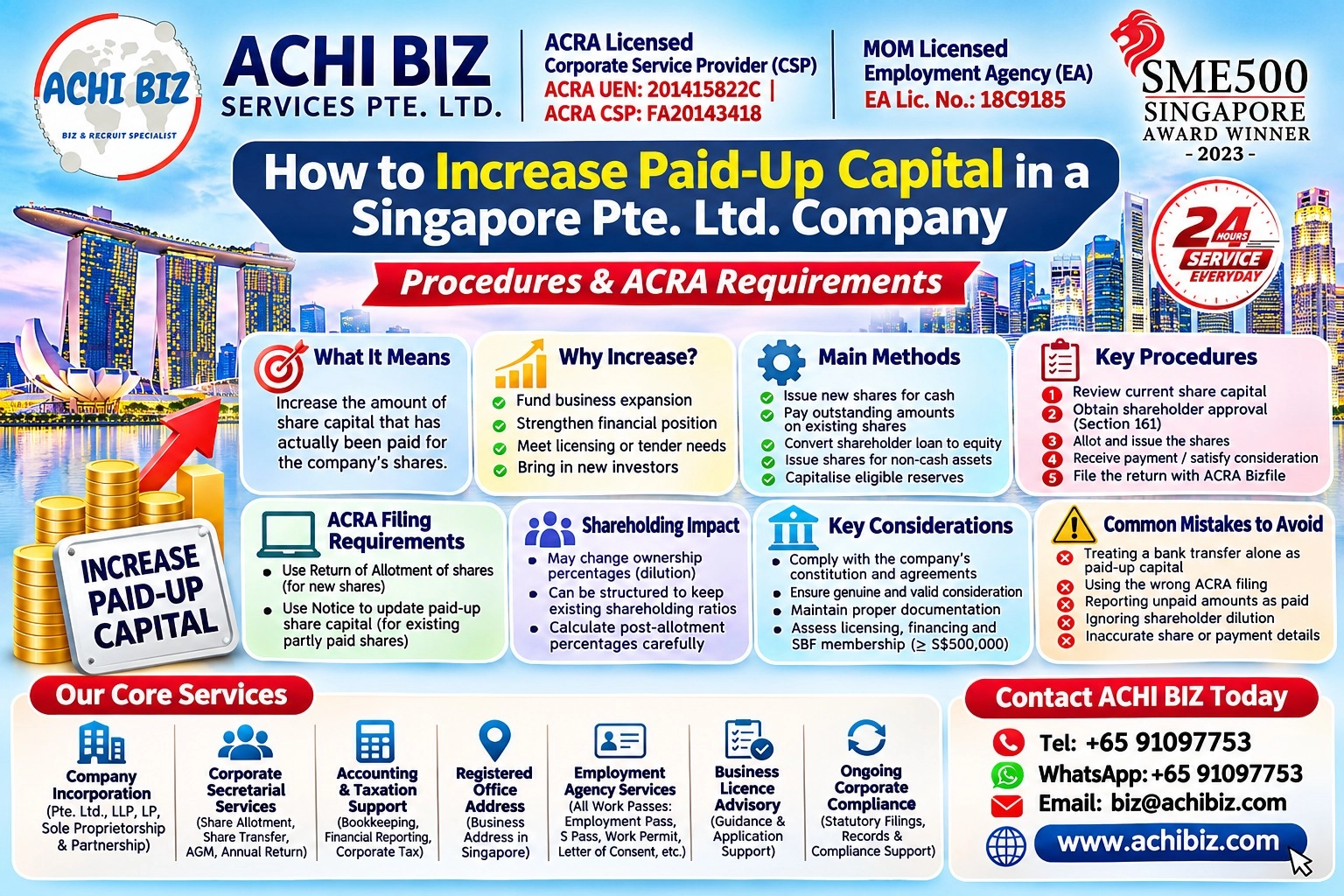
How to Increase Paid-Up Capital in a Singapore Pte. Ltd. Company: Procedures & ACRA Requirements – FAQ Guide
A Comprehensive FAQ Guide to Increasing Paid-Up Share Capital, Issuing New Shares, Shareholder Funding, ACRA Bizfile Procedures, Corporate Compliance and Common Mistakes in Singapore
Increasing the paid-up capital of a Singapore Private Limited Company (Pte. Ltd.) is an important corporate decision that may arise as a business expands, welcomes new investors, requires additional working capital or prepares to meet specific commercial and regulatory requirements.
A company incorporated with S$1, S$100 or S$1,000 in paid-up capital is not necessarily required to maintain that amount permanently. Its capital structure can change as the business develops, provided the relevant legal procedures are followed.
However, increasing paid-up capital is not simply a matter of transferring money into the company’s bank account or changing a figure in ACRA’s records.
The correct procedure depends on how the additional capital is contributed, whether new shares are issued, whether existing shares remain partly paid, and whether the company intends to convert an existing shareholder loan into equity.
For example, a company with S$10,000 in fully paid ordinary share capital may wish to increase its paid-up capital to S$100,000. One possible approach is to issue additional shares for S$90,000 in new subscription consideration. However, the company must consider the required approvals, share issue terms, shareholder ownership percentages, payment evidence and applicable ACRA filing requirements.
Another company may already have issued shares with unpaid subscription amounts. In that situation, receiving payment on those existing shares may increase paid-up capital without requiring a new allotment.
These distinctions are important because an incorrectly structured capital increase can create unintended shareholder dilution, inaccurate statutory records, accounting problems or disputes.
This detailed FAQ guide by ACHI BIZ SERVICES PTE. LTD., an ACRA Licensed Corporate Service Provider (CSP), explains how to increase paid-up capital in Singapore, the procedures involved, the role of ACRA Bizfile, the financial and ownership implications, and the practical considerations directors and shareholders should review before proceeding.
The article focuses on the procedures and compliance requirements for increasing paid-up capital. Related ACHI BIZ articles address minimum incorporation capital, partly paid shares, shareholding calculations, pre-emption rights and the commercial credibility of higher paid-up capital in greater detail.
Understanding Paid-Up Capital Increases in Singapore
What does it mean to increase paid-up capital in a Singapore Pte. Ltd. company?
Increasing paid-up capital means increasing the amount of share capital that has actually been paid or validly satisfied in respect of the company’s issued shares.
This may occur through the issue of new fully paid shares or through payment of outstanding amounts on shares already issued.
Depending on the circumstances, it may also involve a properly structured non-cash contribution or conversion of an existing debt into share capital.
The company must distinguish between an increase in issued share capital and an increase in the amount actually paid.
Can a Singapore company increase its paid-up capital after incorporation?
Yes.
A Singapore Private Limited Company can increase its paid-up capital after incorporation, subject to the Companies Act 1967, its constitution, applicable approvals and statutory filing requirements.
A company may start with modest capital and increase it as its financing needs change.
There is no general requirement to establish the company’s eventual long-term capital amount at incorporation.
Is there a maximum paid-up capital limit for a Singapore Private Limited Company?
Singapore company law does not generally impose a single universal maximum paid-up capital amount applicable to every Pte. Ltd. company.
However, the company must comply with the applicable share issue procedures, constitutional provisions and any relevant regulatory requirements.
The proposed capital increase should also be commercially justifiable and properly documented.
Is there a minimum amount by which paid-up capital must be increased?
There is no universal minimum increase applicable to every ordinary share capital transaction.
For example, a company may consider increasing its paid-up capital by S$1,000, S$10,000 or S$100,000.
The appropriate amount depends on the company’s funding needs and the terms of the proposed transaction.
Can a company increase paid-up capital from S$1 to S$100,000?
Yes, subject to proper structuring and compliance.
For example, a company with S$1 in fully paid share capital may issue additional shares for S$99,999 in fully satisfied consideration.
After completion, its total paid-up capital would be S$100,000, assuming no other capital changes.
However, the number of shares issued and the resulting ownership structure depend on the agreed subscription terms.
Can paid-up capital be increased from S$10,000 to S$1 million?
Yes, where the company lawfully raises and satisfies the additional S$990,000 in share capital.
A substantial increase should be supported by appropriate corporate approvals, transaction documentation and evidence of the consideration.
The company should also assess the effect on its financial statements, shareholder rights and regulatory obligations.
Does increasing paid-up capital automatically increase the number of shares?
No.
Although a new share allotment is a common method of increasing paid-up capital, it is not the only possible method.
For example, a company may receive outstanding payments on existing partly paid shares without issuing additional shares.
The distinction matters because an increase in the number of shares can change ownership percentages, whereas payment on existing shares does not ordinarily change their quantity.
Does increasing paid-up capital automatically increase the company’s value?
No.
A capital contribution may increase the company’s assets and equity, but it does not automatically increase its commercial valuation by the same amount.
Company valuation depends on factors such as profitability, growth prospects, liabilities, assets, market conditions and investor expectations.
A company with S$500,000 in paid-up capital is not necessarily worth more than a profitable company with S$10,000 in paid-up capital.
Is increasing paid-up capital compulsory when a Singapore company grows?
Not generally.
Business growth does not automatically create a universal statutory obligation to increase paid-up capital.
However, particular licences, financing arrangements, contracts or regulatory requirements may impose relevant capital conditions.
A company should evaluate its actual obligations before deciding whether a capital increase is necessary.
Can a company increase paid-up capital several times?
Yes.
A company may undertake multiple capital increases over its operating life.
For example, it may increase paid-up capital from S$1,000 to S$50,000, later to S$200,000 and eventually to S$500,000.
Each transaction must be properly structured, authorised and recorded.
Reasons for Increasing Paid-Up Capital in Singapore
Why would a Singapore company increase its paid-up capital?
Common reasons include:
-
Financing business expansion.
-
Providing additional working capital.
-
Funding equipment, inventory or technology.
-
Bringing new shareholders into the company.
-
Converting shareholder loans into equity.
-
Strengthening the company’s balance sheet.
-
Meeting applicable licensing or contractual requirements.
-
Supporting a restructuring or investment transaction.
The appropriate method depends on whether the company requires new cash, a change in ownership or a restructuring of existing funding.
Does increasing paid-up capital improve a company’s financial position?
It may, particularly where the company receives new cash or other valuable assets without creating an equivalent repayment obligation.
However, the effect depends on the transaction.
For example, converting a genuine shareholder loan into equity may reduce liabilities, while issuing shares for cash may increase available funds.
Neither arrangement guarantees profitability or long-term financial stability.
Can a company increase paid-up capital to support working capital?
Yes.
New equity funding may help a company pay suppliers, hire employees, purchase equipment or finance operating expenses.
However, directors should assess the amount genuinely required rather than increasing capital solely to create a larger figure in corporate records.
Can increasing paid-up capital help a company obtain business financing?
Potentially.
Some lenders consider paid-up capital, equity, liquidity and shareholder support when assessing financing applications.
However, banks also examine profitability, cash flow, credit history, business operations and repayment capacity.
Increasing paid-up capital does not guarantee loan approval.
Can higher paid-up capital improve supplier confidence?
It may support a company’s commercial profile, particularly where the increase reflects genuine funding.
However, suppliers may also consider financial statements, payment history, available cash and guarantees.
A capital increase should not be presented as proof that the company has sufficient cash to meet every obligation.
Can a company increase paid-up capital to qualify for a business licence?
Yes, where the relevant licence has a capital requirement and the proposed increase satisfies that requirement.
However, requirements vary between regulated activities.
The company should verify whether the regulator requires a particular amount of paid-up capital, net worth, security deposit or another form of financial capacity.
These requirements are not interchangeable.
Can paid-up capital be increased before applying for government tenders?
Yes.
However, tender eligibility depends on the specific procurement conditions.
Some tenders may assess financial standing, relevant registrations, track record, turnover or other criteria.
Increasing paid-up capital alone does not guarantee tender eligibility.
Should a company increase paid-up capital solely to appear more credible?
Not necessarily.
A higher capital figure may influence business perception, but a company should consider the financial and administrative implications before proceeding.
A genuine capital increase should be aligned with funding requirements, ownership planning and long-term business objectives.
For a more detailed discussion of commercial credibility, readers may refer to ACHI BIZ’s separate article on whether higher paid-up capital makes a Singapore company more credible.
Methods of Increasing Paid-Up Capital in Singapore
What are the main ways to increase paid-up capital in a Singapore company?
The most common methods are:
-
Issuing new shares for cash consideration that is fully paid.
-
Receiving outstanding subscription payments on existing partly paid shares.
-
Converting a genuine shareholder loan or other qualifying debt into equity through a properly structured share issue.
-
Issuing new shares for valid non-cash consideration.
-
Capitalising eligible reserves or other amounts through an appropriately authorised capitalisation or bonus issue, where legally and accounting-wise supportable.
These methods do not all have the same effect on cash flow, ownership or accounting records.
What is the difference between a share allotment and an increase in paid-up capital?
A share allotment involves issuing additional shares.
An increase in paid-up capital involves an increase in the amount paid or validly satisfied on issued shares.
The two events may occur together, but they are not identical.
For example, issuing 10,000 new shares for S$10,000 in fully paid consideration increases both the issued share quantity and paid-up capital.
By contrast, collecting S$10,000 outstanding on previously issued partly paid shares increases paid-up capital without issuing more shares.
Can paid-up capital increase without issuing additional shares?
Yes.
If the company has existing partly paid shares, shareholders may pay the outstanding consideration.
For example:
| Particulars | Before payment | After payment |
|---|---|---|
| Issued shares | 100,000 | 100,000 |
| Total agreed issue consideration | S$100,000 | S$100,000 |
| Paid-up capital | S$40,000 | S$100,000 |
| Unpaid amount | S$60,000 | S$0 |
The company receives S$60,000, but the number of issued shares remains unchanged.
ACRA provides a dedicated notice for updating the paid-up amount on existing partly paid shares.
Can paid-up capital increase through a new cash share allotment?
Yes. This is one of the most straightforward methods.
The company issues additional shares to existing or new shareholders in exchange for cash.
For example, a company with S$10,000 in paid-up capital may issue 90,000 additional ordinary shares at S$1 each, fully paid in cash.
Its total paid-up capital would then be S$100,000.
The company must obtain the necessary approvals and complete the applicable ACRA return of allotment.
Can shareholders contribute additional capital without receiving more shares?
Potentially, but the legal and accounting treatment must be distinguished from a conventional new share allotment.
A shareholder may make an additional contribution to the company without receiving more shares. However, that contribution does not automatically increase the statutory paid-up share capital recorded with ACRA.
The company must establish the legal basis of the contribution and its proper accounting classification.
A transfer described as an “additional capital contribution” is not automatically an increase in registered paid-up share capital.
Can an existing shareholder loan be converted into paid-up capital?
Yes, where the transaction is legally and properly structured.
For example, a shareholder may have previously lent S$100,000 to the company.
Instead of requiring repayment, the shareholder may agree to subscribe for new shares, with the subscription consideration satisfied through an appropriate debt conversion or set-off arrangement.
The transaction can reduce the company’s liability and increase equity without requiring a new cash transfer.
However, the debt must be genuine, the conversion properly approved and the accounting treatment supported.
Can a company increase paid-up capital through non-cash assets?
Yes, subject to applicable legal and accounting requirements.
For example, shares may be issued in consideration for eligible assets or contractual rights.
However, the company must establish that the consideration is valid, appropriately valued and properly documented.
ACRA expressly recognises share allotments for non-cash consideration and identifies supporting documents that may be required.
Can a company increase paid-up capital by capitalising retained earnings?
Potentially, through a properly structured capitalisation or bonus share arrangement.
However, the transaction requires careful consideration of the available reserves, the company’s constitution, relevant approvals and accounting treatment.
Capitalising reserves does not introduce new cash into the business.
It is therefore important not to confuse a capitalisation of existing equity with a fresh capital contribution.
Can a company increase paid-up capital by transferring money from its retained earnings account?
Not simply by changing accounting labels.
Retained earnings and paid-up share capital represent different components of equity.
A lawful capitalisation transaction may be possible, but it must be supported by appropriate corporate procedures and accounting entries.
A company should not increase its reported paid-up capital merely by moving amounts between ledger accounts.
Can a director’s loan be converted into share capital?
Potentially, yes.
If the company genuinely owes money to a director, the parties may consider converting that debt into equity.
However, the transaction should address conflicts of interest, the validity of the debt, share pricing, approvals and the resulting ownership position.
The director’s status as a creditor does not automatically entitle them to receive shares.
Can a company convert trade creditors’ debts into share capital?
Potentially, subject to the creditor’s agreement and a properly structured transaction.
For example, a supplier may agree to receive shares in settlement of an outstanding amount.
However, this can involve valuation, contractual, tax and corporate governance considerations.
It should not be treated as a routine administrative filing.
Is a bonus share issue the same as receiving additional paid-up capital from shareholders?
No.
A bonus issue generally involves issuing shares through a capitalisation of eligible existing reserves rather than receiving new subscription cash.
Although the company’s share capital presentation may change, the company does not necessarily receive additional assets.
Step-by-Step Procedure to Increase Paid-Up Capital Through New Share Allotment
What is the correct procedure to increase paid-up capital by issuing new shares?
For a straightforward cash-funded share allotment, the company should generally follow this sequence:
-
Review the existing capital structure. Confirm the current issued shares, paid-up amounts, share classes and ownership percentages.
-
Determine the proposed capital increase. Establish the amount to be raised, issue price, number of shares and proposed subscribers.
-
Check the constitution and existing agreements. Identify relevant restrictions, approval requirements and shareholder rights.
-
Obtain shareholder approval. Ensure the directors have the necessary authority to issue shares under section 161 of the Companies Act.
-
Approve the transaction terms. Prepare the relevant board documentation and subscription arrangements.
-
Receive and verify the subscription consideration. Reconcile the amount paid with the proposed paid-up capital information.
-
File the return of allotment through ACRA Bizfile. Submit the correct share, shareholder and consideration particulars.
-
Verify the updated Electronic Register of Members (EROM). For a private company, the allotment takes effect when ACRA updates the EROM.
-
Complete the accounting and corporate records. Reconcile the final shareholding table, payment evidence and supporting documents.
The exact sequence of approvals, subscription documentation and payment arrangements may vary. The statutory effectiveness of a private-company allotment must not be assumed before the EROM update.
What should the company check before increasing paid-up capital?
The company should confirm:
-
Its existing issued and paid-up share capital.
-
Whether any shares remain unpaid.
-
The number and class of shares currently issued.
-
The proposed source of additional capital.
-
Whether new shares are required.
-
Whether existing shareholders will be diluted.
-
Applicable constitutional and contractual restrictions.
-
Required shareholder approvals.
-
Whether the proposed funding will be cash or non-cash.
-
Any relevant licensing or financing conditions.
These checks help the company select the correct transaction instead of filing an inappropriate share capital update.
Does the company need to review its constitution before issuing new shares?
Yes.
The constitution may contain provisions governing share classes, share issue powers, transfer restrictions and shareholder rights.
The company should also review any shareholders’ agreement or investment agreement.
A proposed allotment should not proceed on the assumption that the constitution is irrelevant simply because the company has only a few shareholders.
Is a shareholders’ resolution required to increase paid-up capital?
Where the increase involves directors issuing new shares, prior approval under section 161 of the Companies Act is generally required.
Section 161 allows approval to be given for a particular issue or more generally, subject to its statutory conditions and duration.
If the increase involves payment on existing partly paid shares rather than a new issue, the required procedure is different.
The company should therefore identify the transaction type before determining the necessary resolutions.
Is an ordinary resolution sufficient to approve a new share issue?
A general meeting approval under section 161 is ordinarily considered in accordance with the applicable voting requirements.
However, the company must check whether the proposed transaction also requires a special resolution, class consent or additional contractual approval.
For example, a change to the constitution may involve separate requirements.
The company should not assume that every capital-related transaction can be completed using one ordinary resolution.
Is a special resolution always required to increase paid-up capital?
No.
A straightforward new share issue does not automatically require a special resolution merely because paid-up capital will increase.
However, a special resolution may be necessary for a related transaction, such as an amendment to the constitution, where applicable.
The approvals should be determined from the actual proposed transaction.
Can the directors approve the capital increase without involving shareholders?
Directors may approve implementation matters within their lawful authority, but section 161 generally requires prior company approval for the exercise of the power to issue shares.
A board resolution alone is not a substitute for the required shareholder authority.
Where an existing valid general authority applies, the company should verify its scope and duration before relying on it.
Does the company need a share subscription agreement?
A separate subscription agreement is not universally mandatory for every simple cash allotment.
However, written subscription terms are advisable, especially where the transaction involves significant sums, multiple subscribers, deferred payments or negotiated investor rights.
The documentation should identify the parties, share quantity, consideration, payment terms and any applicable conditions.
Does the company need to receive the subscription money before filing the allotment?
Not every lawful allotment requires full cash payment beforehand, because partly paid shares are permitted.
However, where the company intends to report the new shares as fully paid, it must establish that the relevant consideration has actually been received or otherwise validly satisfied.
A company should not report a promised future payment as cash already received.
Can the subscription money be transferred from a shareholder’s personal bank account?
Yes, where the shareholder is personally subscribing for the shares and the payment can be properly identified.
The company should retain evidence linking the transfer to the subscription.
Where the payment comes from another person or entity, the company should establish the legal basis and ensure that the records accurately reflect the transaction.
Can subscription money be received from an overseas shareholder?
Yes, subject to applicable banking, compliance and regulatory requirements.
The company should retain the relevant remittance evidence and confirm the amount received, currency and purpose of the transfer.
Cross-border transfers may also involve foreign exchange differences and banking charges.
Can the company increase paid-up capital using Singapore dollars or foreign currencies?
Singapore companies may have share capital denominated in different currencies, subject to the applicable corporate and accounting requirements.
The company should accurately identify the relevant currency in the share allotment documentation and ACRA filing.
ACRA’s share capital procedures accommodate currency-specific information.
Can the company issue shares at more than S$1 per share?
Yes.
Singapore’s no-par-value regime does not require every share to be issued at S$1.
For example, the company may issue 1,000 shares at S$100 each, resulting in S$100,000 in total subscription consideration.
The issue price should be properly determined and documented.
Is there a compulsory minimum number of shares for a capital increase?
There is no universal requirement that every increase must involve thousands of shares.
For example, a company could issue 100 shares at S$1,000 each to raise S$100,000.
The number of shares should be chosen with consideration for ownership percentages, pricing and the existing capital structure.
Does the company need to issue share certificates after the allotment?
The company should determine and comply with the applicable statutory and constitutional requirements concerning share certificates and membership records.
For a Singapore private company, the ACRA-maintained EROM is particularly important.
A share certificate should not be treated as a substitute for the legally effective allotment and register update.
ACRA Bizfile Requirements for Increasing Paid-Up Capital
How do you increase paid-up capital through ACRA Bizfile?
The correct Bizfile procedure depends on the transaction.
For new shares, the company uses the return of allotment procedure.
For additional payment on existing partly paid shares, the company uses the notice to update paid-up share capital.
These are different filings, and using the wrong procedure may result in inaccurate share capital records.
What is the ACRA eService for issuing new shares?
ACRA provides the Return of Allotment of shares eService within Update shares information.
The filer logs in to Bizfile, selects the appropriate company and completes the allotment information.
The filing includes details of the shares, consideration, shareholders and relevant approval documentation.
Official guide: ACRA – Filing a Return of Allotment of Shares.
What is the ACRA eService for updating payment on existing partly paid shares?
The relevant eService is Notice to update paid-up share capital, available under Update shares information.
This procedure records an increase in the paid-up amount on shares that were previously issued as partly paid.
It does not require the company to create additional shares merely because an existing shareholder has settled an outstanding subscription amount.
Official guide: ACRA – Filing a Notice to Update Paid-Up Share Capital.
What are the steps for filing a return of allotment in Bizfile?
According to ACRA’s published procedure, the filer should:
-
Log in to Bizfile using the appropriate authorised credentials.
-
Select the correct company.
-
Open Manage → Update shares information.
-
Select Return of Allotment of shares.
-
Verify the company information and provide the relevant section 161 approval details.
-
Enter the share capital, allotment and shareholder information.
-
Review the shareholding and consideration details.
-
Submit the filing and check the acknowledgement and updated EROM.
ACRA provides a detailed filing guide, including the applicable screens and supporting information.
What information is required for an ACRA return of allotment?
Relevant particulars include:
-
Company UEN.
-
Number of shares being allotted.
-
Share class and subclass, where applicable.
-
Currency and relevant share capital amounts.
-
Amount paid or deemed paid on the shares.
-
Amount remaining unpaid, if any.
-
Relevant shareholder information.
-
Required approval and supporting documents.
-
Applicable non-cash consideration documentation.
The exact information depends on the transaction and Bizfile’s filing requirements.
Does ACRA require proof of payment when increasing paid-up capital?
The company must accurately report the amount paid or deemed paid and retain appropriate supporting evidence.
The documents requested or required through Bizfile may depend on the type of allotment.
For non-cash allotments, ACRA identifies relevant supporting documents, including contracts or court orders where applicable.
Even where a bank statement is not uploaded as part of a particular filing, the company should maintain evidence supporting the amount reported as paid.
What is the ACRA filing fee for a return of allotment?
ACRA published filing fee
S$0
Return of allotment of shares — government filing fee, excluding any professional service charges.
ACRA’s current published guide lists the return of allotment filing as free, with immediate processing under the standard procedure.
What is the ACRA filing fee for updating paid-up capital on existing shares?
ACRA published filing fee
S$0
Notice to update paid-up share capital — government filing fee, excluding professional service charges.
ACRA lists the standard processing time as immediate.
How long does ACRA take to process a paid-up capital increase?
ACRA lists immediate processing for standard return of allotment filings and notices updating paid-up share capital.
However, the overall time required for a capital increase may be longer because the company must first complete the necessary approvals, documentation and payment arrangements.
An immediate filing process should not be confused with an assurance that every proposed capital transaction can be completed immediately.
Must a return of allotment be filed within 14 days?
ACRA’s general company information guidance refers to updating newly issued share information within 14 days.
However, the legal mechanics differ between private and public companies.
For a Singapore private company, section 63 provides that a non-deemed allotment does not take effect until ACRA updates the company’s EROM.
ACRA’s specific return-of-allotment guide separately states the 14-day post-allotment filing requirement for public companies.
For a Pte. Ltd. company, the practical priority is to file promptly so that the allotment becomes legally effective, rather than treating an unfiled allotment as already completed.
When does a new share allotment become legally effective for a Singapore private company?
Under section 63(2) of the Companies Act, a non-deemed allotment by a private company takes effect when ACRA updates the electronic register of members.
This means the parties should not assume that signing a subscription agreement, receiving the money or passing a board resolution alone makes the new shares legally issued.
The filing and EROM update are essential.
What is the Electronic Register of Members (EROM)?
The EROM is the electronic register of members maintained by ACRA for Singapore private companies.
It records relevant membership and shareholding information.
For a private company, the EROM has particular legal significance because the effectiveness of new share allotments and transfers is linked to its update under the applicable statutory rules.
Can a company backdate an increase in paid-up capital?
A company must not misrepresent transaction dates or create false payment records.
For a new private-company allotment, the statutory effective date is governed by the EROM update.
Where the company is reporting payment received on existing partly paid shares, it should provide the actual date of the payment-related change in accordance with ACRA’s filing procedure.
A company should not confuse the date funds were received with the legal effective date of a new share allotment.
Can an ACRA filing be amended if the wrong capital amount was entered?
Potentially, but the correction process depends on the nature of the error.
ACRA cautions that share transaction errors can be costly and that some errors which cannot be resolved through a Notice of Error may require a court order.
The company should verify all amounts, shareholder particulars and share quantities before submission.
Can a director file the paid-up capital increase without a corporate secretary?
An authorised company officer may be able to complete the relevant filing directly through Bizfile.
Alternatively, the company may engage an ACRA Licensed Corporate Service Provider (CSP) to assist.
However, the ability to file does not remove the need to comply with the Companies Act and properly prepare the underlying corporate documentation.
Can an ACRA Licensed Corporate Service Provider (CSP) handle the capital increase?
Yes.
An appropriately authorised corporate service provider can assist with preparing the corporate documentation, coordinating approvals, calculating shareholdings and submitting the relevant ACRA filing on behalf of the company.
Professional support is particularly useful where the capital increase involves multiple shareholders, different share classes, non-cash consideration or complex ownership changes.
Increasing Paid-Up Capital Without Issuing New Shares
What is the procedure when a shareholder pays the outstanding amount on existing partly paid shares?
The company should:
-
Verify the existing shares and outstanding subscription amount.
-
Confirm that the shareholder’s payment has been received or validly satisfied.
-
Reconcile the amount against the relevant shares and shareholder.
-
Update the accounting and supporting corporate records.
-
File the Notice to update paid-up share capital through ACRA Bizfile.
-
Verify the updated information.
ACRA’s procedure specifically requires the date of change and the updated paid-up amounts for the relevant shares and shareholders.
Does the company need to pass a new share allotment resolution when collecting unpaid capital?
Not merely because it is receiving payment on existing validly issued shares.
No additional shares are being created in that situation.
However, the company must still comply with the original share terms and any relevant procedures concerning calls, instalments or payment administration.
Does paying unpaid capital change the shareholder’s ownership percentage?
Not ordinarily.
For example, a shareholder who holds 40% of the company’s issued ordinary shares continues to hold the same number of shares after settling the outstanding amount.
The payment increases the paid-up amount but does not itself change the number of shares held.
Can the company use the return of allotment form to update paid-up amounts on existing shares?
It should use the procedure appropriate to the transaction.
ACRA provides a separate notice for updating paid-up capital on previously issued partly paid shares.
A return of allotment is intended for a new share issue.
Using the correct filing helps avoid creating an unintended or inaccurate share transaction.
Can the company update the paid-up capital of only one shareholder?
Yes, where that shareholder has paid an outstanding amount on their existing shares.
ACRA’s eService allows updates to the paid-up amounts for selected shareholders, with the relevant currency and share capital information.
Can the company update several shareholders’ paid-up amounts in one filing?
ACRA’s procedure accommodates updates involving multiple relevant shareholders.
The company should ensure that the total paid-up share capital information reconciles with the individual shareholder amounts.
What happens if a shareholder pays only part of the outstanding balance?
The company should record the amount actually paid and determine the remaining unpaid balance.
For example, if a shareholder owes S$50,000 and pays S$20,000, the remaining unpaid amount is S$30,000.
The company should not report the shares as fully paid unless the full relevant consideration has been satisfied.
Shareholder Loan Conversion into Paid-Up Capital
Can a shareholder loan be converted into paid-up capital without transferring new cash?
Yes, where the transaction is properly structured as a debt-to-equity conversion.
For example, a shareholder previously lent S$150,000 to the company. The parties may agree that S$100,000 of that genuine debt will be satisfied in exchange for newly issued shares.
The company does not necessarily need to receive another S$100,000 bank transfer because the consideration may be satisfied through the agreed extinguishment of the debt.
However, the conversion requires proper documentation, approvals and accounting treatment.
What documents are generally required for a shareholder loan conversion?
Depending on the transaction, the company may need:
-
Evidence of the original shareholder loan.
-
Confirmation of the outstanding loan balance.
-
A debt conversion or settlement agreement.
-
Share subscription terms.
-
Shareholder approval under section 161.
-
Relevant directors’ resolutions.
-
Share allotment documentation.
-
ACRA return of allotment.
-
Appropriate accounting records.
Additional documents may be necessary where the loan is secured, interest-bearing or subject to other contractual restrictions.
Can the full shareholder loan balance be converted into equity?
Potentially, subject to the parties’ agreement and the applicable legal requirements.
The company should establish whether the amount includes principal, accrued interest or other obligations.
The treatment of interest and any associated tax consequences should be considered separately.
Can only part of a shareholder loan be converted into shares?
Yes.
For example, a company may owe a shareholder S$200,000.
The parties may agree to convert S$120,000 into equity while leaving S$80,000 as a loan.
The company should document the remaining debt and ensure that its financial statements reflect the revised position.
Does converting a shareholder loan into equity improve the balance sheet?
It may.
Consider a simplified company with the following financial position:
| Particulars | Before conversion | After conversion |
|---|---|---|
| Assets | S$300,000 | S$300,000 |
| Liabilities | S$200,000 | S$100,000 |
| Total equity | S$100,000 | S$200,000 |
This example assumes that S$100,000 of genuine debt is converted into equity and that no other adjustments apply.
The transaction reduces liabilities and increases equity but does not increase cash.
Does a shareholder loan conversion automatically increase the number of shares?
Where the conversion is implemented through a new share allotment, yes.
However, the number of shares depends on the agreed issue price and transaction terms.
The company should calculate the resulting ownership percentages before approving the conversion.
Can converting a shareholder loan dilute other shareholders?
Yes.
Suppose Shareholder A owns 60% and Shareholder B owns 40%.
If the company issues additional shares only to Shareholder A in exchange for converting a loan, Shareholder A’s ownership percentage may increase.
Shareholder B’s percentage may decrease even though B has not transferred any shares.
The precise result depends on the number of shares issued.
Can a director convert an amount owed to them into shares without other shareholders’ consent?
Not automatically.
The transaction must comply with the relevant statutory approvals, constitutional requirements and contractual arrangements.
Potential conflicts of interest must also be considered.
A director should not assume that being both a creditor and a director gives them unrestricted authority to issue shares to themselves.
Is converting a shareholder loan into equity taxable in Singapore?
The tax consequences depend on the transaction’s substance and circumstances.
A straightforward conversion of genuine loan principal into equity may be a capital restructuring, but interest, debt forgiveness, related-party arrangements and other factors can introduce tax considerations.
The company should obtain tax advice where the amounts or arrangements are material.
Shareholding Percentage and Dilution After a Capital Increase
Does increasing paid-up capital change the shareholders’ ownership percentages?
It depends on how the increase is implemented.
If all shareholders subscribe for new shares proportionately, their percentages may remain unchanged.
If new shares are issued disproportionately or to a new investor, existing shareholders may be diluted.
If the company merely collects outstanding amounts on existing shares, numerical ownership percentages ordinarily remain unchanged.
How do you calculate shareholding percentages after issuing new shares?
For a company with one class of identical ordinary shares:
For example, a shareholder owns 6,000 out of 10,000 shares, representing 60%.
The company issues 5,000 new shares to another investor.
The original shareholder’s revised percentage is:
The shareholder has not sold any shares, but the ownership percentage has decreased.
Can paid-up capital increase without diluting existing shareholders?
Yes.
Possible situations include proportionate new share allotments and payment of outstanding amounts on existing shares.
For example, two shareholders holding 70% and 30% may subscribe for additional shares in the same proportions.
Their ownership percentages can remain unchanged.
Can one shareholder contribute all the new capital without changing ownership percentages?
Potentially, if the contribution is legally structured in a way that does not change share quantities or rights.
However, the company must distinguish between a contribution to equity, a loan and a conventional share allotment.
It should not assume that receiving money from one shareholder can automatically be recorded as additional statutory paid-up share capital without affecting the share structure.
Can a company issue new shares only to one existing shareholder?
Potentially, subject to the necessary approvals and any applicable shareholder rights or restrictions.
The company should assess the effect on other shareholders and whether the issue is consistent with directors’ duties.
The transaction may create dilution.
Can new investors subscribe for shares during a paid-up capital increase?
Yes.
A company may raise equity capital by issuing shares to a new investor.
The investor’s ownership percentage depends on the agreed share quantity and the enlarged issued share base.
The company should also consider the rights attached to the new shares and the effect on existing shareholders.
Does a new investor’s capital contribution belong to the company or existing shareholders?
Where an investor subscribes for newly issued shares, the subscription consideration generally goes to the company.
Where an investor purchases existing shares from a shareholder, the purchase consideration generally goes to the selling shareholder.
These are different transactions.
Only the new share subscription ordinarily raises additional equity funding for the company.
Can a company increase paid-up capital through a share transfer?
A share transfer alone does not ordinarily increase the company’s paid-up capital.
It changes who owns existing shares.
For example, if Shareholder A sells 1,000 fully paid shares to Shareholder B, the company does not receive additional subscription capital merely because the shares change hands.
Can a company issue preference shares when increasing paid-up capital?
Potentially, yes.
However, preference shares may carry different dividend, voting, conversion or repayment rights.
The company should ensure that the proposed share class is lawfully established and that the relevant rights are clearly documented.
A preference share issue should not be treated as identical to an ordinary share allotment.
Should shareholders review pre-emption rights before increasing capital?
Yes.
Where existing shareholders have applicable rights concerning new share issues, the company must consider those rights before proceeding.
The relevant provisions may arise from the constitution, shareholders’ agreements or other applicable legal arrangements.
This article focuses on the capital increase procedure. The detailed operation, waiver and exclusion of pre-emption rights are addressed in ACHI BIZ’s separate share capital articles.
Practical Examples of Increasing Paid-Up Capital in Singapore
The following examples assume straightforward transactions involving identical ordinary shares, unless otherwise stated. Actual implementation remains subject to the relevant approvals, share terms and statutory requirements.
Example 1: How can a company increase paid-up capital from S$1 to S$10,000?
Suppose a company has one fully paid ordinary share issued for S$1.
The sole shareholder wishes to increase paid-up capital to S$10,000.
One possible arrangement is to issue 9,999 additional ordinary shares at S$1 each, fully paid.
| Particulars | Before | After |
|---|---|---|
| Issued ordinary shares | 1 | 10,000 |
| Paid-up capital | S$1 | S$10,000 |
| Additional subscription | — | S$9,999 |
| Sole shareholder ownership | 100% | 100% |
The shareholder retains 100% ownership because all new shares are allotted to the same person.
Example 2: How can a company increase paid-up capital from S$10,000 to S$100,000?
A company has 10,000 fully paid ordinary shares issued at S$1 each.
It proposes to issue another 90,000 ordinary shares at S$1 each.
| Particulars | Amount |
|---|---|
| Existing paid-up capital | S$10,000 |
| Additional capital required | S$90,000 |
| New shares at S$1 each | 90,000 |
| Final issued ordinary shares | 100,000 |
| Final paid-up capital | S$100,000 |
The company must determine who subscribes for the new shares and calculate the resulting ownership percentages.
Example 3: How can two shareholders increase capital while preserving a 60:40 ownership split?
A company currently has:
-
Shareholder A: 6,000 shares.
-
Shareholder B: 4,000 shares.
-
Total paid-up capital: S$10,000.
The company wishes to raise another S$90,000 by issuing 90,000 shares at S$1 each.
To preserve the existing percentages:
| Shareholder | Existing shares | New shares | Final shares | Ownership |
|---|---|---|---|---|
| A | 6,000 | 54,000 | 60,000 | 60% |
| B | 4,000 | 36,000 | 40,000 | 40% |
| Total | 10,000 | 90,000 | 100,000 | 100% |
Both shareholders subscribe proportionately, so their numerical ownership percentages remain unchanged.
Example 4: What happens if only one shareholder contributes the additional capital?
Suppose the same company has 10,000 ordinary shares:
-
Shareholder A: 6,000 shares.
-
Shareholder B: 4,000 shares.
The company issues 10,000 additional ordinary shares solely to Shareholder A.
| Shareholder | Shares after allotment | Ownership |
|---|---|---|
| A | 16,000 | 80% |
| B | 4,000 | 20% |
| Total | 20,000 | 100% |
Shareholder A’s ownership increases from 60% to 80%.
Shareholder B’s ownership decreases from 40% to 20%.
This demonstrates why directors should review dilution before approving a new share issue.
Example 5: How does a company increase paid-up capital by collecting unpaid subscription amounts?
A company previously issued 100,000 ordinary shares at S$1 each.
Only S$30,000 has been paid.
The shareholders subsequently pay the remaining S$70,000.
| Capital component | Before payment | After payment |
|---|---|---|
| Issued share consideration | S$100,000 | S$100,000 |
| Paid-up capital | S$30,000 | S$100,000 |
| Unpaid amount | S$70,000 | S$0 |
| Issued shares | 100,000 | 100,000 |
No new shares are required.
The company should use ACRA’s notice to update paid-up share capital rather than creating an additional allotment.
Example 6: How can a company increase paid-up capital through a shareholder loan conversion?
A company has:
-
Existing paid-up capital: S$50,000.
-
Outstanding shareholder loan: S$150,000.
The shareholder agrees to convert S$100,000 of the loan into equity through a properly approved share allotment.
After the conversion, assuming the consideration is validly satisfied:
| Particulars | Before | After |
|---|---|---|
| Paid-up capital | S$50,000 | S$150,000 |
| Shareholder loan liability | S$150,000 | S$50,000 |
| New cash received from conversion | — | S$0 |
The company reduces its debt and increases equity without receiving new cash at the time of conversion.
Example 7: Can a company increase paid-up capital by S$100,000 while issuing only 1,000 shares?
Yes.
Suppose the company issues 1,000 ordinary shares at S$100 each.
If the consideration is fully satisfied, the paid-up capital increases by S$100,000.
Singapore’s no-par-value share regime does not require the issue price to equal S$1.
Example 8: What happens when a new investor contributes S$250,000?
A company has 100,000 issued ordinary shares and an agreed pre-money valuation of S$750,000.
Assuming a straightforward equity financing:
The investor contributes S$250,000.
The mathematical number of shares is:
Because this does not produce a whole-share allocation, the parties must agree on an appropriate adjustment to the share quantity, issue price or capital structure.
This is an important practical consideration: investment valuation calculations do not always produce an exact whole number of shares.
The parties should finalise the agreed figures before filing the allotment.
Example 9: Can a company increase capital in stages over several years?
Yes.
For example:
| Stage | Additional paid-up capital | Total paid-up capital |
|---|---|---|
| Incorporation | S$1,000 | S$1,000 |
| First expansion | S$49,000 | S$50,000 |
| Second expansion | S$150,000 | S$200,000 |
| Third expansion | S$300,000 | S$500,000 |
Each stage should be supported by the appropriate transaction documentation and filing.
The company should also review whether the increases create additional obligations under other applicable rules.
Example 10: Can a company increase capital without receiving any additional cash?
Potentially, yes.
For example, a properly structured debt-to-equity conversion may increase share capital while reducing liabilities.
Similarly, certain valid non-cash share issues or capitalisation transactions may affect share capital without new cash being received.
However, the company must distinguish between a genuine legally effective capital transaction and a simple accounting reclassification.
Banking, Licensing and Other Regulatory Considerations
Can increasing paid-up capital help a Singapore company open a corporate bank account?
Potentially, but there is no guarantee.
Banks may consider the company’s capital, shareholders, business activities, funding sources and expected transactions.
A higher paid-up capital amount does not replace customer due diligence or automatically secure account approval.
Does increasing paid-up capital guarantee a business loan?
No.
Banks and other lenders may assess paid-up capital alongside cash flow, profitability, liabilities, credit history and repayment capacity.
A company should not increase capital solely on the assumption that doing so will guarantee financing.
Can paid-up capital be increased to meet an Employment Agency licence requirement?
Where a particular employment agency licensing category has a relevant financial requirement, the company should assess the applicable MOM conditions.
However, paid-up capital, security bonds and other licensing requirements are distinct.
A capital increase should be planned based on the actual licence conditions rather than a presumed universal threshold.
Does increasing paid-up capital improve Employment Pass approval chances?
There is no universal rule that increasing paid-up capital to a particular amount guarantees Employment Pass approval.
MOM assesses Employment Pass applications under the applicable eligibility framework.
A company’s genuine financial position may be relevant in some circumstances, but paid-up capital is not a substitute for satisfying the relevant work pass requirements.
Does a Singapore company need S$50,000 or S$100,000 paid-up capital to apply for an Employment Pass?
There is no universal Employment Pass minimum paid-up capital requirement of S$50,000 or S$100,000 applying to every employer.
Companies should avoid treating such figures as guaranteed approval thresholds.
The applicable MOM requirements should be checked for the particular applicant and employer.
Can a company increase paid-up capital to qualify for an S Pass or Work Permit?
A company may increase capital for genuine funding or business reasons.
However, S Pass and Work Permit applications involve separate regulatory requirements.
Increasing paid-up capital does not automatically satisfy quota, levy, eligibility or other conditions.
Can a company increase paid-up capital to meet a government tender requirement?
Yes, where the tender specifies a relevant paid-up capital condition.
However, the company should check whether the requirement concerns paid-up capital, net worth, financial capacity or another measure.
These terms have different meanings.
Can higher paid-up capital satisfy a requirement for minimum net worth?
Not necessarily.
Net worth is affected by assets, liabilities and accumulated results.
A company may have substantial paid-up capital but negative equity because of accumulated losses.
Therefore, a requirement for minimum net worth should not be assumed to be satisfied merely by increasing paid-up capital.
Does a paid-up capital increase automatically improve a company’s credit rating?
No.
Credit assessments may consider multiple factors, including payment history, financial performance, leverage and available cash.
A capital increase may improve some financial measures, but its overall effect depends on the company’s circumstances.
Does increasing paid-up capital to S$500,000 create additional Singapore Business Federation obligations?
Potentially, yes.
ACRA’s published guidance states that companies with paid-up share capital of S$500,000 and above automatically become members of the Singapore Business Federation.
Companies planning to reach or exceed that threshold should consider the applicable membership and subscription implications.
Accounting and Tax Implications of Increasing Paid-Up Capital
How should a cash-funded share capital increase be recorded in the accounts?
For a straightforward issue of fully paid shares for cash, the company generally records an increase in cash or bank balances and a corresponding increase in equity share capital.
For example, where S$100,000 is received for newly issued fully paid shares, a simplified accounting entry may be:
| Account | Debit | Credit |
|---|---|---|
| Bank | S$100,000 | — |
| Share capital | — | S$100,000 |
The actual accounting treatment must reflect the legally effective transaction, applicable accounting standards and any relevant transaction costs.
How should a shareholder loan conversion be recorded?
For a straightforward conversion of S$100,000 in genuine debt into equity, a simplified entry may be:
| Account | Debit | Credit |
|---|---|---|
| Shareholder loan liability | S$100,000 | — |
| Share capital | — | S$100,000 |
This assumes the transaction is properly authorised, the debt is validly extinguished and the relevant share consideration is recognised as equity.
More complex arrangements may require different accounting treatment.
Is money received from a new share subscription taxable revenue?
Genuine proceeds from issuing shares are generally capital receipts rather than ordinary business revenue.
However, the company should distinguish share subscription proceeds from payments for goods, services or other transactions.
Unusual arrangements may require specialist tax advice.
Does increasing paid-up capital create additional corporate income tax?
A genuine cash subscription for shares does not ordinarily create taxable trading income merely because the company receives the capital.
However, tax consequences may arise from associated transactions, particularly debt restructuring, asset transfers or related-party arrangements.
Is GST payable when a company issues new shares?
The GST treatment of share transactions depends on the applicable GST framework and the nature of the activity.
A company should not simply apply GST to a share subscription as though it were an ordinary sale of goods.
Where the company is GST-registered and incurs related professional costs, input tax recovery considerations may also arise.
Is stamp duty payable when a company issues new shares?
A straightforward issue of new shares is generally distinguished from a transfer of existing shares for Singapore stamp duty purposes.
Share transfers may attract stamp duty under the applicable rules.
However, transactions involving property, business assets or more complex restructuring may have additional implications.
The company should confirm the treatment with IRAS or an appropriate tax adviser.
Are professional fees for increasing paid-up capital tax-deductible?
The deductibility of professional fees depends on the nature and purpose of the expenditure.
Costs directly associated with raising share capital may be capital in nature rather than ordinary deductible operating expenses.
The company should assess the applicable tax rules instead of assuming that all corporate secretarial or legal costs are deductible.
Can a company use newly received paid-up capital to pay operating expenses?
Generally, yes, where the funds belong to the company and are used for legitimate business purposes.
Paid-up capital is not necessarily required to remain untouched in the company’s bank account.
However, the company must comply with applicable laws, contractual restrictions and directors’ duties.
Must paid-up capital remain in the company’s bank account permanently?
No.
Once properly contributed, the funds may be used for legitimate company expenditure.
For example, a company may use contributed capital to purchase equipment, pay suppliers or finance operations.
The paid-up capital figure does not automatically decrease merely because the company spends the money.
Does spending paid-up capital reduce the amount recorded with ACRA?
Not automatically.
Paid-up share capital is a capital account figure, not a measure of the company’s current bank balance.
If a company receives S$100,000 in paid-up capital and subsequently spends S$70,000 on legitimate business expenses, its registered paid-up capital does not automatically fall to S$30,000.
The financial statements will reflect the resulting assets, expenses and other changes.
Can a company withdraw paid-up capital and return it to shareholders?
A company cannot simply return share capital to shareholders as though it were a repayable loan.
Returning capital may require a legally permitted transaction, such as an appropriate capital reduction or other statutory mechanism.
The company should obtain professional advice before implementing any proposed return of capital.
Common Mistakes When Increasing Paid-Up Capital
Is transferring money into the company bank account sufficient to increase paid-up capital?
No.
A bank transfer alone does not establish that the payment is share capital.
The company must determine whether the money represents a share subscription, shareholder loan, repayment of an existing debt, advance or another transaction.
The appropriate corporate and accounting procedures must then be completed.
Can a company simply change the paid-up capital amount in Bizfile without issuing shares?
Only where the filing reflects a legally valid underlying transaction.
For example, updating payment on existing partly paid shares is different from issuing new shares.
The company should not change the paid-up capital figure without establishing the legal basis for the increase.
Can a company record a shareholder loan as paid-up capital without converting it?
No.
A shareholder loan remains a liability unless an appropriate transaction changes its legal and accounting character.
A properly structured debt-to-equity conversion may be possible, but the company should not simply relabel the loan as share capital.
Can a company report S$100,000 as paid-up capital when only S$10,000 has been received?
Not merely because shareholders have promised to contribute the remaining S$90,000.
The company must accurately distinguish the consideration already satisfied from the amount outstanding.
Reporting unpaid subscription amounts as paid-up capital may create serious compliance and financial reporting concerns.
What happens if the company issues the wrong number of shares?
An incorrect share allotment may create unintended ownership percentages and disputes.
The company should review the error promptly and determine the appropriate legal correction procedure.
ACRA warns that certain share transaction errors may require a court order where they cannot be corrected through the available administrative process.
What happens if shareholders disagree about the new share issue price?
The company should resolve the commercial terms before proceeding.
The issue price affects the number of shares issued, ownership percentages and potentially the economic interests of existing shareholders.
Disagreements may also engage contractual rights or directors’ duties.
Can a capital increase be reversed after filing with ACRA?
Not simply by deleting the filing or transferring the subscription money back to the shareholder.
Once the shares have been validly allotted, reversing the transaction may require a separate legally permitted process.
The company should seek appropriate advice before attempting to undo a completed capital increase.
Can a company increase capital to an artificially high amount for marketing purposes?
A company should avoid creating a capital structure that misrepresents its genuine financial position.
A higher paid-up capital figure does not guarantee cash availability, solvency or commercial credibility.
Any increase should be properly funded or otherwise validly satisfied and accurately recorded.
Can a company use the same capital contribution to justify two separate share allotments?
Not without a valid legal and accounting basis.
Each allotment must be supported by the agreed consideration.
A company should not double-count a single payment as though it satisfied two independent capital contributions.
Why should directors check shareholder dilution before filing?
Because the shareholding consequences may be difficult to reverse after the allotment becomes effective.
For example, a founder may unintentionally lose majority voting control after new shares are issued.
The proposed post-allotment capitalisation table should be reviewed before the relevant approvals and filing.
Increasing Paid-Up Capital for Foreign-Owned Singapore Companies
Can a foreign-owned Singapore company increase its paid-up capital?
Yes.
A Singapore company with foreign shareholders may increase its paid-up capital, subject to the applicable company law and regulatory requirements.
The procedures for issuing new shares or updating paid-up amounts on existing shares generally follow the same corporate framework.
However, foreign ownership restrictions may apply to particular regulated activities.
Can a foreign shareholder remit additional capital directly from overseas?
Yes, subject to applicable banking and compliance requirements.
The company should retain documentation showing the source, purpose, amount and currency of the remittance.
The payment should be properly linked to the relevant share subscription or existing outstanding capital obligation.
Can an overseas parent company increase the paid-up capital of its Singapore subsidiary?
Yes.
For example, an overseas parent company holding 100% of a Singapore subsidiary may subscribe for additional shares in the subsidiary.
If the parent remains the only shareholder, the subsidiary can increase its paid-up capital without changing its 100% parent-company ownership.
The transaction must still be properly authorised, documented and filed.
Can a foreign shareholder convert an intercompany loan into share capital?
Potentially, yes.
A foreign parent or related company may have previously advanced funds to its Singapore subsidiary.
A properly structured debt-to-equity conversion may allow the outstanding amount to be converted into share capital.
The company should assess the debt documentation, currency, accounting, tax and any relevant cross-border regulatory considerations.
Does a foreign shareholder need to be physically present in Singapore to approve a capital increase?
Not necessarily.
The company may be able to obtain valid approvals through written resolutions or permitted meeting arrangements, depending on the applicable law, constitution and circumstances.
The company should ensure that the required resolutions are properly passed and documented.
Does increasing paid-up capital change a foreign shareholder’s immigration status?
No.
Holding shares or contributing additional capital does not automatically confer immigration status, residence rights or work authorisation in Singapore.
Employment Pass and other work pass eligibility must be assessed separately under the relevant MOM requirements.
Capital Increase Documentation and Corporate Governance
What documents should be prepared for a straightforward cash capital increase?
The documents may include:
-
Current share capital and shareholding information.
-
Proposed share allotment calculations.
-
Relevant shareholder approval under section 161.
-
Directors’ resolutions approving implementation.
-
Subscription documentation or written acceptance.
-
Evidence of subscription consideration.
-
Updated shareholding calculations.
-
ACRA return of allotment acknowledgement.
-
Updated EROM information.
-
Relevant accounting records.
The exact documents depend on the transaction and the company’s existing arrangements.
Is a directors’ resolution sufficient evidence that paid-up capital has increased?
No.
A directors’ resolution may document the company’s approval or intention to implement a transaction.
However, the resolution alone does not prove that subscription consideration has been paid or that a new private-company allotment has become legally effective.
The company should verify the payment and applicable ACRA records.
Should the company prepare a capitalisation table before increasing paid-up capital?
Yes, particularly where new shares are being issued.
A capitalisation table, commonly called a cap table, shows the existing and proposed shareholdings.
It helps shareholders understand whether the transaction changes ownership percentages or voting influence.
Should shareholders sign a subscription agreement before transferring funds?
A written subscription arrangement is advisable, particularly for substantial or complex investments.
It can establish the agreed consideration, share quantity, payment obligations and conditions.
For a straightforward transaction, the company should still maintain sufficient documentation to demonstrate the basis of the payment and allotment.
Can shareholders approve a capital increase through a written resolution?
Potentially, yes, where the Companies Act and the company’s constitution permit the relevant decision to be made by written resolution.
The company should ensure that the resolution is validly passed and that any required procedural conditions are satisfied.
Does a capital increase require changing the company’s constitution?
Not necessarily.
A straightforward issue of shares within the company’s existing legal and constitutional framework may not require a constitutional amendment.
However, an amendment may be necessary where the proposed transaction requires changes to existing share rights or other constitutional provisions.
Should a company update its shareholders’ agreement after a capital increase?
Potentially.
A capital increase involving new investors or changes in ownership may affect governance rights, reserved matters, transfer restrictions and funding commitments.
The company should review whether its existing shareholders’ agreement remains appropriate.
Does a company need to inform its bank after increasing paid-up capital?
This depends on the bank’s requirements and the company’s contractual obligations.
Some banks may request updated corporate documents or shareholder information, particularly where the transaction changes ownership or control.
The company should review the relevant banking arrangements.
Must the company inform its business licensing authority after increasing capital?
Not universally.
However, certain licences may impose notification requirements for changes in ownership, control, share capital or financial circumstances.
The company should check the conditions of each relevant licence.
Can a company secretary prepare the ACRA filing without checking the accounting records?
A filing should be supported by accurate underlying information.
Where the transaction involves payment of capital, the company should verify the relevant consideration and reconcile the figures with the appropriate accounting records.
Corporate secretarial and accounting functions should coordinate where necessary.
Final FAQs: Increasing Paid-Up Capital in a Singapore Pte. Ltd. Company
What is the easiest way to increase paid-up capital in Singapore?
For a straightforward company with fully paid ordinary shares, issuing additional fully paid shares for cash may be a practical method.
However, the company must first consider the required approvals, subscription terms, ownership implications and ACRA filing.
If the company already has partly paid shares, collecting the outstanding amounts may be more appropriate.
Can paid-up capital be increased from S$1 to S$50,000?
Yes, subject to a valid capital transaction.
For example, a company with S$1 fully paid capital may issue additional shares for S$49,999 in fully satisfied consideration.
The resulting paid-up capital would be S$50,000.
Can paid-up capital be increased from S$1,000 to S$100,000?
Yes.
The company would need an additional S$99,000 in properly satisfied share capital.
The number of new shares depends on the issue price and the selected capital structure.
Can paid-up capital be increased to S$500,000?
Yes.
However, companies reaching the S$500,000 threshold should consider applicable Singapore Business Federation membership obligations, in addition to ordinary corporate compliance.
Can a company increase paid-up capital without opening a new bank account?
Generally, a new bank account is not required merely because the company is increasing its share capital.
The company should ensure that the consideration is properly received or satisfied and supported by appropriate evidence.
Can a company increase paid-up capital using cash deposited into its existing bank account?
Yes, where the deposit genuinely represents the relevant share subscription consideration.
However, the company must still complete the applicable corporate approvals and filings.
The bank deposit alone is not sufficient.
Can a shareholder pay additional share capital using several bank transfers?
Yes, where the payments correspond to the agreed subscription terms.
The company should reconcile the transfers and maintain a clear payment record.
Can a company increase paid-up capital while it is making losses?
Potentially, yes.
A company experiencing losses may raise additional equity funding to support its operations.
However, directors should assess the company’s financial position, solvency and the commercial purpose of the transaction.
Can a company increase paid-up capital when it has outstanding debts?
Yes, subject to applicable legal requirements.
New equity funding may help the company meet obligations or strengthen its balance sheet.
However, an increase in paid-up capital does not automatically discharge existing debts.
Can a company increase paid-up capital immediately before applying for a licence?
Potentially, yes.
However, the company should ensure that the capital increase is legally effective, properly recorded and satisfies the specific licensing requirements.
Some regulators may require additional evidence or impose other financial conditions.
Can paid-up capital be increased more than once in the same month?
Yes, provided each transaction is validly authorised, implemented and recorded.
However, unnecessary multiple allotments may create additional administrative work.
The company should consider whether a single properly planned transaction would be more efficient.
Can the company increase paid-up capital without changing its business activities?
Yes.
A capital increase does not ordinarily require the company to change its registered business activities.
The company should nevertheless ensure that the additional funding serves legitimate business purposes.
Does an increase in paid-up capital automatically require issuing new ordinary shares?
No.
A company may issue another permitted share class or receive payment on existing partly paid shares, depending on the circumstances.
The correct method depends on the proposed transaction.
Is ACRA approval required before a company receives additional capital?
The company must comply with the relevant corporate approval and filing requirements.
For a new private-company share allotment, the EROM update is necessary for the allotment to become effective.
Receiving money does not itself establish that the shares have been legally allotted.
Can ACHI BIZ assist with increasing paid-up capital through ACRA?
Yes.
ACHI BIZ can assist with the corporate secretarial administration of a paid-up capital increase, including proposed share allotment calculations, preparation of relevant resolutions, coordination of transaction documentation and applicable ACRA Bizfile filings.
Complex legal, tax or accounting matters may require additional professional advice.
Practical Checklist: Before Increasing Paid-Up Capital in Singapore
| Review item | Key question |
|---|---|
| Existing paid-up capital | What is the company’s current paid-up amount? |
| Existing issued shares | How many shares are currently issued? |
| Outstanding unpaid capital | Are any existing shares partly paid? |
| Purpose of increase | Why does the company need additional capital? |
| Capital increase amount | How much additional capital is required? |
| Funding method | Cash allotment, unpaid capital settlement, debt conversion or another method? |
| Share issue price | What consideration will be payable for each new share? |
| New share quantity | How many additional shares will be issued? |
| Shareholder allocation | Who will receive the new shares? |
| Ownership dilution | Will any shareholder’s percentage decrease? |
| Share class | Are the shares ordinary or preference shares? |
| Constitution | Does the proposed transaction comply with the constitution? |
| Shareholder authority | Is the necessary section 161 approval in place? |
| Directors’ approvals | Have the implementation terms been properly approved? |
| Subscription documents | Are the relevant terms documented? |
| Payment evidence | Has the consideration been received or validly satisfied? |
| ACRA transaction type | Is a return of allotment or paid-up capital update required? |
| EROM | Has the legally effective shareholding information been verified? |
| Accounting records | Are the share capital entries properly recorded? |
| Banking requirements | Does the company need to notify its bank? |
| Licensing requirements | Does the increase affect any regulated business activity? |
| SBF threshold | Will paid-up capital reach or exceed S$500,000? |
| Professional review | Are legal, accounting or tax advisers needed? |
Conclusion: Increasing Paid-Up Capital Requires More Than an ACRA Filing
A Singapore Private Limited Company can increase its paid-up capital at different stages of its business development.
However, the correct procedure depends on whether the company is issuing new shares, collecting outstanding payments on existing shares or implementing another valid capital transaction.
For a straightforward cash-funded increase, the company must consider the share issue price, number of shares, shareholder approvals, subscription consideration and ACRA return of allotment.
Where the company already has partly paid shares, the correct approach may instead involve receiving the outstanding payment and filing a notice to update paid-up share capital.
Companies should also consider the consequences for shareholder ownership, financial reporting, licensing and future financing.
The most important principle is that an increase in paid-up capital must reflect a genuine, legally valid and properly recorded capital transaction.
A larger capital figure should not be the sole objective. The transaction should support the company’s actual funding requirements and long-term business plans.
How ACHI BIZ Can Assist with Increasing Paid-Up Capital in Singapore
ACHI BIZ SERVICES PTE. LTD. provides corporate secretarial and business support services for Singapore companies, entrepreneurs, investors and business owners.
As an ACRA Licensed Corporate Service Provider (CSP), ACHI BIZ can assist with the administrative and compliance aspects of increasing paid-up capital, including:
-
Reviewing existing share capital and shareholding information.
-
Calculating proposed capital increases and share allotments.
-
Preparing relevant directors’ and shareholders’ resolutions.
-
Coordinating share subscription documentation.
-
Assisting with ACRA Bizfile return of allotment filings.
-
Assisting with updates to paid-up amounts on existing partly paid shares.
-
Calculating post-allotment shareholding percentages.
-
Coordinating shareholder loan conversion documentation with relevant advisers.
-
Supporting ongoing corporate secretarial compliance.
Where transactions involve complex share rights, non-cash consideration, disputed ownership or specialist tax issues, additional professional advice may be required.
Important compliance distinction: For Singapore private companies, a new allotment takes effect upon the relevant EROM update. A subsequent payment on existing partly paid shares is a different transaction requiring the appropriate paid-up capital update. Companies should use the correct Bizfile procedure and avoid reporting capital as paid before the consideration has been validly satisfied.
Disclaimer: This article provides general educational information on increasing paid-up capital in Singapore. It is not legal, accounting, taxation or investment advice. Actual procedures depend on the company’s constitution, shareholder arrangements, share classes, transaction terms and applicable legislation. Regulatory and filing requirements should be verified against current official guidance before implementation.
Related Articles
How to Increase Issued Share Capital in Singapore – FAQ Guide
Can a Singapore Company Issue Shares Without Receiving Full Payment? – FAQ Guide
#achibiz