
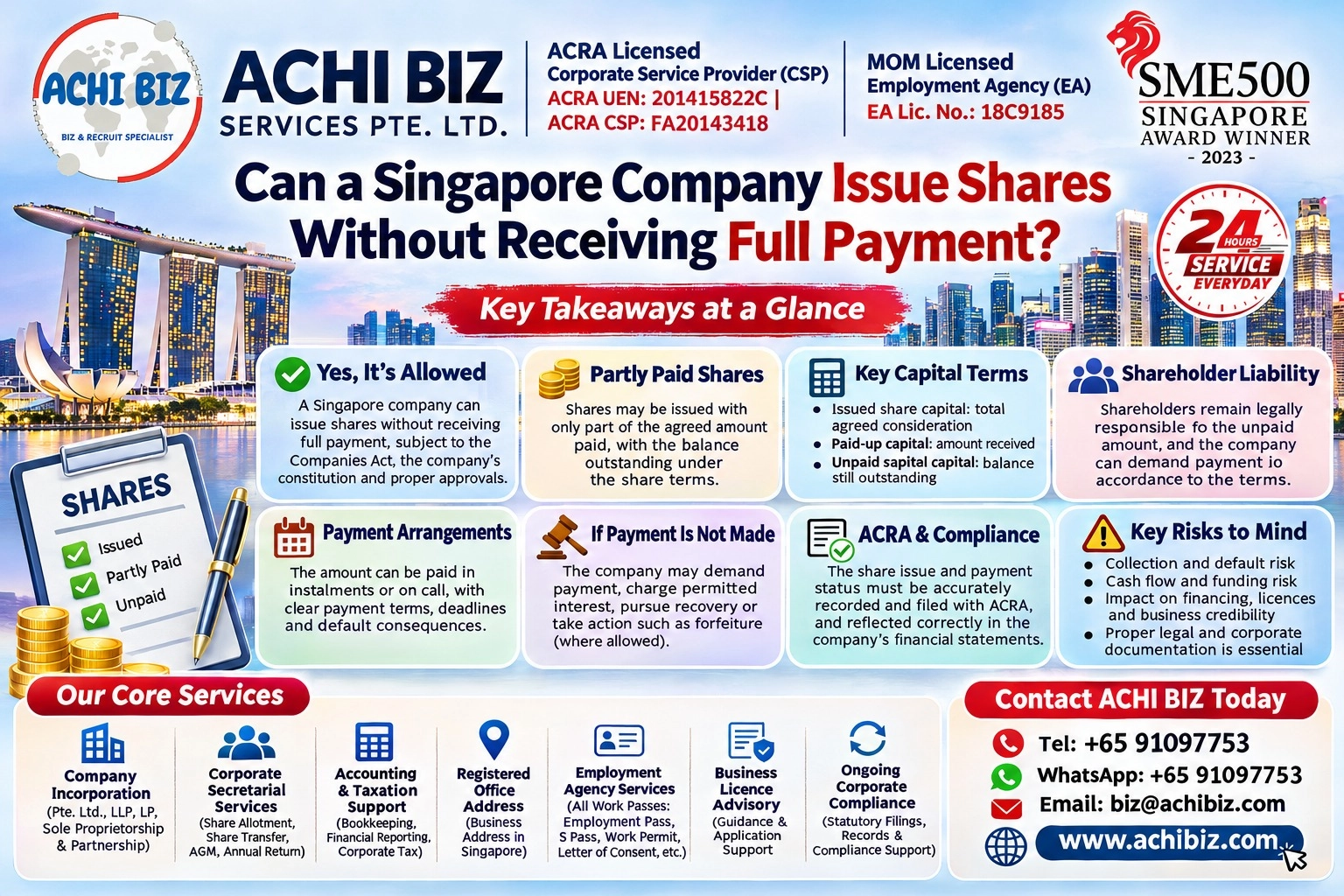
Can a Singapore Company Issue Shares Without Receiving Full Payment? – FAQ Guide
A Comprehensive FAQ Guide to Partly Paid Shares, Unpaid Share Capital, Shareholder Payment Obligations, ACRA Compliance and Financial Risks in Singapore.
A Singapore Private Limited Company (Pte. Ltd.) may need to issue shares before receiving the full amount payable by its shareholders. This can happen when business founders agree to contribute capital in stages, investors negotiate deferred payment arrangements, or shareholders subscribe for shares but have not yet settled the full subscription amount.
This raises an important question: Can a Singapore company legally issue shares without receiving full payment?
The short answer is yes, subject to the applicable legal requirements, the company’s constitution and the terms of the share issue.
Singapore company law recognises that shares may be issued without being fully paid. However, issuing partly paid or unpaid shares is not the same as issuing shares without any payment obligation.
The distinction matters because unpaid share capital can create financial obligations for shareholders, affect the company’s capital records and introduce risks when shareholders fail to pay.
For example, a company may issue 10,000 ordinary shares at S$10 per share, representing S$100,000 in total subscription consideration. If the shareholders have paid only S$40,000, the remaining S$60,000 must be properly accounted for according to the share terms and applicable accounting requirements.
The company should not represent the full S$100,000 as paid-up capital merely because the shares have been issued.
For directors, shareholders and investors, understanding the difference between issued share capital, paid-up capital and unpaid share capital is essential for maintaining accurate corporate records and avoiding misunderstandings.
In this detailed FAQ guide, ACHI BIZ SERVICES PTE. LTD., an ACRA Licensed Corporate Service Provider (CSP), explains how partly paid shares work in Singapore, when shareholders must pay outstanding amounts, what happens if they default and what companies should consider before issuing shares without receiving full payment.
This article focuses specifically on the legal and practical implications of issuing shares before full payment is received. Separate ACHI BIZ guides cover the broader definitions of issued and paid-up capital, shareholding percentage calculations, minimum incorporation capital and the commercial credibility of higher paid-up capital.
Understanding Shares Issued Without Full Payment in Singapore
Can a Singapore Private Limited Company issue shares without receiving full payment?
Yes. A Singapore private limited company may issue shares that are not fully paid, provided the arrangement complies with the Companies Act 1967, the company’s constitution, applicable shareholder approvals and the terms of issue.
Such shares are commonly referred to as partly paid shares.
The company should clearly establish the amount payable for the shares, the amount already paid, the outstanding balance and the circumstances under which further payment becomes due.
Issuing shares without full payment should be a deliberate and properly documented capital arrangement, rather than an accidental consequence of incomplete payment collection.
What are partly paid shares in a Singapore company?
Partly paid shares are shares for which the shareholder has paid only part of the agreed issue consideration.
For example, a company issues 5,000 ordinary shares at S$10 per share.
The total subscription amount is S$50,000.
If the shareholder pays S$20,000, the shares are only partly paid, with S$30,000 remaining unpaid.
The shareholder’s obligation to pay the outstanding amount depends on the applicable share terms and legal requirements.
What are unpaid shares in Singapore?
The expression unpaid shares generally refers to issued shares for which some or all of the agreed subscription amount remains outstanding.
A share may be:
-
Fully paid, where the full amount payable has been satisfied.
-
Partly paid, where only part of the amount payable has been satisfied.
-
Wholly unpaid, where the agreed consideration remains outstanding.
These descriptions concern the payment status of the shares, not necessarily their ownership or voting rights.
Is issuing partly paid shares the same as issuing shares for free?
No.
Partly paid shares normally involve an agreed consideration and an outstanding payment obligation.
For example, a shareholder may subscribe for S$100,000 worth of shares and pay S$25,000 initially, leaving S$75,000 outstanding.
That is different from a share issue structured around valid non-cash consideration or another legally permitted arrangement.
A company should not describe shares as fully paid unless the relevant consideration has been properly satisfied.
Can a Singapore company issue shares with zero payment received initially?
Potentially, yes, where the shares are validly issued on terms allowing the agreed consideration to remain unpaid.
However, the company must properly document the outstanding obligation and comply with the relevant statutory and constitutional requirements.
It should not assume that every proposed zero-payment share issue is automatically permissible or appropriate.
The company’s legal advisers and corporate secretary should review the proposed terms, particularly where the arrangement is unusual or involves substantial capital.
Is it compulsory for all shares in a Singapore company to be fully paid?
No. Singapore’s company law framework recognises shares that are not fully paid.
Nevertheless, the company must comply with the applicable rules and accurately maintain its share capital information.
A company should also consider whether partly paid shares are commercially suitable, particularly if it intends to seek external financing, obtain licences or bring in investors.
Are partly paid shares permitted for newly incorporated Singapore companies?
They may be, subject to the applicable incorporation requirements and properly established share subscription terms.
However, for many small businesses, issuing fully paid ordinary shares at incorporation is administratively simpler.
Where founders intend to contribute funds gradually, they should consider whether partly paid shares, later share allotments or shareholder loans better reflect the intended arrangement.
Can an existing Singapore company issue partly paid shares to a new investor?
Yes, subject to the necessary approvals and share issue terms.
For example, an investor may agree to subscribe for shares with payment due in instalments.
The company should specify the amount payable, payment dates, consequences of default and any restrictions attached to the shares.
A deferred-payment investment should not be treated as completed cash funding merely because the shares have been allotted.
Can a company issue both fully paid and partly paid ordinary shares?
Potentially, yes.
A company may have ordinary shares with different amounts paid or payable, provided the arrangements comply with applicable law and the company’s constitution.
However, different payment statuses can complicate capital administration, shareholder obligations and potentially dividend or voting arrangements.
The company should ensure that the terms and rights of the relevant shares are clearly documented.
Are partly paid shares common among Singapore small and medium-sized enterprises?
They are a recognised corporate arrangement, but many straightforward SME incorporations use fully paid shares to simplify administration.
Partly paid shares may be considered where shareholders have agreed on staged capital contributions or specific investment arrangements.
Their suitability depends on the company’s funding needs, shareholder relationships and willingness to manage outstanding capital obligations.
Issued Share Capital, Paid-Up Capital and Unpaid Share Capital
What is the difference between issued share capital and paid-up share capital?
Issued share capital relates to the consideration associated with shares issued by the company.
Paid-up share capital refers to the portion of that consideration that has been satisfied.
For example:
| Share capital component | Amount |
|---|---|
| 10,000 shares issued at S$10 each | S$100,000 |
| Amount paid by shareholders | S$40,000 |
| Outstanding subscription amount | S$60,000 |
In this example, the total agreed issue consideration is S$100,000, while only S$40,000 has been paid.
The outstanding S$60,000 should not be presented as paid-up capital.
How is unpaid share capital calculated?
For a straightforward cash subscription:
For example:
The unpaid amount is S$60,000.
This calculation assumes no relevant adjustments, waivers, non-cash settlements or other complications.
How do you calculate the unpaid amount per share?
For shares issued at the same price and paid to the same extent:
Suppose a shareholder subscribes for 2,000 shares at S$5 each and pays S$6,000.
Total subscription amount:
Unpaid balance:
Unpaid amount per share:
Each share is effectively S$3 paid and S$2 unpaid, assuming the payment is allocated equally across all shares.
Does Singapore’s no-par-value regime prevent partly paid shares?
No.
Singapore operates under a no-par-value share capital regime, meaning shares do not have a fixed nominal or par value.
However, the absence of par value does not eliminate the need to determine the consideration payable for a share issue.
A company may agree on an issue price and provide for that amount to be paid in stages, subject to the applicable requirements.
Can the issue price be higher than the amount initially paid?
Yes.
For example, a company may issue shares at S$20 each but require only S$5 per share to be paid initially.
The remaining S$15 per share would be outstanding under the agreed terms.
The company should clearly distinguish the issue price from the amount actually paid.
Does unpaid share capital count as cash available to the company?
No.
Unpaid share capital does not represent cash that the company has already received.
For example, a company may have S$200,000 in agreed share subscriptions but only S$50,000 actually received.
It cannot treat the unpaid S$150,000 as cash available for immediate operating expenses.
Does a high issued share capital figure mean the company has received all that money?
No.
A company may have a substantial issued share capital amount while a significant portion remains unpaid.
Business partners, investors and lenders should therefore examine both issued and paid-up capital rather than relying on a single figure.
Can unpaid share capital be treated as a shareholder loan?
Not automatically.
An unpaid subscription amount arises from the shareholder’s obligation to pay for shares.
A shareholder loan is a separate financing arrangement under which money is lent to the company.
The legal rights, repayment obligations and accounting treatment differ.
A company should not reclassify an unpaid share subscription as a loan without a valid legal and accounting basis.
Does a partly paid share represent the same ownership percentage as a fully paid share?
The number of shares held is relevant to numerical ownership calculations.
For example, a shareholder holding 4,000 ordinary shares out of 10,000 holds 40% of that share class by number, even if some shares are not fully paid.
However, the rights attached to partly paid shares may differ depending on the constitution, terms of issue and applicable law.
The numerical shareholding percentage should therefore not be confused with voting rights or dividend entitlements.
Legal Requirements for Issuing Partly Paid Shares in Singapore
Which Singapore law governs the issue of partly paid shares?
The principal legislation is the Companies Act 1967.
Relevant provisions include those governing share allotments, directors’ authority to issue shares, share capital, calls on shares, the liability of shareholders and the company’s statutory registers.
The company’s constitution and the specific terms of issue also play an important role.
For a private company, the statutory rules concerning ACRA’s electronic register of members must also be considered when determining the effectiveness of an allotment.
Does the Companies Act 1967 prohibit issuing shares before receiving the subscription money?
No. The Companies Act does not impose a universal requirement that every share must be fully paid in cash before allotment.
However, this does not give directors unrestricted authority to issue shares without proper consideration or approvals.
The company must comply with the relevant statutory framework, and the terms governing any outstanding payment should be enforceable and properly recorded.
Do directors need shareholder approval before issuing partly paid shares?
Generally, directors’ authority to issue shares is subject to section 161 of the Companies Act 1967, including the applicable requirement for shareholder approval.
The proposed issue must also comply with the company’s constitution and any relevant contractual restrictions.
The company should establish the required authority before proceeding with an allotment, rather than assuming that the directors can issue shares solely by passing a board resolution.
Can directors decide the amount initially payable on newly issued shares?
Directors may be involved in determining and approving share issue terms within the scope of their lawful authority.
However, the arrangement must comply with the Companies Act, the company’s constitution, shareholder approvals and any applicable contractual obligations.
Where the company proposes a substantial unpaid balance, the directors should consider whether the arrangement serves the company’s interests and whether the payment obligation is adequately documented.
Must all shareholders agree before partly paid shares can be issued?
Not necessarily.
The required approvals depend on the applicable statutory provisions, the constitution, existing share rights and any shareholders’ agreement.
Some transactions may require ordinary shareholder approval, while other circumstances may involve additional consent or class-right considerations.
A company should not assume that unanimous approval is always required or that a simple majority is sufficient in every case.
Can a company issue partly paid shares to one shareholder while issuing fully paid shares to another?
Potentially, yes, provided the arrangement is lawfully structured.
However, different payment arrangements may create commercial concerns.
For example, one shareholder may contribute the full subscription amount immediately while another receives shares with payment deferred for several years.
The company should consider whether the pricing and payment terms are commercially justified, properly approved and consistent with the directors’ duties.
Can partly paid shares be issued at a discount?
The concept of a discount must be considered carefully under Singapore’s no-par-value regime.
A company may issue shares at different subscription prices in different transactions, subject to the relevant legal requirements.
However, directors should not assume that they can arbitrarily reduce a shareholder’s agreed payment obligation after shares have been issued.
An original issue price, a deferred payment arrangement and a subsequent release from liability are legally different matters.
Can the company constitution prohibit partly paid shares?
A company’s constitution may contain provisions affecting share allotments, payment obligations, calls on shares and related procedures.
Before issuing partly paid shares, the company should review its constitution to establish whether the proposed arrangement is permitted and what procedures apply.
If the constitution does not support the intended structure, appropriate amendments or alternative arrangements may need to be considered.
Can a shareholders’ agreement regulate partly paid shares?
Yes.
A shareholders’ agreement may address matters such as payment deadlines, funding commitments, consequences of non-payment and the parties’ responsibilities.
However, contractual provisions must be consistent with applicable law and should be coordinated with the company’s constitution and the terms of issue.
A shareholders’ agreement should not be relied upon as a substitute for the necessary statutory approvals and filings.
Can partly paid shares be issued to a company director?
Potentially, yes.
A director may also be a shareholder and subscribe for shares on partly paid terms.
However, transactions involving directors may raise additional considerations concerning conflicts of interest, disclosure, approvals and directors’ duties.
The company should ensure that the arrangement is properly authorised and documented.
Can a company issue partly paid shares to family members or related parties?
Potentially, yes, subject to applicable law.
However, related-party arrangements deserve particular care where the payment terms are unusually favourable.
The company should consider whether the issue has a genuine commercial basis and whether any applicable conflict-of-interest, tax or corporate governance requirements arise.
Can a company issue partly paid shares to foreign shareholders?
Generally, foreign shareholders may subscribe for shares in a Singapore company, including shares with agreed outstanding payment obligations, subject to applicable laws and regulatory restrictions.
The company should consider the practical enforceability of the payment obligation, especially where the shareholder is located overseas.
Cross-border recovery of unpaid subscription amounts may be more complicated than recovery from a shareholder based in Singapore.
Payment Terms and Instalment Arrangements for Partly Paid Shares
Can shareholders pay for their shares in instalments?
Yes, where the share subscription arrangement lawfully provides for instalment payments.
For example, a shareholder may agree to pay S$100,000 as follows:
| Payment stage | Amount | Cumulative payment |
|---|---|---|
| Upon subscription | S$25,000 | S$25,000 |
| After 3 months | S$25,000 | S$50,000 |
| After 6 months | S$25,000 | S$75,000 |
| After 9 months | S$25,000 | S$100,000 |
The company should clearly establish when each instalment becomes payable and the consequences of missing a payment.
Must the full subscription amount be paid within a fixed period under Singapore law?
There is no universal statutory deadline requiring every partly paid share to become fully paid within the same fixed period.
The relevant payment obligations depend on the agreed terms, the company’s constitution and applicable law.
However, a particular licence, financing agreement or commercial arrangement may impose additional capital requirements or deadlines.
A company should not assume that it can defer payment indefinitely without considering these obligations.
Can a shareholder agree to pay the outstanding share capital only when the company needs money?
Potentially, yes.
Such an arrangement may involve shares where the outstanding amount is payable upon a valid call made in accordance with the relevant terms.
However, the company must establish a lawful and sufficiently clear mechanism for requesting payment.
A vague understanding that shareholders will contribute money whenever necessary may create uncertainty and disputes.
What is a call on shares in Singapore?
A call on shares generally refers to a demand made by the company requiring shareholders to pay an outstanding amount on their shares, in accordance with the applicable constitution and share terms.
For example, a shareholder may hold 10,000 shares with S$3 unpaid per share.
A valid call requiring S$1 per share would result in a payment obligation of:
The shareholder would still have S$2 unpaid per share after satisfying that call.
Who has authority to make a call on unpaid shares?
The authority and procedure generally depend on the company’s constitution, terms of issue and applicable law.
Directors commonly administer calls on shares where the relevant provisions authorise them to do so.
The company should verify the required board procedures, notice periods and payment terms before issuing a call.
Can a company demand the entire unpaid share capital immediately?
Not automatically.
The company’s right to demand payment depends on the applicable terms and whether the outstanding amount is already due or can lawfully be called.
For example, if a subscription agreement provides for payment on a future date, the company should not assume it can disregard that arrangement without a valid legal basis.
Must the company give shareholders notice before making a call on shares?
The applicable notice requirements depend on the constitution, share terms and relevant law.
Where notice is required, the company should ensure that it is properly issued and identifies the amount due, payment deadline and applicable consequences.
Clear written communication also helps establish evidence if a dispute subsequently arises.
Can the company make calls on different shareholders at different times?
The answer depends on the rights and terms attached to the relevant shares, together with the constitution and applicable legal requirements.
Different share issues may have different payment schedules.
However, the company should avoid arbitrary or improper treatment of shareholders, particularly where the shares are intended to carry equivalent rights and obligations.
Can a shareholder pay the outstanding amount before it is called?
Potentially, yes, where the company accepts early payment in accordance with the applicable arrangements.
The company should document the payment and update its capital records appropriately.
The treatment of any advance payment should be assessed carefully, including whether it immediately constitutes payment on the relevant shares.
Can a company charge interest on overdue unpaid share capital?
Potentially, where the relevant terms, constitution or applicable law permit interest on overdue payments.
The company should establish the legal basis and applicable rate before imposing interest.
Interest should not be charged merely because management considers a shareholder’s delay unreasonable.
Can shareholders negotiate different instalment schedules?
Potentially, yes.
However, the company should ensure that the arrangements are properly authorised and that any differences are commercially and legally supportable.
The schedules should be documented rather than left to informal verbal understandings.
Can a shareholder use a standing instruction or bank transfer to pay share capital instalments?
Yes.
Payments may be made through appropriate banking arrangements.
The company should retain payment evidence and reconcile each receipt against the relevant shareholder’s outstanding subscription obligation.
Shareholder Liability for Unpaid Share Capital
Is a shareholder legally responsible for unpaid share capital?
Generally, a shareholder may be liable for the amount unpaid on their shares in accordance with the applicable legal and contractual arrangements.
This is an important exception to the assumption that shareholders have no further financial obligations after acquiring shares.
For a company limited by shares, the shareholder’s liability as a member is generally limited to the amount unpaid on the shares, subject to applicable law and any separate obligations.
Does limited liability mean shareholders can refuse to pay outstanding share capital?
No.
Limited liability does not eliminate a valid obligation to pay for shares.
For example, a shareholder who subscribes for shares with S$80,000 outstanding cannot assume that the obligation disappears simply because the company is a private limited company.
The company’s ability to demand or recover the amount depends on the relevant terms and legal requirements.
Can a shareholder lose more than the amount already paid for partly paid shares?
Yes.
A shareholder may have paid an initial amount but remain liable for the outstanding balance.
For example:
-
Total subscription amount: S$100,000.
-
Amount already paid: S$20,000.
-
Remaining unpaid amount: S$80,000.
The shareholder may still be required to pay the outstanding S$80,000 in accordance with the applicable obligations.
Separate personal guarantees or contractual liabilities could create additional exposure beyond the shareholder’s liability as a member.
Can the company sue a shareholder who refuses to pay outstanding share capital?
Potentially, yes.
Where an amount is legally due and the shareholder fails to pay, the company may have contractual or statutory remedies.
The appropriate action depends on the terms of issue, constitution, applicable law and circumstances of the default.
The company should obtain legal advice before commencing recovery proceedings.
Can a shareholder simply resign from the company to avoid paying unpaid share capital?
No.
A shareholder cannot ordinarily eliminate an existing payment obligation merely by stating that they no longer wish to participate in the business.
A lawful transfer, release or other arrangement may affect the position, but the company must consider the relevant legal requirements and the rights of creditors.
Does a shareholder remain liable for unpaid capital if the company is losing money?
Generally, financial losses do not automatically cancel an outstanding share subscription obligation.
The shareholder’s liability depends on the share terms and applicable law, not simply on whether the company is profitable.
Can the company require payment even if the shareholder disagrees with management decisions?
Potentially, yes.
A disagreement with directors does not automatically excuse a shareholder from a valid payment obligation.
However, the shareholder may have separate legal rights or remedies if there has been misconduct or a breach of the relevant arrangements.
These issues should be assessed separately.
What happens if a shareholder cannot afford to pay the outstanding amount?
The company should first review when the amount is due and what remedies are available.
Possible outcomes may include an agreed payment arrangement, lawful enforcement action or other legally permitted measures.
However, directors should not simply ignore the debt or cancel the obligation without considering the company’s interests, applicable law and creditor protections.
Can shareholders be personally liable for company debts beyond unpaid share capital?
Ordinarily, shareholders of a company limited by shares are not personally responsible for all company debts merely because they own shares.
However, additional liability may arise from personal guarantees, independent contractual commitments, fraud or other circumstances recognised by law.
The amount unpaid on shares is a distinct potential liability.
Can creditors directly demand unpaid share capital from individual shareholders?
Not generally merely because they are creditors of the company.
The relevant rights and enforcement mechanisms depend on the legal circumstances.
For example, a liquidator may have powers concerning unpaid capital in a winding-up.
Creditors should not be assumed to have an unrestricted direct right to collect every shareholder’s unpaid subscription amount.
What Happens When a Shareholder Fails to Pay for Issued Shares?
What happens if a shareholder misses the payment deadline for partly paid shares?
The consequences depend on whether the payment is legally due and what the relevant agreements and constitution provide.
The company may be entitled to demand payment, charge permitted interest, pursue recovery or consider other remedies.
Before taking action, directors should confirm the amount outstanding, the applicable deadline and whether the required procedures have been followed.
Can a Singapore company cancel shares because the shareholder has not paid?
Not automatically.
A shareholder’s failure to pay does not necessarily allow the company to cancel the shares immediately.
Any cancellation, forfeiture or other action affecting issued shares must have a proper legal basis and comply with the applicable procedures.
The company should not simply remove the shareholder’s name from its records because payment is overdue.
What is forfeiture of shares?
Forfeiture is a mechanism through which a shareholder may lose shares following specified defaults, where the company’s constitution and applicable law permit that outcome.
For example, a constitution may provide a procedure for forfeiture where a shareholder fails to satisfy a valid call on shares.
The company must follow the applicable conditions, including any required notices and resolutions.
Forfeiture should not be confused with a voluntary share transfer or ordinary cancellation of shares.
Can directors automatically forfeit partly paid shares after a missed instalment?
No.
Directors must first establish whether forfeiture is legally available under the relevant arrangements.
They must then follow the applicable procedures and exercise their powers properly.
An improperly implemented forfeiture may expose the company to disputes and potential legal consequences.
Does forfeiture automatically release a shareholder from all unpaid obligations?
Not necessarily.
The effect of forfeiture on existing payment liabilities depends on the applicable law, constitution and terms of issue.
A company should not assume that forfeiture extinguishes every outstanding obligation, or that all liabilities necessarily continue unchanged.
Can forfeited shares be issued or transferred to another investor?
Potentially, depending on the legal status of the forfeited shares and the applicable provisions.
However, any subsequent disposal or other treatment must be legally valid and properly recorded.
The company should obtain appropriate advice before dealing with forfeited shares.
Can a shareholder challenge the forfeiture of shares?
Potentially, yes.
A shareholder may dispute whether the company had the power to forfeit the shares or whether the required procedures were followed.
This is one reason why accurate notices, board records and payment evidence are important.
Can a company negotiate a settlement with a defaulting shareholder?
Potentially, yes.
For example, the parties may consider a payment schedule or another legally permissible resolution.
However, the company must assess whether the proposed settlement improperly releases share capital obligations or conflicts with statutory capital maintenance requirements.
Directors should not treat the outstanding capital obligation as an ordinary commercial debt that can always be waived freely.
Can the company write off unpaid share capital as a bad debt?
The accounting treatment depends on the nature of the unpaid amount, its enforceability and the applicable financial reporting standards.
A financial statement adjustment does not necessarily extinguish the shareholder’s legal obligation.
The company should distinguish between recognising an accounting impairment and legally releasing a shareholder from liability.
Can a company reduce unpaid share capital instead of collecting it?
Potentially, through an appropriate legally permitted capital transaction.
However, a reduction or cancellation of unpaid share capital may involve statutory capital reduction requirements and creditor protections.
It should not be implemented merely by changing the paid-up capital figure in the company’s accounting software or corporate records.
Partly Paid Shares and Shareholding Rights
Do partly paid shares give shareholders ownership rights?
Yes, validly issued partly paid shares may confer membership and ownership rights.
However, the precise rights depend on the share class, terms of issue, constitution and applicable law.
The shareholder’s outstanding payment obligation does not automatically mean that the shares are legally nonexistent.
Can a shareholder vote using partly paid shares?
Potentially, yes.
Voting rights depend on the applicable share terms, constitution and statutory requirements.
Some arrangements may restrict voting rights where calls or other amounts are overdue.
A company should not assume that partly paid shares always carry either full voting rights or no voting rights.
Does a shareholder who has paid only 20% of the subscription price own only 20% of the shares allotted?
No.
The percentage paid and the percentage of shares held are separate measurements.
For example, a shareholder may hold 5,000 out of 10,000 issued ordinary shares, representing 50% by number.
If only 20% of the subscription amount on those 5,000 shares has been paid, that does not automatically reduce the numerical shareholding to 10%.
However, the rights attached to those shares must still be considered.
Can partly paid shareholders receive dividends?
Potentially, yes, depending on the rights attached to the shares, the constitution and applicable law.
Dividend entitlements may be affected by the amounts paid on shares or other specific provisions.
The company should determine the applicable dividend basis before making distributions.
Can a company declare dividends when shareholders still owe unpaid share capital?
The existence of unpaid share capital does not necessarily prevent every dividend declaration.
However, dividends must comply with Singapore’s legal requirements, including the rules concerning payment out of profits.
The company should also assess the rights attached to the shares and whether any overdue payments affect dividend entitlements.
Can a company offset dividends against unpaid share capital?
Potentially, where a valid legal and contractual basis exists.
However, the company should not assume that every dividend can automatically be offset against an outstanding subscription amount.
The arrangement must be properly authorised, documented and accounted for.
Can partly paid shares be sold or transferred?
Potentially, yes, subject to the company’s constitution, transfer restrictions and applicable law.
However, a buyer must understand that the shares are not fully paid and that outstanding payment obligations may be relevant.
The transaction documents should clearly address the amount unpaid and the parties’ respective responsibilities.
Does the buyer of partly paid shares inherit the unpaid payment obligation?
The buyer may assume relevant obligations associated with the shares, but the precise legal position depends on the transfer terms, constitution and applicable law.
The seller should not assume that transferring partly paid shares automatically releases all existing liability.
Both parties should obtain appropriate advice before completing the transaction.
Can a company refuse to register a transfer of partly paid shares?
Potentially, where a lawful restriction or power of refusal applies.
For example, the company’s constitution may contain relevant transfer provisions.
The directors must exercise any such power in accordance with applicable law and their duties.
Can a shareholder transfer partly paid shares to avoid an outstanding call?
A transfer should not be assumed to eliminate an existing payment obligation.
The company and parties must consider the effect of any amount already due, the transfer arrangements and applicable law.
Attempts to use a transfer solely to defeat a valid liability may create further legal complications.
ACRA Filing and Corporate Secretarial Requirements
Must partly paid shares be reported to ACRA?
Relevant share allotment and share capital information must be accurately reflected in the applicable statutory filings and records.
For a Singapore private company, the company should ensure that the relevant share issue details and payment status are correctly recorded through the applicable ACRA procedures.
The company should not report shares as fully paid when the agreed consideration remains outstanding.
What information should be prepared before filing an allotment of partly paid shares?
The company should establish the relevant information, including:
-
Number and class of shares being issued.
-
Issue consideration and currency.
-
Amount paid or treated as paid.
-
Outstanding amount payable.
-
Shareholder particulars.
-
Applicable payment terms.
-
Required shareholder and director approvals.
-
Supporting subscription and allotment documentation.
Additional information may be required depending on the nature of the transaction.
Can the company declare S$100,000 paid-up capital when only S$10,000 has been received?
Not merely because the shareholders have agreed to subscribe for S$100,000 worth of shares.
If S$90,000 remains unpaid under a cash subscription arrangement, the company should not present that amount as already paid.
A distinction must be made between cash actually received and consideration validly satisfied through another legally permissible method.
How should the company record a later payment of outstanding share capital?
The company should retain the payment evidence, reconcile the amount against the relevant shareholder’s outstanding obligation and update the appropriate accounting and corporate records.
It should also determine whether an ACRA notification or update is required under the applicable filing procedures.
Does a subsequent payment of unpaid share capital require issuing new shares?
Not ordinarily.
If the shareholder is paying an outstanding amount on shares already validly issued, the payment does not itself create additional shares.
For example, a shareholder who owns 10,000 partly paid shares may settle the remaining S$30,000 without receiving another 10,000 shares.
The payment changes the amount paid on the existing shares.
Can a company secretary help maintain records of unpaid share capital?
Yes.
Corporate secretarial support may include documenting share allotments, maintaining relevant corporate records, preparing resolutions and assisting with applicable ACRA filings.
However, legal advice may be necessary for unusual payment terms, disputed liabilities, forfeitures or capital reductions.
What happens if partly paid shares were incorrectly reported as fully paid?
The company should investigate the discrepancy promptly.
The appropriate correction depends on whether the issue involves inaccurate filing information, an accounting error, a misunderstood subscription arrangement or another problem.
A company should not create retrospective payment evidence or backdate documents to conceal the discrepancy.
Where necessary, the company should obtain legal, accounting and corporate secretarial advice on the correct rectification procedure.
Can inaccurate paid-up capital information create regulatory risks?
Yes.
Inaccurate corporate records may create problems with statutory compliance, due diligence, financing and regulatory applications.
The consequences depend on the nature of the inaccuracy and the applicable legal requirements.
Accurate reporting is especially important where third parties rely on the company’s capital information.
Accounting Treatment and Financial Reporting of Unpaid Share Capital
How should unpaid share capital appear in a Singapore company’s financial statements?
The accounting treatment depends on the nature of the share issue, the contractual payment obligation and the applicable financial reporting framework.
A company should determine whether an outstanding subscription amount is recognised as a receivable, presented as a deduction from equity or treated in another manner under the applicable accounting standards.
It is not appropriate to assume that every unpaid subscription must be recorded in the same way.
The company should consult its accountant, particularly where the amount is material.
Is unpaid share capital an asset of the company?
An enforceable subscription receivable may represent a contractual right to receive payment.
However, whether and how it is recognised as an asset depends on the applicable accounting standards and facts.
The company should not confuse a potential receivable with cash already available.
Can unpaid share capital increase the company’s reported equity?
The financial statement treatment depends on the applicable accounting framework and the terms of issue.
A company should not assume that recording a large share subscription automatically improves its financial strength.
The quality and recoverability of the outstanding amount are important considerations.
Does unpaid share capital improve the company’s cash flow?
No.
An unpaid subscription does not provide cash until payment is received.
For example, a company may have S$500,000 in agreed share subscriptions but only S$50,000 in its bank account.
The company must still fund its expenses using cash or other available financing.
Can unpaid share capital affect a company’s financial ratios?
Yes.
Depending on its accounting treatment, unpaid share capital may affect reported equity, receivables and certain financial ratios.
However, lenders and investors may separately assess the amount actually paid and the recoverability of outstanding subscriptions.
Should an auditor examine unpaid share capital?
Where the company is subject to an audit, material unpaid subscription amounts may be relevant to the auditor’s examination of share capital, financial statement presentation and related assertions.
The extent of audit work depends on the applicable auditing standards, materiality and circumstances.
What if a shareholder disputes the amount shown as unpaid?
The company should reconcile the original subscription terms, allotment records, payment receipts and any subsequent agreements.
If the disagreement concerns a legally enforceable obligation, it may require legal resolution rather than merely an accounting adjustment.
Can a company recognise unpaid capital as revenue?
Not ordinarily.
Share subscription consideration is generally a capital transaction rather than revenue generated from the company’s ordinary business activities.
The company should distinguish capital contributions from sales, service income and other operating revenue.
Does payment of unpaid share capital create taxable business income?
The receipt of genuine share subscription capital is generally a capital transaction rather than ordinary trading revenue.
However, the specific tax treatment depends on the nature of the transaction, including whether it involves non-cash consideration, debt restructuring or other arrangements.
Specialist tax advice may be appropriate for complex cases.
Banking, Financing and Commercial Risks of Partly Paid Shares
Can a Singapore company open a corporate bank account if its shares are not fully paid?
Potentially, yes.
There is no universal rule that every Singapore company must have all issued shares fully paid before it can open a corporate bank account.
However, banks conduct their own due diligence and may request information about the company’s shareholders, funding arrangements, business activities and financial position.
Account approval remains subject to the bank’s requirements.
Will a bank treat unpaid share capital as money available to the company?
No.
Banks generally distinguish between actual cash resources and outstanding amounts that shareholders have agreed to contribute.
A company should not rely on unpaid capital as though it were immediately available cash when demonstrating its ability to meet operating expenses.
Can partly paid shares affect a company’s business loan application?
Yes.
A lender may examine the company’s paid-up capital, financial statements, liquidity, shareholder support and outstanding funding commitments.
An unpaid subscription may provide some information about future funding obligations, but it does not guarantee that the money will be collected.
The lender may also assess the shareholder’s financial capacity and the enforceability of the commitment.
Can a company use unpaid share capital as security for financing?
The possibility depends on the nature of the company’s rights and the proposed financing arrangement.
A lender may consider certain contractual receivables or funding commitments, but this requires appropriate legal and commercial assessment.
The company should not assume that every unpaid subscription is acceptable collateral.
Can unpaid share capital affect supplier confidence?
Yes.
Suppliers may be concerned if a company has substantial issued share capital but relatively little paid-up capital or cash.
They may assess actual payment capacity, credit history, financial statements and guarantees rather than relying on the headline share capital amount.
Can partly paid shares affect an investor’s due diligence?
Yes.
An investor may want to know:
-
Which shares are fully paid or partly paid.
-
How much capital remains outstanding.
-
When the outstanding amounts become payable.
-
Whether any shareholders are in default.
-
Whether the obligations are enforceable.
-
Whether the company’s corporate records accurately reflect the position.
These matters can affect investment negotiations and transaction documentation.
Can a company with partly paid shares apply for government tenders?
Potentially, yes, subject to the particular tender’s eligibility requirements.
However, some procurement or registration arrangements may assess financial standing, paid-up capital, net worth or other financial criteria.
A company should not assume that unpaid share capital satisfies a requirement for a specified amount of paid-up capital.
Can unpaid share capital be used to satisfy a minimum paid-up capital requirement for a business licence?
Not automatically.
Where a regulatory licence specifically requires a minimum amount of paid-up capital, the company should establish what qualifies under the relevant regulator’s rules.
An amount that remains unpaid should not simply be counted as paid-up capital.
The applicable licensing requirements must be checked individually.
Does issuing partly paid shares improve a company’s credibility?
Not necessarily.
Partly paid shares may demonstrate a contractual commitment to provide future capital, but they do not necessarily strengthen the company’s immediate financial position.
A company with S$100,000 fully paid may have more immediately available funding than a company with S$1 million in issued share capital but only S$10,000 paid.
Actual liquidity, profitability and financial obligations remain important.
Can unpaid share capital create cash flow problems?
Yes.
If a company expects shareholders to contribute additional funds but they fail to pay on time, the company may struggle to meet expenses.
This risk is particularly significant where management has already committed to projects or purchases based on anticipated capital receipts.
Partly Paid Shares and Work Pass Applications in Singapore
Does MOM require every Singapore company’s shares to be fully paid before applying for an Employment Pass?
There is no universal Employment Pass rule requiring every share issued by the employer to be fully paid.
However, Employment Pass applications are assessed under the applicable MOM eligibility requirements.
The employer’s business circumstances, supporting information and other relevant factors may be considered.
Partly paid shares do not guarantee approval or rejection.
Can a company use unpaid share capital to demonstrate financial capacity for an Employment Pass application?
It should not present unpaid subscriptions as cash already received.
Where MOM requests information about a company’s financial position, the company should provide accurate records and distinguish paid capital from outstanding commitments.
The applicable requirements depend on the application and circumstances.
Does a higher issued share capital amount guarantee Employment Pass approval?
No.
A larger issued share capital figure does not automatically establish that the company is financially strong or that an applicant meets Employment Pass eligibility requirements.
The company must satisfy the relevant MOM criteria.
Can partly paid shares affect S Pass or Work Permit applications?
The existence of partly paid shares does not, by itself, determine eligibility.
S Pass and Work Permit applications involve their own regulatory requirements, including applicable employer and employee conditions.
Companies should assess the relevant pass category rather than assuming that the same capital considerations apply to every work pass.
Should a newly incorporated foreign-owned company issue fully paid shares before applying for work passes?
There is no single answer suitable for every company.
However, a clear and properly funded capital structure may simplify financial documentation and reduce uncertainty.
The company should choose a capital arrangement that reflects its genuine funding position and operational needs, not an artificial figure intended solely to influence an application.
Unpaid Share Capital During Liquidation or Company Closure
What happens to unpaid share capital if a Singapore company enters liquidation?
Unpaid share capital may become particularly important during liquidation.
A liquidator may have statutory powers relating to outstanding amounts on shares and the liabilities of contributories.
The applicable position depends on the nature of the winding-up, the company’s records and the relevant provisions of Singapore law.
Can a liquidator demand payment from shareholders who hold partly paid shares?
Potentially, yes.
Where the relevant statutory conditions are satisfied, a liquidator may seek payment of unpaid amounts on shares.
A shareholder should not assume that the company’s liquidation automatically eliminates an outstanding capital obligation.
Can a shareholder refuse to pay because the company has already stopped trading?
Not necessarily.
A company’s cessation of business does not automatically extinguish valid obligations relating to unpaid shares.
The shareholder’s liability must be assessed under the relevant legal framework.
Can a company be struck off while substantial share capital remains unpaid?
The company must meet the applicable eligibility conditions for striking off.
Outstanding subscription obligations may raise questions about the company’s assets, liabilities and whether the proposed closure is appropriate.
The directors should not assume that an application for striking off is a suitable way to eliminate unpaid share capital.
Can unpaid share capital be cancelled before a company closes?
Potentially, but any cancellation or release must comply with the applicable legal requirements.
The company may need to consider capital reduction procedures, creditor interests and other statutory obligations.
It should not simply remove the outstanding balance from its records without determining the correct legal treatment.
Does a shareholder remain liable after transferring partly paid shares before liquidation?
The answer depends on the timing, transaction terms and applicable legal provisions, including any relevant rules concerning past and present contributories.
A transfer does not necessarily provide an unconditional release from every existing liability.
Legal advice is particularly important where a company is insolvent or approaching insolvency.
Practical Examples: Issuing Shares Without Full Payment
The following examples are hypothetical and illustrate the financial calculations. They do not establish that every proposed arrangement is legally appropriate.
Example 1: Can two founders issue S$100,000 worth of shares but pay only S$20,000 initially?
Suppose two founders agree to subscribe for 100,000 ordinary shares at S$1 each.
| Particulars | Founder A | Founder B | Total |
|---|---|---|---|
| Shares subscribed | 60,000 | 40,000 | 100,000 |
| Total subscription | S$60,000 | S$40,000 | S$100,000 |
| Initially paid | S$12,000 | S$8,000 | S$20,000 |
| Outstanding | S$48,000 | S$32,000 | S$80,000 |
| Numerical ownership | 60% | 40% | 100% |
The founders hold 60% and 40% of the issued ordinary shares by number.
However, only S$20,000 has been paid.
The remaining S$80,000 represents outstanding subscription consideration under the assumed terms.
Example 2: Can an investor subscribe for S$200,000 worth of shares and pay in four instalments?
Suppose an investor subscribes for 20,000 shares at S$10 each.
The agreed payment schedule is:
| Instalment | Payment | Remaining balance |
|---|---|---|
| Initial | S$50,000 | S$150,000 |
| Second | S$50,000 | S$100,000 |
| Third | S$50,000 | S$50,000 |
| Final | S$50,000 | S$0 |
This arrangement may be considered if it is lawfully approved and documented.
The company should not report the entire S$200,000 as paid before the consideration has been satisfied.
Example 3: What happens if a shareholder pays only half of the agreed subscription amount?
A shareholder subscribes for 5,000 shares at S$20 each.
Total subscription:
Amount paid:
Unpaid balance:
The shareholder remains responsible for the outstanding amount in accordance with the applicable terms.
Example 4: Can a shareholder own 70% of a company while having paid less than the minority shareholder?
Consider a company with 10,000 identical ordinary shares issued at S$10 each.
| Particulars | Shareholder A | Shareholder B |
|---|---|---|
| Shares | 7,000 | 3,000 |
| Numerical ownership | 70% | 30% |
| Total subscription | S$70,000 | S$30,000 |
| Amount paid | S$7,000 | S$30,000 |
| Amount unpaid | S$63,000 | S$0 |
Shareholder A owns 70% by number but has paid only S$7,000.
Shareholder B owns 30% and has paid S$30,000.
The arrangement illustrates why ownership percentage and paid-up capital should not be confused.
Actual voting and dividend rights must be assessed separately.
Example 5: What happens when a company makes a call for part of the unpaid share capital?
A company has 50,000 partly paid shares with S$4 outstanding per share.
Total unpaid amount:
The company makes a valid call for S$1.50 per share.
Amount requested:
If the call is fully paid, the remaining unpaid amount becomes:
The company has collected additional capital without issuing new shares.
Example 6: Can a shareholder settle unpaid share capital without changing ownership percentage?
A shareholder holds 4,000 out of 10,000 ordinary shares, representing 40%.
The shareholder owes S$20,000 on those shares.
After paying the full outstanding amount, the shareholder continues to hold 4,000 shares.
The numerical ownership remains 40%.
The payment changes the paid-up status of the shares, not their quantity.
Example 7: What happens when a shareholder defaults on a S$30,000 instalment?
Suppose a shareholder has a legally enforceable obligation to pay S$30,000 by an agreed date but fails to do so.
The company should review the relevant subscription terms and constitution before deciding how to respond.
Depending on the circumstances, the company may be entitled to demand payment, apply permitted default provisions or pursue lawful recovery.
The company should not automatically cancel the shares or treat the amount as received.
Example 8: Can a company with S$1 million issued share capital have only S$100,000 paid-up capital?
Potentially, yes.
For example:
| Capital position | Amount |
|---|---|
| Total subscription consideration | S$1,000,000 |
| Amount paid | S$100,000 |
| Amount outstanding | S$900,000 |
The company should accurately disclose the relevant capital information.
It would be misleading to suggest that the company has received S$1 million in cash.
Example 9: Can a shareholder transfer partly paid shares with S$50,000 still outstanding?
Potentially, yes, subject to the relevant legal and constitutional requirements.
However, the parties should determine how the unpaid S$50,000 obligation will be treated.
The transfer agreement should address the buyer’s responsibilities and any continuing liabilities of the seller.
The company should not register or implement the transfer without reviewing the applicable requirements.
Example 10: What happens if the company becomes insolvent before shareholders pay the remaining capital?
Suppose a company has S$300,000 in unpaid subscription amounts when it enters liquidation.
The liquidator may need to examine the legal enforceability and recoverability of those amounts.
Depending on the circumstances, shareholders may be required to contribute outstanding amounts under the applicable law.
This example illustrates why unpaid share capital can remain financially significant even after the company has ceased operating.
Comparing Partly Paid Shares with Other Funding Arrangements
Is issuing partly paid shares better than issuing fully paid shares later?
Not necessarily.
The better approach depends on the company’s funding requirements and the shareholders’ commercial intentions.
With partly paid shares, ownership may be established before the full subscription consideration is received.
With later allotments, the company may issue additional shares only when the relevant investment is ready to proceed.
Each arrangement has different implications for ownership, funding certainty, approvals and administration.
Is a shareholder loan a better alternative to partly paid shares?
A shareholder loan may be appropriate where the parties intend the funding to be repayable.
Partly paid shares may be appropriate where the parties intend to create an equity subscription obligation.
The two arrangements are not interchangeable.
A shareholder loan can create a repayment liability for the company, whereas payment for shares generally forms part of the company’s equity funding arrangements.
Can a company use a convertible loan instead of issuing partly paid shares?
Potentially, yes.
A convertible loan may provide funding initially as debt, with conversion into shares under specified conditions.
However, convertible instruments introduce additional issues concerning valuation, conversion prices, interest and future dilution.
The company should obtain appropriate advice before selecting this structure.
Can a company issue shares only after receiving each instalment?
Yes, a company may consider separate share allotments as payments are received, subject to the applicable legal requirements and agreed commercial terms.
For example, an investor could subscribe for shares in several stages rather than receiving all shares immediately.
However, this may require additional approvals, documentation and filings.
What is the main advantage of issuing partly paid shares?
One possible advantage is that the company can establish an agreed shareholding structure while allowing shareholders to satisfy their subscription obligations over time.
This may provide flexibility where funding is intended to be contributed in stages.
However, that flexibility comes with payment collection and compliance risks.
What is the main disadvantage of issuing partly paid shares?
The company may issue ownership interests before receiving all the expected funding.
If shareholders fail to pay, the company may face liquidity problems, disputes or recovery costs.
Partly paid shares can also complicate corporate records, financial reporting and future transactions.
Which structure is usually simpler for a small Singapore company?
For a straightforward SME with modest initial funding requirements, fully paid ordinary shares are often simpler to administer.
However, this does not mean partly paid shares are unsuitable in every case.
The appropriate arrangement should reflect genuine funding needs and the intended ownership structure.
Common Mistakes and Misunderstandings About Unpaid Shares
Is it correct to say that issued share capital and paid-up capital must always be equal?
No.
They may be equal where all issued shares are fully paid.
They may differ where shares are partly paid or unpaid.
The company should accurately distinguish the relevant amounts.
Can directors record unpaid shares as fully paid simply because the shareholder promises to pay later?
No.
A promise to pay later should not automatically be treated as payment already received.
The company must determine whether the relevant consideration has actually been satisfied under the applicable legal and accounting requirements.
Is an unpaid share subscription the same as an unpaid invoice?
Not exactly.
Both may involve an outstanding payment obligation, but an unpaid share subscription arises from a capital transaction.
Different legal, accounting and statutory requirements may apply.
Can a company backdate a shareholder’s payment to make the shares appear fully paid?
No.
Corporate and accounting records should reflect the actual transaction dates and legally effective arrangements.
Backdating payment evidence or creating inaccurate records may expose the company and responsible individuals to serious risks.
Can directors waive a shareholder’s unpaid capital obligation without considering creditors?
They should not assume they can do so.
A release from liability for unpaid share capital may engage capital maintenance rules and creditor protections.
Any proposed waiver or reduction should be reviewed under the applicable legal framework.
Does a shareholder automatically lose ownership when a payment becomes overdue?
No.
A payment default does not automatically extinguish the shareholder’s ownership.
Any change must arise through a legally valid process.
Can a company ignore small unpaid share capital balances?
It should not simply ignore them.
Even a small outstanding amount may create discrepancies between the company’s records and the actual payment position.
The company should determine whether the amount remains payable and maintain accurate records.
Does partly paid share capital make a company less legitimate?
No.
Partly paid shares are a recognised corporate arrangement.
However, the arrangement must be genuine, legally compliant and accurately documented.
The commercial suitability of partly paid shares depends on the company’s circumstances.
Final FAQs: Can a Singapore Company Issue Shares Without Full Payment?
Can a Singapore company issue shares before receiving the money?
Yes, subject to the applicable legal requirements and properly established terms of issue.
The shares may be partly paid or unpaid, but the outstanding consideration must be appropriately documented.
Can a company issue 100,000 shares when the shareholder has paid only S$1?
Potentially, where the arrangement is lawfully structured and the balance remains payable under valid terms.
However, the company must not confuse the number of shares issued with the amount actually paid.
Such an arrangement may raise substantial commercial and compliance questions.
Can a shareholder own 100% of a company without having fully paid for the shares?
Potentially, yes.
A sole shareholder may hold all issued shares while still owing an outstanding subscription amount.
However, the payment obligation remains relevant, and the arrangement must comply with applicable law.
Can the company issue shares today and collect payment next year?
Potentially, yes, where the agreed terms lawfully provide for deferred payment.
The company should document the payment deadline, outstanding amount and consequences of default.
Can unpaid share capital remain outstanding for several years?
Potentially, depending on the applicable terms and legal requirements.
However, a long outstanding period may create commercial, accounting and regulatory concerns.
The company should periodically review the status and recoverability of the amount.
Can a company demand payment after the shareholder has left the business?
Potentially, yes, if a valid outstanding obligation remains.
Leaving management or employment does not necessarily terminate a person’s shareholding obligations.
Can a company issue partly paid shares without a written subscription agreement?
The precise documentation requirements depend on the transaction.
However, issuing partly paid shares without clear written terms creates avoidable uncertainty.
A properly documented agreement is strongly advisable.
Can unpaid share capital be paid using non-cash consideration?
Potentially, where the relevant legal requirements are satisfied and the transaction is properly structured.
However, non-cash consideration raises additional valuation, documentation and accounting questions.
The company should not treat an informal promise to provide services or assets as automatically satisfying a share subscription obligation.
Does issuing partly paid shares require a corporate secretary?
A Singapore company must comply with its statutory company secretary requirements.
Corporate secretarial assistance is particularly useful when preparing the necessary resolutions, share allotment records and ACRA filings.
What is the safest approach before issuing shares without full payment?
The company should confirm the commercial purpose, establish legally valid payment terms, obtain the required approvals, review the constitution and ensure that the proposed arrangement can be accurately recorded and administered.
For significant transactions, professional legal and accounting review is advisable.
Practical Checklist: Before Issuing Partly Paid Shares in Singapore
| Review item | What the company should verify |
|---|---|
| Purpose of share issue | Why full payment is being deferred |
| Share quantity | Exact number of shares to be issued |
| Share class | Rights attached to the proposed shares |
| Issue price | Agreed consideration per share |
| Initial payment | Amount payable and received initially |
| Unpaid balance | Outstanding consideration per share and in total |
| Payment deadlines | Fixed dates, instalments or valid call arrangements |
| Company constitution | Applicable powers, restrictions and procedures |
| Shareholder approvals | Compliance with section 161 and other relevant requirements |
| Director approvals | Properly authorised board decisions |
| Subscription documentation | Clear, enforceable payment terms |
| Default provisions | Consequences of late or missed payments |
| Shareholder financial capacity | Likelihood of collecting outstanding capital |
| Voting and dividend rights | Whether unpaid amounts affect shareholder rights |
| ACRA filings | Accurate share allotment and capital information |
| Accounting treatment | Appropriate financial statement recognition and presentation |
| Banking and licensing | Whether actual paid-up capital meets relevant requirements |
| Future share transfers | Treatment of outstanding obligations |
| Insolvency exposure | Potential shareholder liability for unpaid amounts |
| Professional review | Legal, tax or accounting advice where appropriate |
Practical recommendation: For companies considering a substantial partly paid share issue, prepare a written schedule showing each shareholder’s subscription amount, payment received, outstanding balance, due dates and applicable default provisions before completing the allotment.
Conclusion: Singapore Companies May Issue Partly Paid Shares, but the Payment Obligations Matter
A Singapore Private Limited Company can, in appropriate circumstances, issue shares without receiving the full subscription amount immediately.
However, the company must distinguish between shares that have been legally issued and shares for which the agreed consideration has actually been paid.
Partly paid shares may provide flexibility for founders and investors who wish to contribute capital in stages. Nevertheless, they can also create significant obligations and risks.
Shareholders may remain responsible for outstanding amounts, and a company may face financial difficulties if expected payments are delayed or never received.
Directors must also ensure that the share issue is properly authorised, accurately recorded and consistent with applicable company law requirements.
For many small businesses, fully paid shares provide a simpler structure. Where partly paid shares are commercially necessary, the payment terms should be clear, enforceable and supported by proper corporate documentation.
The key principle is straightforward: issuing shares does not mean the company has already received the full amount payable for those shares.
How ACHI BIZ Can Assist with Partly Paid Shares and Share Capital Matters in Singapore
ACHI BIZ SERVICES PTE. LTD. provides corporate secretarial and business support services to Singapore companies, entrepreneurs, shareholders and investors.
As an ACRA Licensed Corporate Service Provider (CSP), ACHI BIZ can assist with the administrative and compliance aspects of share capital transactions, including:
-
Singapore company incorporation and initial share capital arrangements.
-
Corporate secretarial support for share allotments.
-
Preparation of relevant directors’ and shareholders’ resolutions.
-
Review and coordination of share capital particulars for ACRA filings.
-
Administration of share transfers and ownership changes.
-
Maintenance and reconciliation of relevant share capital records.
-
Coordination of statutory corporate compliance requirements.
-
Referral or coordination with appropriate legal and accounting professionals where complex partly paid share arrangements require specialist advice.
Where a proposed transaction involves substantial unpaid capital, shareholder defaults, forfeiture, capital reduction or disputed payment obligations, specialist legal advice should be obtained before implementation.
Disclaimer: This article is intended for general educational and informational purposes only. It does not constitute legal, accounting, taxation, investment or financial advice. The legal consequences of issuing partly paid shares depend on the terms of issue, the company’s constitution, relevant agreements, applicable legislation and the circumstances of each transaction. Companies should obtain appropriate professional advice before implementing unusual share capital arrangements or releasing shareholders from outstanding payment obligations.
Related Pages
Share Capital & Shareholding Percentage Calculation in Singapore – FAQ Guide
Can a Singapore Pte. Ltd. Company Have S$1 Paid-Up Capital? – FAQ Guide
#achibiz