
Introduction
Can you really incorporate a Singapore Private Limited (Pte. Ltd.) company with just S$1 in paid-up capital?
Yes. A Singapore Pte. Ltd. company can generally be incorporated with just S$1 in paid-up share capital, provided the applicable incorporation requirements are satisfied and no industry-specific law or regulatory requirement imposes a higher capital threshold.
Singapore’s relatively flexible share capital framework is one reason entrepreneurs, startups, foreign investors and small business owners find the country attractive for establishing companies.
However, there is an important distinction between being legally permitted to incorporate a company with S$1 paid-up capital and having sufficient financial resources to operate that business successfully.
A company may satisfy the general minimum capital requirement but still need considerably more money to pay for its registered office address, accounting, corporate secretarial services, business licences, equipment, employees, suppliers and other operating expenses.
Likewise, although S$1 paid-up capital may be sufficient for incorporation, it may not be appropriate for every business. Banks, investors, suppliers, customers and regulatory authorities may consider the company’s actual financial position when deciding whether to provide services, extend credit or approve certain applications.
This raises several practical questions:
-
Is S$1 paid-up capital legally sufficient for a Singapore company?
-
Can foreigners incorporate a Singapore Pte. Ltd. company with S$1 capital?
-
Does S$1 paid-up capital affect banking, financing or business credibility?
-
Can a company with S$1 capital hire employees or apply for work passes?
-
What happens if the company incurs losses or cannot pay its debts?
-
Can the company increase its paid-up capital after incorporation?
-
Is S$1 paid-up capital suitable for startups, holding companies and investment businesses?
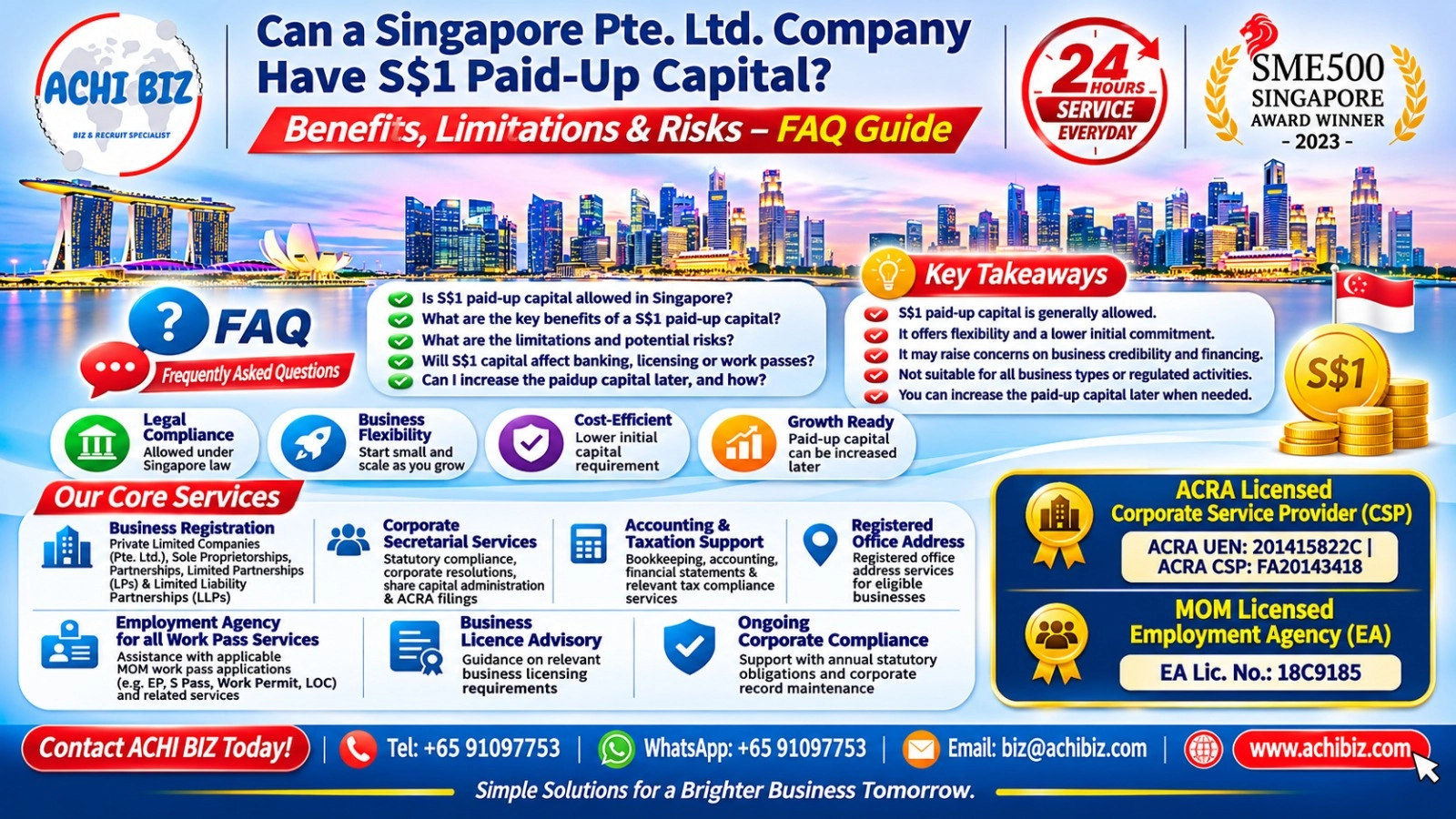
This comprehensive FAQ guide by ACHI BIZ SERVICES PTE. LTD. examines the benefits, limitations, risks and practical implications of incorporating and operating a Singapore Pte. Ltd. company with S$1 paid-up capital.
The discussion focuses specifically on the suitability and consequences of S$1 paid-up capital. Detailed explanations of issued versus unpaid share capital, share allotment procedures, pre-emption rights, capital reduction and other specialised share capital matters are reserved for separate articles to avoid unnecessary duplication.
FAQs About the Legal Minimum Paid-Up Capital in Singapore
Can a Singapore Pte. Ltd. company be incorporated with S$1 paid-up capital?
Yes.
A Singapore Private Limited company can generally be incorporated with S$1 paid-up capital.
For example, a company may issue one ordinary share for S$1, with the shareholder paying the full subscription amount.
This satisfies the general minimum paid-up capital position for a typical Singapore company limited by shares, provided all other incorporation requirements are met.
However, companies operating in regulated industries may be required to maintain higher capital amounts.
Is S$1 the minimum paid-up capital required to register a Singapore company?
For an ordinary Singapore company limited by shares, S$1 is commonly used as the minimum paid-up capital where the shares are denominated in Singapore dollars.
However, Singapore companies may have share capital denominated in permitted foreign currencies, and the relevant minimum is not necessarily expressed in Singapore dollars.
A higher capital requirement may also apply to certain regulated business activities.
Does ACRA allow a company to register with only S$1 paid-up capital?
Yes.
The Accounting and Corporate Regulatory Authority (ACRA) generally permits the incorporation of a Singapore company limited by shares with S$1 paid-up capital, subject to the applicable requirements.
ACRA does not impose a universal requirement for every Pte. Ltd. company to start with thousands of dollars in paid-up capital.
Is S$1 paid-up capital sufficient for every type of Singapore company?
No.
Although S$1 is generally sufficient for an ordinary Pte. Ltd. company, certain regulated businesses may have minimum capital, financial resources or security requirements.
For example, particular financial services and employment agency activities may be subject to additional regulatory conditions.
Business owners should verify the requirements of the relevant licensing authority before deciding on their initial capital.
Can a company be incorporated with less than S$1 paid-up capital?
The commonly stated minimum for a standard Singapore-dollar-denominated incorporation is S$1.
Businesses should not assume that a smaller fractional amount will satisfy the applicable incorporation requirements.
Where shares are denominated in another currency or an unusual capital structure is proposed, the current ACRA requirements should be checked.
Can a Singapore Pte. Ltd. company have zero paid-up capital?
A standard Singapore Pte. Ltd. company limited by shares should not assume that it can be incorporated with zero paid-up capital.
The general incorporation framework requires an appropriate share capital structure, and S$1 is the commonly accepted minimum for an ordinary Singapore-dollar-denominated company.
A company limited by guarantee operates under a different legal structure and should not be confused with a Pte. Ltd. company limited by shares.
Is there a maximum paid-up capital for a Singapore Pte. Ltd. company?
There is no general maximum paid-up capital applicable to all Singapore private limited companies.
The appropriate amount depends on the company’s business needs, shareholders’ funding arrangements and any applicable regulatory requirements.
Is the S$1 minimum paid-up capital requirement stated in the Companies Act?
The Companies Act 1967 establishes the legal framework for companies and their share capital, while ACRA’s incorporation guidance identifies the practical minimum paid-up capital generally applicable to company registration.
It is important not to confuse the general S$1 incorporation position with a universal statutory capital requirement applicable to every regulated business.
Does S$1 paid-up capital mean the company is legally registered for only S$1?
No.
Paid-up capital is only one element of incorporation.
The company must also satisfy the relevant registration, director, shareholder, company secretary, registered office and other statutory requirements.
There are separate government registration fees and professional service costs.
Does S$1 paid-up capital mean the total incorporation cost is S$1?
No.
The S$1 represents the initial shareholder capital contribution, not the total cost of establishing the company.
ACRA’s standard government fees for incorporating a local company generally include a S$15 name application fee and a S$300 incorporation fee, subject to the prevailing fee schedule.
Additional professional and administrative charges may apply.
Must the S$1 paid-up capital be deposited with ACRA?
No.
Paid-up share capital is contributed to the company, not paid to ACRA as a government registration fee.
The company should maintain proper evidence of the shareholder’s capital contribution.
Is S$1 paid-up capital refundable to the shareholder after incorporation?
Not simply because the shareholder wants the money back.
Once validly contributed as share capital, the amount belongs to the company.
A shareholder cannot treat paid-up capital as a personal deposit that may be withdrawn at will.
Any lawful return of capital must comply with the applicable legal requirements.
Does S$1 paid-up capital expire after a certain period?
No.
Paid-up capital does not have an expiry date merely because the company was incorporated with S$1.
The company’s capital structure may subsequently change through legally permitted corporate transactions.
Is S$1 paid-up capital acceptable for a newly incorporated dormant company?
Generally, yes.
A dormant Pte. Ltd. company may have S$1 paid-up capital, provided it satisfies the applicable statutory requirements.
However, dormancy does not automatically remove all corporate compliance obligations.
Is S$1 paid-up capital sufficient for a company that has not started business operations?
Generally, yes, for incorporation where no higher regulatory capital requirement applies.
The company should nevertheless consider the cost of maintaining its registration and fulfilling statutory obligations while inactive.
FAQs About Shareholders and Ownership with S$1 Paid-Up Capital
Can a Singapore Pte. Ltd. company have one shareholder and S$1 paid-up capital?
Yes.
A Singapore Pte. Ltd. company may have a single shareholder.
For example, the company may issue one ordinary share for S$1, which the sole shareholder fully pays.
Can a sole director also be the sole shareholder of a S$1 capital company?
Yes, provided the person satisfies the relevant legal requirements.
A Singapore company must have at least one director who is ordinarily resident in Singapore.
A sole shareholder may also serve as the sole director if eligible.
Can a foreigner own 100% of a Singapore company with S$1 paid-up capital?
Generally, yes.
Singapore permits 100% foreign ownership of many types of private limited companies.
A foreign individual or foreign corporate entity may own all the shares, subject to any applicable sector-specific restrictions.
However, foreign ownership does not remove the requirement for at least one ordinarily resident director or other statutory obligations.
Can a foreign company establish a Singapore subsidiary with S$1 paid-up capital?
Generally, yes.
A foreign parent company may incorporate a Singapore subsidiary with S$1 paid-up capital where no higher capital requirement applies.
The parent should consider whether that amount is commercially appropriate for the subsidiary’s intended activities.
Can two shareholders establish a Singapore Pte. Ltd. company with total paid-up capital of S$1?
A company can have two shareholders with a very small aggregate capital amount, but the proposed share structure must be legally and administratively workable.
For example, issuing two shares for a total consideration of S$1 raises questions about the agreed consideration and the applicable registration arrangements.
A straightforward alternative may be to issue two ordinary shares for S$1 each, resulting in S$2 paid-up capital.
Can three shareholders incorporate a Singapore company with S$1 paid-up capital?
The same practical considerations apply.
Where the founders want equal ownership, issuing one S$1 fully paid ordinary share to each founder would result in S$3 paid-up capital.
This is often simpler than attempting to divide a single S$1 capital amount among multiple shareholders.
Does a shareholder who contributes S$1 automatically own 100% of the company?
Only if the shareholder holds all the issued shares carrying the relevant ownership rights.
For example, a person who owns the company’s only issued ordinary share would ordinarily hold 100% of that class.
However, the rights attached to shares and any other issued classes must also be considered.
Does S$1 paid-up capital mean the shareholder’s investment is worth only S$1?
No.
The initial paid-up capital is not necessarily the current commercial value of the shareholder’s investment.
A company incorporated with S$1 may subsequently develop valuable assets, intellectual property, contracts and profitable operations.
Can a shareholder sell a S$1 share for S$100,000?
Potentially, yes.
The commercial sale price of an existing share may differ substantially from its original subscription amount.
For example, a shareholder may sell a share originally acquired for S$1 at a higher price if the company has become valuable.
The transfer remains subject to applicable legal, constitutional and tax requirements.
Can a S$1 capital company have different classes of shares?
Potentially, yes.
Singapore companies may issue different classes of shares, subject to applicable law and their Constitution.
However, a complex share structure may be unnecessary for a very small startup and should be established for genuine commercial reasons.
Does S$1 paid-up capital affect the maximum number of shareholders?
No.
The maximum number of shareholders in a private company is governed by the applicable company law framework, not simply by its paid-up capital.
A Singapore private company generally has a statutory limit of 50 members, subject to the relevant rules and exclusions.
Can a S$1 capital company later admit new shareholders?
Yes.
A company may admit additional shareholders through legally permitted share allotments or transfers.
The appropriate method depends on the proposed transaction and existing shareholding arrangements.
Can a S$1 capital company issue additional shares later?
Yes.
The company may issue additional shares subject to the Companies Act, its Constitution and the required approvals.
The detailed share allotment process is addressed separately to avoid duplicating the dedicated article on share issuance.
Can a shareholder lose more than S$1 if the company fails?
The answer depends on the shareholder’s circumstances.
Where a shareholder holds a fully paid S$1 share and has no additional obligations, the shareholder’s exposure in the capacity of shareholder is generally limited.
However, the shareholder may face additional liability if they have provided personal guarantees, incurred separate contractual obligations or become liable under another legal basis.
Does S$1 paid-up capital protect directors from personal liability?
No.
Limited liability primarily concerns the company’s separate legal identity and shareholders’ liability.
Directors remain subject to statutory duties and may incur personal liability in circumstances recognised by law.
A company with S$1 paid-up capital does not provide directors with blanket immunity.
FAQs About the Benefits of Incorporating a Singapore Company with S$1 Paid-Up Capital
What are the main benefits of starting a Singapore Pte. Ltd. company with S$1 paid-up capital?
The main advantage is flexibility.
Entrepreneurs can establish a company without committing substantial shareholder capital at the outset, provided their business does not require a higher minimum capital amount.
This may be useful for businesses that have low initial operating costs or intend to arrange funding progressively.
However, low paid-up capital should not be mistaken for low operating expenses.
Is S$1 paid-up capital suitable for first-time entrepreneurs?
Yes, in appropriate circumstances.
A first-time entrepreneur who intends to operate a small consultancy, online service or other low-cost business may find S$1 paid-up capital sufficient for initial incorporation.
The entrepreneur should still prepare a realistic budget for business operations and statutory compliance.
Does S$1 paid-up capital reduce the financial commitment required from shareholders?
Yes, at the incorporation stage.
A shareholder subscribing for one fully paid S$1 share contributes only S$1 as initial share capital.
However, the company may need additional financing to operate, and the shareholder may voluntarily provide further capital or loans.
Does S$1 paid-up capital make Singapore attractive to foreign entrepreneurs?
It can.
Singapore’s flexible capital framework allows many foreign entrepreneurs to establish companies without substantial initial paid-up capital.
However, foreign entrepreneurs must separately consider director residency requirements, work authorisation, business licensing, banking and operating expenses.
Is S$1 paid-up capital useful for testing a new business idea?
Potentially, yes.
A founder may establish a company with modest initial capital while evaluating a business concept.
Nevertheless, incorporation creates legal and administrative responsibilities even if the business does not succeed.
Can S$1 paid-up capital help entrepreneurs preserve personal savings?
It may reduce the amount initially committed as equity.
However, business expenses must still be financed.
If the company subsequently needs funding, shareholders may have to decide whether to contribute additional equity, provide loans or obtain financing from other sources.
Does S$1 paid-up capital make incorporation faster?
Not necessarily.
A lower capital amount does not automatically result in faster incorporation.
Processing time depends on the completeness of the application, required verification, regulatory referrals and other relevant factors.
Does S$1 paid-up capital simplify the company’s initial share structure?
It can.
For example, a single shareholder holding one fully paid ordinary share creates a straightforward initial ownership structure.
However, founders expecting additional shareholders should consider whether issuing more shares initially would make future ownership arrangements easier to administer.
Can a S$1 capital company maintain a simple corporate structure?
Yes.
A company with one shareholder, one eligible director and a single class of ordinary shares may have a relatively simple ownership structure.
It must nevertheless comply with the applicable statutory requirements.
Is S$1 paid-up capital suitable for a business that operates entirely online?
Potentially, yes.
Certain online businesses may require limited physical infrastructure.
However, the company must still consider website costs, software subscriptions, payment processing, advertising, cybersecurity, taxes and any applicable licensing requirements.
Is S$1 paid-up capital suitable for a freelance consultant incorporating a Pte. Ltd. company?
It may be suitable where the consultant’s business has limited initial expenses and no higher regulatory capital requirement.
The consultant should also consider whether incorporation is commercially worthwhile compared with other available business structures.
Is S$1 paid-up capital suitable for a company established mainly to hold intellectual property?
Potentially, yes.
A company formed to own intellectual property may not require substantial initial share capital.
However, the costs and legal implications of acquiring, transferring, protecting and maintaining intellectual property should be considered separately.
Can a S$1 capital company grow into a large business?
Yes.
The initial paid-up capital does not impose a permanent limit on business growth.
A company incorporated with S$1 may subsequently obtain investment, generate profits, employ staff and expand its operations.
Growth depends on commercial performance and access to adequate resources, not merely the initial capital amount.
FAQs About the Limitations of S$1 Paid-Up Capital
What are the main limitations of having only S$1 paid-up capital?
The most significant limitation is that S$1 provides virtually no meaningful financial buffer.
Even a small expense can exceed the company’s initial shareholder contribution.
A company may therefore need additional financing almost immediately after incorporation.
Is S$1 paid-up capital enough to operate a business in Singapore?
Usually not by itself.
Although S$1 may satisfy the general incorporation requirement, it is unlikely to cover meaningful business expenses.
The actual funding required depends on the company’s activities, staffing, premises, technology and other operating commitments.
Can a company operate legally with S$1 paid-up capital but no business revenue?
Yes, provided it complies with applicable laws and can meet its obligations.
A company is not automatically prohibited from operating merely because it has little paid-up capital or has not yet generated revenue.
However, it must manage its financial commitments responsibly.
Does S$1 paid-up capital mean a company is financially weak?
Not necessarily, but it can indicate that very little initial equity was contributed.
A company may have other financial resources, including shareholder loans, accumulated profits or external financing.
Its financial strength should be assessed from its overall financial position.
Does S$1 paid-up capital create a poor impression among customers?
It may, particularly where customers are concerned about the company’s ability to fulfil substantial contractual commitments.
However, many customers place greater importance on service quality, reputation, experience and financial reliability.
The effect varies according to the industry and transaction.
Can S$1 paid-up capital affect business credibility?
Yes.
Some commercial counterparties may view extremely low paid-up capital as a sign that the shareholders have committed limited equity to the business.
This does not necessarily mean the company is unreliable, but it may prompt questions about funding and financial capacity.
Can a company with S$1 paid-up capital win large contracts?
Potentially, yes.
There is no universal rule preventing a S$1 capital company from entering into substantial commercial contracts.
However, customers may require financial statements, performance guarantees, insurance, minimum capital or evidence of financial resources.
Can a S$1 capital company participate in government tenders?
Potentially, yes.
Eligibility depends on the tender’s specific requirements.
Some tenders may impose financial capacity, track record, registration, grading or other qualification conditions.
S$1 paid-up capital does not automatically disqualify a company from every government tender, but it may be insufficient for particular opportunities.
Can a S$1 capital company register as a government supplier?
Potentially, depending on the applicable registration category and requirements.
Supplier registration and tender eligibility should be assessed separately from general company incorporation.
Can S$1 paid-up capital affect supplier credit terms?
Yes.
A supplier may hesitate to extend unsecured credit to a newly incorporated company with minimal equity and no established payment history.
The supplier may instead require advance payment, a deposit or other security.
Can a company with S$1 paid-up capital obtain trade credit?
Potentially, yes.
Trade credit is a commercial decision made by the supplier.
The supplier may consider the company’s payment history, financial statements, business relationships and guarantees.
Can S$1 paid-up capital affect the company’s ability to rent commercial premises?
Yes.
A landlord may assess the company’s financial capacity before agreeing to a lease.
For a newly incorporated company with limited resources, the landlord may require a larger security deposit or additional assurances.
Can a S$1 capital company purchase expensive equipment?
Yes, provided it has the necessary funds or financing.
The amount of paid-up capital does not itself restrict the value of equipment the company may purchase.
However, the company must be able to meet its payment obligations.
Can a S$1 capital company enter into a long-term service agreement?
Yes.
Nevertheless, directors should assess whether the company can realistically fulfil its contractual commitments.
Entering into obligations without a reasonable funding plan may expose the company to financial difficulties.
Does S$1 paid-up capital limit the company’s annual turnover?
No.
There is no general statutory rule limiting a company’s revenue or turnover according to its paid-up capital.
A company with S$1 paid-up capital may generate substantial sales.
However, revenue does not necessarily indicate profitability or adequate cash flow.
Can a company with S$1 paid-up capital earn millions of dollars in revenue?
Yes.
Paid-up capital and revenue are separate financial concepts.
A company may begin with minimal shareholder equity and subsequently generate substantial business income.
Can a S$1 capital company have assets worth more than S$1?
Yes.
The company may acquire assets through business earnings, loans, additional financing or other legitimate transactions.
Its assets are not restricted to the original paid-up capital amount.
Can a S$1 capital company have liabilities exceeding S$1?
Yes.
A company’s liabilities are not automatically limited to its paid-up share capital.
It may incur contractual debts, loans, rental obligations, taxes and other liabilities exceeding S$1.
Does S$1 paid-up capital limit the amount a creditor can claim from the company?
No.
A creditor may have a valid claim against the company for an amount substantially greater than its paid-up capital.
The company’s liability for its debts is different from the limitation of shareholders’ liability.
Can a S$1 capital company be sued for S$100,000?
Yes.
A company’s paid-up capital does not cap the damages or debts that may be claimed against it.
Whether a claim succeeds depends on the applicable law and facts.
Can S$1 paid-up capital affect the company’s ability to obtain insurance?
Potentially.
Insurers may consider the company’s business activities, risk exposure, claims history and financial information.
Some insurance products or underwriting arrangements may involve financial eligibility conditions.
FAQs About Banking and Financial Transactions
Can a Singapore Pte. Ltd. company with S$1 paid-up capital open a corporate bank account?
Yes, potentially.
There is no universal rule preventing a company with S$1 paid-up capital from opening a corporate bank account.
However, account approval remains subject to the bank’s onboarding, customer due diligence, risk assessment and account eligibility requirements.
Does S$1 paid-up capital guarantee corporate bank account approval?
No.
Banks may examine the company’s business activities, ownership structure, directors, source of funds, expected transactions and other relevant information.
A company can satisfy ACRA incorporation requirements but still fail to meet a particular bank’s onboarding criteria.
Must a company deposit S$1 into its corporate bank account immediately after incorporation?
The company should ensure that its stated paid-up capital is genuinely contributed and properly recorded.
However, the practical timing and method of receiving the subscription payment may depend on the company’s incorporation and banking arrangements.
Where a corporate bank account is opened only after incorporation, the company should maintain appropriate documentation of the capital contribution.
Can a company with S$1 paid-up capital open a multi-currency corporate account?
Potentially, yes.
The availability of multi-currency banking depends on the financial institution’s products and eligibility requirements.
S$1 paid-up capital does not automatically entitle the company to every banking service.
Can a foreign-owned company with S$1 paid-up capital open a Singapore corporate bank account?
Potentially, yes.
However, foreign ownership may lead to additional documentation and due diligence requirements.
Banks may examine the identities and residency of beneficial owners, business activities and source of funds.
Can a S$1 capital company obtain a corporate credit card?
Potentially.
Approval depends on the financial institution’s eligibility criteria, which may include financial history, deposits, revenue or other supporting arrangements.
Can a S$1 capital company apply for a business loan?
Yes, it may apply.
However, eligibility and approval depend on the lender’s criteria.
A newly incorporated company with minimal equity, no operating history and limited cash flow may face difficulty obtaining unsecured financing.
Will banks reject a business loan automatically because the company has S$1 paid-up capital?
Not necessarily.
There is no universal rejection rule based solely on S$1 paid-up capital.
Nevertheless, the company’s limited initial equity may be relevant to the lender’s assessment.
Can shareholders provide loans instead of increasing S$1 paid-up capital?
Yes.
A shareholder may lend money to the company under an appropriately documented loan arrangement.
However, shareholder loans and share capital have different legal and accounting characteristics.
A loan may create a repayment obligation, whereas equity capital generally does not operate as an ordinary repayable debt.
Is a S$100,000 shareholder loan equivalent to S$100,000 paid-up capital?
No.
For example, a company may have:
| Financial item | Amount |
|---|---|
| Paid-up share capital | S$1 |
| Shareholder loan | S$100,000 |
| Total initial funding received | S$100,001 |
Although the company has received S$100,001, its paid-up share capital remains S$1.
The shareholder loan must be treated according to its legal terms and applicable accounting requirements.
Can a shareholder fund the company’s expenses personally without increasing paid-up capital?
Potentially, yes.
However, the payments must be properly documented and classified.
Depending on the arrangement, they may represent a shareholder loan, reimbursable expense, capital contribution or another transaction.
The company should not automatically classify every payment made by a shareholder as paid-up share capital.
Can a S$1 capital company obtain financing from private investors?
Yes.
Private investors may provide equity funding, loans or other legally permitted financing.
However, they will generally assess the company’s business prospects, ownership structure, valuation and commercial risks.
Does S$1 paid-up capital make a company unattractive to investors?
Not necessarily.
Early-stage investors often focus on the business idea, founders, market opportunity, intellectual property and growth potential.
However, investors may examine the initial capital structure and require appropriate changes before investing.
Can a S$1 capital company receive a large investment without increasing paid-up capital?
Potentially, depending on how the investment is structured.
For example, financing may take the form of a genuine loan rather than an equity subscription.
However, where an investor subscribes for newly issued shares, the resulting capital treatment must follow the applicable legal and accounting requirements.
FAQs About Business Licences and Regulatory Capital Requirements
Can a company with S$1 paid-up capital apply for a business licence in Singapore?
Yes, where the relevant licensing framework permits.
However, some licences impose financial, capital, security or other eligibility requirements.
The company should check the conditions applicable to its intended business activities before applying.
Does ACRA incorporation approval mean S$1 capital is sufficient for every business licence?
No.
ACRA incorporation and regulatory licensing are separate processes.
A company may be successfully incorporated but still be unable to commence a regulated activity until it satisfies the relevant licensing requirements.
Can a S$1 capital company operate an ordinary consultancy business?
Generally, yes, where the activity does not require a higher regulatory capital amount or a specific licence.
The company must still comply with applicable business, tax and employment laws.
Can a S$1 capital company operate an e-commerce business?
Generally, yes, subject to the nature of the products or services sold.
Some products and activities are regulated and may require licences, approvals or compliance with specific laws.
Can a S$1 capital company operate a retail shop?
Potentially, yes.
Ordinary retail activities may not require a special minimum paid-up capital.
However, the business may still require substantial funding for rental deposits, inventory, renovations and operating expenses.
Can a S$1 capital company operate a restaurant or food business?
Potentially, provided it satisfies the relevant licensing and operational requirements.
A food business may require licences or approvals from the Singapore Food Agency and other relevant authorities.
Even where no higher paid-up capital requirement applies, S$1 will ordinarily be inadequate to finance a physical food establishment.
Can a S$1 capital company operate an employment agency?
Not necessarily.
Employment agency activities are regulated by the Ministry of Manpower (MOM).
Depending on the licence category and circumstances, the applicant may need to meet applicable security bond, certification and other licensing requirements.
Business owners should not assume that S$1 paid-up capital alone is sufficient to obtain or maintain an employment agency licence.
Can a S$1 capital company operate a corporate service provider business?
It must satisfy the applicable registration and regulatory requirements.
Under Singapore’s Corporate Service Providers Act framework, persons providing regulated corporate services may be required to register with ACRA and comply with relevant obligations.
S$1 paid-up capital does not exempt a business from those requirements.
Can a S$1 capital company operate a financial services business?
It depends on the regulated activity.
Certain financial services require licences and may be subject to minimum capital, financial resources or other prudential requirements imposed by the Monetary Authority of Singapore (MAS).
The general S$1 incorporation position should not be relied upon when planning a regulated financial services business.
Can a S$1 capital company operate a payment services business?
Not necessarily.
Depending on the payment services involved, licensing and financial requirements may apply under the Payment Services Act and relevant MAS regulations.
A higher capital amount may be required for certain licence categories.
Can a S$1 capital company operate a construction business?
Potentially, but the company must consider the applicable construction sector requirements.
Certain activities, contractor registrations, workhead grades and employment arrangements may involve financial, personnel or other eligibility criteria.
A S$1 capital company should not assume that incorporation alone qualifies it for construction projects or regulatory registrations.
Can a S$1 capital company register with BCA?
It depends on the particular registration or licensing scheme.
The Building and Construction Authority (BCA) administers different schemes with different eligibility conditions.
The company must assess the requirements of the specific scheme rather than relying solely on its incorporation status.
Can a S$1 capital company operate an import and export business?
Generally, yes, subject to applicable customs, trade and product-specific requirements.
Importing or exporting controlled goods may require additional permits or licences.
The company must also have sufficient resources to finance its transactions.
Can a S$1 capital company operate a real estate agency?
Not automatically.
Estate agency work is regulated by the Council for Estate Agencies (CEA).
The company must satisfy the applicable licensing requirements before carrying out regulated estate agency activities.
Can a S$1 capital company operate a healthcare business?
It depends on the healthcare services involved.
Healthcare service providers may be subject to licensing and other regulatory requirements.
The company’s initial paid-up capital does not replace the need to satisfy those requirements.
Can a S$1 capital company operate an education or training centre?
Potentially, depending on the training activities.
Some education and training providers are subject to registration, licensing, accreditation or financial requirements.
The relevant regulatory framework should be reviewed before operations commence.
Can a S$1 capital company operate a holding company?
Generally, yes.
A company established to hold shares or other investments may have S$1 paid-up capital where no additional regulatory requirements apply.
However, the source of investment funding, nature of the assets and any regulated activities should be considered.
Can a S$1 capital company own another Singapore Pte. Ltd. company?
Yes.
A Singapore company may hold shares in another company, subject to applicable law.
The amount of its own paid-up capital does not automatically limit the number or value of shares it may acquire.
However, it must have a legitimate means of financing the acquisition.
FAQs About Employment Pass, S Pass, Work Permit and Foreign Entrepreneurs
Can a Singapore company with S$1 paid-up capital apply for an Employment Pass (EP)?
A company with S$1 paid-up capital may submit an Employment Pass application where it is eligible to do so.
However, S$1 paid-up capital does not guarantee EP approval.
MOM assesses Employment Pass applications against the applicable eligibility requirements, including qualifying salary, the COMPASS framework where applicable, and other relevant criteria.
The company’s business circumstances and supporting information may also be relevant to the assessment.
Is there a universal minimum paid-up capital requirement for an Employment Pass application?
There is no single universal paid-up capital amount that guarantees Employment Pass eligibility or approval.
Applicants and employers should follow MOM’s prevailing EP eligibility requirements.
A higher paid-up capital amount should not be treated as a substitute for meeting the applicable employment pass criteria.
Can a foreign entrepreneur incorporate a company with S$1 paid-up capital and immediately work in Singapore?
Not automatically.
Incorporating or owning a Singapore company does not, by itself, authorise a foreigner to work in Singapore.
The individual must have the appropriate immigration status and work authorisation.
Does owning a S$1 capital company qualify a foreign shareholder for an Employment Pass?
No.
Share ownership alone does not establish EP eligibility.
An Employment Pass application must satisfy MOM’s applicable requirements.
Can a foreign shareholder appoint themselves as a director of a S$1 capital company?
A foreign shareholder may potentially be appointed as a director, subject to the Companies Act and applicable immigration or work authorisation requirements.
However, the company must have at least one director who is ordinarily resident in Singapore.
Appointment as a director does not automatically grant the foreign individual permission to work in Singapore.
Can a S$1 capital company apply for an S Pass?
Potentially, yes, where the company and applicant satisfy MOM’s requirements.
S Pass eligibility involves qualifying salary, employer obligations, quota availability, levy requirements and other applicable conditions.
Paid-up capital alone does not determine eligibility.
Can a S$1 capital company apply for a Work Permit for a foreign worker?
Potentially, depending on the company’s business sector and MOM’s requirements.
Work Permit eligibility may involve sector-specific rules, quotas, levies and other conditions.
The company must also satisfy its obligations as an employer.
Can a company with S$1 paid-up capital hire Singapore citizens and Permanent Residents?
Yes.
There is no general rule preventing a company from employing local staff merely because it has S$1 paid-up capital.
However, the company must have sufficient resources to pay wages and fulfil its employment obligations.
Can a S$1 capital company register as an employer with CPF?
Yes, where applicable.
The company must comply with its CPF obligations for eligible employees.
Its low paid-up capital does not exempt it from mandatory CPF contributions.
Can a S$1 capital company pay a director’s salary?
Yes, provided the arrangement is legally valid and the company can meet its payment obligations.
Director remuneration, employment income and directors’ fees may involve different approval, accounting and tax considerations.
Can a S$1 capital company pay an employee S$10,000 per month?
Yes, if it has sufficient resources and the employment arrangement complies with applicable law.
There is no general requirement that paid-up capital must exceed an employee’s monthly salary.
However, the company should be able to demonstrate that its employment commitments are financially sustainable.
Can MOM question the financial position of a newly incorporated S$1 capital company?
MOM may request information or supporting documents relevant to an application.
A company should provide accurate information about its business activities, operations and financial circumstances.
It should not assume that increasing paid-up capital alone will resolve every concern raised during an application.
Should a company increase paid-up capital before applying for an Employment Pass?
Not automatically.
The decision should depend on the company’s genuine business funding needs and any applicable regulatory requirements.
Increasing capital merely to create a favourable impression, without corresponding genuine funding or commercial substance, is not a sound approach.
Does increasing paid-up capital guarantee approval of a previously rejected EP application?
No.
An increase in paid-up capital does not guarantee a different outcome.
Any appeal or subsequent application must address the relevant eligibility requirements and reasons for the earlier decision.
Can a Dependant’s Pass holder own shares in a S$1 capital company?
Generally, share ownership is distinct from employment or operating a business.
However, a Dependant’s Pass holder who wishes to work in or operate a business must comply with the applicable MOM work authorisation requirements.
Can a Dependant’s Pass holder operate a S$1 capital company under a Letter of Consent?
Potentially, if the individual satisfies MOM’s eligibility requirements for a Letter of Consent (LOC) for eligible DP holders who are business owners.
The applicable conditions concern matters such as the individual’s qualifying business role and the relevant LOC requirements.
S$1 paid-up capital alone does not establish LOC eligibility.
Does S$1 paid-up capital affect the renewal of a business-owner LOC?
The company and LOC holder must satisfy MOM’s prevailing renewal conditions.
These may include local employment requirements for the relevant LOC category.
A company should not assume that its original S$1 paid-up capital is sufficient to establish continued eligibility.
Can a Student’s Pass holder own shares in a S$1 capital company?
Passive share ownership is generally different from actively working in or managing a business.
A Student’s Pass holder must comply with the applicable ICA and MOM conditions.
The individual should not assume that being a shareholder automatically permits business operations or employment.
FAQs About Taxation, Accounting and Financial Reporting
Does a company with S$1 paid-up capital pay less corporate income tax?
Not merely because it has low paid-up capital.
Singapore corporate income tax is generally determined by taxable income and applicable tax rules, rather than the amount of initial share capital.
Is a S$1 capital company subject to Singapore’s corporate income tax rate?
Yes, where it has taxable income.
Singapore’s prevailing headline corporate income tax rate is 17%, subject to applicable exemptions, rebates and other tax provisions.
A company’s low paid-up capital does not create a separate corporate tax rate.
Can a S$1 capital company qualify for the Start-Up Tax Exemption Scheme?
Potentially, yes.
Eligibility depends on the relevant IRAS conditions, including the company’s incorporation status, tax residency and shareholder requirements, as well as applicable exclusions.
S$1 paid-up capital does not automatically qualify or disqualify a company.
Can a S$1 capital company qualify for the Partial Tax Exemption Scheme?
Potentially, yes.
The relevant tax exemption depends on the company’s taxable income and the applicable IRAS rules.
Paid-up capital alone is not the determining factor.
Does S$1 paid-up capital exempt a company from filing corporate income tax returns?
No.
A company must comply with its applicable IRAS tax filing obligations unless it qualifies for a relevant waiver or exemption.
Low paid-up capital does not automatically remove tax filing responsibilities.
Can a S$1 capital company register for GST?
Yes, where the company is eligible or required to register.
GST registration depends on the applicable turnover, business and registration conditions rather than the amount of paid-up capital alone.
Does S$1 paid-up capital exempt a company from GST registration?
No.
A company must comply with the prevailing GST registration rules.
For example, the compulsory GST registration threshold generally concerns taxable turnover exceeding S$1 million under the applicable tests, not the company’s share capital.
Can a S$1 capital company claim legitimate business expenses?
Yes, subject to the applicable tax deduction rules.
The deductibility of an expense depends on its nature and the relevant Income Tax Act provisions.
The company’s paid-up capital amount does not automatically determine whether an expense is deductible.
Must a S$1 capital company maintain proper accounting records?
Yes.
A Singapore company must comply with the applicable statutory accounting record requirements.
Having only S$1 paid-up capital does not remove the obligation to maintain accurate records.
Must a S$1 capital company prepare financial statements?
Generally, companies must comply with the financial reporting requirements applicable to their circumstances.
Certain dormant companies may qualify for exemptions from preparing financial statements if they satisfy the relevant statutory conditions.
However, S$1 paid-up capital alone does not create such an exemption.
Can a S$1 capital company qualify for audit exemption?
Yes, potentially.
Audit exemption generally depends on whether the company satisfies the applicable small company or other statutory exemption criteria.
Paid-up capital alone does not determine audit exemption eligibility.
Does S$1 paid-up capital exempt a company from holding an AGM?
No.
A company must comply with the applicable Annual General Meeting (AGM) requirements unless it qualifies for a statutory exemption or alternative procedure.
The amount of paid-up capital does not determine AGM exemption by itself.
Must a S$1 capital company file an Annual Return with ACRA?
Yes, subject to the applicable statutory requirements.
A Singapore company must generally file its Annual Return within the relevant deadline, even where its paid-up capital is only S$1.
Does a S$1 capital company need a company secretary?
Yes.
A Singapore company must appoint a company secretary within the statutory timeframe.
Under the Companies Act, the secretary must generally be appointed within six months after incorporation.
The sole director of a company cannot simultaneously act as its company secretary where the company has only one director.
Does a S$1 capital company need a registered office address?
Yes.
A Singapore company must maintain a registered office address that satisfies the applicable statutory requirements.
Its paid-up capital amount does not remove this obligation.
Can a S$1 capital company incur expenses before earning revenue?
Yes.
A newly incorporated company may incur legitimate startup and operating expenses before generating income.
However, it must have an appropriate means of financing those expenses.
Can a company with S$1 paid-up capital record a loss of S$50,000?
Yes.
For example, a company may incur operating expenses financed through shareholder loans or other funding arrangements.
Its accounting loss is not limited to its initial paid-up capital.
Does a S$1 capital company have to increase its capital after making a loss?
Not automatically.
A loss does not necessarily trigger a statutory requirement to increase paid-up capital.
However, the directors must consider the company’s financial position, solvency and ability to meet its obligations.
Can a S$1 capital company distribute dividends?
Potentially, yes.
Under Singapore law, dividends may be paid only out of profits, subject to applicable requirements.
The company must have legally available profits and comply with the relevant corporate procedures.
Can a S$1 capital company declare dividends of S$100,000?
Potentially, if it has sufficient legally available profits and satisfies the applicable requirements.
The amount of original paid-up capital does not, by itself, limit the dividend amount to S$1.
Can a company pay dividends out of its S$1 paid-up capital?
No, not merely by treating the original capital contribution as distributable profit.
A lawful dividend must satisfy the statutory requirements concerning profits.
Returning share capital is a different corporate transaction governed by separate rules.
FAQs About Financial Risks, Insolvency and Shareholder Protection
What is the biggest financial risk of operating with S$1 paid-up capital?
The biggest practical risk is insufficient funding.
A company may be legally incorporated but lack the resources needed to meet its immediate expenses.
Without adequate cash flow, additional financing or financial planning, even routine obligations may become difficult to fulfil.
Can a S$1 capital company become insolvent?
Yes.
A company may become insolvent regardless of its original paid-up capital.
Insolvency issues may arise where it cannot pay debts as they fall due or where other applicable insolvency criteria are met.
Does S$1 paid-up capital mean the company can incur only S$1 in losses?
No.
The company’s losses can substantially exceed its original share capital.
Limited liability does not restrict the company’s operating losses to the amount contributed by shareholders.
What happens if a S$1 capital company owes suppliers S$50,000 but cannot pay?
The suppliers may pursue the legal remedies available to them.
Depending on the circumstances, these may include debt recovery proceedings or applicable insolvency procedures.
The company’s S$1 paid-up capital does not extinguish the debt.
Are shareholders automatically liable for the company’s unpaid debts?
Generally, no.
A company limited by shares is a separate legal entity.
A shareholder’s liability in the capacity of shareholder is generally limited to any amount unpaid on their shares.
However, separate liabilities may arise from personal guarantees, wrongful conduct or other legal obligations.
Can a creditor recover a company’s debts directly from its sole shareholder?
Not merely because the person is the sole shareholder.
The creditor must establish a separate legal basis for personal liability.
For example, a valid personal guarantee may expose the shareholder to liability beyond the amount invested in shares.
Can a shareholder of a S$1 capital company provide a personal guarantee?
Yes.
A shareholder may voluntarily provide a guarantee for company obligations.
However, doing so can create personal financial exposure that is separate from the shareholder’s limited liability.
Does a S$1 capital company protect its shareholder’s personal property?
The company’s separate legal personality generally protects shareholders from automatic personal liability for company debts.
However, that protection is not absolute.
Personal guarantees, fraud, certain statutory liabilities and other legally recognised circumstances may create personal exposure.
Can a director be personally liable if a S$1 capital company continues trading while financially distressed?
Potentially.
Singapore law contains provisions addressing wrongful trading and other misconduct in relevant circumstances.
Directors should carefully assess the company’s ability to meet its obligations and obtain professional advice when serious financial difficulties arise.
Can a company continue operating after its S$1 paid-up capital has been spent?
Yes, provided it can lawfully continue its activities and meet its obligations.
Paid-up capital is not a permanently segregated amount of cash that must remain untouched.
The company may use its funds for legitimate business purposes.
Is a company automatically insolvent when its bank balance falls below S$1?
No.
A company’s solvency cannot be determined solely by comparing its bank balance with its original paid-up capital.
Its assets, liabilities, cash flow and ability to meet debts must be considered.
Can a S$1 capital company have negative shareholders’ equity?
Yes.
Accumulated losses may cause the company’s total equity to become negative.
This can indicate financial weakness, but the precise legal and financial consequences depend on the company’s circumstances.
Can a company with negative equity continue operating?
Potentially, yes.
Negative equity does not automatically mean that every company must cease operations.
However, directors must consider the company’s financial position, solvency and relevant legal obligations.
Can a S$1 capital company be wound up?
Yes.
A Singapore company may be wound up under the applicable legal procedures regardless of the amount of its paid-up capital.
Can a S$1 capital company apply for striking off with ACRA?
Potentially, yes.
The company must satisfy ACRA’s applicable striking-off criteria.
For example, outstanding debts, unresolved liabilities or ongoing legal proceedings may prevent the company from qualifying.
S$1 paid-up capital does not automatically make striking off available.
Will shareholders receive their S$1 back when the company closes?
Not necessarily.
Any distribution to shareholders depends on the company’s remaining assets, liabilities and the applicable closure or liquidation process.
Creditors’ claims generally take priority over distributions to shareholders.
FAQs About Increasing S$1 Paid-Up Capital After Incorporation
Can a Singapore Pte. Ltd. company increase its paid-up capital from S$1 after incorporation?
Yes.
A company may increase its paid-up capital after incorporation through an appropriate legally permitted transaction.
For example, it may issue additional shares for new consideration, subject to the applicable approvals and ACRA requirements.
Is there a deadline for increasing S$1 paid-up capital?
There is no general requirement that every company incorporated with S$1 must increase its capital within a fixed period.
However, the company may need additional capital to satisfy business, contractual or regulatory requirements.
Can a company increase its paid-up capital from S$1 to S$10,000?
Yes.
For example, a company with one fully paid S$1 ordinary share may issue additional shares for an aggregate consideration of S$9,999.
Assuming the new shares are validly issued and fully paid, the company’s aggregate paid-up capital would become S$10,000.
Can a company increase its paid-up capital from S$1 to S$100,000?
Yes.
The company may undertake an appropriate share capital transaction, subject to the Companies Act, its Constitution and the required approvals.
The increase must reflect a genuine and legally effective capital arrangement.
Can a company increase paid-up capital without receiving additional money?
Potentially, depending on the transaction.
Certain legally permitted non-cash consideration or capitalisation arrangements may result in an increase in share capital.
However, the company should not simply increase its declared paid-up capital without a valid legal and accounting basis.
Can a shareholder transfer S$50,000 into the company and automatically increase paid-up capital?
No.
A bank transfer alone does not automatically establish that the amount constitutes share capital.
The purpose and legal nature of the payment must be properly documented.
For example, the payment might represent a shareholder loan rather than an equity subscription.
Can a shareholder loan be converted into paid-up capital?
Potentially, yes.
A genuine debt owed by the company to a shareholder may, under an appropriately structured transaction, be converted into equity.
The company must comply with the relevant corporate, legal and accounting requirements.
Can retained profits be converted into share capital?
Potentially, through an appropriate legally permitted capitalisation arrangement.
However, the company must consider the relevant statutory requirements, available reserves and corporate approvals.
The detailed process is outside the scope of this S$1 capital FAQ article.
Can a company increase paid-up capital without changing its ownership percentage?
Potentially, yes.
For example, where a sole shareholder subscribes for all additional shares of the same class, the shareholder may continue to own 100% of the company.
In a company with multiple shareholders, proportionate subscriptions may preserve existing ownership percentages.
Does increasing paid-up capital automatically increase the company’s market value?
No.
An increase in paid-up capital may improve the company’s financial resources, but market value depends on broader commercial and financial factors.
A capital injection does not automatically increase the value of the business by an identical amount.
Does increasing paid-up capital automatically improve the company’s creditworthiness?
Not necessarily.
A genuine capital contribution may strengthen the company’s financial position.
However, lenders may also consider cash flow, profitability, debt obligations, business performance and repayment capacity.
Should a company increase paid-up capital before signing a large contract?
It depends on the contract and the company’s financial circumstances.
If the customer requires minimum paid-up capital or evidence of financial resources, the company should assess whether additional equity funding is necessary.
Otherwise, the decision should be based on genuine funding needs rather than appearance alone.
Should a company increase paid-up capital before applying for a business licence?
Where the relevant licensing framework imposes a minimum capital requirement, the company must satisfy that requirement.
However, increasing paid-up capital is not necessarily required for every licence.
Can a company reduce its paid-up capital after increasing it?
Potentially, yes, through a legally permitted capital reduction or other applicable corporate procedure.
A company cannot simply reverse a capital contribution through an ordinary withdrawal.
The detailed rules governing capital reduction are addressed in a separate article.
Can a company keep S$1 paid-up capital throughout its entire existence?
Yes, where no applicable legal, regulatory or contractual requirement demands a higher amount.
A company may continue operating with S$1 paid-up capital if it has sufficient financial resources from other legitimate sources.
Nevertheless, the suitability of that structure should be reviewed as the business develops.
FAQs About Choosing an Appropriate Paid-Up Capital Amount
Is S$1 paid-up capital always the best choice for a new Singapore company?
No.
S$1 may be legally sufficient but commercially unsuitable.
The appropriate amount depends on the company’s intended activities, initial expenses, regulatory requirements and funding arrangements.
How much paid-up capital should a small business have in Singapore?
There is no universal amount suitable for every small business.
A small consultancy may require relatively little initial funding, while a retail, manufacturing or construction business may need substantially more.
The company should prepare a realistic startup budget before deciding.
Is S$100 paid-up capital better than S$1?
Not necessarily.
S$100 provides slightly more initial equity than S$1, but the difference may be insignificant compared with the company’s operating costs.
The appropriate amount should reflect actual business needs.
Is S$1,000 paid-up capital sufficient for a Singapore startup?
It may be sufficient for some low-cost startups.
However, businesses requiring premises, equipment, inventory or employees may need substantially more funding.
Is S$10,000 paid-up capital more credible than S$1?
It may be perceived as a greater initial shareholder commitment.
However, credibility depends on more than the amount of paid-up capital.
Customers and lenders may place greater weight on the company’s financial statements, operating history and ability to meet its obligations.
Is S$50,000 paid-up capital necessary for a newly incorporated company?
Not generally.
There is no universal requirement for an ordinary Singapore Pte. Ltd. company to start with S$50,000 paid-up capital.
However, specific regulated activities or commercial arrangements may require that amount or more.
Is S$100,000 paid-up capital compulsory for foreign-owned Singapore companies?
No.
There is no universal S$100,000 paid-up capital requirement merely because a Singapore company is foreign-owned.
Specific regulatory or licensing requirements must be considered separately.
Should paid-up capital be based on the company’s expected annual revenue?
Not necessarily.
Expected revenue may help with business planning, but it does not directly determine the appropriate paid-up capital amount.
The company should also consider startup expenses, working capital, payment cycles, potential losses and financing needs.
Should paid-up capital be based on the company’s expected monthly expenses?
Monthly expenses are a useful starting point.
For example, a company expecting monthly operating expenses of S$8,000 may need sufficient funding to cover several months of expenditure before reliable revenue is received.
However, the entire funding requirement does not necessarily have to be provided as paid-up share capital.
Should paid-up capital cover at least six months of operating expenses?
There is no universal statutory requirement to maintain six months of expenses as paid-up capital.
Nevertheless, maintaining an appropriate financial buffer may be prudent, depending on the company’s business model and risks.
Is it better to inject money as paid-up capital or as a shareholder loan?
The appropriate choice depends on the company’s circumstances.
Equity funding generally strengthens the company’s capital base without creating an ordinary repayment obligation.
A shareholder loan may offer different repayment and financing arrangements but creates a liability according to its terms.
The company should consider legal, accounting, tax and commercial implications before choosing.
Should founders contribute all their available savings as paid-up capital?
Not automatically.
Founders should consider their personal financial circumstances and the company’s genuine funding requirements.
Committing excessive personal savings to a new business can create unnecessary financial exposure.
Can a company start with S$1 and increase capital only when necessary?
Yes.
This may be a practical approach for some businesses.
However, the company should anticipate funding requirements early enough to avoid operational disruption or regulatory non-compliance.
Can a company start with S$1 and rely entirely on business revenue?
Potentially, yes, if its operations can be financed sustainably.
However, many businesses incur expenses before collecting revenue.
The company should plan for timing differences between payments and receipts.
Should a company maintain higher paid-up capital to impress customers?
Capital decisions should be based on genuine commercial needs.
Increasing paid-up capital solely to create an impression of financial strength may be ineffective, especially if the company lacks adequate liquidity or operating performance.
Practical Examples: Is S$1 Paid-Up Capital Enough?
Example: Is S$1 paid-up capital sufficient for a home-based consultancy?
Consider Company A, a newly incorporated consultancy operating without a physical office.
The company has no employees initially and uses the founder’s existing computer equipment.
S$1 paid-up capital may be legally sufficient for incorporation, assuming no special regulatory requirements apply.
However, the company still needs funds for corporate administration, software, communication and other expenses.
Example: Is S$1 paid-up capital sufficient for an online retail business?
Company B intends to sell products through an e-commerce website.
Its estimated startup expenses are:
| Expense | Illustrative amount |
|---|---|
| Website and software | S$1,500 |
| Initial inventory | S$5,000 |
| Marketing | S$2,000 |
| Packaging and logistics | S$1,000 |
| Other startup expenses | S$1,500 |
| Total | S$11,000 |
Although S$1 may satisfy the general incorporation requirement, the company needs a realistic funding plan for approximately S$11,000 in illustrative startup expenses.
These figures are examples, not prescribed market rates.
Example: Is S$1 paid-up capital sufficient for a company employing three workers?
Company C plans to employ three workers with total monthly salaries of S$9,000.
Its estimated monthly expenses are:
| Expense | Illustrative monthly amount |
|---|---|
| Employee salaries | S$9,000 |
| Office rental | S$2,000 |
| Software and utilities | S$500 |
| Other operating expenses | S$1,500 |
| Total | S$13,000 |
The company may require significant working capital to meet its obligations.
S$1 paid-up capital alone is clearly insufficient to finance these expenses.
Additional employer obligations, such as applicable CPF contributions, may also increase the actual cost.
Example: Can a S$1 capital company receive S$100,000 in revenue?
Yes.
Company D begins with one fully paid ordinary share of S$1.
During its first year, it earns S$100,000 in revenue.
The company’s paid-up capital may remain S$1 despite its revenue growth.
However, the company’s profit and cash position depend on its expenses, collections and other transactions.
Example: Can a S$1 capital company have S$200,000 in assets?
Yes.
Company E begins with S$1 paid-up capital.
It subsequently obtains legitimate financing and acquires assets.
Its total assets may reach S$200,000 even though its paid-up share capital remains S$1.
However, the company may also have substantial liabilities arising from the financing.
Example: Can a S$1 capital company have S$500,000 in liabilities?
Yes.
For example, Company F may borrow funds or incur commercial obligations totalling S$500,000.
Its paid-up capital does not limit the amount of debt it can legally incur.
However, its ability to obtain financing and service those liabilities depends on the relevant circumstances.
Example: Can a company with S$1 paid-up capital increase it to S$50,000 later?
Yes.
Assume Company G has one ordinary share issued and fully paid for S$1.
It subsequently issues additional ordinary shares for an aggregate subscription amount of S$49,999.
If the transaction is validly completed and the additional consideration is fully paid:
| Particulars | Before | After |
|---|---|---|
| Paid-up capital | S$1 | S$50,000 |
| Additional capital contributed | — | S$49,999 |
The company must comply with the applicable corporate and ACRA requirements.
Example: Can a company with S$1 paid-up capital make S$80,000 in profit?
Yes.
Company H begins with S$1 paid-up capital.
During the financial year, it earns revenue of S$300,000 and incurs expenses of S$220,000.
Its illustrative accounting profit before tax is S$80,000.
The amount of initial paid-up capital does not determine its operating profit.
Example: Can a S$1 capital company fail despite generating substantial sales?
Yes.
Company I records substantial revenue but experiences delayed customer payments and increasing operating expenses.
Despite strong reported sales, it may face cash-flow difficulties.
This illustrates why revenue, profitability, liquidity and paid-up capital must be assessed separately.
Example: Is S$1 paid-up capital suitable for a dormant holding company?
Company J is incorporated to hold an investment in another company.
It has minimal initial operating expenses.
S$1 paid-up capital may be suitable for incorporation, subject to its intended transactions and applicable requirements.
However, the company still needs to fund its investment and meet its ongoing statutory obligations.
FAQs About Common Misconceptions and Practical Business Decisions
Does S$1 paid-up capital mean the company is not a genuine business?
No.
A company may be legally incorporated with S$1 paid-up capital and carry on genuine commercial activities.
The legitimacy of a business depends on its actual operations, compliance and conduct rather than its initial capital amount alone.
Is a S$1 capital company considered a shell company?
Not automatically.
A shell company generally refers to a company with limited or no substantive business operations or assets.
A company with S$1 paid-up capital may operate a genuine and active business.
Low paid-up capital alone does not establish that a company is a shell company.
Is a S$1 capital company considered a dormant company?
No.
Dormancy depends on the applicable statutory or accounting criteria, not simply on the amount of paid-up capital.
A company with S$1 paid-up capital may be actively trading.
Does S$1 paid-up capital mean the company has no financial responsibilities?
No.
A company must fulfil its legal, contractual, tax and regulatory obligations regardless of its initial capital amount.
Does S$1 paid-up capital mean directors can ignore financial planning?
No.
Financial planning is especially important where a company starts with minimal equity.
Directors should understand expected expenses, funding sources, cash-flow requirements and financial risks.
Does S$1 paid-up capital mean the company can avoid accounting expenses?
No.
The company must maintain appropriate accounting records and comply with applicable financial reporting and tax obligations.
Does S$1 paid-up capital make the company exempt from corporate secretarial requirements?
No.
The company’s corporate secretarial and statutory compliance obligations continue to apply.
Can a company with S$1 paid-up capital advertise itself as financially strong?
Any statement about financial strength should be accurate and supportable.
The company should not use its incorporation status or capital information to create a misleading impression of its financial resources.
Can a S$1 capital company claim to have substantial financial backing?
Only where the claim is supported by genuine evidence.
For example, a company may have committed funding from a financially strong parent company.
However, the existence of a parent company does not automatically mean its financial resources are legally available to the subsidiary.
Does a company’s ACRA registration prove that it is financially stable?
No.
ACRA registration establishes the company’s legal registration status.
It does not guarantee profitability, liquidity, solvency or commercial reliability.
Should customers avoid dealing with companies that have S$1 paid-up capital?
Not automatically.
Customers should consider the nature and value of the transaction, the company’s reputation, operating history, financial capacity and contractual protections.
A small capital amount may justify additional due diligence, but it does not establish that the company is unreliable.
Should a company disclose its S$1 paid-up capital when requested by customers?
Yes, where disclosure is legally required or requested as part of a legitimate commercial assessment.
The company should provide accurate information and avoid misrepresenting its capital position.
Can a S$1 capital company change its business activities after incorporation?
Generally, yes, subject to its Constitution, applicable laws, licensing requirements and relevant ACRA updates.
However, a change into a regulated business activity may create additional capital or licensing obligations.
Should a company review its paid-up capital when expanding overseas?
Yes.
Expansion may involve additional operating expenses, foreign regulatory requirements and financing needs.
The company should assess whether its existing capital structure remains appropriate.
Should a company review its S$1 paid-up capital annually?
It is good practice to review the company’s capital and funding needs periodically.
An annual review may be useful when preparing financial statements, business plans or budgets.
However, this does not mean every company is legally required to increase its capital each year.
Can S$1 paid-up capital remain appropriate after several years of profitable operations?
Yes.
A profitable company may have accumulated sufficient retained earnings or other resources to finance its operations.
There is no universal requirement to increase paid-up capital merely because the company has become successful.
What is the biggest misconception about S$1 paid-up capital in Singapore?
A common misconception is that because S$1 is generally sufficient for incorporation, it must also be sufficient for business operations.
Legal incorporation requirements and practical business funding requirements are entirely different considerations.
Final FAQs and Key Takeaways
Is S$1 paid-up capital legally sufficient for a Singapore Pte. Ltd. company?
Yes, generally.
An ordinary Singapore Pte. Ltd. company can usually be incorporated with S$1 paid-up capital, provided the applicable statutory requirements are satisfied and no higher sector-specific capital requirement applies.
Is S$1 paid-up capital financially sufficient for running a business?
Not necessarily.
Most businesses require additional resources to pay operating expenses and meet financial commitments.
The amount needed depends on the nature and scale of the business.
Is S$1 paid-up capital suitable for every entrepreneur?
No.
It may be appropriate for entrepreneurs establishing low-cost businesses, dormant companies or certain holding structures.
However, businesses involving employees, inventory, premises, substantial contracts or regulated activities may require significantly more capital or funding.
What are the main advantages of S$1 paid-up capital?
The principal advantages are a low initial equity commitment, flexibility in funding arrangements and the ability to establish an ordinary company without contributing substantial share capital at incorporation.
What are the main disadvantages of S$1 paid-up capital?
The disadvantages include minimal initial equity funding, potential concerns about financial capacity and possible difficulties meeting commercial or regulatory requirements.
What is the biggest risk of incorporating with S$1 paid-up capital?
The biggest risk is confusing the minimum legal capital requirement with the amount of money actually needed to operate the business.
A company may be successfully incorporated but lack sufficient funds to meet its obligations.
Can a S$1 capital company become successful?
Yes.
The company’s long-term success depends on its business model, management, financial planning, market demand and commercial performance.
Its original paid-up capital does not permanently determine its potential.
Can the company increase its paid-up capital whenever necessary?
Generally, yes, subject to the applicable statutory requirements and corporate approvals.
The company should plan increases properly rather than waiting until an urgent funding or regulatory issue arises.
Should a company start with S$1 or a higher paid-up capital amount?
The decision should reflect the company’s actual circumstances.
S$1 may be sufficient for a business with minimal initial expenses and no higher regulatory capital requirement.
A higher amount may be more appropriate where the company needs substantial working capital or must demonstrate financial capacity.
What should business owners consider before deciding on S$1 paid-up capital?
Business owners should consider their initial operating expenses, funding sources, expected revenue, cash-flow requirements, business licence conditions, employment plans and commercial obligations.
The objective should be to establish a financially practical structure rather than simply selecting the lowest possible amount.
Can ACHI BIZ assist with incorporating a Singapore company with S$1 paid-up capital?
Yes.
ACHI BIZ SERVICES PTE. LTD., an ACRA Licensed Corporate Service Provider (CSP), assists entrepreneurs, local business owners and foreign investors with Singapore company incorporation, corporate secretarial services, share capital administration and ongoing statutory compliance.
We can assist clients in understanding the incorporation requirements and documenting an appropriate initial share capital structure.
Where a proposed business involves specialised licensing, legal or financial requirements, additional professional assessment may be necessary.
Conclusion: S$1 Paid-Up Capital Is Legally Possible, but Is It the Right Choice?
Singapore’s flexible company incorporation framework allows entrepreneurs to establish an ordinary Pte. Ltd. company with as little as S$1 paid-up capital.
This is particularly attractive to first-time business owners, small startups and foreign entrepreneurs who wish to establish a legal business presence without committing substantial initial equity.
However, the minimum amount permitted for incorporation should not be confused with the amount required to run a sustainable business.
A company with S$1 paid-up capital still needs to meet its contractual obligations, maintain proper accounting records, comply with ACRA and IRAS requirements, and obtain any necessary business licences.
It may also need additional financial resources to satisfy banks, suppliers, landlords, investors or other commercial counterparties.
Importantly, limited liability does not mean that the company’s total debts or financial losses are limited to S$1.
Business owners should therefore consider both the legal and practical implications before deciding on their initial paid-up capital.
The key takeaway is simple: S$1 may be enough to incorporate a Singapore Pte. Ltd. company, but it is not necessarily enough to operate one.
The most appropriate paid-up capital amount is one that reflects the company’s genuine business needs, financial commitments and applicable regulatory requirements.
Need Assistance with Singapore Company Incorporation and Paid-Up Capital?
Whether you are incorporating your first Singapore Pte. Ltd. company, establishing a foreign-owned subsidiary or reviewing your existing share capital arrangements, proper planning and documentation are important.
ACHI BIZ SERVICES PTE. LTD. provides professional corporate services to assist entrepreneurs and businesses with company registration, share capital administration and ongoing statutory compliance.
Our team can help you understand the general incorporation requirements and coordinate the necessary corporate documentation.
Our Core Services
-
Business Registration: Private Limited Companies (Pte. Ltd.), Sole Proprietorships, Partnerships, Limited Partnerships (LPs) and Limited Liability Partnerships (LLPs).
-
Corporate Secretarial Services: Statutory compliance, corporate resolutions, share capital administration and ACRA filings.
-
Accounting & Taxation Support: Bookkeeping, accounting, financial statements and relevant tax compliance services.
-
Registered Office Address: Registered office address services for eligible businesses.
-
Employment Agency for all Work Pass services: Assistance with applicable MOM work pass applications and related services.
-
Business Licence Advisory: Guidance on relevant business licensing requirements.
-
Ongoing Corporate Compliance: Support with annual statutory obligations and corporate record maintenance.
Related Pages
Issued Share Capital, Paid-Up Capital & Unpaid Share Capital – FAQ Guide
Minimum Paid-Up Capital for a Singapore Pte. Ltd. Company – FAQ Guide
#achibiz