
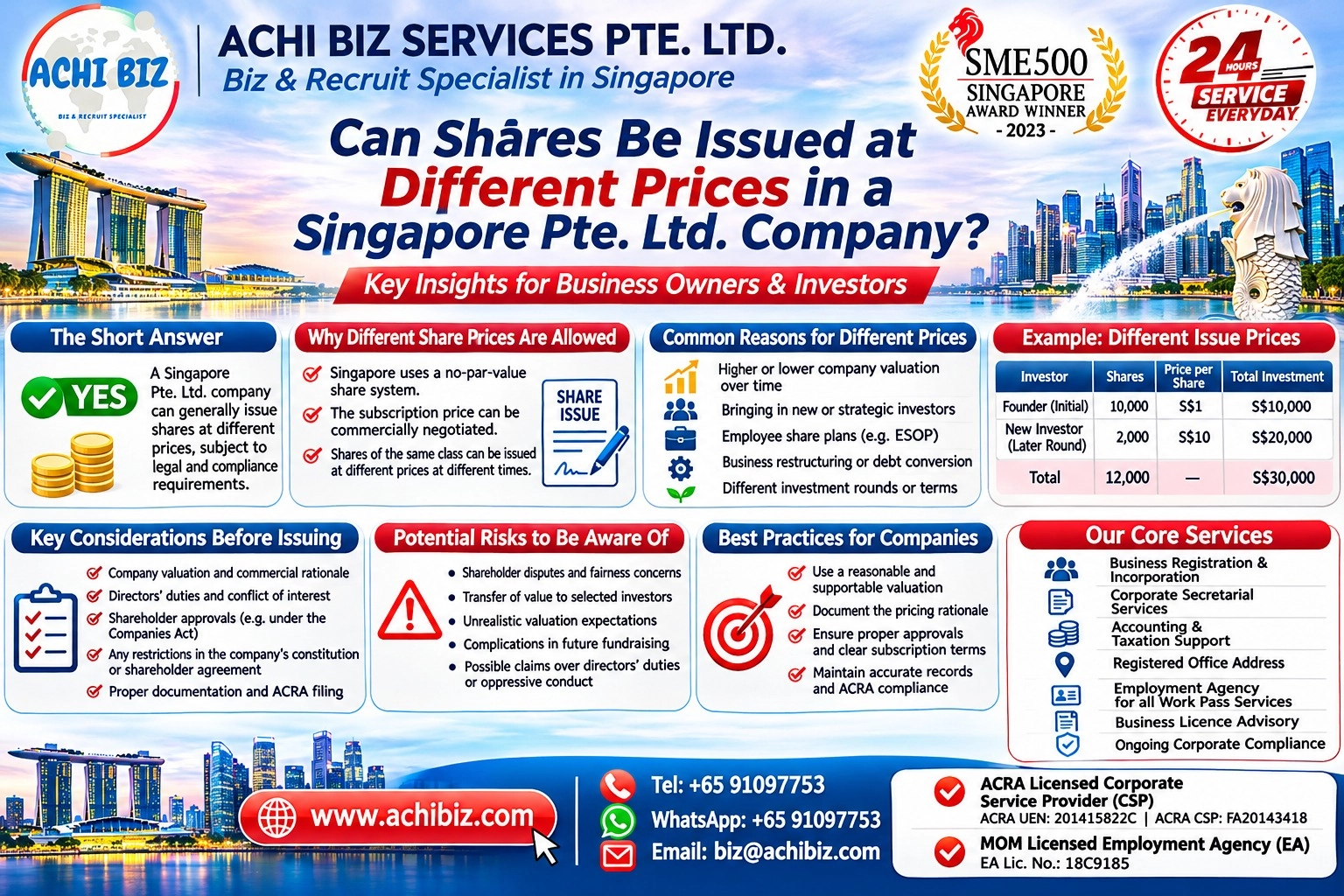
Can Shares Be Issued at Different Prices in a Singapore Pte. Ltd. Company?
A Comprehensive FAQ Guide to Different Share Issue Prices, Share Valuation, Shareholder Rights, ACRA Compliance, Tax Considerations and Business Risks in Singapore.
Issuing shares is one of the ways a Singapore private limited company can raise capital, introduce investors, reward employees or restructure its ownership. However, a question frequently arises when a company has several shareholders or intends to bring in new investors: Can shares in the same Singapore Pte. Ltd. company be issued at different prices?
The short answer is yes. A Singapore company can generally issue shares at different subscription prices, including shares of the same class, provided the transactions comply with the Companies Act 1967, the company’s constitution, applicable shareholder approvals and directors’ duties.
For example, a founder may initially subscribe for 10,000 ordinary shares at S$1 per share. Several years later, when the company has developed a profitable business, a new investor may agree to subscribe for 1,000 ordinary shares at S$50 per share.
Both shareholders may hold ordinary shares with the same rights, even though they paid substantially different prices.
Nevertheless, the ability to issue shares at different prices does not mean directors can determine arbitrary prices without considering fairness, company valuation, shareholder interests and legal obligations.
Different share issue prices can create important commercial and legal consequences, particularly where a company issues shares to founders, directors, related parties, employees or external investors.
This ACHI BIZ FAQ guide focuses specifically on share issue pricing in Singapore private limited companies, including pricing flexibility, valuation methods, discounted share issues, shareholder protections, documentation, accounting treatment and potential disputes.
To avoid repeating our related articles, detailed discussions about share dilution, general share allotment procedures and changes to paid-up capital are covered separately. This article concentrates on why different share prices may be used, how they are determined and when they may become problematic.
Understanding Different Share Issue Prices in Singapore
Can a Singapore Pte. Ltd. company legally issue shares at different prices?
Yes. Under Singapore company law, a private limited company can generally issue shares at different subscription prices in separate allotments, subject to the applicable legal and constitutional requirements.
Singapore operates a no-par-value share system. Consequently, shares do not have a fixed nominal value that dictates the price at which every new share must be issued.
A company may therefore issue ordinary shares at S$1 per share during incorporation and subsequently issue additional ordinary shares at S$10, S$50 or another commercially justified price.
However, directors must ensure that the allotment is properly authorised, serves a legitimate corporate purpose and does not breach applicable shareholder rights or contractual restrictions.
Must all ordinary shares in a Singapore company be issued at the same price?
No. Ordinary shares belonging to the same class do not necessarily need to have the same historical subscription price.
The price paid to acquire a share and the legal rights attached to that share are two separate matters.
For example, a founder who subscribed for ordinary shares at S$1 each and an investor who subsequently subscribed for ordinary shares at S$20 each may have the same voting and dividend rights per share.
The higher subscription price does not automatically give the investor additional voting rights, priority dividends or preferential treatment.
Such rights would need to arise from the company’s share terms, constitution or relevant agreements.
Why would a Singapore company issue shares at different prices?
There are several legitimate commercial reasons.
A company may issue shares at different prices because:
-
Its business valuation has increased or decreased over time.
-
New investors enter the company at different stages of development.
-
A strategic investor contributes commercial benefits beyond funding.
-
The company negotiates different financing terms during separate investment rounds.
-
Employee equity arrangements involve distinct pricing considerations.
-
The company undergoes restructuring or a negotiated debt conversion.
-
Different share classes carry different economic or governance rights.
The key question is whether the price is commercially supportable and whether the directors have complied with their legal responsibilities.
Does a higher share issue price mean the company is more valuable?
Not necessarily, although it may indicate that investors are willing to assign a higher value to the company.
A share subscription price reflects the terms of a particular transaction. It does not automatically establish the company’s independently verified market value.
For instance, an investor may agree to pay a premium because the company owns valuable intellectual property, has strong growth prospects or offers strategic opportunities.
Conversely, a high subscription price negotiated for a small investment may not be representative of what another investor would pay for a controlling interest.
The overall transaction terms, share rights and valuation assumptions must be considered together.
Can a newly incorporated Singapore company issue shares at different prices?
Yes, subject to the company’s incorporation arrangements and subsequent allotment requirements.
For example, a newly incorporated company may issue ordinary shares to its founders under one subscription arrangement and later issue additional shares to an external investor at a different price.
However, where shareholders are subscribing at substantially different prices at approximately the same time, the company should document the commercial reasons carefully.
This is particularly important if all shareholders receive identical share rights but contribute materially different amounts.
Can two shareholders pay different prices for shares with identical rights?
Yes. Different acquisition prices do not necessarily create different legal rights.
Consider a company that issues ordinary shares to two investors:
| Shareholder | Shares subscribed | Price per share | Total investment |
|---|---|---|---|
| Investor A | 10,000 | S$1 | S$10,000 |
| Investor B | 10,000 | S$5 | S$50,000 |
Assuming both investors receive ordinary shares carrying identical rights, each owns the same number of shares despite having contributed different amounts.
The company should nevertheless assess whether the pricing difference is commercially justified and whether any existing agreements impose additional restrictions.
Is the issue price of a share the same as its market value?
No. The issue price is the amount payable under the share subscription arrangement.
Market value generally refers to an estimated price at which the share could be exchanged between willing parties under appropriate market conditions.
For a privately held Singapore company, there may be no readily observable market price because its shares are not publicly traded.
A negotiated issue price may be higher or lower than an independently assessed fair value.
This distinction becomes particularly important when shares are issued to employees, directors, related parties or investors with special contractual rights.
Singapore’s No-Par-Value Share System and Pricing Flexibility
What does the no-par-value share system mean for share issue prices in Singapore?
Singapore abolished the concept of par value for shares in 2006.
Under this system, shares do not carry a predetermined nominal amount that must be used as their issue price.
This provides companies with flexibility when negotiating subscriptions and raising capital.
For example, a company can issue 1,000 ordinary shares for a total consideration of S$100,000 without treating S$1 per share as a compulsory nominal value.
However, the absence of par value does not remove the need for proper authorisation, accurate records or responsible pricing decisions.
Does Singapore company law impose a minimum issue price per share?
There is generally no universal statutory minimum issue price per share for an ordinary Singapore private limited company.
Nevertheless, the issue must involve legally valid consideration, and the company must comply with any applicable restrictions.
The appropriate price depends on the company’s circumstances, the subscription terms and the relevant approvals.
Regulated companies, contractual arrangements and particular transaction structures may involve additional requirements.
Can Singapore companies issue shares above S$1 per share?
Yes. S$1 is not a mandatory issue price.
A Singapore company may issue shares at S$2, S$10, S$100 or another agreed amount per share.
For example, issuing 5,000 ordinary shares at S$20 each would generally represent S$100,000 in aggregate subscription consideration.
The company should document the issue price, consideration, allotment approvals and relevant shareholder arrangements.
Can shares be issued below S$1 per share in Singapore?
Potentially, yes.
Because Singapore shares have no par value, a price below S$1 is not automatically prohibited merely because it is below that amount.
However, the company must consider the proposed consideration, the commercial rationale, any applicable share terms and the requirements of its constitution.
For example, issuing 100,000 shares at S$0.50 per share would represent S$50,000 in aggregate consideration.
Where pricing is unusually low, particularly in transactions involving insiders, directors should assess the risk of unfairness and potential breaches of duty.
Is there a maximum price at which a Singapore company can issue shares?
There is generally no universal statutory maximum issue price for ordinary shares in a Singapore private limited company.
The company and prospective investor may negotiate a price based on the company’s valuation, commercial prospects and the rights attached to the shares.
Nevertheless, an excessively high or unsupported price can create valuation, accounting, tax or commercial concerns.
Directors should avoid presenting a negotiated subscription price as proof of a company’s financial worth without adequate supporting evidence.
Can shares be issued at a premium in Singapore?
Yes. In commercial terminology, a share may be described as issued at a premium when the subscription price exceeds an earlier reference price or an assessed value.
However, Singapore’s no-par-value system means the historical concept of a premium above a share’s nominal value is no longer applicable in the same way.
For example, if existing ordinary shares were previously issued at S$1 each and new ordinary shares are issued at S$15 each, the later shares may informally be described as having been issued at a higher price.
The company should record the actual consideration and apply the appropriate accounting treatment rather than assuming that a separate statutory share premium account must be created.
Does a higher issue price automatically increase the number of shares issued?
No. The number of shares and their issue price are separate transaction variables.
A company raising S$100,000 could potentially issue:
| Issue price per share | New shares issued | Total subscription consideration |
|---|---|---|
| S$1 | 100,000 | S$100,000 |
| S$5 | 20,000 | S$100,000 |
| S$10 | 10,000 | S$100,000 |
| S$100 | 1,000 | S$100,000 |
Each structure raises the same total consideration, but the number of new shares differs.
The resulting ownership percentages depend on the number of shares already issued and the rights attached to the relevant shares.
Determining a Fair Share Issue Price in Singapore
How should a Singapore Pte. Ltd. company determine the price of new shares?
The company should consider its financial position, commercial prospects, existing ownership structure and the purpose of the proposed investment.
Relevant factors may include profitability, net assets, projected cash flows, business risks, intellectual property, outstanding liabilities and comparable transactions.
For an established company, directors may consider obtaining an independent valuation before negotiating a significant share subscription.
For an early-stage business with limited operating history, the price may be based more heavily on projected growth, business potential and negotiations with investors.
The chosen approach should be reasonable for the circumstances and supported by appropriate documentation.
Is an independent valuation compulsory before issuing shares at different prices?
Not generally for every share issue by an ordinary Singapore private limited company.
However, an independent valuation may be advisable where:
-
Shares are issued to directors or related parties.
-
The proposed price differs significantly from recent transactions.
-
Existing shareholders dispute the valuation.
-
The company is undertaking a substantial fundraising exercise.
-
A shareholder’s controlling position may be affected.
-
The transaction involves non-cash consideration.
-
Tax or financial reporting requirements make fair value relevant.
An independent valuation does not guarantee that a transaction will be legally or commercially appropriate, but it can provide useful supporting evidence.
What valuation methods can be used to determine share issue prices?
Different valuation methods may be appropriate depending on the company’s activities and financial circumstances.
| Valuation method | Main consideration | Common application |
|---|---|---|
| Net asset value | Assets less liabilities | Asset-holding businesses |
| Earnings multiple | Profitability and comparable valuations | Established profitable companies |
| Discounted cash flow | Forecast future cash flows | Businesses with supportable projections |
| Revenue multiple | Revenue and growth characteristics | Selected growth-stage businesses |
| Recent investment price | Pricing from comparable transactions | Companies with recent funding rounds |
| Negotiated valuation | Commercial terms agreed between parties | Startups and strategic investments |
No single method is appropriate for every Singapore company.
A valuation should also consider whether the relevant shares represent a minority interest, a controlling interest or shares carrying special rights.
Can a startup issue shares at different prices without a history of profitability?
Yes.
Startups often raise capital before achieving profitability. Their share prices may therefore reflect business potential rather than historical earnings.
Investors may consider the experience of the founders, technology, intellectual property, customer traction, market opportunities and expected future financing requirements.
However, optimistic projections should not be presented as guaranteed results.
Where an early-stage company issues shares at substantially different prices, clear documentation can help explain the commercial assumptions behind each transaction.
Can a loss-making Singapore company issue shares at a high price?
Yes, provided the transaction is otherwise lawful.
A loss-making company may still possess valuable assets, intellectual property, customer relationships or future commercial opportunities.
An investor may therefore be willing to subscribe for shares at a relatively high price despite the company’s current losses.
Nevertheless, the company should avoid suggesting that a high subscription price eliminates its financial difficulties.
Investors should examine cash flow, accumulated losses, outstanding liabilities and the company’s ability to continue operating.
Does the company’s net asset value determine the minimum share issue price?
Not automatically.
Net asset value is one valuation reference, but it is not necessarily a statutory pricing floor for every share issue.
For example, a company may have substantial net assets but weak profitability, significant contingent liabilities or limited marketability.
Alternatively, a technology company may have modest recorded net assets but valuable commercial opportunities.
Directors should consider whether the proposed price is reasonable in the context of the transaction rather than relying exclusively on net asset value.
Can a company issue shares below their independently assessed fair value?
Potentially, but the transaction requires careful examination.
Issuing shares below an assessed fair value may be commercially justified in certain circumstances, such as an urgent fundraising exercise or a transaction involving additional strategic benefits.
However, a discounted issue could also disadvantage existing shareholders or transfer economic value to the new subscriber.
Directors must consider the company’s interests, the proper purpose of the allotment, conflicts of interest and applicable shareholder protections.
The fact that shareholders approve a transaction does not automatically eliminate every potential legal concern.
Can a Singapore company issue shares above their independently assessed fair value?
Yes, an investor may agree to pay more than an independently estimated value.
For example, a strategic investor may value access to the company’s distribution network, technology or commercial relationships.
Nevertheless, the company should ensure that all material terms are accurately disclosed and that the transaction is not supported by misleading financial information.
A premium paid for strategic reasons should not automatically be treated as evidence that every outstanding share could be sold at the same price.
Different Share Prices for Founders, Investors and Employees
Can founders receive shares at a lower price than external investors?
Yes. This is common in many businesses.
Founders frequently subscribe for shares when the company has limited assets, little revenue and considerable commercial uncertainty.
External investors may join much later, after the business has developed products, customers, intellectual property or profitable operations.
The higher price paid by later investors may reflect the increased value and reduced uncertainty of the business.
However, where founders and investors subscribe at different prices at approximately the same time, the company should examine the underlying arrangements more carefully.
Can two new investors subscribe for ordinary shares at different prices during the same fundraising round?
Potentially, yes.
Different prices may arise from negotiated terms, different investment dates, strategic contributions or separate contractual arrangements.
However, the directors should assess whether the distinction is commercially justified.
If two investors receive identical ordinary shares at substantially different prices under otherwise comparable circumstances, the company should be prepared to explain the pricing difference.
Existing shareholders may also have contractual rights requiring equal treatment or approval of particular transactions.
Can a Singapore company offer discounted shares to a strategic investor?
Yes, subject to applicable legal and contractual requirements.
A strategic investor may contribute valuable commercial relationships, technology, distribution capabilities or specialist expertise.
These benefits may influence the negotiated subscription price.
However, the company should distinguish between benefits that are genuinely valuable to the business and unsupported expectations.
Where services, assets or other non-cash benefits form part of the share consideration, the terms and valuation require additional scrutiny.
Can directors subscribe for new shares at a lower price than other shareholders?
Potentially, but such transactions present heightened governance risks.
Directors owe statutory and fiduciary duties to the company. They must exercise their powers for proper purposes and manage conflicts of interest appropriately.
A director receiving shares at a favourable price may have a personal interest that conflicts with the interests of the company or other shareholders.
Depending on the circumstances, the company may need appropriate disclosures, independent assessment, shareholder approvals and additional safeguards.
Directors should not assume that holding a management position entitles them to discounted shares.
Can employees receive company shares at a discounted price in Singapore?
Yes, employee share arrangements may provide shares at discounted prices or under other incentive structures.
However, the commercial and legal treatment depends on the particular arrangement.
Employee share options, direct share awards and employee share purchase arrangements are not necessarily equivalent.
The company should consider employment-related tax implications, vesting conditions, transfer restrictions, accounting requirements and shareholder approvals.
A discounted employee share arrangement should not be treated as an ordinary investment subscription without reviewing its specific terms.
Can a company issue shares to family members at different prices?
Potentially, yes.
However, family relationships do not exempt a company from its legal obligations.
If a family-controlled Singapore company issues shares to relatives at unusually favourable prices, the directors should consider whether the arrangement unfairly disadvantages other shareholders.
The company should also assess whether the transaction involves gifts, employment benefits, related-party considerations or other consequences requiring specialist advice.
Can a foreign investor pay a different share issue price from a Singapore shareholder?
Yes, provided the arrangement complies with applicable law.
Singapore company law does not generally require a foreign investor and a local investor to subscribe at identical prices solely because of their nationality.
Different pricing may reflect investment timing, negotiated rights or commercial considerations.
However, foreign investment restrictions in particular regulated sectors, the company’s constitution and contractual arrangements may affect the transaction.
A foreign investor should also consider exchange-rate exposure and any relevant tax consequences.
Can a holding company subscribe for subsidiary shares at a different price from minority shareholders?
Yes, subject to applicable legal requirements and shareholder protections.
For example, a parent company may subscribe for additional shares in its Singapore subsidiary as part of a group restructuring or capital injection.
Where minority shareholders are present, the directors should carefully consider the subscription price and its impact on those shareholders.
Related-party pricing, financial reporting, governance and potential conflicts of interest may require additional attention.
Share Issue Prices and Shareholder Rights
Does paying more for ordinary shares give an investor greater voting power?
Not automatically.
Voting rights generally depend on the rights attached to the shares and the number of voting shares held, rather than the historical amount paid for each share.
For example, assuming one vote per ordinary share:
-
Shareholder A holds 10,000 ordinary shares purchased at S$1 each.
-
Shareholder B holds 10,000 ordinary shares purchased at S$20 each.
Each would ordinarily have the same number of votes despite their different subscription costs.
Different voting arrangements may apply if the company has lawfully established shares with different voting rights.
Does an investor who pays a higher share price receive larger dividends?
Not automatically.
Dividend entitlements depend on the rights attached to the shares and the company’s lawful dividend arrangements.
Where two shareholders hold the same number of fully paid ordinary shares carrying identical dividend rights, the fact that one paid a higher subscription price does not automatically entitle that shareholder to a larger dividend.
Different outcomes may arise where shares have different rights or where the terms of partly paid shares are relevant.
Can shareholders holding the same class of shares have different acquisition costs?
Yes.
Shareholders may acquire shares through separate subscriptions or transfers at different prices.
Their acquisition costs may affect their individual investment returns and relevant tax positions, but those costs do not necessarily alter the rights attached to the shares.
A shareholder’s personal purchase price should therefore not be confused with the company’s current share capital or the legal characteristics of the shares.
Can an investor demand preferential rights because they paid a higher issue price?
An investor may negotiate preferential rights, but those rights do not arise automatically from paying more.
For example, an investor may seek:
-
Priority distributions under properly structured preference shares.
-
Particular voting or consent rights.
-
Information and reporting rights.
-
Board representation.
-
Restrictions on future share issues.
-
Contractual protections against certain financing transactions.
Whether these arrangements are enforceable depends on their terms, the company’s constitution and applicable Singapore law.
Can shares with different rights also be issued at different prices?
Yes.
A Singapore company may have different classes of shares, subject to the applicable statutory and constitutional requirements.
For example, ordinary shares and preference shares may carry different economic or governance rights.
Their prices may differ because investors are purchasing different rights.
However, a difference in price alone does not establish a separate share class.
The company must properly document the rights attached to each class.
Can a company create different share classes simply to justify different issue prices?
Creating separate share classes should serve a legitimate commercial purpose.
A company should not assume that labelling shares as different classes automatically resolves concerns about fairness, conflicts of interest or shareholder rights.
The rights and restrictions of each class must be clearly established, and the relevant statutory and constitutional requirements must be satisfied.
The company should consider whether separate classes are actually necessary or whether different subscription prices for the same class would adequately address its commercial objectives.
Does a different issue price change a shareholder’s percentage of ownership?
Not by itself.
Ownership percentages generally depend on the number of shares held relative to the relevant total number of issued shares.
For example, if a company has 100,000 ordinary shares and a shareholder owns 25,000 of them, that shareholder holds 25% of those ordinary shares.
The amount paid per share does not independently change that percentage.
However, issuing additional shares may change the ownership percentages. The detailed mechanics are addressed in ACHI BIZ’s separate article, “What Is Share Dilution in a Singapore Pte. Ltd. Company? Causes, Examples & Risks.”
Legal Requirements and Directors’ Responsibilities
What Singapore law governs the issue of shares at different prices?
The principal legislation is the Companies Act 1967.
Relevant provisions include those concerning directors’ powers and duties, shareholder approval for share issues, company records and statutory filings.
In particular, section 161 addresses shareholder approval for directors to issue shares, subject to the statutory framework and applicable exceptions.
Section 157 addresses directors’ duties to act honestly and use reasonable diligence in the discharge of their responsibilities.
The company’s constitution and shareholder agreements may impose further restrictions.
The precise legal requirements depend on the nature of the proposed transaction.
Must shareholders approve a share issue at a different price?
The company must comply with the applicable statutory requirements for authorising the issue of shares.
Under section 161 of the Companies Act, directors generally require approval from the company in general meeting to exercise the power to issue shares, subject to the statutory provisions and exceptions.
The company should also examine whether an existing approval adequately covers the proposed transaction.
Additional approvals may be necessary under the constitution, shareholders’ agreement or relevant contractual arrangements.
A different issue price does not necessarily require a separate category of approval solely because the price differs from earlier allotments.
Can directors independently decide the price of new shares?
Directors may negotiate and recommend subscription prices within the scope of their lawful authority.
However, their pricing decisions must comply with directors’ duties and the applicable corporate approval framework.
They should consider whether the proposed price and transaction structure serve the company’s interests.
Where directors have personal interests in the transaction, proper conflict management is especially important.
Can shareholders challenge an unfair share issue price?
Potentially, yes.
A shareholder may have grounds to challenge a transaction depending on the circumstances, including alleged breaches of directors’ duties, improper purposes, contractual violations or oppressive conduct.
Section 216 of the Companies Act provides a statutory remedy in certain circumstances involving oppression or unfairly prejudicial conduct.
However, a shareholder cannot necessarily invalidate an allotment simply because another investor obtained a more favourable price.
The legal assessment depends on the facts, the rights involved and the conduct of the parties.
Can directors issue cheap shares to themselves to strengthen their control?
Such an arrangement can raise serious legal concerns.
Where directors use share allotment powers primarily to manipulate voting control rather than for a proper corporate purpose, the transaction may be challenged.
The existence of a shareholder approval does not automatically make every exercise of directors’ powers proper.
Companies should obtain legal advice before undertaking transactions involving potential conflicts of interest or changes in control.
Can minority shareholders object to shares being issued below market value?
Yes, minority shareholders may raise objections and seek appropriate remedies where the circumstances justify them.
However, the existence of a discount does not automatically establish wrongdoing.
Relevant considerations include the commercial purpose, financial position of the company, fairness of the transaction, directors’ conduct and any applicable shareholder rights.
A properly documented, commercially justified fundraising transaction may be treated differently from a transaction designed to transfer value to insiders.
Do existing shareholders automatically have the right to subscribe at the same price as new investors?
Not necessarily.
Pre-emption rights may arise under the company’s constitution, shareholder agreements or other applicable arrangements.
Such rights can require shares to be offered to existing shareholders before being issued to outsiders, depending on their precise terms.
However, companies should not assume that every Singapore private limited company has an identical statutory or contractual pre-emption arrangement.
For detailed discussion, refer to ACHI BIZ’s separate articles on pre-emption rights and their waiver or exclusion in Singapore Pte. Ltd. companies.
Can a company issue shares at different prices without informing existing shareholders?
The answer depends on the approvals required, the company’s constitution, shareholder agreements and the circumstances of the transaction.
Directors must comply with applicable legal obligations, including obtaining necessary authorisation and maintaining accurate company records.
Existing shareholders may also possess contractual information or consent rights.
Even where advance notice to every shareholder is not independently required, inadequate communication about a material share issue can create disputes and undermine confidence.
Can a shareholder agreement restrict the issue price of new shares?
Yes.
A shareholder agreement may contain provisions governing future financing, valuation, investor consent, pre-emption rights or restrictions on issuing shares below an agreed price.
For example, an agreement might require investor consent before the company issues shares at a valuation below a specified threshold.
The company should review these contractual obligations before finalising a subscription.
A transaction that satisfies statutory requirements may still create contractual liability if it breaches an enforceable shareholder agreement.
ACRA Requirements and Share Allotment Documentation
Must a Singapore company notify ACRA when issuing shares at a different price?
Yes. A company issuing new shares must comply with the applicable ACRA filing requirements for share allotments.
The company should accurately report the relevant particulars, including the number and class of shares, consideration and other information required by the filing process.
The fact that the issue price differs from an earlier allotment does not remove the filing obligation.
For private companies, the statutory framework governing the electronic register of members is also important when determining when an allotment takes effect.
Does ACRA approve or determine the share issue price?
No. ACRA does not ordinarily act as a commercial valuation authority for private company share subscriptions.
Its role concerns corporate registration, statutory information and regulatory compliance.
A filing being accepted should not be interpreted as confirmation that the issue price represents fair market value or that the directors have fulfilled every fiduciary or contractual obligation.
Responsibility for the transaction remains with the company and its relevant officers.
What documents should support a share issue at a different price?
The documentation depends on the transaction, but commonly includes:
-
Relevant shareholder and board resolutions.
-
A share subscription agreement or written subscription terms.
-
The company’s constitution and relevant shareholder agreement provisions.
-
Supporting valuation or pricing analysis, where appropriate.
-
Evidence of payment or other agreed consideration.
-
Relevant conflict-of-interest disclosures.
-
Updated shareholding and capitalisation records.
-
Applicable ACRA filing records.
Where the transaction involves non-cash consideration, related parties or special share rights, additional documents may be necessary.
Is a share subscription agreement necessary when different investors pay different prices?
A written subscription agreement is strongly advisable, particularly where investors are paying different prices.
It can establish the number and class of shares, price per share, payment arrangements, completion conditions, representations and investor obligations.
It can also explain any additional rights or commercial benefits associated with the transaction.
Although not every simple share allotment necessarily requires a lengthy standalone agreement, clear written terms help prevent misunderstandings.
Should the company explain why different shareholders paid different prices?
Where the pricing difference is material, documenting the rationale is prudent.
The explanation may refer to changes in company valuation, different subscription dates, negotiated commercial terms or the strategic contribution of an investor.
For related-party transactions, stronger documentation may be necessary to demonstrate that the directors considered the company’s interests.
A brief explanation recorded at the time of the transaction is generally more persuasive than a justification prepared only after a dispute arises.
Can shares be allotted before the full subscription price is received?
Shares may be issued on partly paid terms where legally and contractually permitted.
However, the company must accurately distinguish between amounts paid and amounts remaining unpaid.
For example, an investor may agree to subscribe for 10,000 shares at S$10 each, with only part of the S$100,000 consideration payable immediately.
The unpaid amount and payment obligations should be clearly documented.
For detailed analysis of partly paid shares and unpaid share capital, refer to ACHI BIZ’s separate article, “Can a Singapore Company Issue Shares Without Receiving Full Payment?”
Can a company change the issue price after the shares have already been allotted?
A completed allotment should not be treated as though its original terms can simply be rewritten without legal consequences.
If the company discovers an error or wishes to change an agreed price, it should first establish whether the allotment has become effective and what contractual obligations have arisen.
Depending on the circumstances, the matter may require contractual amendments, corrective filings, accounting adjustments or a separate corporate transaction.
The company should not retrospectively alter records merely to achieve a preferred capital figure.
Can ACRA records show shares issued at different prices?
Yes. A company’s statutory records and relevant allotment information can reflect different consideration amounts associated with separate share issues.
However, the presentation of capital information must be distinguished from the company’s underlying share rights and accounting records.
The company should maintain a clear reconciliation between the consideration agreed, consideration received, unpaid amounts and its recorded share capital.
Does a different issue price require the company to amend its constitution?
Not necessarily.
If the proposed shares belong to an existing class and the constitution permits the transaction, an amendment may not be required solely because the price differs.
However, an amendment may become necessary where the company proposes new share rights, changes to existing class arrangements or other matters that require constitutional modification.
The company’s existing constitution must be reviewed before proceeding.
Accounting and Financial Reporting Implications
How are shares issued at different prices recorded in the company’s accounts?
The accounting treatment depends on the applicable financial reporting standards, the nature of the shares and the consideration received.
For a straightforward issue of ordinary equity shares for cash, the company generally recognises the relevant proceeds within equity, subject to applicable transaction-cost and other accounting requirements.
For example, assume a company issues:
| Allotment | Number of shares | Price per share | Gross consideration |
|---|---|---|---|
| First issue | 10,000 | S$1 | S$10,000 |
| Second issue | 5,000 | S$10 | S$50,000 |
| Third issue | 2,000 | S$25 | S$50,000 |
| Total | 17,000 | — | S$110,000 |
Assuming all shares are ordinary equity shares, fully paid in cash, with no relevant transaction costs or other adjustments, the aggregate contributed share capital would be S$110,000.
The company should not assume that all 17,000 shares have a historical issue price of S$1 simply because the first allotment was made at that price.
Does issuing shares at a higher price increase paid-up capital?
Generally, a cash subscription for fully paid ordinary shares increases the company’s contributed share capital by the relevant amount, subject to applicable accounting and legal treatment.
However, the issue price, number of shares and amount actually paid must be distinguished.
For example, issuing 1,000 fully paid ordinary shares at S$100 each would ordinarily involve S$100,000 in gross subscription consideration.
If the shares are only partly paid, the company must properly record the unpaid consideration rather than presenting it as cash already received.
Does a higher share issue price automatically increase company profits?
No.
Proceeds from issuing ordinary equity shares are generally capital contributions rather than revenue earned from ordinary business activities.
For example, receiving S$500,000 from an investor subscribing for shares does not mean the company has earned S$500,000 in operating profit.
The funds may improve liquidity and financial resources, but they should not be confused with sales income.
Does issuing shares at different prices create a separate share premium account?
Not merely because the prices differ.
Singapore’s no-par-value system removed the historical distinction between nominal share capital and share premium for ordinary new share issues.
The company should follow the applicable accounting requirements and accurately record the consideration.
It should not automatically create a separate share premium account simply because shares were issued above an earlier subscription price.
Can different share issue prices affect earnings per share?
Yes, indirectly.
Issuing additional ordinary shares can increase the number of shares used in earnings-per-share calculations where those calculations are applicable.
However, the historical price paid for each ordinary share does not independently determine earnings per share.
The effect depends on the company’s profits, the relevant weighted-average share count and the applicable accounting framework.
Does a higher subscription price improve the company’s balance sheet?
It may strengthen the company’s equity and liquidity where the company receives additional cash without creating an equivalent repayment obligation.
However, the balance-sheet impact depends on the transaction.
For example, an issue of shares in exchange for non-cash assets may increase recognised assets and equity without increasing cash.
Similarly, converting an existing debt into equity may reduce liabilities without generating new cash.
The commercial substance of the transaction is therefore more important than the headline issue price.
Can different issue prices create problems during an audit?
They can lead to additional audit questions, particularly where the differences are significant or involve related parties.
Auditors may examine the subscription agreements, approvals, valuation assumptions, payment records and accounting treatment.
Unusual pricing arrangements may require further explanation.
Maintaining complete contemporaneous documentation can make the audit process more efficient and reduce uncertainty.
Tax Considerations When Shares Are Issued at Different Prices
Does a Singapore company pay corporate income tax on money received from issuing ordinary shares?
Generally, proceeds received by a company from issuing its own ordinary equity shares as capital contributions are not ordinary taxable trading revenue.
However, the precise treatment depends on the nature and substance of the transaction.
The company should distinguish genuine equity contributions from payments for services, business income or other arrangements that may have different tax consequences.
Is GST charged when a Singapore company issues new shares?
The issue of shares is generally treated as an exempt financial supply for Singapore GST purposes, subject to the applicable rules.
It should not be treated in the same manner as an ordinary taxable sale of goods or services.
However, the GST treatment of related professional fees, transaction costs and input tax recovery may require separate consideration.
Is stamp duty payable when a Singapore company issues new shares at different prices?
A genuine allotment of newly issued shares is generally different from a transfer of existing shares.
Singapore share transfer stamp duty ordinarily concerns relevant instruments transferring shares, whereas a straightforward allotment of new shares generally does not attract the same share transfer duty.
However, complex transactions, property-holding entities and associated arrangements may have additional stamp duty implications.
Companies should not assume that every transaction described as a share subscription is automatically free from all possible stamp duties.
Can issuing discounted shares to employees create personal income tax implications?
Yes.
Employee share awards and share options may give rise to employment-related tax consequences.
The treatment depends on the structure of the arrangement, the employee’s circumstances and the applicable IRAS rules.
A discounted subscription price does not automatically mean the entire difference between the subscription price and an estimated market value is taxed in the same way in every situation.
Companies should review the relevant employee equity tax rules before implementing an incentive arrangement.
Can a director receive discounted shares without any tax consequences?
Not necessarily.
Where shares are provided to a director in connection with employment or services, the arrangement may create tax considerations.
The company should assess the nature of the benefit, the director’s role and the applicable tax rules.
It should also consider whether the transaction involves related-party disclosures or conflicts of interest.
Does a higher share issue price affect capital gains tax in Singapore?
Singapore generally does not impose a broad capital gains tax.
However, gains from transactions in shares may be taxable where they are revenue in nature, depending on the circumstances.
The price paid to acquire shares may be relevant in determining the economic gain or loss on a subsequent disposal.
The tax treatment should not be assumed solely from the label attached to a transaction.
Can IRAS question share transactions involving unusually low or high prices?
Potentially, depending on the transaction and the relevant tax provisions.
Unusual pricing may be relevant where shares are connected with employment benefits, related-party arrangements or other tax-sensitive transactions.
The company should maintain appropriate supporting documents and obtain specialist tax advice where material issues arise.
A negotiated issue price does not automatically determine the value that must be used for every tax purpose.
Practical Examples of Different Share Issue Prices in Singapore
How can a Singapore company issue shares at S$1 initially and S$10 later?
Consider a company incorporated with 10,000 ordinary shares issued to its founder at S$1 each.
The initial investment is S$10,000.
Two years later, the company has developed a profitable business and negotiates a subscription with a new investor.
The investor agrees to subscribe for 2,000 new ordinary shares at S$10 each.
| Particulars | Initial issue | Subsequent issue |
|---|---|---|
| Shares issued | 10,000 | 2,000 |
| Issue price per share | S$1 | S$10 |
| Consideration | S$10,000 | S$20,000 |
| Total shares after issue | 10,000 | 12,000 |
Assuming both allotments involve fully paid ordinary shares with identical rights, the company would have 12,000 issued ordinary shares and S$30,000 in aggregate gross contributed share capital.
The founder and new investor have paid different prices, but their shares may carry identical rights.
How does a company’s valuation influence the price paid by a new investor?
Suppose a company and investor agree on a pre-money equity valuation of S$900,000.
The company currently has 90,000 ordinary shares, with no options, convertible instruments or other relevant adjustments.
The implied price is:
If the investor contributes S$100,000 at that price, the company issues 10,000 new shares.
After the issue, the company has 100,000 ordinary shares.
The investor holds 10% of the enlarged ordinary share capital, assuming identical rights.
The post-money valuation would be S$1 million under these simplified assumptions.
Importantly, this is a negotiated valuation example, not a mandatory formula under Singapore company law.
Can a Singapore company issue shares at S$5 and S$50 in different investment rounds?
Yes.
Suppose a startup raises S$100,000 by issuing 20,000 ordinary shares at S$5 each.
Two years later, after substantial business growth, it raises another S$500,000 by issuing 10,000 ordinary shares at S$50 each.
The pricing difference may reflect increased business value between the two fundraising rounds.
However, the company should ensure that the valuations, investor rights and contractual obligations are properly considered.
The second-round price does not automatically mean that all existing shares can immediately be sold for S$50 each.
What happens if a Singapore company issues shares at a lower price than its previous fundraising round?
This is commonly referred to as a down round where the later financing implies a lower company valuation.
For example:
| Financing round | Issue price per ordinary share |
|---|---|
| Earlier investment round | S$20 |
| Later investment round | S$8 |
A lower subsequent price may reflect weaker financial performance, reduced growth expectations, difficult market conditions or an urgent need for funding.
Existing investors may be concerned about the implied reduction in investment value.
The company should review any anti-dilution provisions, investor consent requirements and other contractual protections before proceeding.
Can a profitable company issue shares at a lower price to attract a strategic partner?
Potentially, yes.
For example, a company may consider offering a favourable subscription price to an investor capable of providing access to major customers or overseas markets.
However, the directors should assess whether the anticipated strategic benefits justify the pricing concession.
Where the benefits are speculative, the company risks transferring economic value without obtaining an adequate commercial return.
A clear business case and appropriate approvals are particularly important.
Can a family-owned Singapore company issue shares to the next generation at a lower price?
Potentially, but the arrangement should be reviewed carefully.
Family succession planning may involve commercial, legal and tax considerations beyond an ordinary fundraising transaction.
Where other shareholders are involved, discounted issues may create disputes over fairness and control.
The company should also consider whether a share transfer, share subscription or another restructuring arrangement is more appropriate.
These alternatives have different legal and tax consequences.
Can a company issue ordinary shares at different prices without changing the rights attached to existing shares?
Yes.
A difference in subscription price does not necessarily require any amendment to the rights attached to existing ordinary shares.
However, the issue of additional shares may still affect the proportion of ownership held by existing shareholders.
The company should distinguish between a change in the percentage of shares held and a change in the legal rights attached to each share.
Can different share issue prices create an unfair advantage for certain investors?
Yes, depending on the circumstances.
For example, if an investor receives shares at a substantially lower price without providing corresponding commercial benefits, that investor may obtain a more favourable economic position than others.
However, different prices are not inherently unfair.
The assessment depends on investment timing, transaction terms, risk exposure, valuation, contractual rights and the conduct of the directors.
The company should consider the complete transaction rather than comparing prices in isolation.
Business Risks of Issuing Shares at Different Prices
What are the main risks of issuing shares at different prices in Singapore?
Although different share issue prices are generally permissible, they can create legal, financial and commercial risks if not properly managed.
The principal concerns include shareholder disputes, unsupported valuations, conflicts of interest, unfair economic treatment, misleading investor expectations and inadequate documentation.
Different pricing can also complicate future fundraising negotiations, particularly where earlier investors believe they received less favourable terms.
The company should assess these risks before committing to a subscription price.
Can different share issue prices damage relationships between shareholders?
Yes.
Shareholders may question why another investor received the same class of shares at a substantially lower price.
Such concerns may become more serious where the investors subscribed at approximately the same time or where the lower-priced shares were issued to directors or their associates.
Clear communication, transparent commercial reasoning and properly documented agreements can help reduce misunderstandings.
Can issuing shares at a low price transfer economic value to a new investor?
Potentially, yes.
Consider a company with 100,000 ordinary shares and an estimated equity value of S$1 million.
If the company issues 100,000 additional ordinary shares to a new investor for only S$100,000, the investor would own 50% of the enlarged ordinary share capital.
Under simplified assumptions, the company’s post-investment equity value would be S$1.1 million, giving the new investor’s 50% interest an implied value of S$550,000.
This illustrates how an unusually low subscription price can transfer economic value from existing shareholders to a new subscriber.
Actual valuations depend on the company’s circumstances, transaction terms and applicable share rights.
Can a high share issue price create unrealistic expectations?
Yes.
Investors who subscribe at a high valuation may expect strong future growth or a substantial return on investment.
If the company subsequently underperforms, those expectations may become difficult to satisfy.
A high subscription price does not guarantee future profitability, dividend payments or an opportunity to sell the shares at a profit.
Companies should avoid making unsupported representations about future performance.
Can different issue prices affect future fundraising negotiations?
Yes.
Future investors may examine earlier subscription prices to understand the company’s valuation history.
They may ask why certain shareholders paid substantially more or less and whether special rights were granted.
A company with inconsistent or poorly documented pricing arrangements may face more difficult due diligence.
Maintaining a clear explanation of each financing round can improve transparency.
Can an earlier investor demand a refund if later shares are issued more cheaply?
Not automatically.
An investor generally cannot demand a refund solely because the company subsequently issues shares at a lower price.
However, the investor may have contractual protections or other legal rights that become relevant.
For example, a shareholders’ agreement may contain anti-dilution provisions or consent requirements relating to future fundraising.
The outcome depends on the applicable agreements and circumstances.
Can shareholders sue directors over unfair share pricing?
Potentially.
Where directors allegedly misuse their powers, breach fiduciary duties or participate in oppressive conduct, affected parties may have legal remedies.
However, disagreement over the commercial attractiveness of an issue price does not automatically establish a legal claim.
The relevant evidence may include valuation records, board deliberations, conflicts of interest, shareholder approvals and the purpose of the transaction.
Can different share issue prices affect the sale of a Singapore company?
Yes.
A potential buyer may review the company’s historical share issues during due diligence.
Unexplained pricing differences, disputed allotments or unresolved shareholder claims may complicate negotiations.
The buyer may also examine whether particular investors possess special rights that could affect an acquisition.
Accurate statutory records and complete transaction documents can reduce these difficulties.
Managing Different Share Issue Prices Responsibly
What should directors consider before approving a new share issue price?
Directors should consider whether the transaction serves a legitimate corporate purpose and whether the proposed consideration is commercially reasonable.
They should also review the company’s financial position, valuation assumptions, existing shareholder rights and any conflicts of interest.
Where the pricing difference is substantial, additional supporting evidence may be appropriate.
The decision should be made within the company’s lawful authority and recorded properly.
Should a company establish a share pricing policy?
A formal share pricing policy is not generally compulsory for every Singapore private limited company.
However, companies that regularly raise capital or operate employee equity programmes may benefit from documented pricing principles.
Such principles could address valuation methods, approval procedures, conflicts of interest and the circumstances in which independent valuations should be obtained.
A policy should support responsible decision-making rather than replace the directors’ legal obligations.
How can a company minimise shareholder disputes over different issue prices?
A company can reduce potential disputes by communicating material information appropriately, documenting the commercial reasons for each transaction and complying with applicable shareholder protections.
It should also ensure that the subscription agreements accurately reflect the agreed terms.
Where a transaction involves directors, family members or related parties, independent advice may provide additional safeguards.
Is it better to issue shares at the same price to all investors?
Not necessarily.
Uniform pricing may be appropriate where investors subscribe at the same time under comparable terms.
However, different prices may be commercially reasonable where investments occur at different stages or involve materially different rights and obligations.
The objective should not be uniformity for its own sake. It should be lawful, commercially supportable pricing that serves the company’s interests.
What should a Singapore company do if it discovers inconsistent share issue records?
The company should review the original resolutions, subscription agreements, payment evidence, statutory filings and accounting records.
It should identify whether the inconsistency is a clerical error, an accounting issue or a substantive legal problem.
Corrective action should follow the applicable procedures.
The company should not simply alter historical issue prices or capital records without determining the legal basis for the correction.
Frequently Asked Questions About Different Share Issue Prices
Can a Singapore company issue 1,000 shares at S$1 and another 1,000 shares at S$100?
Yes, generally, provided both allotments comply with the applicable legal and constitutional requirements.
Assuming the shares are fully paid ordinary equity shares issued for cash, the two allotments would involve aggregate gross consideration of S$101,000.
The company should document the commercial basis for the substantially different prices.
Can one ordinary share cost more than another ordinary share in the same company?
Yes.
The acquisition price may differ even where both shares carry identical legal rights.
This commonly occurs when shares are issued or transferred at different times.
Can a company issue shares for less than their previous subscription price?
Yes, potentially.
However, directors should assess the commercial reasons, shareholder rights and potential consequences of the lower price.
Can a company issue shares at a different price every year?
Yes, subject to the applicable legal and contractual requirements.
There is no general requirement that every future share allotment must use a historical subscription price.
Each proposed issue should be considered on its own merits.
Can a shareholder refuse to accept a lower valuation in a future funding round?
A shareholder may object or exercise applicable contractual or statutory rights.
However, whether the shareholder can prevent the transaction depends on the company’s approval requirements and the shareholder’s rights.
A disagreement over valuation does not necessarily give every shareholder an individual veto.
Can different share issue prices affect a company’s bank account application?
They may form part of the company’s ownership and funding history, which a bank could examine during due diligence.
However, a particular issue price does not automatically determine whether a bank will approve an account.
Banks consider various factors, including business activities, ownership, source of funds and compliance requirements.
Does issuing shares at a higher price guarantee better access to business loans?
No.
Lenders generally assess repayment capacity, cash flow, financial statements, existing liabilities, business risks and other credit factors.
A higher share subscription price may contribute additional equity funding, but it does not guarantee loan approval.
Can a Singapore company issue shares at different prices to attract foreign investors?
Yes, where the arrangement is lawful and commercially appropriate.
However, the company should assess whether the pricing terms, ownership arrangements and investor rights are suitable for its circumstances.
Can different issue prices affect an investor’s return on investment?
Yes.
An investor who pays a lower acquisition price may achieve a different percentage return from an investor who pays more for otherwise identical shares.
For example, if two investors eventually sell identical ordinary shares for S$20 each:
| Investor | Original price | Sale price | Gain or loss per share |
|---|---|---|---|
| Investor A | S$5 | S$20 | S$15 gain |
| Investor B | S$25 | S$20 | S$5 loss |
This simplified example excludes transaction costs, taxes and other adjustments.
It demonstrates why subscription price is important to investment returns even when share rights are identical.
Can different share issue prices affect the company’s ultimate beneficial ownership information?
Different prices do not independently determine beneficial ownership.
However, new share issues may alter ownership percentages, voting rights or control arrangements.
The company should review whether any relevant changes require updates to its statutory registers or regulatory information, including applicable registrable controller requirements.
What is the most important consideration when issuing shares at different prices?
The central consideration is whether the transaction is lawful, properly authorised, commercially justified and accurately documented.
A different issue price is not inherently problematic.
Problems are more likely to arise when directors overlook shareholder rights, use unsupported valuations, fail to manage conflicts of interest or maintain inaccurate records.
Practical Checklist Before Issuing Shares at Different Prices
| Area for review | Key question | Why it matters |
|---|---|---|
| Commercial purpose | Why are new shares being issued? | Establishes the business rationale |
| Pricing | How was the subscription price determined? | Supports reasonable valuation |
| Share rights | Do the new shares have identical or different rights? | Clarifies investor entitlements |
| Directors’ duties | Are directors acting for proper purposes? | Reduces governance risks |
| Conflicts of interest | Are directors or related parties involved? | Identifies potential unfairness |
| Shareholder approvals | Have the necessary approvals been obtained? | Supports legal compliance |
| Existing agreements | Are there pricing or consent restrictions? | Avoids contractual breaches |
| Consideration | Is payment in cash or another form? | Determines documentation and accounting |
| Financial reporting | How should the transaction be recorded? | Supports accurate accounts |
| Tax | Are there employee, related-party or other tax issues? | Identifies potential tax exposure |
| ACRA filing | Have the required allotment particulars been filed? | Supports statutory compliance |
| Future financing | Could the pricing affect later investment rounds? | Helps manage long-term risks |
Conclusion: Can Shares Be Issued at Different Prices in a Singapore Pte. Ltd. Company?
Yes. Singapore private limited companies can generally issue shares at different prices, including ordinary shares with identical rights, provided the transactions comply with the applicable legal requirements.
Singapore’s no-par-value share system provides flexibility for companies to negotiate share subscription prices according to their financial position, business valuation and commercial circumstances.
A company may issue shares at a relatively low price during incorporation and subsequently issue shares at a substantially higher price as its business develops.
Likewise, different investors may negotiate different subscription prices depending on the timing, risks and terms of their investments.
However, pricing flexibility must be exercised responsibly.
Directors should ensure that share issues serve legitimate corporate purposes, comply with applicable approvals and respect shareholder rights.
They should also pay particular attention to transactions involving discounted shares, related parties, employee incentives and significant differences between subscription prices and assessed valuations.
Ultimately, the objective is not simply to obtain the highest possible issue price or offer the lowest possible price to attract investors. It is to establish a commercially appropriate share subscription arrangement that supports the company’s interests and long-term development.
How ACHI BIZ Can Assist with Share Issuance and Corporate Compliance in Singapore
Issuing shares at different prices may appear straightforward, but the transaction can involve several corporate secretarial and compliance considerations.
At ACHI BIZ SERVICES PTE. LTD., we assist Singapore companies with corporate secretarial administration and relevant ACRA compliance matters associated with share allotments and changes in share capital.
Our assistance may include coordinating the necessary corporate documentation, preparing relevant resolutions, handling applicable ACRA filings and maintaining statutory corporate records.
Where a transaction involves complex valuation, tax, accounting or legal issues, appropriate specialist advice may also be necessary.
Whether your company is introducing a new investor, raising additional capital or reviewing its ownership arrangements, proper documentation and compliance are essential.
Related Articles
Can a Singapore Company Increase Paid-Up Capital Without Issuing New Shares? – FAQ Guide
How to Increase Issued Share Capital in Singapore Pte Ltd Company – FAQ Guide
#achibiz