
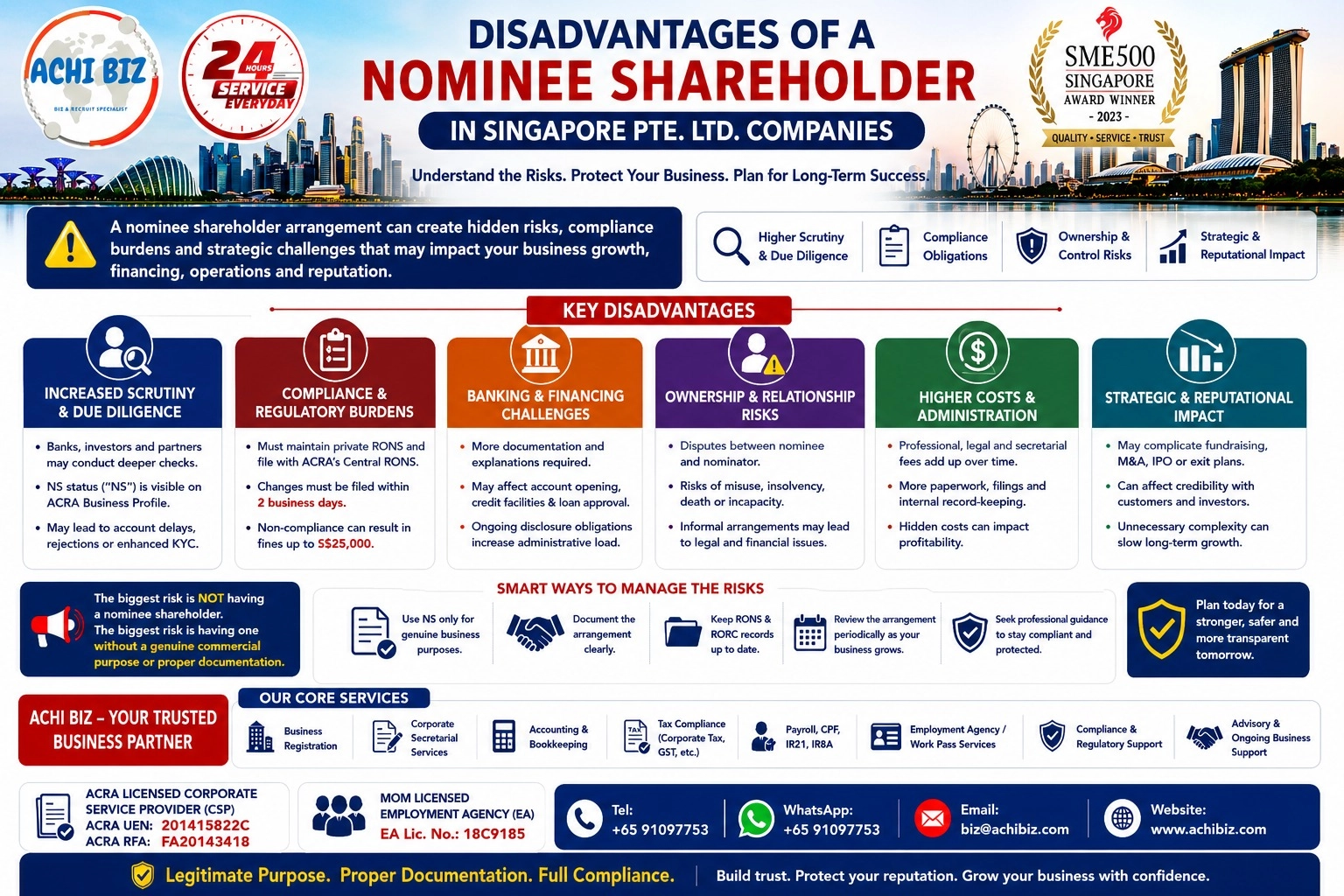
Disadvantages of a Nominee Shareholder in Pte Ltd Companies
A nominee shareholder (NS) arrangement is legally recognised in Singapore, but it can introduce additional layers of compliance, due diligence, banking scrutiny, ownership risk, commercial complexity and reputational considerations that should not be underestimated.
The regulatory environment has also become more transparent. Since 16 June 2025, companies that are not exempt must file their Register of Nominee Shareholders (RONS) information with ACRA’s Central RONS. A current nominee shareholder’s status appears as “NS” on the company’s Business Profile, although the nominator’s detailed particulars remain private and are not generally available to the public. ACRA specifically explains that this enhanced transparency can trigger additional scrutiny and customer due diligence by entities subject to anti-money-laundering obligations.
This FAQ focuses specifically on the disadvantages, commercial concerns, strategic implications and potential reputational impact of nominee shareholding in Singapore.
For the general structure and regulatory framework, please refer separately to ACHI BIZ’s article on Features and Risks of a Nominee Shareholder in Singapore Pte. Ltd. Companies. For the potential benefits, refer to our separate Advantages of a Nominee Shareholder article. A dedicated Nominee Director vs Nominee Shareholder article will separately address the differences between those two arrangements and is therefore not repeated here.
What are the main disadvantages of having a nominee shareholder in a Singapore company?
The disadvantages are not simply about having another person’s name associated with the shares. They arise from the additional relationship, documentation, compliance obligations and scrutiny created by the arrangement.
Depending on the circumstances, an NS arrangement can lead to:
- increased KYC and due-diligence enquiries;
- additional statutory-register and filing requirements;
- potential banking or financing complications;
- greater administrative costs;
- uncertainty if documentation is poor;
- difficulties during investment or acquisition due diligence;
- disagreements between nominee and nominator;
- succession or continuity complications;
- reputational questions if the commercial purpose cannot be explained; and
- additional restructuring work if the arrangement later becomes unnecessary.
These disadvantages do not make nominee shareholding inherently improper. They simply mean that the structure should have a genuine commercial justification strong enough to outweigh the additional complexity.
Is a nominee shareholder arrangement automatically bad for a company’s reputation?
No.
A properly documented and compliant nominee arrangement is not automatically a reputational problem. Singapore law recognises nominee shareholders and establishes specific RONS requirements for them.
However, perception matters in business.
A bank, investor, customer, lender or potential purchaser discovering an NS designation may reasonably ask:
Who is behind the nominee? Why is the nominee being used? Who actually benefits from the shares? Who exercises voting influence?
ACRA itself states that public disclosure of nominee status enhances transparency and can facilitate additional scrutiny and customer due diligence.
The reputational issue therefore usually comes from an unexplained or unnecessarily complicated structure, rather than nominee shareholding itself.
Is nominee-shareholder status publicly visible in Singapore?
Yes, in the company’s Business Profile.
Once applicable nominee information is filed with ACRA, a current nominee shareholder’s status is displayed as “NS” next to the shareholder’s name in the company’s Business Profile.
However, the date of nomination, details of nominators and historical nominee arrangements remain private.
This is important when considering whether a nominee arrangement genuinely provides the level of public-facing privacy expected by the parties.
Does the public NS designation reduce the privacy benefit of nominee shareholding?
It can.
A third party may not obtain the nominator’s detailed particulars from the Business Profile, but they can identify that the registered shareholder is acting as a nominee.
That may prompt further questions.
Therefore, a business should not enter a nominee arrangement believing that nobody will know that a nominee exists.
Singapore’s current framework is deliberately designed to make nominee status transparent while protecting detailed nominator information from general public access.
Can an NS designation attract greater scrutiny from banks?
Potentially, yes.
Banks conduct their own customer due diligence and beneficial-ownership checks under applicable regulatory requirements and internal risk policies.
The existence of a nominee shareholder can naturally require further explanation about the underlying ownership relationship.
ACRA expressly states that public disclosure of nominee arrangements can trigger additional scrutiny and customer due diligence by AML-obligated entities.
That does not mean a bank will reject the company merely because it has an NS. It means the company should be prepared to explain and substantiate the structure.
Can nominee shareholding make opening a corporate bank account more complicated?
Potentially.
The bank may need to understand the actual ownership and control structure rather than relying solely on the registered shareholder’s name.
Additional documents may therefore be requested concerning the nominee arrangement, nominator, beneficial ownership, source of funds, business purpose and other KYC matters.
For a straightforward business that has no compelling reason for nominee shareholding, this additional layer may provide little commercial benefit.
Can an NS arrangement affect existing banking relationships?
Potentially.
Changes to shareholding or beneficial-ownership arrangements may need to be disclosed to banks according to their terms and KYC requirements.
If a bank discovers a material nominee relationship that should previously have been disclosed, the issue may become more serious than the mere existence of the nominee.
For long-term banking credibility, transparent disclosure when required is usually more important than trying to minimise visibility of the arrangement.
Can nominee shareholding make obtaining business loans more difficult?
It may make the due-diligence process more involved.
Lenders commonly assess ownership, control, guarantors, financial standing and business risk before extending credit.
An NS structure introduces another relationship that may need to be understood.
The disadvantage is therefore not necessarily automatic rejection, but additional explanation, documentation and potentially longer processing.
Can nominee shareholding complicate investment fundraising?
Yes, particularly if the arrangement is poorly documented.
Professional investors normally want a clear understanding of the company’s capitalisation and actual ownership relationships.
If a prospective investor encounters nominee shareholding, the investor may want to understand why it exists and whether there are any undisclosed claims, voting arrangements or economic interests attached to those shares.
A complicated NS arrangement can therefore become another due-diligence item before funding is completed.
Could venture capital or institutional investors ask for an NS arrangement to be removed?
Potentially.
An investor may prefer a simpler and more transparent capital structure before investing.
Whether restructuring is required depends on the investor, transaction and commercial circumstances.
For companies intending to raise institutional funding, the question should therefore be considered early:
Will today’s nominee structure create unnecessary restructuring before tomorrow’s investment round?
Can nominee shareholding complicate the sale of a company?
Potentially.
A purchaser conducting legal and financial due diligence will normally want clarity over the company’s ownership.
If shares are registered to a nominee, the buyer may seek evidence establishing the underlying arrangement and confirming that there are no competing ownership claims.
Poorly documented arrangements can therefore delay transactions.
Can an NS arrangement complicate mergers and acquisitions?
Yes.
M&A transactions depend heavily on certainty of title, ownership, authority and contractual rights.
Any ambiguity concerning who economically owns shares, who can authorise transfers or whether another party can assert an interest may need to be resolved before completion.
A nominee arrangement that seemed convenient when the company was small can therefore become a significant due-diligence issue during a major transaction.
Can nominee shareholding complicate an IPO or other major corporate exercise?
Potentially.
Major corporate transactions generally involve extensive ownership and legal due diligence.
Complex or unnecessary nominee arrangements may have to be reviewed, explained or restructured.
Companies with ambitious long-term capital-market plans should therefore consider whether maintaining nominee shareholding genuinely supports those objectives.
Can nominee shareholding create uncertainty over who really owns the shares?
It can if the documentation is inadequate.
The registered shareholder and the underlying nominee relationship need to be clearly understood.
Disputes become more difficult where parties rely on informal conversations, verbal promises, incomplete agreements or undocumented instructions.
This is one of the reasons nominee shareholding should not be treated casually.
What happens if the nominee shareholder later denies the nominee arrangement?
That can create a potentially serious dispute.
The outcome depends on the facts, documents, communications, corporate records and applicable law.
The company and underlying parties may need professional legal advice to establish their respective rights.
This illustrates an important commercial disadvantage: a nominee structure introduces another relationship capable of becoming disputed.
Can the nominator and nominee disagree about voting?
Yes, disputes can arise.
ACRA regards a shareholder as a nominee where the shareholder regularly votes, or is required to vote, according to another person’s instructions and/or receives dividends on behalf of another person.
If the parties disagree about instructions, authority or contractual obligations, the matter can become commercially disruptive.
The exact legal position depends on the arrangement and circumstances.
Can disputes arise over dividends?
Yes.
Where dividends are received by a nominee on behalf of another person, clear documentation and payment records are important.
Problems can arise where parties disagree about entitlement, timing, deductions or the handling of money.
This is another reason why informal nominee arrangements can become disproportionately risky compared with the apparent convenience they originally offered.
Can a nominee shareholder misuse money belonging to the underlying investor?
Any person handling another party’s money can potentially misuse it.
A nominee arrangement should therefore avoid unnecessary movement of funds through the nominee wherever the structure does not require it, and the parties should maintain appropriate records and safeguards.
Suspected misappropriation is a serious legal matter and should be addressed promptly with appropriate professional advice.
Can the nominator also act improperly towards the nominee shareholder?
Yes.
Risk runs in both directions.
A nominee may be exposed to problems if the nominator provides misleading information, engages in unlawful activity, gives improper instructions or fails to disclose important matters.
Therefore, a nominee should not assume that acting merely “on behalf of someone else” eliminates personal or commercial exposure.
Can personal relationships make nominee arrangements risky?
Yes.
Using a friend, relative or trusted associate may initially appear inexpensive and convenient.
But personal relationships change.
Marriage breakdowns, family disputes, financial problems, business disagreements, incapacity or death can transform an informal arrangement into a serious corporate problem.
Trust is useful, but trust without documentation is not corporate governance.
What happens if the nominee shareholder dies?
Death can complicate the arrangement significantly depending on how it has been structured.
Questions may arise concerning the registered shares, the deceased person’s estate and the evidence establishing the underlying nominee relationship.
The company’s constitution, nominee documentation, succession arrangements and applicable law become important.
Long-term nominee structures should therefore consider death and incapacity from the beginning.
What happens if the nominee becomes mentally incapacitated?
Similar continuity issues may arise.
If the nominee can no longer provide instructions, execute documents or perform necessary shareholder actions, corporate transactions may become more difficult.
A professionally structured arrangement should anticipate such scenarios rather than dealing with them only after they occur.
Can bankruptcy of a nominee shareholder create problems?
Potentially, yes.
The legal treatment will depend on the circumstances and the nature of the nominee arrangement.
Questions about the beneficial interest in the shares may become particularly important.
Specialist legal advice should be obtained where insolvency occurs or is reasonably anticipated.
Can a nominee shareholder’s personal creditors create complications?
Potentially.
If creditors, insolvency practitioners or other parties assert claims involving assets registered in the nominee’s name, evidence of the underlying arrangement may become critically important.
A company should not assume that merely calling someone a “nominee” automatically resolves every third-party claim.
Can divorce or matrimonial proceedings involving the nominee create uncertainty?
Potentially.
Where shares are registered in a person’s name, matrimonial or other legal proceedings may create questions about the nature of that person’s interest.
Proper documentation can be important in demonstrating the underlying arrangement, although the actual legal treatment depends on the circumstances.
Can an NS arrangement increase legal costs?
Yes.
The structure may require agreements, compliance administration, due diligence, professional advice, restructuring and dispute-resolution costs that direct ownership might not involve.
Even where no dispute occurs, maintaining an additional ownership layer has a cost.
Can nominee shareholding increase corporate secretarial and compliance work?
Yes.
Unless exempted, companies must maintain a private RONS and file applicable information with ACRA’s Central RONS. ACRA requires updates to the private RONS and subsequent Central RONS filings according to prescribed deadlines.
This means nominee shareholding carries continuing administrative responsibilities.
How quickly must changes to the Central RONS be filed?
After the relevant private register has been updated, changes to the Central RONS generally need to be filed with ACRA within two business days.
ACRA also states that there is no extension of time for ROND/RONS filings.
Companies therefore need reliable procedures for identifying and filing changes promptly.
What is the penalty for failure to comply with RONS filing requirements?
ACRA states that failure to file ROND/RONS information on time may result in prosecution and fines of up to S$25,000.
This is a significant disadvantage of treating nominee arrangements informally. What may appear to be a private arrangement between two parties also carries statutory compliance consequences.
Can a nominee arrangement create RORC issues as well?
Potentially.
The Register of Nominee Shareholders (RONS) and Register of Registrable Controllers (RORC) are separate regulatory concepts.
ACRA specifically states that RONS, ROND and RORC are distinct registers and that being a nominee shareholder does not, by itself, mean that the same person is a registrable controller.
The actual underlying ownership and control structure must therefore be analysed separately for RORC purposes.
Is filing the RONS enough to satisfy all beneficial-ownership requirements?
Not necessarily.
RONS and RORC serve different purposes.
The Central RORC contains information about people or legal entities that beneficially own or control companies and is not publicly available.
Companies should therefore avoid assuming that completing one register automatically resolves obligations concerning another.
Can multiple nominee shareholders make the ownership structure harder to manage?
Yes.
Each additional layer or relationship can increase documentation, administration and due-diligence complexity.
If several nominees, corporate shareholders, holding companies and controllers are involved, understanding the complete ownership chain can become substantially more difficult.
Complexity should exist because it serves a legitimate commercial objective — not merely because the structure can be created.
Can nominee shareholding make corporate governance less transparent internally?
It can if management does not maintain clear records.
Directors and company officers should understand the company’s actual ownership and control arrangements to the extent required for their responsibilities.
Poor internal understanding of nominee arrangements can lead to inconsistent records, incorrect filings and difficulties responding to due-diligence enquiries.
Can nominee arrangements cause confusion about voting power?
Yes.
Registered shareholding does not necessarily tell the complete story where voting is subject to another person’s instructions.
This can become particularly important during shareholder resolutions, disputes, fundraising or corporate restructuring.
The company’s records and governing documents should therefore be consistent with the legal arrangement.
Can an NS arrangement make shareholder disputes more complicated?
Potentially.
A conventional dispute may already involve questions about voting, dividends, share transfers or minority rights.
Adding a nominee relationship can introduce another question:
Whose interests and instructions are actually behind the registered shareholder?
That can increase factual and legal complexity.
Can nominee shareholding cause difficulties when issuing new shares?
Potentially.
New share issuances can change ownership percentages, dilution and control.
Where nominee arrangements exist, the parties may need to consider how new shares affect both registered and underlying ownership relationships as well as applicable RONS and RORC information.
Can nominee arrangements complicate share transfers?
Yes.
The company may need to deal with the registered shareholder while also considering contractual rights arising from the nominee arrangement.
A transfer that appears straightforward on the register may therefore involve additional documentation and approvals.
Can an NS arrangement create problems during succession planning?
It can if succession was not considered when the arrangement was established.
A nominee structure should not be mistaken for a complete succession plan.
Death, incapacity and changes in beneficial ownership can create difficult questions if wills, trusts, shareholder arrangements and nominee documentation do not work together.
Can nominee shareholding create tax complications?
Potentially.
Nominee status itself does not determine the tax treatment of transactions.
Where dividends, capital gains, cross-border ownership or other payments are involved, tax consequences may depend on the underlying facts.
Businesses should not assume that the registered shareholder’s identity alone determines tax treatment.
Can nominee shareholding create cross-border tax issues?
Potentially, especially where the nominee, nominator or underlying investor is located outside Singapore.
Residence, beneficial entitlement, withholding taxes, reporting obligations and foreign tax laws may become relevant.
Complex cross-border arrangements should therefore be reviewed by appropriately qualified tax professionals.
Can nominee shareholding cause problems with grants or government incentives?
Potentially, if eligibility depends on actual ownership or control.
A nominee arrangement should never be used to create a misleading appearance that a business satisfies Singapore ownership, local ownership or other eligibility conditions when the underlying facts do not support that conclusion.
Eligibility should always be assessed based on the relevant scheme’s actual rules.
Can a nominee shareholder be used to make a foreign-owned company look locally owned?
That should not be the purpose.
A nominee arrangement does not necessarily change the underlying economic ownership or control.
Using an NS to misrepresent ownership to government agencies, banks, investors, customers or other parties can create serious legal and reputational consequences.
Can nominee shareholding create problems in regulated industries?
Potentially.
Certain licences and regulated activities require disclosure, approval or assessment of substantial shareholders, controllers or beneficial owners.
A nominee arrangement does not override sector-specific regulatory requirements.
Businesses operating in regulated sectors should examine those requirements separately before establishing an NS structure.
Can a nominee structure affect tender or procurement opportunities?
Potentially.
Government bodies, major corporations and international organisations may conduct ownership and integrity due diligence before awarding contracts.
If nominee arrangements exist, further information may be requested.
A legitimate structure should be explainable. An unnecessarily opaque structure may create avoidable questions.
Can nominee shareholding affect relationships with multinational customers?
Potentially.
Large corporations often operate their own vendor onboarding, sanctions screening and beneficial-ownership procedures.
A nominee arrangement can therefore result in additional compliance questions.
For B2B companies targeting multinational clients, ownership simplicity can sometimes have practical commercial value.
Can an NS arrangement increase AML scrutiny?
Yes, potentially.
This point is particularly important under Singapore’s enhanced transparency framework.
ACRA states that publicly identifying nominee status can trigger additional scrutiny and customer due diligence by AML-obligated entities.
That does not imply wrongdoing. It reflects the additional transparency and risk assessment expected around nominee relationships.
Does increased AML scrutiny mean nominee shareholding is suspicious?
No.
A nominee arrangement can be entirely legitimate.
But legitimate does not mean exempt from scrutiny.
The company should be able to demonstrate a coherent commercial reason for the structure and provide supporting information when lawfully required.
Could nominee shareholding create sanctions-screening complications?
Potentially.
Financial institutions and counterparties may need to identify persons with ownership or control interests for sanctions and other compliance purposes.
A nominee structure that obscures the ownership chain from initial view may require additional investigation.
Again, the disadvantage is usually complexity and scrutiny, not an automatic assumption of illegality.
Can nominee shareholding affect the company’s perceived transparency?
Potentially.
Two companies with otherwise identical businesses may present different levels of ownership complexity if one has straightforward direct ownership while the other has nominee arrangements.
Some investors and counterparties may prefer the simpler structure.
Where a nominee exists, the company should be able to explain why the added complexity is commercially justified.
Can an NS arrangement damage reputation if customers misunderstand it?
Potentially.
The term “nominee shareholder” can be misunderstood by people unfamiliar with corporate structures.
Because the NS designation can now appear on the Business Profile, businesses should recognise that sophisticated customers or counterparties may notice it.
The best response is not concealment but a legitimate, compliant and readily explainable structure.
Does nominee shareholding improve business credibility merely because the nominee is Singaporean?
No.
The nationality or residence of a nominee shareholder does not automatically make the company more credible.
Banks, investors and counterparties increasingly examine the underlying ownership and control rather than relying solely on the name appearing as shareholder.
Can using a prestigious or well-known nominee improve the company’s reputation?
Not necessarily.
Reputation cannot safely be borrowed merely by placing another person’s name on the share register.
The company should build credibility through genuine operations, financial performance, governance, compliance and transparent business practices.
Is using a friend or relative as nominee cheaper but riskier?
It can be.
An informal arrangement may reduce immediate professional costs but potentially increase long-term risk if documentation, continuity and compliance are weak.
Saving money at incorporation can become expensive if a dispute later requires legal proceedings.
Is a professional nominee arrangement free from risk?
No.
Professional administration may improve documentation and continuity, but it cannot eliminate commercial, legal, compliance or relationship risks.
Businesses should still understand the arrangement rather than outsourcing their understanding of it.
Can nominee shareholder fees become a long-term burden?
Potentially.
Professional arrangements may involve establishment, annual administration, compliance or restructuring costs.
These recurring costs should be compared with the actual commercial value received.
If the original purpose disappears, continuing to pay for an unnecessary structure makes little strategic sense.
Can an NS arrangement become outdated as the company grows?
Absolutely.
A structure suitable for a small privately owned business may become inconvenient after institutional investment, expansion, acquisition or succession.
Nominee arrangements should therefore be reviewed periodically rather than maintained indefinitely by habit.
Is nominee shareholding suitable for every foreign entrepreneur?
No.
Foreign investors can generally own shares in Singapore companies directly, subject to applicable sector-specific restrictions.
Therefore, foreign ownership alone is not a reason to appoint a nominee shareholder.
An NS arrangement should solve a genuine commercial problem.
Is nominee shareholding suitable merely because an entrepreneur wants privacy?
That requires careful consideration.
Since current nominee status can appear publicly on the Business Profile, nominee shareholding does not provide complete invisibility.
If privacy is the only objective, the entrepreneur should understand precisely what information remains private and what becomes publicly identifiable before deciding whether the arrangement is worthwhile.
Can an unnecessary NS arrangement make a simple company unnecessarily complicated?
Yes, and this is one of the most practical disadvantages.
If one individual can legitimately hold shares directly but instead inserts a nominee without a strong reason, the business may acquire:
additional documentation + additional filings + additional KYC questions + additional costs + additional relationship risk.
Complex corporate structures should earn their complexity by providing genuine commercial value.
How can a company determine whether its existing NS arrangement is still worthwhile?
Management should periodically ask:
- What original purpose did the nominee arrangement serve?
- Does that purpose still exist?
- What commercial benefit does the company currently receive?
- Has the NS status affected banking or due diligence?
- Are the RONS and related records fully compliant?
- Is the arrangement clearly documented?
- Could death, incapacity or insolvency create difficulties?
- Will the structure complicate future investment or sale?
- What are the annual costs?
- Would direct ownership now be simpler?
If the answers reveal more burden than benefit, restructuring may deserve consideration.
When can an NS arrangement become harmful to long-term business strategy?
It can become strategically counterproductive when it:
- no longer serves its original commercial purpose;
- creates recurring banking difficulties;
- delays investor due diligence;
- complicates fundraising;
- causes uncertainty over ownership;
- increases compliance costs;
- becomes difficult to explain to counterparties;
- creates dependency on a particular nominee; or
- requires major restructuring before a future transaction.
Long-term strategy should favour structures that remain understandable, defensible and commercially useful.
Can removing an unnecessary nominee arrangement improve the company’s corporate structure?
Potentially.
Where there is no longer a legitimate need for the nominee, moving to an appropriate direct or alternative ownership structure may simplify administration and future due diligence.
However, restructuring should not be undertaken casually. Share transfers, contractual arrangements, taxes, RONS/RORC updates and other legal implications may need to be considered.
Can a nominee shareholder simply be removed from the RONS when the arrangement ends?
The relevant records need to be properly updated.
ACRA requires the private RONS to be kept current, followed by the applicable Central RONS filing. Central RONS changes generally must be filed within two business days after the private register is updated.
Ending the nominee relationship should therefore involve proper corporate and regulatory housekeeping.
What happens to the public NS designation after the nominee arrangement ceases?
ACRA states that nominee status will no longer appear in the Business Profile once the relevant cessation has been lodged and the nominee arrangement has ceased. Historical nominee information is not displayed in ACRA’s information products.
This is relevant for companies restructuring away from nominee arrangements.
Is direct shareholding generally simpler than nominee shareholding?
Where there is no compelling reason for an NS arrangement, yes.
Direct shareholding removes one relationship from the ownership chain and may reduce documentation and administrative complexity.
That does not mean direct ownership is always preferable. It means the nominee arrangement should justify the additional layer it creates.
What is the biggest strategic disadvantage of nominee shareholding?
For many businesses, it is additional complexity without sufficient commercial benefit.
A legitimate nominee structure can work perfectly well. But when the structure exists primarily because “someone suggested it at incorporation” and nobody can explain its continuing purpose, the business is carrying unnecessary compliance and relationship risk.
What is the biggest reputational risk of a nominee shareholder?
The biggest reputational issue is usually not the NS designation itself.
It is being unable to provide a credible answer when a bank, investor, auditor, purchaser or regulator asks:
“Why does this company need a nominee shareholder?”
A legitimate business should be able to answer that question clearly.
What is the biggest compliance risk of nominee shareholding?
Failing to recognise that the arrangement carries ongoing statutory obligations.
RONS is not simply an internal agreement between a nominee and nominator. Unless exempted, the company must maintain the relevant private register and make required Central RONS filings with ACRA.
Late or missing filings can result in prosecution and fines of up to S$25,000.
What is the biggest practical risk of an informal nominee shareholder arrangement?
Dependence on personal trust.
The structure may operate smoothly while everyone agrees.
Its weaknesses usually become visible only when someone dies, becomes insolvent, changes their mind, stops cooperating, disputes entitlement or when a major transaction requires documentary proof.
That is why nominee shareholding should be designed for what happens when relationships go wrong, not merely for when everything is going well.
Are the disadvantages greater for long-term businesses?
They can become more significant over time.
A business may eventually require:
bank financing, new investors, acquisitions, overseas expansion, succession planning, major customer onboarding or a sale.
Every major milestone can bring renewed scrutiny of ownership.
A structure that saves some inconvenience today should therefore be assessed against what it might cost the company five or ten years later.
Does this mean companies should avoid nominee shareholders completely?
No.
That would be an overstatement.
Nominee shareholding is a recognised arrangement under Singapore’s corporate framework. The correct approach is not “never use a nominee shareholder”, but:
Use one only when there is a genuine, lawful and commercially defensible reason for doing so.
The benefits should outweigh the additional compliance, costs, scrutiny and relationship risks.
Should a business choose an NS primarily to conceal ownership?
No.
Singapore’s enhanced framework specifically aims to increase transparency and prevent misuse of nominee arrangements. ACRA states that ROND and RONS help mitigate money-laundering risks, enhance ownership and control transparency and prevent misuse.
A nominee structure designed around concealment rather than legitimate commercial purposes is fundamentally inconsistent with that direction.
What warning signs suggest that a nominee-shareholder arrangement should be reconsidered?
Businesses should consider reviewing the arrangement where:
- nobody can clearly explain why it still exists;
- documentation is incomplete;
- the nominee and nominator disagree;
- banks repeatedly raise concerns;
- investors request restructuring;
- RONS information may be outdated;
- ownership and control records are inconsistent;
- recurring costs exceed the practical benefit;
- succession has not been planned; or
- a major corporate transaction is approaching.
These are signs that the structure may no longer be supporting the company’s strategy.
Should companies compare the disadvantages with the advantages before deciding?
Absolutely.
The decision should never be based solely on privacy or convenience.
ACHI BIZ’s separate article on Advantages of a Nominee Shareholder in Singapore Pte. Ltd. Companies examines the potential benefits, while the separate Features and Risks of a Nominee Shareholder article explains the broader structure.
Reading the subjects separately helps business owners assess the arrangement from both sides rather than treating nominee shareholding as automatically good or bad.
Where can businesses read about the general features and risks of nominee shareholders?
Please refer to ACHI BIZ’s separate article on Features and Risks of a Nominee Shareholder in Singapore Pte. Ltd. Companies.
That article covers the broader characteristics and risk framework of nominee shareholding. This FAQ deliberately focuses on the disadvantages and their impact on business strategy and reputation to avoid unnecessary repetition.
Where can businesses read about the advantages of nominee shareholders?
Please refer separately to ACHI BIZ’s Advantages of a Nominee Shareholder in Singapore Pte. Ltd. Companies FAQ guide.
The advantages are intentionally not repeated here so that each article provides a focused analysis for readers and stronger topic separation for SEO.
Will ACHI BIZ separately explain Nominee Director vs Nominee Shareholder?
Yes.
The roles should not be treated as interchangeable. A separate ACHI BIZ article on Nominee Director vs Nominee Shareholder in Singapore can address their differences specifically.
This article therefore does not duplicate that comparison.
Can an ACRA Licensed Corporate Service Provider (CSP) assist with RONS administration?
Yes.
ACRA states that a registered CSP may set up and maintain a company’s ROND/RONS and file the relevant information with ACRA.
Engaging professional corporate support can help businesses manage filing requirements, although the company remains responsible for ensuring its arrangements and information are accurate and compliant.
How can ACHI BIZ assist companies with nominee shareholder and corporate compliance matters?
ACHI BIZ provides comprehensive corporate support for Singapore businesses, including company incorporation and business registration, corporate secretarial services, shareholder and share-capital changes, statutory compliance support, accounting and bookkeeping, corporate tax and GST, payroll, CPF, IR21, IR8A and related services.
For applicable companies with nominee arrangements, ACHI BIZ can assist with corporate administration and relevant RONS compliance and filings within the scope of its corporate services.
ACHI BIZ is an ACRA Licensed Corporate Service Provider (CSP).
Where nominee arrangements involve ownership disputes, trusts, complex tax planning, estate matters, insolvency or questions requiring legal interpretation, appropriate Singapore legal, tax or other professional advisers should also be engaged.
What is the key takeaway about the disadvantages of nominee shareholders in Singapore?
A nominee shareholder can serve legitimate commercial purposes, but it creates an additional layer between the company’s registered ownership and the underlying arrangement.
That additional layer can mean more compliance, more documentation, more KYC questions, more administrative costs, greater dependency on another party and potentially more complicated due diligence during financing, investment or sale.
Singapore’s current transparency regime makes this especially important. Current nominee status can be visible as “NS” on the company’s Business Profile, while detailed nominator particulars remain private.
For a serious long-term business, the relevant question is therefore not:
“Can we use a nominee shareholder?”
It is:
“Does having a nominee shareholder create enough genuine commercial value to justify the additional complexity, scrutiny, costs and long-term risks?”
If the answer is unclear, the ownership structure deserves another review.
Conclusion
The disadvantages of a nominee shareholder in a Singapore Pte. Ltd. company should be assessed from a long-term business perspective, not merely from the convenience available at the time the arrangement is created.
An NS arrangement can introduce additional compliance obligations, banking and KYC enquiries, due-diligence complexity, recurring costs, dependency on the nominee, succession concerns and potential disputes. For companies seeking institutional investment, financing, major customers or an eventual sale, unnecessary ownership complexity can become increasingly important.
Singapore’s regulatory direction is also clearly towards greater ownership transparency. Since 16 June 2025, applicable companies must file RONS information with ACRA’s Central RONS, and current nominee status is publicly identifiable through the company’s Business Profile.
This does not mean nominee shareholding is undesirable in every case. It means the arrangement should have a genuine purpose that remains commercially worthwhile.
A strong long-term corporate structure should be lawful, transparent when required, properly documented, easy to explain and suitable for the company’s future strategy.
For a complete understanding, readers may also refer separately to ACHI BIZ’s articles on Features and Risks of a Nominee Shareholder and Advantages of a Nominee Shareholder. A separate article on Nominee Director vs Nominee Shareholder can address that comparison without duplicating it here.
Disclaimer: This FAQ is provided for general information and service related purposes only. It does not constitute legal, tax, banking, investment, insolvency, estate-planning or other professional advice. The suitability and consequences of any nominee-shareholder arrangement depend on the specific facts, documentation and applicable laws. Appropriate professional advice should be obtained where necessary.
Related Pages
Legal Nominee Shareholder in Singapore: Role and Importance
Nominee Shareholder Service In Singapore
#achibiz