
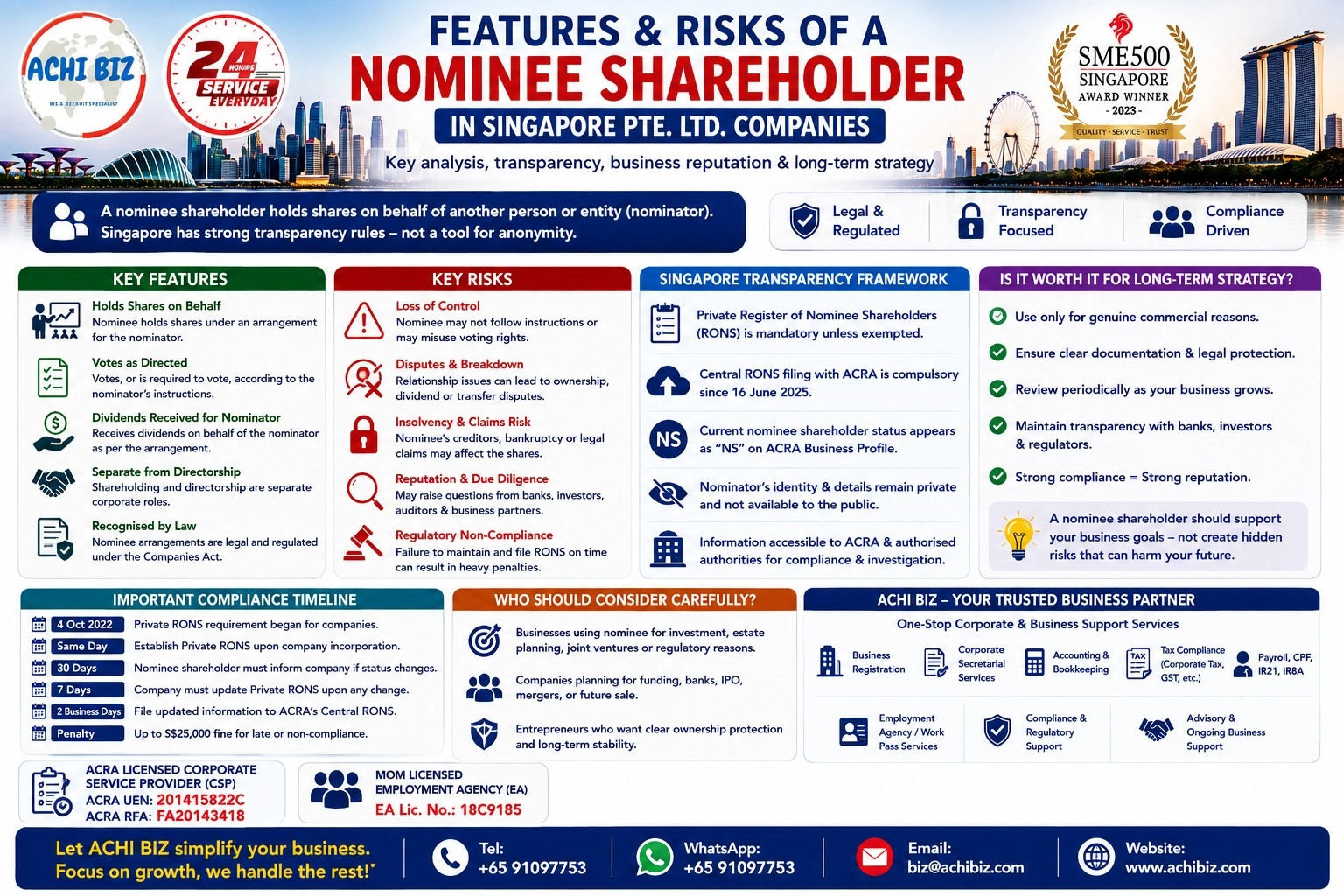
Features and Risks of a Nominee Shareholder – FAQ Guide
A nominee shareholder (NS) arrangement can be used in a Singapore Pte. Ltd. company where a registered shareholder holds shares on behalf of another person or entity, commonly known as the nominator.
However, nominee shareholding should not be confused with anonymous ownership. Singapore’s corporate transparency framework has become substantially stronger. Unless exempted, companies must maintain a private Register of Nominee Shareholders (RONS) and file the relevant information with ACRA’s Central RONS. Since 16 June 2025, the nominee status of a current shareholder is also shown as “NS” on the company’s Business Profile, although the nominator’s identity and details remain non-public.
ACRA describes a nominee shareholder as a shareholder who regularly votes, or is required to vote, according to another person’s instructions and/or receives dividends on behalf of another person.
This FAQ concentrates on the features, risks, transparency, business reputation, ownership protection, long-term suitability and practical governance issues surrounding nominee shareholders in Singapore. It intentionally does not provide a repetitive list of advantages and disadvantages. Those are addressed separately in ACHI BIZ’s dedicated articles on the Advantages of a Nominee Shareholder and Disadvantages of a Nominee Shareholder and another comparison of Nominee Director vs Nominee Shareholder will address those subjects without duplicating them here.
What is a nominee shareholder in a Singapore Pte. Ltd. company?
A nominee shareholder is a shareholder who holds shares under an arrangement involving another person or entity — the nominator.
Under ACRA’s current guidance, a shareholder is considered a nominee where the shareholder regularly votes, or is obliged to vote, the shares according to someone else’s instructions and/or receives dividends on behalf of another person.
The nominee therefore appears as a shareholder of the company, while the nominee arrangement identifies the person or entity for whom the shares are being held.
Who is the nominator of a nominee shareholder?
The nominator is the person or entity on whose behalf the nominee shareholder holds the shares under the nominee arrangement.
A nominator can potentially be an individual or a legal entity. ACRA consequently requires different prescribed particulars depending on whether the nominator is an individual or corporate entity.
Is a nominee shareholder the same as a beneficial owner?
Not necessarily.
The nominee shareholder and the person economically interested in or controlling the shares may be different persons.
This distinction is precisely why Singapore requires transparency through the RONS and, where applicable, the separate Register of Registrable Controllers (RORC) regime.
Companies should therefore avoid treating “registered shareholder”, “nominee shareholder”, “nominator” and “registrable controller” as automatically interchangeable concepts.
Is nominee shareholding legal in Singapore?
Yes. Singapore law expressly recognises nominee-shareholder arrangements and establishes disclosure and record-keeping requirements for them.
The arrangement itself is not inherently improper. The concern arises when nominee structures are used to conceal ownership unlawfully, mislead authorities, facilitate financial crime or circumvent legal obligations.
ACRA states that the RONS framework is intended to mitigate money-laundering risks, improve transparency in ownership and control, and prevent misuse of nominee arrangements.
Does using a nominee shareholder make the real owner anonymous?
No.
This is one of the most important points for anyone considering nominee shareholding in Singapore.
A nominee arrangement can create a distinction between the registered shareholder and the underlying arrangement, but it does not provide secrecy from ACRA and authorised authorities.
Unless exempted, the company must maintain and file the prescribed nominee and nominator information.
Is the nominator’s identity publicly displayed on ACRA’s Business Profile?
No.
ACRA currently distinguishes between information that is public and information that remains private.
The Business Profile can show that a current shareholder is a nominee through the designation “NS”, but the name and details of the nominator, date of nomination and historical nominee arrangements remain private. Members of the public cannot purchase the RONS information itself.
Is the nominee shareholder status itself publicly visible?
Yes, under the current transparency regime.
When nominee information is filed with ACRA, a current nominee shareholder’s status appears as “NS” beside the shareholder’s name on the company’s Business Profile.
This is an important development for businesses considering nominee shareholding primarily for public-facing privacy.
Can someone discover the NS status through ACRA’s people search?
ACRA states that nominee status cannot be checked through Bizfile’s people search.
However, anyone purchasing the relevant company’s Business Profile can see whether a current shareholder is identified as a nominee.
Does the public disclosure of “NS” change the usefulness of nominee shareholding for privacy?
It can.
A nominee arrangement may still keep the nominator’s particulars away from the general public, but outsiders examining the Business Profile can now see that the registered shareholder is acting as a nominee.
Therefore, anyone considering an NS arrangement primarily for confidentiality should understand the distinction between:
privacy of the nominator’s particulars and secrecy about the existence of the nominee arrangement.
The latter should no longer be assumed.
Does an NS designation on the Business Profile mean something is wrong with the company?
No.
Nominee shareholding is a recognised arrangement. The presence of “NS” does not establish fraud, illegality or improper conduct.
However, counterparties can see the nominee status and may make further enquiries about ownership or control as part of their own due diligence.
Can nominee shareholding affect the company’s long-term business reputation?
Potentially, depending on the circumstances.
A legitimate and properly disclosed nominee structure should not automatically damage a company’s reputation. Nevertheless, sophisticated banks, investors, lenders, auditors, professional advisers and counterparties increasingly place importance on ownership transparency.
An NS designation may therefore prompt questions such as:
Who ultimately owns the economic interest?
Why is a nominee arrangement required?
Who exercises voting influence?
Who receives the economic benefits?
Who is the ultimate beneficial owner or registrable controller?
A credible company should be able to answer legitimate due-diligence questions consistently.
Is a nominee shareholder suitable for a business planning to operate in Singapore for many years?
It depends on the commercial reason for the arrangement.
A nominee arrangement established for a genuine reason may remain appropriate. But a company planning substantial long-term operations, institutional investment, financing, succession or a future sale should periodically reconsider whether the arrangement continues to serve a useful commercial purpose.
The structure that was convenient during incorporation may not necessarily remain the best structure ten years later.
Should a company use a nominee shareholder simply to look more “Singaporean”?
That can be problematic if the arrangement is intended to create a misleading impression about the company’s actual ownership.
Corporate structure should accurately reflect legitimate arrangements and comply with applicable disclosure requirements.
A nominee shareholder should not be used to misrepresent foreign ownership to regulators, banks, customers, tendering authorities or other parties.
Does having a Singapore citizen as nominee shareholder make a foreign-owned company locally owned?
Not automatically.
The nationality of the registered nominee does not necessarily determine the underlying economic ownership or control of the shares.
Businesses should be particularly careful where a licence, grant, tender, incentive or regulatory requirement depends on genuine Singapore ownership or control. A nominee arrangement should not be used as a device to circumvent eligibility requirements.
Can a nominee shareholder help a company qualify for grants reserved for locally owned businesses?
A company should not assume so.
Where a scheme requires a particular level of local ownership, the actual eligibility criteria must be examined. Artificially interposing a nominee does not necessarily change the underlying ownership for regulatory or eligibility purposes.
Misrepresenting ownership to obtain grants or benefits can create serious consequences.
Is nominee shareholding the same as nominee directorship?
No.
A nominee shareholder concerns shares and the nominee relationship associated with those shares.
A nominee director concerns a director who acts under a nominee arrangement.
The company may have one without the other.
Singapore also maintains separate statutory registers — RONS for nominee shareholders and ROND for nominee directors.
Can the same person be both nominee shareholder and nominee director?
Potentially, yes, provided each arrangement is properly established and the applicable requirements are satisfied.
However, this concentrates two different corporate positions in the same person and may create additional governance and practical risk.
The RONS and ROND obligations also remain separate.
Does being a nominee shareholder automatically make someone a director?
No.
Shareholding and directorship are separate corporate positions.
A nominee shareholder does not become a director merely because the person holds shares, and a nominee director does not automatically become a shareholder.
Does a nominee shareholder automatically manage the company’s business?
No.
Ownership and management are separate concepts.
The fact that someone’s name appears as shareholder does not automatically make that person responsible for day-to-day company management.
Can a nominee shareholder vote the shares?
Voting arrangements are central to the nominee-shareholder concept.
ACRA’s definition expressly covers a shareholder who regularly votes or is required to vote according to another person’s directions, instructions or wishes.
The nominee arrangement should therefore clearly document how voting is to be handled, while remaining consistent with applicable law and the company’s Constitution.
Can a nominee shareholder vote against the nominator’s instructions?
This can create a serious dispute.
The answer may depend on the legal structure of the nominee arrangement, documentation, trust or contractual principles, the company’s Constitution and the particular corporate action.
The safest approach is not to rely on informal promises. Voting arrangements should be carefully documented before the shares are placed in the nominee’s name.
What happens if the nominee shareholder suddenly refuses to follow voting instructions?
The nominator should review the governing nominee documents and obtain legal advice where necessary.
The dispute may involve contractual, trust, corporate and equitable issues. The correct remedy depends on how the nominee arrangement was established and what evidence exists.
This is one reason professionally prepared documentation is important.
Can a nominee shareholder use voting rights to take control of the company?
A nominee should not misuse the arrangement contrary to the rights of the underlying party.
Nevertheless, because shareholder voting can affect important corporate decisions, a poorly structured nominee arrangement can create practical risk if the relationship breaks down.
The company and nominator should understand that control mechanisms need to work when relationships are bad, not merely when everyone is cooperative.
Can the nominee shareholder remove directors?
Shareholders may have rights concerning director appointments and removals under the Companies Act and the company’s Constitution.
Where the shares are held under a nominee arrangement, the manner in which those shareholder rights are exercised should be consistent with the governing arrangement and applicable law.
A dispute involving the misuse of voting rights should be addressed promptly.
Can a nominee shareholder block shareholder resolutions?
Potentially, depending on the number and class of shares held and the voting threshold applicable to the resolution.
This is precisely why the percentage of shares placed under nominee ownership matters.
Placing a substantial or controlling block of shares with a nominee can create much greater practical exposure than a small holding.
Is a 100% nominee shareholding arrangement riskier than a small nominee holding?
From a practical governance perspective, concentration can increase exposure.
If one nominee is the registered holder of 100% of the shares, disputes concerning voting, transfers, dividends or documentation may affect the entire ownership structure.
The arrangement therefore requires particularly careful documentation and controls.
Can there be more than one nominee shareholder?
Yes.
ACRA’s Central RONS filing framework accommodates multiple nominee arrangements, including situations where one nominee has multiple nominators or one nominator has multiple nominees.
Each arrangement must be recorded correctly.
Can one nominee shareholder represent more than one nominator?
Yes, the filing framework recognises this possibility.
ACRA requires separate records for each nomination where one nominee has multiple nominators.
Can one nominator use several nominee shareholders?
Yes.
Again, ACRA requires separate records for the respective nominee arrangements.
Who legally receives dividends when shares are held through a nominee?
The registered shareholder may receive the dividend at the company/shareholder level, but a nominee arrangement can require the nominee to receive dividends on behalf of another person.
Indeed, receiving dividends on behalf of another person is expressly one of the circumstances within ACRA’s definition of nominee shareholder.
The onward treatment of those funds should be clearly documented.
Can a nominee shareholder keep the dividends?
Not merely because the payment initially reaches the nominee.
Where the shares are held under an arrangement requiring the nominee to receive dividends for the nominator, retaining the money contrary to that arrangement could create contractual, trust or other legal consequences.
Legal advice may be required if the nominee refuses to remit money.
What if a nominee shareholder misappropriates dividends?
The nominator should preserve the nominee agreement, dividend records, bank records, communications and other evidence.
Appropriate legal remedies may be available depending on the arrangement and circumstances.
Where dishonest conduct or misappropriation is suspected, legal advice should be obtained promptly rather than attempting informal retaliation.
Can a nominee shareholder sell the shares without the nominator’s permission?
Whether a transfer can validly occur depends on the company’s Constitution, share-transfer procedures, applicable restrictions, the nominee documentation and the circumstances of the transaction.
A nominee should not be assumed to have unrestricted beneficial authority simply because the nominee’s name appears in the company’s shareholder records.
However, the practical consequences of an attempted unauthorised transfer can be serious, which is why preventative documentation and controls are important.
What happens if the nominee tries to transfer the shares to a third party?
The company and nominator should act quickly.
Relevant share registers, instruments, resolutions, nominee documents and communications should be reviewed. Where necessary, urgent legal advice should be obtained regarding available protective or court remedies.
Waiting until the shares have moved through multiple transactions can make a dispute significantly harder to resolve.
Can a nominee shareholder pledge the shares as security?
This should not be assumed merely from registered shareholder status.
The nominee agreement should clearly address whether any pledge, charge, encumbrance or other dealing with the shares is prohibited.
If a nominee attempts to encumber shares contrary to the underlying arrangement, legal advice may be necessary.
Can a nominee shareholder claim that the shares actually belong to him or her?
A dispute of this nature can become highly fact-specific.
Evidence may include the nominee declaration, trust documentation, subscription funds, share-transfer documents, correspondence, dividend arrangements, voting instructions and other records demonstrating the parties’ intention.
An informal nominee arrangement based solely on verbal trust can therefore be substantially harder to prove than a properly documented arrangement.
Is a nominee declaration enough to eliminate every risk?
No.
Documentation is important, but it cannot prevent every dishonest act, third-party dispute, insolvency issue or enforcement problem.
Good structuring combines documentation with careful selection of the nominee, accurate company records, transparent regulatory filings and ongoing oversight.
Should a nominee shareholder arrangement be based only on friendship or family trust?
That is risky.
Many serious ownership disputes begin when parties say:
“We trusted each other, so we never documented anything.”
Relationships can change because of money, divorce, death, business disagreements, insolvency, family disputes or succession.
Corporate ownership arrangements should be documented professionally regardless of personal relationships.
What if the nominee shareholder dies?
Death can create significant practical complications if the arrangement has not been properly structured.
Questions may arise regarding the nominee’s estate, legal title to the registered shares and how the underlying arrangement is proved and implemented.
Nominee structures should therefore consider death and succession before they happen.
What if the nominee shareholder becomes mentally incapacitated?
Similar continuity issues can arise.
If the registered shareholder can no longer act, voting, transfers and other shareholder matters may become complicated.
Long-term nominee arrangements should therefore include contingency planning rather than assuming the nominee will always remain available and capable.
What happens if the nominee shareholder becomes bankrupt or insolvent?
This can create serious issues concerning the shares and third-party claims.
The extent to which the underlying arrangement protects the nominator can depend on how the shares are legally held, the documentation and applicable insolvency and trust law.
This is an area where proper legal structuring matters significantly.
Can creditors of the nominee shareholder try to claim the shares?
Potential disputes can arise where the nominee’s personal creditors see shares registered in the nominee’s name.
Whether those shares are available to creditors depends on the legal and beneficial ownership arrangements and applicable law.
Clear evidence of the nominee relationship can therefore be extremely important.
What happens if the nominee shareholder gets divorced?
Depending on the circumstances and jurisdiction, personal matrimonial proceedings can create questions concerning assets appearing in the nominee’s name.
Proper documentation distinguishing the nominee’s own assets from assets held for another person becomes particularly valuable.
Can family members of a deceased nominee claim the shares?
They may potentially dispute the arrangement if the nominee relationship is unclear or poorly documented.
Again, contemporaneous evidence is critical.
A nominee structure should not depend on the assumption that the nominee’s heirs will automatically honour an undocumented verbal understanding.
What if the nominator dies?
That is a different succession issue.
The underlying beneficial or economic interest may form part of the nominator’s estate depending on the legal arrangement.
The nominee should not simply decide who inherits the interest.
Estate planning and succession documentation should be coordinated with the nominee arrangement.
Can nominee shareholding complicate succession planning?
Yes.
It introduces an additional layer between the registered shareholding and the underlying interest.
For family businesses and long-term investment companies, nominee arrangements should therefore be reviewed alongside wills, trusts, shareholder agreements and succession plans.
Can nominee shareholding complicate a future sale of the company?
Potentially.
A purchaser conducting legal due diligence may want to understand the complete ownership chain, nominee arrangements, beneficial ownership and whether anyone else can assert rights over the shares.
Incomplete or contradictory documentation can delay a transaction.
Can an NS arrangement affect investment by venture capital or institutional investors?
Potentially.
Professional investors usually perform extensive ownership and cap-table due diligence.
A nominee arrangement is not necessarily unacceptable, but investors may require clear evidence showing:
- who ultimately owns the interest;
- why the nominee exists;
- whether the arrangement is legally enforceable;
- whether the RONS/RORC information is accurate; and
- whether the nominee can create competing claims.
Clean documentation becomes particularly important before fundraising.
Can nominee shareholding complicate bank account opening?
It can result in additional due-diligence questions.
Banks generally need to understand ownership and control. An NS arrangement may therefore require explanation and supporting documents.
Trying to conceal the nominee relationship from a bank can create a much bigger compliance problem than openly explaining a legitimate arrangement.
Can a bank identify that the company has a nominee shareholder?
The company’s current nominee shareholder status can be visible through its ACRA Business Profile.
Banks can also request additional ownership and beneficial-owner information as part of their own due-diligence procedures.
Can nominee shareholding affect payment-provider or fintech onboarding?
Potentially.
Different financial institutions apply different risk assessments and customer-due-diligence procedures.
Where ownership involves nominee arrangements, additional supporting documentation may be requested.
Can nominee shareholding complicate opening overseas bank accounts?
Potentially, especially where the foreign financial institution needs to reconcile Singapore’s registered ownership with ultimate beneficial ownership.
The company should ensure that explanations provided overseas are consistent with its Singapore statutory records.
Does RONS replace the Register of Members?
No.
They serve different purposes.
The company’s shareholder/member information and its nominee-shareholder information form part of different regulatory records.
A company must therefore not assume that updating the shareholder position automatically updates every nominee-related filing.
ACRA specifically states that ROND and RONS information is stored separately from other business information and may require separate updates.
Does RONS replace the RORC?
No.
RONS and RORC are separate registers serving different purposes.
RONS deals with nominee-shareholder arrangements and nominators.
RORC deals with persons or legal entities meeting the applicable criteria for registrable control.
Depending on the structure, information concerning the underlying person may therefore be relevant to more than one statutory register.
Is the nominator automatically the registrable controller?
Not necessarily in every case.
The company should separately apply the statutory tests for registrable controllers.
A nominee relationship should not be used as a shortcut for RORC analysis.
Can a company have a RONS but no registrable controller?
The registers address different tests, so the company must assess each regime independently.
Where the ownership structure is complex, professional review may be appropriate.
Must every Singapore Pte. Ltd. company maintain a RONS?
Unless exempted, companies must comply with the ROND/RONS framework even where they currently have no nominee shareholders.
ACRA states that the requirements apply even where a company has no nominee directors or nominee shareholders, and even where the company is dormant or undergoing winding up, striking off, receivership or judicial management.
When did the private RONS requirement begin?
ACRA states that the private RONS requirement commenced on 4 October 2022 for companies.
When did filing with ACRA’s Central RONS become compulsory?
The Central RONS filing requirement has applied since 16 June 2025.
Companies incorporated from that date must provide the relevant ROND/RONS information as part of the incorporation process, unless exempted.
When must a newly incorporated company establish its private RONS?
ACRA’s current guidance requires the private registers to be established on the same day the company is registered.
When must someone who is already a nominee shareholder at incorporation disclose the nominee status?
For companies incorporated under the current regime, a shareholder who is already a nominee must inform the company of that fact and provide the required information on the date of incorporation.
ACRA’s current operational guidance similarly states that nominee shareholders must inform the company on the incorporation date if already acting as nominees.
What if an existing shareholder later becomes a nominee?
ACRA states that the shareholder must inform the company within 30 days of becoming a nominee.
How quickly must the company update its private RONS?
Where the company receives information concerning a nominee becoming or ceasing to be a nominee, or changes to the nominator’s particulars, the private register must generally be updated within seven days.
How quickly must the Central RONS then be updated?
After the private RONS is updated, the corresponding Central RONS update must be filed with ACRA within two business days.
This is a particularly important compliance deadline because it is much shorter than many ordinary corporate filing periods.
Can a company obtain an extension of time for Central RONS filing?
ACRA states that an extension of time is not available for ROND and RONS filings.
Companies therefore need procedures capable of dealing with nominee changes quickly.
What is the penalty for failing to file RONS information on time?
ACRA states that failure to file ROND/RONS information on time may result in prosecution and a fine of up to S$25,000.
The Companies Act likewise provides for fines of up to S$25,000 for specified failures relating to the RONS and Central RONS requirements.
Is the nominee shareholder personally responsible for providing information?
Yes.
The Companies Act imposes obligations on nominee shareholders to notify the company of the nominee relationship and provide prescribed particulars within the applicable deadlines.
The company and nominee therefore both have roles in keeping the regulatory information accurate.
What information about an individual nominator must be maintained?
ACRA’s current guidance identifies information including the individual’s full name, aliases, residential address, email address, contact number, nationality, identification or passport number, date of birth and relevant nomination dates.
These are sensitive particulars, which is one reason the detailed RONS is not publicly available.
What information is maintained where the nominator is a corporate entity?
Information includes the entity’s name, UEN where applicable, registered-office address, email and contact number, legal form, jurisdiction and governing law, registrar details and relevant registration/identification information and nomination dates.
Where can the private RONS be kept?
ACRA permits the private register to be kept physically or electronically at the company’s registered office or the office of its Corporate Service Provider (CSP).
Must supporting documents be uploaded to ACRA with the Central RONS filing?
ACRA states that supporting documents should be kept with the private RONS, but they do not need to be uploaded when the Central RONS information is filed.
Does the company have to update RONS every year if nothing changes?
No.
ACRA states that the private ROND/RONS need not be updated annually where there have been no changes.
Updates are triggered by relevant changes, including a shareholder becoming or ceasing to be a nominee or changes to the nominator’s particulars.
What if the company has no nominee shareholder?
The company can indicate that it has no active nominee directors or nominee shareholders through the relevant ACRA filing process.
The absence of a nominee does not mean an applicable company should simply ignore the RONS framework.
What happens when a nominee shareholder ceases acting as nominee but remains a shareholder?
The cessation of the nominee arrangement and the person’s continued status as shareholder are separate matters.
The private RONS and Central RONS should be updated to record the cessation of the nomination. The ordinary shareholder records continue to reflect the person as shareholder if the person still owns the shares in his or her own capacity.
What happens if the nominee ceases to be a shareholder entirely?
The company needs to deal with both the underlying shareholder/member change and the nominee-related records.
ACRA expressly notes that nominee information is stored separately from other business information, so the company should not assume that one filing automatically handles every required update.
Does the “NS” designation remain publicly visible forever after the nominee arrangement ends?
No.
ACRA states that the nominee designation will no longer appear where the nominee arrangement has ceased, the shareholder is no longer a member, the company is exempt or the company has no nominee shareholder. Historical nominee arrangements remain private.
Can nominee shareholding be used to hide assets from creditors?
It should not be used for unlawful concealment or fraudulent avoidance of legitimate claims.
The existence of a nominee does not erase the underlying arrangement, and Singapore’s transparency framework is specifically designed to prevent misuse.
Can nominee shareholding be used to hide assets in divorce proceedings?
A nominee structure should not be used to make false representations or unlawfully conceal beneficial interests.
Courts and authorities are not necessarily bound by the name appearing on a corporate register when determining the true ownership of assets.
Can nominee shareholding be used to avoid tax?
A nominee arrangement does not itself eliminate tax obligations.
Tax treatment depends on the underlying facts and applicable tax law. The parties should not assume that inserting another person’s name into the shareholding structure changes the substantive tax position.
Can nominee shareholding be used to conceal sanctions exposure or prohibited ownership?
No legitimate corporate structure should be designed for that purpose.
Banks, CSPs and regulated businesses may need to identify underlying beneficial owners and conduct sanctions and AML screening regardless of nominee arrangements.
Does using a nominee shareholder prevent authorities from identifying the nominator?
No.
The detailed information is filed precisely so that relevant authorities can access ownership information when legally permitted.
ACRA explains that the Central RONS assists law-enforcement agencies in investigating financial crimes.
Why did Singapore introduce stronger nominee-shareholder transparency?
ACRA states that the ROND and RONS frameworks are intended to mitigate money-laundering risks, enhance transparency in ownership and control, and prevent misuse of nominee arrangements.
The Central RONS and public NS designation strengthen that transparency further.
Is nominee shareholding still worthwhile now that “NS” appears on the Business Profile?
That depends entirely on the legitimate commercial objective.
If the only objective was to create the impression that no nominee arrangement existed, the current transparency regime significantly changes that proposition.
If the arrangement serves a genuine legal, investment, custody, estate-planning or commercial purpose, it may still have relevance.
The company should therefore ask why the nominee arrangement is needed, rather than treating nominee shareholding as a standard feature of incorporation.
Should a foreign entrepreneur automatically use a nominee shareholder?
No.
Unlike the requirement for at least one ordinarily resident director of a Singapore company, there is generally no equivalent requirement to appoint a Singapore-resident or Singapore-citizen shareholder merely because the company is foreign-owned.
Foreign ownership of an ordinary Singapore Pte. Ltd. company is generally possible, subject to any sector-specific restrictions or requirements.
A foreign entrepreneur should therefore not assume that a nominee shareholder is compulsory.
Is a nominee shareholder required simply because all shareholders live overseas?
No.
Overseas residence of the shareholders does not itself create a general requirement for a local nominee shareholder.
This is an important difference from the resident-director requirement.
Should a company appoint an NS merely because somebody says every foreign-owned Singapore company needs one?
No.
That advice confuses shareholding with the requirement concerning an ordinarily resident director.
The commercial and legal reason for nominee shareholding should be identified before establishing the arrangement.
Is the cheapest nominee shareholder necessarily the best choice?
No.
Where meaningful ownership rights are involved, choosing solely on annual fees can be short-sighted.
Reliability, documentation, continuity, conflicts, reputation and the nominee’s willingness to comply with the arrangement can matter much more.
Should a professional nominee shareholder be preferred over a friend?
The answer depends on the circumstances, but professionalism and documentation matter more than familiarity.
A friend can fall out with the nominator. A relative can die. A professional arrangement can also fail if poorly structured.
The critical issue is whether the arrangement is legitimate, properly documented, transparent and capable of surviving disagreement or unexpected events.
What are the main warning signs in a nominee shareholder arrangement?
Warning signs include unexplained requests for voting control, reluctance to sign proper documentation, attempts to retain dividends, refusal to cooperate with lawful share transfers, demands for unrelated payments, inconsistencies concerning beneficial ownership and resistance to required ACRA disclosures.
These should be addressed before they become ownership disputes.
What warning signs should a nominee shareholder watch for from the nominator?
Risk also runs in the opposite direction.
A nominee should be cautious if the nominator asks the nominee to conceal ownership from authorities, mislead a bank, evade sanctions, obtain benefits based on false local ownership, sign false documents or participate in suspicious transactions.
A nominee arrangement does not require someone to participate in unlawful conduct.
What if the nominator uses the nominee shareholder for illegal purposes without fully informing the nominee?
The nominee should obtain professional advice promptly after becoming aware of the issue.
Continuing to cooperate blindly after discovering serious misconduct can substantially increase risk.
Relevant legal, regulatory or reporting obligations may arise depending on the circumstances.
Can the nominee shareholder be cheated by the nominator?
Yes.
For example, disputes can arise over unpaid agreed fees, undisclosed regulatory risks, misleading information, misuse of the nominee’s identity or attempts to involve the nominee in transactions outside the agreed arrangement.
Nominee risk therefore runs both ways.
Should a nominee shareholder arrangement include indemnities?
Appropriate contractual protections may be considered, but an indemnity is not a substitute for compliance and cannot safely be treated as protection against participation in unlawful conduct.
The enforceability and scope of indemnities should be professionally reviewed.
Should the nominee shareholder sign blank share-transfer documents?
Using blank or inadequately documented instruments creates obvious risks for all parties.
Corporate ownership changes should be properly authorised, documented and completed in accordance with applicable law and the company’s Constitution.
Should the nominator keep proof that they funded the acquisition of the shares?
Good records can be extremely valuable if ownership is later disputed.
Evidence may include payment records, nominee declarations, agreements, share subscription documents and correspondence showing the purpose of the arrangement.
Should nominee arrangements be reviewed periodically?
Yes.
Long-term arrangements should be reviewed when there are changes involving ownership, residency, succession, banking, investors, financing, tax circumstances, business strategy or the relationship between nominee and nominator.
When should a company consider ending its nominee shareholder arrangement?
A review may be appropriate where the original commercial reason no longer exists, the company is preparing for investment or sale, the arrangement is creating banking or due-diligence difficulties, trust has deteriorated, or direct ownership has become more appropriate.
Ending the arrangement must be properly documented and reflected in the relevant corporate and nominee registers.
Is removing a nominee shareholder as simple as cancelling the person’s name?
No.
There may need to be an actual share transfer or other valid transaction affecting the registered ownership, together with appropriate corporate records, tax/stamp-duty considerations where applicable and RONS updates.
A nominee arrangement should therefore have a clear exit mechanism from the beginning.
What should happen when the nominee and nominator relationship breaks down?
The first priority is to establish the legal position rather than escalating the personal dispute.
The parties should review:
- nominee or trust documentation;
- Register of Members;
- private and Central RONS;
- RORC where relevant;
- share certificates and transfer documents;
- Constitution;
- shareholder agreements;
- dividend records;
- voting instructions; and
- evidence of the original arrangement.
Where ownership, voting, transfers or money are disputed, Singapore legal advice should be obtained promptly.
What should the company do if the nominee shareholder is suspected of fraud?
Preserve evidence and secure corporate records.
The company and affected parties should avoid fabricating retrospective documents or making unauthorised changes to the registers merely to “correct” the dispute.
Where there is credible evidence of fraud, misappropriation, forgery or unauthorised dealings, appropriate legal and potentially law-enforcement remedies should be considered.
What if the nominator is the person committing fraud?
The nominee should not assume that following instructions provides complete protection.
The nominee should document concerns, refuse to participate in clearly improper activity and obtain professional advice where appropriate.
What is the biggest misconception about nominee shareholders in Singapore?
The biggest misconception is:
“A nominee shareholder allows the real owner to remain completely hidden.”
Singapore’s current framework does not support that assumption.
The nominee’s NS status is publicly visible on the company’s Business Profile, while detailed nominator information is maintained privately and filed with ACRA.
What is another major misconception about nominee shareholders?
That a nominee shareholder is compulsory for foreign-owned Singapore companies.
It generally is not.
A nominee shareholder should therefore be used because there is a genuine reason for the arrangement — not because somebody incorrectly says every foreign entrepreneur needs one.
Is nominee shareholding mainly a privacy tool?
It should not be viewed only through that lens.
Singapore’s strengthened transparency regime means the existence of the nominee relationship itself can be visible publicly.
The better approach is to evaluate nominee shareholding as a legal and commercial structuring arrangement with compliance consequences, rather than a secrecy product.
Is an NS arrangement good or bad for business reputation?
Neither conclusion is universally correct.
A properly disclosed nominee structure can be legitimate. A badly explained, unnecessarily complex or misleading structure can create questions.
For long-term reputation, what matters most is that the company can demonstrate:
transparent ultimate ownership + proper statutory records + legitimate business purpose + consistent banking disclosures + tax compliance + sound corporate governance.
What should a company consider before establishing an NS arrangement?
Before proceeding, the company should understand:
- Why is a nominee shareholder actually required?
- Who ultimately owns the economic interest?
- Who will control voting?
- Who receives dividends?
- What happens if either party dies or becomes incapacitated?
- What happens if the nominee becomes insolvent?
- How can the shares be transferred back?
- How will disputes be resolved?
- How will RONS and RORC requirements be satisfied?
- What will banks and future investors be told?
- How does the arrangement affect succession?
- Does it remain sensible for the company’s long-term strategy?
If these questions cannot be answered clearly, the structure is not ready.
Should businesses also read ACHI BIZ’s separate articles on the advantages and disadvantages of nominee shareholders?
Yes.
This FAQ intentionally focuses on how nominee shareholding works, regulatory transparency, ownership risks, reputation, long-term strategy, relationship breakdowns and practical safeguards rather than repeating lists of pros and cons.
For those subjects, please refer separately to ACHI BIZ’s dedicated FAQ articles:
Advantages of a Nominee Shareholder in Singapore Pte. Ltd. Companies
and
Disadvantages of a Nominee Shareholder in Singapore Pte. Ltd. Companies
Keeping the subjects separate provides clearer guidance and avoids repeating the same content across multiple articles.
How can ACHI BIZ assist with nominee shareholder and corporate compliance matters?
ACHI BIZ is an ACRA Licensed Corporate Service Provider (CSP) assisting Singapore companies and foreign entrepreneurs with company incorporation, corporate secretarial services, changes in shareholders and share capital, maintenance and filing of applicable statutory registers, RORC/ROND/RONS compliance, accounting, bookkeeping, tax, payroll, CPF, IR21, IR8A and other corporate compliance matters.
Where a company has or proposes a nominee-shareholder arrangement, particular attention should be given to ensuring that its Register of Members, private RONS, Central RONS and RORC, where applicable, are accurate and consistent with the actual arrangements.
Complex nominee declarations, trusts, beneficial-ownership disputes, succession planning and contested ownership should be referred to an appropriately qualified Singapore lawyer.
What is the key takeaway about nominee shareholders in Singapore?
A nominee shareholder can be part of a legitimate Singapore company structure, but it should never be mistaken for invisible ownership.
Singapore now operates a much more transparent nominee-shareholder framework. Companies generally need to maintain private RONS records and file the information with ACRA’s Central RONS, while the current nominee shareholder’s “NS” status is visible on the company’s Business Profile.
For a serious long-term business, the key question should therefore not be:
“How can we hide the real shareholder?”
It should be:
“Is there a genuine commercial reason for this nominee arrangement, and will it remain appropriate as our company grows?”
Conclusion
Nominee shareholding in Singapore is best understood as a regulated ownership arrangement, not an anonymity mechanism.
A properly structured arrangement may serve legitimate purposes, but it introduces an additional layer between the registered shareholder and the underlying party. That layer can affect voting, dividends, succession, banking, investment due diligence, ownership disputes and future transactions.
Singapore’s RONS regime reinforces the principle that nominee arrangements should be transparent to the authorities. Unless exempted, companies must maintain the required private register and Central RONS filings, and current nominee shareholder status is publicly identifiable on the company’s Business Profile.
For long-term business strategy, companies should periodically ask whether the nominee arrangement still serves a genuine purpose. Good corporate reputation comes from transparent ownership, proper compliance and credible governance — not from trying to make ownership unnecessarily difficult to understand.
Disclaimer: This FAQ is provided for general information and service related purposes only. It does not constitute legal, tax, trust, estate-planning, investment, banking, accounting or other professional advice. Nominee shareholding can involve complex questions of legal and beneficial ownership, voting rights, trusts, succession, insolvency, taxation and enforceability. The applicable outcome depends on the facts, documentation and prevailing Singapore law. Professional legal or other specialist advice should be obtained where appropriate.
Related Pages
Legal Nominee Shareholder in Singapore: Role and Importance
Nominee Shareholder Service In Singapore
#achibiz