
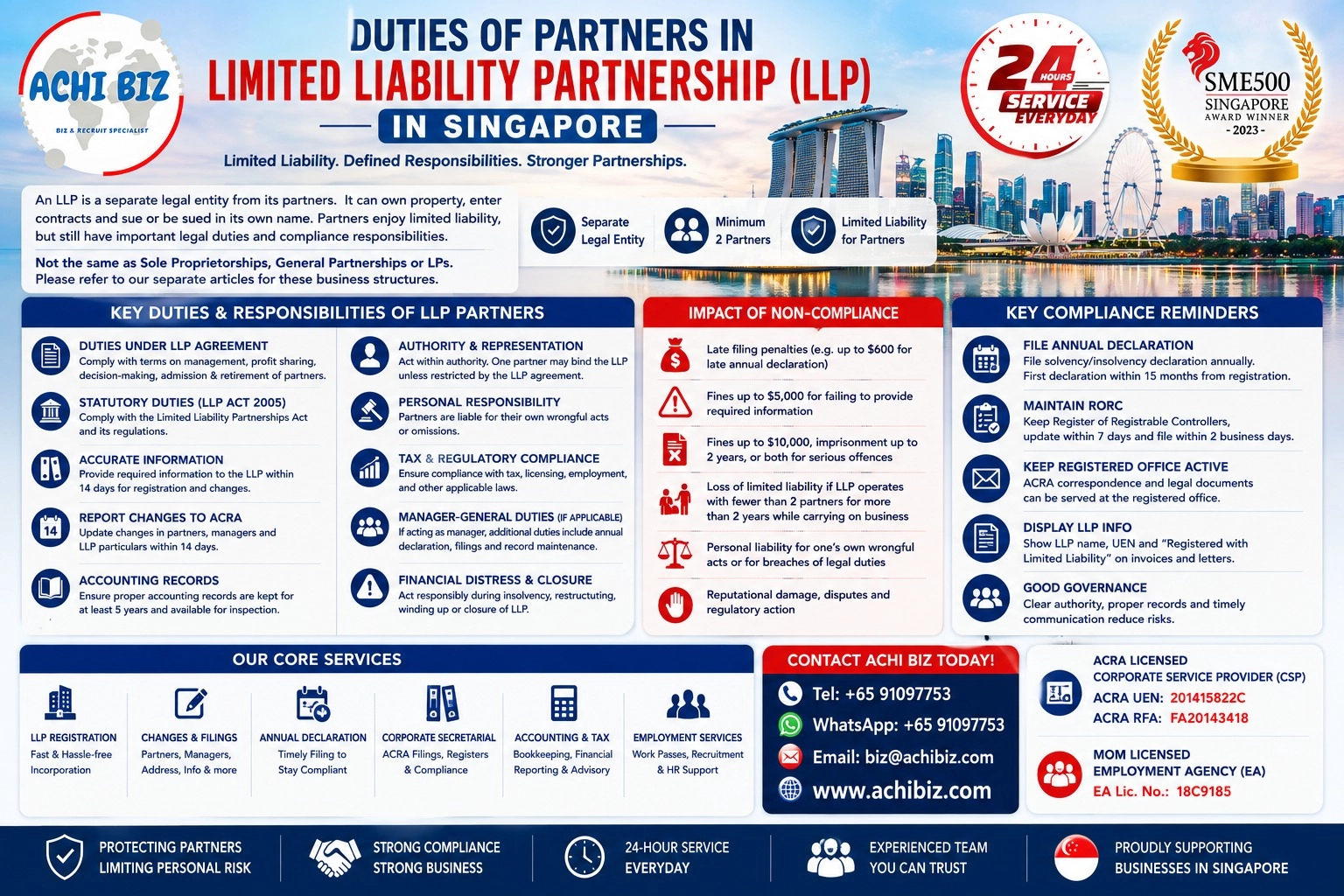
Duties of Partners in a Limited Liability Partnership (LLP) – FAQ Guide
A Limited Liability Partnership (LLP) combines operational flexibility with a legal identity separate from its partners. That separation is one of the LLP structure’s main attractions, but it does not mean that partners are free from personal duties, compliance responsibilities or legal exposure.
Under Singapore’s Limited Liability Partnerships Act 2005, an LLP can own property, enter contracts, sue and be sued in its own name. Partners generally benefit from limited liability and are not personally responsible merely because another partner causes a liability. However, a partner remains exposed for liabilities arising from his or her own wrongful acts or omissions, and there are circumstances where statutory non-compliance can create personal consequences.
This FAQ focuses specifically on the duties, responsibilities, compliance risks and potential liabilities of partners in a Singapore LLP. Sole Proprietorships, General Partnerships and Limited Partnerships (LPs) operate under different legal frameworks and are covered separately in our respective articles.
What are the main types of duties applicable to partners of an LLP in Singapore?
The responsibilities of LLP partners can broadly arise from several areas:
- Duties arising under the LLP agreement
- Statutory duties under the Limited Liability Partnerships Act 2005
- Duties relating to accounting records and financial information
- Duties to provide accurate partner information and report changes
- Duties connected with the LLP’s regulatory filings and registers
- Duties arising from a partner’s authority to act for the LLP
- Duties relating to the partner’s own wrongful acts or omissions
- Responsibilities under tax, licensing, employment and other applicable laws
- Additional statutory responsibilities where a partner also acts as the LLP’s manager
- Duties arising when the LLP experiences financial distress, insolvency, winding up or closure
The exact responsibilities of each partner can therefore depend on both legislation and the LLP agreement.
Is an LLP legally separate from its partners?
Yes. A Singapore LLP is a separate legal entity from its partners.
This is one of the fundamental differences between an LLP and a traditional General Partnership. The LLP can own assets, incur liabilities, enter contracts and commence or defend legal proceedings in its own name.
The separate legal personality provides important protection, but it should not be interpreted as absolute immunity for individual partners.
Does limited liability mean an LLP partner can never be personally liable?
No.
As a general principle, an LLP partner is not personally liable for the LLP’s debts simply because that person is a partner. A partner is also generally not personally responsible for liabilities caused solely by another partner.
However, ACRA specifically notes that a partner can be liable for debts arising from that partner’s own wrongful actions.
Limited liability protects the structure; it does not excuse personal misconduct.
Can one LLP partner bind the entire LLP?
Potentially, yes.
The LLP Act contains provisions dealing with the power of a partner to bind the LLP.
This makes authority controls particularly important. LLPs should clearly establish who may negotiate contracts, approve expenditure, borrow money, operate bank accounts, engage employees, appoint service providers or otherwise commit the LLP.
Internal restrictions in an LLP agreement can be important for governance, although whether a particular transaction legally binds the LLP can depend on the circumstances and the applicable law.
Why is an LLP agreement important when determining partners’ duties?
The LLP agreement is a central governance document because it can regulate the relationship between the partners and between the partners and the LLP.
It can address matters such as management authority, voting, capital contributions, profit distributions, decision-making, admission and retirement of partners, confidentiality, disputes and restrictions on authority.
Where the partners have not adequately agreed on particular matters, statutory default provisions may become relevant. The LLP Act contains a First Schedule of default provisions for LLPs.
A properly drafted LLP agreement therefore helps reduce uncertainty about what each partner may or must do.
Do LLP partners have the same duties as directors of a Pte. Ltd. company?
No. They should not automatically be treated as equivalent.
A partner of an LLP and a director of a company occupy different legal positions under different statutory frameworks.
Likewise, the duties applicable to a General Partner in a Limited Partnership should not simply be transferred to an LLP partner.
This is why business owners should determine their obligations according to the actual legal structure being used.
Does every LLP need at least two partners?
Yes. An LLP is generally required to have at least two partners.
Importantly, ACRA explains that an LLP can operate with only one partner for up to two years. If it continues carrying on business after having fewer than two partners for more than two years, a partner who knows of that situation may become personally liable for obligations incurred during the relevant period.
This is a significant exception to normal LLP limited-liability protection.
What should partners do if an LLP falls below two partners?
The situation should not be ignored.
The remaining partner should take appropriate action to restore the LLP’s minimum partner requirement or consider whether the LLP should continue operating in its existing form.
Allowing the situation to continue beyond the statutory period while carrying on business can expose the remaining partner to personal liability for new LLP obligations.
Does every Singapore LLP require a manager?
Yes. Every LLP must have at least one manager who satisfies the statutory requirements, including being a natural person, at least 18 years old, having full legal capacity and being ordinarily resident in Singapore.
A partner may also be appointed as the LLP’s manager.
This distinction matters because a partner who is also the manager assumes additional statutory responsibilities.
Are the duties of an LLP partner and LLP manager the same?
No.
A partner participates in the LLP according to the LLP Act and the LLP agreement.
The manager, meanwhile, has specific statutory compliance responsibilities. Under the LLP Act, the manager is answerable for specified matters including annual declarations, publication requirements and registration of changes in particulars. The Act can also make the manager personally liable for penalties imposed on the LLP for contraventions of those provisions, subject to the statutory defence.
Therefore, a partner who agrees to become manager should understand that the appointment carries additional legal responsibilities.
What information must partners provide to the LLP?
Partners have a statutory duty to provide information needed by the LLP for certain regulatory purposes.
Among other things, a partner must provide information required for registration and changes in particulars within the prescribed timeframe. Where the LLP requests information to confirm or reconstruct its records, the partner may also be required to provide it.
The LLP Act generally requires relevant information under section 35 to be provided as soon as practicable and no later than 14 days in the circumstances specified by that provision.
What happens if a partner fails to provide required information?
Failure to comply with the statutory information obligations under section 35 can itself constitute an offence.
The current LLP Act provides for a fine of up to $5,000, with a further fine of up to $200 for every day or part of a day during which a continuing offence continues after conviction.
Partners should therefore promptly inform the LLP of relevant changes instead of assuming that the manager or CSP already knows about them.
Must changes concerning partners be reported to ACRA?
Yes. LLP information must be kept current.
ACRA states that changes involving appointed partners or managers, their particulars and other specified LLP information generally need to be updated within 14 days.
This is why an LLP should have an internal process requiring partners to notify the person responsible for compliance whenever their reportable particulars change.
Are LLP partners responsible for maintaining proper accounting records?
The LLP itself must maintain proper accounting and other records that sufficiently explain its transactions and financial position and enable financial statements showing a true and fair view to be prepared.
The records must generally be retained for at least five years from the end of the relevant financial year. They must also be available for inspection by partners.
Importantly, contravention of certain accounting-record requirements can result in liability not only for the LLP but also for every partner.
What are the consequences of failing to keep proper LLP accounting records?
The consequences can be serious.
For contraventions specified in section 31 of the LLP Act, the LLP and every partner may commit an offence. For an individual offender, the statutory consequences can include a fine of up to $10,000, imprisonment for up to two years, or both, depending on the contravention and circumstances.
Proper bookkeeping is therefore not merely an administrative preference.
Does an LLP have to file an annual declaration?
Yes.
Every Singapore LLP must file an annual declaration of solvency or insolvency.
For a newly registered LLP, the first declaration is generally due within 15 months from registration. Subsequent declarations must be filed once every calendar year and no more than 15 months after the previous declaration.
The declaration is made by an LLP manager.
What should partners do before the LLP’s annual declaration is filed?
Partners should ensure that the financial information supplied to the manager is accurate, current and capable of supporting the declaration being made.
The annual declaration should not be treated as a routine checkbox.
The LLP Act imposes consequences where a manager makes a solvency declaration without reasonable grounds, and it also creates offences for knowingly or negligently supplying materially false or misleading information in connection with the declaration.
Can providing false information for an LLP annual declaration create personal liability?
Yes.
The LLP Act provides penalties where a person supplies materially false or misleading information in connection with an annual declaration when that person knows or ought reasonably to know that the information is false or misleading.
More serious consequences can apply where conduct involves an intention to defraud creditors or another fraudulent purpose.
Partners should therefore ensure the manager receives reliable financial information before making the declaration.
What happens if the LLP files its annual declaration late?
Late filing can result in regulatory penalties.
ACRA currently states that LLP annual declarations filed late can attract late lodgement penalties of up to $600.
Persistent statutory non-compliance can create broader enforcement and business risks beyond the immediate late filing penalty.
Do LLPs need a Register of Registrable Controllers (RORC)?
Generally, yes, unless an exemption applies.
ACRA states that LLPs subject to the requirement must maintain their RORC, update changes within the prescribed timeframe and lodge relevant information with the Central RORC.
Current ACRA guidance states that changes to the LLP’s RORC generally need to be updated within seven days, followed by filing with the Central RORC within two business days after the LLP updates its own register.
Can an LLP partner also be a registrable controller?
Yes, depending on the person’s level of significant interest or control and the statutory tests.
Being a partner does not automatically answer every RORC question. The LLP must assess whether an individual or legal entity meets the applicable criteria for registrable control.
A partner who is also a registrable controller may have separate obligations to provide and update controller information under the LLP Act.
What operational risks arise when partners do not clearly define their authority?
Poorly defined authority can create disputes over:
- who can sign contracts;
- borrowing and financing;
- bank mandates;
- hiring employees;
- entering leases;
- purchasing assets;
- admitting new partners;
- approving expenditure;
- dealing with clients; and
- making major strategic decisions.
A comprehensive LLP agreement, internal approval procedures and clear signing authority can substantially reduce these risks.
Can a partner be liable for professional negligence committed personally?
Potentially, yes.
The LLP structure does not protect a partner from liability arising from that partner’s own wrongful act or omission.
This is particularly relevant to LLPs used by professional practices and service businesses.
Professional indemnity insurance may therefore remain important even where the business operates through an LLP.
Is a partner personally responsible for another partner’s negligence?
Not merely because they are partners.
One of the fundamental advantages of an LLP is that a partner is generally not personally liable for debts caused solely by another partner’s wrongful conduct.
However, the actual outcome can depend on the partner’s own involvement, contractual commitments, guarantees and surrounding facts.
Can a personal guarantee override the practical benefit of limited liability?
Yes.
A partner may voluntarily assume personal contractual liability, for example by giving a personal guarantee to a bank, landlord, supplier or lender.
The LLP’s limited-liability structure does not automatically cancel a separate personal obligation voluntarily undertaken by the partner.
Partners should therefore understand exactly what they are signing in their personal capacity.
Are LLP partners responsible for tax compliance?
The LLP structure does not remove tax obligations.
ACRA notes that LLP profits are generally taxed at the relevant partners’ personal or corporate income tax rates, depending on whether the partner is an individual or corporate entity.
The precise tax responsibilities should be considered separately according to the LLP’s activities, partners and applicable IRAS requirements.
Can an LLP partner simply withdraw from the LLP?
A partner’s cessation should be handled according to the LLP agreement and applicable provisions of the LLP Act.
The departure should also be properly documented, and required changes to registered particulars should be lodged with ACRA within the applicable timeframe.
Simply walking away operationally without properly documenting the cessation can leave inaccurate regulatory records and create future disputes.
Does a former partner remain liable after leaving an LLP?
Leaving the LLP does not necessarily erase liabilities or responsibilities arising from matters that occurred while the person was a partner.
The timing of obligations, contracts, wrongful acts, guarantees and cessation of partnership interest can all be relevant.
Partners should therefore document admission and cessation dates carefully and ensure regulatory records are updated promptly.
Can LLP partners be criminally liable even though the LLP has separate legal personality?
Yes.
Separate legal personality does not provide immunity from personal criminal responsibility.
The LLP Act expressly deals with the criminal liability of partners and managers under other written laws.
If an individual personally commits, authorises or becomes legally responsible for an offence, the LLP structure should not be viewed as a shield against criminal liability.
What happens when an LLP becomes financially distressed?
Partners should become particularly cautious when an LLP encounters persistent cash-flow problems, mounting debts or inability to meet obligations.
They should ensure that financial records remain reliable, that statements made to creditors or authorities are accurate and that the annual declaration is based on proper information.
If the LLP cannot realistically continue, professional advice may be required regarding restructuring, receivership, winding up or another appropriate closure process.
Can an insolvent LLP simply apply for striking off?
Not necessarily.
ACRA distinguishes between the two main closure routes: an LLP that is inactive and debt-free may potentially be struck off, whereas an LLP with debts requiring settlement may need to be wound up.
Partners should therefore assess the LLP’s financial position before choosing a closure route.
What happens if partners ignore ACRA correspondence or compliance notices?
Ignoring regulatory correspondence can turn a relatively manageable compliance issue into a more serious one.
The LLP should maintain a valid registered office in Singapore where official notices and communications can be received. ACRA also notes that legal documents can be served at the registered office.
Partners and managers should therefore make sure correspondence is monitored and acted upon promptly.
Must the LLP’s name and limited-liability status appear on business documents?
Yes, applicable publication requirements must be observed.
ACRA states that official correspondence and invoices should display the LLP’s name, UEN and a statement that the LLP is registered with limited liability. Additional disclosure requirements apply for a prescribed period where an LLP was converted from another entity.
What are the main risks LLP partners should monitor?
The major risks include personal liability for one’s own wrongful acts, liabilities voluntarily assumed through guarantees, regulatory penalties, inaccurate filings, inadequate accounting records, partnership disputes, unclear authority, controller-register non-compliance and the exceptional loss of limited-liability protection where the LLP improperly continues with fewer than two partners beyond the statutory period.
The practical lesson is simple: limited liability reduces certain risks; it does not eliminate the need for proper governance and compliance.
Is an LLP automatically better than a General Partnership or Limited Partnership?
No.
An LLP may be attractive where several people want to operate through a separate legal entity while retaining a partnership-style structure, but suitability depends on the business, ownership arrangements, risk profile, tax considerations, financing needs and long-term objectives.
For comparisons with other structures, refer separately to our articles covering Sole Proprietorships, General Partnerships and Limited Partnerships (LPs) rather than applying their rules to an LLP.
What should new LLP partners agree on before starting business?
Before operations begin, the partners should ideally agree on matters including capital contributions, profit sharing, management authority, voting, banking powers, expense approval, partner remuneration, admission of new partners, retirement, death or incapacity, dispute resolution, confidentiality, intellectual property and procedures for winding up or exiting the business.
Clear rules at the beginning are usually far easier to manage than disputes after the business has grown.
What internal compliance system should an LLP maintain?
A practical LLP compliance system should identify who is responsible for regulatory filings, accounting records, tax matters, licences, RORC maintenance, partner information, annual declarations and monitoring the registered office.
Partners should also establish an internal requirement to report relevant changes immediately rather than waiting until an ACRA filing deadline approaches.
Can a Corporate Service Provider assist an LLP with its compliance obligations?
Yes. A Corporate Service Provider can assist with various registration and regulatory transactions, maintenance of entity particulars and other corporate services within the scope of the engagement.
ACRA specifically permits annual declarations to be filed by an LLP’s manager or a Corporate Service Provider (CSP).
How can ACHI BIZ assist with Limited Liability Partnerships in Singapore?
ACHI BIZ, an ACRA Licensed Corporate Service Provider (CSP), provides corporate and business support services for Singapore business structures, including Limited Liability Partnerships (LLPs).
Our services can include LLP registration, changes to partners and managers, changes to registered particulars, regulatory filings, maintenance support, business registration matters and other corporate services. Where businesses also require manpower support, ACHI BIZ operates as a MOM Licensed Employment Agency (EA).
For business owners deciding between a Sole Proprietorship, General Partnership, Limited Partnership, LLP or company, the appropriate structure should be considered based on the actual ownership, liability, management and compliance requirements rather than registration cost alone.
Conclusion
A Singapore LLP offers valuable limited-liability protection, but “limited liability” should never be confused with “limited responsibility.”
Partners remain responsible for complying with their LLP agreement, supplying accurate statutory information, supporting proper record keeping and ensuring their own actions do not expose themselves or the LLP to unnecessary risk. Partners who also serve as managers take on additional statutory compliance responsibilities.
The strongest LLPs therefore combine the protection of separate legal personality with clear partner authority, a properly structured LLP agreement, accurate records and disciplined regulatory compliance.
Disclaimer: This article provides general information on Singapore LLP partner duties and compliance requirements and does not constitute legal, tax, accounting or professional advice. Requirements and regulatory practices may change. The circumstances of each LLP and each partner may differ, so specific professional advice should be obtained where appropriate.
Related Pages
Duties of Partners in a Limited Partnership (LP) – FAQ Guide
Duties of Partners in a Partnership (General) – FAQ Guide
#achibiz