
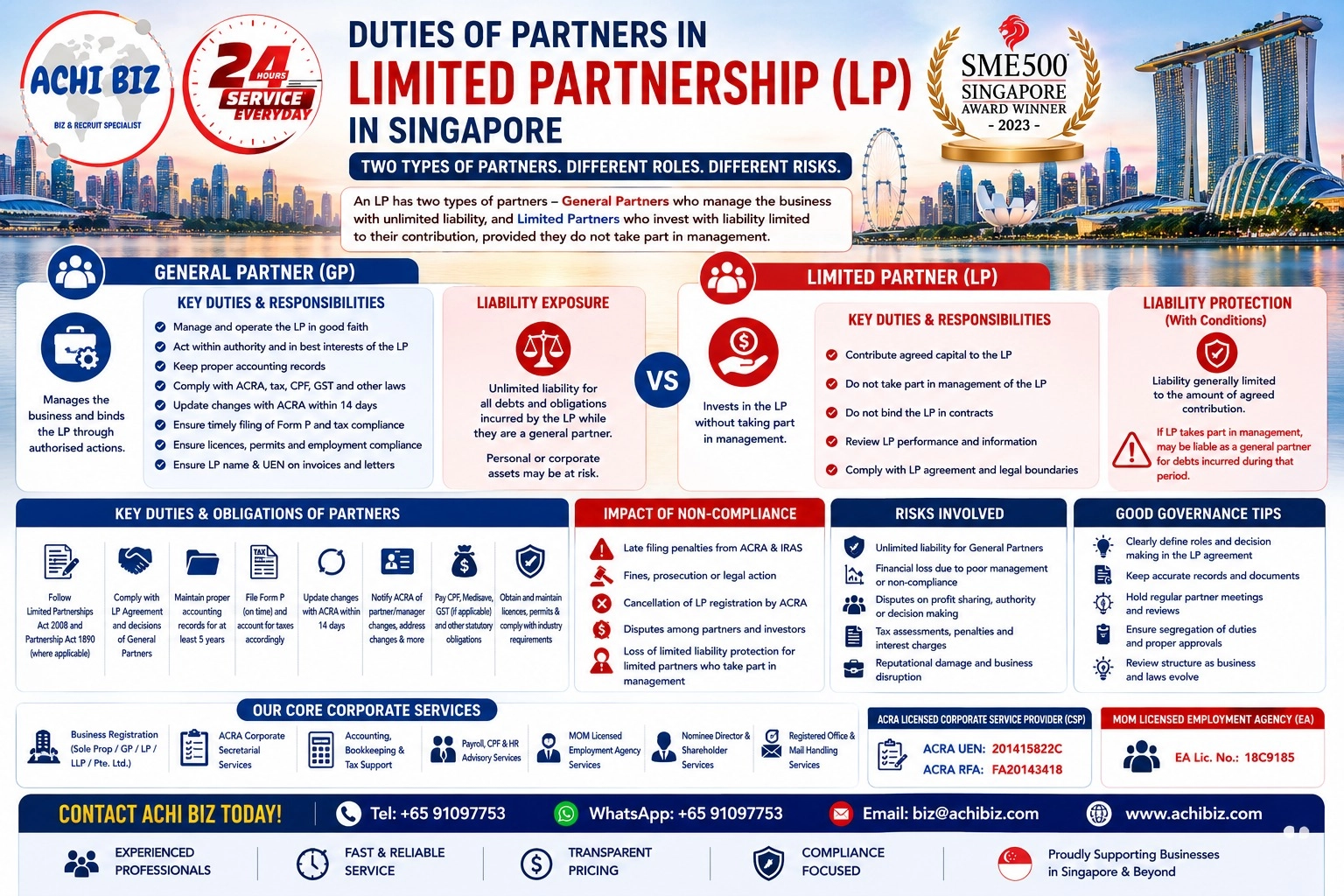
Duties of Partners in a Limited Partnership (LP) – FAQ Guide
A Limited Partnership (LP) in Singapore is quite different from an ordinary General Partnership because it has two distinct categories of partners: general partners and limited partners. Their roles, management rights, responsibilities and exposure to liability are not the same.
An LP must have at least one general partner and one limited partner. It does not have a separate legal personality from its partners and therefore cannot own property, sue or be sued in its own name. The general partner manages the business and bears unlimited liability, while a limited partner’s liability is generally capped at the amount agreed to be contributed, provided the limited partner stays within the statutory limits on participation in management.
This distinction is central to understanding the duties of partners in a Singapore Limited Partnership. A limited partner who becomes too involved in management can potentially lose the liability protection that makes the LP structure attractive in the first place.
This FAQ focuses specifically on Limited Partnerships (LPs). The responsibilities of sole proprietors and partners in an ordinary General Partnership are covered separately. Readers should refer to our respective articles on Duties of a Sole Proprietor in Singapore and Duties of Partners in a General Partnership in Singapore for those structures. A Limited Liability Partnership (LLP) is also a different legal structure and should be considered separately.
What Types of Duties Apply to Partners in a Singapore Limited Partnership?
Depending on whether the person is a general partner or limited partner, responsibilities can broadly include:
- Management and operational responsibilities of general partners
- Unlimited liability exposure of general partners
- Restrictions on management participation by limited partners
- Responsibilities arising under the Limited Partnerships Act 2008
- Applicable responsibilities under general partnership law
- Duties and obligations arising from the LP agreement
- ACRA registration and ongoing compliance responsibilities
- Duty to keep LP particulars updated
- Responsibilities concerning admission, withdrawal and changes of partners
- Accounting and financial record-keeping responsibilities
- Tax and Form P responsibilities
- Individual or corporate partner tax responsibilities
- MediSave responsibilities where applicable
- GST responsibilities where applicable
- Employment, CPF and foreign manpower responsibilities where applicable
- Licensing and industry-specific regulatory responsibilities
- Contractual and commercial responsibilities
- Responsibilities concerning LP property, money and transactions
- Registration renewal responsibilities
- Responsibilities upon cessation or dissolution of the LP
The actual obligations depend on the partner’s legal status, the LP agreement, the activities of the business and the legislation applicable to those activities.
What is a Limited Partnership in Singapore?
A Limited Partnership is a business structure governed principally by the Limited Partnerships Act 2008.
It consists of at least:
- one general partner; and
- one limited partner.
The fundamental difference is that the general partner runs the business and has unlimited liability, while the limited partner normally acts more like an investor and has liability capped at the agreed contribution, subject to the statutory rules.
Is an LP a separate legal entity from its partners?
No.
Unlike a Pte. Ltd. company or LLP, a Singapore LP does not have a separate legal personality from its partners. It cannot own property, sue or be sued in its own name.
This distinction has important implications for liability, ownership and management.
Why are the duties of general and limited partners different?
Because the LP structure deliberately separates management responsibility from investment participation.
General partners are permitted to manage the business but accept unlimited liability. Limited partners generally receive limited liability but are restricted from taking part in management.
The structure effectively creates a trade-off between management control and liability exposure.
What is the role of a general partner in an LP?
A general partner is responsible for running and managing the LP’s business.
General partners can participate in decision-making and may bind the partnership through their actions, subject to the Limited Partnerships Act, applicable partnership law, the LP agreement and the circumstances of the transaction.
Because they control the business, general partners also carry considerably greater liability exposure than limited partners.
What is the role of a limited partner?
A limited partner is generally an investor who contributes capital to the LP without taking responsibility for its management.
The limited partner’s liability is ordinarily capped at the amount that the partner has agreed to contribute. However, maintaining that protection depends partly on respecting the statutory boundary between investment participation and management.
Does a general partner have unlimited liability?
Yes.
A general partner has unlimited liability for the debts and obligations of the LP incurred while that person or entity is a general partner. Where there are multiple general partners, significant personal or corporate exposure can therefore arise from the LP’s activities.
This is one of the most important risks a prospective general partner should understand before entering an LP.
Can a general partner’s personal assets potentially be exposed?
Where the general partner is an individual, potentially yes.
Unlimited liability means that the financial exposure is not necessarily confined to the amount originally invested in the LP.
The precise enforcement consequences will depend on the particular debt, claim and applicable law, but a general partner should not assume that business liabilities remain isolated from personal financial exposure.
Is a limited partner’s liability always limited?
Not absolutely.
A limited partner normally enjoys liability limited to the agreed contribution, but an important exception arises where the limited partner takes part in management of the LP.
The Limited Partnerships Act provides that a limited partner who takes part in management becomes liable for LP debts and obligations incurred while doing so as though that person were a general partner.
Why is participation in management such an important issue for a limited partner?
Because it can fundamentally change the limited partner’s liability exposure.
A person may have joined an LP specifically because the investment risk was intended to be limited. If that person crosses the statutory boundary into management, the protection can be compromised for debts and obligations incurred during that period.
Limited partners should therefore understand exactly what involvement is permitted before becoming actively involved in operational decisions.
Does a limited partner have authority to bind the LP?
Not merely because the person is a limited partner.
The Limited Partnerships Act expressly states that a limited partner does not have power to bind the LP.
This is another important distinction between general and limited partners.
Does every activity performed by a limited partner count as management?
No.
The law recognises certain activities that do not by themselves amount to participation in management. The Limited Partnerships Act contains a statutory framework dealing with this issue.
The distinction can nevertheless become fact-sensitive. A limited partner who intends to become actively involved in important operational decisions should obtain appropriate advice rather than assume that a particular activity is automatically permitted.
Can a limited partner monitor the investment without becoming a general partner?
Limited partners are not expected to remain completely uninformed about their investment.
There is an important distinction between protecting or monitoring an investment and actually managing the LP’s business.
The question becomes particularly important where a limited partner begins directing employees, negotiating operational contracts, controlling day-to-day business decisions or otherwise assuming functions normally exercised by management.
Can the LP agreement allow a limited partner to manage the business without liability consequences?
The partners cannot simply use a private agreement to override statutory restrictions.
The LP agreement can define rights and responsibilities between the partners, but it should be structured consistently with the Limited Partnerships Act.
A clause purporting to give a limited partner unrestricted management powers should therefore not be assumed to preserve the partner’s statutory limited-liability position.
What duties arise under the LP agreement?
The LP agreement can establish important contractual rights and responsibilities concerning matters such as:
- capital contributions;
- profit and loss allocation;
- distributions;
- management authority;
- decision-making procedures;
- reserved matters;
- information rights;
- admission of new partners;
- retirement or withdrawal;
- transfer of partnership interests;
- conflicts of interest;
- dispute resolution;
- death or incapacity; and
- dissolution.
Partners should understand that statutory obligations and contractual obligations can operate together.
Is a written LP agreement compulsory?
The legal framework does not mean that every commercial arrangement must necessarily be contained in one particular document, but operating a significant LP without a carefully considered written agreement can create unnecessary uncertainty.
The agreement becomes especially important because general and limited partners have fundamentally different legal positions.
What happens if the LP agreement does not deal with a particular issue?
Statutory default rules may become relevant.
For example, subject to any agreement between the partners, ordinary differences concerning partnership business may be decided by a majority of the general partners. The Limited Partnerships Act also provides that a person may become a partner without the consent of existing limited partners, subject to any agreement between the partners.
This illustrates why important commercial matters should be addressed deliberately rather than left entirely to statutory defaults.
Can limited partners control the admission of new partners?
That depends significantly on the LP agreement.
Under the statutory default rule, and subject to an agreement between the partners, a person may become a partner without the consent of existing limited partners.
If investors want approval or veto rights over changes in partnership composition, the agreement should be appropriately structured while remaining consistent with the restrictions on limited-partner management.
What happens when there is more than one general partner?
Management authority and decision-making should be clearly documented.
Under the statutory default rules, differences concerning ordinary matters connected with the partnership business may be decided by a majority of the general partners, subject to any agreement between the partners.
An LP agreement can establish more detailed approval thresholds for major transactions.
Do general partnership principles also apply to an LP?
Yes, to an extent.
The Limited Partnerships Act provides that, subject to the Act, the Partnership Act 1890 and applicable rules of equity and common law concerning partnerships apply to Limited Partnerships, except where inconsistent with the LP statutory framework.
However, this does not mean that an LP should simply be treated as an ordinary General Partnership.
For detailed discussion of ordinary partnership duties, readers should refer to our separate article on Duties of Partners in a General Partnership in Singapore rather than repeating those matters here.
Who is mainly responsible for regulatory compliance in an LP?
The general partner carries many of the LP’s operational and statutory responsibilities.
ACRA specifically places responsibility on general partners for matters such as notifying changes in LP information and notifying ACRA about certain changes to the LP’s status.
This reflects the general partner’s management role.
What information must be kept updated with ACRA?
Relevant changes can include:
- appointed partners or managers;
- particulars of partners or managers; and
- the LP’s registered office address.
ACRA currently requires general partners to update applicable LP information within 14 days of a change. Late lodgement penalties may apply.
Who is responsible for reporting changes in partners?
The general partner normally carries the filing responsibility.
However, ACRA also allows former partners or local managers to notify ACRA in certain circumstances where they have ceased their role and believe the general partner has not made the required notification.
Why is promptly updating partner information important?
Because the composition of an LP is fundamental to its legal structure.
An LP must maintain the required categories of partners. A change in partner composition can therefore have consequences beyond simply changing a name on the ACRA register.
ACRA notes that LP registration status may automatically change when partners join or leave.
What happens if the LP loses its only limited partner?
The business may no longer satisfy the defining requirements of an LP.
The general partner should not simply continue indefinitely without considering the consequences. Changes in partner composition can trigger changes to the registration status, and the LP structure should be restored or appropriately dealt with according to the prevailing ACRA requirements.
What happens if the LP loses its only general partner?
This is particularly significant because an LP requires at least one general partner.
The matter should be addressed immediately, including the effect on the LP’s registration status and business operations.
Does an LP need a manager?
A manager may be required depending on the circumstances of the general partners, including where applicable local residency requirements must be satisfied.
The manager’s appointment should not be regarded merely as an administrative formality because statutory eligibility restrictions apply.
Can an undischarged bankrupt act as an LP manager?
Generally not unless the necessary approval has been obtained.
ACRA states that acting as an LP manager while an undischarged bankrupt without approval from the High Court or Official Assignee may constitute an offence. The stated maximum penalty is a fine of up to $10,000, imprisonment for up to two years, or both.
Must an LP maintain proper accounting records?
Yes.
Proper records are essential for establishing the LP’s financial position, partner contributions, income, expenditure, distributions, liabilities and tax position.
They are also important because disputes between general and limited partners frequently become much harder to resolve when financial records are incomplete.
What financial information should an LP monitor?
Depending on the business, records should enable the partners to understand matters such as:
- revenue and expenses;
- assets and liabilities;
- amounts contributed by partners;
- partner capital accounts;
- distributions;
- amounts owing to or by partners;
- borrowing;
- outstanding creditors;
- taxes; and
- overall financial position.
Good accounting is particularly important for a general partner because of the general partner’s unlimited liability exposure.
How is a Singapore LP taxed?
An LP is generally not taxed at entity level.
Instead, each partner is taxed on that partner’s share of the LP’s income according to the tax treatment applicable to the particular partner.
This means the tax treatment can differ depending on whether a partner is an individual or another type of legal person.
Does limited liability mean a limited partner does not pay tax on LP profits?
No.
Liability for business debts and liability for tax are different concepts.
A limited partner’s liability protection does not mean that the partner’s allocated share of partnership income is automatically exempt from taxation.
Each partner’s tax position must be considered according to the applicable IRAS rules.
What is Form P and who is responsible for filing it?
Form P is the Partnership Income Tax Return.
The precedent partner is responsible for filing Form P on behalf of the partnership and informing the partners of their respective shares of partnership income. Individual partners then report their allocated income according to their own applicable tax requirements.
Who is the precedent partner of an LP?
IRAS generally identifies the precedent partner as the first-named partner in the partnership agreement among the partners present in Singapore. Where there is no partnership agreement, the partners may agree upon and appoint the precedent partner.
The precedent partner’s role is primarily relevant to tax administration and should not be confused with the statutory distinction between a general partner and limited partner.
What are the main responsibilities of the precedent partner?
IRAS identifies responsibilities including:
- filing Form P;
- informing partners of their respective shares of partnership income; and
- lodging objections to adjusted partnership profits on behalf of the partners where applicable.
From YA 2027, e-Filing of Form P is compulsory, and IRAS currently specifies a filing period from 1 February to 18 April.
Does every partner still have individual tax responsibilities?
Yes.
The precedent partner’s filing of Form P does not remove the applicable tax responsibilities of individual partners.
Partners must account for their respective shares of partnership income according to their own tax status and applicable IRAS requirements.
What MediSave obligations can apply to partners?
Where partners are self-employed individuals, applicable MediSave obligations may arise.
ACRA’s current LP compliance guidance states that where a self-employed partner has annual net trade income exceeding the applicable threshold, arrangements concerning MediSave contributions must be made with CPF Board.
Partners should check the prevailing CPF requirements rather than relying on historic thresholds or contribution amounts.
Can MediSave issues affect the LP’s administration?
Potentially.
MediSave compliance forms part of ACRA’s current ongoing compliance guidance for LPs. Partners who are self-employed should therefore treat their applicable CPF obligations as part of the overall compliance framework rather than as an unrelated personal matter.
Can GST obligations apply to an LP?
Yes, depending on the applicable GST registration rules and circumstances.
The LP structure itself does not provide an exemption from GST. The business should monitor its GST position and comply with registration, filing, accounting and payment requirements where applicable.
Can an LP employ workers?
Yes, subject to the employment requirements applicable to the business.
Once the LP becomes an employer, obligations may arise concerning employment law, CPF, workplace safety, salary administration, statutory leave, employment records and other applicable requirements.
Can an LP employ foreign workers?
Potentially, where the business and proposed employment satisfy the prevailing MOM requirements.
ACRA registration of an LP does not itself create an entitlement to employ foreign manpower. Applicable work pass, quota, levy, sector and other requirements must separately be met.
Who carries responsibility for employment compliance?
Because general partners manage the LP, they should ensure that appropriate employment compliance systems are in place.
Depending on the particular legislation and circumstances, breaches may create regulatory, financial or other consequences.
Does an LP need licences and permits?
Possibly.
Registering an LP with ACRA does not automatically authorise every type of business activity. Certain industries and activities require separate licences, permits or regulatory approvals.
General partners should establish the applicable licensing requirements before the LP begins regulated activities.
Must the LP’s name and UEN appear on business documents?
ACRA currently requires the LP’s name and UEN to be displayed on relevant documents such as invoices, official receipts and letters to government agencies.
This is an ongoing compliance requirement that can easily be overlooked after registration.
Can a general partner enter contracts on behalf of the LP?
General partners manage the LP and may have authority to conduct its business, subject to the LP agreement, applicable partnership law and the circumstances of the transaction.
For this reason, authority limits should be clearly documented, particularly for borrowing, leases, major purchases, guarantees and long-term contracts.
Why should an LP establish internal approval limits?
Because unlimited liability can make uncontrolled commitments particularly dangerous for general partners.
The LP agreement or internal governance arrangements can establish who may approve expenditure, enter contracts, borrow funds or commit the business above specified thresholds.
Good internal controls cannot eliminate statutory liability, but they can reduce unnecessary operational risk.
What are the major risks faced by a general partner?
The principal risks include:
- unlimited liability for LP obligations;
- contractual claims;
- regulatory non-compliance;
- tax liabilities;
- inadequate financial controls;
- poor accounting records;
- unauthorised commitments by persons acting for the business;
- partner disputes; and
- business failure.
The general partner should therefore assess the LP’s risk profile before accepting the role.
What are the major risks faced by a limited partner?
The risks are different.
They can include:
- loss of the investment;
- inadequate information about the business;
- disputes over distributions;
- problems arising from an inadequate LP agreement;
- dependence on the competence and integrity of the general partner; and
- most importantly, potential exposure to general-partner-style liability if the limited partner improperly participates in management.
Can a limited partner lose more than the amount invested?
Potentially, where the statutory conditions for limited liability are not maintained.
The most significant example is participation in management. The Act provides that the limited partner may become liable for debts and obligations incurred while participating in management as though that person were a general partner.
Does appointing a corporate general partner eliminate all risk?
No.
A corporate general partner can affect how liability is structurally borne, but it does not make business debts, regulatory obligations or compliance requirements disappear.
The suitability of such an arrangement depends on the circumstances and should be considered together with the ownership, tax, governance and commercial structure.
Is insurance important for an LP?
Potentially, yes.
Appropriate business insurance can help manage particular operational risks, but insurance does not change the underlying legal structure.
Policy exclusions, limits and uninsured events can still leave the LP or general partners exposed.
What happens if LP information is not updated with ACRA on time?
ACRA states that general partners must update relevant LP information within 14 days of changes. Late lodgement penalties can apply when this is not done.
Repeated administrative failures can also create practical problems because public records no longer accurately reflect the business.
Can ACRA cancel an LP’s registration?
Yes, in applicable circumstances.
For example, ACRA states that general partners must respond to certain ACRA enquiries within one month. Failure to respond can result in ACRA cancelling the LP’s registration.
Official correspondence should therefore never be ignored.
What are the consequences of non-compliance by an LP or its partners?
There is no single penalty because obligations arise under different laws.
Depending on the breach, consequences may include:
- late lodgement penalties;
- regulatory fines;
- cancellation of registration;
- tax assessments and penalties;
- licensing consequences;
- contractual claims;
- partner disputes;
- personal financial exposure for general partners; and
- loss of limited-liability protection for a limited partner who improperly participates in management.
The financial consequence can therefore be considerably greater than the amount of an administrative penalty.
Can paying a penalty resolve every compliance breach?
No.
A penalty may deal with one consequence of a breach, but the underlying obligation may still need to be rectified.
For example, outstanding information may still need to be filed, tax matters resolved, licences regularised or contractual obligations satisfied.
Does an LP registration need to be renewed?
Yes. LP registration must be kept valid where the partners intend to continue operating the business.
Renewal should therefore be monitored as part of the LP’s regular compliance calendar rather than dealt with only after expiry. ACRA includes renewal among the LP’s ongoing compliance requirements.
What should happen when a general partner leaves?
The LP should immediately review:
- whether another general partner remains;
- the requirements of the LP agreement;
- outstanding liabilities;
- authority and banking arrangements;
- contracts;
- ACRA notifications; and
- whether the LP continues to satisfy its structural requirements.
Leaving the LP should not be treated as merely removing a name from the register.
Does retirement remove a general partner’s previous liabilities?
A retiring general partner should not assume that departure automatically extinguishes liabilities incurred while that person or entity was a general partner.
The legal position concerning existing obligations, contracts and third-party claims should be properly reviewed when a general partner retires.
What should happen when a limited partner leaves?
The remaining partners should check whether the LP still has at least one limited partner and continues to meet the statutory requirements of an LP.
The LP agreement should also be reviewed for matters such as repayment or transfer of capital, distributions, valuation and the treatment of the outgoing partner’s interest.
What happens if a partner or manager resigns but the general partner fails to update ACRA?
ACRA provides a mechanism allowing a partner or manager who has ceased the role to notify ACRA directly where the general partner has not done so.
This helps prevent a former position holder from remaining incorrectly recorded indefinitely.
What responsibilities arise when the LP is dissolved?
General partners are responsible for notifying ACRA about the change in status.
ACRA currently requires notification within 14 days when an LP is dissolved. Late lodgement penalties can apply for failure to do so.
The partners must also properly deal with outstanding business affairs, including debts, assets, tax matters, contracts and records.
Does closing an LP automatically erase its debts?
No.
Closing or ceasing the registration should not be confused with extinguishing legitimate liabilities already incurred.
Outstanding creditors, tax matters, contracts and other obligations should be properly addressed.
Should an LP retain records after it stops operating?
Yes, where statutory record-retention requirements continue to apply.
Closing the business does not automatically remove obligations concerning records relating to earlier transactions.
What is the most important difference between the duties of general and limited partners?
The simplest way to understand the distinction is:
| Area | General Partner | Limited Partner |
|---|---|---|
| Business management | Manages the LP | Generally must not take part in management |
| Liability | Unlimited | Generally capped at agreed contribution |
| Authority | May act for the business subject to applicable authority | Does not bind LP merely as a limited partner |
| ACRA compliance | Carries major operational filing responsibilities | More restricted role |
| Main risk | Unlimited exposure to LP obligations | Losing liability protection by participating in management |
Is an LP the same as an ordinary General Partnership?
No.
Both are partnership structures without the separate legal personality of a company, but an LP introduces the important distinction between general partners and limited partners.
We have covered the responsibilities applicable to an ordinary General Partnership separately. Readers should refer to our article on Duties of Partners in a General Partnership in Singapore for that discussion.
Is an LP the same as a sole proprietorship?
No.
A sole proprietorship has one owner and no division between general and limited partners.
Rather than repeating those obligations here, readers can refer to our separate article on Duties of a Sole Proprietor in Singapore.
Is an LP the same as an LLP?
No.
The similar abbreviations can be misleading.
An LP is not a separate legal entity, whereas an LLP has separate legal personality and a substantially different liability framework.
The duties and responsibilities of partners in an LLP should therefore be analysed separately.
When might an LP structure be appropriate?
An LP may be considered where the commercial arrangement genuinely requires different roles between:
- persons or entities actively managing the business; and
- investors contributing capital without participating in management.
Whether it is appropriate depends on liability, investment, management, taxation, continuity, regulatory and commercial considerations.
When should partners reconsider whether an LP remains suitable?
The structure should be reviewed when there are significant changes such as:
- new investors;
- departure of a general or limited partner;
- major borrowing;
- substantial new contracts;
- expansion into regulated activities;
- significant growth;
- changes in management;
- restructuring; or
- investors wanting greater operational control.
A structure that suited the business at formation may not necessarily remain appropriate indefinitely.
What should general partners review regularly?
A practical compliance review should cover:
- validity of ACRA registration;
- accuracy of registered particulars;
- partner and manager information;
- accounting records;
- Form P and partner tax matters;
- applicable MediSave requirements;
- GST position;
- licences and permits;
- employment compliance;
- contracts and borrowing;
- insurance;
- LP agreement requirements; and
- internal authority limits.
The general partner’s unlimited liability makes disciplined administration particularly important.
What should limited partners review regularly?
Limited partners should understand:
- their agreed capital contribution;
- distributions and profit allocations;
- information rights;
- transfer and withdrawal provisions;
- financial performance;
- the LP agreement; and
- the boundary between permitted investor involvement and prohibited management participation.
The last point is especially important because crossing that boundary can materially change the limited partner’s liability position.
What is the biggest misconception about a Limited Partnership?
Probably the assumption that the word “Limited” means everyone involved has limited liability.
That is incorrect.
The general partner has unlimited liability. The limited partner generally receives limited liability precisely because the partner does not take part in management.
What is the key compliance lesson for general partners?
Do not treat LP administration as a once-a-year registration exercise.
The general partner should continuously monitor regulatory filings, financial records, partner changes, tax matters, licences, contracts and the LP’s compliance with its agreement.
Because the general partner carries unlimited liability, poor administration can become a direct financial problem.
What is the key compliance lesson for limited partners?
Understand the difference between being an investor and managing the business.
A limited partner should know what rights are available under the LP agreement and law, but should be cautious about assuming operational control without understanding the liability consequences.
What is the overall takeaway about the duties of partners in a Singapore LP?
A Limited Partnership works because the two classes of partners have different roles and different risk profiles.
The general partner receives management authority but carries unlimited liability. The limited partner generally receives limited liability but must remain within the statutory boundaries governing participation in management.
For an LP to work effectively, these roles should be clearly documented and respected in practice. A well-written agreement alone is not enough if the actual operation of the business contradicts it.
Proper ACRA compliance, accounting, taxation, record keeping, licensing, internal controls and timely management of partner changes are therefore essential parts of operating an LP responsibly.
How Can ACHI BIZ Assist with Limited Partnership and Other Corporate Services in Singapore?
ACHI BIZ provides Limited Partnership registration and related corporate services in Singapore, together with ongoing assistance for applicable ACRA business-registration and compliance matters.
As an ACRA Licensed Corporate Service Provider (CSP), ACHI BIZ assists entrepreneurs, investors and businesses with services covering sole proprietorships, General Partnerships, Limited Partnerships (LPs), Limited Liability Partnerships (LLPs) and Singapore Pte. Ltd. companies, depending on their requirements.
Services can include business registration, changes to registered particulars, renewal and cessation matters, company incorporation, corporate secretarial services, ACRA statutory filings, corporate compliance, accounting and tax-related support, registered office services, share and share-capital matters, company constitution and resolutions, annual returns and applicable work pass and employment agency services.
Choosing between a sole proprietorship, General Partnership, LP, LLP or Pte. Ltd. company should not be based only on registration cost or simplicity. Liability, management rights, ownership, taxation, continuity, investment plans and ongoing compliance should all be considered before deciding on the appropriate structure.
Disclaimer
This FAQ is provided for general information and educational purposes only. The duties, rights and liabilities of general and limited partners can depend on the Limited Partnerships Act 2008, Partnership Act 1890, LP agreement, tax status, business activities, regulatory requirements and individual circumstances. Laws, procedures and administrative requirements may change from time to time. This article should not be treated as legal, tax, accounting or other professional advice. The prevailing requirements of the relevant Singapore authorities should be checked and professional advice obtained where appropriate.
Related Pages
Duties of Partners in a Partnership (General) – FAQ Guide
Duties of Partners in a Limited Liability Partnership (LLP) – FAQ Guide
#achibiz