
Employment Pass (EP) vs Employment Pass (Sponsorship) in Singapore
Singapore offers different application routes for foreign professionals who need an Employment Pass (EP), depending particularly on whether the employing company has a registered presence in Singapore.
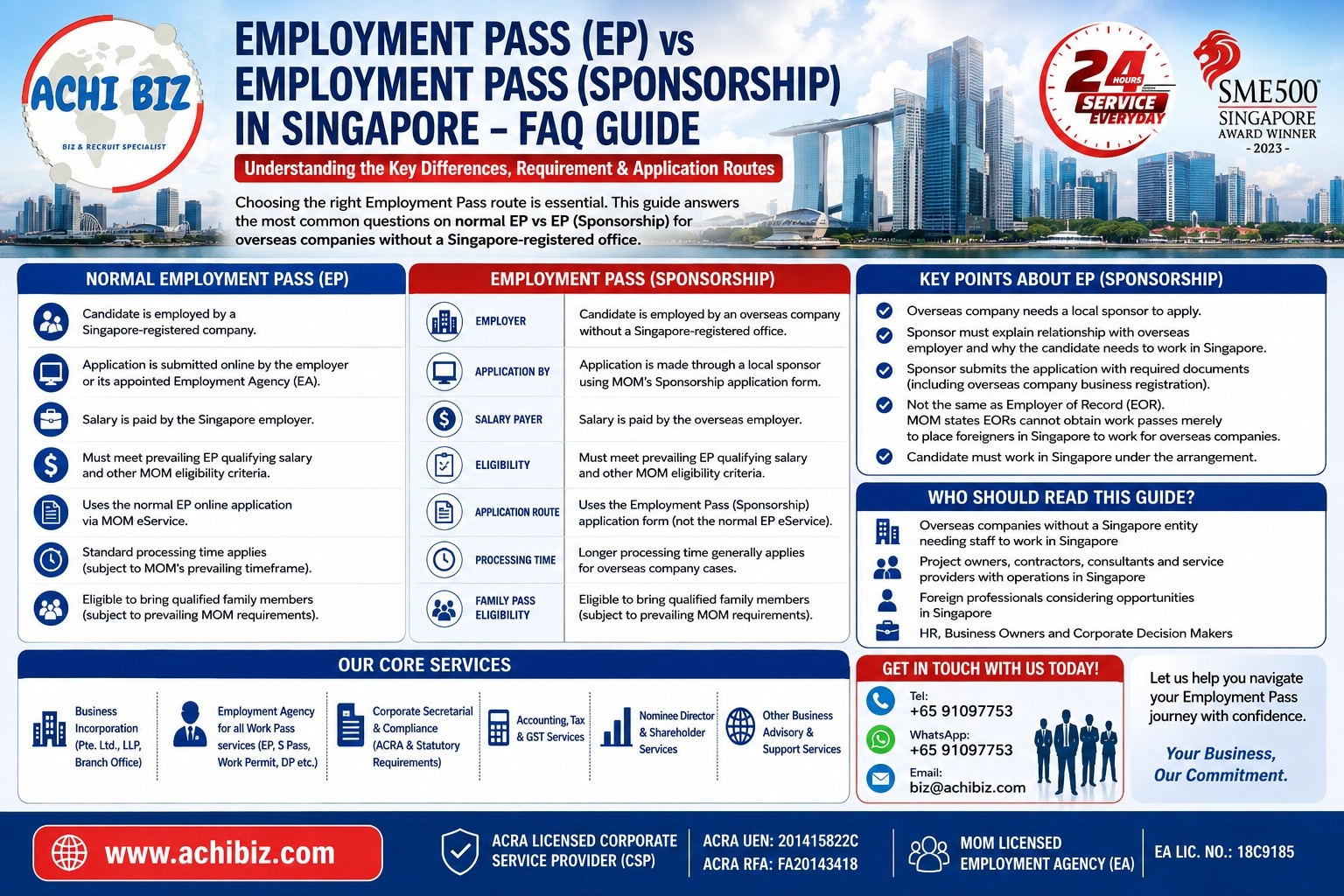
For the usual Employment Pass application, the candidate is employed by a Singapore-based employer, and the application is submitted by the employer or its appointed Employment Agency (EA).
However, the situation can be different when a foreign professional is employed by an overseas company that does not have a Singapore-registered office. MOM states that, in such a case, the Employment Pass application needs to be made through a local sponsor. MOM provides a separate Employment Pass (Sponsorship) Application Form specifically for sponsorship cases.
Although both routes involve an Employment Pass, businesses should not assume that an ordinary EP application and an Employment Pass (Sponsorship) application are interchangeable. The employing entity, local sponsor, business relationship, application procedure, supporting documents and MOM’s assessment can differ.
This FAQ guide compares the Employment Pass (EP) vs Employment Pass (Sponsorship) in Singapore, without stating fixed salary figures that may change over time. Candidates and companies should always refer to the prevailing MOM Employment Pass salary and eligibility criteria at the time of application.
What is an Employment Pass (EP) in Singapore?
The Employment Pass is a work pass for eligible foreign professionals, managers, executives and technicians who will work in Singapore.
For a standard EP application, an employer or its appointed Employment Agency applies on behalf of the candidate. The candidate must meet MOM’s prevailing Employment Pass eligibility requirements.
What is an Employment Pass (Sponsorship) in Singapore?
An Employment Pass (Sponsorship) is the application route used in relevant cases involving an overseas employer without a Singapore-registered office, where a local sponsor is required for the EP application.
MOM expressly states that an overseas company without a Singapore-registered office needs to apply through a local sponsor.
Is Employment Pass (Sponsorship) a completely different type of work pass from an EP?
It is still an Employment Pass, but the application is handled under a different sponsorship arrangement.
MOM maintains a separate Employment Pass Application Form (For Sponsorship cases) and a separate sponsorship renewal form.
Therefore, it is more accurate to understand it as a distinct EP application route or arrangement, rather than treating it as an entirely unrelated work pass category.
What is the main difference between a normal EP and an Employment Pass (Sponsorship)?
The main difference is the underlying employment and application structure.
For a normal EP, the candidate is generally being hired by a Singapore-based employer, which or whose appointed EA applies for the EP.
For an overseas company without a Singapore-registered office, MOM states that a local sponsor is needed to apply.
Who is the employer under a normal Employment Pass?
Under the usual EP arrangement, the candidate has a job offer from the Singapore-based employer that is applying for the Employment Pass.
The EP is therefore tied to the employment arrangement with that employer.
Who is the overseas employer in an Employment Pass (Sponsorship) case?
The overseas employer is the foreign company employing the candidate but which does not have the relevant Singapore-registered office for the ordinary application route.
MOM’s sponsorship application specifically requires information about the overseas employer, including its business details, as well as information about the local sponsor.
Does an overseas company without a Singapore-registered office need a local sponsor for an EP application?
Yes, where it is applying through this route.
MOM’s Employment Pass key facts state that for an overseas company without a Singapore-registered office, the application needs to be made through a local sponsor.
Is the local sponsor the same as the overseas employer?
Not necessarily.
MOM’s sponsorship application separately asks for details of the overseas employer and the local sponsor company.
This distinction is important because sponsorship should not automatically be interpreted as transferring the underlying overseas employment relationship to the sponsor.
Does MOM require a relationship between the overseas employer and local sponsor?
The relationship is clearly relevant to the application.
MOM’s current Employment Pass (Sponsorship) form specifically asks the sponsor to:
- provide the relationship between the overseas employer and sponsor company; and
- explain why the sponsor company needs the candidate to work in Singapore.
Therefore, an overseas company should not assume that any unrelated Singapore company can simply be inserted as a sponsor without an appropriate underlying arrangement and justification.
Can any Singapore company simply provide paid EP sponsorship to an overseas company?
This should not be assumed.
The sponsorship application requires MOM to be informed of the relationship between the overseas employer and local sponsor and why the sponsor needs the candidate to work in Singapore.
The proposed arrangement should therefore be assessed on its actual commercial facts rather than treating sponsorship as merely renting the name of a Singapore company for a work pass application.
Why does MOM ask why the sponsor needs the candidate to work in Singapore?
Because the sponsorship application is connected to an actual work arrangement in Singapore.
The sponsor should be able to explain the commercial context and why the overseas employee’s presence and work in Singapore are required.
This helps distinguish a genuine sponsorship case from an arrangement created solely for immigration purposes.
Is Employment Pass (Sponsorship) the same as an Employer of Record (EOR) arrangement?
No, and this distinction is particularly important.
MOM states that an Employer of Record in Singapore cannot apply for work passes for foreigners to be based in Singapore while working for overseas companies. MOM says EORs doing so would be committing an offence.
Therefore, Employment Pass Sponsorship should not be marketed or structured simply as an EOR workaround.
Can a Singapore EOR employ the foreigner locally just to obtain an EP while the person actually works for an overseas company?
MOM specifically says no in relation to EOR arrangements of this nature.
MOM states that work passes are for foreigners to work for Singapore-based companies and warns against EORs applying for work passes merely so foreigners can be based in Singapore while working for overseas companies.
The actual working arrangement matters, not merely what appears on an employment contract.
Can an overseas company incorporate a Singapore company instead of using the Sponsorship route?
Potentially, yes.
MOM states that where an overseas company has no local presence and wants a foreigner to be based in Singapore for an extended period, options may include incorporating a company with ACRA or, where appropriate, establishing a representative office through Enterprise Singapore’s Representative Office scheme.
The appropriate structure depends on the overseas company’s intended activities and longer-term plans in Singapore.
When might incorporating a Singapore company be preferable to Employment Pass Sponsorship?
A Singapore company may make more commercial sense where the overseas business intends to establish a substantial or continuing Singapore operation, employ additional staff, enter into local contracts or develop a permanent business presence.
Sponsorship may be considered in circumstances where the overseas company does not have a Singapore-registered office but has a genuine business requirement for the candidate to work in Singapore through an appropriate local sponsorship arrangement.
The corporate structure should be driven by the business model rather than by the work pass alone.
Can a Representative Office be an alternative?
Depending on the overseas company’s circumstances and eligibility, MOM identifies establishing a representative office through Enterprise Singapore as one possible route for an overseas company without local presence.
A Representative Office has its own eligibility, permitted-activity and duration considerations and should not automatically be treated as equivalent to incorporating a Singapore company.
Is the candidate required to satisfy Employment Pass eligibility criteria under the Sponsorship route?
The Sponsorship route should not be understood as a way to bypass Employment Pass eligibility requirements.
Candidates should be assessed against the prevailing MOM requirements applicable to their case at the time of application.
What salary is required for a normal Employment Pass?
MOM maintains prevailing qualifying salary requirements for Employment Pass candidates, and these criteria can be revised over time.
For an evergreen guide, companies and candidates should therefore check the current MOM qualifying salary applicable on the date of application, including any sector-specific and age-related requirements, instead of relying on an old salary figure.
What salary is required for an Employment Pass (Sponsorship)?
The candidate should satisfy the prevailing salary and other eligibility requirements applicable to the Sponsorship application.
Because MOM’s work pass policies and salary requirements may change, applicants should verify the current criteria before preparing the application rather than relying on historical figures.
Why should companies avoid relying on old EP salary information found online?
Employment Pass qualifying salary requirements can change.
An article, forum discussion, social media post or old application prepared several years ago may therefore contain figures that no longer apply.
The safest approach is to verify the prevailing MOM criteria for the candidate’s intended application date.
Does meeting the prevailing salary criterion guarantee EP approval?
No.
Meeting a salary threshold should never be presented as a guarantee of approval.
MOM assesses Employment Pass applications according to the applicable eligibility and assessment framework, together with the facts and supporting information submitted.
Does a higher salary automatically guarantee approval?
No.
Salary is important, but an Employment Pass application should be considered as a complete application rather than as a salary-only test.
The candidate’s role, qualifications or professional background where relevant, employer information and other applicable MOM criteria can matter.
Does COMPASS apply to Employment Pass applications?
For standard EP applications, MOM’s Employment Pass framework generally involves the prevailing qualifying salary requirement and the Complementarity Assessment Framework (COMPASS), subject to applicable exemptions. MOM describes COMPASS as a points-based framework considering individual and firm-related attributes.
For a Sponsorship case, applicants should follow the requirements and assessment applicable to MOM’s Sponsorship route rather than simply assuming that every procedural feature of the ordinary online EP route applies identically.
Should an overseas company use the normal EP eService for a Sponsorship case?
No.
MOM provides a dedicated Employment Pass Application Form for Sponsorship cases.
The sponsorship form itself states that it is specifically for Employment Pass (Sponsorship) applications, while ordinary EP applications use the normal EP eService.
Who completes the Employment Pass (Sponsorship) application?
MOM’s sponsorship application separates responsibilities between the candidate and local sponsor.
The candidate completes the candidate sections and sends the form to the local sponsor. The local sponsor checks those details, completes the sponsor-related sections and handles the submission process with the required supporting documents.
Does the local sponsor need a Corppass account?
Yes, for the sponsorship submission process described in MOM’s current form.
MOM states that the sponsor organisation needs a Corppass account to upload the completed application and supporting documents.
What information does MOM ask about the local sponsor?
The sponsorship form asks for information including the sponsor company’s registered name, UEN, contact details and address.
Importantly, it also asks about the relationship between the sponsor and overseas employer and why the sponsor requires the candidate to work in Singapore.
What information does MOM ask about the overseas employer?
The Sponsorship application contains dedicated overseas-employer information and requires supporting documentation relating to the overseas business.
For example, MOM’s supporting-document requirements include the overseas employer’s business registration evidence showing its registered name and date of registration.
Does MOM require evidence that the overseas company genuinely exists?
Yes, the sponsorship application requires supporting information concerning the overseas employer.
The requirement for business registration documentation helps establish the identity and existence of the foreign employing entity.
Can foreign-language company documents be submitted?
Where supporting documents are not in English, MOM’s Sponsorship form states that they must be accompanied by an English translation.
Applicants should check the current form for MOM’s prevailing document and translation requirements before submission.
Are educational certificates required for Employment Pass (Sponsorship)?
MOM’s Sponsorship application lists educational certificates among the supporting documents and may impose additional verification requirements for certain qualifications.
The current requirements should be reviewed for the candidate’s particular qualification and circumstances.
Can regulated professionals use the Sponsorship route?
Potentially, but the relevant professional or regulatory requirements may also need to be satisfied.
MOM’s Sponsorship application identifies occupations for which registration or support letters from the relevant Singapore agency or professional body may be required.
A work pass does not replace professional licensing requirements.
Is the application procedure the same for a normal EP and a Sponsorship EP?
No.
Ordinary Employment Pass applications are generally submitted online by the employer or appointed EA.
Sponsorship cases use MOM’s specific sponsorship application process and documentation.
Is the processing time the same for both routes?
Applicants should not assume so.
MOM currently publishes a shorter standard processing timeframe for most ordinary online EP applications and a longer timeframe for overseas-company cases.
Processing times can change, and individual cases may take longer where MOM requires additional information.
Should a company plan more time for an EP Sponsorship application?
Yes, prudent planning is advisable.
A Sponsorship case involves the overseas employer, candidate and local sponsor and can require additional corporate information and supporting documentation.
Companies should therefore avoid arranging critical deployment dates on the assumption that approval will be immediate.
Can an applicant start working simply because the EP application has been submitted?
No.
Submitting an application is not the same as obtaining authorisation to work.
The candidate must have the appropriate valid work authorisation before commencing work that requires a Singapore work pass.
Does an In-Principle Approval (IPA) mean the same thing as the Employment Pass card?
No.
An IPA represents approval in principle subject to the applicable conditions and issuance requirements.
The employer, sponsor, candidate or appointed EA, as applicable, should follow MOM’s required issuance process before assuming that all work pass formalities have been completed.
Is Employment Pass Sponsorship intended for short business visits?
Not necessarily.
A person visiting Singapore for meetings or other permitted short-term activities may fall under different immigration or work-pass considerations.
MOM itself distinguishes extended work arrangements from activities such as company meetings, corporate retreats or meetings with business partners that may be conducted during permitted short-term visits in relevant circumstances.
The actual activities to be performed in Singapore should be reviewed.
Does every employee of an overseas company who visits Singapore need an EP Sponsorship?
No.
The need for a work pass depends on what the person will actually do in Singapore, the nature and duration of the activities and the applicable immigration/work-pass rules.
A short business visitor attending meetings is fundamentally different from an employee being physically deployed to Singapore to perform ongoing operational work.
What if the employee works only for an overseas company while physically in Singapore?
This can require careful distinction.
MOM states, in the context of persons physically in Singapore holding a stay pass such as a Dependant’s Pass, that a work pass is required where they work for or provide services to a Singapore-based organisation or client, while work solely for an overseas-based organisation or client is treated differently.
The precise facts therefore matter, particularly where there are Singapore clients, projects, sites or counterparties.
What if the overseas employee is performing services for a Singapore client?
That can materially change the analysis.
If the person’s work in Singapore involves providing services to a Singapore-based organisation or client, the company should determine the appropriate work authorisation before the work begins.
The fact that salary is paid overseas does not by itself answer whether Singapore work authorisation is required.
Does being paid by an overseas company automatically mean no Singapore work pass is required?
No.
The source of salary is not the only consideration.
The nature of the work, where it is performed, for whom services are being provided and the applicable MOM rules should be considered.
Can an employee work at a client’s premises under an EP Sponsorship arrangement?
The actual work location and deployment arrangement are relevant.
MOM’s Sponsorship renewal documentation, for example, asks for the address where the candidate’s duties are performed and whether the candidate will be deployed to work for another employer.
Companies should therefore disclose and structure the actual work arrangement accurately rather than treating the work location as an administrative detail.
Why is deployment to another company an important issue?
Because Singapore work passes are connected to genuine employment and work arrangements.
A structure in which a company merely holds a pass while the individual is effectively deployed elsewhere can raise different regulatory considerations.
This is also why the distinction between genuine sponsorship and an inappropriate EOR arrangement is important.
Can a U.S., UK, European, Indian or other foreign company use Employment Pass Sponsorship?
The key issue is not simply the overseas company’s nationality.
The application needs to fit MOM’s Sponsorship framework, and the candidate, overseas employer and local sponsor must provide the relevant information and supporting documents.
Each case should therefore be assessed on its own facts.
Is Employment Pass Sponsorship suitable for an overseas company carrying out a project in Singapore?
Potentially, depending on the project structure.
For example, an overseas company may need specialist personnel physically present in Singapore for a legitimate project while it does not maintain a Singapore-registered office.
The relationship with the local sponsor, reason for the employee’s presence, work location, project arrangement and actual duties should be clearly established.
Can Employment Pass Sponsorship be used for a foreign contractor working on a Singapore project?
Possibly, but the word “contractor” alone does not determine eligibility.
The actual employing company, contractual structure, local sponsor relationship, work being performed and prevailing MOM requirements need to be examined.
Companies should avoid assuming that the Sponsorship route automatically applies simply because an overseas contract exists.
Can Employment Pass Sponsorship be considered for an overseas company performing a government contract in Singapore?
Potentially, depending on the facts.
The existence of a government contract does not itself guarantee EP Sponsorship eligibility or approval.
The overseas employer, local sponsor, candidate’s role, project requirements and relationship between the relevant parties would still need to support the application.
Does having a contract in Singapore automatically qualify an overseas employee for EP Sponsorship?
No.
A commercial contract may help explain why the candidate needs to work in Singapore, but MOM still assesses the Employment Pass application under the prevailing requirements.
There is no automatic entitlement to a work pass merely because a company has secured a Singapore contract.
Can a foreign company use EP Sponsorship simply because it does not want to incorporate in Singapore?
The absence of a Singapore-registered office is relevant to MOM’s Sponsorship route, but the arrangement still needs to be genuine and properly supported.
An overseas company should compare Sponsorship against establishing an appropriate Singapore presence based on its expected duration, operations, staffing and commercial plans.
What if the overseas company later incorporates a Singapore subsidiary?
The company should review the employee’s work pass arrangement against the new corporate and employment structure.
A structure that was appropriate when the overseas company had no Singapore-registered office may no longer be the most suitable arrangement after a Singapore entity has been established.
Can a normal EP holder change to an EP Sponsorship arrangement?
A change in employer or underlying work arrangement should not be treated merely as an administrative amendment.
The company should determine whether a new application is required under MOM’s prevailing procedures and ensure that the candidate remains properly authorised throughout the transition.
Can an EP Sponsorship holder move to a normal Singapore employer?
If the individual obtains employment with a Singapore-based company, the new employer would generally need to follow the appropriate MOM process for the new Employment Pass arrangement.
A work pass should not simply be assumed to transfer automatically from one employment structure to another.
Can an Employment Pass (Sponsorship) be renewed?
Yes. MOM maintains a separate Application for Renewal of Employment Pass (Sponsorship) form.
Renewal should not be assumed to be automatic. The continuing business arrangement and prevailing MOM requirements need to be considered.
Is renewal of an EP Sponsorship guaranteed if the first application was approved?
No.
An initial approval does not guarantee future renewal.
The circumstances at renewal, continuing relationship, candidate’s work arrangement and prevailing MOM policies can be relevant.
Does MOM review the sponsor company again at renewal?
The Sponsorship renewal form requires information about the local sponsor, including its business and financial information, work location and deployment arrangements.
Companies should therefore maintain proper records throughout the sponsorship period rather than viewing sponsor due diligence as a one-time exercise.
Can the local sponsor simply withdraw while the candidate continues working?
The parties should not assume that the employee can continue working unaffected if the sponsorship arrangement ends.
Any change affecting the basis of the work pass should be addressed through the appropriate MOM procedure.
When should an Employment Pass be cancelled?
An Employment Pass should be dealt with appropriately when the underlying employment or work arrangement ends or where cancellation is otherwise required under MOM’s rules.
Employers and sponsors should avoid leaving a work pass active when its underlying basis no longer exists.
What if the EP holder is sent overseas for an extended period?
MOM states that a work pass is issued for the foreigner to perform work in Singapore. MOM advises employers to cancel the work pass where an overseas work stint continues for more than 6 months, with a new application possible when the person is ready to work in Singapore again.
Can the EP holder bring family members to Singapore?
Employment Pass holders may potentially qualify to bring eligible family members under the applicable MOM family-pass framework, subject to the prevailing eligibility requirements.
The current requirements should be checked when the family-pass application is being considered.
Does an EP Sponsorship application guarantee Dependant’s Pass eligibility?
No.
Family-pass eligibility should be separately assessed against MOM’s prevailing requirements.
Approval of the principal Employment Pass should not be represented as an automatic guarantee that every family member will qualify for a related pass.
Does an Employment Pass lead automatically to Singapore Permanent Residence?
No.
An Employment Pass is a work pass and does not automatically convert into Singapore Permanent Residence.
PR is administered separately by the Immigration & Checkpoints Authority (ICA), which assesses applications according to its own criteria.
Is a local sponsor guaranteeing that MOM will approve the Employment Pass?
No.
A sponsor facilitates and supports the application within the relevant sponsorship framework, but the decision on the Employment Pass remains with MOM.
No responsible sponsor or Employment Agency should guarantee approval.
Does the sponsor need to verify the candidate’s information?
MOM’s current Sponsorship form instructs the local sponsor to check the candidate’s information before completing and submitting the remaining portions of the application.
Accurate information is therefore important for both the candidate and sponsor.
Can inaccurate information affect an Employment Pass Sponsorship application?
Yes.
Work pass applications should accurately describe the candidate, overseas employer, local sponsor, work duties, relationship between the parties and other information requested by MOM.
Companies should never construct an artificial arrangement merely to fit a work pass category.
Should the sponsor conduct due diligence on the overseas company?
From a practical risk-management perspective, yes.
Because the sponsor is participating in the application and providing information to MOM about its relationship with the overseas employer, it should understand who the overseas company is, what it does, why the employee needs to work in Singapore and what the underlying project or commercial arrangement involves.
Should the overseas employer conduct due diligence on the Singapore sponsor?
Yes.
The overseas company should understand the sponsor’s identity, role, responsibilities, contractual terms and experience before entering into the arrangement.
Choosing a sponsor should not be treated merely as purchasing an administrative service.
Should there be a written agreement between the overseas employer and local sponsor?
A properly documented commercial arrangement is generally sensible because the parties need clarity about their respective roles and responsibilities.
The agreement should accurately reflect the genuine underlying relationship and should not contradict what is represented to MOM.
The appropriate contractual terms will depend on the particular arrangement.
What issues might a sponsorship agreement address?
Depending on the circumstances, the parties may need clarity regarding their respective responsibilities, information and document provision, regulatory cooperation, fees, work-pass administration, changes in circumstances, renewal, cancellation and termination.
The agreement should be tailored to the genuine arrangement rather than copied from an unrelated employment or EOR contract.
Can the sponsor charge a fee for its services?
Commercial arrangements between the relevant parties need to comply with applicable Singapore laws and regulatory requirements.
More importantly, payment of a fee does not by itself create a valid sponsorship relationship. The underlying arrangement still needs to satisfy MOM’s requirements and accurately reflect the actual work situation.
Can an Employment Agency assist with a normal EP application?
Yes.
MOM expressly allows an appointed Employment Agency (EA) to apply for an Employment Pass on behalf of an employer.
This is why businesses often engage a licensed Employment Agency for work pass application and related administrative assistance.
Is an Employment Agency automatically the local sponsor for an EP Sponsorship application?
No.
The roles should not be confused.
An Employment Agency may provide professional work-pass assistance, while a local sponsor has a specific role in the Sponsorship arrangement. An EA licence does not by itself mean that the EA automatically becomes the appropriate sponsor for every overseas company.
What is the difference between an Employment Agency and an EP sponsor?
An Employment Agency provides regulated employment agency and work-pass related services within the scope of its licence.
The sponsor in an EP Sponsorship case is the local company identified in the Sponsorship application and must provide the information required by MOM about its relationship with the overseas employer and need for the candidate to work in Singapore.
One organisation may potentially have involvement in more than one capacity depending on the facts, but the roles should still be understood separately.
Can an Employment Agency guarantee that a normal EP or EP Sponsorship will be approved?
No.
An EA can assist with eligibility assessment, document preparation, application submission and communication relating to the application, but the approval decision rests with MOM.
Claims of guaranteed approval should be treated cautiously.
Why should an overseas company seek advice before choosing between a normal EP and EP Sponsorship?
Because the appropriate route depends on the actual corporate and employment structure.
A company may discover that incorporating a Singapore entity is more suitable for its long-term operations. Another may have a genuine temporary or project-based requirement that warrants consideration of the Sponsorship route.
Starting with the work pass before understanding the business structure can lead to the wrong solution.
What should an overseas company assess before considering Employment Pass Sponsorship?
It should consider:
- whether it has any Singapore-registered presence;
- what work the candidate will actually perform;
- where the work will be performed;
- whether there is a Singapore client or project;
- the expected duration of the Singapore assignment;
- the relationship with the proposed local sponsor;
- why the sponsor requires the candidate to work in Singapore;
- whether the candidate meets prevailing EP criteria;
- whether a Singapore subsidiary or other local presence would be more appropriate; and
- whether the proposed arrangement could be confused with an EOR structure prohibited by MOM.
These questions help determine whether Sponsorship is commercially and regulatorily appropriate.
What should a Singapore sponsor assess before accepting a Sponsorship case?
The sponsor should understand the overseas employer, candidate, work scope, project, work location and relationship between all relevant parties.
It should also consider whether it can truthfully and adequately answer MOM’s question about its relationship with the overseas employer and why it needs the candidate to work in Singapore.
If that relationship cannot be properly explained, the proposed structure should be reconsidered.
What should the candidate check before accepting an EP Sponsorship arrangement?
The candidate should understand who remains the employer, who is acting as sponsor, where the duties will be performed, what role has been declared to MOM and what happens if the underlying project or sponsorship relationship ends.
The candidate should also ensure that personal, educational and employment information submitted to MOM is accurate.
Is Employment Pass Sponsorship suitable simply because the employee wants to live in Singapore?
No.
The Sponsorship route is a work-pass arrangement, not a general residence solution.
There needs to be a genuine work-related basis for the candidate’s presence and the local sponsorship arrangement.
Can an overseas company use EP Sponsorship indefinitely instead of establishing a Singapore presence?
That should not be assumed.
If an overseas company develops substantial, continuing operations in Singapore, it should periodically review whether its corporate and work-pass structure remains appropriate.
What is commercially sensible for an initial project may not remain appropriate as the Singapore business grows.
Is a normal EP generally simpler than an EP Sponsorship application?
Where a genuine Singapore employer already exists, the normal EP route is generally more straightforward from a structural perspective because the employing Singapore entity can apply through the standard process.
A Sponsorship application introduces additional considerations involving the overseas employer, local sponsor and their relationship.
Is EP Sponsorship necessarily worse than a normal Employment Pass?
No.
It serves a different commercial situation.
For an appropriate overseas-company arrangement, Sponsorship can provide a recognised application route where the company does not have a Singapore-registered office.
The important issue is whether the facts genuinely fit that route.
Is a normal EP necessarily better than EP Sponsorship?
Not automatically.
If the overseas company has no Singapore employing entity, trying to force the arrangement into an ordinary EP structure may be inappropriate.
The correct route should reflect the actual employer and business arrangement.
What is the biggest misconception about Employment Pass Sponsorship in Singapore?
One of the biggest misconceptions is that EP Sponsorship simply means paying any Singapore company to put its name on an EP application.
MOM’s application requirements show why that view is too simplistic: the sponsor must disclose its relationship with the overseas employer and explain why it needs the candidate to work in Singapore.
Sponsorship should therefore have a genuine commercial and operational basis.
What is another common misconception about Employment Pass Sponsorship?
Another misconception is that it is the same as an Employer of Record arrangement.
MOM has specifically stated that an EOR cannot obtain work passes merely to base foreigners in Singapore while they work for overseas companies.
The two concepts should therefore not be used interchangeably.
What is the simplest way to understand normal EP vs Employment Pass Sponsorship?
A useful starting point is:
Normal Employment Pass: A Singapore-based employer hires the foreign professional and the employer or appointed EA applies for the EP.
Employment Pass (Sponsorship): An overseas company without a Singapore-registered office has a candidate who needs to work in Singapore, and the application is made through an appropriate local sponsor under MOM’s Sponsorship process.
The actual case must still satisfy the prevailing requirements.
What is the key takeaway for overseas companies considering an Employment Pass in Singapore?
The starting question should not simply be “How do we get an EP?”
The better questions are:
Who is employing the candidate? Why does the candidate need to work physically in Singapore? Is there a Singapore-registered employer? What relationship exists with the proposed local sponsor? Where will the employee actually work?
Once those facts are clear, the appropriate work-pass and corporate structure can be assessed more accurately.
A normal Employment Pass and an Employment Pass (Sponsorship) ultimately serve different business structures. Choosing the correct route helps reduce compliance risks, unnecessary delays and misunderstandings about the employee’s actual working arrangement.
How can ACHI BIZ assist with Employment Pass and work pass matters in Singapore?
ACHI BIZ, through its MOM Licensed Employment Agency (EA) services, assists employers and foreign professionals with Singapore work pass matters, including Employment Pass applications and related work pass services.
For specialised Employment Pass (Sponsorship) requirements involving overseas companies without a Singapore-registered office, the particular arrangement should first be reviewed to determine the appropriate route and assistance available.
Companies should always check the prevailing MOM eligibility, salary, documentation and application requirements before proceeding, as work pass policies can change.
Related Pages
Employment Pass (EP) vs ONE Pass in Singapore – FAQ Guide
Employment Pass (EP) vs Personalised Employment Pass (PEP) in Singapore – FAQ Guide
#achibiz