
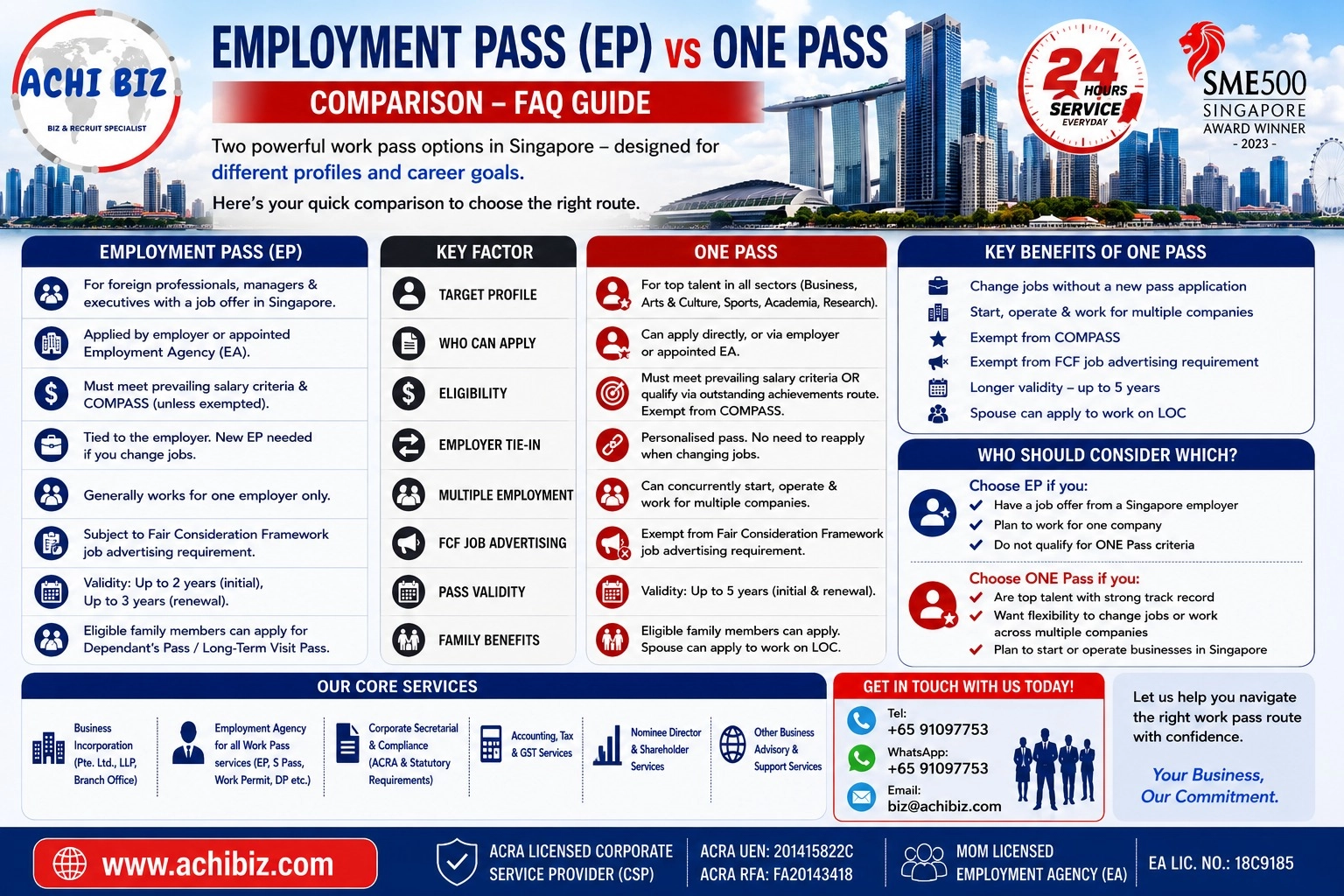
Employment Pass (EP) vs ONE Pass in Singapore
Singapore offers several work pass options for foreign professionals, but the Employment Pass (EP) and Overseas Networks & Expertise Pass (ONE Pass) are designed for distinctly different profiles and employment arrangements.
The Employment Pass is primarily for foreign professionals, managers and executives who have a job offer in Singapore and meet the prevailing Ministry of Manpower (MOM) eligibility requirements. An employer or appointed Employment Agency (EA) generally applies on behalf of the candidate.
The Overseas Networks & Expertise Pass, commonly known as ONE Pass, is a personalised work pass designed for top talent across sectors such as business, arts and culture, sports, academia and research. Unlike a normal EP, eligible ONE Pass candidates can apply directly, and the pass provides considerably greater flexibility to work for, start and operate multiple companies in Singapore.
This FAQ guide provides a detailed comparison of Employment Pass vs ONE Pass in Singapore, focusing on eligibility, employer dependency, COMPASS, job mobility, business activities, multiple employment, family privileges, validity, renewal and other practical considerations.
As MOM periodically revises salary requirements, this guide intentionally does not state fixed salary figures. References to salary requirements mean the prevailing salary criteria applicable at the time of application or renewal.
What is an Employment Pass (EP) in Singapore?
The Employment Pass is a work pass for eligible foreign professionals, managers and executives who have a job offer in Singapore.
The candidate must satisfy MOM’s prevailing EP eligibility requirements, including the applicable qualifying salary and, unless exempted, the Complementarity Assessment Framework (COMPASS).
What is the Overseas Networks & Expertise Pass (ONE Pass)?
The ONE Pass is a personalised work pass for top talent.
MOM identifies its target group as top talent across sectors such as business, arts and culture, sports, academia and research.
Its personalised nature is one of the most important differences between ONE Pass and an ordinary Employment Pass.
Is ONE Pass another type of Employment Pass?
No. They are separate MOM work passes.
Although both can allow eligible foreign professionals to work in Singapore, they have different eligibility criteria, application procedures, employment flexibility and renewal requirements.
What is the biggest difference between Employment Pass and ONE Pass?
The biggest practical difference is employer dependency.
An Employment Pass is generally connected to the Singapore employer that applies for the candidate.
ONE Pass is personalised to the individual. MOM allows ONE Pass holders to concurrently start, operate and work for multiple companies, subject to relevant employment contract terms, and they do not need to reapply for the pass when changing jobs.
Who is the Employment Pass designed for?
The EP is intended for eligible foreign professionals, managers and executives with a job offer in Singapore.
It is therefore suitable for a much broader range of professional employment situations than ONE Pass, provided the candidate and employer satisfy MOM’s prevailing requirements.
Who is ONE Pass designed for?
ONE Pass targets a considerably narrower group of top talent.
Eligibility may be established through MOM’s prevailing salary-based criteria and associated requirements or, in certain specified fields, through the outstanding-achievements route.
Is ONE Pass intended to replace the Employment Pass?
No.
The two passes serve different purposes.
The EP remains the mainstream professional work pass for eligible foreign professionals employed in Singapore, while ONE Pass provides a more flexible personalised pass for qualifying top talent.
Which has higher eligibility requirements: EP or ONE Pass?
ONE Pass is designed for a more selective top-talent profile and therefore has substantially different qualifying criteria.
Rather than comparing old salary figures, applicants should check MOM’s prevailing EP and ONE Pass salary and eligibility criteria when considering which route may apply.
Does the same prevailing salary criterion apply to EP and ONE Pass?
No.
The two passes have different salary and eligibility frameworks.
An individual who satisfies the prevailing EP qualifying salary does not automatically satisfy the ONE Pass criteria.
Similarly, ONE Pass eligibility should be assessed under its own MOM requirements.
Why does this guide not state the actual EP or ONE Pass salary amounts?
Because MOM may revise salary thresholds and eligibility requirements.
Using fixed figures in an evergreen FAQ can cause the information to become outdated. Candidates and employers should always check MOM’s prevailing qualifying salary criteria at the time of application or renewal.
Does meeting the prevailing salary criterion guarantee an Employment Pass?
No.
EP eligibility is not determined solely by salary.
MOM’s current framework involves the qualifying salary requirement and, unless an exemption applies, COMPASS. Other application and employer-related requirements can also be relevant.
Does meeting the prevailing ONE Pass salary criterion guarantee ONE Pass approval?
No.
ONE Pass applications are assessed according to the eligibility route being used and the applicable supporting requirements.
MOM states that ONE Pass candidates are assessed on a case-by-case basis and must satisfy the criteria within the category under which they apply.
Can someone qualify for ONE Pass without meeting the prevailing salary criterion?
Potentially, yes, but only under specified routes.
MOM provides an outstanding achievements pathway for individuals with outstanding achievements in specified areas such as sports, arts and culture, and academia and research. These applications are reviewed holistically by MOM together with relevant government agencies.
Is there an outstanding-achievement route for a normal Employment Pass?
Not in the same way as ONE Pass.
The normal EP follows its own eligibility framework, including the prevailing qualifying salary and COMPASS unless an exemption applies.
The ONE Pass outstanding-achievements pathway is therefore an important distinguishing feature.
Does COMPASS apply to Employment Pass applications?
Generally, yes, unless the candidate falls within an applicable exemption.
COMPASS is MOM’s points-based Complementarity Assessment Framework for EP applications and assesses individual and firm-related attributes.
Does COMPASS apply to ONE Pass?
No.
MOM expressly states that ONE Pass holders are exempt from COMPASS.
This is a major difference between EP and ONE Pass.
Does the Fair Consideration Framework job advertising requirement apply to Employment Pass applications?
Employers applying for an EP generally need to comply with the applicable Fair Consideration Framework requirements, including the relevant job advertising requirement, unless an exemption applies.
Does the Fair Consideration Framework job advertising requirement apply to ONE Pass?
MOM lists ONE Pass as exempt from the Fair Consideration Framework job advertising requirement.
This gives ONE Pass a different application structure from the ordinary EP route.
Who applies for an Employment Pass?
An employer or appointed Employment Agency generally applies on behalf of the candidate.
For an overseas company without a Singapore-registered office, MOM provides a local sponsorship route.
Who can apply for ONE Pass?
An eligible candidate can apply directly.
An appointed Employment Agency or employer can also submit the ONE Pass application on behalf of the candidate.
Can the candidate personally apply for a normal Employment Pass?
Generally, no.
The normal EP application is made by the employer or an appointed Employment Agency on behalf of the candidate.
Can the candidate personally apply for ONE Pass?
Yes.
This is another major difference. Eligible ONE Pass candidates can submit their own applications.
Can an Employment Agency apply for both EP and ONE Pass?
Yes.
An appointed Employment Agency can submit an EP application for an employer and can also apply for ONE Pass on behalf of an eligible candidate.
Can an employer apply for ONE Pass on behalf of its candidate?
Yes.
MOM allows an employer to apply for ONE Pass on behalf of a candidate it wishes to employ.
Can an employer apply for EP and ONE Pass simultaneously for the same candidate?
No.
MOM states that only one work pass application per candidate can be submitted at any one time. Therefore, an EP and ONE Pass application cannot be simultaneously submitted for the same candidate.
Can an existing Employment Pass holder apply for ONE Pass?
Yes, subject to meeting the ONE Pass eligibility requirements.
MOM states that existing work pass holders can apply for ONE Pass.
Must an existing EP holder cancel the EP before applying for ONE Pass?
No.
MOM advises existing work pass holders to cancel their current pass only after the ONE Pass application has been approved and when they are ready to have the ONE Pass issued.
This helps avoid an unnecessary interruption in work authorisation if the ONE Pass application is unsuccessful.
Can someone outside Singapore apply for ONE Pass?
Yes.
MOM states that candidates who are overseas can apply for ONE Pass, provided they meet the applicable eligibility criteria.
Does a ONE Pass applicant need a Singapore job offer?
Not necessarily in every application route.
ONE Pass eligibility can be based on qualifying current or last-held employment, prospective Singapore employment or the specified outstanding-achievements pathway, subject to the applicable criteria.
This differs significantly from the normal EP, which is fundamentally based on a job offer.
Does an Employment Pass applicant need a job offer in Singapore?
Yes. MOM describes the EP as being for foreign professionals, managers and executives with a job offer in Singapore who meet the applicable eligibility criteria.
Can ONE Pass be based on previous overseas employment?
Yes, subject to the applicable eligibility requirements.
MOM has a route for candidates applying based on their current or last-held overseas employment, with requirements concerning the candidate’s employment history, remuneration and the overseas employer.
Does the overseas employer matter for a ONE Pass application?
Yes, where the application relies on overseas employment.
MOM’s eligibility framework contains criteria relating to the overseas employer, and supporting evidence regarding the employer may be required.
Does the prospective Singapore employer matter for ONE Pass?
Yes, where the candidate applies based on prospective employment in Singapore.
MOM requires the prospective employer to satisfy its applicable established company criteria for this application route.
Should the employer’s size be considered when comparing EP and ONE Pass?
Yes, but differently.
For an EP, employer characteristics can affect COMPASS and other application considerations.
For ONE Pass, the status of an overseas or prospective Singapore employer can be directly relevant under certain eligibility routes.
Which pass is more closely tied to a particular employer?
The Employment Pass.
If an EP holder changes employer, the new employer generally needs to apply for a new Employment Pass.
ONE Pass, by contrast, is personalised and does not need to be reapplied for simply because the holder changes jobs.
Can an EP holder freely change jobs without a new EP application?
No.
An EP is tied to the employing entity. A change of employer generally requires the new employer to obtain the appropriate Employment Pass for the candidate.
Can a ONE Pass holder change employer without applying for a new ONE Pass?
Yes.
MOM specifically lists no need to reapply for a pass when changing jobs as a feature of ONE Pass.
Which pass provides greater career mobility?
ONE Pass provides substantially greater career mobility.
Because it is personalised rather than tied to one employer, the holder can change jobs without needing a new work pass application each time.
Can an EP holder work for multiple employers at the same time?
An ordinary EP does not provide the broad multiple-company flexibility available under ONE Pass.
The EP is based on employment with the employer supporting the pass.
Can a ONE Pass holder work for multiple companies?
Yes.
MOM states that ONE Pass holders have the flexibility to concurrently start, operate and work for multiple companies, subject to employment contract terms where relevant.
Can a ONE Pass holder have more than one professional role?
Potentially, yes.
The flexibility to work for multiple companies can accommodate more diverse professional arrangements than a conventional employer-specific EP.
However, any regulated profession, restricted occupation or contractual restriction still needs to be considered.
Can a ONE Pass holder start a company in Singapore?
Yes.
MOM expressly identifies the flexibility to start and operate companies as a feature of ONE Pass.
Does an Employment Pass automatically allow the holder to start and operate multiple companies?
No.
The ordinary EP is based on employment with the employer connected to the pass and does not provide the same broad personalised flexibility as ONE Pass.
Any separate business or directorship arrangement should be assessed independently.
Which pass is more suitable for an entrepreneur?
It depends on the individual’s profile and proposed activities.
A person who qualifies for ONE Pass and intends to participate in multiple ventures may value its flexibility to start, operate and work for multiple companies.
However, ONE Pass should not be regarded as a general entrepreneur visa available to everyone.
Which pass may be better for a senior executive working for only one company?
An EP may be entirely appropriate if the executive has a clear Singapore employer and meets the prevailing EP requirements.
There is no reason to pursue ONE Pass merely because it offers greater flexibility if that flexibility is unnecessary or the candidate does not satisfy its eligibility criteria.
Which pass may be better for a top executive expecting to change companies?
ONE Pass can provide significantly greater mobility because changing employers does not require a new work pass application.
For a qualifying individual with a dynamic regional or international career, this can be a major advantage.
Which pass may be more suitable for someone holding several business roles?
ONE Pass may be more suitable for a qualifying individual who genuinely needs to work across several companies because multiple-company flexibility is an express feature of the pass.
Can a ONE Pass holder be a company director?
ONE Pass provides broad flexibility to start, operate and work for multiple companies.
However, specific directorship arrangements and any restricted or regulated activities should still be considered separately.
Does a ONE Pass holder require a new work pass for every additional company?
No.
That is one of the key advantages of the personalised pass structure. MOM permits ONE Pass holders to concurrently start, operate and work for multiple companies without obtaining a separate ONE Pass for each company.
Does ONE Pass give unlimited freedom to work in every occupation?
No.
MOM identifies certain restricted occupations for ONE Pass holders. Approval from MOM is required before working in such an occupation.
Professional licensing requirements can also apply independently of work pass status.
Does an Employment Pass override professional licensing requirements?
No.
An EP permits employment under the work pass framework but does not replace any separate registration, licensing or professional-practice requirements that apply to regulated occupations.
Does ONE Pass override professional licensing requirements?
No.
The flexibility of ONE Pass does not remove professional or regulatory requirements imposed by other Singapore authorities.
Which pass has a longer initial validity?
MOM states that a first-time EP is generally granted for up to 2 years, whereas ONE Pass can be granted for up to 5 years.
The actual validity granted remains subject to MOM’s applicable requirements.
How long can an Employment Pass be renewed for?
MOM currently states that an ordinary EP renewal can generally be for up to 3 years, although certain eligible experienced technology professionals may qualify for a longer pass duration.
How long can ONE Pass be renewed for?
ONE Pass is renewable for up to 5 years at a time, subject to satisfying MOM’s prevailing renewal criteria.
Is Employment Pass renewal automatic?
No.
MOM expressly states that EP renewals are not guaranteed. The candidate must satisfy the prevailing renewal criteria.
Is ONE Pass renewal automatic?
No.
ONE Pass is renewable, but the holder must meet MOM’s applicable renewal requirements.
Are ONE Pass renewal criteria the same as initial eligibility criteria?
No.
MOM has specific renewal criteria for ONE Pass holders.
This is important because qualifying for the initial pass does not mean renewal five years later will automatically follow.
What does MOM consider when renewing ONE Pass?
MOM’s renewal framework focuses on the holder’s continuing economic contribution through the applicable renewal pathways.
One route considers the holder’s qualifying income over the relevant period, while another concerns establishing and operating a Singapore company that meets MOM’s prescribed local-employment requirements.
As requested, the prevailing salary amount is not reproduced here.
Can operating a Singapore company help a ONE Pass holder qualify for renewal?
Potentially, yes.
MOM provides a renewal pathway for a ONE Pass holder who has started and is operating a Singapore-based company that satisfies MOM’s prevailing local-employment conditions.
Does an EP holder have the same ONE Pass renewal test?
No.
EP renewal follows the Employment Pass renewal framework, including the prevailing qualifying salary and COMPASS where applicable.
Which pass provides greater long-term independence from a single employer?
ONE Pass.
Its personalised nature means the holder is not dependent on one employer maintaining sponsorship of the work pass throughout every job change.
That can provide substantial career continuity for eligible top talent.
What happens to an EP when the holder leaves the employer?
The employer must deal with the Employment Pass in accordance with MOM’s cancellation requirements when the employment relationship ends.
The employee cannot simply retain that employer-specific EP indefinitely for use with another employer.
What happens to ONE Pass when the holder changes jobs?
The holder generally does not need to apply for a new ONE Pass merely because of the job change.
However, MOM notification and other applicable requirements should still be observed.
Can a ONE Pass holder remain in Singapore while temporarily unemployed?
The personalised nature of ONE Pass provides greater flexibility than an employer-specific EP, and MOM expressly addresses situations involving ONE Pass holders who are unemployed.
However, holders remain subject to the pass conditions, annual notification requirements where applicable and renewal criteria.
Can an EP holder remain indefinitely unemployed in Singapore on the existing EP?
An EP is tied to the employment relationship supporting the pass.
It should therefore not be treated as an independent residence pass that can simply continue regardless of the underlying employment.
Does ONE Pass require annual reporting to MOM?
ONE Pass holders may be required to participate in MOM’s annual notification exercise.
MOM may request information concerning employment, occupations, annual income and other professional activities. Holders who receive MOM’s notification are required to submit it.
Does a normal EP have the same ONE Pass annual notification exercise?
No.
The ONE Pass annual notification is a specific feature associated with MOM monitoring the professional and economic activities of ONE Pass holders.
Why does MOM require annual notification from ONE Pass holders?
MOM states that the exercise allows it to understand the contributions of ONE Pass holders in Singapore.
This is particularly relevant because ONE Pass holders can have multiple employers and professional activities.
What information may a ONE Pass holder need to report annually?
MOM may request information including:
- employer or employers;
- occupation or occupations;
- total annual income for the previous calendar year; and
- other professional activities, where applicable.
Must an unemployed ONE Pass holder submit the annual notification?
Yes, if MOM has notified the holder that submission is required.
MOM specifically states that receiving the notification requirement applies regardless of the holder’s current employment status.
Can an Employment Agency submit the ONE Pass annual notification?
Yes.
MOM permits the ONE Pass holder, an Employment Agency appointed by the holder, or the holder’s employer to submit the annual notification. Only one submission is required.
Are there quota requirements for Employment Pass holders?
The Employment Pass is not subject to the foreign worker quota system that applies to certain other work passes such as the S Pass.
Is there a foreign worker levy for Employment Pass holders?
No foreign worker levy applies to the Employment Pass.
Is ONE Pass subject to a foreign worker quota or levy?
No.
MOM expressly states that ONE Pass is not subject to a foreign worker levy or quota.
Is quota or levy therefore a major difference between EP and ONE Pass?
No.
Neither pass is principally differentiated by quota or levy.
The major differences lie in eligibility, employer dependency, COMPASS, job mobility, multiple-company flexibility, validity and renewal structure.
Can Employment Pass holders bring eligible family members to Singapore?
Yes, subject to satisfying MOM’s prevailing family-pass eligibility requirements.
Eligible family members may potentially qualify for a Dependant’s Pass or Long-Term Visit Pass depending on the relationship and applicable criteria.
Can ONE Pass holders bring eligible family members to Singapore?
Yes.
MOM provides family-pass arrangements for eligible family members of ONE Pass holders.
Is there an important family benefit that distinguishes ONE Pass from EP?
Yes.
A particularly notable ONE Pass feature is that the spouse of a ONE Pass holder can apply to work in Singapore on a Letter of Consent (LOC).
This can be an important consideration for internationally mobile families.
Can the spouse of an ordinary EP holder automatically work on a Dependant’s Pass?
No.
A Dependant’s Pass by itself should not be treated as automatic permission to work. The spouse must have the appropriate work authorisation under the prevailing MOM rules.
Can the spouse of a ONE Pass holder apply for a Letter of Consent to work?
Yes.
MOM expressly identifies this as a ONE Pass family benefit.
Does a ONE Pass spouse’s LOC have quota or levy?
MOM states that no foreign worker levy or quota applies under the relevant ONE Pass Dependant’s Pass arrangements.
Can children of ONE Pass holders work automatically?
No.
MOM states that unmarried children on the relevant Dependant’s Pass need to obtain an appropriate work pass if they wish to work.
Is family eligibility guaranteed simply because ONE Pass is approved?
No.
Family members still need to meet the applicable requirements and obtain the relevant passes.
Can ONE Pass family applications be submitted together with the main application?
MOM allows family applications to be submitted in connection with the ONE Pass application, but recommends applying for the family’s passes after the principal ONE Pass has been approved because application fees may otherwise be lost if the main application is rejected.
Does an EP holder converting to ONE Pass need to consider family passes separately?
Yes.
The principal holder should review the status and required arrangements for existing dependants when transitioning from EP to ONE Pass rather than assuming all family passes automatically remain unchanged.
Which pass is more flexible for a married couple where both spouses want to work?
For an eligible top-talent candidate, ONE Pass can provide an attractive family arrangement because the spouse can potentially work through the applicable LOC mechanism.
However, the correct choice of principal work pass should still be based primarily on the principal applicant’s eligibility and circumstances.
Which pass gives an employer greater control over the employment relationship?
An employer-specific EP naturally creates a closer connection between the work pass and the particular employer.
ONE Pass gives the individual substantially greater work-pass independence because the pass does not need to be reapplied for when the holder changes jobs.
Which pass gives the employee greater bargaining power?
From a work-pass mobility perspective, ONE Pass can provide greater independence.
A qualifying ONE Pass holder is not dependent on a new employer successfully obtaining a fresh work pass every time the holder changes jobs.
However, normal contractual employment rights and obligations still apply.
Does ONE Pass mean an employer cannot impose contractual restrictions?
No.
MOM expressly qualifies its multiple-company flexibility by referring to employment contract terms, where relevant.
A ONE Pass does not override legitimate contractual obligations between employer and employee.
Can a ONE Pass holder work for a competitor while employed?
The work pass itself should not be confused with contractual permission.
Employment contracts may contain confidentiality, conflict-of-interest or other lawful restrictions. ONE Pass flexibility does not automatically cancel those obligations.
Which pass is better for someone with several board appointments?
ONE Pass may offer greater work-pass flexibility for a qualifying individual with multiple professional roles.
However, the nature of each directorship, actual work performed and any MOM or professional requirements should still be assessed.
Which pass is better for a startup founder?
It depends.
If the founder independently qualifies for ONE Pass, the ability to start and operate companies can be attractive.
If the founder does not qualify for ONE Pass, another appropriate work pass or business immigration route may need to be considered.
ONE Pass should not be treated as a general startup-founder pass.
Which pass is better for an established multinational executive?
Both can potentially be appropriate.
An executive assigned to one Singapore company may be adequately served by an EP.
A top executive who meets ONE Pass criteria and expects to hold multiple regional roles, board appointments or future employment changes may value ONE Pass flexibility more highly.
Which pass is better for academics and researchers?
It depends on the individual’s profile.
An academic or researcher employed by one Singapore institution may use an EP where eligible.
Individuals with outstanding achievements in academia and research may potentially be considered under ONE Pass’s dedicated outstanding-achievements pathway.
Which pass is better for artists or cultural professionals?
ONE Pass includes an outstanding-achievements route covering arts and culture, subject to MOM’s applicable assessment.
An ordinary professional employment arrangement may instead be considered under the appropriate work pass framework.
Which pass is better for professional sports talent?
ONE Pass also provides an outstanding-achievements pathway for sports, subject to the applicable assessment.
This is another area where ONE Pass differs materially from the general EP framework.
Does being famous automatically qualify someone for ONE Pass?
No.
Public recognition alone should not be confused with MOM eligibility.
Applicants using an outstanding-achievements pathway must provide the required evidence and are assessed holistically by MOM and relevant agencies.
Can a business owner simply pay themselves the prevailing ONE Pass salary and qualify?
Eligibility should not be reduced to a self-declared salary figure.
MOM requires supporting documentation and assesses applications according to the applicable eligibility route, employment history, employer requirements and other evidence.
Are documents for ONE Pass more extensive than for an EP?
The requirements are different rather than simply “more” or “less”.
Depending on the ONE Pass eligibility route, MOM may require evidence relating to previous remuneration, employment verification, employer financial information, prospective Singapore employment or outstanding achievements.
Does MOM verify overseas employment for ONE Pass?
For candidates applying based on current or last-held overseas employment, MOM’s document requirements include employment verification evidence from a background screening company.
Why does ONE Pass require evidence concerning the employer?
Because some ONE Pass eligibility routes depend not only on the candidate’s remuneration but also on whether the relevant employer satisfies MOM’s criteria.
The employer’s standing can therefore form part of the eligibility assessment.
Is a small Singapore company prevented from hiring a ONE Pass holder?
Not simply because it is small.
Once an individual validly holds ONE Pass, the pass provides broad flexibility to work for multiple companies.
However, where the initial ONE Pass application itself is based on prospective Singapore employment, MOM’s established-company requirements for that eligibility route are relevant.
Can a ONE Pass holder join a startup after obtaining the pass?
Potentially, yes.
The personalised pass allows job changes and work across multiple companies without requiring a new ONE Pass for each employer, subject to applicable conditions.
Does a startup need to apply for a new ONE Pass when hiring an existing ONE Pass holder?
Not merely because the individual changes employer.
This is one of the major practical differences from hiring an EP holder.
If an EP holder joins a new startup, does the startup need a new EP?
Generally, yes.
Because the EP is employer-specific, the new employer must obtain the appropriate work pass for the candidate.
Which pass is more convenient during corporate restructuring?
ONE Pass can provide greater personal continuity where the holder’s employer changes as a result of restructuring.
An EP holder may require a new work pass arrangement where the employing entity changes.
The specific transaction should nevertheless be reviewed rather than assuming every restructuring has the same effect.
Can a ONE Pass holder work for their own Singapore company and another employer simultaneously?
Potentially, yes.
MOM expressly permits ONE Pass holders to concurrently start, operate and work for multiple companies, subject to relevant employment contract terms.
Can an EP holder do the same?
An EP does not provide the same general multiple-company work authorisation.
Separate directorship or secondary work arrangements should therefore be assessed carefully before the EP holder undertakes them.
Is ONE Pass more suitable for portfolio careers?
For eligible candidates, yes.
Individuals whose professional activities span employment, entrepreneurship and multiple companies may benefit from the personalised flexibility of ONE Pass.
Is Employment Pass more suitable for conventional employment?
Generally, yes.
Where a foreign professional has one Singapore employer and intends to work solely for that organisation, the EP structure is naturally aligned with the employment arrangement.
Does ONE Pass remove the need for an employment contract?
No.
If the holder is employed by a company, the employment relationship should still be properly documented.
ONE Pass flexibility concerns work-pass status; it does not eliminate employment law or contractual requirements.
Does either EP or ONE Pass guarantee Singapore Permanent Residence?
No.
Neither work pass automatically confers Singapore Permanent Residence.
PR applications are separately administered by the Immigration & Checkpoints Authority (ICA) and assessed according to the applicable PR framework.
Can an EP holder apply for Singapore PR?
An eligible EP holder may apply for PR under ICA’s applicable framework, but approval is not guaranteed.
Can a ONE Pass holder apply for Singapore PR?
Yes, ONE Pass holders can potentially apply for Singapore PR, subject to ICA’s prevailing eligibility and assessment framework.
ONE Pass itself does not guarantee PR approval.
Is ONE Pass automatically better for a future PR application?
No.
It would be inappropriate to promise that holding ONE Pass automatically produces a better PR outcome than holding an EP.
PR is a separate immigration assessment undertaken by ICA.
Is ONE Pass a permanent residence pass?
No.
ONE Pass is a work pass with a specified validity period and renewal requirements.
It should not be confused with Singapore Permanent Residence.
Is Employment Pass a permanent work pass?
No.
An EP has a specified validity period and is subject to renewal requirements.
Can ONE Pass be renewed indefinitely?
ONE Pass can be renewed for further periods where the holder satisfies the prevailing renewal criteria, but future renewal should never be assumed.
Policies and individual circumstances may change.
Can EP be renewed indefinitely?
Similarly, EP renewal may continue where the candidate and employer satisfy the prevailing requirements, but each renewal remains subject to MOM’s assessment.
Which pass provides greater certainty if the holder loses a job?
From a work-pass perspective, ONE Pass provides greater flexibility because it is not tied to one employer and does not require a new pass simply because the holder changes jobs.
An EP is much more dependent on the continuing employer relationship.
Does that mean ONE Pass holders do not need to maintain meaningful economic activity?
No.
ONE Pass has renewal criteria and annual notification requirements designed to assess continuing economic and professional contributions.
The flexibility of the pass should not be confused with an absence of ongoing requirements.
Which pass requires more responsibility from the individual holder?
ONE Pass places comparatively greater responsibility directly on the individual because it is personalised.
For example, eligible candidates can apply themselves, and holders may need to provide annual information to MOM regarding their employment and professional activities.
Which pass places more work-pass responsibility on the employer?
The EP structure places greater responsibility on the sponsoring employer because the employer or appointed EA applies for the candidate and handles relevant employment-related work pass transactions.
Can an Employment Agency assist an employer with an EP application?
Yes.
MOM expressly allows an appointed Employment Agency to submit EP applications on behalf of employers.
Can an Employment Agency assist an individual with ONE Pass?
Yes.
An appointed EA can apply on behalf of an eligible ONE Pass candidate.
Can an Employment Agency determine whether ONE Pass or EP is more suitable?
An EA can assist with assessing the available work-pass options against the candidate’s circumstances and prevailing MOM requirements.
However, final eligibility and approval remain subject to MOM’s assessment.
Can an Employment Agency guarantee ONE Pass approval?
No.
Neither an EA nor an employer can guarantee MOM approval.
Any claim of guaranteed approval should be treated cautiously.
Can an Employment Agency guarantee EP approval?
No.
The same principle applies to an Employment Pass. Professional assistance can improve the organisation and accuracy of an application, but MOM makes the approval decision.
Is ONE Pass always better than Employment Pass?
No.
ONE Pass offers substantially greater flexibility, but it also targets a much narrower group of top talent.
A professional who has a stable Singapore employer and satisfies EP requirements may have no commercial reason to pursue ONE Pass.
Is EP inferior because it is tied to an employer?
No.
Employer-specific work authorisation is entirely appropriate for conventional employment.
The EP is designed around that relationship, whereas ONE Pass addresses a different category of highly mobile top talent.
Should every high-salaried EP holder switch to ONE Pass?
No.
Salary alone should not determine the decision.
The individual should consider eligibility, employer circumstances, career plans, need for multiple-company flexibility, intended business activities, family circumstances and ONE Pass renewal requirements.
When might staying on an Employment Pass make more sense?
Remaining on an EP may make sense where the individual:
- intends to stay with one employer;
- does not require multiple-company flexibility;
- does not intend to start or operate other businesses;
- already has a stable EP arrangement; or
- does not satisfy the prevailing ONE Pass requirements.
Changing passes should solve an actual need rather than merely provide a different pass title.
When might switching from EP to ONE Pass make sense?
For an eligible candidate, ONE Pass may be attractive where the individual expects to:
- change employers;
- work for multiple companies;
- start or operate businesses;
- hold several professional roles;
- seek greater independence from one employer; or
- benefit from the specific ONE Pass family arrangements.
The long-term renewal criteria should also be considered before switching.
Should an EP holder cancel the existing EP immediately after applying for ONE Pass?
No.
MOM advises existing work pass holders to cancel their current pass only after the ONE Pass has been approved and when they are ready for issuance.
Can someone continue working after cancelling an EP but before ONE Pass is issued?
MOM states that once the existing work pass has been cancelled, the person is not permitted to work until the ONE Pass has been issued.
Timing the transition properly is therefore important.
Does ONE Pass have a longer application processing time than EP?
The two passes have their own published processing arrangements, and actual processing can vary depending on the case and whether additional information is required.
Applicants should refer to MOM’s prevailing processing times rather than planning around historical timelines.
Can a candidate submit several work pass applications to increase the chance of approval?
No.
MOM allows only one work pass application for a candidate at a time in the ONE Pass/EP context.
The appropriate route should therefore be selected before submission.
If ONE Pass is rejected, will MOM automatically approve an Employment Pass instead?
No automatic conversion should be assumed.
EP and ONE Pass are separate applications with different eligibility frameworks.
If ONE Pass is unsuccessful, the candidate and prospective employer should separately consider whether an EP application is appropriate.
Is ONE Pass the same as Personalised Employment Pass (PEP)?
No.
ONE Pass and PEP are separate personalised work passes with different eligibility criteria, features, validity and renewal rules.
They should not be used interchangeably.
Is ONE Pass the same as Tech.Pass?
No.
ONE Pass is a specific MOM work pass for qualifying top talent across multiple sectors.
Other talent or business programmes may have different purposes and requirements.
Is ONE Pass limited to the technology sector?
No.
This is a common misconception.
MOM describes ONE Pass as being for top talent in all sectors, with specific references to business, arts and culture, sports, academia and research.
Is Employment Pass limited to the technology sector?
No.
EP applies across industries to eligible foreign professionals, managers and executives, subject to MOM’s prevailing requirements.
Can ONE Pass be useful for regional executives covering several businesses?
Potentially, yes.
Its ability to support work across multiple companies can make it relevant to qualifying executives with complex professional portfolios.
The actual employment and corporate arrangements should nevertheless be properly documented.
Can ONE Pass be useful for investors?
Merely investing in Singapore does not automatically establish ONE Pass eligibility.
However, an eligible ONE Pass holder may have flexibility to start and operate companies as part of their professional activities.
Can buying shares in a Singapore company qualify someone for ONE Pass?
Not by itself.
ONE Pass eligibility is determined according to MOM’s specified criteria, not simply by purchasing shares in a Singapore company.
Does being a shareholder automatically permit a foreigner to work in Singapore?
No.
Share ownership and work authorisation are different legal matters.
A foreign shareholder who intends to work in Singapore must have the appropriate immigration and work authorisation.
Does ONE Pass allow the holder to incorporate a Singapore company?
A ONE Pass holder has flexibility to start and operate companies, but the company itself must still satisfy Singapore’s corporate registration requirements.
Work pass status does not replace ACRA incorporation requirements.
Does ONE Pass remove the requirement for a Singapore company to appoint a locally resident director?
No.
Singapore company-law requirements operate separately from MOM work pass rules.
The company’s board composition must satisfy the applicable Companies Act and ACRA requirements.
Does ONE Pass make the holder automatically a Singapore tax resident?
No.
Work pass status and tax residency are different concepts.
MOM itself notes that ONE Pass holders may be required to pay Singapore income tax. The actual tax position depends on the applicable IRAS rules and individual circumstances.
Is an EP holder automatically a Singapore tax resident?
No.
Tax residency is determined under Singapore tax rules rather than solely by the type of MOM work pass held.
Which pass is better for an overseas professional who has not yet decided on one Singapore employer?
If the individual independently meets the ONE Pass eligibility requirements, its personalised structure may provide greater flexibility.
A normal EP, by comparison, requires the employment relationship on which the employer-sponsored application is based.
Which pass is more suitable for a professional who already has a confirmed Singapore employer?
Often the EP is the natural starting point.
ONE Pass may nevertheless be worth considering if the candidate independently qualifies and has genuine reasons to value its broader flexibility.
Which pass offers better flexibility for future career changes?
ONE Pass.
The ability to change jobs without reapplying for the pass is one of its clearest advantages.
Which pass offers better flexibility for future entrepreneurship?
For an eligible candidate, ONE Pass provides greater flexibility because MOM expressly permits holders to start and operate multiple companies.
Which pass is easier to qualify for?
It would be misleading to describe either as “easy”.
EP serves a broader professional population but has its own prevailing salary, COMPASS and employer requirements.
ONE Pass has a significantly more selective top-talent eligibility framework.
Which pass is easier to maintain after changing jobs?
ONE Pass is generally much more flexible because a change of employer does not itself require a fresh pass application.
Which pass is more dependent on the employer’s COMPASS profile?
The Employment Pass.
COMPASS considers both individual and firm-related attributes, whereas ONE Pass is exempt from COMPASS.
Can a candidate who has difficulty meeting COMPASS simply apply for ONE Pass instead?
Only if the candidate independently meets the ONE Pass eligibility criteria.
ONE Pass’s COMPASS exemption does not make it a workaround for candidates who do not otherwise qualify.
Is ONE Pass a way for companies to bypass Fair Consideration Framework requirements?
It should not be viewed that way.
The exemption is a feature MOM has deliberately provided for qualifying ONE Pass talent. The individual must first satisfy ONE Pass’s substantially different eligibility requirements.
Should employers compare EP and ONE Pass before hiring senior international talent?
Yes.
Where a candidate potentially qualifies for ONE Pass, employers and candidates may want to compare both routes before filing because MOM permits only one work pass application for the candidate at a time.
What should an employer compare before choosing EP or ONE Pass?
Important considerations include the candidate’s eligibility, intended role, need for multiple employment, long-term career plans, COMPASS implications, expected duration in Singapore and whether the individual wants to establish other businesses.
What should a candidate compare before choosing EP or ONE Pass?
The candidate should consider:
- whether they satisfy the prevailing eligibility criteria;
- whether they want to remain with one employer;
- likelihood of changing jobs;
- plans to work for multiple companies;
- entrepreneurial plans;
- family circumstances;
- desired pass duration;
- renewal requirements; and
- ongoing MOM reporting obligations.
The most flexible pass is not necessarily the most appropriate pass.
What should a company consider when hiring an existing ONE Pass holder?
The company should verify the validity of the individual’s ONE Pass, confirm that the intended role is permitted, comply with employment law and professional requirements, and properly document the employment relationship.
The company should not assume that work-pass flexibility removes ordinary employer responsibilities.
What should a company consider when hiring an EP candidate?
The company should assess the candidate against MOM’s prevailing EP eligibility requirements and its own employer-related requirements, including COMPASS and Fair Consideration Framework obligations where applicable.
Is ONE Pass more attractive to employers because they do not need to sponsor it?
It can reduce work-pass dependency on the employer because an existing ONE Pass holder does not require a new pass every time they change jobs.
However, employers still have normal employment, regulatory and contractual responsibilities.
Is ONE Pass more attractive to employees?
For qualifying individuals who value mobility, entrepreneurship and multiple professional activities, the flexibility can be significant.
For someone expecting a long-term career with one employer, those additional features may be less important.
Does ONE Pass create greater flexibility but also greater personal responsibility?
Yes.
Greater independence comes with the need to understand ongoing pass conditions, reporting obligations, restricted occupations and renewal requirements.
The holder should not assume that a personalised pass means there are no compliance obligations.
What is the biggest misconception about EP vs ONE Pass?
One of the biggest misconceptions is that ONE Pass is simply a “higher-level EP.”
It is not.
The Employment Pass is employer-specific and designed for eligible foreign professionals employed in Singapore. ONE Pass is a personalised top-talent pass with different eligibility rules and considerably greater professional flexibility.
What is another common misconception about ONE Pass?
Another misconception is that anyone earning a high salary automatically qualifies.
MOM’s ONE Pass framework includes specific qualifying routes, supporting-document requirements and, depending on the route, criteria relating to employment history and the relevant employer.
Is ONE Pass always the best work pass if a person qualifies for it?
Not necessarily.
Eligibility answers “Can I apply?”
It does not necessarily answer “Which pass best fits my situation?”
Someone who expects stable employment with one company may find an EP perfectly adequate, whereas someone planning multiple professional and entrepreneurial activities may place much greater value on ONE Pass.
What is the simplest comparison between Employment Pass and ONE Pass?
In practical terms:
Employment Pass (EP): employer-specific professional work pass for an eligible foreign professional with a Singapore job offer.
ONE Pass: personalised work pass for qualifying top talent, offering substantially greater flexibility to change jobs and concurrently start, operate and work for multiple companies.
What are the main advantages of an Employment Pass compared with ONE Pass?
For candidates who meet EP requirements, the EP offers a well-established route for professional employment without requiring the individual to satisfy ONE Pass’s more selective top-talent criteria.
It is particularly suitable where the foreign professional intends to work for one Singapore employer.
What are the main advantages of ONE Pass compared with Employment Pass?
For an eligible candidate, the major advantages include:
- personalised rather than employer-specific work authorisation;
- ability to change jobs without obtaining a new pass;
- flexibility to concurrently start, operate and work for multiple companies;
- exemption from COMPASS;
- exemption from the applicable FCF job advertising requirement;
- longer potential pass duration;
- family-pass availability; and
- ability for an eligible spouse to apply to work on an LOC.
What are the potential disadvantages of Employment Pass compared with ONE Pass?
The main limitation is employer dependency.
Changing employers generally requires a new EP application, and the ordinary EP application framework includes employer-related requirements that do not apply to ONE Pass in the same way.
What are the potential disadvantages or considerations of ONE Pass?
ONE Pass has a substantially more selective eligibility framework and specific renewal requirements.
Holders may also need to complete MOM’s annual notification exercise and provide information about their professional activities and income.
Therefore, greater flexibility does not mean fewer responsibilities in every respect.
Should salary be the only factor when comparing EP and ONE Pass?
No.
Salary is only one part of the comparison.
The more meaningful questions concern career mobility, employer dependency, multiple-company activities, entrepreneurship, COMPASS, family arrangements, pass duration and renewal requirements.
Should pass duration be the deciding factor?
No.
Although ONE Pass can offer a longer validity period, choosing a work pass purely because it lasts longer ignores the more important question of whether the candidate actually qualifies and whether the pass suits the intended employment arrangement.
Should family benefits influence the decision?
They can be relevant, particularly for internationally mobile senior professionals.
The ONE Pass spouse LOC arrangement can be attractive, but the principal applicant’s own eligibility and career needs should remain the starting point.
Should a candidate apply for ONE Pass simply to avoid dependence on an employer?
Only if the candidate genuinely satisfies the prevailing ONE Pass eligibility requirements.
Work-pass independence is a major benefit, but it does not create eligibility.
What is the key takeaway when comparing Employment Pass and ONE Pass in Singapore?
The Employment Pass and ONE Pass are not simply two salary levels of the same work pass.
They represent different approaches to attracting foreign professionals and top international talent.
An Employment Pass is generally appropriate where an eligible foreign professional has a defined Singapore employer and will work under that employer-specific arrangement.
ONE Pass is designed for qualifying top talent who may benefit from a personalised pass that provides greater career and business flexibility, including the ability to change employers and concurrently start, operate and work for multiple companies.
The right choice therefore depends not only on whether the candidate meets the prevailing salary criteria, but also on the person’s professional profile, employer arrangement, career mobility, entrepreneurial plans, family requirements and long-term intentions in Singapore.
Before applying, candidates and employers should check MOM’s latest eligibility and application requirements because work pass policies, salary criteria and assessment requirements may change.
How can ACHI BIZ assist with Employment Pass and ONE Pass matters in Singapore?
ACHI BIZ, through its MOM Licensed Employment Agency (EA) services, can assist employers and foreign professionals with Singapore Employment Pass and other Work Pass matters, including assessing the appropriate application route against prevailing MOM requirements, preparing applications and handling related work pass procedures.
Where a candidate may potentially qualify for ONE Pass, the profile should first be assessed against the prevailing ONE Pass eligibility route before deciding whether an Employment Pass or ONE Pass is more appropriate.
Related Pages
Employment Pass (EP) vs S Pass in Singapore – FAQ Guide
Employment Pass (EP) vs Personalised Employment Pass (PEP) in Singapore – FAQ Guide
#achibiz