
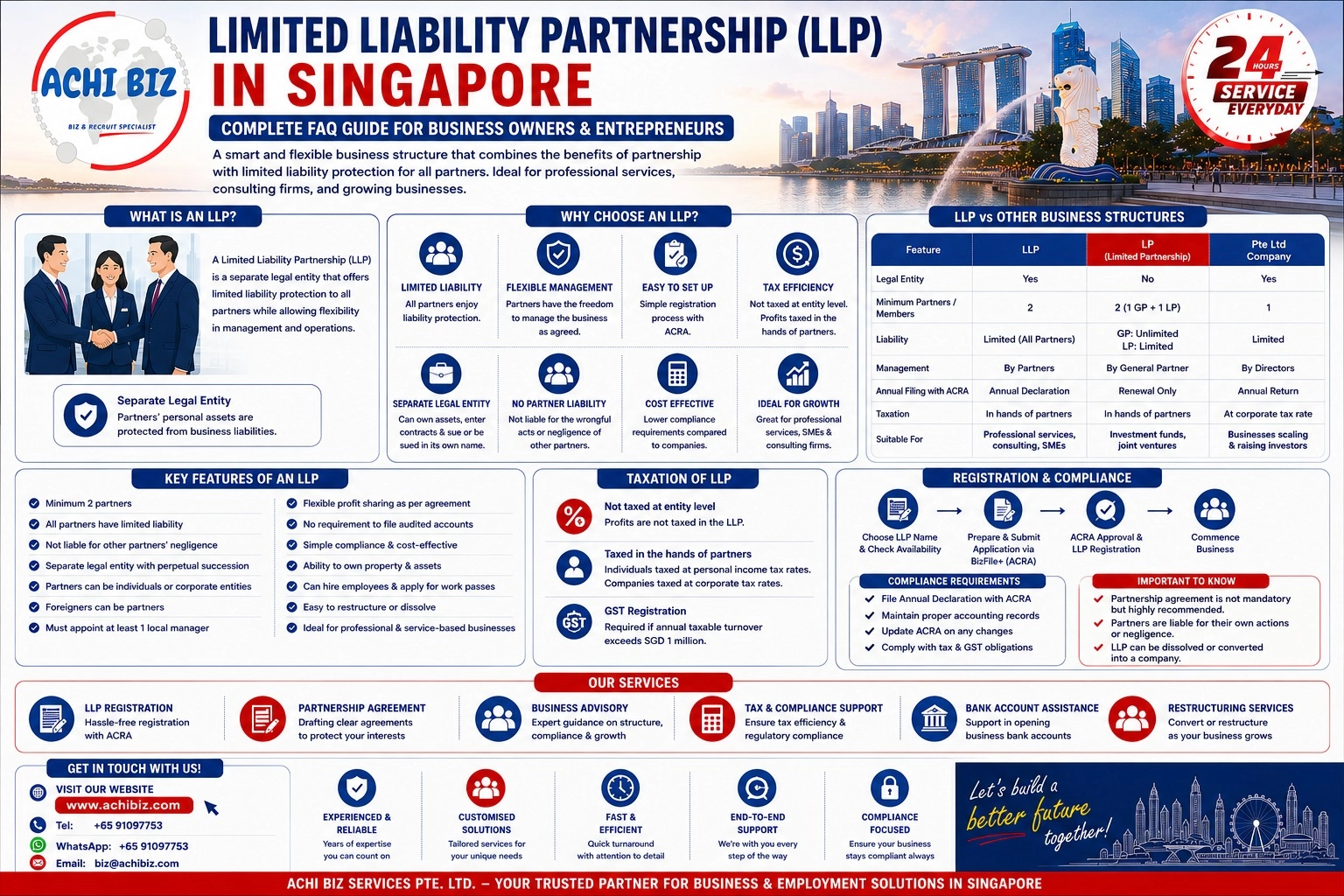
Complete FAQ Guide to Limited Liability Partnership (LLP) in Singapore
What is a Limited Liability Partnership (LLP) in Singapore?
A Limited Liability Partnership (LLP) is a hybrid business structure that combines the flexibility of a partnership with the benefits of limited liability. It is a separate legal entity from its partners.
Is an LLP a separate legal entity?
Yes, an LLP is a separate legal entity. It can own assets, enter into contracts, and operate independently from its partners.
What is the main benefit of an LLP structure?
The key benefit is limited liability for all partners, meaning personal assets are generally protected from business debts.
How many partners are required to form an LLP?
A minimum of 2 partners is required to register an LLP in Singapore.
Who can be a partner in an LLP?
Partners can be individuals or corporate entities, and both locals and foreigners can be partners.
Can foreigners set up an LLP in Singapore?
Yes, foreigners can be partners in an LLP. However, if they intend to manage the business locally, they may need the appropriate work pass.
What is the role of a manager in an LLP?
Every LLP must appoint at least one local manager who is responsible for ensuring compliance with Singapore regulations.
Who can be appointed as a manager of an LLP?
The manager must be a Singapore Citizen, Permanent Resident, or a person with a valid work pass residing in Singapore.
What is the liability of partners in an LLP?
Partners have limited liability and are not personally responsible for the LLP’s debts or liabilities.
Are partners liable for each other’s actions?
No, partners are not personally liable for the wrongful acts or negligence of other partners.
How is an LLP different from a General Partnership?
Unlike a General Partnership, an LLP provides limited liability protection and is a separate legal entity.
How is an LLP different from a Limited Partnership (LP)?
In an LLP, all partners have limited liability. In an LP, at least one general partner has unlimited liability.
What are the advantages of an LLP in Singapore?
An LLP offers limited liability, flexibility in management, ease of setup, and no corporate tax at entity level.
What are the disadvantages of an LLP?
It may be less attractive to investors, and partners are still personally liable for their own negligence or misconduct.
How is an LLP registered in Singapore?
An LLP is registered with ACRA via the BizFile+ system.
What information is required to register an LLP?
Details required include partners’ information, business name, registered address, and nature of business.
Is a partnership agreement required for an LLP?
It is not mandatory but highly recommended to outline roles, responsibilities, and profit-sharing arrangements.
What should be included in an LLP agreement?
Capital contributions, profit distribution, management roles, dispute resolution, and exit provisions.
How are profits distributed in an LLP?
Profits are shared according to the partnership agreement. If not specified, they may be shared equally.
Is an LLP subject to corporate tax?
No, an LLP is not taxed as a separate entity. Profits are taxed in the hands of the partners.
How are LLP partners taxed in Singapore?
Individual partners are taxed at personal income tax rates, while corporate partners are taxed at corporate tax rates.
Is GST registration required for LLPs?
Yes, if annual taxable turnover exceeds SGD 1 million.
Does an LLP need to file Annual Returns?
Yes, LLPs must file an Annual Declaration with ACRA.
What is the difference between Annual Return and Annual Declaration?
Companies file Annual Returns, while LLPs file Annual Declarations confirming solvency or insolvency status.
Can an LLP open a corporate bank account?
Yes, LLPs can open bank accounts subject to standard due diligence by banks.
Can an LLP hire employees?
Yes, LLPs can hire both local and foreign employees.
Can an LLP apply for work passes?
Yes, subject to MOM requirements and business viability.
Can partners withdraw from an LLP?
Yes, partners can exit the LLP based on the agreement terms.
What happens when a partner leaves an LLP?
The LLP continues to exist as a separate legal entity, unless dissolved.
Can an LLP be dissolved easily?
Yes, an LLP can be wound up voluntarily or struck off if it is no longer in operation.
What happens to liabilities upon dissolution?
Outstanding liabilities must be settled before closure.
Can an LLP be converted into a Private Limited Company?
Yes, restructuring into a company is possible and common for growing businesses.
Is an LLP suitable for startups?
Yes, especially for professional services, consulting firms, and small businesses.
What industries commonly use LLPs?
Law firms, accounting firms, consultants, and small service-based businesses commonly use LLP structures.
Can an LLP own property?
Yes, as a separate legal entity, an LLP can own assets and property.
Is audit required for LLPs?
There is no statutory audit requirement unless specified by partners or regulators.
What are the compliance requirements for LLPs?
Maintain proper accounting records, file Annual Declarations, update ACRA on changes, and comply with tax obligations.
What are the risks of an LLP structure?
Partners are still personally liable for their own actions, and improper agreements may lead to disputes.
Why choose LLP over a Pte Ltd company?
LLP is simpler, more flexible, and suitable for partnerships, while Pte Ltd is better for scaling and attracting investors.
Can Achibiz assist with LLP registration in Singapore?
Yes, Achibiz provides complete support for LLP registration, structuring, compliance, and advisory services tailored to your business needs.
Related articles:
FAQ Guide to Limited Partnership (LP)
FAQ Guide to General Partnership
#achibiz