
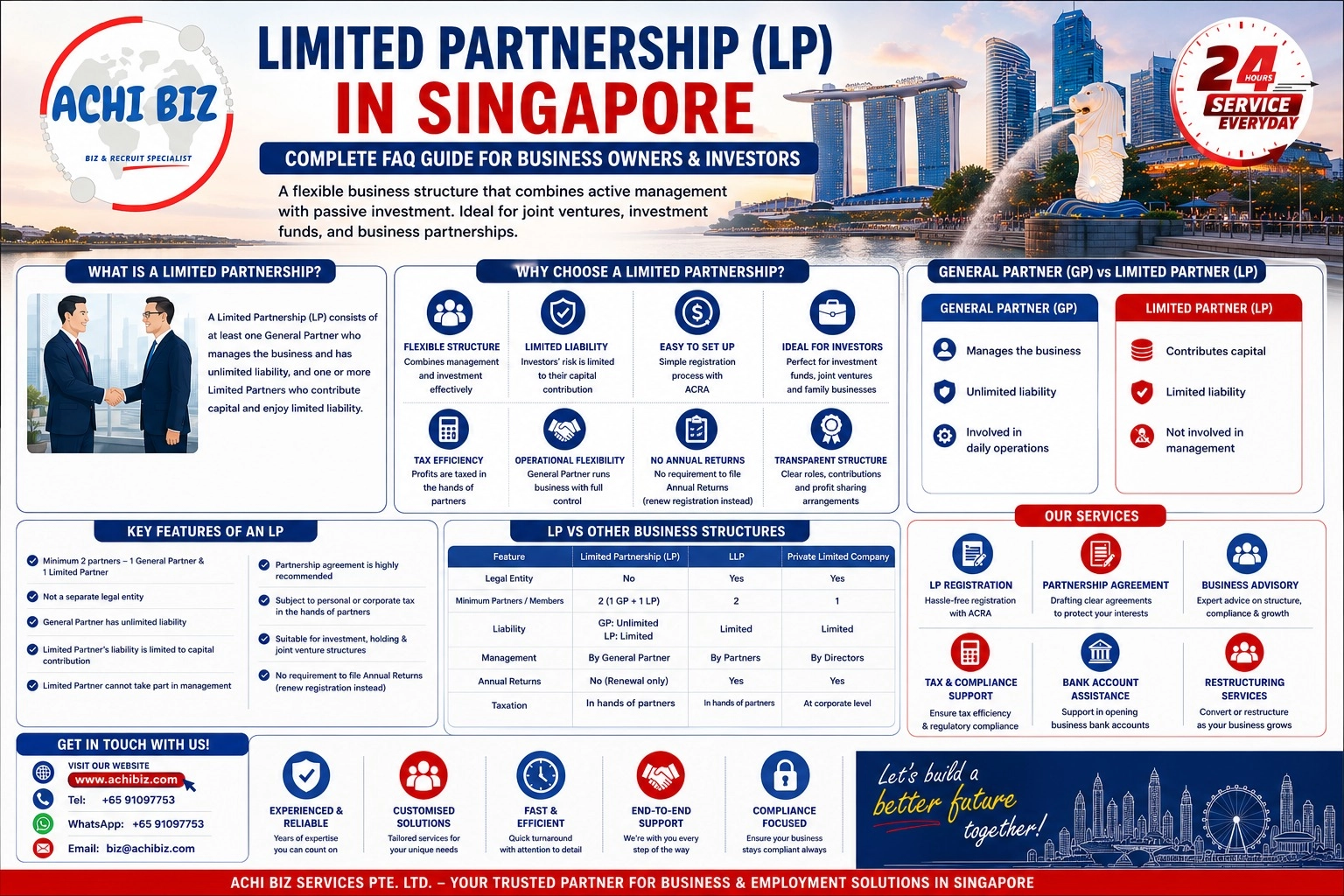
Limited Partnership (LP) in Singapore – Complete FAQ Guide
What is a Limited Partnership (LP) in Singapore?
A Limited Partnership (LP) is a business structure consisting of at least one general partner and one limited partner. It is commonly used for investment and business ventures where some partners prefer limited liability.
What is the difference between a general partner and a limited partner?
A general partner manages the business and has unlimited liability, while a limited partner contributes capital but has limited liability and does not take part in management.
Is a Limited Partnership a separate legal entity?
No, an LP is not a separate legal entity. The general partner is responsible for the business obligations.
How many partners are required to form an LP?
A minimum of 2 partners is required — at least one general partner and one limited partner.
Can a company act as a general partner in an LP?
Yes, a company can act as a general partner, which is often used to limit individual liability.
Can foreigners be partners in a Limited Partnership?
Yes, both foreigners and local individuals or entities can be partners in an LP.
What is the liability of a general partner?
The general partner has unlimited liability and is fully responsible for the debts and obligations of the LP.
What is the liability of a limited partner?
A limited partner’s liability is limited to the amount of capital they contribute, provided they do not participate in management.
Can a limited partner be involved in business operations?
No, if a limited partner takes part in management, they risk losing their limited liability protection.
What are the advantages of a Limited Partnership in Singapore?
It offers flexibility, simple setup, and allows investors to participate without being exposed to full liability.
What are the disadvantages of a Limited Partnership?
The main disadvantage is that the general partner has unlimited liability, and the LP is not a separate legal entity.
How is a Limited Partnership registered in Singapore?
An LP is registered with ACRA through the BizFile+ system.
What information is required to register an LP?
You need details of all partners, registered address, business activities, and capital contribution by limited partners.
Is a partnership agreement required for an LP?
It is not mandatory but strongly recommended to clearly define roles, rights, and responsibilities.
What should be included in an LP agreement?
Capital contributions, profit sharing, management roles, withdrawal terms, and dispute resolution clauses.
How are profits distributed in an LP?
Profits are distributed based on the agreement between partners.
Is a Limited Partnership subject to corporate tax?
No, the LP itself is not taxed. Profits are taxed in the hands of individual or corporate partners.
How are partners taxed in an LP?
Individual partners are taxed at personal income tax rates, while corporate partners are taxed at corporate rates.
Is GST registration required for an LP?
Yes, if the business turnover exceeds SGD 1 million or is expected to exceed it.
Does an LP need to file Annual Returns?
No, LPs do not file Annual Returns, but they must renew their registration with ACRA.
What is the validity period of an LP registration?
An LP registration is valid for 1 or 3 years and must be renewed accordingly.
Can an LP open a business bank account?
Yes, subject to bank due diligence requirements.
Can a Limited Partnership hire employees?
Yes, an LP can hire local and foreign employees, subject to MOM regulations.
Can an LP apply for work passes?
Yes, but approval depends on business activity, structure, and compliance.
Can a limited partner withdraw from the partnership?
Yes, subject to the terms stated in the partnership agreement.
What happens if a general partner leaves the LP?
The LP may need to appoint a new general partner or be dissolved.
Can a Limited Partnership be converted into a company?
Yes, businesses often restructure into a Private Limited Company as they grow.
What is the difference between LP and LLP in Singapore?
An Limited Liability Partnership (LLP) is a separate legal entity with limited liability for all partners, while an LP is not and has at least one partner with unlimited liability.
Is an LP suitable for startups?
It is more suitable for investment structures rather than operational startups due to liability concerns.
What types of businesses commonly use LPs?
Investment funds, joint ventures, and family-managed investment structures.
Can a Limited Partnership own assets?
Assets are typically held in the name of the general partner or jointly by partners.
Is audit required for an LP?
No statutory audit is required for Limited Partnerships.
What are the compliance requirements for an LP?
Maintain proper records, renew registration, comply with tax obligations, and ensure accurate partner details with ACRA.
What are the risks of using an LP structure?
The key risk lies with the general partner’s unlimited liability and the limited partner’s restriction from management.
Why do investors prefer Limited Partnerships?
Because they can invest capital and enjoy returns without being involved in daily operations or bearing full liability.
Can Achibiz assist with Limited Partnership registration in Singapore?
Yes, Achibiz provides full support for LP registration, advisory, structuring, and compliance services tailored to your business goals.
Related articles:
FAQ Guide to General Partnership
FAQ Guide to Private Limited Company
#achibiz