
Tax Planning vs Tax Avoidance vs Tax Evasion in Singapore: Frequently Asked Questions (FAQs) Every Business Owner Should Know
Managing taxes is an important part of running a business. However, there is a significant difference between tax planning, tax avoidance, and tax evasion. Understanding these differences helps businesses remain compliant with Singapore tax laws while avoiding costly penalties, investigations, and reputational damage.
Below are the most frequently asked questions to help business owners, directors, shareholders, and finance personnel better understand these concepts.
What is tax planning?
Tax planning is the legitimate arrangement of business affairs to minimise taxes by making use of incentives, deductions, exemptions, allowances, and reliefs that are legally available under Singapore tax laws.
Is tax planning legal in Singapore?
Yes.
Tax planning is completely legal provided it complies with the Income Tax Act, GST Act, and other applicable tax legislation. Businesses are encouraged to plan their affairs efficiently while remaining fully compliant.
What are some examples of legitimate tax planning?
Examples include:
- Claiming capital allowances.
- Claiming tax deductions allowed by law.
- Utilising tax exemptions available for new start-up companies.
- Timing capital expenditure efficiently.
- Choosing an appropriate business structure based on commercial needs.
- Claiming approved business expenses.
- Making CPF contributions that qualify for tax deductions.
- Utilising available tax incentives offered by IRAS.
What is tax avoidance?
Tax avoidance generally refers to arrangements that technically comply with the wording of tax legislation but are primarily designed to obtain tax advantages without genuine commercial or economic substance.
Is tax avoidance illegal?
Tax avoidance is different from tax evasion.
However, where an arrangement falls within the scope of Section 33 of the Singapore Income Tax Act (General Anti-Avoidance Provision), IRAS may disregard or vary the arrangement and assess taxes based on its true commercial substance.
What is Section 33 of the Singapore Income Tax Act?
Section 33 empowers IRAS to disregard arrangements that are entered into mainly for the purpose of obtaining a tax advantage rather than achieving genuine commercial objectives.
What factors may trigger a Section 33 review?
IRAS may consider factors such as:
- Lack of commercial substance.
- Artificial arrangements.
- Circular transactions.
- Multiple entities with no genuine business purpose.
- Income shifting without economic reality.
- Transactions primarily designed to reduce taxes.
What is tax evasion?
Tax evasion is the deliberate and dishonest act of reducing tax liabilities through fraud, deception, concealment or falsification of information.
Tax evasion is a criminal offence.
Is tax evasion a criminal offence in Singapore?
Yes.
Knowingly providing false information, concealing income or falsifying records to evade taxes may result in criminal prosecution under Singapore tax laws.
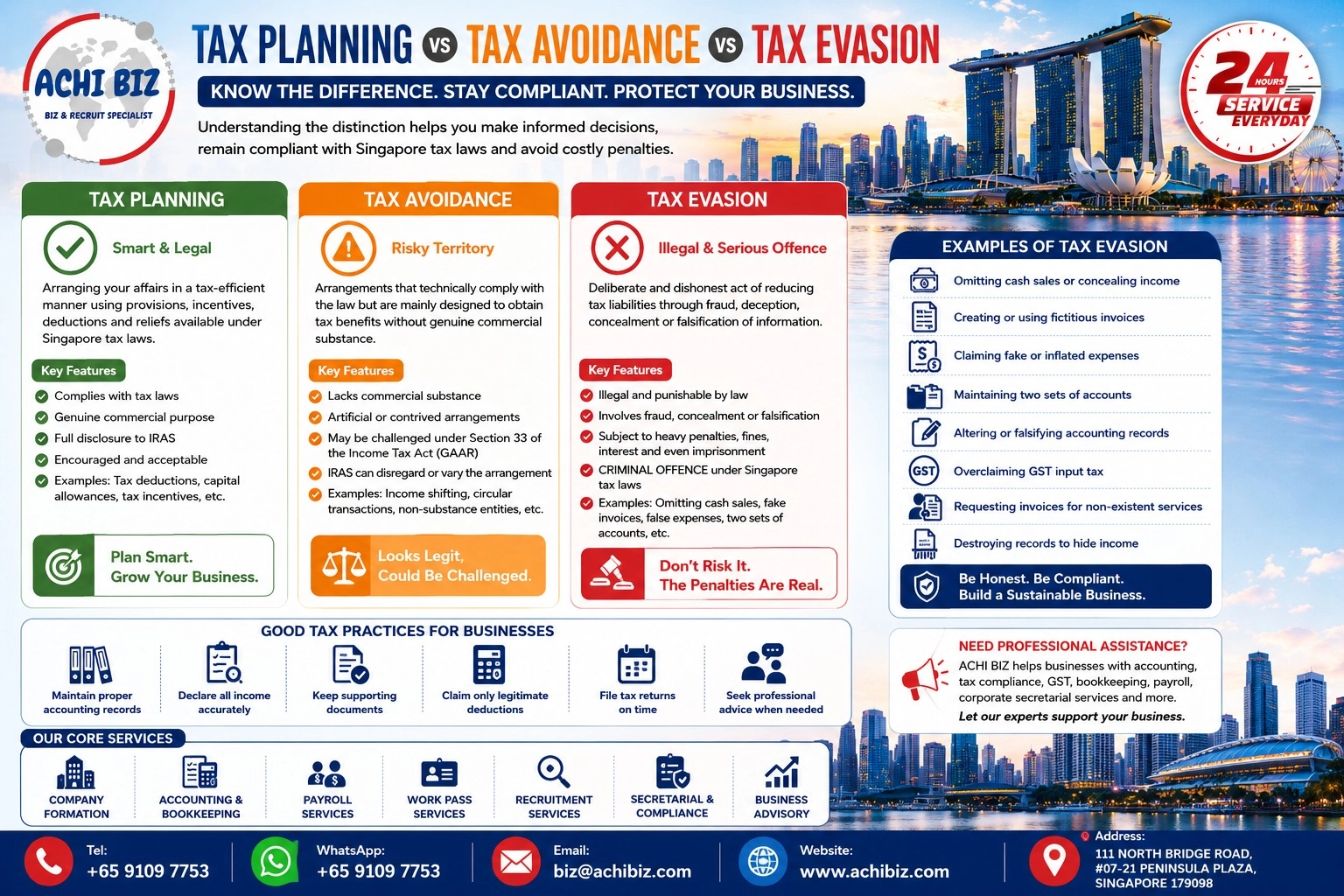
What is the difference between tax planning, tax avoidance and tax evasion?
Tax Planning
- Legal.
- Supported by tax legislation.
- Genuine commercial purpose.
- Full disclosure.
Tax Avoidance
- May technically comply with the law.
- Often lacks commercial substance.
- May be challenged under Section 33.
Tax Evasion
- Illegal.
- Involves fraud or deliberate concealment.
- Subject to civil and criminal penalties.
Is under-reporting sales considered tax evasion?
Yes.
Deliberately omitting sales from accounting records or tax returns constitutes tax evasion.
Is failing to declare cash sales tax evasion?
Yes.
Businesses must declare all taxable income regardless of whether payment is received by cash, NETS, credit card, bank transfer or other payment methods.
Can declaring only credit card or NETS sales amount to tax evasion?
Yes.
Deliberately excluding cash sales while declaring only electronic payments is an example of tax evasion.
Is reporting estimated income lower than actual income allowed?
No.
Where proper financial statements have been prepared, knowingly declaring a lower estimated income may constitute tax evasion.
Can businesses claim expenses that never existed?
No.
Claiming fictitious or fabricated expenses is tax evasion.
Can businesses create false supplier invoices?
No.
Preparing or using fictitious invoices to reduce taxable profits is a serious tax offence.
Can businesses ask suppliers to issue invoices for services never provided?
No.
Requesting invoices for non-existent services and claiming those expenses in tax returns constitutes fraudulent tax evasion.
Is preparing two sets of accounts allowed?
No.
Maintaining one set of accounts for internal use and another set for submission to IRAS with different figures is a serious form of tax evasion.
Can businesses alter accounting records to reduce taxes?
No.
Knowingly falsifying accounting records to reduce taxable income is illegal.
Can non-deductible expenses be claimed as deductible expenses?
No.
Intentionally recording non-tax-deductible expenses as deductible expenses to reduce taxable income may constitute tax evasion.
Can businesses overclaim GST input tax?
No.
Claiming GST input tax that was never incurred or is not claimable is a serious GST offence.
Is inflating purchases considered tax evasion?
Yes.
Creating fictitious purchases or overstating purchases to reduce profits is considered fraudulent conduct.
What are examples of tax evasion?
Examples include:
- Omitting cash sales.
- Concealing business income.
- Creating fictitious invoices.
- Claiming fake expenses.
- Maintaining two sets of accounts.
- Altering accounting records.
- Claiming GST not incurred.
- Using fabricated supplier invoices.
- Reporting false financial information.
- Destroying accounting records to conceal income.
What are some warning signs that may attract IRAS attention?
Potential warning signs include:
- Large differences between GST returns and income tax returns.
- Unusual profit margins.
- Significant cash transactions.
- Unexplained losses.
- Frequent amendments to tax filings.
- Poor accounting records.
- Unsupported expense claims.
- Transactions lacking commercial purpose.
How can businesses avoid tax compliance issues?
Businesses should:
- Maintain complete accounting records.
- Declare all income accurately.
- Keep supporting documents.
- Prepare proper financial statements.
- Claim only legitimate deductions.
- File tax returns on time.
- Seek professional tax advice when necessary.
Why is maintaining proper accounting records important?
Proper accounting records help businesses:
- Prepare accurate financial statements.
- Support tax deductions.
- Demonstrate compliance during IRAS reviews.
- Reduce the risk of penalties.
- Improve business decision-making.
How long should accounting records be retained?
Businesses should retain accounting records and supporting documents for the period required under Singapore law to support tax filings and regulatory compliance.
Can honest mistakes be corrected?
Yes.
If an error is discovered, businesses should rectify it promptly and make the necessary disclosures or amendments where appropriate.
Can IRAS conduct tax audits?
Yes.
IRAS may conduct reviews, audits, or investigations to verify compliance with Singapore tax laws.
What documents may IRAS request during an audit?
Depending on the circumstances, IRAS may request:
- Financial statements.
- Accounting records.
- Bank statements.
- Sales invoices.
- Purchase invoices.
- Contracts.
- Payroll records.
- GST records.
- Supporting schedules.
Can ACHIBIZ help businesses remain tax compliant?
Yes.
ACHI Biz Services Pte. Ltd. assists businesses with bookkeeping, accounting, GST compliance, corporate tax filing, financial reporting, payroll, company incorporation, corporate secretarial services, and business advisory to help clients maintain proper records and comply with Singapore tax regulations.
How can I obtain professional advice on tax compliance?
Every business is unique. Before implementing tax planning strategies or making significant business decisions, it is advisable to seek professional advice to ensure compliance with Singapore tax laws.
Related contents:
Importance of Reconciliation in Accounting for Pte Ltd Companies in Singapore – Complete FAQ Guide
#achibiz