
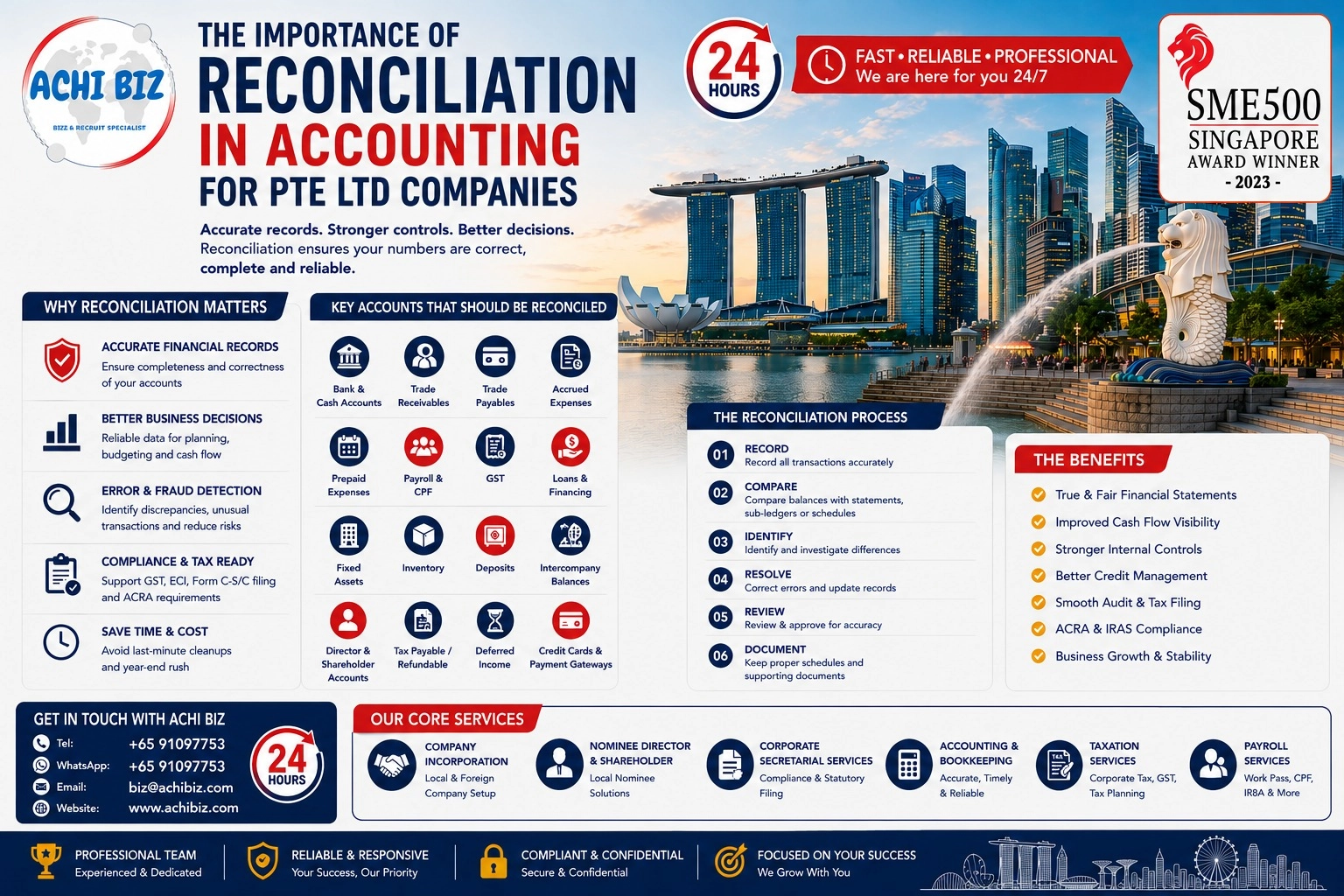
Importance of Reconciliation in Accounting for Pte Ltd Companies
For a Singapore Private Limited Company (Pte Ltd), accurate bookkeeping involves much more than recording invoices, receipts and payments. One of the most important accounting controls is reconciliation—the process of comparing balances in the accounting records against supporting documents, external statements and detailed schedules to identify and resolve differences.
Bank reconciliation may be the best-known example, but proper accounting reconciliation should extend to trade receivables, trade payables, accruals, prepayments, payroll, CPF, GST, loans, fixed assets, deposits, intercompany balances, director/shareholder accounts, inventory, taxes and other balance-sheet accounts.
This matters because a balance appearing in accounting software does not automatically mean that it is correct.
In Singapore, companies are required to maintain proper accounting records that can be used to prepare true and fair financial statements. ACRA also makes clear that directors remain responsible for ensuring that the company’s financial statements comply with prescribed accounting standards and give a true and fair view of its financial position and performance.
The following FAQs explain the importance of reconciliation in accounting for Singapore Pte Ltd companies. In addition, they cover the accounts companies should reconcile and the problems they may face when they neglect reconciliation.
Frequently Asked Questions About Accounting Reconciliation for Pte Ltd Companies
What is reconciliation in accounting?
Accounting reconciliation is the process of comparing a balance recorded in a company’s general ledger or accounting system against an independent source, supporting document, subsidiary ledger or detailed schedule.
The objective is to establish whether the accounting balance is complete, accurate and properly supported.
Where a difference is found, the accountant or bookkeeper should investigate the reason and, where appropriate, correct the accounting records.
Why is reconciliation important for a Singapore Pte Ltd company?
Reconciliation helps a company determine whether the balances shown in its accounts actually represent its financial position.
Without reconciliation, accounting records can contain duplicate transactions, missing entries, incorrect classifications, unreversed accruals, outdated prepayments, unrecorded bank charges, incorrect GST treatment and other errors that may remain unnoticed.
This can ultimately affect management accounts, financial statements and tax computations.
Is reconciliation compulsory for a Pte Ltd company in Singapore?
Singapore law focuses on the requirement to maintain proper accounting records and prepare financial statements that comply with applicable requirements and give a true and fair view, rather than prescribing a universal monthly reconciliation checklist for every private company.
However, reconciliation is an important accounting control for achieving accurate and supportable balances.
ACRA states that companies must keep accounting records for at least five years after the end of the financial year in which the relevant transactions or operations were completed, and those records must enable true and fair financial statements to be prepared.
Are directors responsible for the accuracy of a company’s financial statements?
Yes.
Directors cannot simply assume that accounting is entirely the accountant’s responsibility. Under section 201 of the Companies Act, directors are responsible for ensuring that financial statements comply with prescribed accounting standards and give a true and fair view of the company’s performance and financial position.
This makes properly maintained and reconciled accounting records particularly important.
Does an audit exemption mean reconciliation is unnecessary?
No.
Audit exemption and proper accounting are completely different matters.
An audit-exempt company may not require a statutory audit, but it must still maintain proper accounting records and comply with applicable financial reporting requirements.
In fact, reconciliation can be even more important for an unaudited small company because management cannot rely on the annual audit process to identify certain accounting discrepancies.
What accounts should a Pte Ltd company reconcile?
Depending on its activities, a company’s reconciliation procedures may cover:
- Bank and payment accounts
- Cash balances
- Trade receivables
- Trade payables
- Accrued expenses
- Prepaid expenses
- Deposits
- Payroll
- CPF and other payroll liabilities
- GST
- Corporate income tax
- Loans and hire-purchase accounts
- Fixed assets
- Inventory
- Intercompany accounts
- Director and shareholder accounts
- Credit cards
- Payment gateways
- Foreign-currency accounts
- Deferred income or customer advances
- Share capital and equity accounts
Not every company will have every category, but material balance-sheet accounts should generally be capable of being explained and supported.
Bank Reconciliation
What is bank reconciliation?
Bank reconciliation compares the balance recorded in the company’s accounting ledger with the corresponding bank statement.
Differences are identified and explained so that the company can establish its correct cash and bank position.
Why is bank reconciliation important?
Bank transactions often involve items that may not initially appear in the accounting system, such as:
- Bank charges
- Interest income or expenses
- GIRO deductions
- Returned payments
- Direct debits
- Merchant charges
- Foreign-exchange differences
- Transfers between accounts
- Unidentified receipts
- Unpresented payments
Regular reconciliation helps identify these items before they accumulate.
Is downloading a bank statement the same as reconciling the bank?
No.
Having a bank statement does not prove that the accounting records agree with it.
A reconciliation requires the company to compare the two records, investigate differences and document outstanding items.
IRAS specifically states that keeping only bank statements constitutes poor record keeping. Companies must also retain source documents, accounting records and schedules explaining their transactions.
Can the accounting software’s bank feed replace bank reconciliation?
No.
Automatic bank feeds can make reconciliation much faster, but they do not eliminate the need for review.
Transactions can still be duplicated, incorrectly matched, wrongly classified or posted to inappropriate accounts.
Automation assists reconciliation; it does not replace accounting judgement.
How often should bank accounts be reconciled?
For most active businesses, monthly reconciliation should be regarded as a minimum good practice.
Businesses with high transaction volumes may benefit from weekly or even daily reconciliation.
Waiting until the financial year-end can result in hundreds of unresolved transactions accumulating at once.
Should inactive bank accounts also be reconciled?
Yes, particularly if they continue to appear in the company’s general ledger.
An account assumed to be inactive may still contain charges, interest or residual balances. It should be reconciled until properly closed and accounted for.
Should PayNow transactions be reconciled?
Yes.
PayNow is simply another means of making or receiving payment. The corresponding transactions should still be matched to invoices, expenses, customers, suppliers or other appropriate accounting records.
Should company credit cards be reconciled?
Yes.
The credit-card statement should be compared against the accounting records, and each business transaction should be supported by appropriate documentation.
This also helps identify personal expenses, duplicate postings, subscriptions and unauthorised transactions.
Should Stripe, PayPal and other payment gateways be reconciled?
Yes.
For e-commerce and online businesses, reconciliation should not stop at the bank account.
Payment processors may deduct fees, process refunds, retain reserves or settle multiple customer transactions as a single net bank deposit.
The company may therefore need to reconcile:
Sales records → payment gateway → fees/refunds → bank settlement.
Trade Receivables Reconciliation
What is accounts receivable reconciliation?
Accounts receivable reconciliation compares the trade receivables control account in the general ledger against the detailed customer outstanding balance or aged receivables report.
The total of the customer balances should agree with the corresponding general-ledger balance.
Why should trade receivables be reconciled?
Without reconciliation, the company may show customers owing money that has already been paid, invoices that were duplicated, receipts applied to the wrong customers or old balances that are no longer recoverable.
An overstated receivable also overstates the company’s assets.
What is an aged receivables report?
An aged receivables report lists outstanding customer invoices according to how long they have remained unpaid, commonly grouped into categories such as current, 30 days, 60 days, 90 days and older balances.
It is useful for both accounting reconciliation and credit control.
Can reconciliation improve debt collection?
Yes.
A properly reconciled receivables ledger allows management to distinguish genuine overdue debts from accounting errors.
This makes collection efforts more effective because staff are pursuing amounts that are actually outstanding.
What should be done with very old customer balances?
They should be investigated rather than automatically carried forward every year.
Management should establish whether the amount is genuinely recoverable, disputed, already settled, incorrectly recorded or potentially subject to impairment or write-off considerations.
Trade Payables Reconciliation
What is accounts payable reconciliation?
Accounts payable reconciliation compares the company’s supplier balances against the trade-payables control account and, where appropriate, supplier statements and supporting invoices.
Why is supplier reconciliation important?
It can identify:
- Missing supplier invoices
- Duplicate bills
- Unrecorded credit notes
- Payments posted against the wrong invoice
- Payments made but not recorded
- Old balances no longer payable
- Supplier overpayments
- Incorrect opening balances
Can poor payable reconciliation cause duplicate payments?
Yes.
If the accounts payable ledger is not properly maintained, an invoice already paid may continue appearing as outstanding and could accidentally be paid again.
Regular supplier reconciliation reduces this risk.
Why should supplier statements be compared against the company’s ledger?
The supplier’s records provide an external reference against which the company’s own payable records can be checked.
Differences can reveal missing invoices, credit notes or payments.
Accrual Reconciliation
What is an accrual in accounting?
An accrual generally represents an expense that relates to the current accounting period but has not yet been invoiced or paid.
For example, a company may have consumed electricity in December but receive the invoice only in January.
Why must accrual accounts be reconciled?
Accruals are estimates or amounts recognised before final settlement. If they are not subsequently reviewed, old accruals can remain in the balance sheet long after the underlying expense has been invoiced or paid.
What happens when an accrual is not reversed or cleared?
The expense could effectively be recognised twice—for example, once through the original accrual and again when the supplier invoice is subsequently recorded.
This can understate profit and overstate liabilities.
Should accruals be reviewed every month?
Material accruals should be reviewed regularly.
The accountant should determine whether each balance:
- Remains valid;
- Needs adjustment;
- Has been invoiced;
- Should be reversed; or
- Requires additional accrual.
Can an old accrual simply remain in the balance sheet indefinitely?
It should not remain merely because nobody has reviewed it.
An old accrual should be investigated and supported. If the underlying obligation no longer exists, the accounting treatment should be reconsidered.
Prepayment Reconciliation
What is a prepaid expense?
A prepayment occurs when a company pays for goods or services before the period in which the related benefit is consumed.
Common examples include annual insurance, software subscriptions, maintenance contracts, licences and advance rental.
Why are prepaid expenses reconciled?
Prepayments should normally be allocated to the accounting periods benefiting from the expenditure.
Without a proper prepayment schedule, the company may expense the entire amount too early or leave expired prepayments sitting as assets.
What should a prepaid expense reconciliation include?
A useful schedule normally identifies:
- Nature of expense
- Supplier
- Invoice/payment amount
- Coverage period
- Amount already expensed
- Current-period charge
- Remaining prepaid balance
The remaining schedule should agree with the prepayment balance in the general ledger.
What happens if prepayments are not reconciled?
Expenses and assets may be misstated.
For example, an expired insurance policy could remain recorded as an asset even though there is no remaining future benefit.
Payroll Reconciliation
What is payroll reconciliation?
Payroll reconciliation compares payroll records against salary expenses, bank payments and payroll-related liabilities recorded in the general ledger.
Why is payroll reconciliation important?
Payroll can involve salaries, bonuses, allowances, deductions, employer contributions, reimbursements and other components.
Reconciliation helps ensure that amounts recorded as employee costs correspond with the company’s payroll records and payments.
Should CPF balances be reconciled separately?
Where applicable, yes.
CPF-related balances should be reviewed against payroll computations, contributions payable and payments made so that unpaid or incorrectly recorded liabilities do not accumulate.
Can payroll reconciliation help identify ghost employees or unauthorised payments?
It can form part of the company’s internal controls.
Comparing the employee list, approved payroll, accounting records and actual bank payments can help identify unusual or unauthorised transactions that require investigation.
GST Reconciliation
What is GST reconciliation?
For a GST-registered company, GST reconciliation involves comparing GST recorded in the accounting system against underlying sales, purchases, tax invoices and GST returns.
Why is GST reconciliation important before filing a GST return?
It can identify incorrect tax codes, omitted transactions, duplicate entries and unsupported input-tax claims before figures are submitted to IRAS.
GST-registered businesses must maintain proper records supporting their GST declarations for at least five years.
Should the GST control account agree with GST returns?
Differences between the accounting GST control accounts and submitted GST returns should be identifiable and explainable.
Unexplained differences should be investigated rather than carried forward indefinitely.
Can incorrect reconciliation affect GST claims?
Yes.
IRAS states that failure to maintain the required business and accounting records may result in input GST claims being disallowed and/or penalties.
Fixed Asset Reconciliation
What is fixed asset reconciliation?
Fixed asset reconciliation compares the fixed-asset register against the corresponding general-ledger balances.
What should be checked during fixed asset reconciliation?
The company should consider additions, disposals, depreciation, accumulated depreciation, asset classifications and whether recorded assets still exist and remain in use.
Why is a fixed asset register important?
A detailed register helps explain the composition of the fixed-asset balances appearing in the financial statements.
It can also support depreciation calculations, disposal accounting, insurance reviews and tax computations.
What happens if disposed assets are not removed from the accounts?
Both fixed assets and accumulated depreciation may remain overstated, and gains or losses on disposal may not be properly recognised.
Loan and Financing Reconciliation
Should business loans be reconciled?
Yes.
The accounting balance should be compared against lender statements or repayment schedules.
Why can the loan balance differ from total instalments paid?
A loan repayment commonly includes both principal and interest.
Recording the entire instalment as an expense or reducing the loan by the full payment can produce incorrect financial statements.
Should hire-purchase liabilities be reconciled?
Yes.
Outstanding balances should be supported by the relevant financing schedules and accounting records.
Intercompany Reconciliation
What is intercompany reconciliation?
Intercompany reconciliation compares amounts recorded between related companies.
If Company A records S$50,000 receivable from Company B, Company B would ordinarily be expected to have the corresponding amount appropriately reflected in its own records, subject to matters such as timing and foreign exchange.
Why are intercompany balances frequently problematic?
Differences can arise because one company records a transaction while the other does not, different exchange rates are used, payments are recorded in different periods, or expenses are allocated inconsistently.
Should intercompany accounts be reconciled before year-end?
Yes.
Leaving reconciliation until financial statements are being prepared can cause unnecessary delays, particularly where several related entities are involved.
Director and Shareholder Account Reconciliation
Should amounts due to or from directors be reconciled?
Yes.
Amounts due to or from directors should be supported by the underlying transactions and properly classified.
Why is director account reconciliation particularly important?
Personal and business transactions can sometimes become mixed, especially in owner-managed companies.
Reconciliation helps identify the nature of payments and whether they represent business expenses, reimbursements, advances, loans or other transactions requiring different accounting or tax treatment.
Should shareholder loan accounts be reconciled?
Yes.
The balance should be supported by evidence of funds advanced, repayments and other movements.
Inventory Reconciliation
What is inventory reconciliation?
Inventory reconciliation compares accounting inventory records against stock records and, where applicable, physical stock counts.
Why can inventory balances become inaccurate?
Differences may arise from theft, damage, wastage, incorrect quantities, unrecorded purchases or sales, returns and data-entry errors.
Should physical stock counts be performed?
Businesses holding material inventory should have appropriate procedures for verifying quantities on hand.
The frequency depends on the nature, value and volume of inventory and the strength of the company’s inventory controls.
Deposits and Other Balance-Sheet Reconciliations
Should rental and utility deposits be reconciled?
Yes.
The company should maintain a schedule showing what each deposit relates to, the counterparty and supporting agreement or receipt.
Old deposits should be investigated to establish whether they remain recoverable.
What is deferred revenue reconciliation?
Where customers pay in advance, the amount may need to be recognised as a liability until the relevant goods or services are provided, depending on the applicable accounting treatment.
A reconciliation tracks amounts received, revenue subsequently recognised and the remaining balance.
Should corporate income tax balances be reconciled?
Yes.
Current tax payable, tax payments, assessments and refunds should be compared against the company’s tax records and IRAS documents.
Should share capital be reconciled?
Yes.
The accounting balance should be consistent with the company’s corporate records and relevant share transactions.
Month-End and Year-End Reconciliation
What is month-end reconciliation?
Month-end reconciliation is the process of reviewing and supporting relevant balance-sheet accounts before closing the monthly accounting period.
It allows management accounts to provide a more reliable picture of the business.
What is year-end reconciliation?
Year-end reconciliation is a comprehensive review performed before finalising the company’s annual accounts and financial statements.
Every material balance should ideally be supported by an appropriate statement, schedule, confirmation or other evidence.
Is it enough to perform reconciliation only once a year?
For a very small company with limited transactions, some accounts may require less frequent reconciliation.
However, relying solely on year-end reconciliation can create unnecessary problems. Twelve months of errors may have accumulated by then.
Regular reconciliation makes discrepancies easier to identify because the transactions are still relatively recent.
When is the best time to reconcile accounts?
The most effective approach is generally:
Record → Reconcile → Review → Correct → Close the period.
This is preferable to recording transactions throughout the year and trying to reconstruct everything at financial year-end.
Reconciliation and Financial Statements
How does reconciliation improve the balance sheet?
Most reconciliation work focuses heavily on balance-sheet accounts because balances carry forward from one accounting period to the next.
An unexplained error can therefore remain in the books for years unless somebody investigates it.
Can the profit and loss account be wrong because of an unreconciled balance sheet?
Absolutely.
Accruals, prepayments, depreciation, inventory, payroll liabilities and other balance-sheet items directly affect income and expenses.
An incorrect balance-sheet figure can therefore produce an incorrect profit figure.
Can a company show the wrong profit because of poor reconciliation?
Yes.
For example:
- Missing accrual → expenses understated → profit overstated.
- Duplicate accrual → expenses overstated → profit understated.
- Prepayment fully expensed → current expenses overstated.
- Missing sales invoice → revenue understated.
- Duplicate supplier bill → expenses overstated.
This is why reconciliation is not merely a balance-sheet exercise.
How does reconciliation help directors understand the company’s financial position?
A properly reconciled balance sheet allows directors to ask meaningful questions:
How much cash do we actually have?
How much do customers genuinely owe us?
What do we owe suppliers?
Which liabilities are outstanding?
>>>>>>>>>>>>>>>>>>>>>>>>>Are old assets and deposits still valid?
Without reliable reconciliations, management may be making decisions based on incorrect numbers.
Reconciliation and Corporate Tax
Why is reconciliation important for corporate income tax filing?
Corporate tax computations begin with accounting information.
If revenue, expenses, assets or liabilities are incorrectly recorded, the tax computation may also be affected.
IRAS requires companies to maintain source documents, accounting records, schedules and bank statements supporting business transactions for at least five years from the relevant YA.
Does reconciliation help with ECI filing?
Yes.
ECI is an estimate of a company’s taxable profits for a Year of Assessment. Reliable and up-to-date accounts make it easier to determine a reasonable estimate.
What corporate tax returns does a Singapore company generally file?
IRAS states that companies generally have two corporate income tax filing obligations each year: ECI and Form C-S, Form C-S (Lite) or Form C, subject to applicable exemptions and filing requirements.
Accurate reconciled accounts make preparation of these filings more efficient.
Reconciliation and Internal Controls
Can reconciliation detect accounting errors?
Yes. That is one of its principal purposes.
It can identify missing transactions, duplicate postings, wrong amounts, incorrect accounts and unexplained balances.
Can reconciliation detect fraud?
Reconciliation is not a guarantee against fraud, but it can be an effective detective control.
Unexpected withdrawals, unauthorised payments, altered supplier information or unexplained adjustments may become visible during reconciliation.
IRAS itself identifies awareness of possible internal fraud or theft as one of the benefits of good record keeping.
Should the same person who records transactions also approve reconciliations?
Where staffing permits, segregation of duties is preferable.
For example, one employee may prepare the bank reconciliation while a manager or director reviews it.
Small companies may not have enough employees for complete segregation. In such cases, active director or management review becomes particularly important.
What is a reconciliation review?
Preparation and review are separate controls.
The preparer identifies and explains differences. Moreover, the reviewer checks whether the reconciliation is reasonable, complete, and properly supported. The reviewer also ensures that the company has addressed any unusual items appropriately.
Common Reconciliation Problems
What are unreconciled items?
These are differences or transactions that have not yet been satisfactorily matched or explained.
An unreconciled item should not simply be carried forward month after month without investigation.
What is a suspense account?
A suspense account may temporarily hold a transaction whose correct classification has not yet been determined.
It should generally be investigated and cleared rather than becoming a permanent dumping ground for unexplained transactions.
Why are old outstanding balances a warning sign?
A balance that has remained unchanged for several years may indicate that nobody has established whether it still represents a genuine asset or liability.
Old balances are not necessarily wrong, but they should be supportable.
What are common signs of poor reconciliation?
Warning signs include:
- Large unexplained bank differences
- Negative receivable or payable balances
- Old accruals never reversed
- Prepayments carried forward for years
- Suspense accounts with growing balances
- Intercompany differences
- GST control accounts not matching returns
- Loan balances not matching lender statements
- Numerous unidentified bank transactions
- Director accounts with unexplained movements
These are signs that the accounting records need investigation.
Can opening balances create reconciliation problems?
Yes.
When companies migrate accounting records from another software system or bookkeeping provider, incorrect opening balances can affect future accounts. Therefore, companies should verify these balances carefully during the migration process.
Opening balances should therefore be verified against the previous closing accounts and supporting schedules.
Can reconciliation errors continue for several financial years?
Yes.
Balance-sheet accounts carry forward. An incorrect amount at the end of one year can become the opening error of the following year.
That is why unresolved balance-sheet differences should not simply be rolled forward indefinitely.
Reconciliation When Changing Accountants
Why is reconciliation important when changing accounting service providers?
A new accountant needs to know whether the opening balances received are reliable.
The handover should ideally include general ledgers, trial balances and supporting schedules for material balance-sheet accounts.
What records should be handed over to a new accountant?
Depending on the company, useful records may include bank reconciliations, receivable and payable ageing reports, accrual and prepayment schedules, fixed-asset registers, loan schedules, GST workings, payroll records, intercompany schedules and tax records.
Can a new accountant simply rely on the previous accountant’s balances?
Professional judgement is essential.
Moreover, companies should review supporting schedules and records when balances are material or unusual instead of assuming that every historical figure is correct.
Accounting Software and Reconciliation
Does using accounting software guarantee accurate accounts?
No.
Accounting software processes the information entered into it. If transactions are missing, duplicated or incorrectly classified, the reports can still be wrong.
Software is a tool; reconciliation and review provide the control.
Can cloud accounting improve reconciliation?
Yes.
Modern systems can import bank feeds, match transactions, maintain audit trails and automate recurring entries. This can significantly reduce manual work.
However, automated matching should still be reviewed.
Can AI completely automate accounting reconciliation?
AI and automation can increasingly identify potential matches, anomalies and unusual transactions, but professional judgement remains necessary for complex or ambiguous items.
The objective should be to use automation to make reconciliation faster and more consistent, not to eliminate human oversight.
Record Keeping and Reconciliation in Singapore
How long should a Singapore Pte Ltd keep its accounting records?
ACRA requires companies to keep their accounting records for at least five years after the end of the financial year in which they completed the relevant transactions or operations.
For tax purposes, IRAS requires companies to retain source documents, accounting records and schedules, bank statements and other business transaction records for at least five years from the relevant Year of Assessment.
Companies should therefore ensure that their record-retention procedures satisfy all applicable requirements.
What documents should support accounting reconciliations?
Depending on the account, supporting records may include:
- Bank statements
- Supplier statements
- Customer invoices
- Supplier invoices
- Receipts
- Contracts
- Loan statements
- Payroll reports
- CPF records
- GST returns and workings
- Fixed-asset registers
- Inventory reports
- Tax assessments
- Intercompany confirmations
- Deposit receipts
- Accrual and prepayment schedules
The objective is to create a clear link between the financial statement balance and the underlying evidence.
Why should companies retain reconciliation schedules?
A reconciliation schedule clearly shows how the company established the accounting balance at a particular date.
This can be valuable when preparing financial statements, answering management questions, changing accountants, dealing with auditors or responding to tax queries.
Reconciliation for Small Pte Ltd Companies
Does a small Pte Ltd really need monthly reconciliation?
Size alone does not make inaccurate accounts acceptable.
A small business may have fewer transactions, making reconciliation relatively straightforward. Regular reconciliation can actually save substantial time compared with reconstructing an entire year’s transactions later.
My company has only one bank account. Do I still need reconciliation?
Yes.
A small number of transactions makes reconciliation easier, not unnecessary.
My company is dormant or has very few transactions. Is reconciliation still relevant?
Yes, although the extent of work should be proportionate to the activity.
Any remaining bank balances, loans, share capital, amounts due to directors or other balance-sheet items should still be supportable.
Is bookkeeping the same as reconciliation?
No.
Bookkeeping records transactions. Reconciliation verifies them.
Both are necessary components of reliable accounting.
Is reconciliation the same as an audit?
No.
Reconciliation is an accounting and internal-control procedure. In contrast, an independent auditor conducts an audit according to the applicable auditing requirements.
A company may be audit-exempt but should still maintain properly supported and reconciled accounts.
Benefits of Regular Accounting Reconciliation
What are the main benefits of monthly account reconciliation?
Regular reconciliation can help a Pte Ltd company:
- Maintain more accurate financial records
- Identify errors earlier
- Reduce duplicate payments
- Detect unusual transactions
- Improve cash-flow visibility
- Strengthen credit control
- Improve management reporting
- Support GST and corporate tax preparation
- Make year-end closing faster
- Improve audit readiness where an audit applies
- Strengthen internal controls
- Give directors greater confidence in financial reports
Can reconciliation reduce year-end accounting costs?
Potentially.
Clean, current and properly supported accounts generally require less investigation than records containing twelve months of unresolved differences.
Can reconciliation improve cash-flow management?
Yes.
Knowing the genuine bank balance, collectible receivables and actual liabilities allows management to make better cash-flow decisions.
Can reconciliation improve business decision-making?
Yes.
IRAS specifically recognises that good record keeping helps companies make better business decisions and understand their financial status.
Reconciliation strengthens the reliability of the accounting information on which those decisions are based.
Best Practices for Pte Ltd Account Reconciliation
What is a good monthly reconciliation checklist for a Pte Ltd company?
The exact checklist depends on the business, but a typical month-end process may include:
Bank → Credit cards → Receivables → Payables → Payroll → CPF → GST → Accruals → Prepayments → Loans → Fixed assets → Inventory → Deposits → Intercompany → Director/shareholder accounts → Tax → Other material balance-sheet accounts.
The important principle is not the number of reconciliations. Moreover, companies should ensure that they can clearly explain and support all significant balances.
Should every balance-sheet account have a supporting schedule?
Generally, companies should support material balances with appropriate records or schedules.
Some simple balances may be directly verifiable from external documents, while others require detailed schedules.
What should a company do after finding a reconciliation difference?
First, the company should investigate the difference and identify its cause. Then, the responsible person should make the necessary correction, support it with proper documentation, and review it where required.
Making an arbitrary journal entry simply to force two figures to agree defeats the purpose of reconciliation.
Should reconciliation be documented?
Yes.
A documented reconciliation creates an audit trail showing the balance reviewed, supporting source, differences identified, adjustments made and, where applicable, who prepared and reviewed it.
Who should review reconciliations?
Depending on the company’s size, a senior accountant, finance manager, CFO, director, or external accounting professional may review the reconciliations.
Management oversight is particularly important for unusual, material or long-outstanding items.
Professional Accounting Support
When should a Pte Ltd company consider outsourcing its reconciliation and accounting?
Outsourcing may be practical where the company:
- Does not have an internal accountant;
- Has growing transaction volumes;
- Is repeatedly late with bookkeeping;
- Has unreconciled historical balances;
- Is preparing for financial year-end;
- Has complex GST or intercompany transactions; or
- Wants more reliable monthly management accounts.
Can an accounting service provider clean up historical unreconciled accounts?
Often, yes, provided adequate supporting records are available.
Historical cleanup may involve reconstructing bank reconciliations, reviewing opening balances, clearing suspense accounts, matching receivables and payables, reviewing accruals and prepayments, and rebuilding supporting schedules.
The older and less complete the records are, however, the more difficult the exercise becomes.
Why should companies reconcile accounts before tax filing?
Companies should maintain and reconcile their accounts regularly. As a result, they can prepare accurate tax filings without discovering accounting errors at the last moment.
IRAS requires companies to maintain proper financial transaction records and supporting documents, and Singapore companies generally have recurring corporate income tax filing obligations.
Maintaining reconciled accounts throughout the year makes those obligations considerably easier to manage.
How can ACHI Biz Services assist with accounting and reconciliation for Pte Ltd companies?
ACHI Biz Services Pte. Ltd. can support Singapore companies with bookkeeping, accounting and related corporate services, including the maintenance and review of accounting records and relevant account reconciliations based on the company’s circumstances.
Regular accounting support can help businesses maintain cleaner records, identify discrepancies earlier and prepare more efficiently for financial reporting and tax compliance.
What is the most important takeaway about reconciliation in accounting?
A figure appearing in an accounting system is not automatically a correct figure.
Every important balance should have a reasonable explanation and appropriate supporting evidence.
For a Singapore Pte Ltd company, regular reconciliation of bank accounts, receivables, payables, accruals, prepayments, payroll, GST, loans, fixed assets, intercompany accounts and other material balances provides the bridge between everyday bookkeeping and reliable financial statements.
Good reconciliation is therefore not merely an accountant’s housekeeping exercise. It is an essential part of financial accuracy, internal control, tax readiness, management decision-making and responsible corporate governance.
Related articles:
Why Businesses Prefer Singapore as a Top Business Destination – FAQ Guide
Best Country to Incorporate a Business with a Pte Ltd Structure – Complete FAQ Guide
#achibiz