
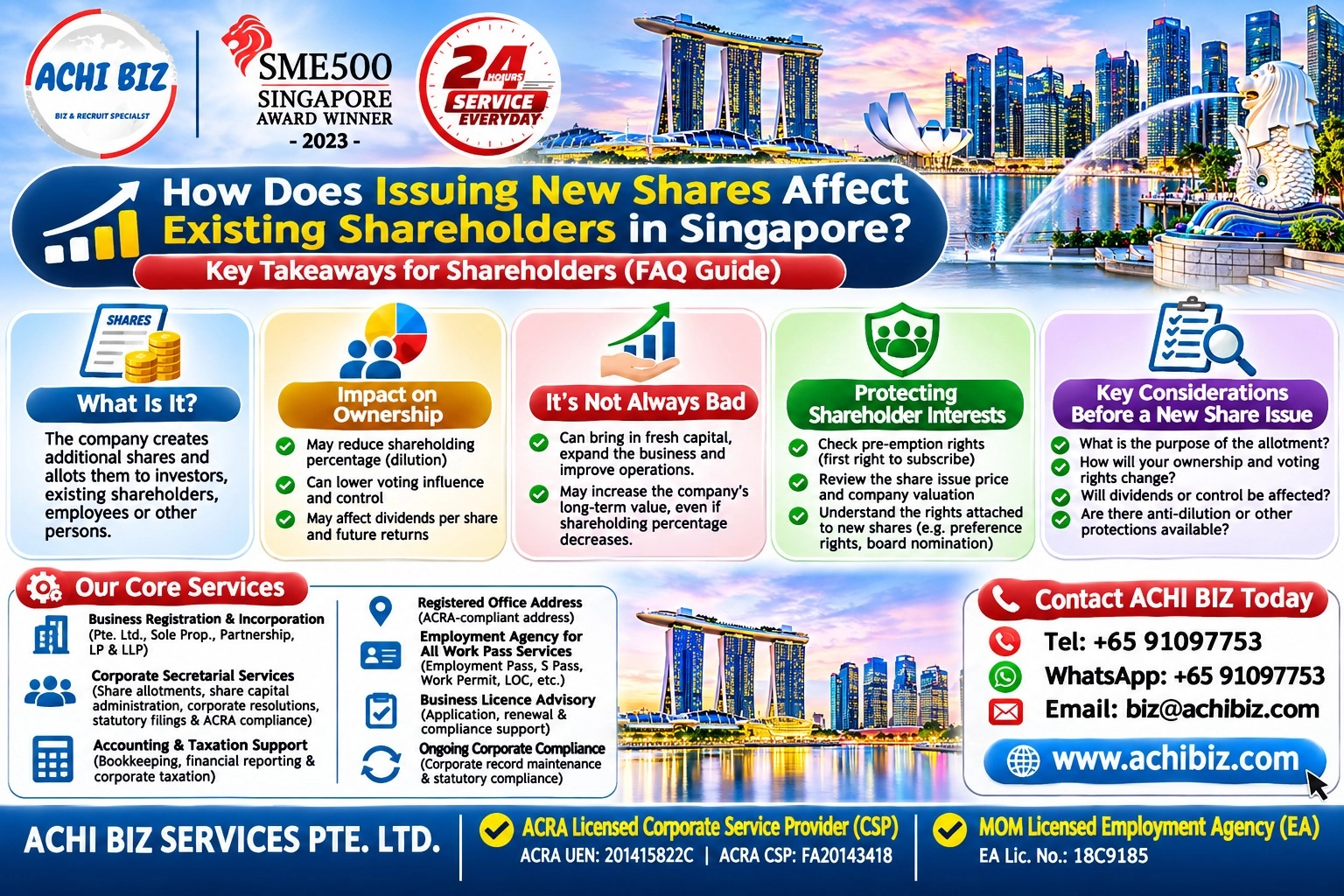
How Does Issuing New Shares Affect Existing Shareholders in Singapore?
A Comprehensive FAQ Guide to Shareholder Dilution, Ownership Percentages, Voting Rights, Dividends, Minority Shareholder Protection and Corporate Governance in Singapore Pte. Ltd. Companies.
Issuing new shares is one of the ways a Singapore private limited company can raise capital, welcome investors, reward employees or restructure its ownership. However, a new share issue does more than increase the number of shares recorded in the company’s statutory records. It can significantly affect the interests of existing shareholders.
For example, a shareholder who originally owns 40% of a Singapore company may find that their ownership falls to 25% after additional shares are issued to another investor. Although the shareholder still holds the same number of shares, their proportionate interest in the company has decreased.
This is known as shareholder dilution.
But dilution is only one possible consequence. New share allotments may also affect voting power, dividend entitlements, control over company decisions, future investment returns, shareholder agreements and the balance of influence between majority and minority shareholders.
Under Singapore’s Companies Act 1967, share issues must comply with applicable statutory requirements, including directors’ authority to issue shares, the company’s constitution and relevant shareholder rights.
Importantly, issuing additional shares does not automatically mean that existing shareholders lose money or that the company’s overall value decreases. The actual consequences depend on the number of shares issued, the subscription price, the identity of the new shareholders, the rights attached to the shares and the company’s valuation.
This ACHI BIZ guide focuses specifically on how issuing new shares affects existing shareholders, rather than repeating the detailed share allotment procedures, capital increase requirements or general shareholding calculations already covered in our related articles.
Understanding the Impact of New Share Issues on Existing Shareholders
What happens to existing shareholders when a Singapore company issues new shares?
When a Singapore company issues additional shares, the total number of issued shares increases.
If existing shareholders do not receive a proportionate allocation of those new shares, their percentage ownership may decrease.
The consequences may include:
-
A smaller percentage of the company’s ordinary shareholding.
-
Reduced relative voting influence.
-
Changes in dividend entitlements.
-
A different balance of control among shareholders.
-
Changes in the economic value attributable to each share.
-
Possible effects on future fundraising and exit arrangements.
-
The entry of new shareholders with contractual or preferential rights.
However, existing shareholders do not automatically lose their original shares.
Their number of shares generally remains unchanged unless a separate transaction affects their holdings.
Does issuing new shares automatically reduce the ownership percentage of existing shareholders?
No. It depends on how the new shares are allocated.
If all existing shareholders subscribe for new shares in proportion to their existing holdings, their ownership percentages can remain unchanged.
However, if additional shares are issued exclusively to a new investor or selected existing shareholders, the ownership percentages of non-participating shareholders will generally decrease, assuming the same class of equally ranking shares.
What is shareholder dilution in a Singapore private limited company?
Shareholder dilution occurs when a shareholder’s proportional ownership decreases because the company issues additional shares to other persons.
For example:
A shareholder owns 400 out of 1,000 ordinary shares, representing 40%.
The company subsequently issues another 600 ordinary shares to a new investor.
The original shareholder still owns 400 shares, but there are now 1,600 ordinary shares in total.
Their new ownership percentage is:
The shareholder’s ownership falls from 40% to 25%.
This represents a reduction of 15 percentage points, or a 37.5% relative reduction in the original ownership percentage.
Does dilution mean that existing shareholders lose their shares?
No.
Dilution generally changes the shareholder’s proportionate interest, not the number of shares already held.
For example, a shareholder with 1,000 shares may continue holding 1,000 shares after a new allotment.
However, if the company’s total issued shares increase from 5,000 to 10,000, that shareholder’s ownership decreases from 20% to 10%.
The shareholder retains the original shares but owns a smaller proportion of the enlarged company.
Is shareholder dilution always bad for existing shareholders?
Not necessarily.
Dilution can be commercially beneficial where the company receives new investment that improves its financial position, supports expansion or increases its long-term value.
For example, a shareholder’s ownership may decrease from 50% to 40%, but the value of their investment may increase if the new funding substantially improves the company’s prospects.
Conversely, dilution may be harmful if new shares are issued at an unjustifiably low price or primarily to shift control away from particular shareholders.
The key distinction is between percentage dilution and economic dilution.
What is the difference between percentage dilution and economic dilution?
Percentage dilution refers to a reduction in the proportion of shares held.
Economic dilution concerns whether the shareholder’s underlying financial interest or value per share is adversely affected.
Consider a simplified example:
A company is valued at S$800,000 before investment.
A new investor contributes S$200,000 for 20% of the enlarged ordinary share capital.
Assuming the transaction is fairly priced and the entire investment becomes part of the company’s value, the post-investment valuation is S$1 million.
The existing shareholders collectively fall from 100% to 80% ownership.
However, their collective interest may still be worth S$800,000.
Their percentage ownership decreases, but their theoretical economic value does not necessarily decrease immediately.
Actual investment values remain subject to market conditions, contractual rights and business performance.
Can an existing shareholder benefit from a new share issue even when their percentage decreases?
Yes.
A new share issue may provide funding for:
-
Business expansion.
-
New equipment or technology.
-
Recruitment and operational development.
-
Debt repayment.
-
Working capital.
-
New business opportunities.
-
Research and product development.
If the additional investment creates sufficient value, the existing shareholder may benefit despite holding a smaller percentage of the company.
Can a shareholder be diluted without agreeing to the new share issue?
Potentially, yes.
Whether the company can proceed depends on the applicable legal requirements, the company’s constitution, directors’ authority and any enforceable shareholder protections.
An individual shareholder does not necessarily have a veto over every proposed share issue.
However, an allotment that breaches applicable legal rights, contractual protections or directors’ duties may be open to challenge.
How New Share Issues Affect Shareholding Percentages
How do existing shareholders calculate their ownership after new shares are issued?
For a straightforward company with one class of equally ranking ordinary shares:
New Ownership % = (Shares Held by Shareholder ÷ Total Shares After Allotment) × 100
For example, if a shareholder owns 2,000 shares and the company’s total ordinary shares increase to 8,000:
(2,000 ÷ 8,000) × 100 = 25%
The shareholder’s new ownership is 25%.
For companies with different share classes, the calculation of voting rights, economic entitlements and other interests may require a separate analysis.
What happens when a company doubles its issued ordinary shares?
If the company doubles its ordinary shares by issuing the same number of additional shares entirely to other persons, the ownership percentage of each non-participating shareholder is halved.
For example, a shareholder holding 30% before the allotment would hold 15% afterwards.
However, if new shares are distributed proportionately among all shareholders, their percentages may remain unchanged.
What happens when a company issues new shares to only one existing shareholder?
The shareholder receiving the new shares generally increases their ownership percentage.
Other shareholders who do not receive additional shares may experience dilution.
This can change the company’s balance of voting power and may create shareholder disagreements if the allotment is perceived as unfair.
What happens when a company issues shares to a completely new investor?
The new investor becomes a shareholder once the allotment takes legal effect and the relevant statutory requirements are satisfied.
Existing shareholders may experience dilution.
The new investor may also obtain voting rights, dividend rights, information rights or other protections, depending on the share class and contractual arrangements.
Can a company issue new shares without changing existing shareholders’ ownership percentages?
Yes.
One approach is a proportionate allotment under which existing shareholders subscribe for new shares according to their current ownership percentages.
For example, shareholders owning 70% and 30% may receive 700 and 300 additional ordinary shares respectively.
Their ownership percentages remain 70% and 30%, assuming no other changes.
Can a company issue shares to employees and dilute existing shareholders?
Yes.
Where employees receive newly issued shares under an employee share ownership or incentive arrangement, the total number of issued shares increases.
Existing shareholders may experience dilution unless the arrangement includes appropriate protections or offsetting measures.
Can a company issue shares to a director and dilute minority shareholders?
Potentially.
However, directors must comply with applicable legal duties, approval requirements and any relevant restrictions.
An allotment intended primarily to manipulate voting control or disadvantage minority shareholders may raise serious legal concerns.
Can a company issue new shares to a related party?
Potentially, subject to applicable legal requirements.
However, transactions involving directors, controlling shareholders, relatives or related entities may warrant particular scrutiny.
The company should consider conflicts of interest, the commercial justification, pricing, approvals and whether the transaction unfairly prejudices other shareholders.
Can a company issue shares to a foreign investor and dilute Singapore shareholders?
Yes.
A foreign investor may subscribe for shares in a Singapore company, subject to applicable restrictions and regulatory requirements.
Existing shareholders may experience dilution in the same way as they would if shares were issued to a Singapore investor.
Foreign ownership restrictions or approval requirements may apply to particular regulated sectors.
Does issuing shares to a parent company affect minority shareholders in a subsidiary?
Potentially.
If a subsidiary issues additional shares to its parent company, minority shareholders may experience dilution.
This may increase the parent company’s ownership percentage and influence over the subsidiary.
The transaction should be assessed against the subsidiary’s constitution, shareholder agreements and applicable legal duties.
How New Shares Affect Voting Rights and Company Control
Does issuing new shares reduce existing shareholders’ voting power?
It can.
Where new shares carry the same voting rights as existing ordinary shares, non-participating shareholders generally hold a smaller proportion of the total voting power after the allotment.
However, voting power does not always correspond directly to shareholding percentage.
Different share classes may carry different voting rights.
Can a shareholder lose majority control after new shares are issued?
Yes.
Suppose a shareholder originally owns 60% of the company’s voting ordinary shares.
If additional shares are issued to another investor, that shareholder’s percentage may fall below 50%.
The shareholder may then lose the ability to independently determine ordinary resolutions where a simple majority is required and all relevant votes are cast.
Can a shareholder lose the ability to block special resolutions after dilution?
Yes.
Special resolutions under Singapore company law generally require at least 75% of the votes cast by shareholders entitled to vote, subject to applicable statutory requirements.
A shareholder with more than 25% of the relevant voting rights can generally prevent a special resolution where they exercise those votes against it and all other relevant votes are cast in favour.
If dilution reduces that shareholder’s voting interest below the blocking threshold, their practical ability to prevent such resolutions may change.
The outcome depends on voting rights, attendance, votes cast and any applicable class voting requirements.
Can a shareholder with 51% ownership lose control after a new allotment?
Yes.
If the company issues enough voting shares to another investor, the original 51% shareholder may fall below majority ownership.
For example, a shareholder holding 510 out of 1,000 shares owns 51%.
If 200 additional equally voting shares are issued to another person, their ownership becomes:
The shareholder no longer holds a majority of the enlarged ordinary share capital.
Can a shareholder with 30% ownership become a minority with little practical influence?
Potentially.
A 30% shareholder may have significant influence over certain decisions, especially where a special resolution is required.
If dilution reduces their holding to 10%, their ability to influence or block shareholder decisions may be materially reduced.
However, contractual veto rights, board representation or class rights may provide additional protections.
Can issuing new shares change who controls the board of directors?
Potentially.
A change in shareholding may affect who can appoint or remove directors under the company’s constitution, shareholder agreements and applicable law.
For example, an investor may negotiate the right to nominate a director as part of a new investment.
However, issuing shares does not automatically appoint or remove directors.
Can issuing new shares affect the appointment of directors?
Yes, indirectly.
Shareholders’ voting power may influence director appointments.
A new investor may also negotiate specific board nomination rights.
The company must distinguish between statutory shareholder voting rights and contractual arrangements governing board representation.
Can a minority shareholder lose their board nomination rights after dilution?
Possibly.
Some shareholder agreements provide board nomination rights only while a shareholder maintains a specified ownership percentage.
If dilution causes the shareholder’s holding to fall below that threshold, the contractual right may cease.
The exact outcome depends on the agreement.
Can a new investor gain control without owning more than 50% of the shares?
Potentially.
Control may arise through voting arrangements, shareholder agreements, board appointment rights, special rights attached to shares or the distribution of voting power among other shareholders.
A shareholder with less than 50% ownership may still exercise substantial influence.
Can non-voting shares be issued to raise capital without diluting existing voting power?
Potentially.
Where the company’s constitution and applicable law permit the relevant share structure, non-voting shares may allow the company to raise capital without increasing the total voting rights in the same way as ordinary voting shares.
However, existing shareholders may still experience economic dilution or changes in dividend and liquidation entitlements.
Can preference shares affect existing ordinary shareholders even if they carry no voting rights?
Yes.
Preference shares may carry priority rights to dividends, capital repayment or distributions on winding up.
Such rights may affect the economic interests of ordinary shareholders even where the preference shares have limited or no general voting rights.
The precise consequences depend on the terms of issue.
Pre-emption Rights and Protection Against Shareholder Dilution
Do existing shareholders automatically have the first right to purchase newly issued shares in Singapore?
Not necessarily.
Singapore law does not provide a universal statutory pre-emption right requiring every private company to offer all newly issued shares to existing shareholders first.
However, pre-emption rights may arise under the company’s constitution, shareholders’ agreement or other binding arrangements.
Existing shareholders should review these documents before assuming that they are entitled to participate in a proposed allotment.
What are pre-emption rights in a Singapore Pte. Ltd. company?
Pre-emption rights may give existing shareholders an opportunity to subscribe for newly issued shares before those shares are offered to other persons.
Their purpose is often to help shareholders preserve their proportionate ownership and voting influence.
For example, a shareholder holding 25% of a company’s ordinary shares may have the contractual right to subscribe for 25% of a proposed new ordinary share issue.
The actual entitlement depends on the relevant provisions.
Can a shareholder prevent dilution by exercising pre-emption rights?
Potentially.
If a shareholder has an enforceable right to subscribe for their proportionate allocation and exercises that right in full, they may preserve their existing percentage.
However, the shareholder must generally satisfy the applicable subscription conditions, including payment requirements.
Pre-emption rights do not necessarily protect shareholders who are unable or unwilling to invest additional funds.
What happens if an existing shareholder cannot afford to subscribe for new shares?
The shareholder may be diluted if the company lawfully proceeds with the allotment.
For example, a shareholder may have the opportunity to subscribe for S$50,000 worth of new shares but lack sufficient funds.
If those shares are subsequently issued to another investor, the shareholder’s percentage may decrease.
This is a practical limitation of pre-emption protection: maintaining ownership may require further investment.
Can existing shareholders waive their pre-emption rights?
Potentially, subject to the relevant legal and contractual requirements.
A waiver may allow the company to issue shares without first offering them to the shareholder concerned.
However, the waiver should be properly documented, and the company must still comply with other applicable requirements.
Can a company remove pre-emption rights from its constitution?
Potentially, through a lawful constitutional amendment.
However, the company must consider the applicable statutory requirements, existing contractual protections, class rights and whether the proposed amendment is legally permissible.
Changing the constitution does not necessarily extinguish independent rights under a shareholders’ agreement.
Can pre-emption rights protect minority shareholders against unfair allotments?
They can provide an important safeguard.
However, pre-emption rights alone may not prevent every form of unfair treatment.
For example, a shareholder may receive a proportionate subscription offer but be unable to participate because of financial constraints.
Other protections may therefore be relevant, including directors’ duties, shareholder agreements and remedies for oppressive conduct.
Can a shareholder challenge a share issue that breaches pre-emption rights?
Potentially.
The available remedies depend on the source of the right, the nature of the breach and the circumstances of the allotment.
Possible legal issues may include breach of contract, breach of the constitution, improper exercise of directors’ powers or minority shareholder oppression.
A shareholder considering a challenge should obtain legal advice promptly.
Are pre-emption rights on new share issues the same as pre-emption rights on share transfers?
No.
Pre-emption rights on new issues generally concern shares being created and allotted by the company.
Pre-emption rights on transfers generally concern existing shares being sold or transferred by a shareholder.
The rights may operate differently and should not be confused.
For a detailed discussion of these protections, readers can refer to ACHI BIZ’s separate article, Pre-emption Rights in Singapore Pte. Ltd. Companies: Features, Benefits & Risks.
How New Share Issues Affect Dividends and Profit Entitlements
Does issuing new shares reduce the dividends received by existing shareholders?
It may.
If the company distributes the same total dividend amount across a larger number of equally ranking shares, the dividend per share decreases.
However, the company’s future profits and total dividend distributions may increase following a successful capital injection.
Therefore, the effect is not necessarily permanent.
How does issuing new shares affect dividends per share?
Consider a company with 10,000 equally ranking ordinary shares.
It declares a total dividend of S$50,000.
The dividend per share is:
If the company later has 20,000 equally ranking ordinary shares and declares the same S$50,000 total dividend:
The dividend per share decreases from S$5 to S$2.50.
This example assumes all the shares are entitled to participate equally in the relevant dividend.
Can existing shareholders receive less dividend income even when the company becomes more profitable?
Yes.
The result depends on the increase in profits, the number of new shares and the company’s dividend policy.
For example, total distributable profits may increase by 20%, but the number of equally ranking shares may increase by 50%.
In that situation, the amount attributable to each share may decrease.
Does issuing new shares automatically entitle the new shareholders to past profits?
Not automatically.
Dividend entitlements depend on the rights attached to the shares, the terms of issue and the relevant dividend declaration.
New shareholders do not automatically acquire a separate legal claim to dividends already validly declared in favour of earlier entitled shareholders.
However, new shares may participate in future dividends according to their terms.
Can a company issue shares with different dividend rights?
Yes, subject to applicable legal requirements.
For example, a company may issue preference shares carrying specified dividend priorities.
Such arrangements can affect the amount available for distribution to ordinary shareholders.
Can issuing preference shares reduce future dividends available to ordinary shareholders?
Potentially.
If preference shareholders have priority dividend rights, the company may need to satisfy those entitlements before making distributions to ordinary shareholders, according to the relevant terms.
The economic impact depends on whether the preference dividends are cumulative, non-cumulative, participating or subject to other conditions.
Can a company promise existing shareholders that their dividends will never decrease after a new share issue?
A company should be cautious about making such promises.
Dividend payments depend on legal requirements, available profits, directors’ decisions and the rights attached to shares.
Contractual arrangements cannot override statutory restrictions on unlawful distributions.
Does a larger number of shareholders mean the company must pay more dividends?
No.
The number of shareholders does not, by itself, determine the company’s total dividend obligation.
Dividends depend on the company’s financial circumstances, applicable law, share rights and valid corporate decisions.
New Share Issues and the Economic Value of Existing Shares
Does issuing additional shares automatically reduce the value of existing shares?
No.
The effect depends substantially on the consideration received and the company’s valuation.
If new shares are issued at a commercially justified price, the company receives additional value in exchange for the new ownership interest.
If shares are issued at an unjustifiably low price, existing shareholders may suffer economic dilution.
What happens when new shares are issued below the company’s fair value?
Existing shareholders may experience a transfer of economic value to the subscribers receiving the discounted shares.
For example, if a company is worth S$1 million and issues a substantial ownership interest for a nominal amount, the new investor may receive an economic benefit disproportionate to the contribution.
The precise impact depends on the valuation, rights attached to the shares and transaction circumstances.
Can a company legally issue shares at different prices to different investors?
Potentially.
Singapore operates under a no-par-value share regime, and subscription prices may vary between allotments.
However, directors must comply with their duties, the company’s constitution, applicable approvals and relevant shareholder protections.
A different issue price should have a proper commercial justification.
Does a higher subscription price mean less dilution for existing shareholders?
Often, yes, where the company is raising a fixed amount of capital under comparable terms.
For example, a company seeking S$100,000 may need to issue fewer shares if each new share is priced at S$100 rather than S$10.
However, the overall outcome also depends on the existing share count, share rights and agreed valuation.
What is a pre-money valuation, and why does it matter to existing shareholders?
A pre-money valuation is the agreed value of a company immediately before a new investment.
It helps determine how much ownership a new investor receives in exchange for the investment.
For example:
-
Pre-money valuation: S$800,000.
-
New investment: S$200,000.
-
Post-money valuation: S$1,000,000.
-
New investor’s ownership: 20%.
The existing shareholders collectively retain 80%, assuming a straightforward investment involving equally ranking shares and no other adjustments.
What is a post-money valuation?
A post-money valuation generally represents the agreed value of the company immediately after the investment.
In a straightforward cash investment:
However, more complex transactions may involve adjustments for debt, options, convertible instruments or other negotiated matters.
Can existing shareholders become wealthier despite owning a smaller percentage?
Yes.
Suppose a shareholder owns 50% of a company valued at S$200,000.
Their theoretical interest is worth S$100,000.
After a successful investment and subsequent business growth, their ownership decreases to 30%, but the company becomes worth S$1 million.
Their theoretical interest is now worth S$300,000.
This illustrates how economic value can increase despite percentage dilution.
The figures are hypothetical and do not represent guaranteed realisable sale proceeds.
Can a shareholder suffer economic dilution even when their ownership percentage remains unchanged?
Potentially.
For example, changes to share rights, preferential distributions or other arrangements may affect the economic value of a shareholder’s interest without changing the nominal percentage of ordinary shares held.
Ownership percentage alone is therefore not a complete measure of shareholder protection.
Why should existing shareholders examine the rights attached to new shares rather than only the issue price?
Because the rights may materially affect future returns.
A new investor may receive:
-
Preferential dividend entitlements.
-
Priority repayment rights.
-
Special voting rights.
-
Contractual veto rights.
-
Board nomination rights.
-
Conversion rights.
-
Anti-dilution protections.
Two investors holding the same nominal percentage may have very different economic and governance rights.
Minority Shareholders and Unfair Dilution in Singapore
Can a majority shareholder use a new share issue to dilute minority shareholders?
A majority shareholder may support a lawful allotment that results in minority dilution.
However, using corporate powers improperly to prejudice minority shareholders may create legal issues.
The transaction should have a legitimate corporate purpose and comply with the applicable statutory and contractual requirements.
Can directors issue new shares primarily to maintain their own control?
Such an allotment may be legally problematic.
Directors must exercise their powers for proper purposes and in accordance with their duties.
A share issue undertaken primarily to manipulate voting control, rather than for a legitimate corporate purpose, may be open to challenge.
The legal assessment depends on the circumstances and evidence.
Can minority shareholders refuse to accept dilution?
A minority shareholder may object to a proposed allotment, but an objection does not automatically prevent a lawfully authorised transaction.
The shareholder’s ability to stop or challenge the allotment depends on their voting rights, contractual protections and applicable legal remedies.
Can minority shareholders sue over an unfair share allotment?
Potentially.
Section 216 of Singapore’s Companies Act provides remedies in circumstances involving oppression, disregard of shareholder interests or conduct that is unfairly prejudicial or discriminatory.
Whether an allotment constitutes actionable conduct depends on the facts.
Not every dilution is oppressive.
What evidence may be relevant when assessing whether a share issue unfairly prejudices minority shareholders?
Relevant circumstances may include the company’s genuine funding needs, the subscription price, the identity of the subscribers, the directors’ reasons for the allotment and the resulting change in control.
The court may also consider relevant communications, corporate approvals, shareholder agreements and the overall pattern of conduct.
Can a minority shareholder challenge a new share issue simply because their percentage has decreased?
Not necessarily.
Dilution alone does not establish wrongdoing.
The shareholder would generally need to identify a relevant legal or contractual basis for the challenge.
Can a minority shareholder demand that the company buy back their shares after dilution?
Not automatically.
A shareholder does not generally acquire an unconditional right to require a private company to buy back shares merely because dilution has occurred.
An exit right may arise under a shareholders’ agreement, a lawful corporate arrangement or a court order in appropriate circumstances.
Can a minority shareholder request information about a proposed share allotment?
Shareholders may have relevant statutory, constitutional or contractual information rights.
However, the extent of those rights varies.
A shareholder does not necessarily have an unrestricted right to inspect every internal management document.
Can existing shareholders ask directors to explain why new shares are being issued?
Yes.
Shareholders may seek an explanation through appropriate corporate channels.
Whether directors are legally required to disclose particular information depends on the circumstances and applicable rights.
Clear communication is nevertheless good corporate governance practice.
Can minority shareholders protect themselves through a shareholders’ agreement?
Yes.
A properly drafted shareholders’ agreement may contain protections concerning future allotments, valuation, voting rights, reserved matters and shareholder exits.
However, the effectiveness of those protections depends on their wording, enforceability and consistency with applicable law.
Can a minority shareholder lose important contractual rights after falling below a specified ownership threshold?
Yes.
For example, a shareholders’ agreement may grant board nomination rights only while a shareholder owns at least 15% of the company.
If dilution reduces that holding to 12%, the shareholder may lose the contractual entitlement, depending on the agreement.
This is one reason dilution should be assessed beyond the headline ownership percentage.
Anti-Dilution Protections and Investor Agreements
What is an anti-dilution clause in a Singapore shareholders’ agreement?
An anti-dilution clause is a contractual provision intended to protect an investor against certain future share issues.
Such clauses commonly address situations where new shares are issued at a lower valuation than an earlier investment.
They may adjust conversion terms or provide other agreed protections.
Are anti-dilution rights the same as pre-emption rights?
No.
Pre-emption rights generally provide an opportunity to participate in a new issue.
Anti-dilution rights may adjust an investor’s economic or conversion entitlements when specified events occur.
The two protections serve different purposes.
What is a down round, and how does it affect existing shareholders?
A down round occurs when a company raises new investment at a valuation lower than that used in an earlier financing round.
It may result in significant dilution for existing shareholders.
The impact may be more complicated where earlier investors hold preference shares with anti-dilution protections.
What is full-ratchet anti-dilution protection?
Full-ratchet protection generally adjusts the relevant conversion price to reflect a lower-priced subsequent issue, according to the contractual terms.
It can provide substantial protection to the investor benefiting from the clause.
However, it may impose significant additional dilution on founders and other shareholders.
What is weighted-average anti-dilution protection?
Weighted-average protection generally adjusts the conversion price using a formula that considers the price and quantity of the newly issued shares.
It may produce a less severe adjustment than full-ratchet protection, depending on the circumstances.
The specific formula must be examined.
Can anti-dilution clauses protect founders as well as investors?
Potentially.
Contractual protections can be negotiated for different shareholder groups.
However, the commercial bargaining power of the parties often influences the terms ultimately agreed.
Can anti-dilution protection make future fundraising more difficult?
Yes.
Potential investors may be concerned if existing investors have extensive preferential rights that significantly affect the economics of a new investment.
Complex anti-dilution arrangements may also complicate the company’s capitalisation table.
Can anti-dilution rights result in additional shares being issued?
Potentially.
Depending on the contractual structure, an adjustment may result in the issuance of additional shares or changes to conversion entitlements.
The company must still comply with the applicable legal and corporate requirements.
Should founders accept anti-dilution clauses without understanding their long-term consequences?
No.
Founders should understand how the provisions operate in different financing scenarios, especially where future investment valuations decrease.
Professional legal advice is advisable before agreeing to complex investor protections.
Founder Dilution and Business Ownership After New Investment
How does issuing new shares affect the founders of a Singapore startup?
Founders may experience dilution when the company raises equity funding from outside investors.
For example, two founders who originally own 50% each may collectively retain 80% after an investor acquires 20% of the enlarged company.
If their relative holdings remain equal, each founder would own 40%.
Although their ownership percentages decrease, the company may gain the funding required to expand.
Can founders lose control of their own company after several fundraising rounds?
Yes.
Repeated share issues can gradually reduce founders’ ownership and voting power.
For example, founders may collectively hold 100% at incorporation, 80% after the first financing round and 60% after a subsequent round.
Further investment may reduce their collective interest below 50%.
However, control may also depend on voting arrangements, board composition and contractual rights.
Can founders protect their voting control while accepting new investors?
Potentially.
Possible arrangements may include negotiated voting rights, board representation, reserved matters and different classes of shares.
Such arrangements must comply with Singapore law and the company’s constitution.
Founders should also consider whether proposed protections will be acceptable to future investors.
Can issuing shares to employees dilute the founders?
Yes.
New shares issued under employee incentive arrangements may dilute founders and other existing shareholders.
The extent depends on the number of shares issued and the overall capital structure.
What is an employee share option pool, and how does it affect shareholders?
An employee share option pool generally represents shares reserved or made available under an employee incentive arrangement.
An option pool does not necessarily mean all the underlying shares have already been issued.
However, shareholders and investors often consider the potential dilution arising from future option exercises.
Why do investors examine a fully diluted capitalisation table?
A fully diluted capitalisation table attempts to show the potential ownership structure after taking into account relevant options, warrants, convertible instruments and other rights to acquire shares.
It helps investors and existing shareholders assess possible future dilution.
The assumptions should be clearly identified because not every instrument will necessarily convert or be exercised.
Can convertible loans dilute existing shareholders in the future?
Yes.
A convertible loan may give the lender the right to convert outstanding debt into shares when specified conditions are satisfied.
The conversion may increase the company’s issued shares and dilute existing shareholders.
The outcome depends on the conversion price, valuation cap, discount and other contractual terms.
Can a shareholder loan be converted into shares without affecting other shareholders?
It may affect other shareholders.
If a shareholder loan is converted through the issuance of new shares to the lender, other shareholders may experience dilution.
The transaction may also alter the company’s balance between debt and equity.
Can a strategic investor improve the company’s value despite diluting existing shareholders?
Yes.
A strategic investor may contribute more than funding, such as industry expertise, commercial relationships, technology or access to new markets.
However, these benefits should be evaluated realistically.
A shareholder should not assume that every strategic investment will create sufficient value to justify the dilution.
Practical Examples: How Issuing New Shares Changes Existing Shareholders’ Interests
The following examples use hypothetical Singapore private limited companies. Unless otherwise stated, the shares are ordinary shares carrying equal voting and economic rights, and the calculations exclude options, warrants and other convertible instruments.
Example 1: How does a new investor dilute two existing shareholders?
ABC Pte. Ltd. has 10,000 ordinary shares.
Shareholder A owns 6,000 shares and Shareholder B owns 4,000 shares.
The company issues 5,000 new shares to Investor C.
| Shareholder | Before allotment | After allotment |
|---|---|---|
| A | 60% | 40% |
| B | 40% | 26.67% |
| C | 0% | 33.33% |
| Total | 100% | 100% |
A loses majority ownership, while B’s ownership falls below 30%.
Neither shareholder loses their original shares.
Example 2: How can a shareholder retain the same percentage after a new share issue?
Suppose two shareholders hold 70% and 30% of a company.
The company issues 2,000 additional shares, allocated proportionately.
| Shareholder | Existing shares | New shares | Final ownership |
|---|---|---|---|
| A | 700 | 1,400 | 70% |
| B | 300 | 600 | 30% |
| Total | 1,000 | 2,000 | 100% |
Both shareholders retain their original percentages because they participate proportionately.
Example 3: What happens when a 51% shareholder is diluted below majority ownership?
Suppose Shareholder A owns 510 of the company’s 1,000 voting shares.
The company issues 300 additional voting shares to Investor B.
A’s new ownership becomes:
A no longer holds majority voting control.
The shareholder’s influence over ordinary resolutions may therefore change significantly.
Example 4: What happens when a 30% shareholder is diluted below the usual special-resolution blocking threshold?
Suppose Shareholder A owns 300 out of 1,000 voting shares.
The company issues 500 additional voting shares to another investor.
A’s new ownership becomes:
The shareholder’s percentage falls from 30% to 20%.
Assuming all relevant votes are cast, A acting alone would no longer have sufficient voting power to block a special resolution requiring at least 75% approval.
Example 5: How can issuing shares at a low price harm existing shareholders economically?
Suppose a company is worth S$1 million and has 10,000 ordinary shares.
Its theoretical value per share is S$100.
The company then issues 10,000 additional equally ranking shares for only S$10,000 in total.
Assuming the pre-issue valuation remains valid and the only change in value is the S$10,000 contribution:
| Particulars | Before | After |
|---|---|---|
| Company value | S$1,000,000 | S$1,010,000 |
| Total ordinary shares | 10,000 | 20,000 |
| Theoretical value per share | S$100 | S$50.50 |
The original shareholders collectively fall from 100% ownership to 50%.
Their theoretical collective interest falls to S$505,000.
This illustrates the potential economic consequences of a substantially underpriced allotment. It does not establish whether any particular allotment is lawful or unlawful.
Example 6: How can a fairly priced investment preserve the economic value of existing shareholders?
Suppose a company has 10,000 ordinary shares and an agreed pre-money valuation of S$800,000.
A new investor contributes S$200,000 for 2,500 newly issued shares.
| Particulars | Before | After |
|---|---|---|
| Agreed company valuation | S$800,000 | S$1,000,000 |
| Total ordinary shares | 10,000 | 12,500 |
| Existing shareholders’ collective ownership | 100% | 80% |
| New investor’s ownership | 0% | 20% |
| Implied value per share | S$80 | S$80 |
The existing shareholders experience percentage dilution but no immediate theoretical reduction in the value of their collective holding under these assumptions.
Example 7: What happens when an employee receives 1,000 newly issued shares?
Suppose a company has 9,000 ordinary shares owned by its founders.
It issues 1,000 new ordinary shares to an employee under an appropriate incentive arrangement.
The founders collectively retain 90%, while the employee owns 10%.
The founders’ collective ownership decreases even though they retain all their original shares.
Example 8: What happens when a minority shareholder cannot afford to participate in a rights-based allotment?
Suppose a shareholder owns 20% of a company with 10,000 shares.
The company proposes issuing another 10,000 equally ranking shares.
The shareholder is entitled to subscribe for 2,000 additional shares under an applicable pre-emption arrangement but cannot afford the subscription.
If the company lawfully allots all 10,000 new shares to other persons, the shareholder retains 2,000 shares out of 20,000.
Their ownership falls from 20% to 10%.
Example 9: How does issuing preference shares affect existing ordinary shareholders?
Suppose a company has 10,000 ordinary shares held by its founders.
It issues preference shares to a new investor carrying a specified priority entitlement on a future liquidation.
The founders may retain all 10,000 ordinary shares, but their economic position may change because the preference investor has priority over certain distributions.
The effect depends on the actual rights attached to the preference shares.
Example 10: What happens when a company completes several investment rounds?
Suppose the founders collectively own 100% of a company.
In the first round, a new investor receives 20% of the enlarged company.
In the second round, another investor receives 25% of the further enlarged company.
| Shareholder group | After first round | After second round |
|---|---|---|
| Founders | 80% | 60% |
| First investor | 20% | 15% |
| Second investor | — | 25% |
| Total | 100% | 100% |
The founders collectively retain 60%, while the first investor is diluted from 20% to 15%.
This illustrates why shareholders should model multiple future funding rounds, rather than assessing only the immediate allotment.
Legal and Corporate Governance Requirements Affecting Existing Shareholders
Can directors issue new shares without obtaining shareholder approval in Singapore?
Directors’ authority to issue shares is subject to Section 161 of the Companies Act and other applicable requirements.
Generally, prior approval from the company in general meeting is required for directors to exercise the power to issue shares, subject to the statutory framework.
The scope and continuing validity of any approval should be checked.
Does shareholder approval automatically make every share allotment lawful?
No.
An allotment must comply with the applicable statutory requirements, the company’s constitution, relevant contractual obligations and directors’ duties.
Shareholder approval does not necessarily cure every defect or improper purpose.
Can a shareholder vote against a proposed share allotment?
Yes, where the proposed matter is submitted for shareholder approval and the shareholder is entitled to vote.
However, voting against a resolution does not necessarily prevent its passage.
The outcome depends on the applicable voting threshold and votes cast.
Can directors issue shares for a purpose other than raising money?
Potentially.
Shares may be issued for valid non-cash consideration or other legitimate corporate purposes.
However, the directors must exercise their powers lawfully and for proper purposes.
What happens if directors issue shares for an improper purpose?
The allotment may become the subject of legal challenge.
Possible consequences depend on the circumstances, including the nature of the breach and the remedies available.
A court may consider directors’ duties, the company’s interests and the effect on shareholders.
Can a company issue shares without informing every existing shareholder individually?
The applicable notice and information requirements depend on the statutory framework, the company’s constitution and relevant agreements.
Not every shareholder necessarily has an independent contractual right to receive personal advance notice of every allotment.
However, the company must comply with all applicable approval, notice and filing requirements.
When do newly allotted shares become legally effective in a Singapore private company?
For a private company, the electronic register of members maintained by ACRA is particularly important to the legal effectiveness of an allotment.
The company should ensure the required allotment information is properly lodged and the relevant statutory requirements are satisfied.
A signed subscription agreement or receipt of money alone should not be assumed to complete the legal allotment.
Does the company need to update its register of members after issuing new shares?
Yes.
The relevant statutory shareholder records must accurately reflect the allotment.
For Singapore private companies, the ACRA-maintained electronic register of members is a key statutory record.
Can shareholders check whether new shares have been issued?
Yes.
Relevant company records and ACRA information may help shareholders establish the company’s issued share capital and registered shareholding particulars.
The information available depends on the records and the applicable access rights.
Can a shareholder rely on an old share certificate to prove their current ownership percentage?
Not necessarily.
A share certificate may help establish the number of shares held, but it does not by itself establish the shareholder’s current percentage of the company’s enlarged issued share capital.
The current statutory records and relevant share rights should be reviewed.
Does issuing new shares require the company to amend its constitution?
Not always.
An amendment may be necessary if the proposed allotment is inconsistent with existing constitutional provisions or requires changes to share rights or other arrangements.
Can issuing new shares affect the company’s register of registrable controllers?
Yes, potentially.
A change in ownership or control may affect the individuals or entities that qualify as registrable controllers.
The company should review its obligations under Singapore’s applicable beneficial ownership transparency framework.
Can issuing shares to a foreign investor create additional compliance requirements?
Potentially.
The company may need to review beneficial ownership, identification, licensing, sector-specific restrictions and other applicable requirements.
The specific obligations depend on the investor and the company’s activities.
Can issuing new shares affect the company’s tax obligations?
Potentially.
A genuine equity subscription is generally not ordinary taxable business income merely because the company receives subscription funds.
However, non-cash transactions, employee share benefits, related-party arrangements and other circumstances may have specific tax consequences.
Is stamp duty payable when a Singapore company issues new shares?
A straightforward original allotment of new shares generally does not attract the same share transfer stamp duty that may apply to transfers of existing shares.
However, the overall transaction should be assessed, particularly where it involves other chargeable instruments or arrangements.
Can a company issue new shares while it has outstanding shareholder disputes?
Potentially.
However, an allotment during an ongoing dispute may increase the risk of legal challenges, especially where it affects voting control or existing contractual rights.
Independent legal advice may be appropriate before proceeding.
Shareholder Decision-Making Before a New Share Issue
What should existing shareholders examine before approving a new share allotment?
Existing shareholders should assess the proposed allotment from both a financial and corporate governance perspective.
Important considerations include the number and class of new shares, the proposed subscription price, the company’s valuation, the identity of the subscribers, the commercial purpose of the investment and the resulting ownership percentages.
Shareholders should also consider whether the allotment changes voting influence, dividend rights, board representation or future exit opportunities.
Should existing shareholders request a dilution calculation before new shares are issued?
Yes.
A dilution calculation helps shareholders understand how their ownership percentages will change.
For companies with multiple share classes or convertible instruments, the analysis should also consider potential future dilution.
Should existing shareholders request an independent valuation before approving a new share issue?
An independent valuation may be appropriate where the transaction is substantial, the subscription price is disputed, the company has valuable assets or intellectual property, or the proposed allotment involves related parties.
However, an independent valuation is not universally required for every private company share issue.
What questions should minority shareholders ask before accepting dilution?
Minority shareholders should consider whether the company genuinely requires additional funding, whether the proposed subscription price is commercially reasonable and whether alternative financing arrangements have been considered.
They should also understand how the allotment affects their voting rights, contractual protections, future dividends and exit opportunities.
Can shareholders negotiate the terms of a proposed allotment?
Potentially.
Shareholders may negotiate matters such as valuation, subscription price, participation rights, voting arrangements and investor protections.
However, the outcome depends on the parties’ legal rights, bargaining positions and the company’s circumstances.
Should shareholders consider debt financing instead of issuing additional shares?
Yes, where appropriate.
Debt financing may provide funding without immediately diluting share ownership.
However, borrowing introduces repayment obligations, financing costs and potentially security or guarantee requirements.
Equity financing avoids ordinary loan repayment obligations but may reduce existing shareholders’ percentage ownership.
The company should assess which funding structure best suits its financial position and commercial objectives.
Can a company raise funds through shareholder loans instead of issuing new shares?
Yes.
Shareholder loans may provide an alternative source of funding.
However, the terms should be properly documented, and the company should consider interest, repayment obligations, related-party considerations and future conversion arrangements.
Should a shareholder invest additional money merely to prevent dilution?
Not necessarily.
Maintaining ownership may be important, but shareholders should evaluate the company’s prospects, financial risks and the commercial reasonableness of the investment.
Investing additional money solely to preserve a percentage may not always be financially sensible.
What should shareholders do if they believe a proposed share issue is unfair?
They should review the company’s constitution, shareholders’ agreement, relevant resolutions and proposed allotment terms.
Where there are concerns about improper dilution, breach of rights or directors’ duties, shareholders should obtain independent Singapore legal advice promptly.
The availability of legal remedies may depend on timing and the particular circumstances.
Final FAQs About Issuing New Shares and Existing Shareholders
Can a Singapore company issue new shares without reducing existing shareholders’ ownership percentages?
Yes, where the allotment is structured so that shareholders retain their existing proportional interests.
Can a shareholder retain the same number of shares but lose voting influence?
Yes.
Can a shareholder lose majority control without selling any shares?
Yes.
Can a shareholder be diluted even when the company is profitable?
Yes.
Can a shareholder benefit financially despite dilution?
Yes, if the investment creates sufficient additional value.
Can a new share issue reduce dividends per share?
Yes, depending on the company’s profits, dividend policy and share rights.
Can preference shares affect ordinary shareholders without changing their ordinary share count?
Yes.
Can employee share incentives dilute existing shareholders?
Yes, where additional shares are issued or relevant convertible rights are exercised.
Can a foreign investor dilute existing Singapore shareholders?
Yes.
Can an existing shareholder refuse to invest additional capital?
Generally, a shareholder is not automatically required to subscribe for new shares merely because the company proposes an allotment.
However, existing contractual obligations and unpaid share commitments must be considered.
Can a shareholder lose contractual rights after dilution?
Yes, where those rights depend on maintaining a specified ownership threshold.
Can existing shareholders negotiate protection against future dilution?
Yes, through appropriate contractual and corporate arrangements.
Can a minority shareholder challenge an unfair allotment?
Potentially, where a valid legal basis exists.
Does issuing new shares automatically increase the company’s value?
No.
A capital injection may increase the company’s resources, but the resulting value depends on the transaction and business circumstances.
Does issuing new shares automatically change the company’s UEN?
No.
Does issuing new shares automatically change the company’s incorporation date?
No.
Does issuing new shares automatically change the company’s directors?
No.
Does issuing new shares automatically change the company’s registered office?
No.
Is shareholder dilution always permanent?
Not necessarily.
A shareholder may subsequently acquire additional shares, participate in another allotment or benefit from a lawful restructuring.
However, there is no automatic right to reverse dilution.
What is the most important consideration for existing shareholders before new shares are issued?
Existing shareholders should understand not only how much their ownership percentage will decrease, but also how the allotment will affect the economic value, voting power and legal rights attached to their investment.
Practical Checklist for Existing Shareholders Before a New Share Issue
| Area to review | Key question |
|---|---|
| Purpose of allotment | Why does the company need to issue additional shares? |
| Subscription price | Is the proposed price commercially reasonable? |
| Company valuation | What valuation is being used to determine the investor’s ownership? |
| Shareholding dilution | What percentage will each existing shareholder own afterwards? |
| Voting rights | Will any shareholder lose majority control or blocking influence? |
| Pre-emption rights | Are existing shareholders entitled to participate first? |
| Shareholder agreements | Are any contractual consents or protections triggered? |
| Share classes | Will the new shares have preferential or different rights? |
| Dividend entitlements | How may future distributions be affected? |
| Board representation | Will the investor obtain director nomination or other governance rights? |
| Anti-dilution protections | Are existing or new investors receiving special protection? |
| Future fundraising | What additional dilution may occur in later investment rounds? |
| Related-party concerns | Is the proposed subscriber connected to a director or controlling shareholder? |
| Corporate approvals | Has the company obtained the necessary authorisations? |
| ACRA compliance | Will the allotment and statutory records be properly updated? |
| Financial impact | What new funds or other consideration will the company actually receive? |
| Exit arrangements | How will the allotment affect future share sales or business acquisitions? |
Conclusion: How Does Issuing New Shares Affect Existing Shareholders in Singapore?
Issuing new shares can create valuable opportunities for a Singapore private limited company. It may bring in additional capital, attract strategic investors, strengthen business operations or support long-term expansion.
However, every proposed allotment should be considered carefully from the perspective of existing shareholders.
A new share issue may reduce their ownership percentages, weaken their voting influence, affect future dividends or alter the balance of control within the company.
For minority shareholders, the consequences may be particularly significant where dilution affects their ability to influence important corporate decisions or retain contractual protections.
Nevertheless, shareholder dilution does not automatically mean financial loss.
A properly structured investment may improve the company’s value and benefit existing shareholders, even where their proportional ownership decreases.
The real issue is whether the company receives appropriate value for the shares issued and whether the transaction is commercially justified, properly authorised and consistent with shareholders’ legal rights.
Before approving or participating in a new share issue, existing shareholders should understand the proposed capital structure, valuation, voting consequences, economic implications and potential future dilution.
For companies planning to raise additional equity, transparent communication and careful corporate governance can help protect shareholder relationships and reduce the risk of disputes.
How ACHI BIZ Can Assist with Share Allotments and Shareholder Changes in Singapore
ACHI BIZ SERVICES PTE. LTD., an ACRA Licensed Corporate Service Provider (CSP), assists Singapore companies with corporate secretarial administration and statutory compliance relating to share allotments and changes in shareholding.
Our corporate secretarial support includes coordinating relevant corporate resolutions, preparing allotment documentation, assisting with applicable ACRA filings, maintaining corporate records and supporting post-allotment compliance.
We can also assist companies with the administrative aspects of updating their shareholding structures and recording changes in issued and paid-up share capital.
Where a proposed transaction involves complex shareholder disputes, valuation disagreements, preferential rights or specialised legal matters, independent legal or financial advice should be obtained.
Related Articles
How to Increase Paid-Up Capital in a Singapore Pte. Ltd. Company – FAQ Guide
How to Increase Issued Share Capital in Singapore Pte Ltd Company – FAQ Guide
#achibiz