
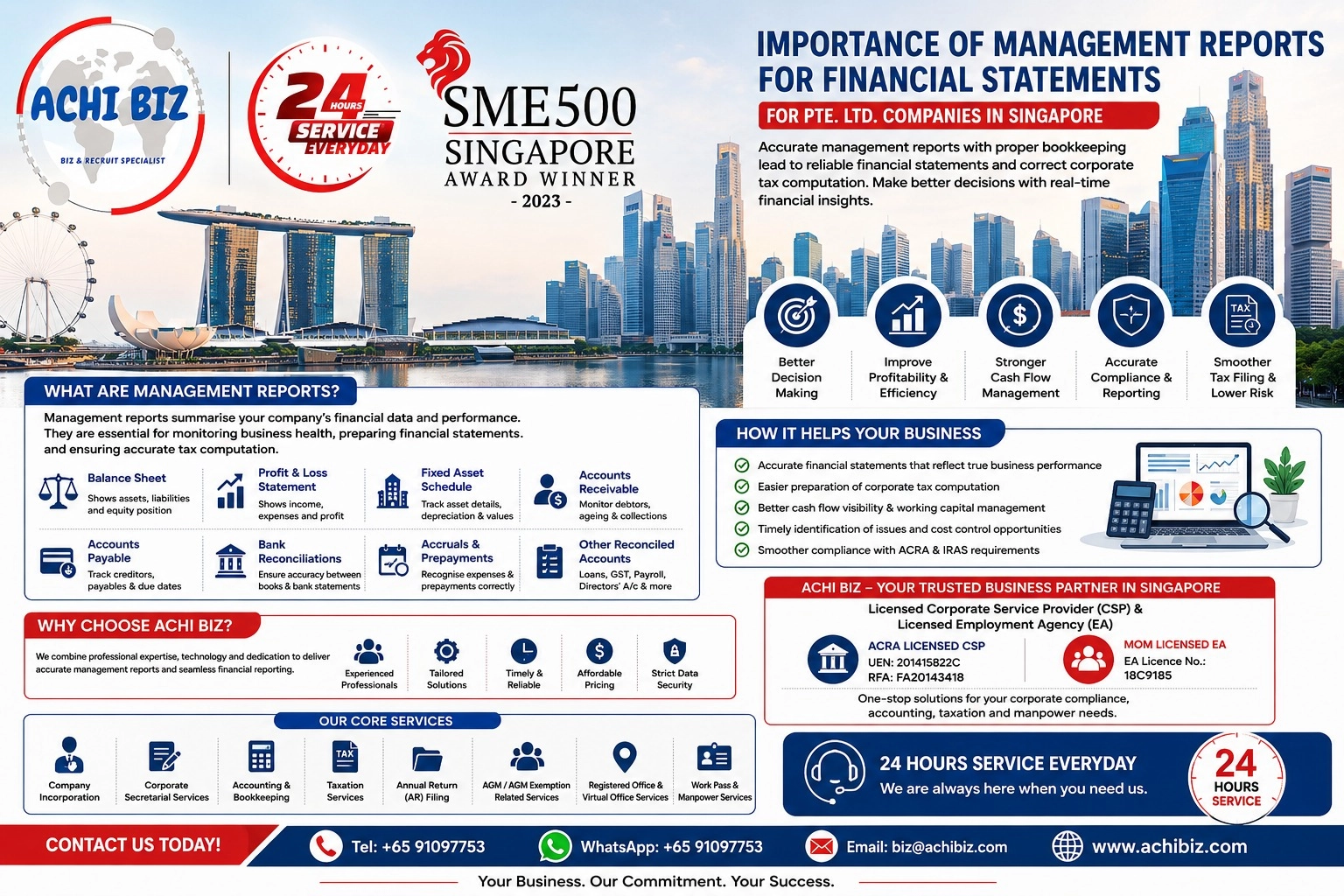
Importance of Management Reports for Financial Statements (FS) of Pte. Ltd. Companies in Singapore
For a Singapore Private Limited (Pte. Ltd.) company, accurate financial statements do not begin at year-end. They begin with proper bookkeeping, supporting documents, regular reconciliations and well-prepared management reports throughout the financial year.
Management reports such as the Balance Sheet, Profit & Loss Statement, fixed asset schedule, accounts receivable and accounts payable schedules, bank reconciliations, accrual and prepayment schedules, loan schedules and other reconciled accounts provide management with a structured view of the company’s financial position.
More importantly, these reports create the accounting foundation from which reliable year-end financial statements and corporate income tax computations can be prepared.
This is consistent with Singapore’s regulatory framework. ACRA states that companies must maintain accounting records that enable true and fair financial statements to be prepared, while directors are responsible for ensuring that financial statements comply with the prescribed accounting standards and give a true and fair view of the company’s performance and financial position.
IRAS similarly requires companies to maintain proper financial records and supporting documents. IRAS specifically notes that good record keeping helps businesses understand their financial status, make better decisions and reduce the cost and effort involved in preparing Corporate Income Tax Returns and responding to tax queries.
Frequently Asked Questions on Management Reports, Bookkeeping and Financial Statements in Singapore
What are management reports in accounting?
Management reports are accounting reports prepared from a company’s books and records to provide management with a structured view of its financial performance, financial position, assets, liabilities, receivables, payables and other significant account balances.
Depending on the size and nature of the Pte. Ltd. company, a management reporting package may contain:
- Balance Sheet or Statement of Financial Position
- Profit & Loss Statement
- General Ledger
- Trial Balance
- Fixed Asset Schedule
- Accounts Receivable Schedule
- Accounts Payable Schedule
- Bank Reconciliations
- Accrual Schedules
- Prepayment Schedules
- Directors’ and shareholders’ account schedules
- Loan and financing schedules
- Intercompany balances
- Inventory records
- Payroll-related balances
- CPF and other payroll liabilities
- GST-related balances
- Tax balances
- Deposits
- Other supporting schedules and reconciliations
The exact reports required depend on the company’s activities and complexity.
Why are management reports important for a Singapore Pte. Ltd. company?
Management reports turn day-to-day bookkeeping data into useful financial information.
A company’s accounting software may contain thousands of transactions. Management cannot realistically assess its financial condition by reviewing individual invoices, receipts and journal entries.
Well-prepared management reports consolidate those transactions so that directors and management can understand questions such as:
Is the company profitable?
How much does the company owe?
What amount do customers or other parties owe to the company?
How much cash is actually available?
Are expenses increasing?
Are customers paying on time?
Does the Balance Sheet contain unexplained balances?
Are there outstanding liabilities that have not been recorded?
This makes management reporting useful for both business decision-making and year-end statutory financial reporting.
Is management reporting compulsory for every Pte. Ltd. company?
There is an important distinction between management reports as an internal reporting package and the company’s statutory obligation to maintain proper accounting records and prepare compliant financial statements.
Singapore law does not simply prescribe that every small Pte. Ltd. company must prepare an identical monthly “management report” in a particular format.
However, companies are required to keep proper accounting records, and those records must enable true and fair financial statements to be prepared.
Therefore, even where a formal monthly management reporting package is not itself mandatory, maintaining the underlying bookkeeping, reconciliations and accounting schedules is extremely important.
What is the relationship between bookkeeping, management reports and financial statements?
They are interconnected but are not the same thing.
A useful way to understand the process is:
Source Documents → Bookkeeping → Reconciliations → Accounting Schedules → Trial Balance → Management Reports → Year-End Adjustments → Financial Statements → Tax Computation
If the bookkeeping at the beginning of this process is incomplete or inaccurate, errors can flow through every subsequent stage.
Why is proper bookkeeping the foundation of accurate financial statements?
Financial statements ultimately depend on the transactions recorded in the company’s accounting records.
Proper bookkeeping means systematically recording transactions such as:
sales, purchases, expenses, receipts, payments, payroll, loans, fixed assets, deposits, accruals, prepayments and other financial transactions.
If these transactions are incomplete, duplicated, wrongly classified or recorded in the wrong accounting period, the financial statements may also be inaccurate.
What happens if bookkeeping is done only once a year?
Year-end bookkeeping is possible for some very small businesses, but it can create practical problems.
Trying to reconstruct twelve months of transactions at once may make it harder to identify:
missing invoices, unexplained bank transactions, incorrect payments, duplicate entries, forgotten expenses, outstanding receivables, unrecorded liabilities and transactions requiring clarification.
Regular bookkeeping allows problems to be identified much closer to the time they occur.
Why should management accounts be prepared monthly or quarterly?
Regular management accounts allow management to monitor the company throughout the year instead of discovering its actual financial condition only after FYE.
For many SMEs, monthly or quarterly reporting provides a practical balance between cost and financial oversight.
The appropriate frequency depends on transaction volume, business complexity and management needs.
What is a Balance Sheet and why is it important?
The Balance Sheet, commonly referred to as the Statement of Financial Position in statutory financial statements, shows the company’s assets, liabilities and equity at a particular date.
It may contain balances such as:
cash and bank balances, trade receivables, inventory, fixed assets, deposits, prepayments, trade payables, accruals, loans, tax liabilities, share capital and retained earnings.
A properly reconciled Balance Sheet is one of the strongest indicators of whether the underlying accounting records have been properly maintained.
Why should every Balance Sheet account be reviewed and reconciled?
Because a Balance Sheet balance should normally have a reasonable explanation or supporting record.
For example:
Bank balance → bank reconciliation
Trade receivables → customer outstanding invoice schedule
Trade payables → supplier outstanding invoice schedule
Fixed assets → fixed asset register
Prepayments → prepayment schedule
Accruals → accrual schedule
Loans → loan statement or agreement
GST → GST reconciliation
Director’s account → transaction schedule
Unexplained Balance Sheet balances are a warning sign that further accounting review may be necessary.
What is a Profit & Loss Statement?
The Profit & Loss Statement (P&L) shows the company’s income and expenses over a particular accounting period and ultimately whether the company generated a profit or loss.
It may include:
revenue, cost of sales, salaries, rental, professional fees, utilities, marketing expenses, depreciation, finance costs and other operating income and expenses.
Why should management review the P&L regularly?
Regular review can identify unusual or unexpected movements.
For example, management may notice that:
revenue has fallen, payroll costs have increased, gross profit margins have changed, professional expenses are unusually high or an expense has been posted to the wrong account.
Correcting these matters during the year is usually easier than investigating them months later during year-end closing.
What is a fixed asset schedule?
A fixed asset schedule or fixed asset register provides detailed information supporting the company’s property, plant and equipment balances.
Depending on the assets, it may contain:
asset description, purchase date, original cost, additions, disposals, depreciation method, useful life, accumulated depreciation and net book value.
Why is the fixed asset schedule important for financial statements?
Without an accurate fixed asset schedule, the company may incorrectly report:
asset cost, depreciation, accumulated depreciation, disposals or net book value.
It is therefore an important supporting schedule for both the Balance Sheet and Profit & Loss Statement.
Why is the fixed asset schedule also important for corporate tax?
Accounting depreciation and Singapore tax deductions are not necessarily the same.
For corporate income tax purposes, qualifying fixed assets may potentially attract capital allowances, subject to the applicable tax rules.
IRAS explains that tax computation involves adjustments to accounting profit and may include capital allowance claims relating to fixed assets.
A properly maintained fixed asset schedule therefore provides important information for preparing the relevant tax schedules.
What is an accounts receivable schedule?
The Accounts Receivable (AR) schedule shows amounts owed to the company by customers.
A proper schedule should allow the company to identify which invoices remain unpaid and how long they have been outstanding.
Why is an accounts receivable ageing report useful?
An ageing report categorises outstanding receivables according to how long they have remained unpaid.
For example:
current, 30 days, 60 days, 90 days and more than 90 days.
This allows management to identify slow-paying customers and potentially problematic debts.
Can receivable reports help improve cash flow?
Absolutely.
A company can report an accounting profit while simultaneously experiencing serious cash-flow problems because its customers have not paid.
Management reports help distinguish between revenue recognised and cash actually collected.
What is an accounts payable schedule?
The Accounts Payable (AP) schedule shows amounts the company owes to suppliers and other creditors.
It assists management in understanding upcoming payment obligations and ensures supplier invoices are properly captured.
Why is accounts payable reconciliation important?
If supplier invoices are omitted, liabilities and expenses may be understated.
If invoices are duplicated, expenses and liabilities may be overstated.
Regular reconciliation therefore helps improve the completeness and accuracy of both the Balance Sheet and P&L.
Why is bank reconciliation one of the most important accounting controls?
Bank reconciliation compares transactions recorded in the company’s accounting system with transactions appearing in its bank statements.
Differences are investigated and resolved.
Common reconciling items include:
bank charges, interest, unidentified receipts, omitted payments, duplicate postings, outstanding payments, foreign exchange differences and timing differences.
Does the accounting software bank balance automatically mean the account is correct?
No.
A bookkeeping system can show a balance while still containing missing or duplicate transactions.
The accounting balance becomes much more reliable after it has been reconciled against the independent bank statement.
Should every company bank account be reconciled?
Yes. Each active business bank account should normally be reconciled against the corresponding accounting ledger.
This becomes especially important where a company operates multiple SGD and foreign-currency accounts.
What are accruals?
Accruals recognise expenses relating to the current accounting period even where the invoice has not yet been received or payment has not yet been made.
For example, professional services may have already been provided before FYE but the supplier invoice may arrive after year-end.
Without an appropriate accrual, the company’s expenses and liabilities may be understated.
Why are accrual schedules necessary?
An accrual schedule explains what each accrual relates to and supports the amount recognised in the accounts.
It also allows prior accruals to be reviewed and reversed or adjusted when the actual invoice is received.
What are prepayments?
Prepayments arise when the company pays for goods or services in advance but part of the benefit relates to a future accounting period.
Examples may include annual insurance, software subscriptions, maintenance contracts or certain rental payments.
Rather than charging the entire amount immediately to expense, the appropriate portion may need to be recognised as a prepaid asset and expensed over the relevant period.
Why should prepayments be reconciled?
Without a proper schedule, expenses can easily be recognised in the wrong accounting period.
A prepayment schedule helps ensure that the appropriate amount is recognised as an expense and the remaining amount is carried forward as an asset.
Should directors’ and shareholders’ accounts be reconciled?
Yes.
Transactions involving directors or shareholders should be clearly identified and supported.
Unexplained personal payments, reimbursements, advances or withdrawals should not simply remain indefinitely in miscellaneous accounts.
These balances can have accounting, corporate governance and potentially tax implications depending on their nature.
Why should loan balances be reconciled?
A company’s accounting records should agree with its actual financing arrangements.
Loan reconciliation may involve reviewing:
principal outstanding, repayments, interest, accrued interest and current versus non-current portions.
Without reconciliation, both liabilities and finance costs may be incorrect.
Why should intercompany balances be reconciled?
Where a company transacts with related companies, one entity may record an amount receivable while the other records the corresponding payable.
Differences can arise because of timing, foreign exchange movements, missing transactions or inconsistent classifications.
Periodic reconciliation helps identify these differences before year-end.
Why is payroll reconciliation important?
Payroll affects several accounts simultaneously, including:
salary expenses, CPF, bonuses, commissions, employee reimbursements and other payroll-related liabilities.
The payroll reports should therefore be reconciled against the accounting records and payments.
Why is GST reconciliation important for GST-registered companies?
GST figures reported to IRAS should be supported by the company’s underlying accounting records.
A GST reconciliation can help identify differences between the accounting ledgers, GST control accounts and amounts reported in GST returns.
Good bookkeeping throughout the year makes this process significantly easier.
What is a Trial Balance?
A Trial Balance lists the closing balances of the company’s general ledger accounts.
It is an important bridge between detailed bookkeeping records and higher-level financial reports.
However, a Trial Balance that mathematically balances is not necessarily accurate.
Incorrect classifications, duplicated transactions or unsupported balances can still exist.
What is a General Ledger and why is it important?
The General Ledger (GL) provides detailed transaction activity behind individual account balances.
If management reports show an unusual expense or Balance Sheet balance, the GL is often the first place accountants investigate.
The management report tells you where the issue may be; the ledger helps determine what transactions caused it.
How do management reports improve the accuracy of year-end financial statements?
Regular management reporting creates multiple opportunities to identify errors before year-end.
Instead of discovering twelve months of accounting problems simultaneously, the company can resolve them progressively.
This can substantially improve the efficiency of financial statement preparation.
Are management accounts the same as statutory financial statements?
No.
Management accounts are primarily prepared for internal monitoring and decision-making.
Statutory financial statements are prepared in accordance with applicable Singapore financial reporting requirements and Companies Act obligations.
Management accounts nevertheless provide much of the underlying accounting information required to prepare statutory financial statements.
What responsibility do directors have for financial statements?
ACRA states that directors must ensure the company’s financial statements comply with prescribed accounting standards and give a true and fair view of the company’s financial performance and position. These responsibilities remain applicable even where the company is audit-exempt.
Engaging an external accountant does not transfer the directors’ underlying statutory responsibilities to the accountant.
Does audit exemption mean management reports and proper bookkeeping are unnecessary?
No.
Audit exemption simply means a qualifying company may not need its financial statements audited.
It does not remove the need for proper accounting records or compliant financial statements.
ACRA specifically states that audit-exempt companies may present unaudited financial statements, while directors remain responsible for ensuring those statements provide a true and fair view.
How do management reports facilitate corporate income tax computation?
This is one of their most important functions.
Singapore corporate income tax is not simply calculated by multiplying the accounting profit by the prevailing tax rate.
IRAS explains that a tax computation begins with the company’s accounting profit or loss, after which tax adjustments are made to arrive at chargeable income. Adjustments can include non-deductible expenses, non-taxable receipts, further deductions and capital allowances.
Accurate accounting records therefore provide the starting point for an accurate corporate tax computation.
Is accounting profit the same as taxable profit?
No.
A company can report one amount as accounting profit but have a different amount of income chargeable to tax.
Certain accounting expenses may not be deductible for tax purposes, while certain income may be non-taxable or subject to different tax treatment.
The tax computation reconciles these differences.
Why does a detailed P&L help with tax computation?
A detailed P&L allows the tax preparer to analyse individual expense categories and determine whether tax adjustments may be required.
For example, certain expenses may require examination to determine whether they are:
revenue or capital in nature, wholly and exclusively incurred in the production of income, specifically deductible, specifically prohibited from deduction or subject to another tax treatment.
Poorly classified bookkeeping makes this analysis more difficult.
Why shouldn’t too many transactions be posted to “Miscellaneous Expenses”?
Because a large miscellaneous account conceals the actual nature of expenditure.
The accountant or tax agent may then need to investigate individual transactions at year-end before determining their proper accounting and tax treatment.
Using meaningful account classifications throughout the year makes both financial reporting and tax preparation more efficient.
Why are supporting schedules important when preparing a tax computation?
IRAS requires companies to prepare their tax computation and relevant supporting schedules before completing Form C-S, Form C-S (Lite) or Form C.
Well-maintained management schedules can therefore substantially reduce the work required to reconstruct information during tax filing.
Does a company filing Form C-S still need financial statements and a tax computation?
Yes.
Although qualifying Form C-S or Form C-S (Lite) companies generally do not submit all of these documents together with the return, IRAS requires the company to prepare its financial statements, tax computation and supporting schedules and have them available if requested.
This is an important reason not to regard a simplified tax return as permission to maintain simplified or incomplete accounting records.
What about companies filing Form C?
Companies filing Form C are required to prepare and submit their audited or unaudited financial statements, detailed P&L, tax computation and applicable supporting documents with the return.
Proper year-round bookkeeping therefore directly facilitates the Form C preparation process.
How can poor bookkeeping result in an incorrect corporate tax computation?
If bookkeeping is inaccurate, the starting accounting profit may already be wrong.
Problems may include:
unrecorded revenue, duplicated expenses, personal expenditure recorded as business expenditure, capital expenditure incorrectly treated as ordinary expenses, missing fixed assets, incorrect depreciation, unrecorded accruals or expenses posted to the wrong period.
The tax computation cannot reliably correct accounting records that have never been properly established.
Can good bookkeeping reduce corporate tax compliance costs?
Potentially, yes.
IRAS itself notes that good record keeping can reduce the cost and effort involved in filing Corporate Income Tax Returns and responding to IRAS queries.
When accounts are already reconciled and supporting schedules are readily available, substantially less time may be needed to investigate unexplained transactions during year-end and tax preparation.
How long must Singapore companies retain accounting records?
IRAS requires companies to retain relevant source documents, accounting records, schedules, bank statements and other business transaction records for at least five years from the relevant Year of Assessment for tax purposes.
Companies should also consider the applicable Companies Act record-retention requirements.
What can happen if proper accounting records are not maintained?
For tax purposes, IRAS states that non-compliance with record-keeping requirements may result in revenue being estimated using its best judgement, expense claims, capital allowances or GST input tax claims being disallowed, and penalties being imposed.
Poor accounting records can therefore have consequences extending well beyond administrative inconvenience.
Can management reports identify fraud or unusual transactions?
They can assist.
Regular comparison of actual financial information can reveal unusual payments, unexplained withdrawals, duplicate expenses, abnormal supplier balances or unexpected changes in margins.
IRAS also identifies awareness of possible internal fraud or theft as one of the benefits of good record keeping.
Management reports are not a substitute for a proper internal-control or fraud investigation system, but they can provide useful warning signals.
Can management reports improve budgeting and cash-flow planning?
Yes.
Historical financial information provides management with a factual basis for preparing forecasts.
For example, management can analyse:
monthly revenue trends, recurring operating expenses, customer collection periods, supplier payment obligations, loan repayments and seasonal cash requirements.
This is significantly more reliable than budgeting purely from intuition.
Can a profitable company still have cash-flow problems?
Yes.
Profit and cash are different concepts.
A company may report a substantial profit but have large unpaid customer balances and insufficient cash to pay suppliers, employees or taxes.
Reviewing the P&L, Balance Sheet, receivable ageing and cash position together gives management a much clearer picture.
Can management reports help companies control receivables and payables?
Yes.
Receivable and payable ageing reports allow management to monitor amounts outstanding and prioritise collection and payment activities.
This can improve working-capital management and reduce unpleasant cash-flow surprises.
Can management reports help directors make better business decisions?
Yes.
Management reports can provide evidence for decisions concerning:
hiring, pricing, cost reduction, expansion, financing, dividend planning, investment in equipment, customer credit terms and supplier negotiations.
The value of the reports, however, depends on the accuracy and timeliness of the underlying bookkeeping.
Why should management compare current results with previous periods?
Comparative reporting can reveal trends that a single month’s figures may not show.
Management can compare:
current month vs previous month, current quarter vs previous quarter, current year vs prior year, actual results vs budget.
Large or unexpected movements can then be investigated.
Should management reports be customised for the company’s business?
Yes.
A construction company, consultancy, restaurant, trading business and investment holding company will not necessarily require identical internal reports.
The accounting structure should reflect the nature of the company’s operations while still supporting statutory financial reporting and tax requirements.
Are accounting software and automation enough to guarantee accurate reports?
No.
Accounting software can substantially improve efficiency, but software only processes the information entered into it.
Incorrect coding, duplicate entries, missing transactions or improper accounting treatment can still produce inaccurate reports.
Automation should therefore be accompanied by professional review and regular reconciliation.
Why is year-end reconciliation still necessary if monthly accounts are prepared?
Because year-end financial statements may require additional adjustments.
These can include:
accruals, prepayments, depreciation, impairment considerations, foreign exchange adjustments, tax provisions, reclassifications and other closing entries.
Regular monthly reconciliation makes this year-end process much easier because most balances have already been reviewed.
What is a good year-end accounting workflow for a Singapore Pte. Ltd. company?
A practical workflow is:
Complete bookkeeping → obtain missing documents → reconcile bank accounts → reconcile receivables and payables → reconcile Balance Sheet accounts → update fixed asset schedules → review accruals and prepayments → reconcile payroll/GST/loans/intercompany accounts → review Trial Balance and General Ledger → prepare final management reports → post year-end adjustments → prepare financial statements → prepare corporate tax computation and supporting schedules.
This approach creates a clear audit trail from individual transactions through to the final financial statements and tax computation.
Should directors review management reports even if an external accountant handles everything?
Yes.
Outsourcing bookkeeping does not mean management should stop understanding the company’s finances.
Directors know the underlying business transactions better than an external accountant. Their review can help identify transactions that have been incorrectly classified or circumstances that require additional accounting information.
What should directors look for when reviewing management accounts?
Rather than simply checking whether the company made a profit, directors should consider whether:
bank balances are reconciled, receivables are collectible, payables are complete, fixed assets are properly recorded, director/shareholder balances make sense, accruals and prepayments are reasonable, unusual expenses are explained and the Balance Sheet contains any long-outstanding or unexplained amounts.
Why is a clean Balance Sheet particularly important before preparing financial statements?
The P&L resets over accounting periods, but many Balance Sheet balances carry forward from year to year.
An error left unresolved can therefore continue affecting future financial statements.
For example, an unexplained receivable or director’s balance may remain on the books for several years unless somebody actively investigates it.
Can management reports help during an audit?
Yes.
Where an audit is required, organised accounting records and reconciled supporting schedules can make it substantially easier to provide supporting information to the auditor.
Poor records can result in additional queries, adjustments and delays.
Can management reports help with ACRA Annual Return compliance?
Indirectly, yes.
Management reports do not replace the Annual Return, but accurate and timely accounting facilitates the preparation of financial statements and other annual compliance work that may need to be completed before or in connection with the company’s annual corporate compliance cycle.
Should dormant companies still maintain accounting records?
Dormant status should not be interpreted as permission to disregard record keeping.
Even a company with little activity may have bank charges, corporate secretarial expenses, share capital, director transactions or other balances requiring proper recording.
The exact financial reporting and tax obligations will depend on the company’s circumstances.
Are management reports useful only for large companies?
No.
Small Pte. Ltd. companies may actually benefit significantly because the owner-director often handles operational, financial and strategic decisions personally.
Even a relatively simple quarterly reporting package can provide much better visibility than looking only at the company’s bank balance.
What are common bookkeeping problems that affect financial statements?
Common problems include:
missing transactions, duplicate entries, personal and company expenses being mixed, incorrect account classifications, unreconciled banks, old receivables and payables, unsupported director balances, unrecorded accruals, incorrect prepayments, incomplete fixed asset registers and failure to reconcile tax-related balances.
Most of these become harder to resolve the longer they remain outstanding.
Why should source documents be properly maintained?
Accounting entries should be supported by appropriate evidence.
IRAS requires companies to retain source documents, accounting records, schedules, bank statements and other records connected with their business transactions for the prescribed retention period.
Invoices, receipts, contracts and other supporting records provide evidence explaining why an accounting transaction was recorded.
Can accurate management accounts guarantee that IRAS will accept every tax deduction?
No.
Accurate accounting establishes what happened financially. Tax law determines how those transactions are treated for tax purposes.
A correctly recorded accounting expense may still be non-deductible for corporate income tax.
That is why accounting and tax computation are connected but distinct processes.
What is the biggest mistake companies make regarding management reporting?
Waiting until year-end to find out whether their accounting records are correct.
A company may operate for twelve months assuming its bookkeeping is accurate, only to discover during financial statement preparation that several accounts have never been reconciled.
Regular review turns year-end closing from a reconstruction exercise into a verification exercise.
How can ACHI BIZ assist with bookkeeping, management reports and financial statements?
ACHI BIZ SERVICES PTE. LTD. can assist Singapore companies with bookkeeping and accounting support, including the preparation and review of relevant management reports and supporting schedules required for year-end financial reporting.
Depending on the company’s requirements, this can include bookkeeping, Balance Sheet and Profit & Loss reporting, bank reconciliation, receivables and payables schedules, fixed asset schedules and other accounting reconciliations.
The objective is to maintain an organised accounting trail from the underlying transactions through to the year-end accounts, financial statements and related tax preparation.
Can ACHI BIZ assist with corporate income tax after completing the accounts?
Yes. Where applicable, accounting and financial reporting information can be coordinated with corporate tax computation and filing support, reducing the need to reconstruct the company’s accounting records separately when the tax filing becomes due.
This is particularly useful because IRAS requires companies to prepare financial statements, tax computations and applicable supporting schedules before completing their Corporate Income Tax Returns.
What other services can ACHI BIZ provide to Singapore companies?
In addition to accounting, bookkeeping, management reporting, financial statement and taxation support, ACHI BIZ provides a broader range of corporate services, including company incorporation, corporate secretarial services, Annual Return filing, AGM-related compliance, registered office and virtual office services, changes to company officers and shareholders, share-related corporate services and other ongoing statutory compliance support.
ACHI BIZ also provides applicable Employment Agency and work pass-related services as a MOM-licensed Employment Agency.
What are ACHI BIZ’s corporate service and Employment Agency credentials?
ACHI BIZ SERVICES PTE. LTD.
ACRA UEN: 201415822C
ACRA RFA: FA20143418
MOM EA Licence No.: 18C9185
Businesses requiring accounting together with ongoing corporate compliance can therefore coordinate multiple requirements rather than treating bookkeeping, financial statements, taxation and corporate secretarial matters as completely separate exercises.
What is the key takeaway about management reports for Pte. Ltd. companies?
The most important principle is:
Accurate financial statements are the result of accurate accounting—not a year-end correction exercise.
Proper bookkeeping records the transactions. Reconciliations verify the balances. Management reports organise the information. Supporting schedules explain the balances. Year-end accounting adjustments finalise the records. Financial statements then present the company’s financial position and performance, while the tax computation uses those accounts as its starting point for determining the company’s taxable income.
In simple terms:
Proper Bookkeeping → Regular Reconciliation → Reliable Management Reports → Accurate Financial Statements → Better Corporate Tax Computation → Stronger Compliance & Business Decisions
Conclusion
Management reporting should not be viewed as something reserved for large corporations. For a Singapore Pte. Ltd. company, it can be one of the most practical ways of maintaining reliable accounting records and avoiding year-end surprises.
A Balance Sheet and Profit & Loss Statement alone do not provide enough information if the company cannot clearly explain the balances behind them. The real strength of management reporting comes from the supporting schedules and reconciliations—bank reconciliations, receivable and payable ageing, fixed asset registers, accruals, prepayments, loans, director balances and other relevant accounts.
Proper bookkeeping throughout the year, along with regular account reconciliations, makes year-end financial statement preparation much more structured and efficient. The same reliable accounting information then provides the starting point for the company’s corporate income tax computation.
For directors, the benefit goes beyond compliance. Timely management reports provide a clearer understanding of profitability, cash flow, debtors, creditors, assets and liabilities, allowing decisions to be based on reliable financial information rather than assumptions.
For Singapore Pte. Ltd. companies seeking an integrated approach, ACHI BIZ SERVICES PTE. LTD. can support bookkeeping, management reporting, financial statement preparation, corporate taxation and related corporate compliance services, helping businesses maintain a more organised financial and statutory reporting process.
Related pages:
Annual Return (AR) for Pte. Ltd. Companies in Singapore – FAQ Guide
FAQ on Cheapest Way to Incorporate a Pte Ltd Company
#achibiz