
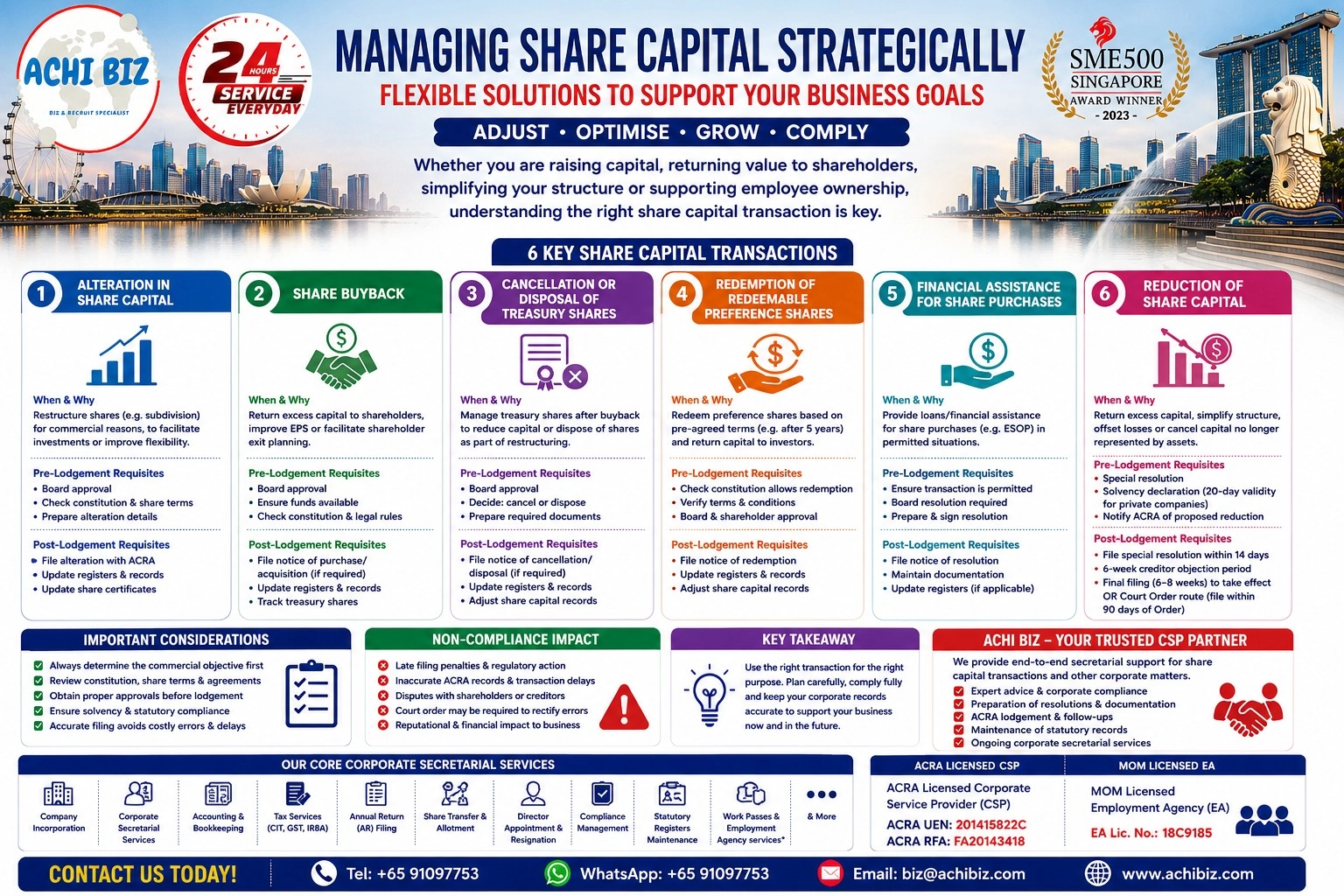
Managing Share Capital Strategically in Pte Ltd Companies–FAQ
Share capital is not something that becomes permanently fixed once a Singapore Private Limited (Pte. Ltd.) company is incorporated. As a business develops, its capital structure may need to change because of investment arrangements, restructuring, excess capital, shareholder exits, accumulated losses or other commercial considerations.
Singapore companies have several mechanisms for managing share capital. ACRA identifies key transactions including alteration of share capital, share buybacks, cancellation or disposal of treasury shares, redemption of redeemable preference shares, financial assistance for share purchases and reduction of share capital. Each transaction serves a different purpose and may involve different approvals, constitutional requirements, solvency considerations, documentation and ACRA filings.
This FAQ focuses specifically on strategic management of share capital in Singapore, including when each transaction may be appropriate, what companies should consider before proceeding, pre-lodgement and post-lodgement compliance, and the consequences of getting a share capital transaction wrong.
What does “managing share capital strategically” mean for a Singapore company?
Managing share capital strategically means changing or reorganising the company’s capital structure to support a genuine commercial, financial or ownership objective rather than treating the existing share structure as permanent.
The appropriate transaction depends on what the company is actually trying to achieve. For example, subdividing shares changes the structure of existing capital, whereas a share buyback involves the company purchasing its own shares. Capital reduction permanently decreases issued capital, while redemption operates specifically in relation to redeemable preference shares.
The legal mechanism should therefore follow the commercial objective—not the other way around.
What are the main ways a Singapore Pte. Ltd. company can strategically manage its share capital?
For the share-capital transactions covered in this guide, the main mechanisms are:
- Alteration of share capital
- Share buyback
- Cancellation or disposal of treasury shares
- Redemption of redeemable preference shares
- Providing financial assistance for share purchases
- Reduction of share capital
ACRA describes these as transactions that allow companies to adjust their share capital to support business goals or respond to changing circumstances.
Why should directors determine the purpose of a share capital transaction before approving it?
Because these transactions are not interchangeable.
Management should first identify the intended outcome. Is the company trying to reorganise the number of shares? Return excess capital? Buy out particular shareholders? Deal with treasury shares? Redeem an existing class of preference shares? Facilitate an acquisition of shares? Or permanently reduce issued capital?
Once the objective is clear, the company can determine the appropriate legal route, required approvals, supporting documentation and ACRA filing.
Is changing share capital simply an administrative ACRA filing?
No. That is an important distinction.
An ACRA lodgement may be one part of the process, but the underlying corporate action must itself be properly authorised and legally valid. Depending on the transaction, the company may first need to review its constitution, directors’ powers, shareholder approval requirements, solvency position, share terms, existing agreements and applicable Companies Act requirements.
The filing should record a properly completed corporate transaction; it should not be used as a substitute for the transaction’s required approval process.
What should a company review before carrying out any major share capital transaction?
Before proceeding, the company should establish its current capital position and determine whether the proposed transaction is legally and commercially workable.
A sensible pre-transaction review may include the company’s constitution, existing share classes and rights, issued and paid-up capital, shareholder holdings, previous share transactions, shareholders’ agreements where relevant, financial position, existing treasury shares, contractual restrictions and the specific corporate approvals required.
The precise checklist will depend on the transaction concerned.
ALTERATION OF SHARE CAPITAL
What is an alteration of share capital?
An alteration changes the structure of a company’s share capital without necessarily having the same effect as a capital reduction.
ACRA gives the example of subdividing one share worth $10 into ten shares worth $1 each. The overall commercial value represented may remain the same, but the number and denomination of shares are reorganised. ACRA requires the alteration in share capital to be filed.
Why might a company alter its share capital?
An alteration can be useful when the existing share structure has become commercially inconvenient.
For example, a company may want a greater number of lower-value shares to facilitate investment arrangements, future transfers, employee participation or a more flexible ownership structure.
The transaction should nevertheless have a clear commercial rationale and be implemented using the correct procedure.
What should be checked before lodging an alteration of share capital?
The company should establish exactly what alteration is proposed and confirm the resulting number, class and capital position of the shares.
The corporate approvals should be completed before the filing where required, and the information submitted to ACRA should correspond precisely with the approved transaction.
What should be done after an alteration of share capital?
The company should ensure that its internal corporate records accurately reflect the altered capital structure.
Relevant registers, shareholding records, certificates or other corporate documents should be reviewed and updated where applicable. Management should also ensure that future corporate documents use the revised share structure rather than continuing to rely on outdated information.
SHARE BUYBACKS
What is a share buyback in a Singapore company?
A share buyback occurs when the company purchases its own shares from its shareholders.
ACRA gives the example of a company with excess cash buying back shares to return capital to shareholders while potentially improving earnings per share. Depending on the company type and circumstances, a notice of purchase or acquisition may need to be filed.
Why might a Pte. Ltd. company consider buying back its own shares?
A buyback can potentially be used as part of capital management, shareholder exit planning or ownership restructuring.
However, directors should not assume that buying shares back from a shareholder is equivalent to an ordinary transfer between two shareholders. The purchaser is the company itself, so specific statutory procedures and financial considerations apply.
What should directors consider before approving a share buyback?
The company should consider why the buyback is being undertaken, whether the proposed route is permitted, what approvals are necessary, how the purchase will be funded and what effect the transaction will have on the remaining shareholders and capital structure.
The company’s constitution and relevant agreements should also be checked where applicable.
Is a share buyback automatically the same as a capital reduction?
No. Although both can affect a company’s capital structure, they are separate corporate mechanisms with different procedures.
A company should determine the intended transaction first and then comply with the rules applicable to that transaction rather than treating “buyback” and “capital reduction” as interchangeable terms.
TREASURY SHARES
What happens to shares after a company buys them back?
The treatment depends on the applicable legal requirements and how the company deals with the acquired shares.
Where shares are held as treasury shares, the company may subsequently need to decide whether they should continue to be held, disposed of or cancelled.
ACRA treats cancellation or disposal of treasury shares as a separate share-capital transaction and states that a notice of cancellation or disposal may need to be filed.
What is the difference between cancelling and disposing of treasury shares?
Cancellation removes the relevant treasury shares, whereas disposal involves the company dealing with those treasury shares rather than permanently cancelling them.
The company should therefore document which action has actually been approved. A cancellation should not be recorded as a disposal, or vice versa.
Why is post-buyback compliance important?
Completing the purchase is not necessarily the end of the corporate exercise.
If the shares become treasury shares, subsequent treatment of those shares may trigger its own corporate and filing requirements. Companies should therefore track treasury shares separately rather than assuming that all compliance ended when the buyback was completed.
REDEEMABLE PREFERENCE SHARES
What is redemption of redeemable preference shares?
Redeemable preference shares are issued with terms permitting their subsequent redemption.
ACRA gives the example of preference shares issued to investors on terms under which the company will buy them back after five years at an agreed price. A notice of redemption must be filed with ACRA.
Must the company’s constitution permit redeemable preference shares?
Yes. ACRA specifically states that the company’s constitution must allow the transaction.
This makes constitutional review an important pre-transaction requirement rather than something to check only after the redemption has been agreed.
What should be checked before redeeming redeemable preference shares?
The company should examine the constitution and the terms attached to the relevant preference shares.
It should establish matters such as which shares are redeemable, whether the redemption conditions have arisen, the applicable redemption terms, required corporate approvals and whether the proposed redemption complies with the relevant legal requirements.
What needs to happen after redemption?
The company must make the required ACRA notification and ensure that its share capital and internal records properly reflect the redemption.
Any documents continuing to show the pre-redemption capital structure should also be reviewed and updated where applicable.
FINANCIAL ASSISTANCE FOR SHARE PURCHASES
What does financial assistance for the purchase of shares mean?
Broadly, this concerns a company providing financial assistance to help another person acquire shares in the company or its holding company.
ACRA gives the example of a company lending money to an employee to purchase shares under an employee share ownership scheme. Importantly, ACRA states that financial assistance is permitted only in specific situations and requires a notice of resolution to be filed where applicable.
Why should financial assistance be treated cautiously?
Because it should not be assumed that a company is free to fund any person’s acquisition of its shares simply because directors and shareholders agree commercially.
The company must first determine whether the proposed arrangement falls within a legally permitted situation and what statutory procedure applies.
What should be reviewed before providing financial assistance?
The substance of the arrangement matters more than its label.
The company should identify who is receiving the assistance, what form the assistance takes, which shares are being acquired, whether the shares are in the company or its holding company, and which statutory route or exception permits the arrangement.
The necessary corporate approvals and documentation should then be completed before the relevant filing.
Is a loan the only form of financial assistance that requires attention?
Companies should not determine the issue solely by asking whether there is a conventional cash loan.
Where a proposed arrangement directly or indirectly assists a share acquisition, its substance should be examined carefully to determine whether the financial-assistance provisions are relevant.
REDUCTION OF SHARE CAPITAL
What is a reduction of share capital?
A capital reduction permanently decreases a company’s issued share capital.
ACRA identifies several possible commercial purposes, including returning excess capital to members, simplifying the capital structure, cancelling capital no longer represented by assets and eliminating losses that may otherwise prevent dividend payments.
How can a Singapore company reduce its share capital?
ACRA currently identifies two routes:
Reduction by members’ approval, involving the prescribed special-resolution and solvency process; or
Reduction by Order of Court, involving shareholder approval followed by Court approval and the prescribed filing process.
The correct route should be determined before documentation is prepared.
What is required for a capital reduction by members’ approval?
For the members’ approval route, ACRA states that a special resolution must be passed and a director must make a solvency declaration. For a private company, the solvency declaration has a 20-day validity period.
The timing therefore needs to be carefully coordinated. Preparing documents without considering the validity period can disrupt the entire transaction.
When must the special resolution for a share capital reduction be filed?
ACRA states that the special resolution must be filed within 14 days from the date of the special resolution. The company must also notify ACRA of the proposed capital after reduction through the prescribed publication process.
Why is there a six-week waiting period for a capital reduction?
The waiting period protects creditors.
Creditors have up to six weeks after the special resolution to apply to the Court to object to the proposed reduction. Where there is no creditor objection, the company may proceed to the final filing stage.
When does a capital reduction by special resolution actually take effect?
Where there are no objections, ACRA states that the final share capital reduction filing must be made between six and eight weeks from the date of the special resolution.
The reduction takes effect immediately after that filing is submitted.
This distinction is important: passing the special resolution does not by itself mean that the entire reduction process has been completed.
What happens when a capital reduction is carried out through a Court Order?
The company first passes the required special resolution and applies to the Court for approval.
Once the Court approves the reduction, the notice of Court Order approving the reduction must generally be filed with ACRA within 90 days after the Court Order date. The reduction takes effect immediately after the filing is submitted.
Why is a solvency declaration a serious document?
A solvency declaration is not merely paperwork accompanying a filing.
A director making such a declaration should have an appropriate basis for doing so and should properly consider the company’s financial position and obligations. It should never be signed automatically simply because it is required to complete the capital reduction process.
PRE-LODGEMENT COMPLIANCE
What are the most important pre-lodgement checks for share capital transactions?
There is no single checklist suitable for every transaction, but a company should generally determine the exact legal transaction, confirm the current share structure, review its constitution and relevant agreements, identify the required directors’ and/or members’ approvals, check financial or solvency requirements where applicable, prepare the necessary resolutions and supporting documents, and verify all figures before submitting anything to ACRA.
The filing data should be checked against the approved corporate documents before lodgement.
Why must the company’s constitution be checked before changing share capital?
The constitution forms part of the company’s governance framework and may contain provisions affecting share classes, rights, redemption, transfers, approvals and other capital matters.
This is particularly explicit for redeemable preference shares: ACRA states that the constitution must allow the redemption transaction.
Should shareholder agreements also be reviewed?
Where a shareholders’ agreement exists, yes.
A transaction may satisfy an ACRA filing requirement but still raise contractual issues between shareholders. Matters such as consent rights, reserved matters, exit arrangements or restrictions may therefore need separate consideration.
POST-LODGEMENT COMPLIANCE
Does compliance end once the Bizfile transaction has been submitted?
Not necessarily.
The company should confirm that the filing has produced the intended result and that its corporate records correspond with ACRA’s records. Relevant registers, share records, accounting records, certificates and internal ownership schedules should be updated where applicable.
The company should also retain the resolutions, declarations, notices and supporting documents forming the audit trail for the transaction.
Why should the company check its updated ACRA records after filing?
Because an incorrectly entered number, class, currency, shareholder detail or capital amount can create inconsistencies that affect future transactions.
ACRA specifically warns that share transactions are complex and errors can be costly. If an error cannot be resolved through a Notice of Error, an Order of Court may be required to amend the error.
What are the consequences of incorrect or late share capital filings?
The impact depends on the particular transaction and breach.
Possible consequences include inaccurate ACRA records, delayed or ineffective corporate actions, difficulty completing subsequent share transactions, late-filing consequences, shareholder or creditor disputes, additional rectification work and, for serious filing errors, potentially having to seek a Court Order to correct the position.
This is why share capital compliance should be treated as a corporate transaction rather than simple data entry.
Can a company backdate a share transaction to match an earlier commercial agreement?
Companies should be very careful about distinguishing the date parties commercially agreed something from the legal effective date of a transaction.
For example, ACRA expressly states that, for private companies, share allotments and share transfers take effect only when ACRA’s Electronic Register of Members (EROM) is updated upon filing, and they cannot be backdated.
The effective-date rules for the particular transaction should therefore be checked rather than assumed.
Who is responsible for ensuring that a share capital transaction is properly carried out?
Responsibility cannot simply be shifted to the person making the Bizfile submission.
Directors should understand the proposed corporate action and ensure the company follows the applicable legal and governance requirements. Shareholders may also need to approve certain transactions. The company secretary or appointed corporate service provider can assist with the corporate documentation, procedural requirements and filings.
Why should directors avoid treating share capital restructuring as a routine secretarial exercise?
Because changing share capital can affect ownership, shareholder rights, company assets, creditor protection and the company’s financial structure.
A transaction that appears simple commercially can involve several interconnected legal steps. Capital reduction is a clear example: ACRA’s process can involve a solvency declaration, special resolution, statutory filing, publication, creditor objection period and final filing before the reduction becomes effective.
How can ACHI BIZ assist with share capital transactions in Singapore?
ACHI BIZ, as an ACRA Licensed Corporate Service Provider (CSP), can assist Singapore companies with corporate secretarial procedures relating to applicable share and share-capital transactions, including reviewing the proposed corporate action from a secretarial compliance perspective, preparing relevant resolutions and corporate documentation, coordinating required approvals, handling applicable ACRA lodgements and updating the company’s corporate records.
For complex transactions involving legal, tax, accounting, valuation, financing or Court considerations, appropriate professional advice may also be required.
What is the key takeaway when managing share capital strategically?
Start with the commercial objective, identify the correct corporate transaction, and only then work through the required approvals, documentation and filing.
Alteration of capital, share buyback, treasury-share cancellation or disposal, redemption of preference shares, financial assistance and capital reduction have different purposes and procedures. Using the wrong route—or filing before the necessary corporate steps have been completed—can create significantly more work than doing the transaction correctly from the beginning.
ACRA itself cautions that share transactions are complex and that filing errors can be costly. Proper pre-lodgement review, accurate ACRA filing and post-lodgement record maintenance should therefore be treated as one continuous compliance process.
Related Pages:
Reduction of Capital to Increase the Cash Flow Explained
Share Allotment in a Singapore Pte. Ltd. Company – FAQ Guide
#achibiz