
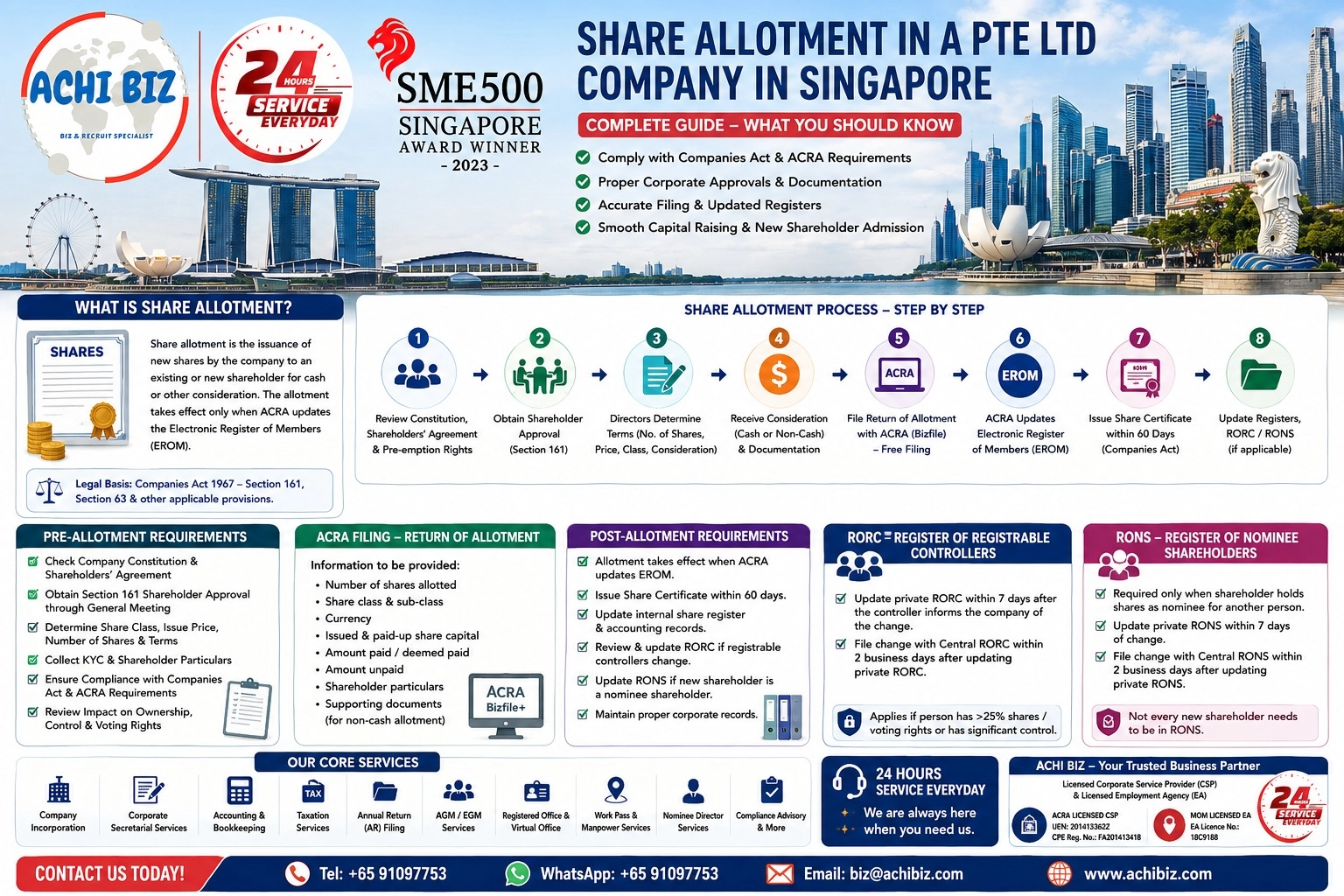
Share Allotment in a Singapore Pte. Ltd. Company: FAQ Guide to Pre-Allotment, ACRA Filing and Post-Allotment Compliance
Share allotment is a common way for a Singapore private limited company to bring in additional capital, admit a new shareholder, restructure ownership or issue further shares to existing shareholders. However, it is not simply a matter of receiving money and issuing shares.
A properly managed share allotment in Singapore involves corporate approvals, compliance with the company’s constitution and the Companies Act 1967, accurate ACRA filing, updating the Electronic Register of Members (EROM), issuing share certificates and reviewing whether the allotment triggers changes to the Register of Registrable Controllers (RORC) or Register of Nominee Shareholders (RONS).
Importantly, ACRA states that for a private company, an allotment of new shares takes effect only when ACRA updates the company’s EROM following the filing. This makes the sequence and accuracy of the transaction particularly important.
Below is a detailed FAQ guide covering the practical and compliance issues companies, directors and shareholders should understand.
What is a share allotment in a Singapore Pte. Ltd. company?
A share allotment is the issuance of new shares by the company to an existing or new shareholder.
The company may issue shares for cash to raise capital or, where appropriate, for non-cash consideration. ACRA gives examples of non-cash allotments involving contractual obligations, provisions in a company’s constitution or shares issued in place of dividend payments.
The allotment increases the company’s issued shares and may increase its share capital.
Is share allotment the same as a share transfer?
No. This distinction is fundamental.
A share allotment creates and issues new shares. A share transfer moves existing shares from one shareholder to another.
For example, if a company has 100,000 existing shares and issues another 20,000 shares to a new investor, this is an allotment. If an existing shareholder sells 20,000 of their existing shares to that investor, it is a share transfer.
The corporate approvals, documentation, ACRA procedures and stamp-duty considerations can therefore be different.
Why would a Pte. Ltd. company allot additional shares?
Companies commonly allot shares to:
- raise additional working or expansion capital;
- admit a new investor or business partner;
- increase an existing shareholder’s investment;
- implement an agreed ownership restructuring;
- issue shares as consideration for an appropriate transaction;
- capitalise certain amounts where legally and commercially appropriate; or
- implement investment arrangements involving different classes of shares.
The commercial reason should be established before the company decides the number, class, issue price and terms of the new shares.
Who has authority to allot shares in a Singapore company?
Directors generally deal with the terms of an allotment, but they cannot simply issue shares whenever they wish.
ACRA specifically states that shareholder approval through a general meeting must be obtained before shares are allotted, even where the company’s constitution allows directors to decide on share allotment. The directors may then determine matters such as the number of shares, terms and issue price, subject to Section 161 of the Companies Act and the company’s constitution.
What is Section 161 approval for a share allotment?
Section 161 of the Companies Act is an important pre-allotment requirement concerning shareholder approval for directors to issue shares.
Before proceeding, the company should establish that the required approval has been properly obtained and documented. ACRA’s current Bizfile process specifically asks whether prior approval from the general meeting to issue shares has been filed and provides for the relevant resolution to be uploaded where necessary.
Should the company’s constitution be checked before allotting shares?
Yes.
The constitution should be reviewed for provisions affecting share capital, classes of shares, shareholder rights, pre-emption arrangements, procedures for issuing new shares and any restrictions relevant to the proposed allotment.
A company should not treat an ACRA filing as a substitute for complying with its constitution or contractual obligations.
Should an existing shareholders’ agreement also be reviewed?
Yes, where one exists.
A shareholders’ agreement may contain pre-emptive rights, anti-dilution provisions, reserved matters, investor consent requirements or other contractual restrictions on issuing additional shares.
An allotment that is technically capable of being filed with ACRA can still create a contractual dispute if the company ignores existing shareholder arrangements.
What are pre-emption rights and why do they matter?
Pre-emption rights can give existing shareholders the opportunity to subscribe for new shares before those shares are offered to another person.
Whether such rights apply depends on the company’s legal and contractual arrangements.
They matter because issuing new shares to one party can dilute the ownership and voting percentage of existing shareholders.
What should directors determine before proceeding with a share allotment?
The proposed transaction should be clearly defined before documents are signed or filed.
Among other matters, the company should determine the intended allottee, number and class of shares, issue price, consideration, amount paid or unpaid, resulting shareholding percentages, voting implications and whether any special rights attach to the shares.
ACRA requires detailed information concerning the shares, capital and shareholders when the return of allotment is filed.
Can ordinary shares and preference shares be allotted?
Potentially, yes, provided the company’s constitution and applicable law permit the relevant class and the necessary approvals and terms are properly established.
Different classes can carry different voting, dividend, redemption, conversion or capital rights. A company should therefore avoid casually creating or issuing a new class without properly documenting the rights attached to it.
Can shares be allotted for cash?
Yes. Raising capital for the company is one of the most straightforward reasons for issuing new shares.
The company should maintain proper evidence of the subscription and payment, including relevant banking and accounting records.
Can shares be allotted for non-cash consideration?
Yes, depending on the circumstances.
ACRA’s filing process accommodates shares payable otherwise than wholly in cash and may require supporting documents, such as a relevant contract or court order, depending on the nature of the transaction.
Non-cash allotments deserve additional attention because the consideration and accounting treatment should be properly supported rather than simply assigning an arbitrary value.
Must the company receive the share subscription money before completing the allotment?
The actual payment arrangement must correspond with the terms of the allotment and what is reported to ACRA.
The return requires information concerning the amount paid or deemed paid and any amount unpaid on the shares. The company’s accounting and bank records should therefore support the transaction rather than contradict the statutory filing.
What information should be collected for a new shareholder?
For a new shareholder, ACRA’s current filing requirements include information such as the shareholder’s full name, identification details, nationality, contact address and number and class of shares held.
For individuals, ACRA also applies requirements concerning the contact address, including that it must be in the same jurisdiction as the residential address; a P.O. Box cannot be used as the contact address.
Where a CSP is involved, applicable customer due diligence and beneficial ownership checks should also be completed.
Can a foreigner become a shareholder through a share allotment?
Generally, a foreign individual or foreign corporate entity may hold shares in a Singapore private company, subject to any sector-specific restrictions, licensing requirements, sanctions or other applicable laws.
Foreign ownership of shares is also separate from immigration status. Merely becoming a shareholder does not itself give a foreign individual the right to work in Singapore.
Can a corporate entity receive newly allotted shares?
Yes, subject to the company’s arrangements and applicable requirements.
Where a corporate shareholder is introduced, the company and its CSP should pay particular attention to ownership chains, beneficial ownership, controllers and nominee arrangements.
Does allotting shares to a new shareholder automatically make that person a registrable controller?
No.
A shareholder and a registrable controller are not necessarily the same thing.
For a company with share capital, one significant-interest test is whether a person or legal entity has an interest in more than 25% of the shares or shares carrying more than 25% of total voting power. Significant control can also arise through other criteria.
Accordingly, the entire post-allotment ownership and control structure should be reviewed.
Can an allotment change the company’s existing registrable controllers?
Yes.
An allotment can dilute an existing shareholder below a relevant threshold, bring a new shareholder above a threshold, or otherwise change who has significant interest or control.
That means RORC compliance should be reviewed as part of the allotment rather than treated as an unrelated annual exercise.
What must be done if the allotment changes the RORC?
Where the company is subject to the RORC regime and a relevant change occurs, ACRA currently requires the private RORC to be updated within seven days after the controller informs the company of the change, followed by filing the change with the Central RORC within two business days after the private RORC is updated.
Does every new shareholder have to be entered into the RONS?
No. This is an important distinction.
RONS means Register of Nominee Shareholders. It is not a general register containing every shareholder.
A shareholder is relevant to RONS when the shareholder acts as a nominee—for example, where the shareholder regularly votes or is required to vote according to another person’s instructions and/or receives dividends on behalf of another person.
Therefore, merely becoming a shareholder through an allotment does not automatically trigger a RONS entry.
What if the newly allotted shareholder is a nominee shareholder?
Then the company should address RONS compliance.
Unless exempt, companies must maintain their private RONS and file applicable information with ACRA’s Central RONS. ACRA requires the private register to be updated within seven days when a shareholder becomes or ceases to be a nominee or when a nominator’s particulars change. The relevant Central RONS update must then be filed within two business days after updating the private register.
Who is the nominator of a nominee shareholder?
The nominator is the person or entity on whose behalf the nominee shareholder holds or exercises rights over the shares.
The company should obtain and maintain the prescribed information concerning the nominee arrangement rather than recording only the registered shareholder’s name.
Is RONS information publicly available?
Not fully.
ACRA maintains the Central RONS to support ownership transparency and law-enforcement purposes, but the underlying nominee/nominator information is not fully available to the public.
What is the penalty risk for failing to comply with RONS requirements?
This should not be treated as a minor housekeeping matter.
ACRA states that failure to file ROND/RONS information on time may result in prosecution and fines of up to S$25,000. ACRA also states that an extension of time is not available for Central ROND/RONS filings.
Does a share allotment need to be filed with ACRA?
Yes, a private company must lodge the prescribed Return of Allotment of Shares for the allotment to be reflected in its EROM and take legal effect.
The filing records changes to the company’s share capital and shareholding.
When does a share allotment in a private company legally take effect?
This is one of the most important points in the entire process.
Under Section 63(2) of the Companies Act, an allotment by a private company does not take effect until ACRA’s electronic register of members is updated. ACRA similarly states that the allotment takes effect on the filing date once the EROM has been updated.
Therefore, companies should be very careful about describing someone as a shareholder before the allotment has legally taken effect.
Can a private company’s share allotment be backdated?
Generally, no.
Because the allotment takes effect when ACRA updates the EROM, ACRA states that backdating a private-company allotment is generally not permitted.
This is particularly important when preparing resolutions, investment agreements, accounting records and other documents that refer to the shareholder’s effective ownership date.
What details are reported in the ACRA Return of Allotment?
Depending on the transaction, the filing can include:
- number of shares allotted;
- share class and sub-class, where applicable;
- currency;
- issued share capital;
- paid-up share capital;
- amount paid or deemed paid;
- amount unpaid;
- shareholder particulars;
- number and class of shares held; and
- supporting documentation for certain non-cash allotments.
These details should be checked carefully against the resolutions, subscription documentation and accounting records.
Who can file the Return of Allotment with ACRA?
ACRA states that company officers, such as a director or company secretary, may file it directly. A company may also engage a registered Corporate Service Provider (CSP) to make the filing on its behalf.
Does ACRA charge a filing fee for a Return of Allotment?
ACRA’s current guidance lists the filing fee for a Return of Allotment as free, with immediate processing in the normal course.
Professional service fees charged by a CSP are separate from ACRA’s filing fee.
What is the Electronic Register of Members (EROM)?
The EROM is ACRA’s electronic register recording the members of a local company.
Changes involving shares and shareholders are reflected through the relevant Bizfile filings, and for private companies the EROM has particular legal significance because the allotment takes effect when the EROM is updated.
Should the company verify the EROM after filing?
Yes.
A post-filing review is sensible to ensure that the new shareholder, number of shares, class, share capital and resulting shareholdings have been correctly reflected.
An incorrect share filing should not simply be ignored.
What happens if incorrect information is submitted to ACRA?
Share-transaction errors can be difficult and expensive to rectify.
ACRA specifically warns that if an error cannot be resolved through a Notice of Error, obtaining an Order of Court may be necessary to correct it.
This is a strong reason to verify the entire capital structure before submitting the filing.
Must a share certificate be issued after an allotment?
Yes, the company’s share-certificate obligations should be completed following the allotment.
For a private company, the Companies Act requires the appropriate certificate to be completed and ready for delivery within 60 days after the allotment.
What information should a share certificate contain?
The Companies Act prescribes requirements for share certificates, including the company name, authority under which the company is constituted, registered-office address, class of shares, whether the shares are fully or partly paid and any amount unpaid.
A share certificate constitutes prima facie evidence of the member’s title to the shares.
What happens if the company fails to prepare the share certificate on time?
Failure to comply with the statutory certificate requirements can constitute an offence.
Under the Companies Act provision governing timely issue of certificates, the company and every officer in default may be liable on conviction to a fine of up to S$1,000, together with a default penalty. The person entitled to the certificate may also have recourse to court procedures in the circumstances prescribed by the Act.
Does a new allotment require cancellation of existing shareholders’ certificates?
Not ordinarily merely because new shares have been allotted to somebody else.
However, where an existing shareholder receives additional shares, the company should ensure that its certificate records and documentation accurately reflect the resulting holdings and that any replacement or additional certificate is dealt with appropriately.
Does share allotment attract the same 0.2% stamp duty as a share transfer?
A new allotment should not automatically be treated as though it were a sale or transfer of existing shares.
IRAS’s 0.2% share duty concerns the transfer/acquisition of existing shares, calculated on the relevant purchase price or value.
Where a proposed transaction contains additional agreements, transfers or other dutiable instruments, however, the stamp-duty position should be assessed based on the actual documents and transaction rather than assuming that the label “allotment” determines the tax treatment.
Does share allotment dilute existing shareholders?
Usually, yes, where existing shareholders do not participate proportionately.
For example, if A owns 60 shares and B owns 40 shares out of 100 shares, A owns 60%. If the company issues another 100 shares solely to a new investor, A still owns 60 shares, but now only 30% of the enlarged 200-share capital.
The number of A’s shares has not changed, but A’s percentage ownership has been diluted.
Can dilution affect voting control?
Absolutely.
A seemingly straightforward capital injection can alter majority control, special-resolution thresholds, dividend participation and beneficial ownership reporting.
Companies should calculate the post-allotment cap table before approving the transaction, not afterwards.
Could an allotment affect the company’s exempt private company status?
Potentially.
Whenever a new shareholder is admitted, the company should reassess whether it continues to satisfy the legal requirements applicable to its company status. The nature and number of shareholders can matter.
Is there a maximum number of shareholders for a private company?
A private company is generally subject to the statutory limit of 50 members. ACRA’s allotment system specifically checks this limit when new shareholders are being added.
A proposed allotment should therefore be reviewed before filing if it could approach or exceed the permitted limit.
Can shares be allotted at different prices to different shareholders?
The issue terms need to be legally authorised, commercially supportable and consistent with the constitution, shareholder approvals and any applicable agreements.
Directors should also remain mindful of their statutory and fiduciary duties when deciding how shares are issued.
Should the company’s accounting records be updated after the allotment?
Yes.
The accounting records should reflect the actual capital received and the nature of the transaction. The updated share capital should reconcile with the company’s statutory records and ACRA information.
Discrepancies between the financial statements, general ledger, bank receipts and ACRA share capital can create unnecessary problems during year-end accounts preparation, tax work, due diligence or future corporate transactions.
Does an allotment affect the company’s financial statements?
It can.
An allotment can change issued and paid-up share capital, cash or other assets and relevant equity disclosures. The accounting treatment depends on the nature and terms of the issue.
This is why corporate secretarial records and accounting records should not be maintained independently without reconciliation.
Should KYC and beneficial ownership checks be performed on a new shareholder?
Yes, particularly where a CSP is handling the transaction.
Introducing a new individual or corporate shareholder can change the company’s ownership and risk profile. Appropriate identification, verification, beneficial-owner assessment and other applicable due-diligence measures should be completed before the transaction is accepted and filed.
What additional checks are important for a foreign corporate shareholder?
The ownership chain should be understood.
Depending on the circumstances, relevant incorporation records, ownership structure, directors, authorised representatives, beneficial owners, controllers, source of funds and nominee arrangements may need to be established.
Complex offshore ownership should not simply be copied into a filing without understanding who ultimately owns or controls the shareholder.
What are the key post-allotment compliance steps?
Once the allotment is completed, the company should ensure that the ACRA filing and EROM are correct, prepare the appropriate share certificate within the statutory period, update its internal corporate and accounting records, reassess the RORC and update it where required, and determine whether the new shareholder is a nominee requiring RONS updates.
The company’s cap table and beneficial ownership information should also be reconciled with the new structure.
What documents should normally be retained for a share allotment?
Depending on the transaction, the corporate records may include the shareholder approval, directors’ resolutions, subscription or investment documentation, evidence of consideration, shareholder particulars, KYC records, ACRA filing acknowledgement, updated company profile or EROM information, share certificate, updated cap table and relevant RORC/RONS documentation.
For non-cash allotments, the supporting transaction documents are particularly important.
What is the biggest practical mistake companies make with share allotments?
Treating the transaction as merely an ACRA data-entry exercise.
A share allotment can change ownership, voting power, control, beneficial ownership, share capital and financial reporting simultaneously. Filing the wrong number, wrong shareholder, wrong class or wrong capital amount can have consequences extending well beyond Bizfile.
What should a company check before finalising a share allotment?
A sensible pre-filing review should answer four basic questions: Is the allotment properly authorised? Are the terms and consideration correctly documented? What will the ownership and control structure look like after the allotment? Are all consequential statutory-register and accounting updates identified?
If any of these remain unclear, the filing should not be rushed.
Can a Corporate Service Provider assist with share allotment in Singapore?
Yes. A registered CSP can assist with the corporate secretarial process and make the relevant ACRA filing on behalf of the company. ACRA itself recommends seeking professional advice where companies are uncertain about share transactions because errors can be costly.
A proper service should look beyond the Return of Allotment itself and consider the supporting resolutions, shareholder information, resulting share structure and consequential statutory-register requirements.
How can ACHI BIZ assist with share allotment and corporate compliance?
ACHI BIZ SERVICES PTE. LTD. can assist Singapore companies with share allotment, ACRA corporate filings, corporate secretarial services, statutory compliance, accounting and related corporate services.
For a share allotment, the objective is not merely to submit a Bizfile transaction. The supporting approvals, new shareholding structure, EROM, share certificate and applicable RORC/RONS implications should be handled as one coordinated compliance process.
What is the key takeaway for Pte. Ltd. companies considering a share allotment?
A share allotment should be planned before money is received and before anything is filed with ACRA.
The company should establish the legal authority and commercial terms, calculate the resulting ownership structure, obtain the necessary shareholder approval, complete the ACRA Return of Allotment accurately and then attend to the post-allotment requirements.
Most importantly, remember that RONS is not automatically updated simply because there is a new shareholder. RONS becomes relevant where that shareholder is acting as a nominee. Separately, the company should assess whether the allotment changes its registrable controllers under the RORC regime.
Getting these distinctions right is essential for accurate and compliant share allotment in a Singapore Pte. Ltd. company.
Disclaimer: This FAQ provides general information on Singapore corporate compliance and should not be treated as legal, tax or investment advice. The appropriate procedure can vary depending on the company’s constitution, shareholder arrangements, share class, consideration and ownership structure.
Related Pages:
Share Transfer in Singapore Pte. Ltd. Companies: e-Stamping & ACRA Filing – FAQ Guide
Managing Share Capital Strategically in Pte Ltd Companies–FAQ