
Overseas Company vs Offshore Company – Complete FAQ Guide
What is an overseas company?
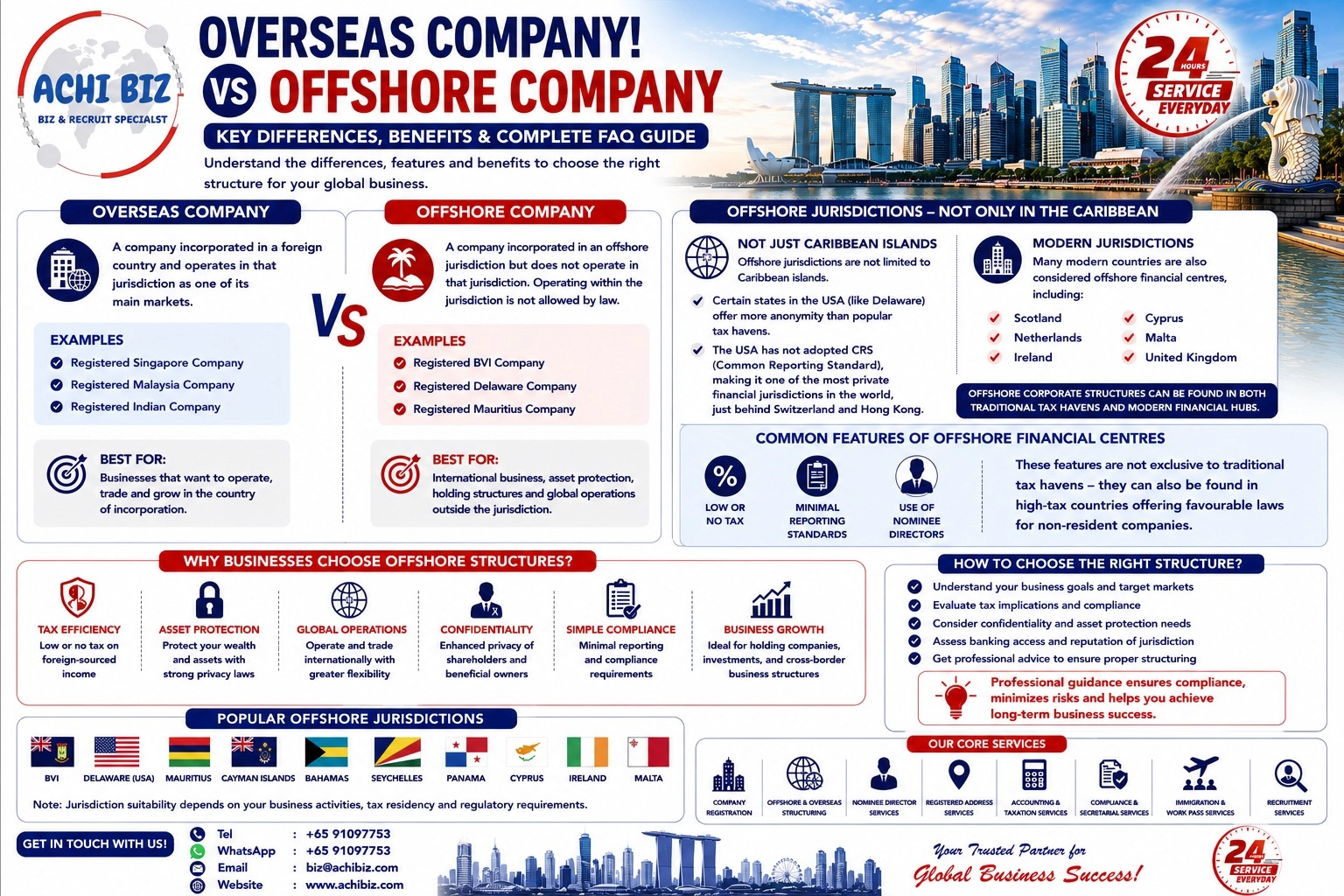
An overseas company refers to a business that is incorporated in a foreign country and actively operates within that jurisdiction as one of its main markets.
What is an offshore company?
An offshore company is a business incorporated in a specific offshore jurisdiction but does not conduct business within that jurisdiction. It is typically used for international operations outside the place of incorporation.
What is the main difference between an overseas company and an offshore company?
The key difference lies in operations. An overseas company operates in the country where it is incorporated, whereas an offshore company is incorporated in a jurisdiction where it does not carry out business activities.
Can you give examples of overseas companies?
Examples include companies incorporated and operating in countries such as Singapore, Malaysia, or India.
Can you give examples of offshore companies?
Examples include companies incorporated in jurisdictions such as British Virgin Islands (BVI), Delaware (USA), or Mauritius.
Understanding Offshore Jurisdictions
Are offshore jurisdictions only located in the Caribbean?
No, offshore jurisdictions are not limited to Caribbean islands. Many countries, including parts of the United States and Europe, offer offshore-like benefits.
Is the United States considered an offshore financial centre?
Certain states in the United States, such as Delaware, are considered favourable jurisdictions due to flexible corporate laws and privacy features.
Why is Delaware considered an offshore-friendly jurisdiction?
Delaware offers business-friendly laws, flexible structures, and relatively high levels of privacy, making it attractive for international business setups.
What is the Common Reporting Standard (CRS)?
CRS is an international framework for the automatic exchange of financial information between countries to combat tax evasion.
Does the absence of CRS participation affect offshore structures?
Yes, jurisdictions that do not fully participate in CRS may offer higher levels of financial privacy, which can influence business structuring decisions.
Modern Offshore Financial Centres
What are modern offshore jurisdictions?
Modern offshore jurisdictions are countries or regions that offer tax-efficient structures and financial benefits, even if they are not traditionally considered tax havens.
Which countries are considered modern offshore financial centres?
Countries such as Ireland, Netherlands, Scotland, Cyprus, Malta, and the United Kingdom are often used for tax-efficient corporate structures.
Why do multinational companies use modern offshore jurisdictions?
These jurisdictions offer favourable tax regimes, strong legal systems, and access to international markets.
Are modern offshore jurisdictions considered tax havens?
Not necessarily. They are often legitimate financial hubs offering structured tax benefits within legal frameworks.
Key Features of Offshore Companies
What are the common features of offshore companies?
Offshore companies typically offer low or zero tax, minimal reporting requirements, and flexible corporate structures.
Do offshore companies require extensive reporting?
Most offshore jurisdictions have simplified reporting requirements compared to onshore companies.
What is the role of nominee directors in offshore companies?
Nominee directors are used to enhance privacy and confidentiality by acting on behalf of the actual owners.
Is confidentiality a key advantage of offshore companies?
Yes, many offshore jurisdictions provide higher levels of confidentiality for shareholders and directors.
Business and Tax Considerations
Do offshore companies pay tax?
Many offshore jurisdictions do not tax foreign-sourced income, but tax obligations may still apply in the owner’s country of residence.
Can offshore companies legally reduce tax?
Yes, offshore companies can be used for legitimate tax planning when structured properly and in compliance with applicable laws.
Are offshore companies suitable for all businesses?
No, offshore companies are more suitable for international trading, investment holding, and cross-border operations.
Can offshore companies operate globally?
Yes, offshore companies are commonly used to conduct international business across multiple jurisdictions.
Choosing the Right Structure
How do I decide between an overseas company and an offshore company?
The decision depends on your business goals, target markets, tax considerations, and operational needs.
When should I choose an overseas company?
Choose an overseas company if you intend to operate and generate revenue within the country of incorporation.
When should I choose an offshore company?
Choose an offshore company if your business operates internationally and does not require a physical presence in the incorporation jurisdiction.
Is there a clear distinction between offshore financial centres?
No, many jurisdictions share similar features, making it difficult to clearly distinguish between traditional offshore centres and modern financial hubs.
Professional Guidance
Why is professional advice important when setting up offshore structures?
Offshore structuring involves legal, tax, and compliance considerations. Professional guidance helps ensure proper setup and avoids regulatory risks.
How can Achibiz assist with offshore and overseas company setup?
Achibiz provides expert advisory, jurisdiction selection, company incorporation, and ongoing compliance support tailored to your business objectives.
Related pages:
FAQ on registration of Offshore Company
Guide For Offshore And Overseas Corporate Services
#achibiz