
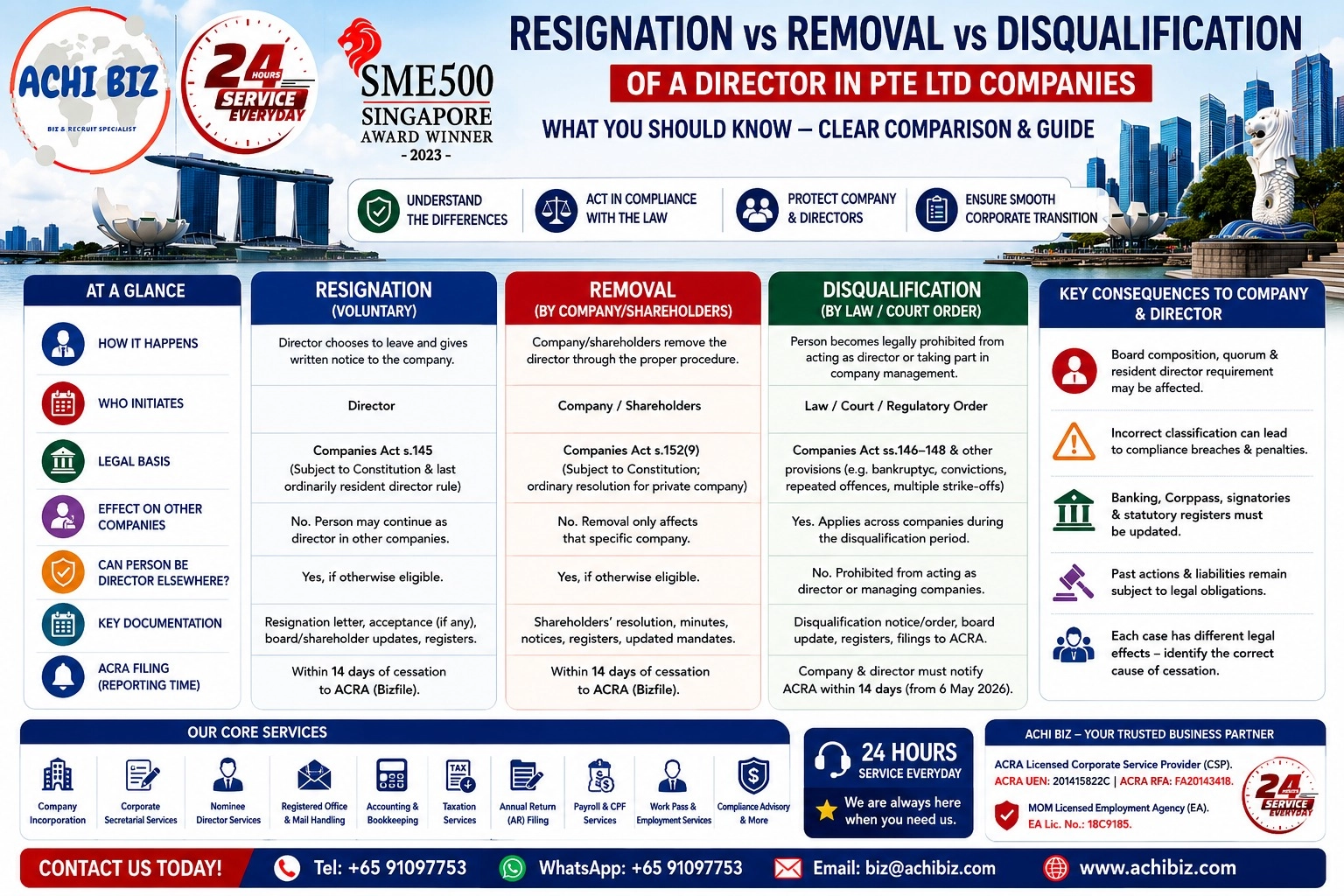
What Is the Difference and How Do You Determine the Correct Cessation?
When a director stops serving a Singapore Private Limited (Pte. Ltd.) company, it is important to identify why the directorship ended. Resignation, removal and disqualification are not interchangeable terms. Each arises from a different legal event, involves different parties and can produce different consequences for the director and the company.
A resignation originates from the director. A removal originates from a corporate decision to remove the director. A disqualification arises because the individual has become legally prohibited from acting as a director or participating in company management.
Getting this classification wrong can lead to incorrect corporate documents, inaccurate ACRA records and confusion over the actual effective date of cessation.
This FAQ provides a comparison-focused guide rather than treating each type of cessation separately.
What is the simplest way to distinguish resignation, removal and disqualification of a director?
Ask one fundamental question:
What caused the director to cease holding office?
If the director voluntarily decided to leave and gave the company notice, it is generally a resignation.
If the company or its shareholders validly terminated the person’s directorship through the applicable corporate process, it is a removal.
If the individual became legally prohibited from acting as a director because a statutory ground or disqualification order applies, it is a disqualification.
The correct classification should therefore follow the underlying legal event rather than whichever description is administratively convenient.
Is resignation a voluntary cessation of directorship?
Generally, yes.
Unless the company’s Constitution provides otherwise, a director may resign by giving the company written notice. Subject to the requirement concerning the remaining ordinarily resident director, the resignation is not conditional upon the company’s acceptance.
The defining feature is that the director initiates the departure.
Is removal voluntary?
No, not from the director’s perspective.
Removal means the directorship is terminated through a corporate mechanism rather than through the director choosing to resign.
For a private company, section 152(9) of the Companies Act provides that, subject to any contrary provision in the Constitution, the company may by ordinary resolution remove a director before the end of the director’s term despite anything in an agreement between the company and director.
Is disqualification simply another form of removal?
No.
A disqualified person is legally restricted from acting as a director and from being involved, directly or indirectly, in company management.
Disqualification can arise under different provisions of the Companies Act, including circumstances involving undischarged bankruptcy, specified convictions, repeated filing offences and multiple companies being struck off by ACRA.
The company is not simply choosing whether it wants the individual to remain. The person’s legal eligibility to act as director has been affected.
What is the main difference between the three situations?
The clearest comparison is:
| Issue | Resignation | Removal | Disqualification |
|---|---|---|---|
| Who or what triggers it? | Director | Company/shareholders through applicable procedure | Law, statutory event or court/regulatory consequence |
| Usually voluntary for director? | Yes | No | No |
| Is shareholder action necessarily the cause? | No | Generally central to removal | No |
| Does it necessarily affect other companies? | No | Normally concerns that particular company | Potentially yes |
| Can the person generally become a director elsewhere? | Yes, if otherwise eligible | Yes, if otherwise eligible | Generally prohibited during the applicable disqualification |
| Key question | Did the director choose to leave? | Did the company validly remove the director? | Has the individual become legally disqualified? |
This distinction is particularly useful when reviewing ambiguous corporate records.
Why does it matter which description is used?
Because each description represents a different legal history.
If a director was removed by shareholders, recording the event internally as a voluntary resignation can create a misleading paper trail.
Similarly, describing a statutory disqualification as a resignation can conceal the actual reason the individual ceased being qualified to act.
Good corporate governance requires the documents, resolutions, notices, registers and ACRA filings to reflect what actually happened.
Can a company ask a director to resign instead of formally removing the director?
Yes, the parties may discuss a voluntary resignation.
But the resulting classification depends on what actually occurs.
If the director freely submits a valid resignation, the cessation can be treated as resignation. If the director refuses and the company proceeds through its lawful mechanism to terminate the directorship, that is removal.
The company should not manufacture a resignation letter after the fact simply to make a removal appear voluntary.
Why might a company prefer a resignation rather than removal?
A mutually agreed departure can sometimes be administratively simpler and less contentious.
For example, the director and shareholders may agree that the individual will step down on an agreed date as part of a broader commercial separation.
However, convenience should not override accuracy. If the director has not actually resigned, the company should not record a resignation merely because it produces cleaner paperwork.
Can a director refuse to be removed?
A director may disagree with the proposed removal, but disagreement alone does not necessarily prevent a valid removal.
For a Singapore private company, the company’s Constitution is particularly important because section 152(9) expressly makes the statutory removal power subject to any provision to the contrary in the Constitution.
Accordingly, the company should examine its Constitution before assuming that an ordinary resolution automatically resolves every private-company removal situation.
Is the removal procedure for a private company identical to that of a public company?
No.
This is an important distinction.
Section 152 contains detailed statutory protections and procedures for removal of directors of public companies, including special notice and the director’s opportunity to be heard. The private-company rule appears separately in section 152(9) and is expressly subject to contrary provisions in the private company’s Constitution.
A Pte. Ltd. company should therefore not blindly copy a public-company removal checklist.
Should the company’s Constitution be reviewed before removing a director?
Absolutely.
For a private company, the Constitution may materially affect the removal process.
It may also contain provisions dealing with meetings, voting rights, quorum and other governance procedures relevant to implementing the decision.
The correct approach is therefore:
Companies Act + company Constitution + relevant agreements + actual facts.
Can a director’s service agreement prevent the company from removing the director?
Not necessarily.
Section 152(9) states that, subject to a contrary provision in the Constitution, a private company may remove a director by ordinary resolution before the expiration of the director’s period of office despite anything in an agreement between the company and the director.
But this does not mean the agreement becomes irrelevant.
Can a removed director still have a contractual claim against the company?
Potentially, yes.
The corporate office of director and the person’s contractual relationship with the company are not necessarily the same thing.
Removing someone from the board does not automatically determine every question concerning contractual notice, remuneration, compensation, employment rights or damages.
This distinction becomes particularly important where the person is both a director and an employee.
If a director is removed, does his employment automatically end too?
Not necessarily.
Someone can simultaneously hold several capacities—for example:
director, employee, shareholder, creditor, or personal guarantor.
Ending the directorship does not automatically extinguish every other legal relationship.
The relevant employment or service agreement should therefore be reviewed separately.
If a director resigns, does his employment automatically terminate?
Again, not necessarily.
A person may resign from the board while continuing to work for the company in another capacity.
This is why a resignation letter should clearly identify whether the person is resigning only as director, or also from employment or other appointments where applicable.
Does resignation mean the director has done something wrong?
No.
Directors resign for many legitimate reasons: retirement, relocation, restructuring, changes in ownership, personal commitments, completion of an investment arrangement or changes in business strategy.
A resignation should not be interpreted as evidence of misconduct merely because the person has left the board.
Does removal automatically mean misconduct occurred?
No.
Shareholders may want a different board composition even without misconduct.
Removal could arise from strategic disagreement, loss of shareholder confidence, restructuring, changes in control or other commercial considerations.
Misconduct may be a reason in some cases, but removal itself is not proof of misconduct.
Does disqualification necessarily mean fraud?
No.
Fraud or dishonesty is one possible route to disqualification, but it is not the only one.
ACRA identifies several statutory grounds, including undischarged bankruptcy, certain convictions involving fraud or dishonesty, conviction for repeated ACRA filing offences, and having three or more companies struck off by ACRA within a five-year period.
There are also other statutory and court-ordered disqualification provisions under Singapore law.
Can someone be removed as director without becoming disqualified?
Yes.
This is one of the most important distinctions.
Removal normally concerns the person’s position in a particular company.
If the person remains legally qualified, being removed from Company A does not automatically prevent that person from serving as director of Company B.
Can someone resign from one company while remaining director of other companies?
Yes, assuming the person remains legally eligible.
Resignation normally concerns the directorship from which the person resigned.
It does not create a general prohibition against holding directorships elsewhere.
Can disqualification affect all the person’s directorships?
Potentially, yes.
Unlike an ordinary resignation or company-specific removal, disqualification can prohibit the person from acting as a director or taking part directly or indirectly in management during the applicable disqualification period.
That is why disqualification is fundamentally different from merely leaving one company’s board.
What if a director says, “I was removed,” but the company says, “He resigned”?
The documentary evidence needs to be examined.
Relevant evidence could include the director’s written resignation notice, shareholders’ resolutions, meeting records, Constitution, correspondence, service agreement and ACRA records.
The classification should follow the genuine sequence of events.
Where the parties dispute the legal effect of the documents, the matter may require legal advice rather than merely a corporate secretarial determination.
What if the company pressures a director into submitting a resignation?
That can create a more complicated factual and contractual dispute.
A CSP should not attempt to resolve contested allegations concerning coercion, employment rights or contractual liability.
The corporate records should be based on legally effective documentation, while disputed rights may require advice from a Singapore lawyer.
Can shareholders simply write “director removed” without passing the required corporate resolution?
That is not a safe approach.
Removal is a corporate action and must be supported by the applicable legal and constitutional procedure.
An informal email or verbal statement from one shareholder should not automatically be treated as valid removal where the required corporate authority has not been established.
Can the board of directors remove another director from a Pte. Ltd. company?
This should not be assumed.
For a private company, the statutory removal mechanism in section 152(9) is based on removal by ordinary resolution of the company, subject to contrary provisions in the Constitution.
The company’s Constitution should therefore be checked carefully before relying on a board-only decision to terminate another person’s directorship.
What if the director is also the majority shareholder?
Removal from the board and ownership of shares are separate matters.
Removing the person as director does not automatically remove that person’s shares.
A majority shareholder may therefore cease being a director while continuing to exercise substantial shareholder rights.
The voting mathematics may also make a proposed removal practically difficult, depending on the company’s ownership structure and Constitution.
What if the director being removed is the sole shareholder?
This creates an obvious governance issue because the person controlling the shareholder vote may be the very person whose directorship is in question.
The actual Constitution, shareholding rights and circumstances need careful review.
Removal should not be presented as a simple administrative filing where the corporate authority to achieve it does not exist.
Does disqualification remove the person’s shares?
No.
Directorship eligibility and share ownership are separate concepts.
A disqualified director may still be a shareholder unless some separate legal event affects the shares.
Disqualification restricts the individual’s ability to act as a director or participate in management; it does not automatically confiscate the person’s ownership interest.
Can a disqualified director remain the beneficial owner of the company?
Potentially, yes, but the distinction between ownership and management becomes crucial.
A shareholder can exercise legitimate shareholder rights, but a disqualified person must not circumvent the prohibition by effectively continuing to manage the company behind another director.
The use of a replacement director as a mere front for a disqualified person’s continued management creates serious concerns.
Can a disqualified director simply appoint someone else and continue making all decisions behind the scenes?
No.
Disqualification extends beyond merely having one’s name listed as director. A disqualified person can also be prohibited from being directly or indirectly concerned in or taking part in company management.
A replacement director must therefore exercise genuine director responsibilities rather than simply act as the disqualified person’s proxy.
What happens if the resigning director is the company’s only ordinarily resident director?
This is where resignation differs sharply from removal or disqualification.
Under section 145, a director cannot validly resign or vacate office if doing so would leave the company without at least one director ordinarily resident in Singapore. A purported resignation contrary to this requirement is invalid.
The company should therefore arrange an eligible replacement before the last ordinarily resident director’s voluntary resignation takes effect.
Does the same protection prevent the only resident director from being removed?
No. The Companies Act expressly distinguishes compulsory cessation situations from voluntary resignation.
The restriction preventing the last ordinarily resident director from resigning does not operate in the same way where vacation of office occurs because of specified disqualification or removal circumstances.
Accordingly, a company can become non-compliant with the resident-director requirement following an involuntary cessation and must address the deficiency promptly.
What if the only ordinarily resident director becomes disqualified?
The individual cannot simply remain as director to preserve the company’s resident-director requirement.
The disqualification takes priority over relying on that person as the company’s resident director. The company must restore a compliant board structure with an eligible ordinarily resident director.
Why is this difference important for sole-director companies?
Because the cause of cessation determines the immediate legal position.
A sole resident director attempting to resign may find the resignation legally ineffective if it would leave no ordinarily resident director.
A sole director who is validly removed cannot simply be treated as remaining in office merely to solve the company’s director shortage.
A sole director who becomes disqualified cannot continue acting merely because the company has no replacement.
This distinction is one of the clearest reasons why resignation, removal and disqualification must never be treated as interchangeable.
Does appointing a replacement director change the reason the former director ceased?
No.
If the former director was removed, appointing a replacement does not transform the event into resignation.
If the former director was disqualified, replacing the person does not change the historical reason for cessation.
Corporate records should preserve the actual sequence.
What is the difference between an effective date of resignation and an ACRA filing date?
They are not necessarily the same date.
The legal cessation event occurs according to the applicable notice, resolution, statutory event or disqualification. The subsequent Bizfile lodgement records the change with ACRA.
ACRA requires changes involving directors joining or leaving to be updated within the applicable 14-day reporting period.
The filing date should therefore not casually be substituted for the true effective date.
Does a disqualified director now have a specific duty to notify the company?
Yes. This is particularly relevant under the current law.
From 6 May 2026, a director who ceases to be qualified under specified Companies Act provisions or a relevant court disqualification order must notify the company of the disqualification as soon as practicable and no later than 14 days after the disqualification.
This is a useful distinction from the documentary trail ordinarily associated with resignation or shareholder-driven removal.
What must the company do after becoming aware of a director’s disqualification?
Under the current Companies Act provisions effective from 6 May 2026, the company must furnish prescribed information to the Registrar within 14 days after becoming aware that the individual has ceased to be qualified to act as director under the specified provisions or disqualification order.
This means companies should not treat disqualification as something that only the affected director needs to handle.
Can a director notify ACRA personally if the company fails to report the cessation?
The Companies Act provides self-notification mechanisms in specified circumstances.
A director who has resigned, been removed or retired may notify the Registrar if there is reasonable cause to believe that the company will not do so. Current provisions also provide a mechanism relating to specified disqualifications.
This reinforces the importance of maintaining accurate ACRA records.
What records should be reviewed after any of the three forms of cessation?
The exact work depends on the circumstances, but companies should think beyond the Bizfile transaction.
The corporate secretarial review may include the register of directors, resolutions or notices supporting the cessation, board composition, authorised signatories, internal governance records and any other register affected by the person’s separate capacity.
The key principle is that one person’s departure may affect several corporate records for different reasons.
Does ROND automatically need to be changed every time a director leaves?
Not necessarily.
The Register of Nominee Directors (ROND) is relevant where the individual has a nominee-director relationship.
A director leaving office and a nominee relationship ending are related but legally distinct facts. Where the outgoing director was a nominee director, the company’s ROND and applicable central filing obligations should be reviewed accordingly.
What if the outgoing director was also a registrable controller?
The Register of Registrable Controllers (RORC) should be considered separately.
Ceasing to be a director does not necessarily mean ceasing to be a registrable controller, particularly where the individual continues to own or control significant shares or voting rights.
Companies should avoid mechanically deleting someone from every register merely because the directorship ended.
What if the outgoing director is also a nominee shareholder?
Again, each legal capacity should be analysed separately.
The person’s directorship may end while the nominee shareholding arrangement continues, or both relationships may change at different times.
This is precisely why proper corporate compliance requires more than a single ACRA cessation filing.
Should bank mandates be changed after resignation, removal or disqualification?
Where the outgoing director was an authorised signatory or banking administrator, yes, the company’s banking authority should be reviewed.
But banks may require different supporting documents depending on whether the departure was voluntary, shareholder-driven or legally compulsory.
The company should provide documents that accurately reflect the actual event.
Should Corppass access be reviewed?
Yes.
A person who no longer has authority within the company should not retain digital access merely because the company’s internal access controls were overlooked.
Corppass, banking, accounting systems, corporate email, cloud storage and other administrative permissions should be reviewed as part of the transition.
What happens to directors’ duties after cessation?
Cessation prevents the person from continuing to exercise the office of director, but it does not rewrite history.
Actions taken while the individual was a director remain subject to the legal standards and obligations that applied at the time.
Resigning or being removed therefore does not automatically erase potential responsibility for earlier conduct.
Similarly, disqualification does not replace or extinguish liabilities that may independently arise from past conduct.
Can a director resign to avoid an investigation or potential liability?
Resignation can end the person’s future role on the board, but it does not erase conduct that occurred while the individual held office.
The company should therefore distinguish cessation of office from responsibility for historical conduct.
Does removal prove that the company has a claim against the former director?
No.
Removal determines whether the person continues holding office. It does not itself establish that the former director owes damages or committed a breach.
Any claim concerning misconduct, fiduciary duties, contractual obligations or losses must be considered on its own facts.
Does disqualification automatically prove that the director caused losses to the particular company?
Not necessarily.
A disqualification may arise from events outside the particular company.
For example, certain disqualifications can result from repeated filing offences or multiple companies being struck off.
The company should therefore not automatically equate “disqualified” with “liable to this company for damages.”
Can an undischarged bankrupt act as a company director?
Section 148 restricts an undischarged bankrupt from acting as director or participating in company management unless the required court or Official Assignee permission has been obtained. Where such permission is granted, a copy must be lodged with the Registrar within the prescribed period.
Bankruptcy therefore illustrates why disqualification is an eligibility issue, rather than a company simply choosing to remove somebody.
How can repeated ACRA non-compliance lead to director disqualification?
ACRA states that conviction for three or more filing offences can result in disqualification, and a director associated with three or more companies struck off by ACRA within a five-year period can also become disqualified under the relevant Companies Act provisions.
This demonstrates why persistent statutory non-compliance can eventually affect an individual’s ability to manage companies, rather than merely producing penalties against one company.
Can a company “remove” a director who is already legally disqualified?
The company should first identify the legal event correctly.
If disqualification has already caused the person to cease being qualified to act, the corporate records should reflect that fact rather than creating an artificial removal narrative solely to explain the departure.
Separate corporate actions may still be needed to restore the board, but they should not obscure the underlying disqualification.
Can a company label a removed director as “disqualified” because it believes the person behaved badly?
No.
“Disqualified director” has a legal meaning. A company cannot create a statutory disqualification simply by passing a resolution or accusing a director of misconduct.
The company can potentially remove the director through the applicable process, but legal disqualification must arise from the relevant statutory or judicial basis.
Can shareholders disqualify a director by voting?
No.
Shareholders can potentially remove a director where the law and Constitution permit.
They cannot create a statutory disqualification simply by shareholder vote.
This is one of the easiest ways to distinguish removal from disqualification.
Can ACRA simply “resign” a director from a company?
No. The terminology should remain precise.
Resignation is the director’s voluntary act.
Regulatory records may reflect cessation arising from other legal circumstances, but that does not convert those circumstances into resignation.
What if a director reaches the end of a fixed appointment term?
That may constitute retirement or expiry of office, depending on the company’s arrangements, rather than resignation, removal or disqualification.
Not every director cessation must be forced into one of these three categories.
Correct classification means recognising when a fourth category actually applies.
Is death of a director resignation, removal or disqualification?
None of the three.
Death is a separate cessation event.
This distinction is particularly important because the director did not voluntarily resign, shareholders did not remove the person, and death itself should not be inaccurately described as statutory disqualification.
Why should a CSP determine the actual cessation event before preparing documents?
Because the documentation should follow the facts—not create them.
Before preparing a resignation, removal or disqualification filing, the CSP should establish the legal basis, effective date, board and shareholder position, resident-director status and any affected registers.
Where the underlying event is disputed, the CSP should avoid effectively deciding a legal dispute between shareholders and directors.
What is a practical decision test for determining the correct category?
A company can use the following sequence:
Did the director voluntarily give valid notice of resignation?
If yes, assess it as resignation.
If not, did the company validly exercise its corporate power to terminate the person’s directorship?
If yes, assess it as removal.
If not, has a statutory disqualification or relevant court/regulatory disqualification made the person legally unable to act?
If yes, assess it as disqualification.
If none applies, investigate whether the cessation actually resulted from retirement, expiry, death, vacation under the Constitution or another legal event.
This approach is much safer than choosing the terminology first and trying to make the facts fit afterwards.
What should shareholders ask before deciding whether to request resignation or proceed with removal?
They should understand why the director needs to leave, whether a voluntary departure is realistically achievable, what the Constitution permits, what voting rights exist, whether contractual arrangements are affected and whether removing the person creates a resident-director or board-quorum problem.
The corporate consequence should be considered before, not after, the decision.
What should a director check before resigning?
The director should consider whether the resignation is permitted to take effect, particularly if he or she is the company’s last ordinarily resident director.
The person should also distinguish the directorship from any employment, shareholding, nominee arrangement, guarantee or other relationship that may continue after the resignation.
What should a company check when it discovers a director may be disqualified?
The company should verify the actual legal basis and effective date rather than relying on rumours or assumptions.
It should then assess whether the individual must immediately cease management involvement, whether ACRA notification is required, whether another resident director remains and whether a replacement director needs to be appointed.
Which situation generally creates the widest personal restriction on the outgoing director?
Disqualification.
Resignation and removal generally determine whether the individual remains director of a particular company.
Disqualification can go considerably further by restricting the individual’s legal ability to act as director or participate in company management during the relevant period.
Which situation gives the director the greatest control over the timing?
Generally, resignation, because the departure originates from the director’s own notice, subject to the Constitution, applicable effective date and the statutory restriction concerning the last ordinarily resident director.
Removal and disqualification are inherently less within the individual’s control.
Which situation should concern the company most from a regulatory perspective?
There is no universal answer.
A resignation can be serious if it would leave the company without its required resident director.
A contested removal can become a governance and shareholder dispute.
A disqualification can require urgent action because the affected individual may no longer legally participate in management.
The correct risk assessment depends on the cause and resulting corporate structure, not merely the label.
What is the biggest mistake companies make when dealing with director cessation?
Treating the ACRA filing as the entire transaction.
The filing records a corporate change, but the underlying legal event must first be valid.
A company should be able to answer:
Why did the director cease?
When did the cessation legally occur?
Who had authority to cause it?
Does the Constitution support the procedure?
Does an eligible ordinarily resident director remain?
What other corporate records or authorities are affected?
If those questions cannot be answered, the company may not yet be ready to lodge the cessation.
How can ACHI BIZ assist with resignation, removal or disqualification of directors in Singapore?
ACHI BIZ SERVICES PTE. LTD. can assist companies with the corporate secretarial and regulatory aspects of director cessation, including identifying the appropriate corporate procedure based on the documents provided, preparing relevant corporate documentation, reviewing the resident-director position, handling applicable ACRA lodgements and updating affected corporate records and statutory registers.
Where the matter involves a contested removal, disputed resignation, employment claim, shareholder dispute, alleged misconduct or interpretation requiring legal advice, appropriate Singapore legal counsel should be engaged.
ACHI BIZ is an ACRA Licensed Corporate Service Provider (CSP) providing company incorporation, corporate secretarial, nominee director, registered office, accounting, bookkeeping, taxation, Annual Return and related corporate compliance services.
ACHI BIZ is also a MOM Licensed Employment Agency (EA) providing employment and work pass related services.
ACRA UEN: 201415822C | ACRA RFA: FA20143418
MOM EA Lic. No.: 18C9185
What is the key takeaway about resignation vs removal vs disqualification of a director?
The most important distinction is who or what legally caused the directorship to end.
Resignation is generally the director’s voluntary decision to leave.
Removal is a corporate action that terminates the person’s position as director.
Disqualification is a legal restriction affecting the individual’s eligibility to act as director or participate in management.
The consequences are therefore not interchangeable. A person removed from one company may remain perfectly eligible to direct another. A director who resigns may continue as shareholder or employee. A disqualified individual may be prohibited from company management more broadly.
For a Singapore Pte. Ltd. company, the correct approach is not simply to ask, “How do we remove this name from ACRA?” The better question is:
“What legally caused this person to cease as director, and what must the company do as a result?”
That distinction produces cleaner corporate records, better governance and more reliable regulatory compliance.
Disclaimer: This FAQ provides general information on Singapore corporate compliance and does not constitute legal advice. Director removal, disputed resignations, disqualification and shareholder or employment disputes can involve legal rights beyond corporate secretarial administration. The company’s Constitution, agreements and specific circumstances should be reviewed before action is taken.
Related Pages:
Director Disqualification in Pte Ltd Company-FAQ
Resignation of Director in Pte Ltd Company-FAQ
#achibiz