
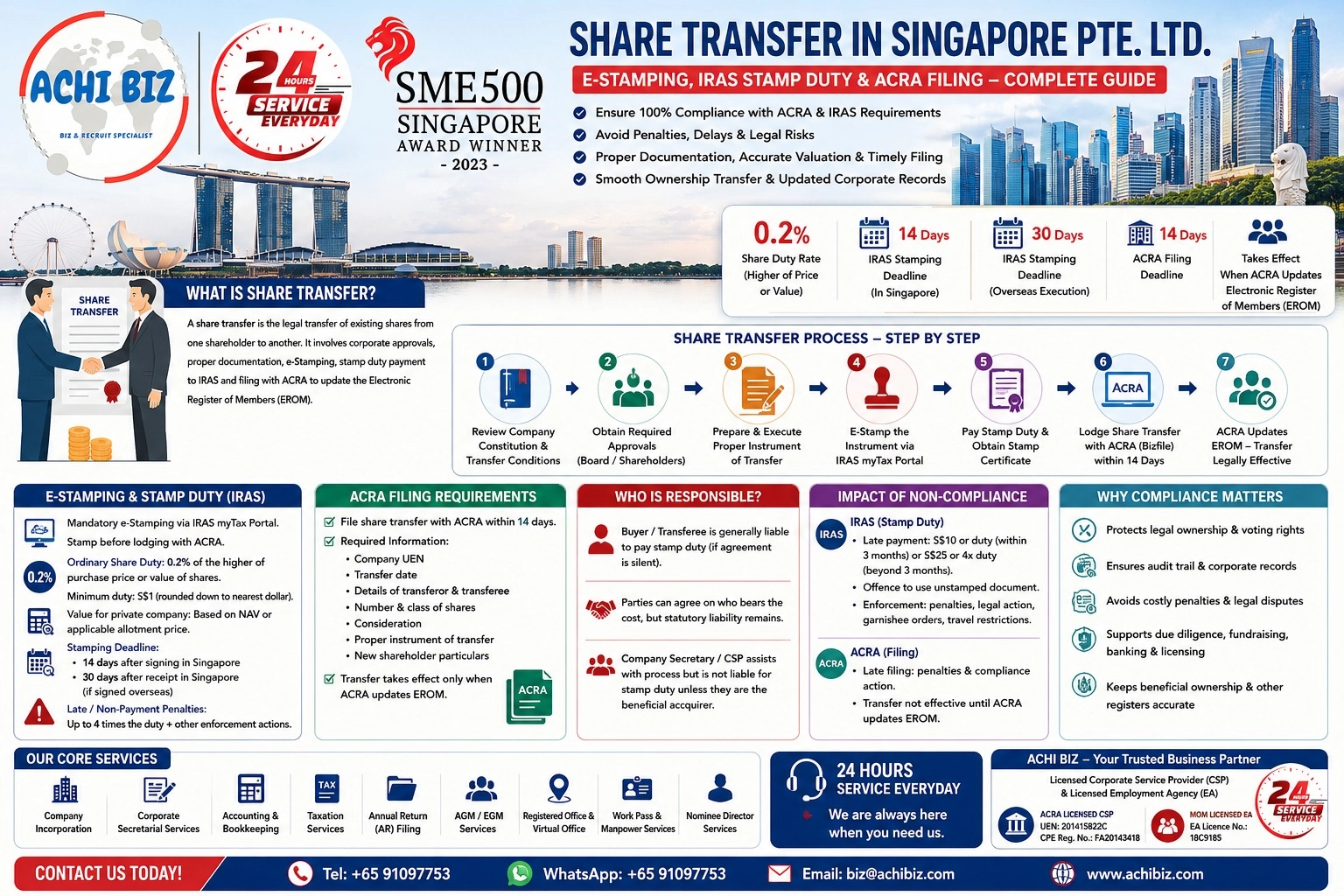
Share Transfer in Singapore Pte. Ltd. Companies: Mandatory e-Stamping, IRAS Stamp Duty, ACRA Filing, Deadlines and Non-Compliance
A share transfer in a Singapore Private Limited (Pte. Ltd.) company is more than a private arrangement between a seller and buyer. It involves corporate-law requirements under the Companies Act, stamp duty obligations administered by IRAS, the company’s constitution, supporting documentation and an ACRA Bizfile filing that updates the Electronic Register of Members (EROM).
For a typical transfer of shares in a private company, a proper instrument of transfer must be prepared and the relevant share transfer instrument must be stamped before it is lodged with ACRA. IRAS currently imposes share duty at 0.2% of the purchase price or value of the shares transferred, whichever is higher, subject to applicable exemptions, remissions or special rules.
The sequence matters. For private companies, the transfer does not legally take effect merely because the buyer paid the seller or both parties signed an agreement. Under the Companies Act, the transfer takes effect when ACRA updates the company’s EROM.
This FAQ guide examines the entire process, including share transfer e-Stamping, stamp duty calculation, NAV, IRAS deadlines, ACRA’s 14-day filing requirement, responsibility for stamp duty, late-payment penalties and common compliance mistakes.
Frequently Asked Questions on Share Transfer, e-Stamping, IRAS and ACRA in Singapore
Is e-Stamping mandatory when transferring shares in a Singapore Pte. Ltd. company?
For a dutiable share transfer instrument, stamping is required unless a specific exemption, remission or other exception applies.
IRAS no longer uses adhesive revenue stamps. Documents chargeable with stamp duty are stamped electronically through the Stamp Duty service on myTax Portal.
So, in an ordinary private-company share transfer, e-Stamping should be treated as an essential part of completing the transaction.
What exactly is being stamped—the shares or the document?
Technically, stamp duty is imposed on the dutiable document, not simply on the fact that somebody owns shares.
For an ordinary acquisition, the relevant document is generally the executed share transfer instrument. IRAS expressly identifies physical and electronic transfer instruments as dutiable documents relating to share transfers.
This distinction becomes important when dealing with unusual transfers, trusts, gifts, restructuring or exemptions.
Is a Share Sale and Purchase Agreement itself subject to stamp duty?
For an ordinary share transfer that is not subject to Additional Conveyance Duties (ACD), IRAS states that share duty on the share sale and purchase agreement is remitted. Share duty remains payable on the executed share transfer instrument.
If ACD applies, different rules can apply and the SPA or transfer instrument may become relevant depending on which is executed first.
Must the share transfer instrument be stamped before filing the transfer with ACRA?
Yes.
IRAS expressly states that the share transfer instrument should be stamped before it is lodged with ACRA.
A practical sequence is therefore:
Review Constitution & Transfer Conditions → Prepare Corporate Documents → Execute Share Transfer Instrument → e-Stamp & Pay Applicable Stamp Duty → Obtain Stamp Certificate → Lodge Share Transfer with ACRA → ACRA Updates EROM
What is a proper instrument of transfer?
It is the document recording the transfer of legal title to the shares from the existing shareholder to the incoming shareholder.
ACRA requires a proper instrument of transfer for a private-company share transfer, and section 126 of the Companies Act prevents the company from lodging the transfer unless the proper instrument has been delivered to it.
Can shareholders simply agree by email to transfer shares?
An email agreement by itself should not be treated as completing the statutory share-transfer process.
Even where the commercial agreement between the parties is clear, the company must comply with the Companies Act, its constitution, stamp-duty requirements and ACRA filing requirements.
Can shares be transferred before they are fully paid?
ACRA’s current guidance states that existing shareholders can transfer shares where the shares are fully paid and the transfer complies with the company’s constitution.
The status of the shares should therefore be checked before documents are prepared.
Why must the company’s constitution be checked before transferring shares?
Private companies commonly have constitutional provisions governing share transfers.
Depending on the constitution, these may concern:
- directors’ approval;
- pre-emption rights;
- rights of existing shareholders;
- restrictions on transfers;
- procedures for executing transfer documents; and
- other conditions.
ACRA itself states that a transfer must comply with the company’s constitution.
A shareholder therefore cannot safely assume that owning shares automatically gives an unrestricted right to transfer them to anyone at any time.
What are pre-emption rights in a share transfer?
Pre-emption provisions may require shares proposed for sale to be offered to existing shareholders before they can be transferred to an outsider.
Whether such rights apply depends on the company’s constitution and any relevant shareholders’ agreement.
Ignoring them can turn what appears to be a routine ACRA filing into a shareholder dispute.
Is board approval required for every share transfer?
That depends on the company’s constitution and circumstances.
The corporate documents should be reviewed before assuming directors’ approval is or is not required.
A Corporate Service Provider should not treat a share transfer as a mechanical Bizfile transaction without first examining the company’s applicable documentation.
How much stamp duty is payable on a normal transfer of shares?
The current ordinary share duty rate is:
0.2% × the higher of:
(a) purchase price/consideration; or
(b) value of the shares transferred.
The duty is rounded down to the nearest dollar, subject to a minimum duty of S$1.
If shares are sold cheaply, is stamp duty calculated only on the sale price?
No.
This is a common misunderstanding.
IRAS uses the higher of the actual purchase price and the value of the shares transferred.
Selling valuable shares for a nominal S$1 does not necessarily mean the stamp duty will be calculated on S$1.
How does IRAS determine the value of shares in a private company?
For private-company shares, IRAS generally refers to the Net Asset Value (NAV) or applicable allotment price in determining value.
For a company incorporated for more than 18 months, IRAS states that the NAV of the transferred shares is generally computed using the latest statement of accounts of the target company, which should be dated within 24 months before the date of transfer.
Different circumstances may require different valuation treatment.
Why are updated management accounts important before a share transfer?
Because the accounting records may directly affect the stamp-duty calculation.
For example, inaccurate accounts can produce an inaccurate NAV.
This is another reason proper bookkeeping, reconciled accounts and reliable financial statements are important even for relatively small Pte. Ltd. companies.
Can parties simply use the company’s paid-up capital as the share value?
Not necessarily.
Paid-up share capital and the economic/NAV value of the shares are different concepts.
A company incorporated with S$10,000 capital could later have substantial retained earnings and assets. Conversely, it could have accumulated losses.
Stamp duty should therefore be calculated using the applicable IRAS valuation rules rather than assuming nominal or paid-up capital represents market value.
What happens if the company has preference shares as well as ordinary shares?
Valuation becomes more complicated.
IRAS recognises that where a target company has different classes of shares, including preference shares, the NAV attributable to each class can depend on the rights attached to those shares.
Professional advice may be sensible before stamping such a transaction.
Who is legally responsible for paying share transfer stamp duty?
First, check the transaction documents.
IRAS states that the agreement will normally specify which party is responsible.
If the agreement does not specify liability, the Stamp Duties Act rules apply. For buying or acquiring shares, IRAS identifies the buyer/transferee as the party liable to pay stamp duty.
Can the seller agree to bear the stamp duty instead?
The commercial agreement can allocate costs between the parties.
However, the statutory liability position should still be understood separately. The parties should not assume that a private cost-sharing arrangement necessarily alters IRAS’s statutory rights against the legally liable party.
Is the company secretary responsible for paying the shareholder’s stamp duty?
Not ordinarily merely because the person is the company secretary.
The secretary or CSP may assist administratively with preparing documents, e-Stamping and lodging the transfer, but that does not automatically make the secretary the beneficial buyer or statutory party liable for the duty.
The engagement should make responsibility for payment clear.
Can a CSP e-Stamp a share transfer on behalf of the parties?
A representative may assist with stamping where appropriately authorised.
IRAS provides electronic facilities for stamping and recognises representative arrangements in appropriate circumstances.
The underlying parties nevertheless remain responsible for supplying accurate transaction and valuation information.
Where is a share transfer e-Stamped?
Share transfer documents can be stamped through IRAS myTax Portal – Stamp Duty.
The electronic process generates the duty payable and, after successful payment, a Stamp Certificate.
What is a Stamp Certificate?
The Stamp Certificate is evidence generated after the stamping transaction and successful payment.
It should be retained with the share transfer documentation and corporate records.
How can someone check whether a Stamp Certificate is genuine?
IRAS provides facilities for verifying Stamp Certificates.
This can be useful where a transaction involves external parties and the company wants to verify that stamping was genuinely completed rather than relying on an unverified document supplied by another person.
When should share transfer stamp duty ideally be paid?
IRAS states that a document should be stamped before signing.
However, where it has already been signed, no late-stamping penalty is imposed if it is stamped and the duty is paid within the applicable statutory timeframe.
What is the stamping deadline if the share transfer instrument is signed in Singapore?
It must generally be stamped within 14 days after signing to avoid a late-stamping penalty.
The execution date therefore matters.
What is the stamping deadline if the share transfer instrument is signed overseas?
Where the document is executed overseas, IRAS generally requires stamping within 30 days after the document is received in Singapore.
Electronic documents have specific rules determining execution and receipt, so cross-border transactions deserve particular attention.
Do electronic share transfer documents have stamp duty obligations?
Yes.
IRAS expressly states that dutiable share-transfer documents include physical and electronic versions.
Using electronic signatures or an electronically executed instrument does not automatically avoid stamp duty.
Why does the location of execution matter for electronic documents?
Because it can determine the applicable stamping deadline.
IRAS has specific rules concerning when and where an electronic document is treated as executed or received.
This can be particularly important where the seller, buyer, directors and corporate service provider are located in different countries.
Can a foreign shareholder’s share transfer still attract Singapore stamp duty?
Yes.
The shareholder’s nationality or physical residence does not automatically eliminate Singapore stamp duty on a dutiable instrument concerning shares.
The nature of the shares and instrument must be examined under Singapore’s stamp-duty rules.
Are gifts of shares exempt from stamp duty because no money changes hands?
Not automatically.
IRAS expressly identifies acquisition of shares by way of gift as an example where stamp duty can be payable.
The absence of cash consideration therefore does not necessarily mean zero duty.
What about transferring shares between family members?
Family relationships do not by themselves create a general exemption.
A transfer from a parent to a child, between spouses or between other relatives must still be examined under the applicable stamp-duty rules, although specific reliefs may exist in particular circumstances.
Are there stamp duty exemptions or reliefs for some share transfers?
Yes.
IRAS provides various statutory exemptions, remissions and reliefs for qualifying transactions, including certain corporate restructurings and transfers between associated permitted entities.
These reliefs usually have detailed eligibility conditions and deadlines.
A company should never assume that a related-party transfer is automatically exempt.
Can stamp duty relief be claimed after completing a corporate restructuring?
Possibly, but the applicable relief must satisfy its statutory conditions and timelines.
For example, IRAS imposes specific requirements on reliefs for transfers between associated entities and reconstruction or amalgamation arrangements.
Professional advice is particularly important for restructuring transactions.
Are transfers of listed scripless shares treated the same way?
Not always.
IRAS states that electronic entries made by CDP to effect transfers of qualifying scripless shares listed on the Singapore Exchange are exempt from stamp duty under the relevant rules.
This FAQ primarily concerns private-company share transfers.
What is Additional Conveyance Duty (ACD), and can it apply to a share transfer?
Potentially.
ACD can apply to qualifying acquisitions or disposals of equity interests in certain Property-Holding Entities (PHEs) that primarily hold Singapore residential property.
This can create substantial additional stamp-duty exposure beyond the ordinary 0.2% share duty.
A company holding Singapore residential property should therefore not treat its share transfer as an ordinary 0.2% transaction without checking the PHE rules.
Is ordinary 0.2% share duty still payable where ACD applies?
Yes, where applicable.
IRAS states that for acquisition of equity interests in a PHE, ordinary share duty remains payable in addition to ACD.
What documents and information are generally required for a private-company share transfer?
Depending on the circumstances, the transaction may require:
- company UEN and corporate information;
- details of transferor and transferee;
- number and class of shares;
- transfer consideration;
- transfer date;
- proper instrument of transfer;
- relevant financial information for valuation;
- board/shareholder approvals where applicable;
- constitution review;
- Stamp Certificate;
- identification and address details for a new shareholder; and
- appropriate supporting resolutions and corporate records.
ACRA specifically requires information including the UEN, transfer date, share information, new shareholder particulars and proper instrument of transfer.
Does the company need to conduct KYC before accepting a new shareholder?
Where a CSP is engaged, applicable customer due-diligence and regulatory requirements should be considered.
The corporate transaction should not be treated merely as data entry where there are concerns regarding identity, beneficial ownership, sanctions, suspicious circumstances or source of transaction information.
How is the share transfer updated with ACRA?
The transfer is lodged through Bizfile’s “Update shares information” eService.
Company officers such as directors or the company secretary may file, or the company may engage a Corporate Service Provider to make the filing.
How quickly must a share transfer be filed with ACRA?
ACRA’s current guidance requires the share transfer to be filed within 14 days to notify ACRA.
This deadline is separate from the IRAS stamp-duty deadline.
Are the ACRA 14-day deadline and IRAS 14-day stamping deadline the same requirement?
No.
This distinction is extremely important.
The IRAS deadline concerns stamping and payment of stamp duty.
The ACRA deadline concerns notifying the Registrar of the share transfer.
They arise under different legislation and are administered by different government agencies.
Which should happen first: IRAS e-Stamping or ACRA filing?
For a normal dutiable share transfer:
IRAS stamping first → ACRA lodgement afterwards.
IRAS expressly instructs that the share transfer instrument should be stamped before it is lodged with ACRA.
When does the buyer legally become the shareholder of a private company?
This is one of the most important legal points.
Under section 126(3) of the Companies Act, a transfer of shares in a private company does not take effect until ACRA updates the company’s Electronic Register of Members.
Therefore:
Signing ≠ completed legal transfer.
Payment ≠ completed legal transfer.
Stamping ≠ completed legal transfer.
For a Singapore private company, completion requires the relevant ACRA EROM update.
What is the Electronic Register of Members (EROM)?
ACRA maintains the Electronic Register of Members for private companies.
It contains shareholder information and shareholding details, and is updated when the relevant information is lodged with the Registrar.
Can a share transfer be backdated in ACRA?
ACRA’s current guidance says no.
For private companies, the transfer takes effect when the EROM is updated upon filing. ACRA expressly states that a transfer cannot be backdated.
This is particularly important where parties try to make a transaction appear effective in an earlier financial year.
Can the parties privately agree that the transfer was effective earlier?
They may have contractual arrangements governing economic rights between themselves, but that does not override the statutory rule governing when membership changes take effect in the company’s EROM.
Corporate, contractual, accounting and tax consequences should therefore be analysed carefully where different dates are involved.
What happens if the share transfer is not updated with ACRA within 14 days?
The company risks regulatory non-compliance.
ACRA states that directors and secretaries must report applicable changes to shares and shareholders through Bizfile within 14 days to avoid penalties.
More fundamentally, because a private-company transfer takes effect only when the EROM is updated, failing to complete the ACRA process can also leave the intended ownership change legally incomplete.
What happens if the share transfer instrument is stamped late?
IRAS imposes late-stamping penalties.
For a delay not exceeding three months, the current penalty is:
S$10 or an amount equal to the stamp duty payable, whichever is greater.
For a delay exceeding three months, the penalty is:
S$25 or four times the stamp duty payable, whichever is greater.
Can IRAS impose a penalty of four times the unpaid duty?
Yes.
IRAS states that documents which are unstamped, stamped late or insufficiently stamped may attract a penalty of up to four times the duty, and its current late-payment framework provides the specific penalty structure described above.
Is it an offence to use an unstamped dutiable share transfer document?
IRAS states that it is an offence to use a document for which the required stamp duty has not been paid.
This is why stamping should not be regarded as optional paperwork.
What enforcement action can IRAS take for unpaid stamp duty?
IRAS states that enforcement can include:
- penalties;
- appointing agents such as banks, employers, tenants or lawyers to recover overdue amounts;
- travel restriction orders;
- legal action; and
- other recovery measures.
Does filing the share transfer with ACRA mean IRAS stamp duty has automatically been paid?
No.
ACRA filing and IRAS stamping are separate processes.
A Bizfile update should never be mistaken for proof that stamp duty was correctly assessed and paid.
The Stamp Certificate is the relevant evidence of stamping.
Does paying IRAS stamp duty automatically update the shareholder with ACRA?
No.
The opposite misunderstanding is equally dangerous.
e-Stamping the transfer instrument does not automatically update ACRA’s EROM.
The transfer must still be lodged through the appropriate ACRA process.
What if the wrong number of shares is filed with ACRA?
The consequences can be significant because the EROM determines legal membership for a private company.
ACRA specifically warns that share transactions are complex and filing errors can be costly. Where an error cannot be resolved through a Notice of Error, an Order of Court may be required to correct it.
Accuracy before submission is therefore critical.
Why should the shareholding position be checked before submission?
Because the filing changes legal ownership.
Before submitting, the filer should reconcile:
existing shares + shares transferred + resulting seller balance + resulting buyer balance = correct post-transfer shareholding.
The class and currency of the shares must also be correct.
Can the company secretary simply rely on whatever figures the shareholder provides?
That is risky.
The secretary or CSP should obtain appropriate supporting documentation and verify the transaction against the company’s corporate records, constitution and relevant instructions.
Where valuation information is used for stamp duty, appropriate financial information should also be available.
Who is responsible for the accuracy of the ACRA filing?
Company officers have statutory responsibilities concerning company information.
Where a CSP is engaged, it also has professional and regulatory responsibilities relating to the work it undertakes.
Engaging a CSP does not give shareholders or directors permission to provide false, incomplete or misleading information.
What if the buyer or seller provides false information about the consideration?
That can create serious tax and regulatory problems.
The declared consideration should reflect the genuine transaction.
Artificially reducing the stated purchase price does not necessarily reduce duty anyway because IRAS calculates ordinary share duty on the higher of price or value.
Can the CSP determine NAV without proper accounting records?
Reliable valuation requires reliable financial information.
Where accounts are outdated, incomplete or unreconciled, the CSP may need updated management accounts or other appropriate documentation before a defensible stamp-duty calculation can be made.
Can a share transfer affect the Register of Registrable Controllers (RORC)?
Potentially.
A change in share ownership can alter who has significant interest or control over the company.
The company and its CSP should therefore assess whether the transaction triggers corresponding RORC changes rather than treating the EROM update as the only compliance requirement.
Can it affect the Register of Nominee Shareholders (RONS)?
Potentially.
If the incoming or outgoing shareholder is or becomes a nominee shareholder, the company’s Register of Nominee Shareholders obligations should be considered separately.
Can share transfer affect beneficial ownership even if the registered shareholder remains unchanged?
Yes.
Legal ownership, beneficial ownership and nominee arrangements are not always identical.
Where the underlying beneficial interest changes without an ordinary registered transfer, the transaction may raise separate corporate, tax, trust and beneficial-ownership issues requiring professional review.
Can share transfer affect the company’s tax position?
Potentially.
The transfer itself may create stamp-duty obligations, while changes in ownership can also be relevant to certain corporate tax rules, loss carry-forward conditions, group arrangements and other tax matters.
The tax implications should therefore be assessed separately where the shareholding change is substantial.
Can a major shareholding change affect carried-forward tax losses?
Potentially.
Singapore tax rules contain shareholder continuity requirements for the utilisation of certain unabsorbed losses, capital allowances and donations.
A significant share transfer should therefore not be viewed purely as an ACRA secretarial transaction where substantial tax attributes exist.
Can share transfer affect banking arrangements?
Yes.
Banks commonly conduct KYC and beneficial ownership checks.
A material change in shareholders or controllers may therefore need to be notified to the company’s bank under its account terms and compliance requirements.
Can share transfer affect an Employment Pass or other work pass?
Potentially, depending on the circumstances.
Where a shareholder is also a director, key employee or work pass holder, a substantial ownership or corporate-control change may need to be considered against applicable MOM requirements.
The corporate and immigration consequences should be assessed independently.
Can a transfer affect existing shareholders’ voting rights?
Yes.
Voting power generally follows the rights attached to the shares held.
Transferring shares therefore changes not only economic ownership but potentially control of shareholder resolutions, dividend entitlements and strategic decision-making.
Can a transfer change who controls the company?
Absolutely.
A transfer of only a relatively small percentage may change whether a person can pass or block particular shareholder resolutions.
Directors and shareholders should therefore understand the post-transfer voting structure before approving the transaction.
Should directors check whether the buyer is suitable before approving a transfer?
Where the constitution gives directors discretion or approval rights, those powers must be exercised properly and consistently with directors’ duties.
Corporate approvals should not be treated as meaningless signatures.
What if there is a shareholders’ agreement in addition to the constitution?
Both should be reviewed.
The constitution governs the company’s corporate framework, while a shareholders’ agreement may impose contractual obligations between shareholders.
A transfer that satisfies ACRA’s filing mechanics can still create a contractual dispute if it breaches a shareholders’ agreement.
Can a shareholder transfer shares while there is a dispute with other shareholders?
Possibly, but the circumstances need careful review.
Restrictions in the constitution, shareholders’ agreement, court orders or other legal arrangements may affect the transaction.
A CSP should avoid becoming involved in a disputed transfer without clear authority and supporting documentation.
What if a share transfer is fraudulent or unauthorised?
This can have severe consequences because ACRA’s EROM determines membership in a private company.
Identity, authority, supporting documents and corporate approvals should therefore be carefully checked before filing.
Suspicious or disputed transactions should not be treated as routine secretarial instructions.
Why is a proper audit trail important?
A complete file should allow a future reviewer to understand:
who transferred what, to whom, why, for what consideration, when the instrument was executed, how the shares were valued, when stamp duty was paid, what approvals were obtained and when ACRA updated the ownership.
This can be valuable during audits, due diligence, financing, disputes or a future sale of the company.
What records should be retained after the share transfer?
Depending on the transaction, the corporate records should ordinarily include relevant:
- executed transfer instrument;
- Stamp Certificate;
- sale and purchase agreement, if any;
- directors’/shareholders’ resolutions;
- valuation or NAV working;
- financial statements or management accounts used;
- constitution review;
- KYC/supporting identification documents;
- ACRA filing confirmation; and
- updated corporate/beneficial ownership records where applicable.
Can an unstamped transfer cause problems during a future company sale?
Yes.
A purchaser conducting legal due diligence may review the chain of ownership.
Missing transfer instruments, absent Stamp Certificates, incorrect ACRA records or unexplained shareholding changes can delay a transaction and may require remediation before completion.
Can it cause problems when opening or updating a bank account?
Potentially.
Banks may compare ACRA records, beneficial ownership information and supporting corporate documents.
Inconsistent ownership records can trigger additional questions or compliance reviews.
Can incorrect share transfer records affect future investors?
Yes.
Investors expect the company’s cap table and statutory records to accurately establish who owns the company.
Unresolved historical share-transfer problems can undermine confidence and complicate investment documentation.
What is the difference between a share transfer and share allotment?
They are fundamentally different.
A share transfer moves existing shares from one shareholder to another.
A share allotment creates/issues shares to a shareholder.
The ACRA procedures, supporting documents and potential stamp-duty consequences are therefore different.
Is stamp duty normally payable when a company simply issues new shares?
Do not confuse an allotment with a transfer.
Ordinary share-transfer duty concerns the acquisition or transfer of existing shares through a dutiable instrument. A fresh allotment should be analysed under its own legal and tax framework.
What is the biggest mistake companies make with share transfers?
Treating the transaction as a single ACRA form.
A proper private-company share transfer may involve:
Constitution → Corporate Approval → Transfer Instrument → Financial Valuation → IRAS Stamp Duty → Stamp Certificate → ACRA Filing → EROM Update → Beneficial Ownership/Other Registers → Banking/Tax/Other Consequential Updates.
Missing one part can undermine the entire transaction.
What are the two deadlines businesses should remember most?
For an ordinary transaction, remember these separately:
IRAS: generally stamp within 14 days after signing in Singapore, or within 30 days after receipt in Singapore where signed overseas.
ACRA: notify ACRA of the share transfer within 14 days.
And critically, stamp the relevant instrument before lodging it with ACRA.
What is a good compliance workflow for a Singapore Pte. Ltd. share transfer?
A practical sequence is:
1. Review the constitution and existing shareholding
2. Check transfer restrictions and approvals
3. Conduct necessary KYC and authority checks
4. Agree the transaction and consideration
5. Determine the appropriate share value/NAV
6. Prepare and execute the proper instrument of transfer
7. e-Stamp the instrument and pay IRAS stamp duty within the applicable deadline
8. Obtain and retain the Stamp Certificate
9. Lodge the transfer with ACRA within the applicable deadline
10. Confirm ACRA’s EROM has been updated
11. Update other applicable statutory/beneficial ownership records
12. Consider consequential bank, tax, licence and work-pass implications
This sequence substantially reduces the risk of incomplete or inconsistent compliance.
Should companies engage a licensed Corporate Service Provider for share transfers?
Share transactions can be deceptively complex.
ACRA itself warns that errors in share transactions can be costly and recommends seeking professional CSP advice where a company is uncertain about the correct filing.
Professional assistance is particularly useful where there are foreign shareholders, multiple share classes, substantial NAV, gifts, related-party transfers, property-holding entities, corporate shareholders, nominee arrangements, historical discrepancies or shareholder disputes.
Can a CSP guarantee that a share transfer will never be challenged?
No.
A CSP can assist with compliance and documentation, but cannot eliminate disputes between shareholders or validate facts that have been deliberately concealed.
Directors, transferors and transferees must provide complete and truthful information.
How can ACHI BIZ assist with share transfer, e-Stamping and ACRA filing?
ACHI BIZ SERVICES PTE. LTD., as a registered Corporate Service Provider, can assist Singapore companies with the corporate compliance aspects of share transfers, including reviewing the relevant company records, preparing applicable corporate documentation, coordinating IRAS e-Stamping and Stamp Certificate requirements, and filing the transfer through ACRA’s Bizfile where the transaction is suitable for engagement.
Where required, the process can also be coordinated with related corporate secretarial, accounting, bookkeeping, taxation, Annual Return and other corporate compliance requirements.
The objective is not merely to change a shareholder’s name in Bizfile. A properly handled transfer should leave the transfer instrument, stamp-duty position, corporate approvals, ACRA EROM and supporting records aligned with one another.
Conclusion: Is e-Stamping Mandatory Before Updating a Share Transfer with ACRA?
For an ordinary dutiable transfer of shares in a Singapore Pte. Ltd. company, yes—the relevant share transfer instrument must be properly stamped, and IRAS specifically requires it to be stamped before it is lodged with ACRA.
The ordinary share duty is currently 0.2% of the higher of the purchase price or value of the transferred shares. The applicable stamping deadline is generally 14 days after signing in Singapore or 30 days after receipt in Singapore for a document executed overseas.
The company must separately notify ACRA of the share transfer within 14 days, and for a private company, the transfer does not legally take effect until ACRA updates the Electronic Register of Members.
The simplest way to remember the process is:
Proper Transfer Documents → IRAS e-Stamping & Stamp Duty → ACRA Filing → EROM Updated → Share Transfer Legally Effective
Failing to deal with either side can be costly. Late IRAS stamping can result in substantial penalties and enforcement action, while incorrect or delayed ACRA filing can create statutory non-compliance and leave the intended ownership change incomplete.
For that reason, a share transfer should be handled as a legal, tax and corporate compliance transaction—not merely an administrative change of shareholder details.
Related Pages:
Individual vs Corporate Shareholding in Singapore Pte Ltd: Which Is Better for Your Business?
Share Allotment in a Singapore Pte. Ltd. Company – FAQ Guide
#achibiz