
Types of Shares & Shareholding in Singapore Pte Ltd Companies – FAQ Guide
Shares are at the heart of ownership in a Singapore Private Limited (Pte. Ltd.) company. They determine not only who owns the company, but can also influence voting power, entitlement to dividends, return of capital and other economic or governance rights.
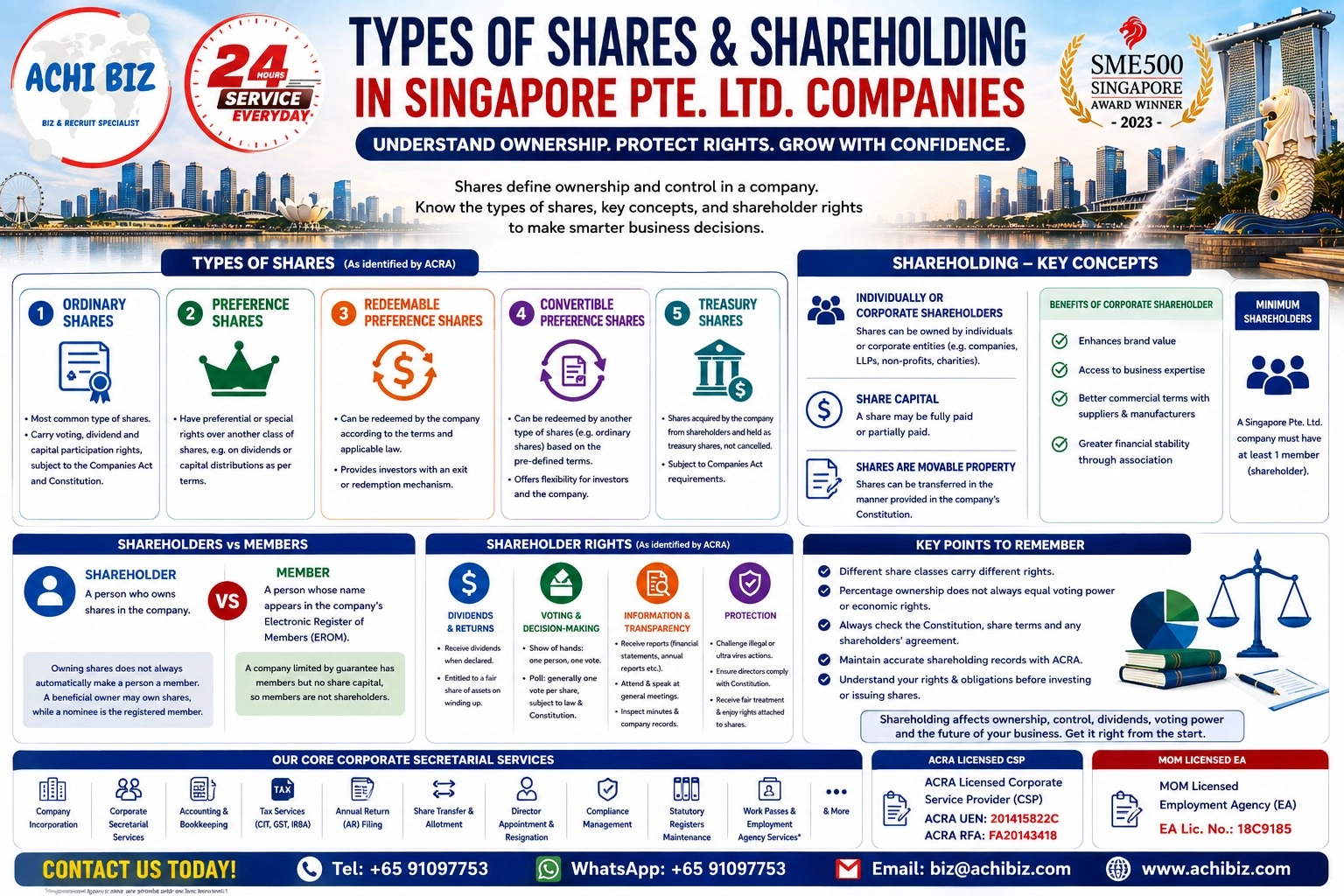
However, not every share has to carry identical rights. ACRA currently explains five types of shares—ordinary shares, preference shares, redeemable preference shares, convertible preference shares and treasury shares. A company may also have individual or corporate shareholders, while the concepts of “shareholder” and “member” are related but not always identical.
This FAQ focuses on the practical differences between share types, shareholding structures, shareholders and members, and the rights that may come with owning shares in a Singapore Pte. Ltd. company.
What is a share in a Singapore Pte. Ltd. company?
A share represents ownership in a company. When shares are issued to a person, that person acquires an ownership interest represented by those shares, and the amount contributed forms part of the company’s share capital.
ACRA also notes that a share may be fully paid or partially paid.
The number of shares alone, however, does not always tell the complete story. The class of shares and rights attached to them also matter.
Why are shares important in a Singapore company?
Shares establish the ownership framework of a company.
Depending on their terms and the company’s constitution, shares can affect matters such as:
- ownership percentage;
- voting power;
- entitlement to dividends;
- participation in distributions;
- return of capital;
- rights on winding up;
- conversion or redemption rights; and
- control over important corporate decisions.
This is why shareholding should not be viewed merely as a number shown on an ACRA business profile.
What are the five types of shares identified by ACRA?
ACRA currently identifies these five types:
- Ordinary shares
- Preference shares
- Redeemable preference shares
- Convertible preference shares
- Treasury shares
Each has different characteristics and should be considered according to the company’s capital, investment and governance requirements.
What are ordinary shares?
Ordinary shares are the most common type of shares issued by Singapore companies.
They typically form the basic ownership structure of a Pte. Ltd. company. Subject to the Companies Act and the company’s constitution, ordinary shares commonly carry voting, dividend and capital participation rights.
However, companies should not simply assume that every ordinary share carries identical rights without checking the constitution and applicable terms.
Does one ordinary share normally mean one vote?
Under section 64 of the Companies Act, a share generally confers one vote on a poll on any resolution, subject to the statutory provisions and the company’s constitution. The constitution may, within the limits permitted by law, negate, alter or add to that default right.
Accordingly, the voting rights attached to the particular share class should always be checked.
What are preference shares?
Preference shares are shares carrying preferential or specially defined rights compared with another class of shares.
The preference may concern matters such as dividends or participation in capital distributions. The exact rights depend on the terms attached to the particular class.
The word “preference” does not mean the holder automatically has priority in every aspect of the company. The specific rights must be examined.
Why might a company issue preference shares instead of ordinary shares?
Preference shares can be useful where an investor and the existing shareholders want economic rights that differ from the company’s ordinary ownership arrangements.
For example, an investor may negotiate particular dividend or capital rights without necessarily having exactly the same governance position as ordinary shareholders.
The appropriate structure depends on the commercial arrangement and should be reflected correctly in the company’s constitutional and corporate documentation.
Are preference shareholders always entitled to dividends?
Not automatically simply because the shares are called preference shares.
Dividend entitlement depends on the rights and terms attached to the shares and whether the relevant requirements for a distribution are satisfied.
Companies should therefore avoid describing preference shares merely as “shares with guaranteed dividends”.
Can preference shares carry voting rights?
Voting rights depend on the applicable share terms, constitution and statutory provisions.
The Companies Act provides default rules concerning voting rights and also contains protections for certain resolutions involving shares that otherwise have restricted voting rights.
Accordingly, a preference shareholder should check the actual rights attached to the shares rather than assuming that “preference” means either full voting rights or no voting rights.
What are redeemable preference shares?
Redeemable preference shares are preference shares structured so that they may be redeemed in accordance with their terms and applicable law.
They can therefore provide an investment arrangement under which the shares do not necessarily remain permanently in issue.
This distinguishes them from ordinary shares that are not normally issued on the same redemption basis.
Why would a company issue redeemable preference shares?
They may be useful where investors and the company want an investment with a contemplated exit or redemption mechanism.
For example, the parties may structure an investment so that eligible shares can be redeemed after a particular period or upon agreed conditions.
The redemption terms should be clearly established rather than decided informally only when an investor later wants to exit.
Is redeeming preference shares the same as an ordinary share transfer?
No.
A share transfer involves ownership moving from one holder to another. Redemption involves the company dealing with redeemable shares under the applicable redemption mechanism.
The corporate procedures and consequences are therefore different.
What are convertible preference shares?
Convertible preference shares are preference shares carrying a mechanism under which they may be converted into another type or class of shares according to their terms.
For example, an investor might initially hold preference shares that can subsequently convert into ordinary shares when specified conditions are satisfied.
Why might investors prefer convertible preference shares?
Conversion can provide flexibility.
An investor may initially want preferential economic rights while retaining the possibility of becoming an ordinary shareholder later.
For the company, convertible instruments can also form part of a broader investment or financing structure.
However, the conversion terms need to be clearly documented because conversion can materially affect ownership percentages and voting arrangements.
Can conversion dilute existing shareholders?
Potentially, yes.
If conversion results in a larger number of ordinary shares or changes the distribution of voting or economic rights, existing shareholders’ relative percentage interests may change.
Companies should therefore model the post-conversion shareholding structure before agreeing to convertible share terms.
What are treasury shares?
Treasury shares are shares that the company has acquired from its shareholders under the applicable statutory framework and retains as treasury shares rather than cancelling them.
They differ fundamentally from shares held by an ordinary external shareholder because the company itself holds them.
The Companies Act also excludes the company itself, where it holds treasury shares, from certain references to a “member”.
Is a treasury share a normal shareholder?
No.
A treasury share is a share, not a separate person or shareholder.
The company holds those shares itself, subject to the statutory rules applicable to treasury shares.
This distinction is important when considering voting, membership and ownership calculations.
Can treasury shares later be cancelled or disposed of?
Yes, subject to the applicable Companies Act requirements and corporate procedures.
A company therefore needs to keep proper records of treasury shares rather than treating a completed share buyback as the end of the matter.
What is shareholding?
Shareholding refers to the ownership of shares in a company.
It can be expressed as a number of shares, a percentage of the company’s relevant issued shares, or by reference to the particular class and rights attached to those shares.
For example, two shareholders may each hold 50 shares, but their rights may not necessarily be economically or legally identical if they hold different classes.
Can a Singapore Pte. Ltd. company have only one shareholder?
Yes. The Companies Act requires a company to have at least one member.
A Singapore Pte. Ltd. company can therefore operate with a single shareholder/member, subject to the other applicable incorporation and ongoing compliance requirements.
Can a company have several shareholders?
Yes.
A private company may have multiple shareholders subject to the applicable statutory framework and its constitution.
As the number of shareholders increases, matters such as voting, transfer restrictions, minority rights, reserved matters and shareholder agreements often become increasingly important.
Can an individual own shares in a Singapore Pte. Ltd. company?
Yes. ACRA confirms that companies can have individual shareholders.
An individual shareholder owns shares personally, subject to the company’s share terms and applicable laws.
Can another company be a shareholder?
Yes. A Singapore company can have corporate shareholders.
ACRA gives examples including other limited companies, limited liability partnerships, non-profit organisations and charities.
The eligibility and implications of a particular entity holding shares should nevertheless be assessed according to the circumstances.
What is a corporate shareholder?
A corporate shareholder is a legal entity or organisation holding shares in another company rather than an individual owning the shares personally.
For example, Company A may hold shares in Company B. Company A is then a corporate shareholder of Company B.
What are the potential benefits of having a corporate shareholder?
ACRA identifies potential benefits including brand value, access to business expertise, potentially better commercial terms with suppliers and manufacturers, and greater financial stability through association with an established entity.
Whether these advantages actually arise depends on the shareholder and commercial relationship concerned.
Is a corporate shareholder the same as a corporate director?
No.
Shareholding concerns ownership.
Directorship concerns management and governance.
A company can therefore be a shareholder without being a director. In Singapore, a director must ultimately satisfy the statutory requirements applicable to individuals serving as directors.
Can a shareholder also be a director?
Yes.
It is very common in owner-managed Pte. Ltd. companies for the same individual to be both a shareholder and director.
However, the two roles remain legally distinct. A person acting as a director has responsibilities associated with the directorship that are separate from rights enjoyed as a shareholder.
What is the difference between shareholders and members?
This distinction is important because the terms are often used interchangeably in everyday business conversations, even though they do not always mean exactly the same thing.
ACRA explains:
Member: a person whose name appears in the company’s Electronic Register of Members (EROM).
Shareholder: a person who owns shares in the company.
In a typical Pte. Ltd. company, the same person is often both, but the concepts should still be distinguished.
Is every member necessarily a shareholder?
No.
ACRA points to a company limited by guarantee as a clear example. Such a company has members but does not have share capital, so its members are not shareholders.
This demonstrates why “member” is a broader company-law concept than simply “person owning shares”.
Is every shareholder automatically a member?
Not necessarily.
ACRA specifically explains that ownership of shares does not always automatically make someone a member. A beneficial owner, for example, may have the economic ownership of shares while a nominee is the registered member.
The Electronic Register of Members therefore has particular legal significance.
Why is the Electronic Register of Members important?
For Singapore private companies, membership is tied to registration in the Electronic Register of Members.
It is therefore not sufficient to look only at a private agreement or payment for shares when determining registered membership.
This becomes especially important when shares are allotted or transferred because the company’s registered ownership records need to accurately reflect the transaction.
What is the difference between a registered shareholder and beneficial owner?
Broadly, the registered holder is the person whose name appears in the relevant membership/shareholding record, while beneficial ownership concerns the person who ultimately enjoys or controls the economic interest in the shares.
A nominee arrangement can therefore separate legal registration from beneficial ownership.
This distinction can also trigger separate transparency and regulatory obligations.
What is a nominee shareholder?
A nominee shareholder holds shares on behalf of another person in circumstances meeting the applicable nominee relationship.
The registered nominee and the person for whom the shares are held should not simply be treated as the same concept.
Singapore companies may also have separate compliance obligations concerning nominee shareholders.
Does nominee shareholding affect the Register of Nominee Shareholders (RONS)?
Where the statutory definition and requirements are met, nominee-shareholder arrangements can trigger obligations concerning the Register of Nominee Shareholders (RONS) and applicable regulatory filings.
Companies should therefore identify nominee arrangements when onboarding a shareholder rather than discovering them only after the share transaction has been completed.
What are shareholder rights in a Singapore Pte. Ltd. company?
ACRA groups shareholder rights broadly into four areas:
dividends and returns, voting and decision-making, information and transparency, and protection.
However, the rights available to a particular shareholder depend on the Companies Act, the company’s constitution and, importantly, the type and class of shares held.
Do all shareholders have exactly the same rights?
No.
The rights can vary according to the class of shares.
Two people may both be shareholders of the same company while having different dividend, voting, redemption, conversion or capital rights.
This is why analysing shareholding solely by percentage can sometimes be misleading.
What rights can shareholders have to dividends and returns?
ACRA explains that shareholders may receive dividends where the company has profits and decides to distribute them. They may also be entitled to an appropriate share of proceeds where the company closes and its assets are distributed, subject to the rights attached to their shares and applicable law.
Share ownership does not mean a shareholder can simply withdraw company money whenever desired.
Are dividends automatically payable whenever a company makes a profit?
No.
Profitability alone does not mean every shareholder is automatically entitled to an immediate cash distribution.
Whether a dividend is properly payable depends on applicable company law, corporate decisions and the rights attached to the shares.
What voting rights do shareholders have?
Voting rights depend particularly on the share type and voting method.
ACRA explains the general distinction:
Show of hands: ordinarily one person gets one vote, regardless of how many shares the person owns.
Poll: the default is generally one vote per share.
The Companies Act similarly provides the default poll voting rule, subject to the Act and constitution.
Can a 60% shareholder always cast 60% of the votes?
Not necessarily in every voting situation.
On a poll, shareholding commonly determines voting strength according to the voting rights attached to the shares. On a show of hands, however, the default rule works differently.
The company’s constitution, share class and applicable statutory provisions must therefore be considered before equating ownership percentage with voting power.
Can a shareholder vote without physically attending a meeting?
Potentially, yes.
ACRA notes that voting may occur in person, through a proxy, or through an attorney or other authorised representative, subject to the applicable requirements.
Corporate shareholders can also appoint representatives under the Companies Act.
Do members have a right to attend general meetings?
Section 180 of the Companies Act provides that a member has a right to attend a general meeting and speak on any resolution before the meeting, despite any provision in the constitution. Voting depends on whether the relevant share carries the applicable voting right.
This illustrates again why membership and voting entitlement should not automatically be treated as identical concepts.
What information rights can shareholders have?
ACRA identifies information and transparency rights that may include receiving reports and information such as annual reports and financial statements, attending and speaking at general meetings, and inspecting minutes of general meetings.
The precise statutory entitlement and procedure should be checked for the information concerned.
What protection rights may shareholders have?
ACRA notes that shareholder protections may include the ability to challenge illegal actions or actions beyond the company’s lawful authority, ensure directors comply with the constitution, receive fair treatment and enjoy the specific rights attached to their shares.
These protections can become particularly important for minority shareholders.
What is a minority shareholder?
A minority shareholder is generally a shareholder who does not control enough voting power to determine company decisions alone.
Being a minority shareholder does not mean having no rights. The Companies Act, constitution and rights attached to the relevant shares remain important.
Does owning more than 50% of shares give complete control of a company?
Not necessarily.
Different corporate decisions can require different voting thresholds. Share classes may also carry different voting rights, and the constitution or other governance arrangements can affect decision-making.
A simple majority therefore does not automatically give unlimited authority over every company matter.
Why does a 75% shareholding often matter?
Many significant corporate actions require a special resolution, for which the statutory voting threshold is generally at least 75% of votes cast by members entitled to vote on the resolution, subject to the applicable legal requirements.
Accordingly, ownership around this level can be commercially significant, but actual control still depends on voting rights and the particular resolution.
Can rights attached to a class of shares be changed?
Potentially, but class rights cannot simply be ignored.
Section 74 of the Companies Act provides a framework for variation or abrogation of class rights. Where the constitution does not prescribe the relevant consent or resolution threshold, the Act provides for approval by holders representing at least 75% of the total number of shares of that class.
This gives class rights significance beyond ordinary shareholder voting.
Why should class rights be clearly documented?
Because ambiguity can create disputes over voting, dividends, conversion, redemption and distributions.
If investors are intended to have different rights, those rights should be properly structured and documented rather than relying on informal understandings between shareholders.
What is the difference between fully paid and partly paid shares?
A fully paid share has had its required issue amount paid in full.
A partly paid share still has an unpaid amount associated with it.
ACRA confirms that shares may be fully or partially paid. Where a private company subsequently receives amounts on partly paid or unpaid shares, the Companies Act requires the prescribed notice concerning the increase in paid-up amount to be lodged within 14 days after payment.
Is the shareholder’s liability unlimited?
Generally no, in a company limited by shares.
ACRA explains that shareholders are liable only for the amount invested in their shares. More precisely, where shares are not fully paid, the unpaid amount can remain relevant.
The company’s own liabilities should not ordinarily be confused with the shareholder’s personal liabilities.
Are shares considered property?
Yes. The Companies Act provides that shares or other interests of members are movable property and are transferable in the manner provided by the company’s constitution.
This reinforces the importance of checking the constitution before dealing with share transfers.
Can shares be transferred freely between shareholders?
Not necessarily.
Although shares are transferable property, the Companies Act expressly refers to transfer in the manner provided by the constitution.
A private company’s constitution may therefore contain transfer procedures or restrictions that need to be followed.
Is share allotment the same as share transfer?
No.
Share allotment generally involves the company issuing new shares.
Share transfer involves existing shares moving from one holder to another.
The distinction matters because the effect on issued capital, ownership percentages, documentation and ACRA lodgement can be different.
Can issuing new shares dilute existing shareholders?
Yes.
If additional shares are issued and an existing shareholder does not acquire a proportionate amount, that shareholder’s percentage ownership may decrease.
Dilution can affect voting power, economic participation and practical control. Companies should therefore understand the post-allotment ownership structure before issuing additional shares.
Does holding 50% of shares always mean receiving 50% of dividends?
Not necessarily.
If all shares are of the same class with identical dividend rights, percentage ownership may broadly correspond to dividend participation. But where different share classes exist, the rights attached to those classes can produce a different outcome.
The rights attached to the shares, not merely the number of shares, determine the answer.
Does holding 50% of shares always mean owning 50% of the company?
In a straightforward company with only one class of identical ordinary shares, that is a useful general description.
In a company with several classes carrying different economic and voting rights, however, “50% ownership” can oversimplify the actual position.
It is often better to ask: 50% of which class, carrying which rights?
Why should a company review its Constitution before creating different share classes?
Because the constitution forms part of the framework governing the company’s shares and shareholder rights.
Where new or specialised share classes are proposed, the company should ensure that its constitutional framework properly supports the intended rights and that the required corporate approvals are obtained.
Should a shareholders’ agreement also describe share rights?
Where shareholders have a shareholders’ agreement, relevant rights and commercial arrangements may also be addressed there.
However, the constitution and shareholders’ agreement are not the same document. They should be reviewed together to avoid contradictory governance arrangements.
What should investors check before accepting shares in a Singapore Pte. Ltd. company?
An investor should look beyond the headline percentage offered.
Important questions include:
What class of shares am I receiving? What voting rights attach? What dividend rights apply? Are the shares redeemable or convertible? Are there transfer restrictions? What happens on a sale or winding up? Will future allotments dilute me? What does the company constitution provide?
A 10% shareholding with carefully defined rights can be materially different from another 10% shareholding.
What should founders consider when deciding what type of shares to issue?
Founders should consider the desired balance between ownership, control, investment return and future flexibility.
Issuing a specialised class merely because an investor requests “preference shares” without defining the rights properly can create uncertainty later.
The commercial intention should first be established and then translated into an appropriate share structure.
Why should a company maintain accurate shareholding records?
Because shareholding affects ownership, membership, voting and corporate decision-making.
Inaccurate records can create problems when paying dividends, approving resolutions, transferring shares, bringing in investors, restructuring the company or selling the business.
The company’s ACRA records and internal corporate documentation should therefore remain consistent.
What should be reviewed when a new shareholder joins the company?
The company should consider the proposed share class, number of shares, rights attached, constitution, necessary approvals, existing shareholder arrangements, nominee status where relevant, beneficial ownership and applicable ACRA filing requirements.
The post-transaction shareholding should also be calculated before the transaction is completed.
Why is it dangerous to focus only on percentage shareholding?
Because percentage ownership is only one dimension of shareholder rights.
Two shareholders with equal percentages may have different rights if they hold different classes. Conversely, a shareholder with a smaller economic stake may have important governance rights under the applicable share terms.
A proper analysis therefore considers quantity + class + rights + registration + governing documents.
What is the simplest way to distinguish shares, shareholders and members?
Think of them this way:
Share – the ownership interest or unit carrying particular rights.
Shareholder – the person who owns shares.
Member – the person whose name appears in the company’s Electronic Register of Members.
In many ordinary Singapore Pte. Ltd. companies, the shareholder and member are the same person. But the distinction becomes important in nominee, beneficial ownership and non-share-capital situations.
What is the key takeaway about types of shares and shareholding in Singapore?
Do not judge a shareholding simply by asking “How many shares does this person own?”
The more useful questions are:
What type of shares are they? What rights attach to them? Who is the registered member? Is someone else the beneficial owner? What voting and dividend rights apply? Are there redemption or conversion features? What does the Constitution provide?
ACRA recognises five share types—ordinary, preference, redeemable preference, convertible preference and treasury shares—and makes an important distinction between shareholders and members. Understanding these concepts helps companies structure ownership properly and helps investors understand what they actually receive when acquiring shares.
How can ACHI BIZ assist with shares and shareholding matters?
ACHI BIZ, an ACRA Licensed Corporate Service Provider (CSP), provides corporate secretarial support for Singapore Pte. Ltd. companies in relation to applicable share and shareholding matters.
This can include corporate secretarial assistance for share allotments, share transfers, changes in shareholding, share capital transactions, preparation of relevant resolutions and documentation, ACRA lodgements, maintenance of corporate records and applicable nominee shareholder compliance, together with other ongoing corporate secretarial services.
Where a proposed share structure involves complex investor rights, legal drafting, tax consequences, valuation or investment arrangements, appropriate specialist professional advice may also be required.
Related Pages:
Managing Share Capital Strategically in Pte Ltd Companies–FAQ
Legal Nominee Shareholder in Singapore: Role, Features, and Importance
#achibiz